
Persecution of Ahmadis Spreads
By Zofeen Ebrahim
KARACHI, Nov 22, 2011 (IPS) — “Hatred against us has now spread to small towns and villages,” Saleemuddin, spokesperson of the persecuted Ahmadiya community in Pakistan, told IPS.
The Ahmadis believe that Mirza Ghulam Ahmad, a 19th century cleric, “was the messiah promised by God”. Such beliefs are seen by orthodox Muslims as unacceptable. Pakistan has declared its four million Ahmadis to be non-Muslim.
Speaking to IPS over the phone from Rabwah – a city in the Punjab province also known as Chenab Nagar – which is 95 percent Ahmadi, Saleemuddin added, “We are in a fix – if we say we are Muslims, we will be charged and sentenced; but we cannot say we are non-Muslim when we are Muslims.”
On May 28, last year, 94 members of the Ahmadi community were massacred in their mosques during the Friday congregation in the eastern city of Lahore. Since then, Saleemuddin said, there has been a marked increase in persecution, with 11 more people killed.
Last year, the Punjab government made it mandatory for students to reveal whether they were ‘Muslim or non-Muslim’ before being admitted to school or college, or even before registering for the board exams.
Two months ago Raziatul Bari, a 23-year-old English teacher at Chenab Public School in the Punjab village of Dharanwali, was sacked from work. The same afternoon ten students – some from Chenab Public School and some, like four-year old nursery student Manahil Jameel, from the Muslim Public School – were expelled.
Yasser Arafat, the principal of Chenab Public School, told IPS, “The teacher was preaching her faith in school despite warnings, so she was asked to leave. The students left in protest.”
Arafat charged that the students and the teacher want “international attention so they can seek asylum.”
Bari, who had studied at Chenab Public before becoming a teacher there, said she had never faced a problem like this before.
“It all began a few months ago when a cleric came and poisoned our village,” she told IPS. Following the cleric’s visit, Arafat asked Bari on several occasions to convert to Islam. “Each time I would tell him I was a Muslim,” Bari said, adding that her insistence was in vain.
Of the 210 households in Dharanwali, Bari says just nine belong to Ahmadis, who live in constant fear.
“Today our children have been expelled from schools, tomorrow we may be forced to leave our homes. Where will we go?“
For years Ahmadis in Pakistan have kept a low profile, living in constant fear and humiliation. Now the hatred has spread and the oppressors have become more belligerent, which has led to several instances of overt faith-based persecution.
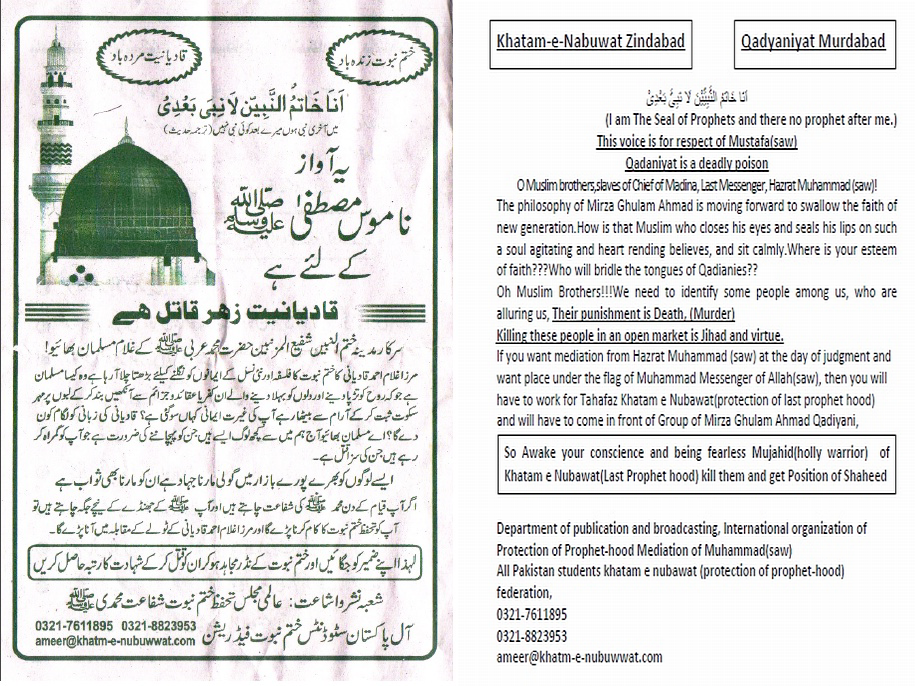
In June, pamphlets listing the names and addresses of Ahmadi families alongside messages inciting murder were distributed in the Punjab city of Faisalabad. Several months later 55-year-old Naseem Ahmed, whose name had appeared on that list, was shot dead in his home.
In another case, the local cleric of a small village in Punjab issued a severe edict after seeing the sons of a deceased Ahmadi offering funeral prayers for their father: “Anyone who offers prayers for a kafir (an infidel, in this case an Ahmadi) gets expelled from Islam.”
This anti-Ahmadi sentiment is not restricted to Punjab alone. In Quetta, the provincial capital of Balochistan, a group of clerics forced an Ahmadi to ‘renounce’ his beliefs, warning him that if he refused his business would be set aflame and he would be killed.
According to Pakistan’s constitution, the Ahmadi minority cannot call themselves Muslims, are banned from referring to their places of worship as mosques and cannot even sing hymns in praise of Prophet Muhammad.
Meanwhile the government of Pakistan has updated the electoral list for the forthcoming 2013 national elections to include a new column for religion, meaning that if Ahmadis choose to cast their vote, they will be forced to mark this new form, thereby accepting their designated ‘status’ as non-Muslim.
The new form states that any citizen who declares himself a Muslim also affirms that “he believes in the finality of Prophet Muhammad; that he is not a follower of any person who claims to be a prophet after Muhammad and does not call himself an Ahmadi.”
Qari Shabbir Ahmed Usmani, a leading cleric for Khatme-Nabuwat Momin, one of the several religious movements in Pakistan that aims to protect the sanctity of Prophet Muhammad, has been living in Chenab Nagar since 1976. He believes that if the constitution has declared Ahmadis non-Muslim, they should accept that status if they want to continue living in the country.
“They lead astray the true believers and want Pakistan to disintegrate. They are enemies of our country,” Usmani said, adding he has never maintained any “social contact” with Ahmadis.
But Ali Dayan Hasan, the Pakistan director of Human Rights Watch, told IPS that the government’s move to update the electoral lists was a “historical blunder”, adding that the “unwillingness” of the government to either repeal or amend discriminatory legislation has made it “complicit” in abuses perpetrated against the Ahmadis.
Since 1974, various civilian and military governments have passed a series of ordinances that discriminate against Ahmadis.
Hasan said, “the legal apartheid that the state instituted against Ahmadis in 1974 has led to increased social apartheid over the decades.”
Describing the recent expulsion of students and the teacher in Dharanwali as “obscenely abusive”, Hasan said Pakistan’s state and some sections of its society “appear determined to deny Ahmadis, Christians and any others who question bigotry and prejudice any place at all in the social fabric.”
Saleemuddin, too, blames the government for stoking hatred against his community. “It has allowed extremist clerics to hold hate campaigns against our community,” he said.
Rights groups and the usually raucous media have been virtually silent in the face of such blatant discrimination. “The role of the media in our society is deeply flawed,” Kamila Hyat, a rights activist and journalist told IPS. “The same biases that pervade the rest of society also influence the reporting of these cases.” (END)
The Ahmadis believe that Mirza Ghulam Ahmad, a 19th century cleric, “was the messiah promised by God”. Such beliefs are seen by orthodox Muslims as unacceptable. Pakistan has declared its four million Ahmadis to be non-Muslim.
Speaking to IPS over the phone from Rabwah – a city in the Punjab province also known as Chenab Nagar – which is 95 percent Ahmadi, Saleemuddin added, “We are in a fix – if we say we are Muslims, we will be charged and sentenced; but we cannot say we are non-Muslim when we are Muslims.”
On May 28, last year, 94 members of the Ahmadi community were massacred in their mosques during the Friday congregation in the eastern city of Lahore. Since then, Saleemuddin said, there has been a marked increase in persecution, with 11 more people killed.
Last year, the Punjab government made it mandatory for students to reveal whether they were ‘Muslim or non-Muslim’ before being admitted to school or college, or even before registering for the board exams.
Two months ago Raziatul Bari, a 23-year-old English teacher at Chenab Public School in the Punjab village of Dharanwali, was sacked from work. The same afternoon ten students – some from Chenab Public School and some, like four-year old nursery student Manahil Jameel, from the Muslim Public School – were expelled.
Yasser Arafat, the principal of Chenab Public School, told IPS, “The teacher was preaching her faith in school despite warnings, so she was asked to leave. The students left in protest.”
Arafat charged that the students and the teacher want “international attention so they can seek asylum.”
Bari, who had studied at Chenab Public before becoming a teacher there, said she had never faced a problem like this before.
“It all began a few months ago when a cleric came and poisoned our village,” she told IPS. Following the cleric’s visit, Arafat asked Bari on several occasions to convert to Islam. “Each time I would tell him I was a Muslim,” Bari said, adding that her insistence was in vain.
Of the 210 households in Dharanwali, Bari says just nine belong to Ahmadis, who live in constant fear.
“Today our children have been expelled from schools, tomorrow we may be forced to leave our homes. Where will we go?“
For years Ahmadis in Pakistan have kept a low profile, living in constant fear and humiliation. Now the hatred has spread and the oppressors have become more belligerent, which has led to several instances of overt faith-based persecution.
In June, pamphlets listing the names and addresses of Ahmadi families alongside messages inciting murder were distributed in the Punjab city of Faisalabad. Several months later 55-year-old Naseem Ahmed, whose name had appeared on that list, was shot dead in his home.
In another case, the local cleric of a small village in Punjab issued a severe edict after seeing the sons of a deceased Ahmadi offering funeral prayers for their father: “Anyone who offers prayers for a kafir (an infidel, in this case an Ahmadi) gets expelled from Islam.”
This anti-Ahmadi sentiment is not restricted to Punjab alone. In Quetta, the provincial capital of Balochistan, a group of clerics forced an Ahmadi to ‘renounce’ his beliefs, warning him that if he refused his business would be set aflame and he would be killed.
According to Pakistan’s constitution, the Ahmadi minority cannot call themselves Muslims, are banned from referring to their places of worship as mosques and cannot even sing hymns in praise of Prophet Muhammad.
Meanwhile the government of Pakistan has updated the electoral list for the forthcoming 2013 national elections to include a new column for religion, meaning that if Ahmadis choose to cast their vote, they will be forced to mark this new form, thereby accepting their designated ‘status’ as non-Muslim.
The new form states that any citizen who declares himself a Muslim also affirms that “he believes in the finality of Prophet Muhammad; that he is not a follower of any person who claims to be a prophet after Muhammad and does not call himself an Ahmadi.”
Qari Shabbir Ahmed Usmani, a leading cleric for Khatme-Nabuwat Momin, one of the several religious movements in Pakistan that aims to protect the sanctity of Prophet Muhammad, has been living in Chenab Nagar since 1976. He believes that if the constitution has declared Ahmadis non-Muslim, they should accept that status if they want to continue living in the country.
“They lead astray the true believers and want Pakistan to disintegrate. They are enemies of our country,” Usmani said, adding he has never maintained any “social contact” with Ahmadis.
But Ali Dayan Hasan, the Pakistan director of Human Rights Watch, told IPS that the government’s move to update the electoral lists was a “historical blunder”, adding that the “unwillingness” of the government to either repeal or amend discriminatory legislation has made it “complicit” in abuses perpetrated against the Ahmadis.
Since 1974, various civilian and military governments have passed a series of ordinances that discriminate against Ahmadis.
Hasan said, “the legal apartheid that the state instituted against Ahmadis in 1974 has led to increased social apartheid over the decades.”
Describing the recent expulsion of students and the teacher in Dharanwali as “obscenely abusive”, Hasan said Pakistan’s state and some sections of its society “appear determined to deny Ahmadis, Christians and any others who question bigotry and prejudice any place at all in the social fabric.”
Saleemuddin, too, blames the government for stoking hatred against his community. “It has allowed extremist clerics to hold hate campaigns against our community,” he said.
Rights groups and the usually raucous media have been virtually silent in the face of such blatant discrimination. “The role of the media in our society is deeply flawed,” Kamila Hyat, a rights activist and journalist told IPS. “The same biases that pervade the rest of society also influence the reporting of these cases.” (END)
Copyright © 2011 IPS-Inter Press Service. All rights reserved.
URL: http://ipsnews.net/news.asp?idnews=105923
URL: http://ipsnews.net/news.asp?idnews=105923










 Posts
Posts


