Showing posts with label political parties. Show all posts

Tuesday, November 22, 2011

Persecution of Ahmadis Spreads

IPS-Inter Press Service, Italy

Persecution of Ahmadis Spreads

By Zofeen Ebrahim

KARACHI, Nov 22, 2011 (IPS) — “Hatred against us has now spread to small towns and villages,” Saleemuddin, spokesperson of the persecuted Ahmadiya community in Pakistan, told IPS.

The Ahmadis believe that Mirza Ghulam Ahmad, a 19th century cleric, “was the messiah promised by God”. Such beliefs are seen by orthodox Muslims as unacceptable. Pakistan has declared its four million Ahmadis to be non-Muslim.

Speaking to IPS over the phone from Rabwah – a city in the Punjab province also known as Chenab Nagar – which is 95 percent Ahmadi, Saleemuddin added, “We are in a fix – if we say we are Muslims, we will be charged and sentenced; but we cannot say we are non-Muslim when we are Muslims.”

On May 28, last year, 94 members of the Ahmadi community were massacred in their mosques during the Friday congregation in the eastern city of Lahore. Since then, Saleemuddin said, there has been a marked increase in persecution, with 11 more people killed.

Last year, the Punjab government made it mandatory for students to reveal whether they were ‘Muslim or non-Muslim’ before being admitted to school or college, or even before registering for the board exams.

Two months ago Raziatul Bari, a 23-year-old English teacher at Chenab Public School in the Punjab village of Dharanwali, was sacked from work. The same afternoon ten students – some from Chenab Public School and some, like four-year old nursery student Manahil Jameel, from the Muslim Public School – were expelled.

Yasser Arafat, the principal of Chenab Public School, told IPS, “The teacher was preaching her faith in school despite warnings, so she was asked to leave. The students left in protest.”

Arafat charged that the students and the teacher want “international attention so they can seek asylum.”

Bari, who had studied at Chenab Public before becoming a teacher there, said she had never faced a problem like this before.

“It all began a few months ago when a cleric came and poisoned our village,” she told IPS. Following the cleric’s visit, Arafat asked Bari on several occasions to convert to Islam. “Each time I would tell him I was a Muslim,” Bari said, adding that her insistence was in vain.

Of the 210 households in Dharanwali, Bari says just nine belong to Ahmadis, who live in constant fear.

“Today our children have been expelled from schools, tomorrow we may be forced to leave our homes. Where will we go?“

For years Ahmadis in Pakistan have kept a low profile, living in constant fear and humiliation. Now the hatred has spread and the oppressors have become more belligerent, which has led to several instances of overt faith-based persecution.

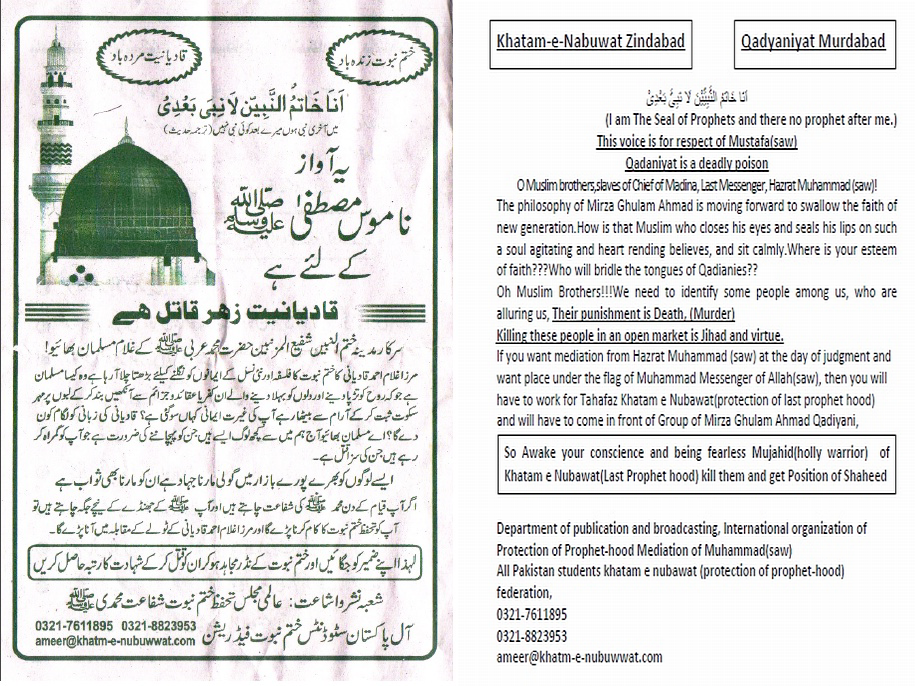
In June, pamphlets listing the names and addresses of Ahmadi families alongside messages inciting murder were distributed in the Punjab city of Faisalabad. Several months later 55-year-old Naseem Ahmed, whose name had appeared on that list, was shot dead in his home.

In another case, the local cleric of a small village in Punjab issued a severe edict after seeing the sons of a deceased Ahmadi offering funeral prayers for their father: “Anyone who offers prayers for a kafir (an infidel, in this case an Ahmadi) gets expelled from Islam.”

This anti-Ahmadi sentiment is not restricted to Punjab alone. In Quetta, the provincial capital of Balochistan, a group of clerics forced an Ahmadi to ‘renounce’ his beliefs, warning him that if he refused his business would be set aflame and he would be killed.

According to Pakistan’s constitution, the Ahmadi minority cannot call themselves Muslims, are banned from referring to their places of worship as mosques and cannot even sing hymns in praise of Prophet Muhammad.

Meanwhile the government of Pakistan has updated the electoral list for the forthcoming 2013 national elections to include a new column for religion, meaning that if Ahmadis choose to cast their vote, they will be forced to mark this new form, thereby accepting their designated ‘status’ as non-Muslim.

The new form states that any citizen who declares himself a Muslim also affirms that “he believes in the finality of Prophet Muhammad; that he is not a follower of any person who claims to be a prophet after Muhammad and does not call himself an Ahmadi.”

Qari Shabbir Ahmed Usmani, a leading cleric for Khatme-Nabuwat Momin, one of the several religious movements in Pakistan that aims to protect the sanctity of Prophet Muhammad, has been living in Chenab Nagar since 1976. He believes that if the constitution has declared Ahmadis non-Muslim, they should accept that status if they want to continue living in the country.

“They lead astray the true believers and want Pakistan to disintegrate. They are enemies of our country,” Usmani said, adding he has never maintained any “social contact” with Ahmadis.

But Ali Dayan Hasan, the Pakistan director of Human Rights Watch, told IPS that the government’s move to update the electoral lists was a “historical blunder”, adding that the “unwillingness” of the government to either repeal or amend discriminatory legislation has made it “complicit” in abuses perpetrated against the Ahmadis.

Since 1974, various civilian and military governments have passed a series of ordinances that discriminate against Ahmadis.

Hasan said, “the legal apartheid that the state instituted against Ahmadis in 1974 has led to increased social apartheid over the decades.”

Describing the recent expulsion of students and the teacher in Dharanwali as “obscenely abusive”, Hasan said Pakistan’s state and some sections of its society “appear determined to deny Ahmadis, Christians and any others who question bigotry and prejudice any place at all in the social fabric.”

Saleemuddin, too, blames the government for stoking hatred against his community. “It has allowed extremist clerics to hold hate campaigns against our community,” he said.

Rights groups and the usually raucous media have been virtually silent in the face of such blatant discrimination. “The role of the media in our society is deeply flawed,” Kamila Hyat, a rights activist and journalist told IPS. “The same biases that pervade the rest of society also influence the reporting of these cases.” (END)

Copyright © 2011 IPS-Inter Press Service. All rights reserved.
URL: http://ipsnews.net/news.asp?idnews=105923

Saturday, February 6, 2010

Pakistan and Ongoing Christian Persecution

--- The Seoul Times, Korea
Friday, February 05, 2010
Asia-Pacific

Letters from Tokyo

Pakistan and Ongoing Christian Persecution

By Lee Jay Walker
Tokyo Correspondent


Christians and other minorities in Pakistan continue to face enormous discrimination and persecution, and in extreme cases, but not rare cases, many Christians have been killed by either Muslim mobs or by state sanctioned policies. Therefore, the endless suffering and discrimination in Pakistan must come to light and the international community must put more pressure on the government of Pakistan to act, and to rescind brutal laws.

Pakistan is currently in crisis and much of the current crisis in self induced because it is clear that Pakistan supported radical Sunni Islam in Afghanistan and Kashmir for decades. Now the very same Sunni Islamic radicals who were supported by the security services in Pakistan have decided to turn Pakistan into another radical Sunni Islamic nightmare. Therefore, the ongoing “year zero Islamization” is leading to more hatred and this hatred is also being aimed at all minorities.

Even worse, for Christians, and other minorities like the Ahmadiyya Muslims and Hindus; they are suffering at the hands of radical Sunni Islamists, institutionalized laws which discriminate against minorities, government indifference, police bias, and every day discrimination where individual Muslims can abuse their power.

Emmanuel Y. Mani wrote an article on 11/10/2009 which was published on http://www.asianews.it and he stated that the “Blasphemy laws include Article 295, Sections B and C, and Article 298, Sections A, B and C, of the Pakistan Penal Code. These laws were incorporated into the criminal justice system between 1980 and 1986 by then President of Pakistan Zia-ul-Haq, supposedly to ensure respect for the Prophet Mohammed, his Companions and the Holy Qur’an. These laws are unique in the contemporary world because they allow dubious charges to be brought against people who have been subjected to extra judicial killings, arson and destruction of their property.”

“From 1986 to October 2009, at least 966 persons were accused under the blasphemy laws, 50% were Muslims, 35% Ahmadis, 13% Christians, 1% Hindus and 1% with no known religious background. At least 33 persons have been killed extra judicially after allegations were made against them; 15 were Muslims, 15 Christians, two Ahmadis and one Hindu.”

This law is not only being used against Christians, Hindus, and Ahmadiyya Muslims, but it is also being used by the dominant Sunni Islamic sect in Pakistan in order to crush all alternative voices or the law is being manipulated on any grounds in order to bypass real justice.

Last year on September 15th a young Christian male called Robert Fanish was found dead in his cell. Of course, the usual mantra was stated and a cover up was started from the start but clearly he had been tortured and victimized. The National Commission for Justice and Peace (NCJP) which is a Catholic-led advocacy group, however, stated that the brutal death of Robert Fanish was an “extra-judicial murder.”

Therefore, in modern day Pakistan this Sunni Islamic madness continues and now they are killing each other in the north of the nation, while causing mayhem in Afghanistan. At the same time, they are killing minority Christians, Shia Muslims and Ahmadiyya Muslims. It is like a state of madness with no end game apart from complete Sunni Islamization and then an internal Sunni Islamic war on the grounds of who is the most radical.

This madness led to 6 Christians being burnt alive last year and numerous other attacks. More recently, we have a 12 year old Christian girl called Shazia Bashir who was raped and tortured to death according to local Christians and advocacy groups.

Shazia Bashir was employed in the household of a wealthy Muslim lawyer and like many poor Christian domestic workers in Pakistan, she suffered abuse, however, her abuse would lead to her death but will justice be done in Pakistan?

A Protestant NGO, Sharing Life Ministry Life (SLMP), gave details about the young Christian girl. They stated that she had been working for eight months and that she had suffered constant stress and had been treated harshly before her death. This applied to ill treatment, verbal abuse and other forms of mistreatment.

SLMP chief coordinator Sohail Johnson commented “…that 99 per cent of Christian girls from poor families are hired by wealthy Muslims, and are often physically, psychologically and sexually abused.” He continued by stating that “In some cases, their employers marry them off to Muslim servants, and forcibly convert them to Islam.”

Sohail Johnson also mentioned about the failings of the government of Pakistan in protecting Christian girls. He states that “These vulnerable Christian girls do not have any state protection. We urge the government to ensure protection of these disadvantaged girls.”

Therefore, in 2009 we heard about Christians being burnt alive in Pakistan and many other cases of violence which was aimed at Christians and other minorities. Sadly, the same pattern is continuing but this time it is the brutal murder of a young Christian girl and many Christians doubt that justice will be done.
In Pakistan it is clear that Christians, Ahmadiyya Muslims, Hindus, and others, face an uphill struggle and death and persecution is never far away. However, what makes the situation worse is that it is not only radical Islamists who are persecuting all minorities but it is also the state apparatus of Pakistan.

The cycle of violence, intimidation, and persecution, can only be imagined from a distance. Yet the daily terror caused by Islamists and the betrayal of the institutions of Pakistan means that this nightmare is ongoing. However, will the international community just “turn a blind eye” or will outside pressure be put on Pakistan?
Lee Jay Walker serves as Tokyo Correspondent of The Seoul Times. He specializes in int'l relations and geopolitics. He is also involved in analyst work and research on business. After finishing BA degree in East European Studies at the University of London, he earned MA degree in Asia Pacific Studies at Nottingham Trent University. Website at http://www.leejaywalker.wordpress.com where work is published.
URL: http://theseoultimes.com/ST/?url=/ST/db/read.php?idx=9352

Thursday, October 15, 2009

Pakistan: Ahmedi-baiting: ridiculous or tragic?

---Daily Times, Pakistan
Wednesday, September 30, 2009

Second Editorial: Ahmedi-baiting: ridiculous or tragic?

The 20 shopkeepers of Green Town in Lahore have been advised to remove any Quranic verses from their shops simply to avoid bloody mayhem, given the atmosphere of extremism in the country. The shopkeepers are Ahmedis who represent the cluster of 200 houses belonging to the community in the nearby Township area. Some of them have written verses from the Quran (like the kalima) on the front of their shops and houses.

The Ahmedis complain that the Sunni shopkeepers had gone to the police in the matter out of business jealousy. They say the verses had stayed written on their houses and shops for many years. But the stark fact is that under the Constitution and the laws framed in line with an amendment made in it, the Ahmedis are not even allowed to show respect towards Islamic symbols. They have been declared non-Muslims but with the distinction that while other non-Muslims can show respect, they cannot.

Outsiders will regard this as ridiculous or even funny, but in Pakistan this is a deadly serious matter. People have died for it, and angry organisations with global connections are calling for more drastic action against the Ahmedis every day. The application to the police against the Ahmedis has been moved in the name of the International Majlis Khatm-e-Nabuwwat. The police in the area of Green Town cannot wave the affair away.

According to Section 298-B of the Pakistan Penal Code (PPC), the Ahmedi community cannot call its place of worship a masjid and cannot give the call to prayer (azan). According to Section 298-C of the PPC, they cannot pose as Muslims, directly or indirectly. There was this extremely absurd incident of an Ahmedi being hauled up for having written the kalima on the house that he had just bought; but he was hauled up again, for desecration, when he tried to wipe it off. *

URL: www.dailytimes.com.pk/default.asp?pa...tory_30-9-2009_pg3_1

Tuesday, October 6, 2009

PAKISTAN: Repeal of Blasphemy Laws Still a Pipe Dream

---IPS-Inter Press Service, Italy

PAKISTAN: Repeal of Blasphemy Laws Still a Pipe Dream

By Zofeen Ebrahim

KARACHI, Oct 6 (IPS) — It is a never-ending saga.

Every time someone charged with violation of the controversial blasphemy laws is murdered or suffers mistreatment in the hands of an angry mob or individual, calls for their repeal intensify.

Yet concerned sectors are still waiting anxiously for concrete action by the state to stem the tide of religious violence against minority groups who bear the brunt of these laws.

The death of a 20-year-old Christian while in the custody of the police has intensified the campaign against the laws. But clerics are not backing down, insisting the laws should stay.

In 2000, then President Pervez Musharraf promised to repeal the laws. “He retracted when the ‘mullahs’ (religious teachers) threatened protests,” recalled Zohra Yusuf, vice chairperson of the Sindh chapter of the Human Rights Commission of Pakistan (HRCP).

Robert Fanish Masih was arrested around mid-September on blasphemy charges after Muslims went on a rampage in his village, Jaithikey, near Sialkot, close to the Indian border. He was found dead in his cell four days later. Asma Jahangir, the head of the HRCP, called it “death in custody” and held the police authorities responsible for it.

His family and community members were forced to flee the area, where they were also prevented from burying him.

Rights activist Tahira Abdullah said mobs using the law to inflict harm on others are acting “like private vigilante groups,” she said.

No less than governor of Punjab, Salman Taseer has called for a repeal of the blasphemy laws. But his bold call on Sep. 16 for the controversial laws’ repeal was met with a warning from the president of the conservative Pakistan Muslim League (Quaid-e-Azam), Chaudhry Shujaat Hussain, who said that his party would resist any attempt to annul the blasphemy laws.

Continued state inaction on the much-maligned blasphemy laws has only reinforced perceptions that “the present government has no intention of repealing the laws,” said Yusuf.

I.A. Rehman, noted rights activist and secretary general of the HRCP, told IPS “(neither) the present government (nor any) government in Pakistan is likely to have the courage to repeal the blasphemy laws”. He added that “the state has committed the folly of making obscurantist fanatics stronger than itself.” Calling for a repeal of the law “is the only rational way out” although “this demand is unlikely to be met.”

The Pakistan Minorities’ Democratic Movement, which has 51,500 members and affiliates in 47 districts, has started a signature campaign for the repeal of the blasphemy laws. “Since July 16, 2009, we have collected over 200,000 signatures,” said party chairman Atif Jamil Paggan.

“What we hope to gain from our pressure is a policy of making the laws dormant. If these are not invoked, for some years or do not yield the results the fanatics expect, repeal will become possible,” said Rehman.

Declaring Masih’s alleged suicide a “judicial murder,” the HRCP, in a press statement issued shortly after his death, expressed concern “over the increased attacks on religious minorities” demanding the “government take proactive measures to prevent such violence.”

The blasphemy laws were enacted by military dictator Muhammad Zia-ul-Haq in 1986 in a bid to Islamise the country, where only four percent of the country’s 170 million population consists of religious minorities, including Christians.

While none has been executed since the laws were passed, lynch mobs have killed several of the accused, citing the laws to justify their actions.

According to the National Commission of Justice and Peace (NCJP), which provides legal aid to the victims of these laws irrespective of religion, at least 966 people have been charged under the blasphemy laws between 1986 and September 2009. These include 481 Muslims, 120 Christians, 340 Ahmadis, 14 Hindus and 10 people of unidentified religion. About 32 people have been killed extrajudicially by an angry mob or individuals, states NCJP.

On Sept. 15, jail officials of Sialkot district jail claimed that Masih had committed suicide by hanging himself. Rights group refused to believe this statement, alleging he was “tortured to death” by jail officials.

Sialkot is about 125 kilometres from Lahore, capital city of the Punjab province and is famous internationally as manufacturing hub for sports equipment and surgical instruments.

Following the public outcry triggered by Masih’s death, the government suspended the jail superintendent. But such an action has done nothing to appease the concerned sectors.

A U.S.-based non-profit group, Advocates International (AI), has urged Pakistan to “end unlawful impunity, police brutality and religious persecution caused on its blasphemy laws.”

The AI said photographs of Masih taken at the morgue show clear signs of torture, and not strangulation as the police are claiming was self-inflicted.”

“We are investigating the cause of (his) death as there are signs of torture on his body,” said Shahbaz Bhatti, minister for minority affairs, speaking to IPS by phone from Islamabad. He described the death as “very barbaric, tragic and highly condemnable,” intimating that he, too, believed that Masih was murdered.

Masih’s alleged murder came in the wake of two violent attacks against Christian communities in Korian village and Gojra in Punjab on July 31 and Aug. 1, respectively. The incidents left nine people dead and led to the burning and looting of hundreds of Christian homes by an enraged Muslim group, reacting violently to reports of Christian children tearing pages off the Quran, Islam’s holy book, during some wedding festivities.

“Considering the environment prevailing in the country, we’re asking for a review, revisit and amendment to the laws,” said Bhatti, a Catholic.

Mohammad Nafees, a journalist and senior research fellow for Aryana Institute for Regional Research and Advocacy in Islamabad, supports this move. He knows, however, that the “religious lobby” against such a call was so strong that “any attempt to change (the laws) may not be very easy.”

The controversy sparked by the Gojra incident, he said, failed to bring justice to the victims, who were “now being haunted by law enforcers while the culprits are at large.”

“If we can at least save these poor people from this legal harassment and torture, we would be able to claim some sort of success. If we fail here, we can’t even talk about a little change in the blasphemy laws,” he said. “It’s a simple equation.”

“A bad law cannot be amended to make it better,” argued HRCP’s Yusuf. “No government has been able to roll back the intolerance unleashed (by the laws). The current spurt (of violence) is due to the extremist forces wanting to assert their power.”

Nafisa Shah, a member of the National Assembly and a long-time rights activist acknowledged that the questionable laws have been abused.

“We have stated that these laws have caused religious violence and have been used to settle personal scores. The laws have made minorities vulnerable but have also been used against people of the Muslim majority and several cases of public lynching and mob violence are incited on the premise of blasphemy,” said Shah, who has been selected to head the newly formed subcommittee of Parliament’s Standing Committee on Minorities. The committee is tasked to prepare a comprehensive report on the damaging effects of this law and make recommendations to the government.

“Laws are made according to the needs of society, but in Pakistan, there was no need for these laws,” said Peter Jacob, chairman of the NCJP.

“What we need, apart from repeal/amendment, is greater tolerance in society — from revision of textbooks to sensitisation of police, administration, councilors, parliamentarians,” said Yusuf.

Shah said she favours a repeal of the law but reminded civil society that “that there are a range of parties from extreme right to left in the parliament and the standing committee which have to be brought on board,” adding that without including them, nothing can be passed in the assembly.

“What we are trying to do is to create a negotiating space through which we can enlarge our support in the parliament and move forward against discriminatory laws.”

“Blasphemy laws can at least be taken up by our legislators, and it won’t create a storm,” said Jacob. They did so when they reverted the holiday from Friday to Sunday and amended the Hudood Ordinances — still another controversial legislation that makes it difficult for women to prove an allegation of rape — were amended, nothing adverse happened, he added.

(END/2009)

URL: www.ipsnews.net/news.asp?idnews=48736

Thursday, October 1, 2009

Protests mount against Pakistan’s blasphemy laws

---World Socialist Web Site, USA

Protests mount against Pakistan’s blasphemy laws

By Ali Ismail
1 October 2009


Pakistan’s draconian “blasphemy” laws have come under renewed criticism since several Christians were killed this summer by a mob of Muslim fundamentalists in a pogrom-style attack. Demands have risen for the abolition of these laws, which were introduced in the 1980s by the US-backed dictator General Zia-ul Haq as part of an “Islamization” drive. They have often been used to persecute Christians and members of other religious minorities.

The violence occurred in the town of Gojra in eastern Punjab, when a banned Islamist group falsely accused local Christians of desecrating the Qur’an. A large crowd of Muslim fundamentalists set fire to several homes, leaving their occupants to be burned to death. Seven people were killed, all believed to be Christians.

Over 100 people were arrested in connection with the massacre, which according to Pakistani officials, was ordered by Sipah-e-Sahaba, a Sunni Islamist group that has frequently been involved in sectarian violence against the country’s Shia minority.

Attacks against Pakistani Christians usually go unpunished. But because of the outcry from Pakistani Christians, civil rights groups, sections of the press, and international Christian groups, Pakistan president and People’s Party of Pakistan (PPP) head Asif Ali Zardari may be compelled to deliver at least a modicum of justice.

President Zardari and Punjab’s provincial government have offered paltry compensation to the victims’ survivors, amounting to just a few thousand dollars per family.

There were several other incidents of violence perpetrated against Christians in Pakistan in the months leading up to the Gojra atrocity. Last March, a Christian woman was killed when a church was attacked in Gujranwala. On June 30, dozens of Christian homes were attacked when Muslims plundered a village in the Kasur district.

Islamic militants and bigoted clerics have been able to foster animosity between Muslims and Christians by exploiting the disgust generated by the crimes of US imperialism in Afghanistan and Iraq and in Pakistan itself. The Bush administration funded and armed the dictator General Pervez Musharraf, who was only forced out as president in August 2008, and under Obama the US has declared Pakistan an integral part of the Afghan counter-insurgency war, mounted regular drone missile attacks inside Pakistan and prevailed upon the government to bloodily suppress Taliban-allied militia in the country’s northwest.

Notwithstanding the outcry over the Gojra massacre, attacks on Christians are continuing. On September 12, the Pakistani English-language daily Dawn reported that a church was set ablaze by Muslim communalists after another dubious allegation of desecration of the Qur’an. Bishop Samuel Pervaiz subsequently accused the government of failing to protect minorities.

In a particularly disturbing incident, 20-year-old Robert Fanish Masi, who had been arrested on blasphemy charges, was found dead September 15 in his jail cell in the Sialkot district. While police claim Masi’s death was a suicide, his body was reported to bear clear signs of torture, indicating that he may have been murdered while in custody. The Daily Times cites the Punjab Minister for Minority Affairs Kamran Michael as saying, “I have seen the body and there were torture marks on it.”

Masi is by no means the first person accused of blasphemy to be found dead in their cell under mysterious circumstances.

Local authorities denied Masi’s family permission to bury him in his native village, some 20 kilometers from Sailkot, and police attacked his funeral procession in Sailkot with tear-gas after it transformed into a protest demanding repeal of the blasphemy laws and a public inquiry into his death.

The recent anti-Christian communal attacks have sparked protests involving Christians, human rights activists, and other working people in cities across Pakistan. According to Joseph Francis, the chairman of the Christian National Party, people are saying “We hate Pakistan and we want to leave. It’s truly a terrible thing for community relations.”

The protestors are outraged not only by the violence, but by police indifference to, and outright collusion, in the attacks.

To cite but one example, on September 16 The News reported that police in Karachi severely beat up several members of a Christian family, the Lawrence’s, after a family-member, a 60 year-old diabetic patient, allegedly urinated on the roof of a neighbor’s house where there was said to be some religious literature.

According to the Human Rights Commission of Pakistan, “There was a hue and cry and local clerics gathered and attacked Lawrence’s house. An HRCP team is investigating this case.” Yousuf Ashiq of the Muthahida Qaumi Movement (MQM), the political party that leads Karachi’s municipal government, said, “Although there is no eyewitness to the incident, the Christian family has decided to pay compensation in accordance with Islamic laws and an announcement has been made in this regard at the local mosque.”

Pakistan’s approximately three million Christians make up less than two percent of the country’s total population. Most of the Christians are descendents of untouchables who converted to Christianity during the second half of the 19th Century and early 20th Century. The conversions were at least in part an effort to improve their socio-economic status and escape caste oppression. Today they are the largest non-Muslim minority group in Pakistan.

Although only Brahamanical Hinduism gives religious sanction to untouchability, in colonial India better-off Muslims, as well as Hindus, enforced caste divisions. Today Pakistan’s Christian must deal with both class and caste-based prejudice. They are often taunted as “cleaners” referring to the menial tasks performed by their ancestors—tasks which dire poverty compel many of them to continue to perform today.

Bigotry and religious sectarianism are the inevitable products of the betrayal of the mass anti-imperialist movement that convulsed British India during the first half of the 20th Century by the Indian National Congress and the Muslim League and the creation in 1947, under the tutelage of the British of imperialism, of twin independent bourgeois states—an expressly Muslim Pakistan and a predominantly Hindu India. The immediate result of partition was an orgy of communal violence in which up to two million people died and more than 12 million were uprooted from their homes.

Virtually all Hindus and Sikhs fled the western half of the bifurcated Pakistani state, while millions of Muslims from north India sought refuge in Pakistan.

Christians, by contrast, did not leave Pakistan in large numbers, and thus subsequently became the country’s largest religious minority. There are several reasons for this. Mohammed Ali Jinnah, the “founder of Pakistan,” courted the tiny Christian elite. Even as he was inciting communalism and violence with cries of Islam in danger and by insisting that Islam and Hinduism were incompatible ways of life, Jinnah claimed that the Christians would have equal rights in Pakistan. Being amongst the poorest of the poor, Pakistan’s Christians lacked the connections, transportable skills, and financial resources to migrate in 1947-48.

In Pakistan, as in post-independence India, the bourgeoisie has used communalism as a means of diverting and derailing the social discontent born of its inability to ensure the basic needs of masses and as a means of mobilizing popular support for the geo-political struggle against the rival state created in 1947.

Under the dictatorship of Zia-ul Haq, Pakistani politics and society underwent a further communalization, with disastrous consequences for the Pakistani people. Zia openly promoted Islamic parties and the Muslim clergy as a bulwark against the working class. At the behest of the United States and their Saudi allies, the Pakistani state armed the mujahedeen in Afghanistan and made Islamicist militias an integral part of the Pakistani bourgeoisie’s geo-political strategy. Zia also promoted religious schools and social services as an alternative to state funding for education and health.

It was under Zia that Pakistan developed its draconian blasphemy laws. In 1982, Section 295-B was added to the Penal Code. It states, “Whoever willfully defiles, damages or desecrates a copy of the Holy Quran or of an extract therefrom, or uses it in any derogatory manner or for any unlawful purpose shall be punishable with imprisonment for life.” In 1990, the Federal Shariat Court, which was authorized by Zia, made death the only punishment for blasphemy.

Section 298 of the Penal Code is particularly discriminatory. It was enacted for the sole purpose of preventing members of the Ahmadiyya community from freely practicing their religion. Ahmadiyya is a religious movement which venerates Mirza Ghulam Ahmad who claimed to be the Mahdi, a messiah-like figure awaited by Muslims. Although Ahmadis consider themselves to be Muslims, they are considered heretics by the state. There is a direct correlation over the years between the enactment of anti-Ahmadiyya laws and violence committed against Ahmadis by Sunni extremists. In 2008, two Ahmadis were murdered after a TV news anchor justified attacks on the community saying Ahmadis should be killed.

The blasphemy laws are only one of the means by which Pakistani state infringes on the freedoms of religious minorities and non-believers.

Article 2 of the Pakistani Constitution declares Islam the state religion. Non-Muslims cannot aspire to the highest offices in the government. Pakistani passports stipulate the faith of the passport holder and minorities must vote in communal electorates for their own parliamentary representatives, instead of with the general population, thereby making clear that they are to be viewed as apart from and inferior to the Muslim majority.

While religious fundamentalism contributes to massacres like Gojra, accusations of blasphemy usually occur over property and other financial disputes. Nearly every accusation ends up being proved baseless. It is a clear case of landowners and clerics capitalizing on poverty and unemployment to assert their own financial interests.

In the face of the recent protests against the communal attacks on the country’s Christian minority, Pakistan’s government has merely promised to “review” the blasphemy laws.

Meanwhile sections of the establishment are sponsoring a movement in favor of keeping the laws intact. Chaudhry Shujaat Hussain, president of the Pakistan Muslim League (Q), told a commercial television channel that his party would oppose any measure to abolish the blasphemy laws, cynically adding that it was the duty of every Muslim to protect minorities. The PML (Q) was the party created by former President Pervez Musharraf and his supporters, many of whom had defected from the Nawaz Sharif-led PML (N). Many Islamist parties have also come out in opposition to abolishing the laws.

Communal violence is symptomatic of the general crisis confronting Pakistani society. The country’s economy has been hit hard by the world financial meltdown. The IMF recently allocated an additional $3.2 billion to Pakistan, in exchange for government promises to eliminate fuel price subsidies, raise more tax revenue and lower the budget deficit. The austerity measures imposed by the IMF will continue to wreak havoc on the living standards of the Pakistani working class. The majority of Pakistanis live on less than $2 per day. The lack of access to public education and health services will inevitably lead to the continuation of wretched living conditions for the vast majority of the population.

A client-state of the US virtually since its establishment, Pakistan and its bourgeois elites remain heavily dependent on foreign powers, especially Washington.

Now the Pakistani government has obediently declared war on a large segment of its own population in the interest of US imperialism. The collaboration with the US has only intensified under the leadership of the Pakistan People’s Party (PPP)—a party that in the past has postured as socialist and epitomizes the craven and venal character of Pakistani liberalism.

The blasphemy laws are but one example of the anti-democratic character of the Pakistani state. Political power in Pakistan remains largely in the hands of the US-backed military, while the various politicians engage in reactionary religious, nationalist, and ethno-linguistic appeals. And the politicians and army are equally committed to upholding the present grossly unequal socio-economic order.

The struggle to complete basic democratic tasks such as the separation of mosque and state and the eradication of landlordism is bound up with larger struggle against capitalism itself. Pakistani workers and their counterparts across South Asia must unite across religious and ethnic lines to fight for socialism in Pakistan and throughout the region.

Copyright @copy; 1998-2009 World Socialist Web Site - All rights reserved
URL: www.wsws.org/articles/2009/oct2009/paki-o01.shtml

Monday, September 28, 2009

Green Town Police to remove Quranic verses from Ahmadis’ shops

---Daily Times, Pakistan
Tuesday, September 29, 2009

Green Town Police to remove Quranic verses from Ahmadis’ shops

  • Community leader says police warned Ahmadis on complaint of business rivals
  • Local Ahmadi says police did not act on his complaint of stones thrown at his house
  • SHO says verses to be removed in next couple of days
By Rana Tanveer

LAHORE: The Green Town Police is set to launch an operation to remove verses of the holy Quran from more than 20 shops of the Ahmadiya community on College Road, Township, on the complaint of local traders, sources told Daily Times.

The community owns shops of electronics, hardware and home appliances on the road as well as over 200 houses in C-Block of nearby Township. Some of the people have written verses from the Quran (like the kalima) on the front of their shops and houses.

According to local Ahmadiya residents, the traders of the locality were seeking action against them over business rivalries. They said they had written the verses to receive God’s blessings. They said the verses had been written on their houses and shops for many years, and some extremists were now seeking action against them for their own gains.

Members of the Ahmadiya community claimed that their opponents had distributed pamphlets on many occasions, urging the locals to boycott the community, not talk to them, shake hands with them, or shop at their stores.

Waseem Amjad Mahmood, a community leader, said on the complaint of the owners of a local shop Al-Makkah Electronics, the Green Town Police had warned the community to remove all Islamic writing from their houses and shops, or the police would do it.

Sayyed Farrukh Hafeez, another member of the community, told Daily Times that the police had told him to remove a plaque from his front door, which carried a Quranic verse. He said he had removed the plaque. He said local shopkeepers often passed derogatory remarks against the Ahmadiya community.

Hafeez claimed some young men had made videos of the Ahmadiya houses on some occasions. He said some Taliban elements might be behind this.

Abdul Qayyum Mughal, another member of the community, said he had also filed an application with the Green Town Police, seeking action against some locals for hurling stones at his house, which had broken some windowpanes. He said the police did not take any action.

Green Town Police Station House Officer (SHO) Inspector Ghulam Abbas told Daily Times that after receiving an application against the Ahmadiya community, he had called them to the police station, and had told them to remove the verses of the holy Quran. He said he would make the community remove the verses from their shops in the next couple of days.

Tauseef, the proprietor of Al-Makkah Electronics, told Daily Times that the application against the Ahmadiya community had been moved from the platform of the International Majlis Khatam-e-Nabuwat. He denied that bricks were thrown at the houses of the community. He said there were laws against the community.

Human Rights activist Hina Jillani said no one had the right to impose his will on anyone else. She said there were some restrictions on the Ahmadiya community by law, but no one had the right to harass others.

Jamia Naeemia patron Dr Raghib Naeemi told Daily Times that the Ahmadiya community could not do the things barred to them by the Prohibition of Qadianiat Ordinance, 1984. According to Section 298-B of the Pakistan Penal Code (PPC), the community cannot call its places of worship a ‘masjid’ and cannot give the call to prayer (azan). According to Section 298-C of the PPC, they cannot pose themselves as Muslims, directly or indirectly.

URL: www.dailytimes.com.pk/default.a...9-9-2009_pg13_10

Monday, September 21, 2009

Pakistan: Looking for justice [Comment]

--- Daily Times, Pakistan
Monday, September 21, 2009
COMMENT: Looking for justice — Syed Mansoor Hussain

The ultimate conundrum is that if a Christian is asked the question, do you believe that the Prophet of Islam (pbuh) was a Prophet and the Quran is the word of God, the believing Christians must say no, and if they say that, under the law are they not guilty of blasphemy and have committed a capital offence


Last week I had hinted that I might write about how Muslim Americans have become discriminated pariahs in the US after 9/11. But then something at home forced me to concentrate on what is happening to minorities in Pakistan. Indeed in comparison it almost made me feel better about how we as Muslims are being treated in the US.

The Gojra carnage that has mysteriously disappeared from public perception and our news channels and newspapers is just one thing. More recently, a young Christian boy arrested for blasphemy died in jail, the ‘authorities’ insisting that it was a suicide. Sure!

And then the story broke about the case of a ‘mentally retarded’ woman who has languished in custody for thirteen years after being accused of blasphemy but was never presented in court. This woman has been officially declared as somebody probably incapable of even understanding the meaning of blasphemy and yet remained incarcerated for all this time without judicial review.

“You are free; you are free to go to your temples, you are free to go to your mosques or to any other place of worship in this State of Pakistan.” That is what Jinnah said sixty-two years ago to the people of Pakistan but today the very same people who shout the loudest about Jinnah and his legacy are the ones that ignore his words.

Almost two decades ago when democracy had just returned to Pakistan after a rather egregious military dictatorship, Pakistani Americans had a series of seminars in New York City to discuss what needed to be done in Pakistan to strengthen democracy. Platitudes galore! However, one almost offhand remark about the state of minorities in Pakistan during one such ‘seminar’ remains stuck in my mind.

Somebody brought up the fact that the Pakistani flag has a white part representing minorities and therefore minorities are an important and protected part of our national heritage. But then an obviously ‘liberal’ cynic pointed out that after all Pakistanis needed some part of the flag to drive the pole through. Of course what he said sounds a lot more ‘descriptive’ in Punjabi.

As I sit here today thinking about how our minorities, especially the Christians are being treated in ‘modern’ Pakistan, that remark reverberates ever so much in my mind. However, historically the Pakistani establishment has never been kind to minorities.

The Ahmadiyya community was targeted during the agitation in 1953 and Zulfikar Ali Bhutto the secularist declared them non-Muslims twenty years later under religious pressure. Even the Shia have been, and still are, under threat. Fortunately for the Shia they are much too large a community and too integrated to be easily separated and targeted except in discrete areas of the country.

Perhaps some of my readers might even remember a time not too long ago when Shia doctors were being killed just because they were Shia. Interestingly, some of them were killed just because they had Shia-sounding names, so much so that Shia doctors and even some with Shia-sounding names began to leave Pakistan.

Of the minorities, most of the Sikhs left Pakistan at the time of partition as did most Hindus with a few staying behind, mostly in Sindh. During the first few decades of Pakistan, the Christian community was an important and fully integrated part of the national fabric. There was a thriving ‘Anglo’ community in Lahore that I remember well and many Christians held important positions as educators, civil servants and members of the armed forces.

But everything started to change after the “enlightened” days of Islamisation. Most, if not all, of those that could afford it among the Christians, the Ahmadis and even the Parsees left Pakistan for western countries. Sadly, of the Christians left behind the majority now belongs to the poorer classes and therefore is most vulnerable.

The recent spate of violence against the Christian community is not entirely about religious extremism and an excess of ‘Islamist’ zeal. I personally believe that after the Taliban and their supporters became isolated and unpopular due to attacks on other Muslims, they have changed tactics. Any radical organisation needs to keep its base involved and fired up and since attacks that killed other Muslims became undesirable, the Christian community has become an easy and obvious target.

Considering the political and bureaucratic indifference to these attacks, this strategy of attacking Christians seems to be paying off. It provides the Taliban types with enough ‘face time’ on TV and in newspapers and keeps their radical base involved and active. Unfortunately many in our bureaucracy, among the politicians as well as in our lower judiciary are either entirely intimidated by, or else agree with, the Islamist types and therefore do not pursue cases against them to bring them to justice.

The ‘apologists’ for the Taliban types keep repeating the mantra that Islam is a tolerant religion and as such the violence aimed at Christians or even against Muslims could not possibly be the work of real Muslims. Who then were the people that burned houses and residents in Gojra or recently blew up a hotel in Kohat? Are they not Muslims and are they not doing whatever they are doing in the name of Islam?

The ultimate conundrum is that if a Christian is asked the question, do you believe that the Prophet of Islam (pbuh) was a Prophet and the Quran is the word of God, the believing Christians must say no, and if they say that, under the law are they not guilty of blasphemy and have committed a capital offence?

And that is my question to the powers that be. What is more important when it comes to the survival of the federation, the price of sugar or the legally sanctioned killing of non-Muslims just because they believe in their faith as we do in ours?

Syed Mansoor Hussain has practised and taught medicine in the US. He can be reached at smhmbbs70@yahoo.com

URL: www.dailytimes.com.pk/defau...y_21-9-2009_pg3_3

Monday, August 10, 2009

Blasphemy laws a tool in the hands of extremist: Asma Jahangir

---Daily Times, Pakistan
Monday, August 10, 2009
Blasphemy laws a tool in the hands of extremist: Asma Jahangir

* HRCP chairperson says repeal of blasphemy laws necessary
* Activists stress need for monitoring, early warning systems

Staff Report

LAHORE: Human Rights Commission of Pakistan (HRCP), South Asia Partnership (SAP), other non-governmental organisations and human rights activists have demanded the filtration of extremist elements from all political parties in order to avoid future incidents like the Gojra killings.

In a press conference held at the Lahore Press Club on Sunday, HRCP Chairperson Asma Jahangir said the blasphemy laws had become a tool for extremists and individuals who manipulated public sentiments to settle their scores or exploit situations.

SAP Executive Director Mohammad Tehseen and human rights activists including Josef Francis and Irfan Barkat were also present.

Repeal: Jahangir said it was necessary to repeal these laws to stop their exploitation since they affected all citizens, but mostly non-Muslims.

The activists said representatives of the citizens, and non-governmental organisations were appalled by false or flimsy allegations of blasphemy against peaceful citizens.

They said the Gojra incident was the worst example, since organised groups were allowed by the local administration to kill Christians. The extremists were still threatening Christians in Gojra and the tension was building up again.

Monitoring: The activists emphasised the need to develop a monitor and an early warning system in areas where minorities were vulnerable to future attacks.

They said a number of extremist elements were present in all political parties and those who had perpetrated the Gojra incident reportedly had links with some local leaders of a ruling party.

The press conference stated that false accusations of blasphemy must be punished in equal measure and all such cases should be heard by the High Court and senior police officers should be deployed for investigation to ensure transparency.

The activists urged the government to take stern action against clerics who spread hatred among citizens and misuse loud speakers.

URL: www.dailytimes.com.pk/default....y_10-8-2009_pg13_8

Thursday, August 6, 2009

Christians in Pakistan Attacked for Religious Beliefs

---Salem News, USA

Aug-06-2009 12:52
Christians in Pakistan Attacked for Religious Beliefs

Ahmadiyya Muslim Community denounces violence against Pakistan’s Christian minority.

(GOJRA, Pakistan) - The Ahmadiyya Muslim Community (AMC) strongly condemns the violence towards Pakistan’s Christian minority last week in the town of Gojra.

In response to a report that a Quran had been defiled, a mob of up to 20,000 individuals in Gojra rioted and, on Saturday, attacked local Christian residents for no other reason than their religious beliefs.

More than 100 Christian houses were burned and looted in a rampage that lasted 8 hours and resulted in 20 injuries and seven deaths. Pakistani authorities later stated that the report that spurred this violence was spurious.

Such episodes of religious intolerance and violence have become increasingly common since the passing of Pakistan’s anti-blasphemy laws in 1984.

Many legal experts say the laws have been badly misused since their introduction by the military dictator General Muhammad Zia ul-Haq.

Under the laws, a religious charge filed by anyone can be subsequently used to stir hatred and justify sectarian violence. “The blasphemy law is being used to terrorize minorities in Pakistan,” said Shahbaz Bhatti, Pakistan’s minister of minority affairs, in an interview in Gojra on Sunday.

The AMC has also experienced violence towards members of its community in Pakistan due to the anti-blasphemy laws. Because of their belief in Mirza Ghulam Ahmad as the Promised Messiah, over 100 members of the AMC have been killed by extremists in Pakistan. The AMC strongly opposes all violence in the name of religion and advocates universal freedom of religion.

“The Quran clearly states that there is no compulsion in religion” stated Dr. Nasim Rehmatullah, vice president of AMC USA. “Freedom of religious beliefs should be a right given to all citizens of democracy and such [blasphemy] laws demonstrate the lack of tolerance for all religious minorities within Pakistan and should be strongly denounced worldwide.”

The Ahmadiyya Muslim Community (AMC) is a dynamic, reformist and fast growing international movement within Islam. Founded in 1889, AMC spans over 190 countries with membership exceeding tens of millions. AMC USA, established in 1921, is the first American-Muslim organization.

Source: AMC, the only Islamic organization to believe that the long-awaited messiah has come in the person of Mirza Ghulam Ahmadas (1835-1908) of Qadian. Ahmad (as) claimed to be the metaphorical second coming of Jesusas of Nazareth and the divine guide, whose advent was foretold by the Prophet of Islam, Muhammadsa. AMC believes that God sent Ahmadas, like Jesusas, to end religious wars, condemn bloodshed and reinstitute morality, justice and peace. Ahmadas’s advent has brought about an unprecedented era of Islamic revival and moderation. He divested Islam of fanatical beliefs and practices by vigorously championing Islam’s true and essential teachings.

URL: www.salem-news.com/articles/august062009/christians_gojra_8-6-09.php
 
^ Top of Page