Showing posts with label asma jahangir. Show all posts

Wednesday, October 27, 2010

Asma targeted in Ahmedi hate campaign

Express Tribune, Pakistan
Pakistan
Punjab
Asma targeted in Ahmedi hate campaign
Rana Tanveer
October 27, 2010
Pamphlet calls her an anti-Pakistan, pro-American and pro-Indian Ahmedi.
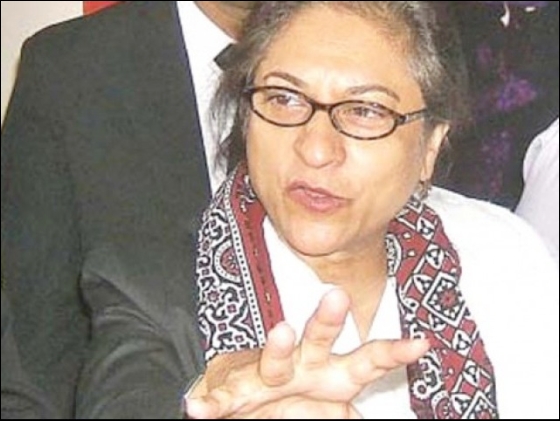
LAHORE: One of the leading candidates in the Supreme Court Bar Association (SCBA) elections is being targeted by a hate campaign that calls her an Ahmedi, pro-American and pro-Indian.

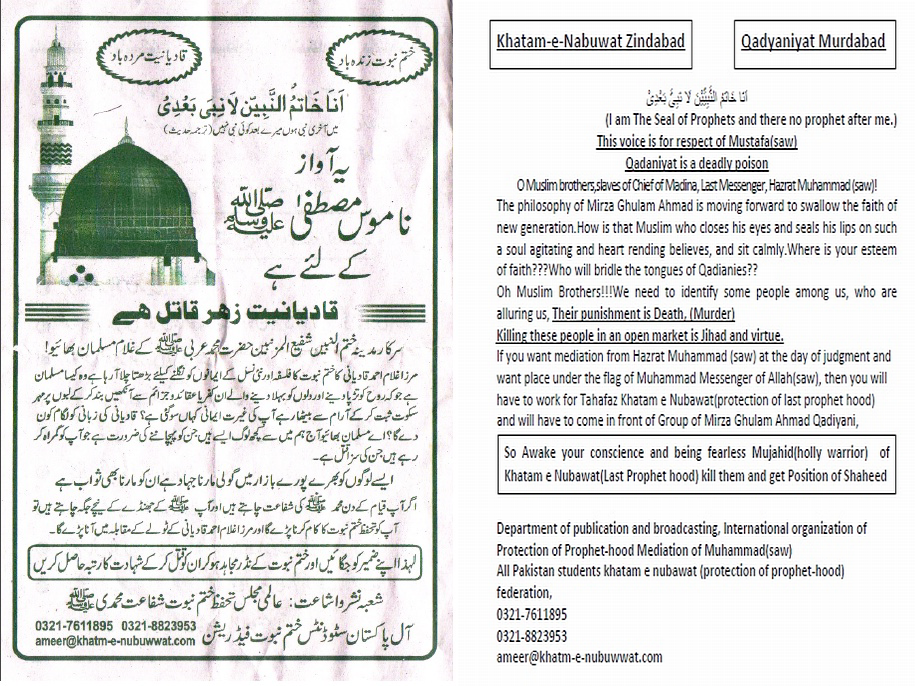
The Khatme Nabuwwat Lawyers Forum based in Markaze Sirajia, a seminary in Ghalib Market, Gulberg, Lahore, recently published an eight-page pamphlet titled Targeted Missile Against Supreme Court that claims Asma Jahangir, a contender for the office of SCBA president, is a Qadiani, a derogatory term for Ahmedis. It also accuses her of being anti-Pakistan and pro-US and pro-India.

The pamphlet has been distributed at the Lahore Bar Association and posted to members of the SCBA.

Also, an Urdu language daily recently published a statement from Majlise Ehrar secretary general Abdul Latif Khalid Cheema that “Qadiani elements” were campaigning for Jahangir in the SCBA elections. He said “anti-Muslim forces” wanted her elected president in a nefarious plot to abolish the blasphemy laws.

Jahangir, talking to The Express Tribune, accused her opponents of resorting to dirty tricks to win the election. She was confident that the SCBA members would not be influenced by “such mudslinging”, but regretted that such a campaign had been undertaken.

Hassnain Jameel, her spokesman, said Jahangir is a Muslim and her opponents were criticising her for fighting for the rights of minorities and the destitute.

Advocate Tahir Sultan Khokhar, vice chairman of the Khatme Nabuwwat Lawyers Forum, who is not a member of the SCBA, said that this was not the first time the group had acted against a ‘Qadiani’. “Since its inception two years ago we have taken significant steps in this regard,” he said.

Khokhar said the pamphlet was meant to tell voters the truth about Jahangir. He said he only wrote facts about her in the pamphlet and left it up to voters to decide which candidate was the right choice.

‘Military candidate’

Ahmed Awais, Jahangir’s main rival in the election, denied having anything to do with the hate campaign or the pamphlet. “It is not right to bring religion or other matters into it. The elections are an internal matter for lawyers,” he said. Awais said he had always been respectful towards his opponents during his campaign speeches, though they had abused him in their speeches.

He said he too was being targeted by “hateful propaganda” portraying him as the army candidate in the elections, a major insult since lawyers worked so hard for the ouster of General (retired) Pervez Musharraf as president. He was also being called a PML-N candidate to get the sympathies of PML-Q lawyers and a PML-Q candidate to get the sympathies of PML-N lawyers.

Senior members of the bar condemned the circulation of the pamphlet and the unsubstantiated rumours about the candidates. They said such mudslinging was an insult to the bar and the values it stood for.

Published in The Express Tribune, October 27th, 2010.

Monday, September 21, 2009

Pakistan: Looking for justice [Comment]

--- Daily Times, Pakistan
Monday, September 21, 2009
COMMENT: Looking for justice — Syed Mansoor Hussain

The ultimate conundrum is that if a Christian is asked the question, do you believe that the Prophet of Islam (pbuh) was a Prophet and the Quran is the word of God, the believing Christians must say no, and if they say that, under the law are they not guilty of blasphemy and have committed a capital offence


Last week I had hinted that I might write about how Muslim Americans have become discriminated pariahs in the US after 9/11. But then something at home forced me to concentrate on what is happening to minorities in Pakistan. Indeed in comparison it almost made me feel better about how we as Muslims are being treated in the US.

The Gojra carnage that has mysteriously disappeared from public perception and our news channels and newspapers is just one thing. More recently, a young Christian boy arrested for blasphemy died in jail, the ‘authorities’ insisting that it was a suicide. Sure!

And then the story broke about the case of a ‘mentally retarded’ woman who has languished in custody for thirteen years after being accused of blasphemy but was never presented in court. This woman has been officially declared as somebody probably incapable of even understanding the meaning of blasphemy and yet remained incarcerated for all this time without judicial review.

“You are free; you are free to go to your temples, you are free to go to your mosques or to any other place of worship in this State of Pakistan.” That is what Jinnah said sixty-two years ago to the people of Pakistan but today the very same people who shout the loudest about Jinnah and his legacy are the ones that ignore his words.

Almost two decades ago when democracy had just returned to Pakistan after a rather egregious military dictatorship, Pakistani Americans had a series of seminars in New York City to discuss what needed to be done in Pakistan to strengthen democracy. Platitudes galore! However, one almost offhand remark about the state of minorities in Pakistan during one such ‘seminar’ remains stuck in my mind.

Somebody brought up the fact that the Pakistani flag has a white part representing minorities and therefore minorities are an important and protected part of our national heritage. But then an obviously ‘liberal’ cynic pointed out that after all Pakistanis needed some part of the flag to drive the pole through. Of course what he said sounds a lot more ‘descriptive’ in Punjabi.

As I sit here today thinking about how our minorities, especially the Christians are being treated in ‘modern’ Pakistan, that remark reverberates ever so much in my mind. However, historically the Pakistani establishment has never been kind to minorities.

The Ahmadiyya community was targeted during the agitation in 1953 and Zulfikar Ali Bhutto the secularist declared them non-Muslims twenty years later under religious pressure. Even the Shia have been, and still are, under threat. Fortunately for the Shia they are much too large a community and too integrated to be easily separated and targeted except in discrete areas of the country.

Perhaps some of my readers might even remember a time not too long ago when Shia doctors were being killed just because they were Shia. Interestingly, some of them were killed just because they had Shia-sounding names, so much so that Shia doctors and even some with Shia-sounding names began to leave Pakistan.

Of the minorities, most of the Sikhs left Pakistan at the time of partition as did most Hindus with a few staying behind, mostly in Sindh. During the first few decades of Pakistan, the Christian community was an important and fully integrated part of the national fabric. There was a thriving ‘Anglo’ community in Lahore that I remember well and many Christians held important positions as educators, civil servants and members of the armed forces.

But everything started to change after the “enlightened” days of Islamisation. Most, if not all, of those that could afford it among the Christians, the Ahmadis and even the Parsees left Pakistan for western countries. Sadly, of the Christians left behind the majority now belongs to the poorer classes and therefore is most vulnerable.

The recent spate of violence against the Christian community is not entirely about religious extremism and an excess of ‘Islamist’ zeal. I personally believe that after the Taliban and their supporters became isolated and unpopular due to attacks on other Muslims, they have changed tactics. Any radical organisation needs to keep its base involved and fired up and since attacks that killed other Muslims became undesirable, the Christian community has become an easy and obvious target.

Considering the political and bureaucratic indifference to these attacks, this strategy of attacking Christians seems to be paying off. It provides the Taliban types with enough ‘face time’ on TV and in newspapers and keeps their radical base involved and active. Unfortunately many in our bureaucracy, among the politicians as well as in our lower judiciary are either entirely intimidated by, or else agree with, the Islamist types and therefore do not pursue cases against them to bring them to justice.

The ‘apologists’ for the Taliban types keep repeating the mantra that Islam is a tolerant religion and as such the violence aimed at Christians or even against Muslims could not possibly be the work of real Muslims. Who then were the people that burned houses and residents in Gojra or recently blew up a hotel in Kohat? Are they not Muslims and are they not doing whatever they are doing in the name of Islam?

The ultimate conundrum is that if a Christian is asked the question, do you believe that the Prophet of Islam (pbuh) was a Prophet and the Quran is the word of God, the believing Christians must say no, and if they say that, under the law are they not guilty of blasphemy and have committed a capital offence?

And that is my question to the powers that be. What is more important when it comes to the survival of the federation, the price of sugar or the legally sanctioned killing of non-Muslims just because they believe in their faith as we do in ours?

Syed Mansoor Hussain has practised and taught medicine in the US. He can be reached at smhmbbs70@yahoo.com

URL: www.dailytimes.com.pk/defau...y_21-9-2009_pg3_3

Monday, August 10, 2009

Blasphemy laws a tool in the hands of extremist: Asma Jahangir

---Daily Times, Pakistan
Monday, August 10, 2009
Blasphemy laws a tool in the hands of extremist: Asma Jahangir

* HRCP chairperson says repeal of blasphemy laws necessary
* Activists stress need for monitoring, early warning systems

Staff Report

LAHORE: Human Rights Commission of Pakistan (HRCP), South Asia Partnership (SAP), other non-governmental organisations and human rights activists have demanded the filtration of extremist elements from all political parties in order to avoid future incidents like the Gojra killings.

In a press conference held at the Lahore Press Club on Sunday, HRCP Chairperson Asma Jahangir said the blasphemy laws had become a tool for extremists and individuals who manipulated public sentiments to settle their scores or exploit situations.

SAP Executive Director Mohammad Tehseen and human rights activists including Josef Francis and Irfan Barkat were also present.

Repeal: Jahangir said it was necessary to repeal these laws to stop their exploitation since they affected all citizens, but mostly non-Muslims.

The activists said representatives of the citizens, and non-governmental organisations were appalled by false or flimsy allegations of blasphemy against peaceful citizens.

They said the Gojra incident was the worst example, since organised groups were allowed by the local administration to kill Christians. The extremists were still threatening Christians in Gojra and the tension was building up again.

Monitoring: The activists emphasised the need to develop a monitor and an early warning system in areas where minorities were vulnerable to future attacks.

They said a number of extremist elements were present in all political parties and those who had perpetrated the Gojra incident reportedly had links with some local leaders of a ruling party.

The press conference stated that false accusations of blasphemy must be punished in equal measure and all such cases should be heard by the High Court and senior police officers should be deployed for investigation to ensure transparency.

The activists urged the government to take stern action against clerics who spread hatred among citizens and misuse loud speakers.

URL: www.dailytimes.com.pk/default....y_10-8-2009_pg13_8

Thursday, October 23, 2008

Religious minorities continue to suffer in many countries, UN expert says

--- UN News Center

Religious minorities continue to suffer in many countries, UN expert says

23 October 2008 — Religious minorities in different parts of the world continue to be persecuted and discriminated against based on their beliefs, with some living in “perpetual threat,” according to an independent United Nations expert, who added that the problem is prevalent across a wide range of countries.

“At national levels, I see that religious minorities continue to suffer, and the more despotic a regime, the more suffering of religious minorities,” Asma Jahangir, Special Rapporteur on the freedom of religion or belief, said in an interview with the UN News Centre.

At the same time, she pointed out that violations of this basic human right – which manifest themselves in, among others, not being allowed to gather together for worship, desecration of religious sites, and being prevented from making pilgrimages – do not just occur in countries with certain types of political systems.

“One would have imagined that such incidents only take place in countries which have been unfortunately left behind, where political systems and social values have remained stunted,” she stated. “But these also take place in countries which have very good democratic credentials and which have progressed both socially and politically.”

In more multicultural and diverse societies, tensions can be expected to arise, she noted. “But the kind of animosity that one sees is inhuman. And the way we have received reports of how people kill each other in the name of religion and the manner in which that killing is done… shows the venom people have towards each other simply because of difference of religion or belief,” she added. “And I think that really is very frightening.”

One example of this is India, which, with its multitude of cultures, languages and religions, “oozes” diversity, she said, noting that the country is a vibrant democracy and has many people who are committed to secularism.

“And yet some of the worst forms of killings have taken place there,” said Ms. Jahangir, referring to the communal tensions and violence that the South Asian nation has witnessed over the years.

The Special Rapporteur added that violations are perpetrated not just by individuals or groups but also by States themselves.

“There are still States that heavily discriminate… that persecute religious minorities. And these minorities live in perpetual threat,” said Ms. Jahangir, who continues to receive reports of arrests, torture and intimidation by “States and their agents.”

The groups that she receives reports about include the Baha’is in Iran, Buddhists in Tibet and Ahmadis – a religious group that identifies itself as Muslim – in a number of countries.

An important related issue, and one which Ms. Jahangir highlighted yesterday in her speech to the General Assembly’s third committee (social, humanitarian and cultural), is the compulsory mentioning of one’s religion on official identity cards or passports, which she stressed carries a serious risk of abuse.

“I don’t think there is any reason to indicate religion on identity cards or passports,” she reiterated today. “But there can be a situation where, for the purposes of governance and for the purposes of giving affirmative action, like in India and Pakistan, people have to identify their religions, or for census purposes.

“Now that might be necessary, but it’s not necessary for them to always carry this passport or identity card that shows their religion,” she added.

URL : www.un.org/apps/news/story.asp?NewsID=28688&Cr=religion&Cr1
 
^ Top of Page