Introduction
HRCP Report TitleIn the context of human rights, 2008 was a year of opportunities and challenges. After the bleak human rights situation in 2007, it was believed that things could only get better, and in some areas they did as a civilian government emerged after nine years of dictatorship.
Though many of the expectations of a civilian set up were not fulfilled, significant steps were taken.
Pakistan signed or ratified three key UN human rights treaties, though steps for their implementation remained elusive. The new government initially thought of converting all death sentences into life imprisonment, but later on seemed to back paddle and introduced more laws punishable with death.
The elected government distinguished itself from the preceding dictatorship in allowing greater freedom of assembly, expression and movement. A new law on industrial relations freed the trade unions of some of the curbs imposed by the previous legislation.
In other areas, however, things remained as bad as they had earlier been.
Women continued to suffer more than the rest of the population at the hands of Taliban extremists, and on account of inhuman customs and traditions. Even unborn girls continued to pay for quarrels of their male relatives, and were married off to settle disputes.
The lot of victims of ‘enforced disappearances’ did not change. Citizens continued to face harassment by state agents and terrorists alike. At least 67 suicide attacks across Pakistan killed 973 people and injured 2,318. During the same period, at least 289 people were killed in police encounters.
The state’s keenness to hold talks with and give concessions to Taliban engaged in terrorizing civilians, blowing up government schools and butchering civilians and security personnel also remained unchanged. The use of military might remained the preferred option for dealing with militants in Balochistan, who demand greater control over the province’s resources.
Media’s concerns about curbs by the state diminished somewhat with the new government’s emergence, but the state failed to protect media persons against violence and threats from non-state actors.
Working for human rights generally remained a dangerous proposition. The extremist elements’ growth and threats to NGOs, lawyers, government officials and artists, were largely seen as a direct result of the authorities’ policy of appeasing them.
Legislation through the exercise of the President’s power to issue ordinances was not wholly given up by the civilian government. The government was slow in securing the people’s release from grinding poverty and unemployment with due seriousness.
There was a lack of urgency to address the problems of overcrowded prisons even by the country’s top leadership, which had until recently been imprisoned in the same jails.
In many areas, the state of affairs deteriorated considerably in 2008.
While election results of 2008 made it abundantly clear that the militants enjoyed very little support amongst the population, extremist militants’ sway and religious intolerance spread unchecked.
The government seemed to have lost control of vast areas to extremist militants. Its capacity to protect lives against terrorist attacks or other criminal acts suffered severe erosion in many areas. Government response to terrorism mostly comprised meaningless gestures of issuing alerts after suicide bombing, or announcing the number of suicide bombers believed to have entered various cities, speculating whether an explosion was a suicide bombing or not, and advising the harried citizens to look after themselves.
All evidence indicated that the prevailing militancy and large-scale internal displacement would be a long-term problem, but measures to deal with the challenges were largely inadequate or inappropriate. It is a measure of their desperation and lack of any semblance of security that hundreds of internally displaced families from Pakistan’s tribal areas fled to Afghanistan in search of safety.
The society’s descent into brutalisation was manifested in shocking incidents of mobs getting hold of suspected robbers and burning them alive.
Towards the end of 2008, the main political parties were on the verge of an encore of confrontational politics of the 1990s. The government seemed incapable of achieving consensus on crucial issues or imaginative solutions to the problems facing the country.
Lack of interest by the government in effectively addressing major human rights issues and the growing threat of extremism from non-state actors dampened hopes of 2009 being a better year in terms of human rights.
-- Najam U Din
Saira Ansari
HighlightsFreedom of thought, conscience and religion- Members of religious minorities were targeted because of their faith. At least three Ahmadis were killed in September after a popular television channel declared that killing Ahmadis was permissible under Islamic norms.
- In Kurram tribal agency, clashes between members of Sunni and Shia sects led to over 1,000 deaths.
Administration of justice
Cases on religious groundsThe most shocking incident in the category of cases involving allegations of offences against religion concerned Jagdish Kumar, a Hindu Pakistani, who was lynched in a factory in Korangi, the industrial area of Pakistan’s largest city, Karachi.
Some of the workers at the factory alleged that the 22-year-old Jagdish had made some blasphemous remarks against the Holy Prophet (PBUH). A large mob dragged him to a room on the factory premises and bludgeoned him to death. The police did arrive while he was alive but was unable, or unwilling, to intervene.
Another version of the cause of murder was some young workers’ jealousy at Jagdish’s intimacy with a female fellow-worker belonging to a different faith.
At least two cases of offences against religion were decided during the year, both in Punjab.
Shafique, belonging to Sialkot, was awarded death penalty and life imprisonment, by the trial court. He was accused of defiling the Holy Quran and passing derogatory remarks against the Prophet (PBUH) and was tried under sections 295-C and 295-B of the PPC. The case was registered in 2006.
In the other case, Mumtaz Husain of Hafizabad was sentenced to six years’ imprisonment.
Against AhmedisTwo Ahmedis, Rana Khalil and Rashid Iqbal, both belonging to Kunri, Sindh, and three Ahmedis from Nankana Sahib in Punjab, were charged under section 295-C in new cases.
The 11 other new cases — 9 in Punjab, 2 in Sindh — against the Ahmedis were: (details undecipherable or missing from report).
Azad KashmirThree cases against the Ahmedis were instituted in Azad Kashmir. These were: (details undecipherable or missing from report).
Fundamental freedomsFreedom of thought, conscience and religion… It is the will of the people of Pakistan to establish an order … wherein shall be guaranteed fundamental rights, including equality of status, of opportunity and before law, social, economic and political justice, and freedom of thought, expression, belief, faith, worship and association, subject to law and public moralityConstitution of Pakistan
Preamble
Subject to law, public order and morality (a) every citizen shall have the right to profess, practise and propagate his religion; and (b) every religious denomination and every sect thereof shall have the right to establish, maintain and manage its religious institutions.Article 20
All human beings are born free and equal in dignity and rights. They are endowed with reason and conscience and should act towards one another in a spirit of brotherhood.Universal Declaration of Human Rights
Article 1
Everyone has the right to freedom of thought, conscience and religion; this right includes freedom to change his religion or belief, and freedom, either alone or in community with others and in public or private, to manifest his religion or belief in teaching, practice, worship and observance.Article 18
No one shall be subject to coercion which would impair his freedom to have a religion or belief of his choice.No one shall be subject to discrimination by any state, institution, group of persons, or person on the grounds of religion or other belief.UN Declaration on the Elimination of All Forms of
Intolerance and of Discrimination Based on Religion or Belief
Articles 1(2) and 2(1)
The Human Rights Commission of Pakistan is guided by international human rights law, particularly while monitoring the human rights situation under freedom of thought, conscience and religion. Domestic legislation departs and at times is ambiguous regarding the principles of human rights on freedom of religion, belief and conscience.
The standard-setting norm on freedom of religion or belief was initially included in Article 18 of the Universal Declaration of Human Rights 1948. The Declaration recognised without exception the freedom of thought and conscience in matters of religion or belief. Freedom to change one’s religion or belief and the freedom to manifest a religion or belief in teaching and in practice was recognised as a right.
The International Covenant on Civil and Political Rights (ICCPR), 1966, expanded on this right but a limitation provision was also added to make manifestation of these rights subject to laws that are necessary to protect public safety, order, health, or morals or the fundamental rights and freedoms of others. Article 20 of the ICCPR obliges governments to prohibit by law, “any advocacy or national, racial or religious hatred that constitutes incitement to discrimination, hostility or violence”.
The Declaration on the Elimination of All Forms of Intolerance and of Discrimination Based on Religion or Belief, 1981, is the most important global instrument regarding the freedom of thought, conscience and religion. Although not binding, the 1981 Declaration implies an expectation of observance and has laid a solid ground for interpreting and evolving this right into a binding legal instrument of the United Nations in the future.
The 1981 Declaration follows the pattern of previous international norms on the subject by drawing a distinction between basic rights in the inner form – thought, conscience and belief – and the external manifestation of these e.g. worship, observance, practice and teaching. Only external manifestations can be limited.
Other UN instruments that also include provision for freedom of thought, conscience and religion are the Convention on the Prevention and Punishment of the Crime of Genocide, the Geneva Conventions, CEDAW and the CRC.
Freedom of thought, conscience and religion is partially recognised by the legal system of Pakistan. Article 20 of the Constitution guarantees right to profess, practise and propagate religion and grants every religious denomination and every sect the right to establish, maintain and manage its religious institutions. These rights can be limited by law and “subject” to public order and morality. Article 21 ensures that no person shall be compelled to pay any special tax the proceeds of which may be spent on the propagation or maintenance of any religion other than his/her own. Article 22 guarantees that no person attending any educational institution shall be required to receive religious instructions, or take part in any religious ceremony, or attend religious worship, if such instructions, ceremony or worship relates to a religion other than his/her own. Religious institutions are prohibited from discriminating against any community in granting exemption or concession in relation to taxation. Unless so provided by law, no religious community or denomination can be prevented from providing religious instruction for pupils of that community or denomination in any educational institution maintained wholly by that community or denomination. The Constitution prohibits denial of admission to any citizen in educational institutions receiving aid from public revenues on the basis of race, religion, caste or place of birth.
In 1988, no case law is reported under these Articles of the Constitution. Since 2005, a number of constitutional petitions were filed challenging building of a church, banning books on Christianity and appointment of a non-Muslim as judge to superior courts. The courts upheld the spirit of the Constitution and refused interference on the principle of non-discrimination. The Sindh High Court dismissed the plea that a non-Muslim could not be appointed as a judge as s/he may be required to interpret Sharia law. The courts emphasised that discrimination based on religion cannot be promoted. However, in the case of religious practices of Ahmadis the courts followed a contrary principle. The law prohibiting Ahmadis from using exclusive descriptions and titles like mosque or Azan while manifesting their religion was upheld on the principle that Ahmadis were obliged to honour the Constitution, which declared Ahmadis as non-Muslims.[1] From the constitutional declaration of defining Ahmadis as such it follows that all Muslim religious symbols are exclusive to them alone.
The Constitution of Pakistan defines citizens as “Muslims” or “Non-Muslims”. A Muslim is defined as a person who believes in the unity and oneness of God, in the finality of the Prophethood of Muhammad (peace be upon him), and does not recognise as a prophet or religious reformer any person who claimed or claims to be a prophet after Muhammad (peace be upon him). Non-Muslims are those who are not Muslims and include Christians, Hindus, Sikhs, Buddhists, Parsis, and Ahmadis. The Constitution, therefore, recognises all religions but decides the faith of any group that may believe itself to be Muslims.
Article 2 of the Constitution declares Islam as the State religion. The United Nations Special Rapporteurs on freedom of religion or belief as well as the UN Human Rights Committee have pointed out that an official or State religion in itself is not apposed to human rights. It could simply be symbolic because of historical reasons but emphasised that it must not be exploited at the expense of the rights of minorities. They have also cautioned that while in its Constitution a state may simply profess its adherence to a particular faith, yet some may see the mere profession of that faith as a form of discrimination against other ethnic or religious minorities. They have noted that it often becomes inevitable that the established religion or ideology guides the vision of society to the exclusion of others. The State religion of Pakistan is a driving force making Islam the preferred religion through laws and practices. For example Article 2(a) of the Constitution recognises principles of democracy, freedom, equality, tolerance and social justice as “enunciated by Islam”. It guarantees “adequate provisions” for the minorities to freely profess and practice their religions and develop their cultures.
A Federal Shariat Court hears appeals of certain convictions under criminal law and can declare any law repugnant to the injunctions of Islam. All eight judges of the court must be Muslims.
……
The Pakistan Penal Code prescribes penal sanctions for arousing communal unrest based on the premise of protecting public order.[2] Imprisonment for life is prescribed for “wilfully” defiling, damaging or desecrating a copy of the holy Quran. The death penalty is prescribed for anyone who “by words, either spoken or written, or by visible representation, or by any imputation, innuendo, or insinuation, directly or indirectly, defiles the sacred name of the Holy Prophet Muhammad (peace by upon him). HRCP has documented several cases and found that there is a clear trend of exploiting these provisions by religious zealots.
There are penal sanctions for Ahmadis for misusing religious “epithets” reserved for Muslims. They are prohibited from describing or copying their call to prayer as “azan” or their place of worship as a “mosque”.
HRCP remains concerned at the high level of religious persecution by religious zealots and rising threats as well as violence perpetrated by religious militant groups. The authorities, by and large, remain unconcerned and law enforcement staff is most reluctant to take any action against religious groups or militants. While women and religious minorities bear the worst brunt of religious extremist groups, men and Muslims are not spared either. Artists, musicians and those affiliated with performing arts are at risk in all parts of the country but particularly vulnerable in the province of NWFP. Sectarian violence and victimisation under the blasphemy law continues. The Ahmadi community was targeted throughout but they saw worse times after a popular television station, in a talk show, declared that killing them was permissible under Islamic norms. This was followed by the killing of three Ahmadis in Sindh in the month of September. [See the chapter ‘Administration of Justice’]
……
An editorial comment in a daily referred to some of the causes of minority persecution. It mentioned instances of discrimination, such as the kidnapping of Christians, including two priests while they were offering prayers in Peshawar, suspension of around two dozen Ahmadi students from Punjab Medical College, and the dire plight of scheduled caste Hindus in Sindh. The writer said that the blame rested on several parties: liberal and secular politicians who, in order to appease the religious right in Pakistan, did not lift a finger to mainstream the minorities; elite minority leaders, co-opted time and again by both military and civilian rulers, who compromised the rights of the minority community which was largely poor and disadvantaged; and those who had joined the rule of former president Ziaul Haq, who was responsible for pushing the minorities to the margins by introducing discriminatory legislation and by promoting a curriculum which was demeaning for the minorities. (NE, Jun 27)
Reserved seats for minorities in parliamentThe system of reserved seats for minorities and women introduced by President Musharraf in 2002 failed to fulfil the required objective of giving a political voice to minorities. The minorities’ representatives in the assemblies usually followed the line of the party that got them elected and not the interest of their communities.
In early February, the World Minorities’Alliance Convener, Mr. J. Salik, said the current system did not allow any minority person to contest elections independently on the minorities’ seat. He had challenged that process in the Supreme Court in 2002 but to date no hearing had been set. (N, Feb 6) A minority representative said: “When the Hasba Bill was approved in the NWFP, two persons elected by the MMA on reserved seats also voted for it. This instance showed that representatives of religious minorities elected on reserved seats were not free to pursue private agendas”. (DT, Feb 24)
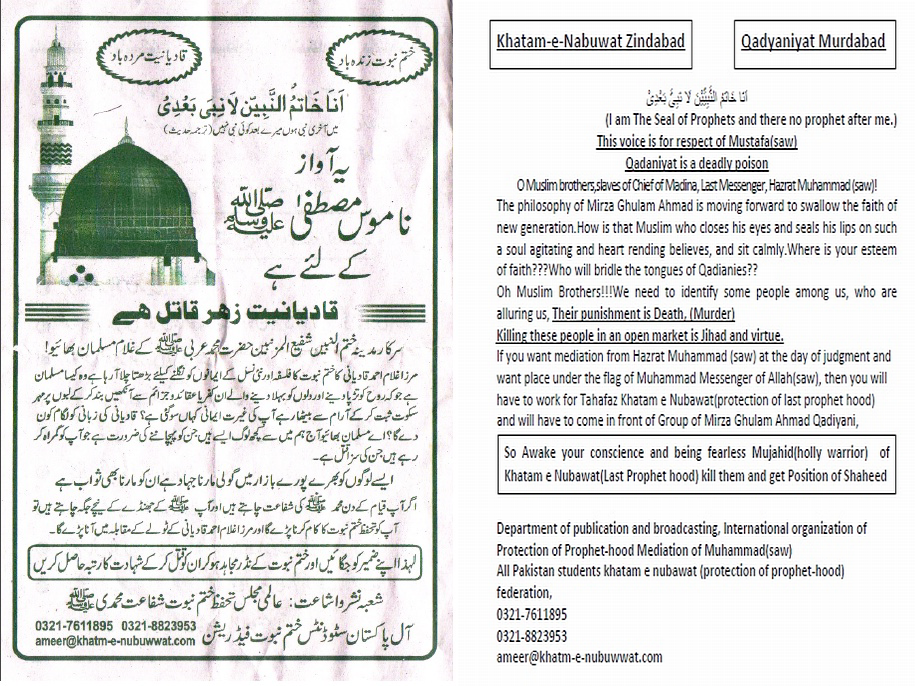
Freedom of ReligionAhmadisAs in previous years, the spread of hatred against the Ahmadis continued. At least six Ahmadis were murdered because of their faith during 2008.
An anchorperson of a popular TV channel held a prime-hour discussion commemorating the 1974 amendment to the Constitution declaring Ahmadis as “not Muslims”. The programme ended with a verdict by a participating mufti, of an extremist school, that the Ahmadis deserved to be murdered for deviating from the view of the finality of the prophethood of the Holy Prophet (PBUH). Neither the TV channel nor the anchorperson was chastised by the government for the virulent broadcast. Following the TV discussion, three Ahmadis were shot dead in early September – Dr. Abdul Mannan Siddiqui in Mirpurkhas, Seth Yusuf, a Nawabshah trader, and Sheikh Saeed at his pharmacy in Karachi. (D, Sep 21)
In Lahore in late May the International Khatm-e-Nabuwwat Movement (IKNM) announced a moot to be held at the Aiwan-e-Iqbal. IKMN Ameer MPA Maulana Ilyas Chinoti added the moot would mark a hundred years of successfully countering Qadiyaniat. (N, May 23)
In Faisalabad in early June, a mob of 300 college students barged into the rooms of Ahmadi students, beat them up and threw their belongings out of their rooms. The boarders also stole valuables from the Ahmadi students. The Punjab Medical College (PMC) through a notification rusticated 23 Ahmadi students on the report of the disciplinary committee. It was alleged that they were preaching and distributing Ahmadi literature. (DT, Sep 9) The students suffered harassment and interruption in their studies for months before they were allowed to resume their studies. In Shabqadar, Charsadda district, local clerics refused to lead the funeral prayers for a man believed to be an Ahmadi. The local clerics issued a fatwa (decree) that the deceased had become an Ahmadi and, therefore, no one would lead his funeral prayers. (DT, Sep 23)
Recommendations- The blasphemy law was promulgated in 1985 and in 1990 the punishment under this law, which sought to penalise irreverence towards the Holy Quran and insulting the Holy Prophet (PBUH), was life imprisonment. In 1992, the government introduced death penalty for a person guilty of blasphemy. Immediate abolition of ‘blasphemy’ laws is needed as these provisions are often used against non-Muslims as well as Muslims to settle personal scores.
- School curriculum has to be sensitised toward non-Muslim Pakistanis so that children feel safe, secure and equal.
- The Ahmadis have been denied the benefit of the joint electorate system which was revived in 2002. The discrimination should be ended.
- The Commission on Minorities should be made functional by reinforcing its independent status and providing it with the necessary resources, human as well as financial.
Freedom of assemblyEvery citizen shall have the right to assemble peacefully and without arms, subject to any reasonable restrictions imposed by law in the interest of public order.Constitution of Pakistan
Article 16
Everyone has the right to freedom of peaceful assembly and association.Universal Declaration of Human Rights
Article 20(1)Freedom of Assembly
Ban on public gatherings……
On May 26, the district authorities in Jhang imposed a ban on the centenary celebrations of Jamaat-e-Ahmadia in Rabwah after Muslim religious organisations and clerics pushed the authorities to do so.
Political participationThe state shall encourage local government institutions composed of elected representatives of the areas concerned and within such institutions special representation will be given to peasants, workers and women.Constitution of Pakistan
Article 32
All human beings are born free and equal in dignity and rights. They are endowed with reason and conscience and should act towards one another in a spirit of brotherhood.Universal Declaration of Human Rights
Article 1
Challenges for women and minorities……
The ECP compiled a separate electoral roll just for Ahmadis, distinguishing them from the list of all other eligible voters in the country. In addition to outright religious discrimination, a separate list for Ahmadis completely disregarded the spirit of the joint electorate, the Constitution of Pakistan, and the guarantee of international human rights. As had happened in previous elections, the Ahmadis chose not to participate in the elections.
……
Appendix - IIHRCP standsMinorities / freedom of belief and religionJuly 2: HRCP has expressed its serious concern at the authorities’ failure to redress the grievance of the unlawfully expelled Ahmadi students of the Punjab Medical College, Faisalabad, and urged firm action against the trouble-makers. The rustication of 23 Ahmadi students early last month on the ground of their belief was apparently a case of extraordinary discrimination. HRCP therefore requested a senior member of its governing body to probe the matter. This inquiry shows that while rusticating the unfortunate students the college administration did not follow the rules prescribed for this extreme action; that the committee of teachers set up to examine the victims after the event included teachers who were in the body that had taken the decision to rusticate them; and that the few students who appeared before the investigating committee were unduly harassed and intimidated. There were also indications that some members of the faculty colluded with the Ahmadi-baiting trouble-makers. HRCP is therefore seriously apprehensive of justice being denied to the unlawfully expelled students. It calls upon the provincial and federal governments both to intervene immediately to protect the wronged students and deal firmly with hate-preachers and disrupters of peace because much more than the career of Ahmadi students is at stake.
Footnotes
- Article 260 (3) defines a “Muslim” and a “Non-Muslim”. A “Non-Muslim” is defined as a person who is not a Muslim and includes a “person belonging to the Christian, Hindu, Sikh, Budhist or Parsi community, a person of Qadiani group or the Lahori group (who call themselves “Ahmadis” or by any other name), or a Bahai and a person belonging to any of the scheduled castes”.
- Article 295 and 295-A
HRCP Website : http://www.hrcp-web.org/












 Posts
Posts


