Showing posts with label Pancasila. Show all posts

Wednesday, May 11, 2011

Islamic Hard-Liners Plan Massive Pancasila Rally

Jakarta Globe, Indonesia
HOME
Islamic Hard-Liners Plan Massive Pancasila Rally
Nivell Rayda | May 11, 2011

Cianjur, West Java. After failing to kick-start a revolution through massive protests echoing those in the Middle East this year, hard-line Muslim groups are now plotting an even bigger rally next month, this time claiming they have forged an unlikely alliance with nationalists.

Speaking from his home in West Java, Chep Hermawan, the leader of the Islamic Reform Movement (Garis), said that 40,000 protesters were expected to rally in front of the Presidential Palace in Jakarta on June 1.

“Basically everyone who is a staunch critic of SBY will be on board,” Chep said, referring to President Susilo Bambang Yudhoyono. “It will be like Cairo, where everyone who didn’t like Mubarak joined forces to topple a corrupt government.”

Chep named Sri Bintang Pamungkas, a Suharto-era political activist, and Andi Mapetahang Fatwa, a member of the Regional Representatives Council (DPD), as being among the nationalists who had expressed an interest in taking part in the rally.

“We plan on doing this on the anniversary of the Pancasila,” Chep said, referring to the state ideology first articulated by former President Sukarno on June 1, 1945.

Chep said Muslim groups were hoping to return the Pancasila to its original state, as outlined in the Jakarta Charter of June 22, 1945. The first principle of the Jakarta Charter, which was ultimately incorporated into the preamble of the constitution, was the “obligation for all followers to observe Shariah law.” It was later changed to “Belief in the one and only God,” by then-Vice President Mohammad Hatta.

“We want the Pancasila to return to its original state,” Chep said. “We don’t reject the Pancasila, rather we want to restore it to its intended purpose.”

The protest, Chep added, would also cover other topical issues. “Basically our plan is to stage a rally that appeals to all, not just Muslims,” he said. “We have been talking with the nationalists and they agreed to join our rally, but they will be pushing labor issues, agricultural reform and so on.”

Demonstrators, he said, would also demand the dissolution of Ahmadiyah, a minority Islamic sect considered deviant by mainstream Muslims.

In February, a massive rally by hard-line groups demanded Yudhoyono issue a decree banning Ahmadiyah, threatening a revolution if he failed to do so by March 1. Nothing has happened since the deadline passed.

Chep blamed a lack of coordination and funds for the failure of the February protests.

For the June protest, Chep said that meetings had been, and would continue to be, held with leaders of opposition parties and former presidential candidates, asking them for political and financial support. “I have also prepared Rp 2 billion [$234,000] to finance the rally in the hope that opponents of the government will be convinced to invest as well,” Chep said.

Executives of the hard-line Islamic Defenders Front (FPI) and the Islamic People’s Forum (FUI) said they had not yet heard of the plan.

Copyright 2010 The Jakarta Globe
URL: www.thejakartaglobe.com/news/islamic-.../440537

Sunday, August 22, 2010

Ahmadiyah Members See Their Civil Rights Trodden Upon

Jakarta Globe, Indonesia
Jakarta
Ahmadiyah Members See Their Civil Rights Trodden Upon
Nivell Rayda | August 22, 2010
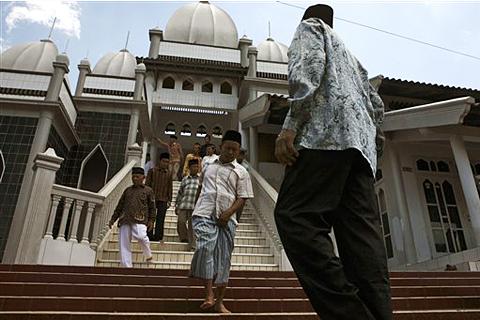
Ahmadiyah members leaving their mosque after Friday prayers in Manis Lor village in Kuningan, West Java. The mosque has been at the center of protests by hard-line Muslims groups from the area. (AFP Photo/Yonda)
Jakarta. Weddings in Indonesia often are elaborate feasts with at least 500 guests and the best food and drinks money can buy. But this wasn’t the case for 21-year-old Nur (not her real name).

Nur is a member of the controversial sect of Ahmadiyah, considered by many to be outside of mainstream Islam. Her wedding took place in secrecy and was attended by only six people — three members of her family, and three from her husband’s.

Although there is no formal instruction from the Ministry of Religious Affairs, there seems to be an unspoken rule prohibiting Indonesia’s Religious Affairs Office (KUA) from marrying a couple from the Ahmadiyah sect.

When she was applying for a marriage license, Nur was sent all over West Java, from one KUA office to another. “Like all brides and grooms from my village, I had to go to different districts [before I could] get my marriage license. We were asked to change our residency to the district [where we could get married], but we needed to have a sponsor living there before we could change our ID card,” Nur told the Jakarta Globe.

“I begged and I begged. Thankfully, because of the goodness of one KUA official, we were eventually able to get married. But everything had to be done in secrecy.”

After six months, the KUA official called Nur’s family to say it was safe to choose a venue and perform the wedding ceremony. A small mosque far away from the issuing KUA office was chosen to avoid detection.

But Nur was told not to hold a wedding reception. “But if we insisted, it had to be held months after the actual marriage, again to avoid detection,” she said.

“The official that oversaw our wedding could get into trouble if we did [get detected] and that would mean every Ahmadiyah couple after us could forget about getting married.”

Marriage is only one of the things made more difficult for members of Ahmadiyah, decreed a deviant sect in 2008 after mounting pressure on the government from mainstream Muslim organizations. Though the decree stopped short of banning the sect completely, it banned its members from publicly practicing their faith and spreading their beliefs, or proselytizing.

Not Always an Issue

Members of Ahmadiyah, founded in India in 1889, hold that the group’s founder, Mirza Ghulam Ahmad, was the last prophet, a belief that contradicts a tenet of Islam that reserves that position for the Prophet Muhammad.

But the sect wasn’t always a religious pariah.Ahmadiyah once lived in harmony with other Muslim groups. It traces its roots in Indonesia to 1925, when two Muslim scholars in Sumatra began spreading their beliefs upon their return from their studies in India.

Separately in Yogyakarta in 1929, several former members of the mainstream Muhammadiyah organization established their own Ahmadiyah group. This group, however, adopted a less controversial view already popular in Lahore, Pakistan, which maintains that Mirza Ghulam Ahmad was not a prophet but a reformer of Islam.

In 1953, the Indonesian government acknowledged Ahmadiyah as an Islamic organization, and it ranks of followers grew.

For the most part, the government managed to suppress calls for the Ahmadiyah to disband, though in 1980 several mainstream Muslim groups decided to consider the sect both deviant and blasphemous.

It was not until the end of former President Suharto’s regime, in 1998, that mainstream Muslim groups began to actively call for a prohibition of the sect.

After former President Abdurrahman Wahid — seen by many as a champion of religious tolerance — stepped down in 2001, the call intensified and the sect became the target of violent actions.

In 2005, the nation’s leading Islamic authority, the Indonesian Council of Ulema (MUI), issued a fatwa, or religious edict, against Ahmadiyah, calling its teachings blasphemous and deviant.

The increasing tension eventually led to the joint issuance of the 2008 decree by the Religious Affairs Ministry, the Home Affairs Ministry and the Attorney General’s Office.

Endless Intimidation

Zafrullah Pontoh, the president of the Indonesian Ahmadiyah Congregation (JAI), said that while the decree was a form of oppression directed against the estimated 600,000 members of the sect, it still left room for multiple interpretations.

“Members of Ahmadiyah face constant harassment both from the government and members of the public,” he said.

“The longer the government stays quiet about this, the harsher the intimidation against Ahmadiyah members.”

In February 2006, thousands of mainstream Muslims in West Nusa Tenggara province burned homes belonging to Ahmadiyah members in West Lombok district. The incidents left as many as 137 people homeless, all of whom had to be escorted by police officers to a temporary shelter in the provincial capital, Mataram.

Four years after the incident, more than 40 Ahmadiyah families still live in the shelter without electricity or any certainty about whether they will be able to return home. Most are traumatized and fear a repeat of the incident.

“Some families insisted on returning home to their village, although they know that police and the government have refused to vouch for their safety if they do,” Saeful Uyun, secretary of the provincial chapter of the JAI, told the Globe. “The conditions in the shelter are unbearable to some, so many have reluctantly ventured to other cities and provinces.”

Saeful added that one of the countless forms of discrimination that members of Ahmadiyah in Mataram had to endure was the fact that the local government had been refusing to grant members of the sect ID cards that are obligatory for all Indonesian citizens.

Without an ID card it is almost impossible for the Ahmadiyah members — having already lost virtually all their belongings in the attack — to apply for jobs, obtain a driver’s license or a passport for the Hajj pilgrimage.

“The city of Mataram refuses to give the refugees ID cards because officially they are listed as residents of West Lombok district, while the district argues that they should apply for Mataram residency because they have been living in Mataram for years,” he said. “They are left in limbo over their status and fate.”

For Ahmadiyah members in Manis Lor village, in Kuningan, West Java, the threat of violence returns almost every year. It comes from the local government and hard-line Muslim groups, both seeking the closure of an Ahmadiyah mosque and seven prayer facilities, or musholla, in the village.

“It seems like there is an agenda every year just before Ramadan to scare us off,” said Nurahim, the secretary of the An Nur Mosque in Manis Lor. “This is our home. The Ahmadiyah have existed in Manis Lor since 1953. We will fight for our rights until the end.”

Violent scenes erupted between July 26 and 29 in Kuningan when hundreds of police and public order officers tried to seal off the mosque and musholla.

The closures were met with resistance from members of the sect, with protesters blocking attempts to shut down the facilities. But a number of hard-line Muslim groups soon flocked to the village carrying wooden planks, knives and slingshots, and scuffles quickly broke out.

Nurahim said that the July confrontation was fairly minor compared to a 2006 incident in the village, when dozens of Ahmadiyah members were left heavily injured after being pelted with rocks and beaten.

Muslim Sect or Other Religion?

Witnesses have singled out the hard-line Islamic Defenders Front (FPI) as the force behind the string of attacks in Kuningan.

The FPI was also believed to be behind another attack on an Ahmadiyah mosque in Surabaya, East Java, on Aug. 9.

Around 200 people rallied in front of the mosque at that time, demanding the government shut it down. They ended up vandalizing the mosque by dismantling the signage at its gate.

Muhammad Shobri Lubis, an FPI leader, did not deny that members of his organization had participated in the attacks. “Even if they did attack an Ahmadiyah member it was because the FPI was provoked,” he said.

“The Ahmadiyah are a menace. Their members are hard-headed. They refuse to follow the MUI fatwa. They have also ignored calls from the government to cease their activities. We are merely urging them to respect the government, to respect Islam, the Koran and the Hadith [the narrated teachings of the Prophet Muhammad].”

Malik Madani, one of the leaders of Nahdlatul Ulama, the largest Islamic organization in the country, said that although the NU believed in peaceful dialogue to resolve differences with the sect, the organization’s standpoint was that Ahmadiyah should not be seen as an Islamic sect, but as a religion distinct from Islam, as is the case in places like Pakistan.

“People are anxious because most within the Muslim community feel that Ahmadiyah has disgraced Islam and the Prophet Muhammad. Muhammad is the final prophet and there is no negotiating that,” Malik said.

“The longer Ahmadiyah is allowed to practice its faith, the more the Islamic ideals and fundamentals will suffer.”

‘Muslims Just Like Us’

But Nuniek Susilowati disagrees. Although not an Ahmadiyah member herself, she lives in close proximity to the Ahmadiyah community in the Kebayoran Lama area of South Jakarta. She said that as a mainstream Muslim, she never felt that Ahmadiyah’s religious activities were disgracing her faith.

“They’re quite friendly and open about their beliefs. In fact, they are quite generous. They participate in a lot of community activities and social occasions. You can ask anyone here, they’re not troublemakers,” she said.

Ahmadiyah members in Kebayoran are a clear minority. The Ahmadiyah mosque there is completely surrounded by residents adhering to mainstream Islam. Just a few meters from the mosque is a secretariat of the Betawi Community Forum (FBR), which is considered by many to be an organization of very conservative and devout Muslims.

Nuniek also dismissed claims from hard-line Muslim groups that Ahmadiyah members performed different prayer rituals.

“Growing up, I was told that Ahmadiyah had a different version of the Koran, that their prayers were different, that their adhan [call to prayer] was different and that they didn’t believe Muhammad was a prophet. None of it is true,” she said.

“When I first moved here, I prayed at their mosque by mistake. My husband scolded me and told me that I had just prayed at a mosque of infidels. But after a while, I noticed that there were no differences. They’re Muslims just like us. Since then, I’ve often prayed at their mosque even though I’m not a member.”

Bonar Tigor Naipospos, deputy chairman of the Setara Institute for Peace and Democracy, said that Ahmadiyah members in major cities faced less intimidation than those in remote villages across the country.

“Mainstream Muslim groups in the rural areas have a more conservative and narrower view of Ahmadiyah. They hold greater prejudices toward Ahmadiyah because of their lack of understanding of the sect,” Bonar said.

Witnesses alleged that those attacking the Ahmadiyah mosque in Kuningan were not locals, but came from Cirebon in West Java, and places as far as Ponorogo in East Java. Those who burned down houses of the Ahmadiyah community in West Lombok are said to have come from the adjacent district of Central Lombok.

“Those who live in close proximity to Ahmadiyah members and those who often interact with them know that they’re just like other Muslims,” Bonar said.

Government (In)action

Nasarudin Umar, the Religious Affairs Ministry’s director general of Islamic affairs, claims that although the government no longer recognizes Ahmadiyah as part of Islam, Indonesia protects the human rights of the sect’s members and their privileges as Indonesian citizens.

“The government certainly never bars Ahmadiyah members from marrying at the KUA nor does it deny their rights as citizens, such as the right to obtain an ID card, to receive education and health care and to hold public office. The Religious Affairs Ministry even helps them if they want to perform the Hajj pilgrimage,” Nasarudin told the Globe.

“As far as intimidation goes, the government always tries to protect Ahmadiyah members’ civil rights. The government always prevents violence from escalating and facilitates peaceful talks between members of the sect and the wider Muslim population.”

These statements, though, do not seem to reflect the situation on the ground, as Ahmadiyah members in Lombok and Kuningan said that police were at the scene when the violence broke out but did very little to bring the situation under control.

Andreas Harsono, a representative of Human Rights Watch in Indonesia, said that there had never been any police investigation into the alleged human rights abuses against Ahmadiyah members or any record of the perpetrators being arrested.

“Ahmadiyah members in Lombok lost their homes and some were beaten until they were seriously injured. I know of one man in Lombok who was left permanently crippled from the injuries he sustained,” Andreas said.

“There are witnesses to the attack, the evidence is there, but the police have never arrested anyone. The same goes for the attacks against Ahmadiyah members in Garut, Bogor and Kuningan.”

Setara’s Bonar said the government itself was discriminating against Ahmadiyah members. He said his institute had discovered instances where Ahmadiyah members were dismissed from public office or discriminated against at public schools.

Siti Hafizah, a member of Ahmadiyah in Kuningan, said that because of her beliefs she was discriminated against during her high school years, particularly during classes on Islamic studies.

One of her teachers, Siti said, discovered that she was from Manis Lor, where 90 percent of the 4,500 residents are members of Ahmadiyah.

“I wasn’t allowed to participate in classes unless I denounced my beliefs and embraced mainstream Islam,” she said.

“All I could do was cry at the library each time we had a class on Islamic studies. Thank God my parents intervened so that I could at least take the tests. But still, although I knew I did well during the tests, the teacher kept giving me bad grades.”

Other Ahmadiyah students said that they were not allowed to take their final examination (part of the National Final Examination, or UAN) in the subject.

Legitimized Hostility?

Bonar said attackers have always been able to use the 1965 Blasphemy Law to legitimize hostilities against Ahmadiyah.

“Clearly the law, which is out of date and no longer relevant in today’s world, is being utilized as a weapon. The law creates an opportunity for the attackers to intimidate Ahmadiyah members and take the law into their own hands,” Bonar said.

The law forbids blasphemy and desecration of religions. Violators face lengthy jail terms.

Several groups have challenged the law and filed for a judicial review with the Constitutional Court, arguing the law is contradictory to the Constitution, as the latter guarantees freedom of worship. However, the court in April rejected the motion to annul the law.

Human Rights Watch said the government should annul both the Blasphemy Law and the 2008 joint decree against Ahmadiyah.

“Indonesia is a secular state and the government should not make laws and regulations that inhibit religious freedom. The Indonesian Constitution makes it clear that it is the government’s job to ensure that all citizens can exercise their religion freely,” Andreas said.

Bonar added that the only way to end the ongoing discriminatory acts against Ahmadiyah was for the government to enforce the rule of law. “The government must ensure impartial legal treatment and human rights protection for all citizens,” he said.

Copyright 2010 The Jakarta Globe

Tuesday, August 10, 2010

‘Politically Motivated’ Anti-Ahmadiyah Sentiment Growing in West Java

Jakarta Globe, Indonesia
Jakarta
‘Politically Motivated’ Anti-Ahmadiyah Sentiment Growing in West Java
Ulma Haryanto & Nurfika Osman | August 10, 2010

Garut, West Java. Iin, a resident of Cikedu village in Garut, West Java, said on Monday that she vividly recalled the third and last time she was harassed by officers from the local Indonesian Council of Ulema (MUI).

Iin told the Jakarta Globe on Saturday that she was forced by MUI officers, who were also accompanied by local residents, to sign a statement and recite the Syahadat, the Muslim declaration of belief in one God and in the Prophet Muhammad, or “face the consequences.”

That would have been fine for Iin had the 51-year-old not been a member of the Ahmadiyah Muslim community, which has been the target of a recent wave of attacks and discrimination in predominantly Sunni Indonesia.

“I was confused. If I agreed to sign, then I would be defying my own faith. If I refused, then I would be a constant target of the people’s wrath,” Iin said.

The Ahmadiyahs in her village reported the case to local police. But that did little good.

“They told me that my village was just too far away. But it’s just a kilometer away from the administration ward.”

Cecep Ahmad Santoso, chief of the Ahmadiyah congregation in Garut, said that this type of persecution was all to common an occurrence in the area.

A 2008 joint decree issued by the Religious Affairs Ministry, the Home Affairs Ministry and the Attorney General’s Office is often used as the very basis for the persecution, Cecep said.

The decree states that Ahmadiyah followers should desist from conducting acts that “violate Islamic principles.”

This follows an effort by local government administrations and the MUI to have the Ahmadiyah sect officially banned.

But the statements made by Iin and Cecep, coming just days following an attack on Ahmadiyah sect members in Kuningan, West Java, show that the rhetoric and finger-pointing is becoming increasingly heated.

Ichwan Sam, the secretary general of the MUI, said that when it came to the Ahmadiyah, the stance of the MUI was clear.

“Ahmadiyah is not Islam. The Ahmadiyah are haram [forbidden] as they deviate from the original Islamic values and teachings. They have their own Koran, which is not acceptable, and they also think that Prophet Muhammad is not the last messenger,” Ichwan said.

A report released on Monday by the Setara Institute for Peace and Democracy highlighted a worrying and rising trend of persecution and discrimination against Ahmadiyah followers, particularly in the West Java districts of Tasikmalaya, Bogor, Garut and Kuningan.

“We concluded that all incidents had telling political motives. During elections, candidates for district head announces publicly that they would disband the Ahmadiyah if they were elected,” said Institute researcher Ismail Hasani, who has been monitoring Ahmadiyah affairs for the institute since 2007.

“This year alone, 19 acts [of persecution] have occurred against the Ahmadiyah sect. Last year there were 33,” Ismail said.

Copyright 2010 The Jakarta Globe

Monday, August 9, 2010

Sectarian Clashes Are Tearing Us Apart

Jakarta Globe, Indonesia
Opinion
Sectarian Clashes Are Tearing Us Apart
Nicholaus Prasetya | August 09, 2010

The signs for religious harmony in Indonesia have not been comforting of late. On Sunday, there was another attack on a small Christian congregation in Bekasi, part of a pattern of attacks in the area linked to the Islamic Defenders Front (FPI) and designed by the group to prevent supposed “Christianization.” Two weeks ago, the hard-line Betawi Brotherhood Forum (FBR) clashed with local groups in Rempoa, South Jakarta. In Kuningan, West Java, the Ahmadiyah sect has been the target of another wave of attacks by supposed purists enforcing religious correctness.

It seems to be getting harder to settle differences here peacefully.

A multitude of tribes, religions and ethnic groups make up Indonesia.

This is the reality that gave rise to Pancasila as the founding principle of the country and an expression of unity and a hoped-for utopia of religious diversity.

This utopian principle now finds itself under attack by intolerant attitudes and also miscommunication between different tribes, religions and ethnic groups.

Instead of communicating with each other, they seem to want mass organizations and pressure groups to enhance their exclusiveness, in the process fragmenting Indonesia.

There are two questions to discuss. First, is achieving true religious and cultural peace nothing more than a utopian and impossible dream?

Second, is Indonesia now witnessing the death of Pancasila and the finishing off for good of our national motto, Bhinneka Tunggal Ika (Unity in Diversity)?

Communication — or miscommunication — is obviously one of the many aspects of this crisis. In any given situation, it can ease tension, mediate conflicts or just make things worse.

The philosopher Jurgen Habermas said that as long as we freely communicate with each other we will one day agree across religious and secular lines about what true values are and how to deliver them.

This obviously involves allowing the values of one’s religion to be freely expressed while respecting the views of others.

Sadly, as we see from these recent incidents, there is a wide gap between those who are in conflict. Their exclusiveness has become a defining characteristic.

Hard-line groups, which seem to feel that their principles are the “right” ones and the others are “wrong,” should be abolished.

In fact, these conflicts could be eased by better communication and dialogue in an atmosphere of mutual tolerance and respect.

Unfortunately, this has been lost and the widening divide between opposing groups cannot easily be bridged.

The reason for the hardened lines are the rejection of dialogue and the inability to keep tempers in check — as long as these attitudes exist, real communication is impossible.

Given the dire risks to a society founded on an ancient principle of tolerance (Bhinneka Tunggal Ika has its roots in ancient Javanese culture) it is imperative that organizations prioritize communication instead of holding to presumed ideals that only lead to more conflict.

Beyond communication, there is the role of Pancasila and Bhinneka Tunggal Ika in the life of mass organizations.

These should form the basis of unity and organization.

Their purpose is not to restrict or impede the democracy that has been developing in Indonesia, but instead to prevent the country from fragmenting.

Indonesia’s founding fathers built this nation to ensure its firm foundation as a state, not to see it disintegrate into quarreling factions.

With both Pancasila and Bhinneka Tunggal Ika, they tried to engage society as a whole.

The warnings of former President Sukarno that our main struggle might be internal seem to be coming true. This is happening, as the clashes and tensions clearly show.

Since there are no longer any colonizers to blame, Indonesians attack and kill other Indonesians.

“The principle of live and let live and our motto, Unity in Diversity, are the unifying forces that bring us all together,” Sukarno said during a conference in 1955.

The country’s founding president called for “friendly, uninhibited discussion, [and] ways and means by which each of us can live his own life, and let others live their own lives, in their own way, in harmony, and in peace.”

We are forgetting the meaning of such words. The religious conflicts tearing at the fabric of society clearly show that Bhinneka Tunggal Ika is losing its essence and Indonesia risks being torn apart.

It is imperative that mass organizations use Pancasila and Bhinneka Tunggal Ika as living and guiding principles, not just as state emblems or subjects to be memorized by schoolchildren.

In this conflict, the Indonesian government cannot avoid responsibility.

The government needs to have the courage to act decisively and to disband those mass organizations that make chaos and base their brutal actions on views that contradict Indonesia’s founding basic principles.

Unfortunately, the current reality is that the government lacks the will to take these steps.

Often, destructive organizations are not banned, and indeed have been able to flourish under our democratic framework.

But democracy in Indonesia needs to be guided by good communication and the framework of Pancasila — something currently lacking.

If the government cannot take responsibility for stopping these religious and sectarian clashes, speculation will continue to grow as to whether the government is encouraging organizations like the FPI to sow chaos.

If the government does not want this kind of speculation, it must act to protect minorities who suffer persecution and to punish groups that oppress others.

In addition, being decisive in enforcing the rule of law, the government should also be a mediator and facilitator of dialogue and understanding in order to stop these destructive clashes before they happen.

Nicholaus Prasetya is a student at the Bandung Institute of Technology.

Copyright 2010 The Jakarta Globe
Monday, August 2, 2010

West Java Ahmadiyah Mosque Attacks Expose Deep Institutional Shortcomings

Jakarta Globe, Indonesia
Opinion
August 2, 2010
West Java Ahmadiyah Mosque Attacks Expose Deep Institutional Shortcomings
.
Last week’s attacks on Ahmadiyah Muslims in West Java reveal once again the terrible consequences citizens suffer when the state interferes in religious disputes.

The Kuningan district head’s order to close down Ahmadiyah mosques was, of course, against our Constitution.

However, it was arguably in line with a 2008 government decision that effectively banned Ahmadiyah from worshiping in public or proselytizing, while stopping short of outlawing the sect completely.

Yet like any other Muslim, an Ahmadiyah follower is obliged to spread the light of Islam through speech and actions — and that means proselytizing.

Therefore, the government’s decision, made under pressure from religious groups, is an oxymoron: it directly interferes with the right of a follower of Ahmadiyah to practice his or her faith.

As a blatant affront both to the Constitution and Pancasila, the national doctrine of unity, it should never have been passed and should be scrapped immediately.

Moreover, the parties responsible for curbing Ahmadiyah’s religious freedom should face serious charges in court.

Leaders like Aang Hamid Suganda, the Kuningan district head, should be seriously reprimanded for inciting violence by meddling in religious affairs.

If only we could only trust our courts to fairly dispense justice, we could drag such leaders before a panel of judges to face charges of treason against Pancasila and the Constitution.

Charging an official with treason and bringing a district head to court might sound rather harsh. It is not unreasonable, however.

Stern measures are required because the government needs to send a clear message about its position regarding religious tolerance in our pluralistic society.

At the time of independence in August 1945, our founding fathers wisely rejected calls from Islamists for every Indonesian Muslim to be obliged to follow Shariah law, as stated in the Jakarta Charter.

Instead, our leaders settled on the state ideology of Pancasila, which respects many religions and formally elevates none above others.

Unfortunately, however, a compromise was made with established Islamists in the Ministry of Religious Affairs, and ever since we have been paying dearly for that folly.

Although there has never been a transparent audit to reveal which institution is the nation’s most corrupt, the Ministry of Religious Affairs is certainly high on the list.

Because it organizes the hajj pilgrimage and people can compare ticket and accommodation prices, everyone can see how the ministry has cruelly hiked up hajj costs to squeeze money from pilgrims who have saved their pennies for a lifetime just to make the trip to Mecca.

What worse representation of Islam could our state support?

This means it is futile to suggest that the government uphold the Constitution on this issue, let alone scrap the Ministry of Religious Affairs anytime soon.

However, we can still hope that in the future we may have people in government who are confident enough in their own commitment to the Islamic faith to dismantle this useless ministry and deal evenhandedly with all religious groups in Indonesia.

Our founding president, Sukarno, was an eloquent and progressive Islamic polemicist in his youth.

But during his time in office he never hesitated to uphold Pancasila when facing armed attempts to create an Islamic Indonesian state under the banner of Darul Islam, the descendants of which remain active to this day.

Sukarno’s successor, Suharto, who had a background in Muhammadiyah, manipulated Islamists to purge the communists and sailed into power on the sea of blood they created, only to later cruelly suppress political Islam until his own interests obliged him to court it again.

Significantly, the late President Abdurrahman “Gus Dur” Wahid, who was himself a respected Islamic scholar as head of Nahdlatul Ulama, has been our best champion of peaceful Islam and our sanest bastion against violent Islamism to date.

Apparently, leaders who feel insecure in their own Islamic faith fear being perceived as not sufficiently devout. Thus, they overcompensate in their efforts to appear “more Muslim than thou.”

On the other hand, Gus Dur never hesitated to stand up against those who would do away with Pancasila and implement a harsh version of Shariah law here, even when he was accused of being a pawn in a “Jewish conspiracy” to destroy Islam.

We should be grateful that Gus Dur’s brave pluralist spirit is still present today.

As extremists attack Ahmadiyah in West Java, Nuruzzaman, the head of the Cirebon chapter of the Ansor Youth Movement, NU’s militia organization that is known to be loyal to the ideals of Gus Dur, has vowed to mobilize thousands of its men to protect Ahmadiyah from attack.

Nuruzzaman’s willingness to defend the Constitution against violent mobs who falsely claim to represent mainstream Islam is certainly noble, but it exposes a darker problem.

The state itself has been too slow in reacting to these and other blatant attacks.

When civilians feel obliged to come forward to uphold Pancasila with force, this opens further divisions that can easily disintegrate into still more sectarian conflict.

Radical Islamists who use violence to enforce their will are enemies of all sane Indonesians, whether they attack Christian churches, Ahmadiyah mosques or gay and lesbian activists.

But it should be the police who stand up to them, not the Ansor Youth Movement or other civilian bodies.

However, the police are preoccupied with attempts to mask their own corruption and incompetence.

Thus, much ado is made about frivolities like homemade celebrity porn. The dismal reality is that citizens cannot depend on law enforcers for security.

Lasting peace among religious groups here demands clean and honest institutions and not just courageous individuals.

Bramantyo Prijosusilo is an artist, poet and organic farmer in Ngawi , East Java.

Copyright 2010 The Jakarta Globe

Friday, May 21, 2010

A ‘difficult marriage’: Sharia and civil law in Indonesia

---The Jakarta Post, Indonesia
Opinion | Fri, 05/21/2010 11:09 AM

A ‘difficult marriage’: Sharia and civil law in Indonesia

Muhamad Ali, Riverside, California

Why do the state and civil society find it so difficult to negotiate whether to implement the sharia or civil law in modern pluralistic Indonesia?

The state continues to function as the legitimate power to produce laws in which the sharia contributes and must adjust to in the Muslim majority, yet pluralistic, nation.

The tensions and negotiations result from a long history of encounters between global and local cultures in the Indonesian archipelago.

During the late colonial era, the world’s economy and capitalism led to the emergence of socialist, nationalist and Islamic organizations.

Pan-Arabism, and pan-Islamism tried to penetrate the Indonesian market of ideas through returning students, teachers and books, but they were unsuccessful. Instead, localized, Java-based organizations were established – with Islam as their spirit and ethic rather than political ideology.

The Republic of Indonesia adopted and adapted centuries of such different types of influences in making laws. The government and the people’s representatives continued to regulate differences based on various and changing communal markers, particularly ethnicity, class and religion.

With the end of the Caliphate system in 1924, Muslims and non-Muslim minorities endorsed the modern nation-state. The earliest debate was about whether or not Islam would become the Constitution.

Thus, the controversy of the Jakarta Chapter emerged about whether or not the Constitution includes the obligation of Muslims following sharia.

Indonesians see law as both the principle and mechanism to managing pluralism and ensuring order, but at the same time, law becomes a site of contentious discourse involving the governments and civil society.

Law and order are closely intertwined, but disorder and sometimes violence have also become part of legal discourse and struggle.

Indonesia’s legal pluralism is manifested primarily from three schools: The Roman Dutch colonial law (although the Dutch later subscribed to French civil law), orally passed down cultural law (adat, customary law), and Islam – predominantly Sunni and Shafi’i. Because Islam does not provide detailed legal procedures, the Dutch derived civil law has become the main source for such procedures.

Sharia at first dealt primarily with some domestic matters, such as marriage, divorce, and inheritance.

Gradually, sharia-minded Muslims sought to incorporate more into the Islamic legal system, including the sharia court (parallel with the civil court), the zakat form of tax collection and distribution, pilgrimage and interest-free banking.

Decentralization – after 32 years of central government control, has lead some regencies to enact Islamic-based bylaws, concerning dress codes, gambling, drugs, and moral issues.

The debates on the formalization of Islamic law at the national and local levels reflect ever increasing influences of global ideas, including with the Iranian revolution, the global movement of caliphate, global Islamic movement for anti-neo-imperialism and neo-liberalism, and more recently the global sentiments of anti-American colonialism in the Middle East.

However, the manifestation of such global ideas remains within the local and national constraints. In the autonomous province of Aceh, for example, due to its unique history, the central government has allowed it to pursue the formalization of Islamic Law.

They have regional law dealing with various aspects of private and public lives of Muslims, excluding non-Muslims.

The sharia council and morality police oversee and restrict people’s prayers, fasting, gambling and sexual relations. The codification of the local law, Qanun, which deals with the Islamic court includes appropriates types of punishments and fines for each infringement.

The Qanun stipulates that non-Muslims, although not subject to Islamic law, shall respect the implementation of the Islamic Law in Aceh.

The Acehnese local rules dealing with heresy, blasphemy and apostasy indicate the increased influence of the religious authority in con-trolling the faith of the people, in the hope for religious conservatism and social order, but without necessarily considering the rights of minorities and the Indonesian Constitution.

The classical and medieval concept of the dhimmi (non-Muslims living in a sharia state but experience restricted rights) has been revived by some, but the idea is seen not realistic.

There are some Islamic movements who see the Constitution of Medina as the model for a pluralistic, tolerant state. That being said, the histories of prophet Muhammad and Indonesian Muslims are different.

Others point to Islamic medieval Spain when talking about coexistence of Muslims, Christians and Jews, but the still unresolved Israeli-Palestinian conflicts and local interfaith tensions overshadow the spirit of harmony.

The persistence of the State Ideology of Pancasila and the 1945 Constitution, which up until this day show how world ideologies (monotheism, humanism, nationalism, democracy and socialism) have their strengths and are relevant to nation building.

The Constitution, which guarantees religious freedom (despite its definition and limits having been contested), provides Indonesians with a basis for justifying their actions toward one another.

In the courts, political speeches, scholarly statements, leaders and people attempt a balancing act: Indonesia being neither an Islamic state, nor a purely Western type secular state; is instead a state of Pancasila, which guarantees freedom of religion, but supports religious development of the population.

The Council of Islamic Scholars, for example, have issued fatwas on minority group, which are not legally binding but are often heard by many.

The Council has, for example, issued fatwas condemning religious pluralism, liberalism and secularism by their very definitions (pluralists believe all religions are equal, liberals use reason over revelation and secularists separate the worldly from the religious).

They also condemned the Jamaah Ahmadiyah sect as heretical, sparking tension and violence against its followers in different parts of Indonesia.

The Constitutional Court’s recent rejection of a judicial review of the 1965 Blasphemy Law, reveals the the persistent mentality that religious differences may still have the power to cause social disorder.

Religious interpretations are subject to law, offering a sense of security. Some say, however, that Indonesia is neither an Arab nor a Western country. Tensions remain between outright Arabization, Westernization, and Indonesianization.

For most, the formalization of Islamic law is against Pancasila and the Constitution. Others argue the Koran has substance and ethics, not details about the kind of governance.

Others suggest that categorizing Muslims as the majority and others as minorities will lead to a lack of diversity among Muslims themselves.

Religion, nationalism and globalization often experience tensions in ways that prophet Muhammad himself and Muslim caliphs never anticipated.

The writer is an assistant professor at the School of Religious Studies, University of California, Riverside.

URL: www.thejakartapost.com/news/2010/05/21/a-%...aw-indonesia.html

Friday, June 26, 2009

Perspectives of Major Media Outlets Reflect Country’s Pluralism, Study Says

---Jakarta Globe, Indonesia

June 25, 2009

Ismira Lutfia

Perspectives of Major Media Outlets Reflect Country’s Pluralism, Study Says

Despite a study showing that five national publications had strikingly different perspectives when it came to reporting on Ahmadiyah and the antipornography bill, the general feeling is that the country’s media is a healthy example of the how the press works in a pluralistic society.

“It’s inevitable that the media would project differing perspective as they were formed in a pluralistic society,” journalist Aristides Katoppo said on Thursday.

“No media exists whose participants are homogenous.”

A team of five researchers from the Habibie Center, who presented their findings during the launch of a book, “Pluralism Issues in Media Perspective,” chose the controversial Ahmadiyah Muslim community and anti- pornography bill as representations of pluralism in the country because they sparked polar opposite views, which the media itself contributed in shaping.

The study analyzed how weekly news magazines Gatra and Tempo, and dailies Kompas, Media Indonesia and Republika framed the two issues by their choice of sources and words in their reports.

“These five media outlets are aspects of the plurality in our society,” Sumarno, one of the researchers, said in his presentation, adding that the media members had different views in framing the news and presenting the facts.

He said Kompas, Media Indonesia and Tempo tended to quote news sources that were against the antipornography bill and supported Ahmadiyah’s existence, while Republika took the opposing stance but with a similar approach. Gatra displayed a more impartial view on both issues.

Sumarno said that the main message conveyed by Kompas, Media Indonesia and Tempo was that to deny Ahmadiyah its right to exist violated the Constitution and was an abuse of human rights, while passing the antipornography bill would limit freedom of expression and discriminate against women.

“Republika viewed Ahmadiyah as blasphemous and therefore pushed the government to take a stand against it,” said Afdal Makkuraga Putra, a fellow researcher, adding that the paper saw the antipornography bill as an attempt to protect women.

“Their choice of words reflected the news perspective that they represented,” Afdal said.

A. Makmur Makka, communications director at the Habibie Center, said that as an organization, each media establishment had its own distinctive characteristics, which were shaped by its audience and by its management.

“This is reflected in its editorial policies, so it is acceptable to be partial as long as the news report is written in good conscience,” Makmur said, adding that what was presented in a news report was a result of agreements between various interests in the newsroom.

“We can’t really label media outlets as pluralist or non-pluralist based on their perspectives on two issues,” he said.

Copyright 2009 The Jakarta Globe
URL: http://thejakartaglobe.com/ne...ys-pluralism-study-says/314490


Thursday, June 18, 2009

Indonesia: Debate Fails to Tackle Human Rights Issues


---Jakarta Globe, Indonesia
June 18, 2009
Editorial
Dozens of victims of human rights violations in 1965 rallying in front of the Merdeka Palace in Jakarta. (Photo: Afriadi Hikmal, JG)
Debate Fails to Tackle Human Rights Issues

Millions of Indonesians across the country would have tuned in on Thursday night to watch the first official presidential debate. The overall tone of the debate was civil and the three candidates were asked a range of questions. But on the most crucial issue, that of human rights and how the next government would deal with past abuses and ensure basic freedoms, none of the candidates addressed the questions squarely or adequately.

None of the candidates, for example, touched on the most fundamental human right — the right to freely worship one’s God. Our national ideology, Pancasila, enshrines the belief in one God and the right to worship one’s God without fear. This is a God-given right, but sadly neither the state nor previous governments have prevented church burnings or the open persecution of the Ahmadiyah sect.

Religion is at the very heart of our society. If we do not respect each other’s beliefs, how can we discuss human rights? This also applies to the how we treat women in our society. As long as women are not accorded full and equal rights, we have no starting point on this issue.

The second most important human right is the right to a secure life. Governments in the past have trampled on the lives of ordinary citizens through kidnappings and torture. It is the duty of the next president to provide hope and succor to ordinary citizens by creating good policies, displaying leadership and investing in infrastructure, education and health care. In a nutshell, to empower the people to create better lives for themselves.

Do we as a country excel in the promotion and protection of these human rights? Do our citizens feel safe and secure in their own country from their own government?

Human beings have several basic needs that must be met for a fulfilled life. These start from meeting physical needs, such as food and shelter, to feeling safe and secure, being loved and having self-esteem. Irrespective of race, religion, skin color and ethnic background, is every Indonesian proud to be an Indonesian?

In today’s Indonesia, unfortunately we do not have a Martin Luther King Jr. or a Kartini championing human rights. One of the worst perpetrators of human rights in this country has been the military establishment, and all three presidential candidates have direct or indirect links to the military. Susilo Bambang Yudhoyono is a retired general while the vice presidential running mates of both Megawati Sukarnoputri and Jusuf Kalla are former generals.

There is no denying this fact and it colors the whole debate over human rights. Two of the vice presidential candidates are connected to human rights issues that have not been resolved. If we are to move forward, we must resolve and account for what happened in May 1998, when innocent Indonesians were raped and murdered. No inquiry has been held and no attempt has been made at punishing the perpetrators, as well as those who fueled the violence.

Unless this issue is resolved, there can be no credible discussion on human rights. Educated Indonesians watching the debate will have made up their own minds.

Copyright 2009 The Jakarta Globe
URL: http://thejakartaglobe.com/opin.....ssues/313111

Monday, June 1, 2009

Indonesia: Religious politicization should be rejected

--- The Jakarta Post, Indonesia
The Archipelago Mon, 06/01/2009 12:58 PM
Religious politicization should be rejected

A. Junaidi and Slamet Susanto, The Jakarta Post, Bandung

Activists have called upon the nation to reject any politicization of religion aimed at replacing the Pancasila state ideology and threatening the country’s diversity.

While issuing a petition in Bandung on Saturday, activists from various civil society organizations also appealed against all kinds of violence justified in the name of religion, such as church closures and traditional rite banning.

The petition was issued at the end of a three-day meeting organized by the Unity and Diversity National Alliance (ANBTI).

ANBTI coordinator Nia Sjarifuddin said the West Java capital had been chosen as the location for the gathering because of the recent incidents of religious intolerance that took place in the province.

“We have an obligation to remind people to defend our united Indonesia based on diversity in terms of religions and cultures,” Nia said.

Several Christian houses of worships have been forcibly closed in Bekasi while in Depok, Mayor Nurmahmudi Ismail, who was nominated by the Islamist Prosperous Justice Party (PKS), annulled a building permit for a place of worship in the city.

Last year, several mosques across the country belonging to the Ahmadiyah Islamic sect - including in Kuningan, Parung and Bogor in the province - were sealed off and destroyed by Muslim militants. Several regencies in the province have issued bylaws requiring students and civil servants to wear Muslim attires on certain days.

West Java Goverrnor Ahmad Heryawan, who is also a PKS politician, recently asked Jaipong traditional dancers to be more “polite” when wearing their costumes and performing moves.

Nia said the activists also deplored the governor’s banning of cultural expression in the name of morality and religion.

“We also urge the state to ratify the convention on indigenous people and reject discrimination based on race, religion, gender and sexual orientation,” she said.

After the meeting, the activists, along with about a thousand of people, held parade to celebrate cultural diversity. Performing a variety of dances, they marched from the municipality building to the Bandung Lautan Api monument.

Constitutional Court Chief Mahfud MD admitted several bylaws had violated the Pancasila state ideology and the state Constitution.

“Many bylaws have deviated from the values of Pancasila and the Constitution, but so far, nobody has filed a judicial review on the bylaws,” Mahfud said in his opening speech at the three-day Pancasila Congress held at Gadjah Mada University, Yogyakarta, on Saturday.

Based on the Constitution, he said, the Supreme Court could conduct the bylaw review.

“But so far, the Supreme Court has not responded yet and people are not asking for a review either.”

Mahfud said many state officials, including local officials, did not abide by the Pancasila values when managing their administrations.

The Congress was held to commemorate the Pancasila’s anniversary, observed on June 1.

In Jakarta, activists commemorated the Pancasila anniversary at Ismail Marzuki Cultural Park on Monday. They earlier planned to meet at Monas Park, but cancelled their gathering to avoid clashes with certain radical groups, like the ones that occurred last year.

URL: www.thejakartapost.com/news/2009/06/01/religious-politicization-should-be-rejected.html
 
^ Top of Page