Showing posts with label jihad. Show all posts

Sunday, October 2, 2011

‘Heretical’ Ahmadiyya sect raises Muslim hackles

Hindustan Times
Icon Sun. 02 Oct 2011
New Delhi
‘Heretical’ Ahmadiyya sect raises Muslim hackles
First Published: 23:31 IST(2/10/2011)
Last Updated: 23:36 IST(2/10/2011)
Zia Haq, Hindustan Times
New Delhi, October 02, 2011

They proudly claim to be Muslims but are laughed off by mainstream Islam as “fakes”. The dispute goes beyond mere ridicule. From Pakistan to Indonesia, the Ahmadiyyas are often killed for believing in their own line of subordinate prophets after Mohammed. Now, as they try to assert themselves in India, the sect’s very birthplace, a conflict looks likely.

In Delhi’s Constitution Club last month, a Quran exhibition held by the Ahmadiyyas had to be called off because of shrill protests from Jama Masjid Imam Ahmed Bukhari and an All-India Muslim Personal Law Board member.

Yet the Ahmadiyyas — a minority within minority — believe if there is a place to thrive, it is India.

“This is one of the few countries where we have the same rights as others,” Syed Tanveer, the spokesperson for Ahamiddya Muslim Jamaat, told HT from Qadian, Punjab.

Backing them is the National Commission for Minorities, which is now examining if Bukhari and All-India Muslim Personal Law Board member Kamal Farooqui attempted to curb the Ahmadiyyas’ religious freedom.

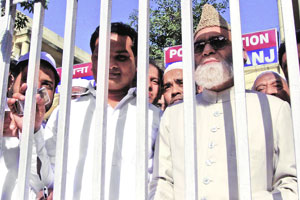
Bukhari and his brother Yahya, among others, were briefly arrested on September 24 for disrupting the exhibition.

Politically, the Ahmadiyyas are seeking legitimacy from Congress MP Pratap Singh Bajwa, who represents in their religious nerve-centre — Qadian in Gurdaspur.

“Bajwa had judged us well and found us to be law-abiding. That’s why he supports us,” Tanveer said.

Minority watchdog chief Wajahat Habibullah said: “An attack on the religious freedom of Ahmaddiyas clearly falls under our jurisdiction.”

Despite the proposed intervention, the Ahmadiyyas are unlikely to find acceptability because of a worldwide fatwa (edict) against them.

“The commission has to serve notices to 150 million Muslims of India who will never allow Ahmadiyyas to call themselves Muslims,” Bukhari said. Habibullah is facing attacks for visiting the Quran exhibition.

The conflict could escalate in India, where the Ahmadiyyas want to spread themselves.

Muslims generally believe there can be no prophets after Mohammed. The Ahmadiyyas have their own TV station in the UK, where their “caliph” lives in exile.

Copyright © 2011 HT Media Limited. All Rights Reserved
URL: www.hindustantimes.com/Heretical-Ahmadiyya-sect...752846.aspx

Saturday, September 24, 2011

Delhi: Quran exhibition called off after protests

Zee News India
Delhi
Delhi: Quran exhibition called off after protests
Last Updated: Saturday, September 24, 2011, 18:41

Shahi Imam Bukhari detained fearing violence.New Delhi: An exhibition on Quran and the message of Islam being held here was called off Saturday mid-way through its schedule after facing protests from other Muslim groups.

The three-day exhibition was organised in the constitution club by Ahmadiyya Muslim Jamaat, a group of representatives of Ahmadiyyas sect of Muslims. The exhibition was supposed to end Sunday, however, following strong protests from majority of Muslim groups, led by the Shahi Imam of Jama Masjid, Maulana Syed Ahmed Bukhari.

The exhibition was wrapped up after apprehensions of tension as Bukhari announced a protest. This also resulted in a brief detention of Bukhari, spurting up tension in the area of old Delhi.

“We had to wrap up our exhibition after a protests from the hardliners,” a member of the Ahmadiyya Muslim Jamaat told agency.

“We were spreading the message of love, to tell the world that Quran is for everyone. But the hardliners don’t want this,” he said.

Bukhari was briefly detained and taken to the Daryaganj police station of old Delhi. The Shahi Imam said that they were protesting against the exhibition as it was not spreading “correct messages” of Islam.

“They don’t consider Prophet Mohammad the last prophet, hence they are not Muslims,” Bukhari said.

“We had urged the government to stop the exhibition as what they are promoting is not authentic. We gave the government time till Friday to close the exhibition, but our requests were not heard, so we decided to protest,” Bukhari told IANS.

“However, when we were to start the protest, I was detained along with my supporters and taken to Daryaganj police station,” he said.

Bukhari said that he then refused to leave the police station premise till the exhibition was called off.

“Protestors were gathering, they (police) then said that the exhibition was being wound-up,” he said.

Bukhari was at the police station from 12 noon to around 4 p.m.

According to police, the situation in the area is now normal.

“Bukhari was detained for some time in the morning. The situation in the area is normal now,” Central Delhi DCP Vivek Kishore said.

© 1996-2011 Zee News Limited, All rights reserved
URL: http://zeenews.india.com/news/...protests_733318.html

Fearing row, Bukhari detained

Hindustan Times
IconSat. 24 Sep 2011
New Delhi
Fearing row, Bukhari detained
First Published: 23:14 IST(24/9/2011)
Last Updated: 23:16 IST(24/9/2011)
HT Correspondent, Hindustan Times
New Delhi, September 24, 2011

Shahi Imam Bukhari detained fearing violence.The Shahi Imam of the Jama Masjid and more than a hundred of his supporters were detained for four hours at the Daryaganj Police Station on Saturday morning, police said. Police said Maulana Syed Ahmed Bukhari and motorcade composed of 25 to 30 vehicles, which was en route the Constitution Club to protest against a three-day seminar organised by proponents of the Ahmadiya sect, was intercepted at Delhi Gate around 12 pm.

“The step was in line with ensuring that the law and order situation did not get out of hand after the Imam and his followers reached the venue.

They were detained under Section 65 of the Delhi Police (DP) Act and later released at 3:30 pm,” said a senior police officer.

According to the Imam, his visit was meant to ensure that the said exhibition, which also featured copies of the Holy Quran containing modifications introduced by the sect as early as 1901, be cancelled on religious grounds.

“I had formally requested the state government to cancel the said exhibition because it is against the prevailing and true tenets of Islam – failing which I would go to the Club to ensure that it was called-off,” Maulana Bukhari told Hindustan Times.

He added that the works on display at the exhibition were ‘more desecrating than the Danish cartoon lampooning Prophet Muhammad’.

Police released the Imam and his supporters from the Daryaganj Police Station at 3:30 pm but the former refused to leave the premises till the authorities concerned called-off the seminar and communicated it to them at 3:45 pm.

Copyright © 2011 HT Media Limited. All Rights Reserved
URL: www.hindustantimes.com/Fearing-row-Bukhari-detained/Article1-749803.aspx

Exhibition on teachings of Quran denounced

The Hindu, India
News » Cities » Delhi
NEW DELHI, September 24, 2011
Exhibition on teachings of Quran denounced
Madhur Tankha
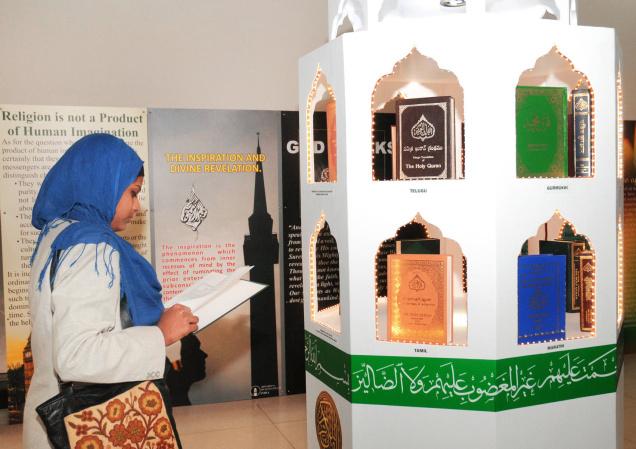
HOLY READING: A visitor at the three-day Quran exhibition titled 'Love for all, Hatred for none' that began in New Delhi on Friday. Photo: V. V. Krishnan
HOLY READING: A visitor at the three-day Quran exhibition titled ‘Love for all, Hatred for none’ that began in New Delhi on Friday. Photo: V. V. Krishnan
Protest by Muslim Law Board member and Shahi Imam’s brother

A three-day exhibition on the teachings of the Quran by Ahmadiyya Muslim Jammat, Delhi, that opened at the Constitution Club here on Friday ran into trouble when All-India Muslim Personal Law Board member Kamaal Farooqui and Syed Yahya Bukhari, brother of the Shahi Imam of Jama Masjid, along with their supporters denounced the event for “wrongly interpreting the tenets of Islam and the holy Quran”.

Talking to the media outside the Constitution Club, Mr. Farooqui said since Ahmadiyyas have been branded as non-Muslims in Pakistan, Iran, Iraq and other Islamic countries they cannot mount an exhibition in which they have interpreted the teachings of the holy Quran.

“If we start interfering in other people’s religion as it is being done through this exhibition, then it would create a dangerous precedent in the country. This exhibition cannot be allowed at any cost. Today we are demonstrating peacefully, but if this exhibition continues then on Saturday there will be a bigger demonstration,” he warned.

After the demonstrators had left, Ahmadiyya Muslim Jamaat External Affairs Secretary Syed Tanvir Ahmed said: “Ahmadiyyas are Muslims because they follow what Hazrat Mohammad taught them, read namaz and keep roza. But as this exhibition seeks to promote peace and brotherhood we will discontinue our exhibition after 5 p.m. on Saturday.”

National Minority Commission Chairman Wajahat Habibullah said he had no problem if the Ahmadiyyas described themselves as Muslims. “The teachings of the holy Quran have been beautifully displayed.”

The exhibition is displaying the Quran in 53 Indian and foreign languages including Kashmiri, Tamil, Telugu, Marathi and Gurmukhi, Russian, Spanish, Korean and Vietnamese. Seeking to dispel misunderstanding surrounding Islam, the exhibition is highlighting the tenets of Islam. “We want people to know that Islam stands for peace,” said Ahsan Ghori, while presenting the exhibition before guests. The exhibition highlights that Islam has assigned a position of dignity and honour to women and is a peaceful religion.

Ahmadiyyas face protest at peace mission

Times of India
Delhi
Ahmadiyyas face protest at peace mission
Shreya Roy Chowdhury, TNN | Sep 24, 2011, 06.49AM IST

NEW DELHI: The Islamic concept of jihad is often misunderstood in the current times of war and terrorism. And Ahmadiyyas have organized an exhibition to tell the world about what they claimed to be the real message of Quran — peace and brotherhood. Through their ‘Holy Quran Exhibition’ at Constitution Club, they said they wanted to change common perceptions.

This is perhaps one of the rare occasions when members of this sect, who face persecution in Pakistan, have come out to proclaim the inclusivity of their faith and answer queries on a wide range of issues. A 10-minute video on Islam’s emphasis on peace and rejection of war is a highlight of the exhibition. “This is an effort by the Ahmadiyyas to tell society that Quran is for everybody,” says Sayed Salahuddin, a volunteer.

But the exhibition has triggered strong protests from other Muslim sects at the venue. They were protesting against the Ahmadiyyas’ claim of being Muslims. The protests forced rescheduling of the exhibition, which will now end on Saturday instead of Sunday.

When the organizers set up the exhibition on Friday morning, they put up display boards addressing issues of jihad, women’s rights, science and globalization along with handsome volumes of over 70 translations of the Quran.

But after the protests the organizers scaled down the exhibition. The books are gone and so have the displays. “We were advised by police to remove the books as mischief-mongers from other sects might desecrate them. We agreed, because we believe in peace,” said Sayed Tanvir Ahmed, one of the organizers, who had come from Qadian, Punjab, where the Ahmadiyya sect was born.

But the man who led the protests, Kamal Faruqui, executive committee member of All-India Muslim Personal Law Board said, “We did not want to create a law and order problem. We wanted a token protest. Ahmadiyyas can’t call themselves Muslims. To be a Muslim, you have to believe in the oneness of God and finality of prophethood. Anyone who doesn’t believe in this is not a Muslim. They have been declared non-Muslims allover the world,” he said.

He heard about the exhibition on Thursday and rumours were confirmed by advertisements in the newspapers. “It’s not a new organization,” continued Faruqui, “They have every right under the Constitution to practice their religion and be treated as a minority. But by calling themselves Muslims, they are deceiving the people.”

The Ahmadiyyas are branded heretics in Pakistan and face opposition. “We are not popular among Muslims,” said Shiraz Ahmad, in charge of education for the Ahmadiyyas in India. “But we never retaliate. We spread the message of peace. We are declared non-Muslims by ulemas because they are afraid they’ll lose control if the masses follow us,” said Ahmad. But he also likes challenges. “We have been facing oppression for over 100 years. But where there is opposition, people also ask questions. They think, let’s go find out.”

Copyright © 2011 Bennett, Coleman & Co. Ltd. All rights reserved
URL: http://timesofindia.indiatimes.com/city/delhi/Ahmadiyyas...10099709.cms

Sunday, December 5, 2010

In the name of God

Daily Times, Pakistan
Sunday,
December 05, 2010

VIEW: In the name of God — Andleeb Abbas

Andleeb AbbasReligion has become license to categorise and exorcise personal vendettas. The Blasphemy Law, which itself is blasphemy against the legal system of Pakistan, is a shameful intention of maligned intentions and misrepresentation of Islamic law, letter and spirit

“For God’s sake” is the best license to deceive and decree anybody and everybody. From an ordinary beggar on the street to the big guns responsible for ‘religious affairs’ in Pakistan, all is holy and sanctimonious for religion and the Almighty. Hajj, which is the highest and purest of spiritual cleansing practices for a Muslim, has been turned into a filthy game of money guzzling and insatiable greed, completely degrading the spirit and soul of the occasion. The shameful treatment meted out to the pilgrims from Pakistan is now open news with all implicated busy trying to shrug the filth off their shoulders and pile it on whoever is trying to implicate them in this ruthless game of snatching other people’s money.

The government, deaf to the pleas of the suffering pilgrims, was finally forced into action when the Supreme Court received a letter by Saudi Prince Bandar Bin Khalid alleging corruption of billions by the local ministry of religious affairs, which was managing the travel and boarding facilities of the pilgrims. According to him, the accommodation he was offering was only 2 km from the Haram and was priced at Saudi Riyals 33.50 while the one chosen by the ministry was far away and was rented at the cost of Saudi Riyals 3,600. The living conditions were so bad that people had little access to proper tenting and basic water and toilet facilities. Imagine their focus on surviving the lack of facilities rather than getting closer to God. As the Pandora’s Box opens, whistle-blowing becomes a favourite pastime of the people involved. The Pakistani Ambassador in Saudi Arabia has blamed it on the minister of religious affairs who in turn has blamed and ordered the arrest of DG Hajj, Rao Shakeel. The prime minister has ordered his customary enquiry and has gladly accepted the generous offer of the Saudi government to give Saudi Riyals 250 per pilgrim as token compensation for the difficulties faced by them, caused by their own corrupt leaders.

Hajj is the single biggest religious congregation in the world and is a huge miracle of almost three million people bowing in front of the Almighty in submission of their flawed humanity. However, this ritual where the rich and poor, black and the not-so-black are supposed to stand equal and go through the tough rituals with due endurance has also become a marketing and money making religious tourism package industry. Various groups have introduced differentiated packages that include special early flights, customised training and education programmes, six-star facilities and a grouping of who is who to give the feeling of exclusivity to these privileged classes. How on earth such discrimination serves the purpose of Hajj, which is a symbol of humility, inclusivity and equality, God only knows. The exploitation of religion is not a new phenomenon but what is novel in today’s world is what a professional and organised industry it has become, which targets every single religious instinct anyone has to ensnare and entrap vulnerable minds, be it the ignorance and innocence of a suicide bomber, the guilt of middle-class morality or the pomp and religiosity of the elite of society.

Religion has become license to categorise and exorcise personal vendettas. The Blasphemy Law, which itself is blasphemy against the legal system of Pakistan, is a shameful intention of maligned intentions and misrepresentation of Islamic law, letter and spirit. Aasia Bibi’s case may have become the favourite topic of talk shows and a chance for the ruling and opposition party to procure the unfound, favourable limelight. However, the fact remains that this law itself is Tauheen-e-Risalat. The hallmark of the Holy Prophet (PBUH) was his magnanimity of heart and humility of action. His exemplary patience and abstinence from retaliation was what made him the greatest of the greats and converted the bitterest of his enemies into the most loyal of followers. The religious parties, including the Jamaat-e-Islami (JI), Jamiat Ulema-e-Islam (JUI) and so many other groups of Islamic defaming factions, are busy condemning those who dare touch the ‘holy’ law of blasphemy and threatening hell on earth to all those who dare question the interpretation of Islamic laws other than the ones decreed by them. This arrogance and insecurity of the religious clergy has always brought about their downfall and will again reduce them to a meaningless and irritating political echo.

These religious factions, no matter how irritating, are loud and obvious. The more worrying fact is the rise of the educated and sophisticated religious resellers who are subtle and devious in their apparently modern enlightenment version of Islam. These cosmetically well read Islamic exhibitors, at the peak of their life, claim to have done a deep study of Islam, which has transformed them into humble orators who can quote a Quranic verse at will to support any western quotation they may have uttered earlier on. It is this new breed of pseudo-reformed Islamists, having perfected the art of religious hypocrisy, who present the most dangerous trend in ‘Godly’ exploitation in the present times. They are dangerous because they have a higher credibility and following than the mullahs and thus actually disturb and disarm young minds more than the screaming imam with his predictable pre-Friday prayer condemnations.

Humanity is a universal religion and only its true followers and practitioners have the right to be called Muslim or Christian or any other title. God never believed in names only and He, through His prophets, gave the message of how a human gets the right of being, of existing, of elevating himself to the highest of cadres by respecting the differences in other people, by forgiving other people’s misdeeds and by concentrating on developing in oneself values of integrity, patience and tolerance. It is the flagrant devaluation of these principles that has, today, made the brand name Muslim such a dubious and distrustful trademark, which is associated with terror, intolerance and violence. It is thus not only for God’s sake but for the sake of the revival of the human race’s supremacy over all other species that we need to understand that religion without humanity and compassion is itself the biggest blasphemy, turning ‘mankind’ into ‘mancruel’.

The writer is a consultant and can be reached at andleeb@franklincoveysouthasia.com

Friday, December 3, 2010

COMMENT: The blasphemer must not be pardoned

Daily Times, Pakistan
Friday,
December 03, 2010

COMMENT: The blasphemer must not be pardoned — Abbas Zaidi

Allah has very, very explicitly said in the very beginning of the Quran that whosoever kills one human being is guilty of killing the entire humanity. Thus, by wanting to kill humans in the name of the Prophet (PBUH), these mullahs, in letter and spirit, want to launch an insane jihad against Allah

Hundreds of mullahs have taken to the streets to warn against the possible pardon President Zardari might grant Aasia Bibi, who allegedly blasphemed against Prophet Muhammad (PBUH). They say that if Aasia Bibi, the Christian blasphemer, is pardoned, they will launch a jihad against the government and the entire world and kill all the blasphemers. Aasia Bibi must not be pardoned. Otherwise, the lives of around five billion humans might be jeopardised. And now the Lahore High Court has also passed an order on the petition of a private citizen that the president cannot pardon Aasia Bibi because the case is sub judice. Why do mullahs so fanatically react to each case of perceived or alleged blasphemy?

The logic is very simple. Non-Muslims have, roughly speaking, two views of Prophet Muhammad (PBUH): (1) they (for instance, Christians and Jews) do not consider him to be a prophet at all, and (2) they (Hindus, Buddhists, and the rest) are not bothered about the issue at all. Now this is not acceptable as far as our furious mullahs are concerned. They demand that the world positively accept him to be the last prophet. Which effectively means that non-Muslims either convert or be ready for the sword.

Was Prophet Muhammad (PBUH) the last prophet of Islam or the world? This is a tricky issue, which the mullahs are not prepared to deal with. If he were the last prophet of Islam, then it would be unfair on our part to force non-Muslims to accept him as the last prophet of Islam. If prophet Muhammad (PBUH) was the last prophet of humankind, then we must look for guidance in the Holy Quran. And if the Holy Quran says that he was the last prophet of humanity, then we must seek guidance from the Book of Allah and see if Allah instructs us Muslims to wage a jihad against those who deny Prophet Muhammad’s (PBUH) prophetic finality. If Allah gives no such an instruction, then we Muslims must fear His wrath because Allah has very, very explicitly said in the very beginning of the Quran that whosoever kills one human being is guilt of killing the entire humanity. Thus, by wanting to kill humans in the name of the Prophet (PBUH), these mullahs, in letter and spirit, want to launch an insane jihad against Allah.

But my plea that Aasia Bibi must not be pardoned is based upon a different logic. If Aasia Bibi is pardoned, it would establish her guilt. The president of Pakistan has a constitutional privilege to pardon anyone who has been punished for some offence. Now this implies that the person pardoned is indeed guilty. Thus, it would mean that Aasia Bibi did, in fact, commit a crime of immensely heinous nature, which resulted in the death penalty verdict against her.

In 1992, the Pakistan government formulated the blasphemy law whose fruit Aasia Bibi is made to taste today. At that time, I wrote against the law saying that it would be misused by criminals and criminal-minded people to settle personal scores and commit acts of robbery and snatching people’s possessions. Many people resented my argument and blamed me for being a Jewish agent. Three mullahs came over to ‘see’ me in the newspaper office where I worked. Those were different times. Now I may be dealt with in a different manner. However, certain things never change. In 1992, I wrote that the stature of Prophet Muhammad (PBUH) was not so weak as to need, of all the people, Pakistanis for protection. I say the same thing today: the great Prophet (PBUH) needs no protection from a country which, year after year, is a contender for the top slot on the international list of the most corrupt countries. The Prophet (PBUH) does not need to be protected by the fascists who commit the ultimate blasphemy against Allah by killing people, His creation, in His prophet’s name.

The writer is a researcher with a PhD in sociolinguistics. He can be reached at hellozaidi@gmail.coma

URL: www.dailytimes.com.pk/default.asp?page=2010\12\03\story_3-12-2010_pg3_6

Monday, July 5, 2010

Tolerance for our inner terrorist

Express Tribune, Pakistan
Blogs
Tolerance for our inner terrorist
Shams Hamidby Rabia Mehmood
Monday, 05 July 2010
'Data Sahib' was a place which represented religious harmony
‘Data Sahib’ was a place which represented religious harmony

I might get my share of hate mail if this piece finds it way online and people read it. Actually, I wanted to claim responsibility for the attacks. I want to share some burden. I want to say that what happened at the Data Darbar was our own doing, we the people of Pakistan brought it upon us.

Living in a society which openly engages in discourse where those who have different religious beliefs will always be vulnerable to a death wish… where they would always be ‘waajib-ul-qatal’… what else could we possibly expect? I mean it is OK as long as the people who are victimized in the name of religion are Christians or Ahmadis for that matter. No? How many of these maulanas demanding mass resignations from the government in the aftermath of the attacks of Data Darbar actually condemned the May 28 attacks? Not even one representative of these jamaats… not even for the sake of appearances, they simply did not care, they never gave two hoots as to when those who represent the other are affected. And the only incident of violence towards Christians condemned by the maulanas was the Gojra Riots. However, the reason why Christians were attacked in the first place was never addressed by them.

So, I would say they encouraged the terrorist. They allowed him to think that he can get away with attacking others for their beliefs, even attacking the Data Sahib as we call it here in Lahore, the only place which represents the harmony of Aunnis, Deobandis, Shias, Wahabis (yes even Wahabis, I know some who go there for a prayer or two) Ahmadis, Christians and Hindus in this country.

For how long have we been persecuting people in the name of religion in this country? Decades. And known terrorist attacks are not the only incidents. Every other month in some remote or not-so-remote town of Punjab there is a 60 yr old Christian woman, a 19-year-old Christian man, a 14-year-old Ahmadi kid who is taken into police custody and tortured for alleged blasphemy.

We are a country that thrives on religious intolerance, we are insecure and indifferent to others pain. And to top it all we have discriminatory laws which are practiced religiously. I know bashing 295 C is an old tradition of the English press which has apparently never made a difference. I know so many English speaking, reading, writing people who also thought that Ahmadis ‘asked for it’ on May 28. So many among our educated class condemned the riots in Gojra but never questioned the absurdity of reason for provocation behind the instigation of the attacks i.e. alleged blasphemy by elders and children of a Christian family. That part just got lost in translating the condemnation by the governments and the so-called religious jamaats.

Now, I feel like questioning every person who, after the May 28 attacks on Ahmadis said ‘Well, now these Ahmadis will find a new to getfundingfrom theirforeign sources’ or that ‘They were involved in the campaig for lifting the facebook ban” and then those who thought they simply deserved to die… yes, hate speech but all true … or take a soundbyte from those who devotedly support the blasphemy law and say that Gojra was a foreign conspiracy or initiated by a new wave of post-9/11 terrorism. Who amongst us is innocent of the bigotry we have always directed towards the religious minorities.

I understand the popular argument that the ‘Salafi’ school has an anti-Sufism agenda. But this does not mean that the Salafi school has managed to oppress the Sufi and remaining schools of thoughts of Pakistan and forced its own supporters to measure their love for Islam by how many non-Muslims do they count as ‘wajib-ul-qatal.”

While prejudice is ingrained in most of us, the Punjab police and government appear to be very tolerant. They know all about the existence of seminaries where ‘what the Pakistani media calls terrorism and is actually jihad” is taught openly but do not conduct crackdowns. It must be tolerance, right? Last month when two low intensity bombs exploded right outside the shrine of Baba Noori Bori Waali Sarkaar in a Lahore suburbs, the SHO continued to deny the explosions and told the media that it was just a mild gas leakage. Of course, he did not think it was a big deal.

URL: http://blogs.tribune.com.pk/story/408/tolerance-for-our-inner-terrorist/

Tuesday, June 29, 2010

Pakistan history, distorted by the literalists

Express Tribune, Pakistan
Blogs
Pakistan history, distorted by the literalists
Shams Hamidby Dr.Shams Hamid
Tuesday, 29 June 2010
Literalists have always invented Islam depriving it of universalism

Recently released, the Brookings Institute report claims that the real cause of militancy in Pakistan is the public education system, and not religious schools (madrssas) because the majority of Pakistani students attend public school whereas only ten per cent attend madrassas. It states that Pakistani public schools disseminate militancy, hatred, jihad and distort history.

Until 1970, despite bureaucratic and military dictatorships, the Pakistani educational curriculum and textbooks, for example, had included the history of the Maurya and Gupta dynasties of the sub-continent conforming to the secular ideals of Pakistan clearly expressed by Mohammad Ali Jinnah in his speech to the constituent Assembly on 11th August 1947. Mohammad Ali Jinnah said:

quote
“We are starting with the fundamental principle that we are all citizens and equal Citizens of one state … Now I think we should keep that in front of us as our ideal, and you will find that in the course of time Hindus would cease to be Hindus and Muslims would cease to be Muslims, not in the religious sense, because that is the personal faith of each individual but in the sense as citizens of the state. …You may belong to any caste or creed – that has nothing to do with the business of the state.”

Mohammad Ali Jinnah never used the term ‘Ideology of Pakistan’ during the struggle for independence nor after independence. Mohammad Ali Jinnah sternly scolded a prominent leader of Muslim League Raja Sahab Mahmudabad when he wrote to the historian Mohibul Hassan in 1939 that we want the dictatorship of Koranic laws. Sharifuddin Pirzada documented another failed attempt of an Abdul Hameed Kazi to propose a bill to create Pakistan as an Islamic state in All India Muslim League’s 1943 session.

quote
“The Quaid-i-Azam never used the words ‘Ideology of Pakistan’ … For fifteen years after the establishment of Pakistan, the Ideology of Pakistan was not known to anybody until in 1962 a solitary member of the Jama’at-I-Islami used the words for the first time when the Political Parties Bill was being discussed. On this, Chaudhry Fazal Elahi, [who later became Pakistan’s president during Z. A. Bhutto’s regime], rose from his seat and objected that the ‘Ideology of Pakistan’ shall have to be defined. The member who had proposed the original amendment replied that the ‘Ideology of Pakistan was Islam’.”

The three rigid religious political parties Jamiat-i-Ulama-i-Hind, the Majlis-i-Ahrar and Jamat-e-Islami were opposed to Muslim league and the demand for an independent Pakistan. In Punjab Majlis-i-Ahrar exploited Islamic ideology to defeat Muslim League in pre-partition election of 1945 calling Muslim League leaders ‘Kafirs’ and opposing their demand for a separate state.

Ironically, the term “Ideology of Pakistan” was also first coined and used by Jamat-e-Islami who were against the creation of Pakistan and they did not participate with the Muslim League in the movement for the independence of Pakistan.

After the independence of Pakistan, Jamat-e-Islami established its Pakistan chapter claiming that Pakistan was created for Muslims to live according to Islamic Shariah. Jamat-e-Islami even forgets that the Ahmadiya community supported Independence of Pakistan after Mohammad Ali Jinnah’s assurance that Pakistan will be a modern Muslim state, neutral on sectarian matters (Report of the Court of Inquiry, 1954: 196). However, Jamat-e-Islami Pakistan still cannot justify their opposition to the creation of Pakistan if it was being created only for Muslims to practice the literalist interpretation of Islam.

In late 1970’s, after the fall of East Pakistan, the Pakistani educational system began to implement the Islamisation project based on the literalist interpretation of Islam practiced by a very small percentage of the Muslim population. Jamat-e-Islami and other religious political parties championed the Islamisation project. This is a shameful testimonial to the twisted logic of the handful of Muslim literalists.

The unholy alliance of 1980s, between the dictatorial military regime of Pakistan under General Zia-ul-Haq, the unelected literalist religious political party Jamat-e-Islami and American government, cemented Islamisation of all Pakistani institutions including public educational institutions. The national education policy was Islamised in accordance with the narrow literal interpretation of Islam. The national educational curriculum was revised and textbooks were re-written to re-invent Pakistan as a purely religious society only for Muslim citizens.

Syed Abul A’la Maudoodi of Jama’at-e-Islami prescribed that all educational subjects should be taught from the perspective of the literal interpretation of Quran. Maudoodi did not accept the distinction between the religious and the non-religious worldly disciplines of education.

quote
“In the teaching material, no concept of separation between the worldly and the religious be given; rather all the material be presented from the Islamic point of view.” (Curriculum Document, Primary Education, Class K-V, 1995, p. 41.)

The Sustainable Development Policy Institute found four major themes emerging strongly from their analysis of the curricula and textbooks of the three compulsory subjects:

quote
“1. that Pakistan is for Muslims alone;
2. that Islamic teachings, including a compulsory reading and memorisation of Qur’an, are to be included in all the subjects, hence to be forcibly taught to all the students, whatever their faith;
3. that Ideology of Pakistan is to be internalized as faith, and that hate be created against Hindus and India; and
4. students are to be urged to take the path of Jehad and Shahadat.”

Literalists have always invented Islam depriving it of universalism and divesting its teachings of its historic context. ‘Pakistan ideology’ is also a case of their figment of imagination that has no basis in Pakistani history.

Islam has multiple interpretations and only one of those interpretations, i.e., the literalist interpretation of Islam, is fatalistic and anti-humanistic. However, there are only a few Muslims who accept or live by the literalists’ interpretation of Islam, whereas more than 95 per cent of Muslims consciously reject the literalist interpretation of Islam.

Literalists themselves fail in avoiding contradictions in their own literal interpretation in their attitude and lifestyle. Zakir Naik, an Indian Muslim preacher of these parochial views of unequal human rights for men, women and for people of different faith has recently been restricted from giving a speech in UK and Canada but he is fighting against this verdict on the grounds of freedom of speech and equal human rights. They are not ready to allow equal human rights in their society while shamelessly demanding it from the secular societies.

These literalists simultaneously benefit from all the modern technologies, like getting photographed, using phones, watching television, flying in airplane, using western banking and so on; and criticise them all for being ‘non-Islamic’ and ‘secular’.

Literalists have a very small following because most people find it difficult to live in bad faith with a false consciousness, i.e. believing in one thing and doing its opposite. They have changed already, they should understand and accept it. The idea of a return is impossible; you cannot travel back in history.

Pakistani public education needs to focus on re-designing its curriculum, re-writing and reconstructing teaching material including textbooks and constructing a non-violent, democratic learning environment in the public schools to disseminate tolerant views and employment-oriented education.

Saturday, January 30, 2010

Persecution of Ahmadis in Pakistan during the Year 2009 - A Summary

Pakistan has suffered greatly at the hands of the mulla during the past decade. The present democratic regime is literally at war with extremist elements. However, it is yet to realize that extremism and sectarianism are evil in all their forms. The federal government has not even hinted that it will repeal the unjust laws specific to Ahmadis. The provincial governments, notably in the Punjab and Azad Jammu and Kashmir have gone out of their way to show that they are in league with the mulla in his anti-Ahmadiyya campaign...

Download complete report in Adobe PDF format.
annual_report2009.pdf (1.93 mb)

Monday, November 24, 2008

Bangladesh’s Secular Democracy Struggles with Violent Radical Islam

--- The Cutting Edge News

Inside Islam
Bangladesh’s Secular Democracy Struggles with Violent Radical Islam
Benedict Rogers November 24th 2008

Cutting Edge Burma Desk

Bangladesh is a country associated more with floods, cyclones and poverty than terrorism or radical Islamism. Indeed, it is a country founded on secular, democratic values and widely regarded as a moderate Muslim state. In recent years, however, militant Islamism has quietly been taking ground – and Bangladesh’s survival as a progressive state is on a knife-edge.

The warning signs have been there for some years, and some commentators have been sounding the alarm. In 2002, Ruth Baldwin wrote a piece in The Nation headlined: “The ‘Talibanisation’ of Bangladesh.” Hiranmay Karlekar wrote Bangladesh: The Next Afghanistan? While Maneeza Hossain’s Broken Pendulum: Bangladesh’s Swing to Radicalism and Ali Riaz’s God Willing: The Politics of Islamism in Bangladesh are all important contributions.

Perhaps the most visible and dramatic sign of the growth of extremism came three years ago. On 17 August 2005, between 11 and 11.30 am, 527 bombs were exploded in a massive attack on all but one of the country’s 64 districts. Such a carefully co-ordinated campaign of terror shocked the nation – but in many respects it was just the tip of the terror iceberg. Other terrorist incidents, including an attack on the Bangladeshi-born British High Commissioner, members of the judiciary and sporadic attacks on religious and ethnic minorities are further indicators of the presence of well-organised terrorist networks.

However, it is not simply the acts of violence that should cause concern. The Islamists’ ideological influence has spread to almost all parts of Bangladeshi society – not least the political arena.

The umbrella organisation is Jamaat-e-Islami, a radical group founded in India in 1941 by Mawlana Abul Ala Maududi. According to one analyst in Bangladesh, Jamaat’s objective is to create “a monolithic Islamic state, based on Shari’ah law, and declare jihad against Hindus, Buddhists, Christians and free-thinking Muslims.” Religious minorities – and Muslims regarded by Jamaat as heretical, such as the Ahmadiyya sect – are targeted for eviction, according to one human rights activist, “or at least to be made into a ‘non-existent’ element whose voice cannot be heard.” Jamaat’s tentacles now reach into major sectors, including banking, health care, education, business and non-profit organisations, and they aim to “destroy” the judicial system, according to one critic, including by “physically eliminating judges.” In 2001, Jamaat won 17 parliamentary seats in alliance with the governing party, the Bangladesh National Party (BNP), and became a partner in the coalition government until its overthrow by the military in 2007. Elections scheduled for next month could result in Jamaat’s return to government, if BNP wins, and even in the current caretaker administration there are believed to be Jamaat-sympathisers.

While Jamaat is the umbrella, according to journalist Shahriar Kabir and the Forum for Secular Bangladesh there are over 100 Islamist political parties and militant organisations in Bangladesh. Only four of these have been banned, and even they continue to operate under alternative names. Extremist literature, audio and video cassettes are widely distributed, and thousands of madrassas teach radical Islamism.

All this is completely at odds with the vision of Bangladesh’s founder, Sheikh Mujibur Rahman, who led the struggle for independence from Pakistan in which at least three million were killed, ten million displaced and 250,000 women raped. According to Hiranmay Karlekar, at the heart of the birth of Bangladesh was a belief that “the Bengali identity had prevailed over the Islamic identity.” The preamble of the first constitution explicitly stated a commitment to secularism and democracy, and political parties were banned from using religion as a basis for their activities.

Bangladesh began sliding slowly towards Islamism following the assassination of Rahman in 1975. In 1977, references to secularism were deleted from the constitution and the phrase “Bismillah-Ar-Rahiman-Ar Rahim” (“In the name of Allah, the Beneficient, the Merciful) was inserted. Five years later, General Ershad – one of the military dictators who ruled the country in the alternating competition between the army and the democrats – introduced the Eighth Amendment, making Islam the state religion. The constitution now states that “absolute trust and faith in the Almighty Allah shall be the basis of all actions.”

There remain some provisos, which give religious minorities protection. For example, while Islamic principles are set out as guiding values, the constitution states that they “shall not be judicially enforceable.” The Chief Justice has said clearly that Shari’ah does not constitute the basis of the country’s legislation. Religious freedom, including “the right to profess, practice or propagate any religion”, is protected, and discrimination on religious grounds prohibited.

Nevertheless, in practice Christians, Hindus and Buddhists are denied promotion in the government and the military and in the view of one Bangladeshi journalist, religious and ethnic minorities have seen “unprecedented persecution” in recent years.

In 1998, for example, three Christian sites in Dhaka were attacked – a Catholic girls’ school, an Anglican church and a Baptist church. A mob set fire to the school, destroyed property, burned books, pulled down a cross and smashed statues of the Virgin Mary and St Francis of Assisi. Death threats were issued from the nearby mosque. Since then, sporadic attacks on churches have escalated. In 2007, at least five churches were attacked. Hindus and Ahmadiyyas face similar violence.

Cases of abduction, rape, forced marriage and forced conversion of religious minority women – and particularly young girls – are increasing, in a trend worryingly reminiscent of Pakistan. On 13 February 2007, for example, Shantona Rozario, an 18 year-old Christian student, was kidnapped. She was forced at gunpoint to sign a marriage document with her kidnapper, and an affidavit for conversion to Islam, witnessed by a lawyer, a mullah and a group of young men. After a month she managed to escape, but others are not so fortunate. On April 30 of this year a 14 year-old Christian girl, Bituni de Silva, was raped at gunpoint, and on May 2 a 13 year-old daughter of a pastor was gang-raped.

Apostates in Bangladesh face similar severe consequences for leaving Islam as they do throughout the world. On 1 February this year, a 70 year-old woman convert to Christianity from Islam, Rahima Beoa, died from burns suffered when her home was set ablaze after her conversion.

In 2004, a Jamaat Member of Parliament attempted to introduce a blasphemy law in Bangladesh, modelled on Pakistan’s notorious legislation. Attempts have been made to ban Ahmadiyya literature. And even during the State of Emergency, when protests and processions are supposed to be banned, extremists led by groups such as Hizb-ut-Tahrir have held angry rallies. On 17 September 2007, for example, a cartoon was published in a satirical magazine, Alpin, featuring a conversation between a child and an imam, in which the boy was told that he should always use the prefix ‘Mohammed’ before a name. The boy then decided to call his cat “Mohammed Cat.” The cartoon sparked outrage, and effiges of the newspaper editor were burned in street protests. The cartoonist and the editor were arrested, charged with sedition, and the publication was closed down. In April this year, large protests were held after Friday prayers in major cities, opposing the government’s plans to legitimate women’s rights in the constitution. Maulana Fazlul Haq, chairman of the Islami Oikya Jote, described such a policy as “anti-Qu’ran” and “anti-Islamic.”

An estimated 2.5 million people in Bangladesh belong to indigenous ethnic tribal groups, sometime sknown as “Adibashis.” There are at least 40 different ethnic groups, mainly inhabiting the Chittagong Hill Tracts and the plains area around Mymensingh. Most of these tribal groups are non-Muslim – predominantly Buddhist, Christian and Animist. Since the late 1970s, the Bangladeshi government has actively sponsored the resettlement of Bengali Muslims into the tribal areas – resulting in the construction of mosques, land-grabbing, evictions and discrimination against non-Muslims. One indigenous rights campaigner said: “Our way of life is an open society. Men and women can work anywhere. We are more flexible on gender issues. But the settlers have come in and built mosques, and they use their loudspeakers which affects us culturally and psychologically.”

In one village near Mymensingh, for example, a Bengali Muslim married a Christian from a tribal group. All the other villagers are Christians. After a few years, he decided he needed a mosque – even though he was the only Muslim in the area. So now he is building a mosque – and the likelihood is he will bring in an imam, who will bring his family, who will bring their relatives: and the slow, subtle, insidious repopulation of a non-Muslim, non-Bengali area will unfold. When I visited the remote jungle village, the atmosphere was tense – and the imam, sitting at the mosque construction site, was unwelcoming.

The prediction of Bangladesh’s “Talibanisation” may sound extreme, and in the immediate term the likelihood of Bangladesh becoming like Afghanistan is far-fetched. Bangladesh has not gone as far down the road of radicalisation as Pakistan, for example. Nevertheless, the warnings need to be taken seriously. If it continues as it is, Bangladesh will go the way of Pakistan – and then the risk of Talibanisation becomes realistic.

Indeed, it is Pakistan and Saudi Arabia that are fuelling the Islamisation of Bangladesh. As one person put it, “Pakistan is the breeding ground and the brain, and Saudi Arabia provides the money.” Saudi Arabia is a major funder of madrassas and mosques in Bangladesh, for example – and it is no coincide that Wahhabi teaching is on the rise.

A prominent church leader predicts that full Shari’ah law will be implemented if the situation does not change. “Some day, it will happen. Maybe not immediately, but it will happen … The support of voices in the international community is very much needed. More people need to come and find out what is happening here.” As Ali Riaz says, “there is no doubt that if the present trend continues, the nation will inevitably slide further down the slope toward a regime with a clear Islamist agenda … What is necessary is a decisive change in the direction of the nation.” Such a decisive change is vital, to restore the founding principles of Bangladesh – secularism, democracy, equal rights. There is still a thriving civil society, with bold intellectuals, journalists and human rights activists willing to challenge radical Islamism – and that is a cause for hope. Bangladesh has not been lost to radical Islamism completely – but it will be if the alarm bells are not heard.

Cutting Edge Contributor Benedict Rogers is a human rights activist with Christian Solidarity Worldwide, and serves as Deputy Chairman of the UK Conservative Party's Human Rights Commission. He is the author of A Land Without Evil: Stopping the Genocide of Burma's Karen People (Monarch, 2004).

URL: www.thecuttingedgenews.com/index.php?...e=Features
 
^ Top of Page