Showing posts with label Islamic extremists. Show all posts

Sunday, December 5, 2010

In the name of God

Daily Times, Pakistan
Sunday,
December 05, 2010

VIEW: In the name of God — Andleeb Abbas

Andleeb AbbasReligion has become license to categorise and exorcise personal vendettas. The Blasphemy Law, which itself is blasphemy against the legal system of Pakistan, is a shameful intention of maligned intentions and misrepresentation of Islamic law, letter and spirit

“For God’s sake” is the best license to deceive and decree anybody and everybody. From an ordinary beggar on the street to the big guns responsible for ‘religious affairs’ in Pakistan, all is holy and sanctimonious for religion and the Almighty. Hajj, which is the highest and purest of spiritual cleansing practices for a Muslim, has been turned into a filthy game of money guzzling and insatiable greed, completely degrading the spirit and soul of the occasion. The shameful treatment meted out to the pilgrims from Pakistan is now open news with all implicated busy trying to shrug the filth off their shoulders and pile it on whoever is trying to implicate them in this ruthless game of snatching other people’s money.

The government, deaf to the pleas of the suffering pilgrims, was finally forced into action when the Supreme Court received a letter by Saudi Prince Bandar Bin Khalid alleging corruption of billions by the local ministry of religious affairs, which was managing the travel and boarding facilities of the pilgrims. According to him, the accommodation he was offering was only 2 km from the Haram and was priced at Saudi Riyals 33.50 while the one chosen by the ministry was far away and was rented at the cost of Saudi Riyals 3,600. The living conditions were so bad that people had little access to proper tenting and basic water and toilet facilities. Imagine their focus on surviving the lack of facilities rather than getting closer to God. As the Pandora’s Box opens, whistle-blowing becomes a favourite pastime of the people involved. The Pakistani Ambassador in Saudi Arabia has blamed it on the minister of religious affairs who in turn has blamed and ordered the arrest of DG Hajj, Rao Shakeel. The prime minister has ordered his customary enquiry and has gladly accepted the generous offer of the Saudi government to give Saudi Riyals 250 per pilgrim as token compensation for the difficulties faced by them, caused by their own corrupt leaders.

Hajj is the single biggest religious congregation in the world and is a huge miracle of almost three million people bowing in front of the Almighty in submission of their flawed humanity. However, this ritual where the rich and poor, black and the not-so-black are supposed to stand equal and go through the tough rituals with due endurance has also become a marketing and money making religious tourism package industry. Various groups have introduced differentiated packages that include special early flights, customised training and education programmes, six-star facilities and a grouping of who is who to give the feeling of exclusivity to these privileged classes. How on earth such discrimination serves the purpose of Hajj, which is a symbol of humility, inclusivity and equality, God only knows. The exploitation of religion is not a new phenomenon but what is novel in today’s world is what a professional and organised industry it has become, which targets every single religious instinct anyone has to ensnare and entrap vulnerable minds, be it the ignorance and innocence of a suicide bomber, the guilt of middle-class morality or the pomp and religiosity of the elite of society.

Religion has become license to categorise and exorcise personal vendettas. The Blasphemy Law, which itself is blasphemy against the legal system of Pakistan, is a shameful intention of maligned intentions and misrepresentation of Islamic law, letter and spirit. Aasia Bibi’s case may have become the favourite topic of talk shows and a chance for the ruling and opposition party to procure the unfound, favourable limelight. However, the fact remains that this law itself is Tauheen-e-Risalat. The hallmark of the Holy Prophet (PBUH) was his magnanimity of heart and humility of action. His exemplary patience and abstinence from retaliation was what made him the greatest of the greats and converted the bitterest of his enemies into the most loyal of followers. The religious parties, including the Jamaat-e-Islami (JI), Jamiat Ulema-e-Islam (JUI) and so many other groups of Islamic defaming factions, are busy condemning those who dare touch the ‘holy’ law of blasphemy and threatening hell on earth to all those who dare question the interpretation of Islamic laws other than the ones decreed by them. This arrogance and insecurity of the religious clergy has always brought about their downfall and will again reduce them to a meaningless and irritating political echo.

These religious factions, no matter how irritating, are loud and obvious. The more worrying fact is the rise of the educated and sophisticated religious resellers who are subtle and devious in their apparently modern enlightenment version of Islam. These cosmetically well read Islamic exhibitors, at the peak of their life, claim to have done a deep study of Islam, which has transformed them into humble orators who can quote a Quranic verse at will to support any western quotation they may have uttered earlier on. It is this new breed of pseudo-reformed Islamists, having perfected the art of religious hypocrisy, who present the most dangerous trend in ‘Godly’ exploitation in the present times. They are dangerous because they have a higher credibility and following than the mullahs and thus actually disturb and disarm young minds more than the screaming imam with his predictable pre-Friday prayer condemnations.

Humanity is a universal religion and only its true followers and practitioners have the right to be called Muslim or Christian or any other title. God never believed in names only and He, through His prophets, gave the message of how a human gets the right of being, of existing, of elevating himself to the highest of cadres by respecting the differences in other people, by forgiving other people’s misdeeds and by concentrating on developing in oneself values of integrity, patience and tolerance. It is the flagrant devaluation of these principles that has, today, made the brand name Muslim such a dubious and distrustful trademark, which is associated with terror, intolerance and violence. It is thus not only for God’s sake but for the sake of the revival of the human race’s supremacy over all other species that we need to understand that religion without humanity and compassion is itself the biggest blasphemy, turning ‘mankind’ into ‘mancruel’.

The writer is a consultant and can be reached at andleeb@franklincoveysouthasia.com

Friday, December 3, 2010

COMMENT: The blasphemer must not be pardoned

Daily Times, Pakistan
Friday,
December 03, 2010

COMMENT: The blasphemer must not be pardoned — Abbas Zaidi

Allah has very, very explicitly said in the very beginning of the Quran that whosoever kills one human being is guilty of killing the entire humanity. Thus, by wanting to kill humans in the name of the Prophet (PBUH), these mullahs, in letter and spirit, want to launch an insane jihad against Allah

Hundreds of mullahs have taken to the streets to warn against the possible pardon President Zardari might grant Aasia Bibi, who allegedly blasphemed against Prophet Muhammad (PBUH). They say that if Aasia Bibi, the Christian blasphemer, is pardoned, they will launch a jihad against the government and the entire world and kill all the blasphemers. Aasia Bibi must not be pardoned. Otherwise, the lives of around five billion humans might be jeopardised. And now the Lahore High Court has also passed an order on the petition of a private citizen that the president cannot pardon Aasia Bibi because the case is sub judice. Why do mullahs so fanatically react to each case of perceived or alleged blasphemy?

The logic is very simple. Non-Muslims have, roughly speaking, two views of Prophet Muhammad (PBUH): (1) they (for instance, Christians and Jews) do not consider him to be a prophet at all, and (2) they (Hindus, Buddhists, and the rest) are not bothered about the issue at all. Now this is not acceptable as far as our furious mullahs are concerned. They demand that the world positively accept him to be the last prophet. Which effectively means that non-Muslims either convert or be ready for the sword.

Was Prophet Muhammad (PBUH) the last prophet of Islam or the world? This is a tricky issue, which the mullahs are not prepared to deal with. If he were the last prophet of Islam, then it would be unfair on our part to force non-Muslims to accept him as the last prophet of Islam. If prophet Muhammad (PBUH) was the last prophet of humankind, then we must look for guidance in the Holy Quran. And if the Holy Quran says that he was the last prophet of humanity, then we must seek guidance from the Book of Allah and see if Allah instructs us Muslims to wage a jihad against those who deny Prophet Muhammad’s (PBUH) prophetic finality. If Allah gives no such an instruction, then we Muslims must fear His wrath because Allah has very, very explicitly said in the very beginning of the Quran that whosoever kills one human being is guilt of killing the entire humanity. Thus, by wanting to kill humans in the name of the Prophet (PBUH), these mullahs, in letter and spirit, want to launch an insane jihad against Allah.

But my plea that Aasia Bibi must not be pardoned is based upon a different logic. If Aasia Bibi is pardoned, it would establish her guilt. The president of Pakistan has a constitutional privilege to pardon anyone who has been punished for some offence. Now this implies that the person pardoned is indeed guilty. Thus, it would mean that Aasia Bibi did, in fact, commit a crime of immensely heinous nature, which resulted in the death penalty verdict against her.

In 1992, the Pakistan government formulated the blasphemy law whose fruit Aasia Bibi is made to taste today. At that time, I wrote against the law saying that it would be misused by criminals and criminal-minded people to settle personal scores and commit acts of robbery and snatching people’s possessions. Many people resented my argument and blamed me for being a Jewish agent. Three mullahs came over to ‘see’ me in the newspaper office where I worked. Those were different times. Now I may be dealt with in a different manner. However, certain things never change. In 1992, I wrote that the stature of Prophet Muhammad (PBUH) was not so weak as to need, of all the people, Pakistanis for protection. I say the same thing today: the great Prophet (PBUH) needs no protection from a country which, year after year, is a contender for the top slot on the international list of the most corrupt countries. The Prophet (PBUH) does not need to be protected by the fascists who commit the ultimate blasphemy against Allah by killing people, His creation, in His prophet’s name.

The writer is a researcher with a PhD in sociolinguistics. He can be reached at hellozaidi@gmail.coma

URL: www.dailytimes.com.pk/default.asp?page=2010\12\03\story_3-12-2010_pg3_6

Wednesday, December 1, 2010

No minority rights in Pakistan

Daily Times, Pakistan
Wednesday,
December 01, 2010

COMMENT: No minority rights in Pakistan — Shahid Saeed

We live in such an ideologically insecure country hell-bent on maintaining our brand as an Islamic Republic that we undercount and under-report the percentage of minorities in our census. There is a barrier the size of the Great Wall of China that prevents minorities from becoming successful citizens in Pakistan

Amidst the outrage over the sentencing to death of Aasia Bibi, a 45-year old mother of five, over charges of blasphemy that seem difficult to prove and have triggered a debate on the blasphemy law itself, what has been conveniently ignored is the fact that the said incident occurred after people refused to drink water brought by Aasia Bibi, considering it to be napaak (impure). Ironically, it is socially acceptable that people belonging to the poor Christian community are treated despicably, considered unhygienic, called names such as choora (sewer cleaner), regardless of their actual profession. The accusers who refused to drink water brought by Aasia Bibi were somehow acting within religious guidelines. I would like to ask them whether they would act in the same manner if Aasia Bibi and her likes were to be replaced by white Caucasian Christian women. I am pretty positive that there would be no qualms in accepting that glass of water or food touched by Christians who are not chooras. Clearly, then, it is not a matter of religion but socio-economic status that makes people discriminate in such an outrageous and horrific manner in the name of religion.

A few years ago, the Capital Development Authority (CDA) had put up a banner on the Islamabad Expressway inviting the Christian biradari (community) to apply for janitorial jobs vacant at the CDA. Historically, Christians from poor backgrounds have served as janitors and cleaners, and many continue to do so whilst fighting social injustice, but for a government department to declare janitorial jobs solely reserved for Christians is disgusting. Our society tolerates, accepts and practises shameful, abominable and repulsive behaviour every day, all in the name of religion. My head hangs in shame.

We live in a country where, for a long time, elections were carried out under religious apartheid as minorities were denied their right to universal franchise by forcing separate electorates on them. The freedom to profess religion guaranteed by Article 20 of the constitution has been meaningless in the light of the legal and social discrimination against minorities. Article 20 grants people of all faiths freedom to “profess, practice and propagate” their religion, but the Second Amendment and Ordinance XX prohibit the Ahmedis from practising their religion openly and denies them the right to call themselves Muslims by categorising their faith for them. We guarantee them freedom of religion, only as long as the majority can feel secure by calling itself the constitutional Muslims and prohibiting the Ahmedis from nearly everything that they believe in, including the right to name their small town of Rabwah, as it has been rechristened Chenab Nagar. The insecurity of the majority sects has been written down in the Second Amendment and Ordinance XX and continues with constant court cases against the Ahmedis.

The fact is there are no minority rights in Pakistan. Minority members of parliament have to begin their speeches by first praising Islam and the government of Pakistan for guaranteeing them whatever limited rights they have, and still they are looked down upon by the ulema (sitting mostly on the treasury desks). It is as if we are doing a favour to them by extending basic humanitarian rights. The Hindu community has faced constant harassment and the number of forced conversions in Sindh has been on a constant rise. The Christian community faces social barriers of enormous proportions and has been the target of innumerable terrorist attacks too. Starting from partition when the Sikh and Hindu populations were killed in massive numbers, minority faiths have suffered immensely. The anti-Ahmedi agitation of 1953 started the wave of mass harassment and persecution that continues to this day. Temples have been razed, churches have been burnt and poor people lynched and killed in the name of religion.

From Shantinagar to Gojra, the history of this land is full of the murder of minorities at the hands of the self-proclaimed righteous guardians of religious boundaries. In a country where sectarian terrorism consumed thousands of lives and minorities have been forced to live in fear, Article 20 is nothing but hollow words.

We live in such an ideologically insecure country hell-bent on maintaining our brand as an Islamic Republic that we undercount and under-report the percentage of minorities in our census. There is a barrier the size of the Great Wall of China that prevents minorities from becoming successful citizens in Pakistan. The wall has been raised by legal and social measures that persecute them and discriminate against them. The majority Muslim population, hijacked by a significant number of hardline religious leaders and their followers, has made life for the minorities a living hell. They use mosque loudspeakers for telling them that they will inevitably go to hell in their afterlife.

With the passage of the Objectives Resolution, the fate of minorities in this country was sealed forever and the dream of the state envisaged in Jinnah’s August 11, 1947 speech had died. The report of the Court of Inquiry constituted under the Punjab Act II of 1954 to enquire into the Punjab Disturbances of 1953, commonly known as the Justice Munir report, had then answered some valid questions about the role of religion in the state. The ulema — disunited as they are on a million issues and unable to come to a single definition of a Muslim — were then nearly united, and still are, on how to treat minorities: they shall be zimmies and “will have no say in the making of law and no right to administer the law” and would not be allowed to propagate their religion. Summarising, the good Justices Munir and MR Kayani wrote: “It is this lack of bold and clear thinking, the inability to understand and take decisions which has brought about in Pakistan a confusion which will persist and repeatedly create situations of the kind we have been inquiring into until our leaders have a clear conception of the goal and of the means to reach it…The sublime faith called Islam will live even if our leaders are not there to enforce it. It lives in the individual, in his soul and outlook, in all his relations with God and men, from the cradle to the grave, and our politicians should understand that if Divine commands cannot make or keep a man a Musalman, their statutes will not.”

These words have proven to be prophetic and stand so apt for today, albeit with the caveat that we no longer have liberal judges who did not think secularism was a bogeyman. The 11-year rule of ‘Islamisation’ has changed our attitudes, ideologies and beliefs immensely, and now we teach our children lies that never were a part of our history. We are confused about the very ideology behind the creation of this country, what it was meant to be, what it has become and what it should be. The confusion persists, but with laws that demand a blind Safia Bibi to produce four witnesses to support her claim of rape, laws that allow honour killings to take place through forgiveness granted under diyat and laws that sentence people to death over fake blasphemy charges, we have arrived at a point where it is clear that theocracy has failed us. Only a secular, progressive and democratic Pakistan can guarantee social progress for the people of this country. Rest assured, the future looks bleak if things are to continue the way they are now.

The writer is interested in history and public policy. He can be reached at shahid@live.com.pk

Tuesday, November 30, 2010

ROVER’S DIARY: Much ado about blasphemy

Daily Times, Pakistan
Tuesday,
November 30, 2010

ROVER’S DIARY: Much ado about blasphemy — Babar Ayaz

Babar AyazA cursory view of the whole debate about the Blasphemy Law shows that there are many saner and more intellectually sound Muslims who do not support the existing draconian law. Except for a small extremist coterie of bigots, many politicians are all for removing Section 295-B and C

Way back on March 6, 1927, Bertrand Russell delivered a lecture to the National Secular Society, South London Branch, at Battersea Town Hall. It was subsequently published in pamphlet form that same year. This essay achieved fame when Paul Edward published a compilation of Russell’s essays on religion, titled Why I Am Not a Christian and Other Essays. In his lecture, he talked about his agnostic views about God and questioned certain Christian values.

The blasphemy and blasphemous libel laws were part of the British common law at that time. The laws had existed since the 17th century and were punishable by the common law courts. This law was not invoked against Russell by the Church or the British government, although a police case was registered against one rationalist, Harry Boulter, in 1908. He repeated the offence in 1909 and was jailed for six months for speaking against religion.

The last person sent to prison for blasphemy in Britain was John William Gott in December 1921. He had three previous convictions for blasphemy when he was prosecuted for publishing two pamphlets titled Rib Ticklers, or Questions for Parsons and God and Gott. While Russell’s intellectual criticism of Christ and God was tolerated by British society, Gott’s satire of the biblical story of Jesus was found punishable. He was sentenced to nine months hard labour. As he was suffering from some incurable illness, he died shortly after he was released. The case became the subject of public outrage.

There were outbursts by religious lobbies against the subsequent writing and art work, which they considered were blasphemous but the law was not invoked and freedom of expression was respected. The debate about this law gained currency when British author Salman Rushdie’s novel, The Satanic Verses, was published in 1988. Strong reaction against Rushdie in Muslim countries and an Iranian fatwa sanctioning that he should be killed “stimulated debate on this topic”, with some arguing that the same protection should be extended to all religions, while others claimed the UK’s ancient blasphemy laws were an anachronism and should be abolished. Despite much discussion surrounding the controversy, the law was not amended. The law was however abolished in 2008. The lobbying for the abolition was done by the National Secular Society and was signed by leading figures including Lord Carey, former Archbishop of Canterbury, who urged that the laws be abandoned.

In 2006, a Dalit intellectual Kancha Ilaiah, who is Head of the Political Science Department of Osmania University in Hyderabad (India) wrote Why I am not Hindu. He wrote with “passionate anger, laced with sarcasm on the caste system and Indian society”. The book criticises the Hindu gods and goddesses and provides socio-economic context to the Dalitbhujan gods and goddesses. There was indeed a strong reaction against the book from extremist Hindu organisations, but it was supported by many Hindu intellectuals and civil society activists. As Hinduism does not have the concept of blasphemy, such laws are absent in their tradition. Today, Section 295-A of the Indian Penal Code punishes “hate speech, insults or attempts to insult the religion or the religious beliefs of any citizen with deliberate and malicious intention of outraging religious feelings.” The law is not religion-specific.

There is enough literature written by Jews against Judaism. The Jewish right has always condemned such moves but has not been able to get them tried under any law. More recently, David Dvorkin published his paper Why I am not a Jew in the US. Nobody demanded that he should be tried and no attempt on his life was made. In any case, he could not have been tried in the US because freedom of expression is an inalienable right of the people under the First Amendment.

However, in 1995, a book was published in the US, Why I am not a Muslim. The writer used a pen name, Ibn Warraq, fearing the strong reaction from Muslim extremists. The question thus arises is why, in our Muslim society, is free thinking not challenged by rational argument by the Muslim theologists? Why do we need one of the most extensive and repressive blasphemy laws?

A cursory view of the whole debate about the Blasphemy Law shows that there are many saner and more intellectually sound Muslims who do not support the existing draconian law. Except for a small extremist coterie of bigots, many politicians are all for removing Section 295-B and C. To my pleasant surprise, even Rana Sanaullah, who is generally considered to be a fundamentalist, agreed to change in the law on a TV talk show recently.

Gutsy MNA Sherry Rehman is moving a bill in the National Assembly suggesting some changes in the Blasphemy Law. Her approach is pragmatic as she is of the view that the bill, demanding the abolition of the law, would not be possible at this juncture. Several sections of Pakistan’s Criminal Code comprise blasphemy laws. Section 295 forbids damaging or defiling a place of worship or a sacred object. Section 295-A forbids outraging religious feelings. Section 295-B forbids defiling the Quran. Section 295-C forbids defaming Prophet Mohammad (PBUH). Except for Section 295-C, the provisions of 295 require that an offence be a consequence of the accused person’s intent. Defiling the Quran merits imprisonment for life. Defaming Prophet Mohammad (PBUH) merits death with or without a fine.

The issue is that even according to Islamic history and tradition, the Prophet (PBUH) himself did not give the death sentence to anybody who opposed and even harmed him. Then are these bigots, who have endorsed section 295-C, justified to fight for it? These additions were made in Section 295 by General Ziaul Haq without any parliamentary sanction and thus should be deleted. Sherry’s proposed change is too soft because the courts are intimidated by Islamic extremists to give a verdict against the accused on technical grounds, as it did in the Aasia Bibi case.

Islamic teachings clearly say that Muslims should respect other people’s religions and should not hurt their feelings. This principle is precisely enunciated in 295-A, so the matter should rest there (unfortunately, all those Muslim invaders who destroyed temples and churches are revered in our Islamic history). So the problem is much more deep-rooted than the laws alone; there are psychological, historical, social and political reasons for the Muslims to be over-sensitive about the blasphemy issue. And, in this society where freedom of expression is limited, any intellectual discourse about these factors is risky.

The writer can be reached at ayazbabar@gmail.com

Monday, June 7, 2010

Massacre at Ahmadiyya Muslim Mosque; Random act of violence or State Sanctioned Terrorism

inewp.com
OPINIONS, RELIGIONS
Massacre at Ahmadiyya Muslim Mosque; Random act of violence or State Sanctioned Terrorism
By iNewp Citizen Journalist
Published: June 7, 2010

The Holy Quran says; “If God did not repel some people by means of others, there would surely have been destroyed cloisters and churches and synagogues and mosques, wherein the name of Allah is oft commemorated” (22:41). In a true Islamic state, the minorities enjoy freedom to practice and preach their religion without fearing for their lives. It is the state’s responsibility to not only protect the lives and mosques of its Muslim constituents but also protect the places of worship of other faiths.

This is not the case in Pakistan, which claims to be an Islamic state and was founded 63 years ago on the basic principles of equality and freedom for all. Instead, it is a country whose name and the word “terrorism” are today often mentioned in the same sentence. Today, Pakistan has laws written in its books which prohibit a large group of Muslims from practicing their faith and they are made to endure a life full of fear and hardships due to their belief on the Messiah of the later days as prophesied by Islam’s prophet, Mohammad (May peace be with him).

In 1974, Zulfiqar Ali Bhutto, then President of Pakistan, proclaimed Ahmadis “non Muslims” but allowed them to practice their religion. To further satisfy the unabated appetite of fanatics in the country, in 1984, the government of General Zia ul Haq further tightened the law and with one ordinance snatched the basic human rights from Ahmadiyya Muslim Community. Furthermore, they tried to break the spirits of Ahmadi Muslims by taking away their identity and barred them from using the word “Muslim” for themselves.

Ahmadis today are prohibited from calling their religion Islam, their places of worship mosques, making the call for prayer “Adhaan” or even making the most basic proclamation of faith which states that “God is One and Mohammad is His messenger”. In an arrogant gesture, the government tried to erase all Muslim words and phrases from Ahmadi lexicon which were built into the soul and daily life of Ahmadiyya Muslim Community.

General Zia ul Haq (left), a public flogging during his reign (right), Ahmadis were persecuted even more during Haq's rule.
General Zia ul Haq (left), a public flogging during his reign (right),
Ahmadis were persecuted even more during Haq’s rule.
While I have been greeted many times in America by non-Muslims with the words “Assalamo Alaikum” (may peace be with you), as an Ahmadi Muslim one can be thrown in jail for using the same greeting in Pakistan.

There are hundreds of Ahmadi Muslims languishing in jails for the crime of sending peace to their fellow Muslims. On a daily basis Ahmadi Muslims face discrimination in jobs, schools and military for the crime of believing in the Messiah.

This state sanctioned persecution has encouraged the fanatic elements in the Pakistani society to make the Ahmadiyya Muslim Community a constant target of threats and attacks. Target killing of community leaders and attacks on Ahmadiyya mosques have become a norm and rarely attracts attention or condemnation from the government. These fanatic elements encourage and incite masses to kill Ahmadis, in plain sight on state sanctioned events and in media. Driving through the main roads of Lahore, a culturally bustling city, one can see banners and graffiti on the walls with incendiary slogans against Ahmadis.

The brutal attacks and massacre in two Ahmadiyya mosques on May 28th are a culmination of years of government policies and an insincere, half hearted effort to control the extremist elements in Pakistan. This heinous attack by Pakistani Taliban has resulted in the death of 95 Ahmadis, while more than 150 are critically injured. Ahmadiyya Muslim Community strictly follows the policy of “Love for All, Hatred for None”. Unlike other religious groups, Ahmadis will not retaliate, they will not raise arms, and they will not come out on the streets to protest or destroy public property. Their 120 year history is filled with patience, tolerance, and non violence. These brutal attacks have however, raised some questions.

How can Ahmadis trust the motives of Pakistan government with the above track record? How can any minority feel protected in a state that has seen Ahmadis literally thrown under the bus over and over again? How can any Pakistani citizen sleep soundly at night with a corrupt government in charge? And how can we Americans trust the motives and sincerity of Pakistan as an ally in this war on terrorism?

(Cover Picture: Chaudary/AP) — Op-Ed Article Contributed By: Aziza Faruqi

Friday, June 4, 2010

The Demonization of Ahmadis in Pakistan

inewp.com
RELIGIONS, WORLD
The Demonization of Ahmadis in Pakistan
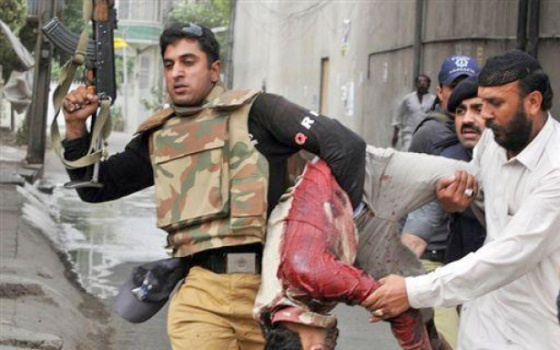
Elite Force rescues one injured at Garhi Shahu
By iNewp Citizen Journalist
Published: June 4, 2010


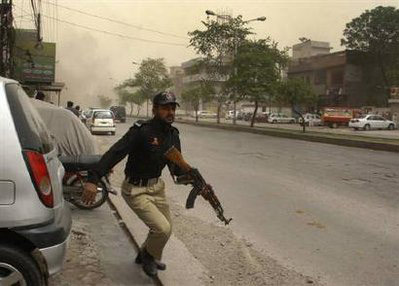
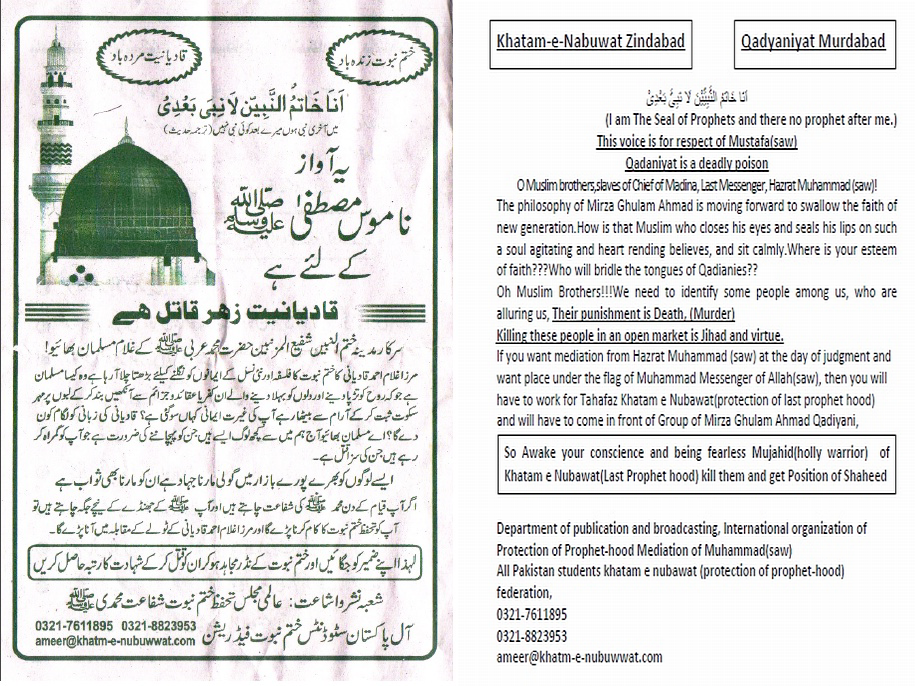
Even during the immediate aftermath of last Friday’s brutal attacks on two Ahmadi mosques in Lahore, Pakistan, even as Ahmadis around the world attempt to comprehend the savagery that has swept through their community, there are those who doubt the religious hatred which motivated these attacks. These skeptics claim that the attacks are simply the latest in a series of attacks by Islamic extremists against innocent Pakistani citizens, attacks in which militants target people indiscriminately. Therefore, they claim, these attacks should receive no special treatment or discussion.

This is disingenuous at best. The extremists who perpetrated these attacks were aided by the government, media, and people of Pakistan.

The government’s role in this tragedy began in 1974, when it declared Ahmadis to be “non-Muslim.”

As Pakistan is an Islamic state, this had wide-reaching ramifications for Ahmadis. A further injustice occurred in 1984, when it became illegal for Ahmadis to practice their faith. One of the consequences of these laws was that it became a trivial matter to accuse an Ahmadi of blasphemy, a crime in Pakistan punishable by fines and prison. Though the rule of law is tenuous at best in Pakistan, the situation is even worse for an Ahmadi.

It is commonplace for the government to ignore Ahmadis who have been threatened, harassed, or attacked.

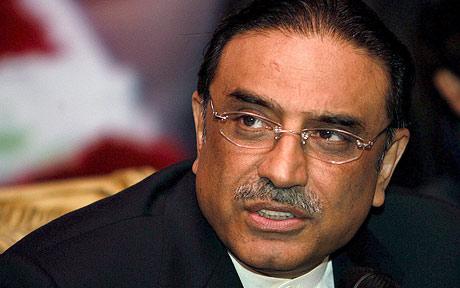
Occasionally, this is taken to the cruelest extremes: murderers of Ahmadis, often religiously motivated, face no consequences. Local and provincial governments are no better; they often claim to be taking action while sitting idly, ignoring the plight of their citizens. This gross mistreatment of the Ahmadi community is exemplified by the fact that even today, almost a week after the attacks in Lahore, the government, led by President Asif Ali Zardari has not issued any statements condemning the attacks or offering condolences to the community.

President Asif Ali Zardari of Pakistan
President Asif Ali Zardari of Pakistan.
Alongside Pakistan’s government, the media has chosen to ignore the needs of the Ahmadi community. If an Ahmadi is murdered, it goes unreported; if an anti-Ahmadi rally takes place, the views of the Ahmadi community are not represented.

After the Lahore attacks, the Ahmadi community held a press conference which went completely ignored by Pakistan’s news outlets. That an average Pakistani citizen’s knowledge of Ahmadis comes from the community’s opponents is only a natural consequence of the lack of fair reporting.

Finally, and perhaps most dishearteningly, the people of Pakistan are complicit regarding their government’s treatment of the Ahmadi community. It has become extremely difficult for Ahmadis to advance in government careers or work for many Pakistani companies—because of their beliefs.

An Ahmadi can also expect to be ostracized or treated poorly by friends and family who don’t share their beliefs. Many Ahmadis, in order to protect themselves, do not associate with those outside of the religion or are extremely discreet about it.

In Pakistan, Ahmadis are stripped of many of their fundamental rights. They have few allies. The government has abandoned them, the media ignores them, and the Pakistani people have left them to bleed. To say that the Lahore attacks, attacks which deliberately targeted Ahmadis, are not worthy of special attention is beyond callous—it’s dead wrong. The Lahore attacks, which left more than ninety people dead, were not acts of random, extremist violence. They were premeditated attacks which could have only occurred in an atmosphere created by the widespread institutional and social bias against the Ahmadi community.

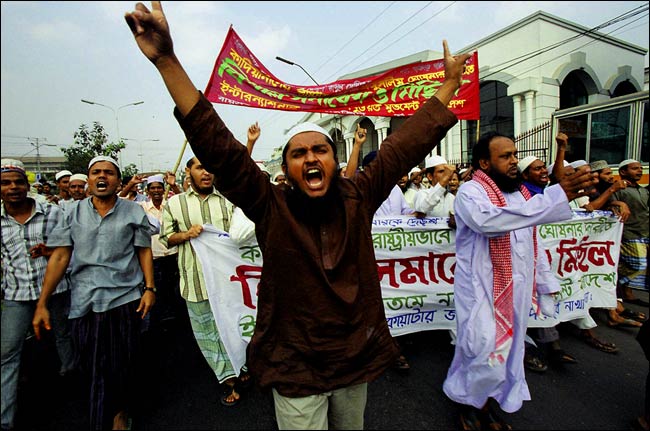
Militant Islamists protest outside an Ahmadiyya mosque; Ahmadiyya Muslims are accused of being infidels and are often victims of violence. (Meredith Davenport for The New York Times)
To correct the misperceptions about Ahmadis inculcated in the Pakistani population will take time, but the government must stop treating Ahmadis as second-class citizens.

All courses of action which will achieve these ends begin with the repulsion of the Second Amendment to the Pakistan Constitution, which declares Ahmadis to be non-Muslim. The government must also repeal the blasphemy laws which have been used to oppress countless people, not only Ahmadis.

Equality under the law is an ideal which the Pakistan government must strive for, regardless of the citizen’s religion. Only when these laws have been repealed will peace be on the horizon for not only the beleaguered Ahmadi community in Pakistan, but other minority groups like the Christians and Sikhs who all call Pakistan their home.

(Cover Picture: AFP) — Article Contributed By: Nurul Ain


^ Top of Page