Showing posts with label Ahmedis. Show all posts

Monday, October 10, 2011

Qadri supporters rail against US, Ahmadis

Express Tribune, Pakistan
Pakistan
Punjab
Qadri supporters rail against US, Ahmadis
By Rana Tanveer
Published: October 10, 2011
Sunni Ittehad announces ‘Remove government’ train march on Nov 21. PHOTO: AFP
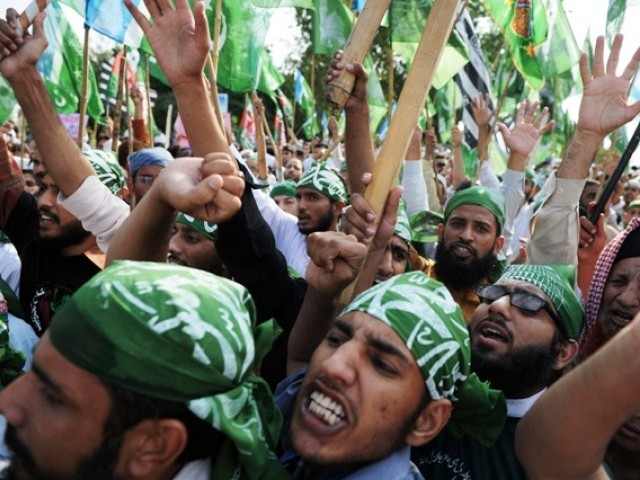
LAHORE: Speakers at the Sunni Ittehad Council’s (SIC) National Khatam-i-Nabuwat Conference railed against the death sentence handed to Mumtaz Qadri for the murder of Salmaan Taseer, as well as Ahmedis and America, on Sunday.

SIC Chairman Sahibzada Fazle Karim announced that they would hold a ‘Remove government’ train march from Rawalpindi to Karachi on November 21 to press for Qadri’s release. “We will not let them hang Mumtaz Qadri,” he said to loud cheers. He said that Islam allowed the killing of a blasphemer.

Karim said Ahmedis were conspiring with America against Islam. He said that the SIC would fight for Islamic rule in Pakistan. They would also stop “the US dream of Indian supremacy in the subcontinent” from becoming a reality. He said the Sunni Tehrik was being victimised in Karachi and demanded that the government release its workers and leaders.

Jamat Ahle Sunnat (JAS) Nazim Aala Allama Syed Riaz Hussain Shah also spoke out against Ahmedis, saying they were “agents of anti-Pakistan forces” and involved in anti-state activities.

JAS Ameer Syed Mazhar Saeed Kazmi said appointing Ahmedis to key posts was a violation of the Constitution. He demanded that all Ahmedis be expelled from key posts. He said Ahmedis were created by the British.

At the end of the conference, the participants passed a resolution demanding the government end unemployment and power outages, and the president pardon Mumtaz Qadri.

Published in The Express Tribune, October 10th, 2011.

Copyrighted © 2011 The Express Tribune News Network
URL: http://tribune.com.pk/story/270591/qadri-...us-ahmedis/

Friday, September 16, 2011

EDITORIAL: Religious freedom in Pakistan

Daily Times, Pakistan
Friday,
September 16, 2011

EDITORIAL: Religious freedom in Pakistan

US Department of State’s July-December, 2010 International Religious Freedom Report has documented “major developments with respect to religious freedom in 198 countries and territories”. The report placed China, Eritrea, Iran, Myanmar, North Korea, Saudi Arabia, Sudan and Uzbekistan as “countries of particular concern” regarding religious freedom while 10 other countries, including Pakistan, were cited for failing to sufficiently protect religious rights. The report has raised important points regarding our country. On Pakistan, it says: “The government did not reform a blasphemy law that had been used to prosecute those who belong to religious minorities, and in some cases Muslims who promote tolerance. The government also used provisions of the penal code to prevent Ahmedis from practicing their religion. Members of other Islamic sects, Christians, Sikhs, and Hindus also reported governmental and societal discrimination…The government of Pakistan rarely prosecuted perpetrators of extremist attacks, deepening the climate of impunity.”

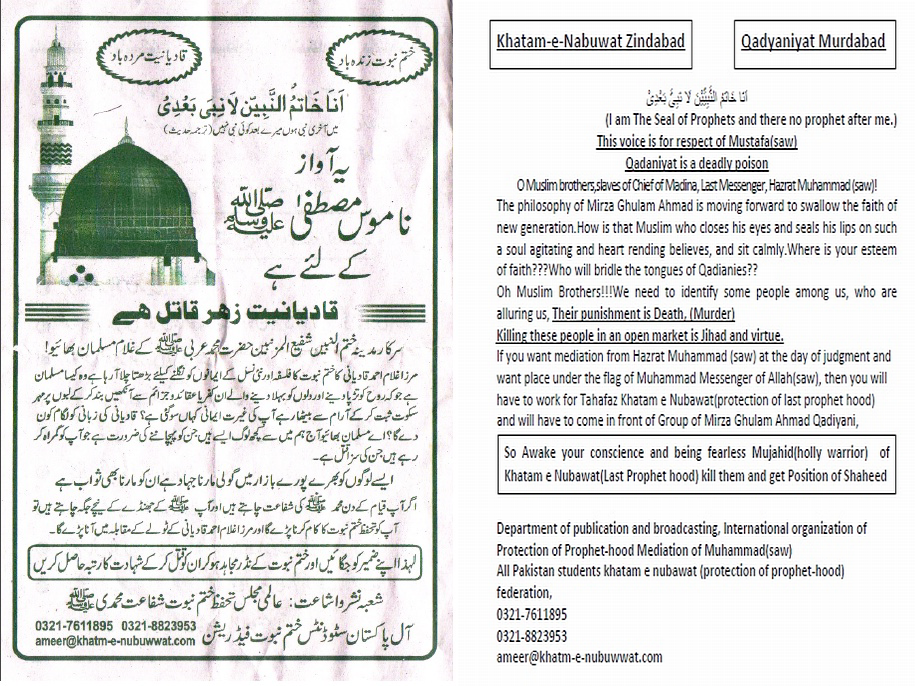
When late Governor Salmaan Taseer raised the issue of amending the blasphemy laws, he was silenced by a fanatic’s bullets. With Mr Taseer’s death, the issue of blasphemy laws also died a silent death. Minorities Minister Shahbaz Bhatti was the second victim of the religious fanatics who opposed anyone challenging the flawed blasphemy laws. These laws have been used to settle petty feuds, personal rivalries, property disputes, etc, both against the Muslims and non-Muslims by people with vested interests. Many Islamic scholars are of the opinion that Pakistan’s blasphemy laws are man-made and thus can be changed since they are not based on Islamic teachings. Unfortunately, anybody who dares to challenge the veracity of these laws as per Islamic jurisprudence are threatened, harassed and/or killed. The government has, by the looks of it, given up on any debate regarding the blasphemy laws in view of two publicised killings of politicians this year — Punjab Governor Salmaan Taseer and federal Minorities Minister Shahbaz Bhatti. Blasphemy laws are not the only flawed laws present in Pakistan’s statute books. General Ziaul Haq might not have been responsible for declaring the Ahmedis non-Muslims but the laws promulgated under his command banning the Ahmedis from practicing their religion openly led to the persecution of the Ahmediyya community. The hate campaign against the Ahmedis continues to date. Just this year, Tehrik-e-Tahafuz-e-Khatm-e-Nabuwat took out pamphlets openly inciting violence against the Ahmedis in Punjab. It has led to various attacks on Ahmedi citizens resulting in the deaths. So far, the Punjab government has not just failed to nab the culprits but it has also turned a blind eye to such hate-mongering campaigns in the province. Sectarian violence is rampant all over Pakistan. Many Shias have lost their lives at the hands of banned sectarian outfits like the Lashkar-e-Jhangvi (LeJ) and Sipah-e-Sahaba Pakistan (SSP). These outfits have the overt and covert support of our intelligence agencies, which is why no action has been taken against them either. Christians, Hindus and Sikhs do not feel safe in this hostile environment. Religious minorities are treated worse than second-class citizens in our country.

There are many reasons for religious intolerance in Pakistan. Madrassas, jihadi organisations, textbooks with distorted history, sermons by illiterate and intolerance clerics, etc, are but a few reasons why Pakistan remains one of the most intolerant societies worldwide. The government must bring about educational reforms and close down religions seminaries or at least bring them into the mainstream. Hate literature should be banned. The military’s flawed policies of supporting sectarian outfits and other religious organisations must come to an end apart from making Pakistan’s constitution secular in letter and spirit. *

Monday, March 21, 2011

Year 2010, bloodiest chapter in history of Ahmedi killings

Daily Times, Pakistan
Monday, March 21, 2011

Year 2010, bloodiest chapter in history of Ahmedi killings

By Afnan Khan

LAHORE: The year 2010 witnessed a series of intermittent persecutions of Ahmedis and can be labelled as the bloodiest chapter in the history of the minority’s killings in Pakistan with an unprecedented number of assassinations including a twin terrorist attack on their worship places in Lahore.

At least 98 people were gunned down for following Ahmedis’ religious beliefs, while 86 were brutally killed and 124 injured when terrorists attacked their worship places in the city last year on May 28. Separately, several others survived assassination bids during numerous incidents in different parts of the country.

Among the victims of the target killings was Professor Muhammad Yusuf, who was murdered by terrorists in his own locality.

Yusuf ran a small, charitable school at his house where he provided education to the poor and downtrodden children of Ferozwala area, irrespective of their colour, creed or caste. However, after Yusuf’s assassination, his own family was forced to flee to Sri Lanka in order to survive.

Separately, as per the annual report issued by the community’s information office, at least three Ahmedis were wrongfully booked under the blasphemy law and 67 others were unjustly charged with and dragged into religion-based cases.

The report also accused the civil judge Mirpur for sentencing three Ahmedis, namely Masood Ahmad Chandio, Abdul Razzaq and Abdul Ghani to three years of imprisonment in March 2010 under Ahmedi specific law. Meanwhile, three others, namely Muhammad Qasim, Mazahir Ahmad and Ahmad Yar, were arrested under PPC 298-C and 295-C on false accusation of preaching and blasphemy in Sargodha.

Other incidents involving injustices to Ahmedi citizens include handing over the control of an Ahmadiyya worship place in Ahmad Nagar to non-Ahmedis on January 14 last year as per the orders of the Chiniot District Co-ordination Officer and the denial of shelter and food to the flood affected Ahmedis in the ravaged areas of southern Punjab.

Friday, August 20, 2010

HRCP condemns denial of relief to Ahmedis

HRCP
Date: 20 August 2010
HRCP condemns denial of relief to Ahmedis

The HRCP is shocked by reports that government officials and local clerics have refused to provide shelter to around 500 flood-affected Ahmedi families from Dera Ghazi Khan, Muzaffargarh and Rajanpur districts

Lahore, August 20: The Human Rights Commission of Pakistan (HRCP) has expressed serious concern over the murder of two Ahmedis in the last three days and over reports of denial of shelter to members of the Ahmedi community displaced by massive floods in South Punjab, and has called upon the government to take urgent measures to ensure there is no discrimination on the basis of belief and that assistance and protection are not denied to a community that faces specific threats.

In a statement issued on Friday, HRCP said: “The unrelenting targeted killings of members of the Ahmedi community by extremists is a poor reflection on the State’s obligation to protect the lives of all subjects. This week, the murder of an Ahmedi in Sanghar and another, a doctor, in Karachi only highlights the impunity the perpetrators of such heinous crimes enjoy. Only bringing the culprits to justice and promoting tolerance in society would bring an end to these senseless killings and would give the Ahmedi community confidence that they can lead peaceful lives as equal citizens of Pakistan.

The HRCP is also shocked by reports that government officials and local clerics have refused to provide shelter to around 500 flood-affected Ahmedi families from Dera Ghazi Khan, Muzaffargarh and Rajanpur districts.

The Commission has noted with extreme concern reports of lack of provision of relief goods to the flood-affected Ahmedi families, expulsion of displaced Ahmedis from a government school in Dera Ghazi Khan and from rented lodgings elsewhere in South Punjab following clerics’ pressure as well as the issuance of edicts by clerics that the affected Ahmedis must not be provided help.

HRCP reiterates the urgent need for distribution of relief goods and extension of other support to the affected people without any discrimination on the basis of faith or gender. The fact that the Ahmedis are a vulnerable community on account of their religious beliefs must lead to specific assistance and protection measures for them, including protection of their lives and property.

The extensive scale of displacement and destruction by the massive floods has understandably stretched the resources of the government to their very limits. However, it is hoped that whatever little is available from any source will be distributed among those in need without discrimination on the basis of religious belief. It would be a greater tragedy than the devastation caused by the floods if the people cannot find enough humanity and compassion in their hearts to rise above personal biases to help without distinction fellow human beings that are in desperate need of help.”

Dr Mehdi Hasan
Chairperson


URL: http://www.hrcp-web.org/showprel.asp?id=158

Thursday, June 10, 2010

Religious Leaders Imply Ahmedis not Victims

Newsline, Pakistan
Home »
Blog Row, The Water Cooler
Religious Leaders Imply Ahmedis not Victims
By Talib Qizilbash                                          10 JUNE 2010
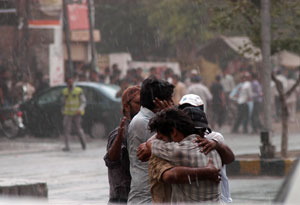
Drowned in sorrow: Men console each other after the deadly attacks on Ahmedi places of worship on May 28. Photo: AFP

First they condemned the attacks. Religious parties got together after the May 28 attacks on the Ahmedi places of worship and termed them un-Islamic (while tempering their criticism with some conspiracy theories). The News reported this:


Jamaat-e-Islami ameer Syed Munawwar Hasan termed the attacks on the Youm-e-Takbeer a conspiracy to trigger a civil war in the country and justify the US interference in the country. He said Islam strongly prohibited persecuting minorities and causing any harm to their worship places. He said the minorities in the country had always been secure and Islam made it a state responsibility to protect them.

Of course, everyone knows that minorities have NOT always been secure in Pakistan, but at least the religious parties agreed that the attacks on the Ahmedi community “were uncalled for and condemnable”.

But clearly it was false sympathy and crocodile tears. The view that the attacks were also, as reported by The News, a foreign “conspiracy to malign the country in the world in order to put more pressure [on Pakistan] regarding a change in the blasphemy laws” came with a sickening twist yesterday.

A BBC Urdu article reported on a Lahore meeting of leaders of the Muttahida Tehrik-i-Khatm-i-Nabuwat where the attendees concluded that the May 28 attacks on Ahmedis were part of a conspiracy to repeal the laws against them and challenge the finality of the Prophethood. There is an inherent insinuation that Ahmedis were an active part of the conspiracy; that Ahmedis hired terrorists to kill other Ahmedis in order to garner attention because they want to remake Islam. So, Ahmedis are not the real victims here?

This is like 9/11 conspiracy theorists: Americans killed Americans to launch a crusade against Islam.

Further, a Dawn.com report referencing the BBC article said that “the gathering was attended by leaders of the Jamaat-i-Islami, Jamiat-i-ulema-i-Islam Fazlur Rahman group, Jamaatud Dawa and Markazi Jamaat-i-Ahl-i-Sunnat among others” and that “Maulana Ilyas Chinioti, a member of the PML-N and the Punjab provincial assembly, condemned Nawaz Sharif’s statement in which he had sympathised with the Ahmadis and called them his brothers.”

Maulana Chinioti seems to be openly preaching that non-Muslims are lesser humans: only certain Pakistanis who are brutally massacred are worthy of pity. Our religious leaders believe Allah to be the most compassionate and merciful (and expect Him to show compassion towards them) but do they not believe they have a duty to love and show compassion in their lives (or even try to show compassion) to all people of all faiths. The people killed and injured on May 28 were innocent people, harming no one, only kneeling before God in peace. What about the verse from the Quran that says “killing one innocent person is regarded as the equivalent to killing all of mankind?”

The US, Israel and India (and whatever other foreign agents are at work) do not have to do anything to “malign the country in the world.” These religious and political ‘leaders’ are doing a fine job themselves.

Talib Qizilbash has been freelance writing since 2003. He joined Newsline in 2006, working as both a writer and editor. He is currently the magazine’s online editor.

URL: www.newslinemagazine.com/2010/06/religious-leaders-imply-ahmedis-not-victims/

Editor’s Note: June 2010

Newsline, Pakistan
Home »
Editorial, Opinion
Editor’s Note: June 2010
By Rehana Hakim                                                   10 JUNE 2010

Pakistan is fast becoming a state that will be habitable only for extremists: religious bigots who hold the view that only Muslims (as defined by them) have the right to live in this country – and that all non-Muslims are kafirs, infidels who are wajib-ul-qatl or deserve to be killed. Further, that all those who kill them are guaranteed a place in heaven, replete with houris and streams of milk and honey.

It’s criminal that those who harbour such hatred are being allowed to operate with impunity, to spout venom from the pulpits of mosques, to train in the Punjab government’s backyard while the head honcho feigns ignorance, even as his own law minister is seen hobnobbing with the Sipah-e-Sahaba at an election rally in Jhang.

Is it any surprise then that two dastardly attacks are carried out in broad daylight on Ahmedi mosques in Lahore, killing 95 people and injuring a 100 more. This is followed by yet another strike by the same terrorist group at a government hospital – to kill or secure the release of an accomplice recuperating in the same emergency ward as the victims of the earlier attacks.

How does this reflect on the intelligence and state of preparedness of this country’s security network that still remains ‘unaware’ of the hideouts of these elements, who have been making life intolerable for Pakistan’s small minority communities for several years now?

Ahmedi mosques, Christian churches and Hindu temples have been vandalised, their properties burnt or seized illegally; additionally, forcible conversions and marriages have taken place. And the culprits have always managed to escape the (not-so-long?) arm of the law.

Ironically, it is these very characters who have been quick to use the controversial blasphemy law to implicate minorities in false cases and make sure that they are lynched by charged mobs or left to rot in jails forever. Any attempts to make amendments to this law have met with stiff resistance from them, forcing the government to back off.

Consequently, the perpetrators of these hate crimes are getting bolder by the day. Three days after the attacks on the Ahmedi mosques, a father and son from the community were stabbed by a fanatic in Narowal wanting to convert them. The father died instantaneously. The hate crimes against the Shias have not ceased either. Yet another young doctor was gunned down – a stark reminder of the murder of 74 other Shia doctors in Karachi between the early 1990s and 2002, which remain unresolved to this day.

Likewise, the victims of the Gojra and Shantinagar incidents in which several Christian families lost their family members and property are yet to get any justice. There are no accused to hold to account – and the few who were arrested have been acquitted for “want of evidence.”

What evidence would be needed to prove an “identified” accused’s culpability? Only recently, Maulana Aziz and his entire family were acquitted of charges of illegally occupying a children’s library in Islamabad for lack of evidence.

Wasn’t this “illegal occupation” one of the causes that had sparked off the whole Lal Masjid furore in the first place? This fact was reported in the country’s major newspapers at the time. If these reports were inadmissible in a court of law, why couldn’t the police find any witnesses to substantiate the charge? Was it the threats from extremist forces or orders from some relevant quarters at the top that made the police and the prosecutor back off?

Rehana Hakim is one of the core team of journalists that helped start Newsline. She has been the editor-in-chief since 1996.

Wednesday, June 9, 2010

‘Attack on Ahmedis conspiracy to repeal laws against them’

Daily Dawn, Pakistan
PAKISTAN


‘Attack on Ahmedis conspiracy to repeal laws against them’
Wednesday, 09 Jun, 2010

People from Ahmadi community prepare to bury a casket containing a victim of an attack by militants, at their graveyard in Rabwah, some 150 kilometres northwest from Lahore, May 29, 2010. - AP
People from Ahmadi community prepare to bury a casket containing a victim of an attack by militants, at their graveyard in Rabwah, some 150 kilometres northwest from Lahore, May 29, 2010. — AP

LAHORE: A gathering of the leaders of 13 religious and political parties in Lahore claimed that the attack on Ahmedis on May 28 was part of a conspiracy to repeal the laws against them, BBCUrdu reported.

The meeting was held in an office of the Majlis Ahrar Islam in Lahore’s Muslim Town. The parties concluded that a conspiracy was in place to debate the laws against Ahmedis, the report said.

Maulana Zahidul Rashdi, who is a founding member of the Muttahida Tehrik-i-Khatm-i-Nabuwat and also the Secretary-General of the Pakistan Shariat Council, read the joint statement at the meeting’s conclusion: The attack on Ahmedis is being used as an excuse to generate suspicions regarding the concept of khatm-i-nabuwat.

The gathering was attended by leaders of the Jamaat-i-Islami, Jamiat-i-ulema-i-Islam Fazlur Rahman group, Jamaatud Dawa and Markazi Jamaat-i-Ahl-i-Sunnat among others.

During the meeting, Maulana Ilyas Chinioti, a member of the PML-N and the Punjab provincial assembly, condemned Nawaz Sharif’s statement in which he had sympathised with the Ahmedis and called them his brothers.

The meeting’s participants demanded that Nawaz Sharif immediately withdraw his statement.

©2010 DAWN Media Group. All rights reserved

Tuesday, June 8, 2010

Not an eye-opener: time to act

Daily Times, Pakistan
Tuesday, June 08, 2010

VIEW: Not an eye-opener: time to act —Daud Khattak


Daud KhattakThe current set up of militants is the amalgamation of many diverse elements from different areas and backgrounds with the apparent patronage of the Wahabi-dominated al Qaeda out to carry forward its religious-political agenda in the region

Few countrymen rejoiced as the military high command announced victory against militants in the Orakzai tribal agency the other day mainly because the bleeding sore is finally emerging in the heartland of Pakistan now.

Friday’s blatant attack on the Ahmedis’ places of worship in Lahore followed by an audacious attack on the ICU of Jinnah Hospital in the same city just two days after, and that too at a time when the so-called ‘stepped up’ security measures were in place, is anything but an eye-opener for the Punjab government to do away with its compromising stance towards the religious bigots operating in the name of Jaishs, Lashkars, Tehriks, Hezbs or anything of the sort.

Alarm bells have been ringing about the breeding grounds, training facilities and presence of leadership of various sectarian, jihadi and other banned militant outfits in southern Punjab over the past few years, but criminal negligence on part of the previous and current government emboldened religious extremists to challenge the government and security agencies in the provincial capital of Lahore, the most secure and peaceful of Pakistani cities.

The Friday and Monday night brazen strikes are not the first in this eastern city. Rather, those were par for the course underway in Lahore or other cities of Punjab and even Azad Kashmir since early 2009.

The first of the series was the March 3, 2009, attack on the visiting Sri Lankan cricket team that killed eight people, besides tarnishing the image of Pakistan and blocking the way of international cricket in the country for many years to come.

On March 30, 2009, armed men attacked the Manawan police station killing eight people. That same year, on October 15, three simultaneous terrorist attacks were carried out in Lahore killing 30 people. And the twin suicide attacks in the same city on March 12, 2010, killed 45 more people.

Besides, two major and daring attacks were also carried out in Rawalpindi, home to the headquarters of the Pakistan army, on the GHQ and a high-profile mosque in October and December 2009 respectively.

But, to the dismay of many, the Punjab government, instead of picking up the gauntlet, continued with its compromising attitude and occupied a reactionary position instead of advancing with action.

While sectarian groups were already holding all the aces in southern Punjab, jihadi outfits started camping there following the withdrawal of support by former president Pervez Musharraf for their armed struggle in Indian Occupied Kashmir in 2006 and 2007.

Finding no other way to quench their jihadi hysteria and thirst, these young misguided men, numbering in the hundreds and later multiplying into the thousands, started pouring into the tribal region, where the predominantly Pashtun Tehrik-i-Taliban Pakistan (TTP) was spreading its offshoots with full impunity and attracting youth from the lawless region through its heroic statements and videos about fighting against the Afghan and ‘infidel’ forces in neighbouring Afghanistan.

The mishandling of the Laal Masjid episode proved to be a catalyst. The Punjabi Taliban, mainly belonging to banned sectarian and jihadi outfits, got so much leverage in the TTP that they were given seats in the 40-member Shura of the Pashtun-dominated umbrella of Taliban groups.

It was during their stay in the TTP — an associate of the US-declared terrorist network of al Qaeda — that those dubbed the Punjabi Taliban discovered new recruitment vistas, financial backup and technical and planning support, mainly from al Qaeda. As their bases remained intact in southern Punjab, while the number of religious seminaries multiplied over the years there, members of the jihadi and sectarian outfits returned to their old bases along with some of their TTP leaders and colleagues, following the increasing attacks by CIA-operated spy planes and the launching of operations by the Pakistani security forces in the tribal areas.

The obvious case, in this connection, is that of one Dr Osman who was allegedly involved in the October 2009 attack on the GHQ. In the first stage, Osman was a member of the sectarian outfit Lashkar-e-Jhangvi, who then went on to join the TTP and later became a member of the al Qaeda network.

Though an investigation spanning some years has yet to bring something to the fore, some recent statements from top government functionaries revealed that the Lashkar-e-Jhangvi was involved in the 2008 bombing of a five-star hotel in Islamabad.

It is depressing, at least for the peace-loving citizens of Pakistan, to see that a militant outfit that once used pistols, AK-47s and hand-grenades at worship places or gatherings of rival sects, could assume that much power, men, material and technical expertise to target high-profile places like a five-star hotel and the GHQ by using truckloads of explosives and several armed men without the knowledge of nearly half a dozen intelligence agencies, the police force and the all powerful army.

The current set up of militants full of religious frenzy is not as simple as to be called only the TTP, Lashkar-e-Jhangvi, Jaish, etc. It is the amalgamation of many diverse elements from different areas and backgrounds with the apparent patronage of the Wahabi-dominated al Qaeda out to carry forward its religious-political agenda in the region.

In the words of Rohan Gunaratna, author of Inside al Qaeda, “Jhangvi is now the eyes, ears and operational arm of al Qaeda and the TTP (based in Waziristan). It is hard to distinguish between the three.”

The fresh attacks in Lahore left no room for a second thought for the government in going all out against all these groups, their patrons and supporters, both materially and financially, in southern and the rest of Punjab.

The attacks per se should not be taken as an eye-opener to think over what to do. It is time to act and act decisively, lest it be too late to force the army to open another unending front like the ill-fated tribal region.

The writer can be reached at daud_72@yahoo.com

The demand for Pakistan and Islam

Daily Times, Pakistan
Tuesday, June 08, 2010

VIEW: The demand for Pakistan and Islam

The Muslim League’s propaganda struck terror in the hearts of the Hindus and Sikhs who were told that they would be paying jazya and Islamic law will prevail in all sectors of individual and collective life. The minority Shia and Ahmediyya communities were also fearful that it would result in Sunni domination

The recent attack on a congregation of Ahmedis during prayers, which claimed more than 90 innocent lives, has revived a discussion as to whether there is a connection between the creation of Pakistan and Islam. Within the Muslim League there was always a constituency in favour of Pakistan becoming an Islamic state. One of its proponents was a close confident of Jinnah: Raja Sahib Mahmudabad, a Shia. In 1939 he wrote to the historian Mohibul Hassan:

“When we speak of democracy in Islam it is not democracy in the government but in the cultural and social aspects of life. Islam is totalitarian — there is no denying about it. It is the Quran that we should turn to. It is the dictatorship of the Quranic laws that we want — and that we will have — but not through non-violence and Gandhian truth” (Mushirul Hasan, 1997: 57-8).

If the March 23, 1940, Lahore Resolution be taken as the start of the Pakistan campaign, then Jinnah had to make a breakthrough in the Muslim-majority provinces of northwestern India — Khyber Pakhtunkhwa, Punjab and Sindh — each of which had regional parties headed by Muslims. The Muslim League had to convince the Muslim voters in these provinces that their leaders were courting Hindus and Sikhs and thus were paving the way for Hindu Raj under the Indian National Congress. That opportunity arrived in July 1945 when the British government announced provincial elections for February 1946. Punjab Governor Sir Bertrand Glancy has recorded in several secret fortnightly reports (FR) the tactics that the Muslim League adopted during the long election campaign. In the FR of December 27, 1945, Glancy noted:

“Among Muslims the Leaguers are increasing their efforts to appeal to the bigotry of the electors. Pirs and maulvis have been enlisted in large numbers to tour the province and denounce all who oppose the League as infidels. Copies of the Holy Quran are carried around as an emblem peculiar to the Muslim League. Feroz [Khan Noon] and others openly preach that every vote given to the League is a vote cast in favour of the Holy Prophet (PBUH). These deplorable tactics, as I have frequently said, were only to be expected; they provide a grim augury of the future peace of India and they are certainly not easy for the Unionists to counter” (Lionel Carter, 2006: 160).

In the FR of February 2, 1946, Glancy wrote:

“The ML [Muslim League] orators are becoming increasingly fanatical in their speeches. Maulvis and pirs and students travel all round the province and preach that those who fail to vote for the League candidates will cease to be Muslims; their marriages will no longer be valid and they will be entirely excommunicated…It is not easy to foresee what the results of the elections will be. But there seems little doubt the Muslim League, thanks to the ruthless methods by which they have pursued their campaign of ‘Islam in danger’, will considerably increase the number of their seats and Unionist representatives will correspondingly decline” (Carter, 2006: 171).

Similar tactics were adopted in the campaigns in Khyber Pakhtunkhwa and Sindh. In his doctoral dissertation, India, Pakistan or Pakhtunistan?, Erland Jansson writes:

“The pir of Manki Sharif…founded an organisation of his own, the Anjuman-us-asfia. The organisation promised to support the Muslim League on the condition that Shariat would be enforced in Pakistan. To this Jinnah agreed. As a result the pir of Manki Sharif declared jihad to achieve Pakistan and ordered the members of his anjuman to support the League in the 1946 elections” (pg 166).

Jinnah wrote in November 1945 a letter to Pir Manki Sharif in which he promised that the Shariat would apply to the affairs of the Muslim majority. He wrote:

“It is needless to emphasise that the Constituent Assembly, which would be predominantly Muslim in its composition, would be able to enact laws for Muslims, not inconsistent with the Shariat laws and the Muslims will no longer be obliged to abide by the un-Islamic laws” (Constituent Assembly of Pakistan Debates, Volume 5, 1949, pg 46).

The Muslim League’s propaganda struck terror in the hearts of the Hindus and Sikhs who were told that they would be paying jazya and Islamic law will prevail in all sectors of individual and collective life. The minority Shia and Ahmediyya communities were also fearful that it would result in Sunni domination. This is obvious from the correspondence between the Shia leader Syed Ali Zaheer and Jinnah in July 1944 (G Allana, 1977: 375-9). Although the Council of Action of the All-Parties Shia Conference passed a resolution on December 25, 1945, rejecting the idea of Pakistan (SR Bakshi, 1997: 848-9), most Shias shifted their loyalty to the Muslim League in the hope that Pakistan will be a non-sectarian state. Initially the Ahmediyya were also wary and reluctant to support the demand for a separate Muslim state (Munir Report, 1954: 196). It is only when Sir Zafarullah was won over by Jinnah that the Ahmedis started supporting the demand for Pakistan. To all such groups Jinnah gave assurances that Pakistan will not be a sectarian state.

In my forthcoming book on the partition of Punjab, now running into more than 1,000 pages but which is at last completed and for which I am now looking for a publisher, I will shed light on how the fierce Islamist propaganda impacted on the partition of Punjab. The Sikhs had more fears than anyone else about what could happen to minorities in Pakistan. In a meeting in May 1947 sponsored by Lord Mountbatten to help the Muslims and Sikhs reach an agreement on keeping Punjab united, Jinnah offered the Sikhs all the safeguards they wanted if they agreed to support Pakistan. Only in March 1947 some 2,000-10,000 Sikhs — depending on who you cite — were butchered in the Rawalpindi rural areas so the Sikhs were very wary of Jinnah’s overtures. Chief Minister of Patiala Hardit Singh Malik writes he had an inspiration and asked Jinnah: “Sir you are making all the promises but God forbid if something happens to you, what will happen then?” The exact words Jinnah used in reply will be revealed in my forthcoming book, but the reasoning was that his followers will treat his words as sacred.

Ishtiaq Ahmed is a Visiting Research Professor at the Institute of South Asian Studies (ISAS) and the South Asian Studies Programme at the National University of Singapore and Professor Emeritus of Political Science at Stockholm University. He is currently working on a book, Is Pakistan a Garrison State? He can be reached at isasia@nus.edu.sg

Monday, May 31, 2010

COMMENT: We are in it together

---Daily Times, Pakistan
Monday, May 31, 2010

COMMENT: We are in it together — Dr Syed Mansoor Hussain

The Ahmedis have never done anything to harm Pakistan, and yet those that opposed the creation of Pakistan are at the forefront of accusing them of being anti-Pakistan

After the Friday massacre in Lahore, I kept asking myself, how and why we have come to this point. I grew up in the Lahore of the late 50s and 60s. My family was not very religious but neither were they very liberal. I went through a typical upper middle class education for that time, English medium schools, followed by a couple of years in Government College (GC) and then five years in the King Edward (KE) Medical College.

During those years, I had of course heard about the Ahmedis and very probably had friends and classmates who were Ahmedi as there were Shias, Sunnis, and even some Christians, but never gave it a thought. The first time this sectarian anger against the Ahmedis came to the fore in my life was when as a second year student in KE, a classmate of ours died in a tragic swimming pool accident.

We decided to have a funeral prayer (namaaz-e-jinaza) for our classmate on the college campus. Suddenly out of nowhere appeared a bunch of students who belonged to the Islami Jamiat-i-Talaba (IJT) trying to convince us that the deceased was an Ahmedi and a funeral prayer should therefore not be held for him. Fortunately, a majority of students in our class ignored these IJT types and went ahead to offer the prayers.

My earliest memories of Lahore as a child were of processions, riots leading to curfews and eventually something called a Martial Law. Many years later when I went back and read about the early history of Pakistan, I realised that those riots were part of the anti-Ahmedi movement led by anti-Pakistan religious groups like the Ahrar and the Jamaat-e-Islami. Part of my reading included the ‘Munir Report’ written by Justices Munir and Kayani about those ‘disturbances’.

In that report I also found out that the Pakistan Muslim League (PML) government in Punjab led by Mian Mumtaz Daultana had aided and abetted this movement. Indeed that report was an eye-opener and is perhaps a great example of the erudition and the objectivity of the senior judiciary in Pakistan. In my opinion any serious student of the history of Pakistan must read that report.

The decade of the 60s ended with the fall of the military dictatorship of General and then Field Marshal Ayub Khan, leading to the second military dictatorship in the history of Pakistan led by General Yahya Khan. Whatever one might say about the 13 years under these two generals, Pakistan was very much a country infused by a pluralist religious ethos. Sectarianism existed but was very much in a muted and undercover form.

Towards the end of 1971 I left Pakistan for the US. When I left Pakistan it still had two wings, East and West Pakistan; however, soon the country went through a violent rupture. During the next decade, things changed a lot. The Ahmedis were declared non-Muslims by Zulfikar Ali Bhutto (ZAB), their mosques became ‘prayer houses’ and they were forbidden to call themselves Muslims.

Then came the evil decade of Islamisation in which Pakistan changed entirely. Religiosity of an extreme sort became the accepted norm, and virtually all Muslims not subscribing to an extremist vision of Islam became pariahs. The Ahmedis were pushed into a corner and became completely ostracised. The 1953 agitation against them had finally succeeded. All members of religious minorities who could, fled the country including the Parsees, the Christians, Hindus, and the Ahmedis.

For three decades I lived and worked in the US. Other than the family members of the close friends I made during those years, half were probably Jewish and the rest divided between Christians of different denominations, Indians including Hindus, Sikhs and a couple of Jains, and some Muslims from Pakistan. For me religion became the least important barometer of friendship. Frankly, for most of my professional life in the US, if I had to depend on somebody, it was the Jews followed by the Indians with the Pakistani sorts being quite unreliable as a group.

When I returned to Pakistan some years ago, another General was in charge, and ‘enlightened moderation’ was the slogan being touted by the General and his acolytes. Sadly, whatever the facade was, the reality was that Talibanisation and religious extremism were being pushed by the ‘establishment’. All claims of enlightened moderation were completely exposed when the attempt to take off the ‘religion’ column in the Pakistani passports failed. Like ZAB, Musharraf might have been a religious moderate, but he also gave in to the religious extremists to save his job.

The last few years have seen an escalation of both religiosity as well as religiously-motivated terrorism in Pakistan. It is true that many external factors are stimulating the extremist revival, the most important being the US-led invasion and occupation of first Afghanistan and then Iraq. But that does not absolve us in Pakistan from the charge of letting this menace grow.

It happened due to the collusion of the people in power and flourished because many ordinary Pakistanis support the violent and extreme vision of Islam that is pushed by the Taliban and their ilk. Of course the new democratic governments both at the Centre as well as in Punjab have made appropriate noises but they just do not have the gumption to come out openly against religious extremism and those that pander to it. Unless the ordinary people rise up against this menace, it will never be checked.

As far as the attack on the Ahmedi places of worship (cannot call them ‘mosques’ because that is against the law) is concerned, that is particularly despicable. People aggregate to worship Allah, and they become victims of an attack by those that claim to serve Allah. As far as I know the Ahmedis have never done anything to harm Pakistan, and yet those that opposed the creation of Pakistan are at the forefront of accusing them of being anti-Pakistan.

Syed Mansoor Hussain has practised and taught medicine in the US. He can be reached at smhmbbs70@yahoo.com

URL: www.dailytimes.com.pk/default.asp?page=2010\05\31\story_31-5-2010_pg3_3

Friday, May 28, 2010

Attackers Strike Sect Mosques in Pakistan

---Time CNN, USA                        World

Attackers Strike Sect Mosques in Pakistan
By AP/BABAR DOGAR                                  Friday, May. 28, 2010
 
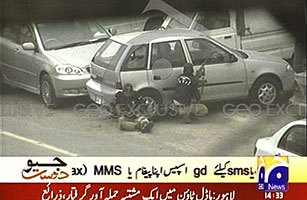
An image made from Geo TV video shows Pakistani police officer 
takes cover during a crackdown operation against militants in Lahore, 
Pakistan on Friday, May 28, 2010 - Geo TV / AP
An image made from Geo TV video shows Pakistani police officer takes cover during a crackdown operation against militants in Lahore, Pakistan on Friday, May 28, 2010 - Geo TV / AP
(LAHORE, Pakistan) Gunmen armed with grenades attacked two mosques of a minority sect during Friday prayers in eastern Pakistan, seizing control of one mosque and battling with police, officials and witnesses said. At least 20 people were killed, and worshippers were believed held hostage.

The attacks by suspected Islamist militants in Lahore city targeted the Ahmadi sect, which has experienced years of state-sanctioned discrimination and occasional attacks by radical Sunnis. It has never before been hit on such a large scale or coordinated fashion.

One of the attackers climbed atop the minaret of one of the mosques, firing an assault rifle and throwing hand grenades, TV footage showed. Outside, police were engaged in a fierce gunfight with the attackers, an Associated Press reporter at the scene said.

Police officer Imtiaz Ahmad said several attackers were inside and were suspected to be holding hostages.

Outside the other mosque several kilometers (miles) away, a witness complained of police inaction when the attackers struck.

“I asked the policeman to open fire. He told me he could not because he only had four bullets in his gun,” said Ghalib Hussain.

Dr Rizan Nasir said 20 people had been killed in one mosque. Figures were not available for the other.

Pakistan has seen scores of attacks by groups of Islamist militants against government, Western and security force targets over the past three years. Lahore, the second largest city in the country and a vital a military and political center, has been the scene of several.

Many Islamist militants believe it is permissible or honorable to kill non-Muslims, or even those Muslims who do not share their views.

The Ahmadis call themselves Muslims but believe their founder declared himself a prophet centuries after Muhammad, who other Muslims believe was the final prophet. They have long been subject to informal and state-sanctioned discrimination in Pakistan.

An Ahmadi spokesman said the sect abhors violence and was deeply concerned about the attacks.

“We are a peaceful people and monitoring the situation and hoping and praying that the authorities are able to take all necessary action to bring the situation to normalcy with the least number of casualties,” Waseem Sayed said via e-mail from the United States, where he lives.

Under pressure from hard-liners, the Pakistani government in the 1970s declared the Ahmadi a non-Muslim minority. They are prohibited from calling themselves Muslims or engaging in Muslim practices such as reciting Islamic prayers.

There are an estimated 4 million Ahmadis in Pakistan out of a total Muslim population of around 170 million.

© 2010 Time Inc. All rights reserved
Source : www.time.com/time/world/article/0,8599,1992573,00.html

Thursday, April 29, 2010

Pakistan’s Punjab region on knife-edge as extremists take hold, says governor

---Guardian, UK
News > World > Pakistan
Pakistan’s Punjab region on knife-edge as extremists take hold, says governor
Politicians accused of backing banned groups as minorities suffer violence and intimidation
Saeed Shah Faisalabad
guardian.co.uk, Thursday 29 April 2010 19.31 BST


Pakistan’s heartland Punjab province is an extremist “bomb” ready to explode, the region’s highest official has warned, with the recent targeting of minority groups seen by some as evidence of jihadists’ grip on the area.

The provincial governor accused the regional government, led by former prime minister Nawaz Sharif’s party, of tolerating or even supporting extremists, who are said to operate openly in Punjab free from the military operations waged against Taliban guerrillas in the area bordering Afghanistan.

“The Sharifs are creating a potential bomb here in Punjab,” said Salman Taseer, the governor of Punjab, who was appointed by the national government. “These [militant] groups are armed and dangerous. There is no way you can accommodate these people. There has to be zero tolerance.”

In recent weeks, a spate of armed robberies and kidnappings of the Ahmedi sect in the city of Faisalabad was traced to members of Jamaat-ud-Dawa, the group previously known as Lashkar-e-Taiba that was blamed for the devastating 2008 terrorist attack on Mumbai. Three Ahmedis were also shot dead, thought to be the work of the same group.

Sharif’s opponents accuse his party, the opposition Pakistan Muslim League-N – whose support comes partly from the religious right – of accommodating extremists such as Sipah-e-Sahaba, a banned sectarian group blamed for the deaths of hundreds of Shias.

In Jhang town, a byelection last month saw Sharif’s party openly court Sipah-e-Sahaba supporters. Punjab’s law minister, Rana Sanaullah, was pictured on the campaign trail with the alleged head of the group, Ahmed Ludhianvi.

Experts believe that the Pakistani Taliban is deeply influenced by Sipah-e-Sahaba, with the Taliban’s leader, Hakimullah Mehsud, a former member.

Sheikh Waqas Akram, an opposition member of parliament from Jhang, which is the headquarters of Sipah-e-Sahaba, likened the situation in Punjab to the Swat valley, where official inaction allowed the Taliban to take over in 2008. “There can be 10 Swats in Punjab, if you don’t check them [extremists],“ said Akram.

But Sanaullah denied the claims, saying that while banned groups operated in the province there was no “Talibanisation” in Punjab. “Not a single street where you can say there is a no-go area,” he said.

Sanaullah said that groups based in the north-west were behind the terrorist attacks in Punjab, not local organisations, adding that “95% of the people of Sipah-e-Sahaba are not terrorists”. He said: “We must persuade these persons to put aside their guns, to participate in elections. They have the right to vote, so why can’t I ask them [Sipah-e-Sahaba] for votes?“

Over the last year the affluent Ahmedi community in Faisalabad has been rocked by a campaign of violence and intimidation, which intensified in recent weeks. Ahmedi are classified as non-Muslims under Pakistani law, for believing that Muhammad was not the final prophet.

Police arrested four suspects last month. Three days later, on 1 April, three members of an Ahmedi family were shot dead as they returned from work. Their car was sprayed with bullets, in what police believe was a “very professional” hit and possible revenge for the arrests.

“The four people in jail are in Jamaat-ud-Dawa,” said senior Faisalabad police officer Abid Hussain. “They told us that they got a decree from a maulvi (priest) in their group that says that robbing, kidnapping and killing Ahmedis is allowed and would be rewarded in heaven.”

The city’s Ahmedi community have restricted their movements and some have hired bodyguards.

“We are now scared to leave the house, when the door bell rings, we are frightened about who might be there. Outside, we feel always like someone is following us,” said Mohammad Iqbal Ahmed, whose son and nephew were kidnapped in March and returned after the payment of a £20,000 ransom.

© Guardian News and Media Limited 2010
URL : www.guardian.co.uk/world/2010/apr/29/pakistan-punjab-taliban

Pakistan’s Punjab heartland alive with extremist groups

---McClatchy News, USA
Posted on Thursday, April 29, 2010
Pakistan’s Punjab heartland alive with extremist groups
By Saeed Shah | McClatchy Newspapers

FAISALABAD, Pakistan — Even the Pakistan army conducts military operations against Taliban guerrillas in northwest tribal areas bordering Afghanistan, banned al Qaida-linked groups are operating openly in the Pakistani heartland of Punjab, which itself has been the target of dozens of terror attacks.

The province on Pakistan’s eastern border with India is home to more than half the country’s population and functions as its economic and political powerhouse, as well as the main recruiting ground for the military.

It is the stronghold of Prime Minister Nawaz Sharif, who leads the opposition to President Asif Zardari’s Pakistan Peoples Party, which rules nationally from Islamabad.

Critics accuse Sharif and his brother, the chief minister, of accommodating extremist groups like Sipah-e-Sahaba, a banned sectarian group blamed for the killing of hundreds of Shiites, the minority sect of Islam. The Sharifs draw political support from the religious right.

During a recent election campaign, Punjab’s law minister, Rana Sanaullah, who is close to the Sharifs, seemed to endorse Sipah-e-Sahaba when he traveled in a triumphal motorcade with Ahmed Ludhianvi, the alleged leader of the group in the town of Jhang, in southern Punjab province.

They were surrounded by the green and red flags of Sipah-e-Sahaba, and the group’s gunmen provided security, working alongside the Punjab police. The crowd showered rose petals on the pair, who stood in an open vehicle, garlands around their necks.

Sanaullah denied that there was any danger of extremists taking over parts of Punjab.

“There is no Talibanization in Punjab. Not a single street where you can say there is a no-go area,” Sanaullah told McClatchy.

The federally appointed provincial governor disagreed.

“The Sharifs are creating a potential bomb here in Punjab,” Salman Taseer, the governor, told McClatchy in an interview. “These (militant) groups are armed and dangerous. There is no way you can accommodate these people. There has to be zero tolerance.”

Punjab government officials and police personnel insist that Sipah-e-Sahaba, and Jaish-e-Mohammad, another major military group, are not involved in terror activity within Pakistan.

That view is not shared by U.S. officials, who are now broadening their attention from what had been a singular focus on Pakistan’s northwest fringe. Both Punjabi groups are thought to have links to al Qaida.

“We think there also needs to be progress against these Punjab-based groups, many of which, by the way, are targeting Pakistan, as well,” Robert Blake, an assistant secretary of state, told reporters in Washington earlier this month after returning from Pakistan.

Although security in the provinces is a local responsibility, the growth of the banned groups in Pakistan’s industrial and political heartland raises new questions about the commitment of the country’s security services, especially its Inter-Services Intelligence spy agency, to cracking down on the Islamic extremists they created to wage a proxy war against rival India over the divided Kashmir region.

In March, Nawaz Sharif’s younger brother, Shahbaz Sharif, who is chief minister of Punjab, provoked an outcry when he appealed in a speech to the Taliban to spare his province violence because his party, known as PML-N, shared their ideals. He contrasted his party’s position to that of Pakistan’s previous ruler, military dictator Gen Pervez Musharraf.

“Gen. Musharraf planned a bloodbath of innocent Muslims at the behest of others only to prolong his rule, but we in the PML-N opposed his policies and rejected dictation from abroad,” Shahbaz Sharif said in an address delivered at a religious seminary in Lahore, the provincial capital.”If the Taliban are also fighting for the same cause then they should not carry out acts of terror in Punjab.”

Militancy appears to be on the rise. Police in recent weeks have traced a spate of armed robberies and kidnappings of the Ahmedi religious sect in the central Punjabi city of Faisalabad to members of Jamaat ud Dawa, the group previously known as Lashkar-e-Taiba that was blamed for the devastating 2008 terrorist attack on Mumbai, India.

Three Ahmedis were also shot dead, in what was likely to be the work of the same outfit. Jamaat ud Dawa is focused against India and was not previously known for violence inside Paksitan. The United Nations labeled Jamaat ud Dawa a terrorist group in the wake of the Mumbai attack.

In March, Jamaat ud Dawa held a public rally in Lahore, marching down the colonial-era Mall Road, the city’s main thoroughfare, to protest against India “stealing” water from rivers that flow from its territory into Pakistan.

The recent admission in U.S. federal court by an American citizen, David Headley, that he scouted targets for the Mumbai attacks raised the profile of Lashkar-e-Taiba, with which he was affiliated. A recent Pentagon report found that Lashkar-e-Taiba was active in the insurgency in Afghanistan.

McClatchy reported in September that another banned group, Jaish-e-Mohammad, whose orientation is anti-India, was operating openly from Bahawalpur, another town in Punjab, and had expanded to a new site on the outskirts of town.

Sheikh Waqas Akram, an opposition member of parliament from Jhang, which is the headquarters of the banned Sipah-e-Sahaba, likened the situation in Punjab to the Swat valley, where official inaction led to the area being taken over by Taliban in 2008.

“There can be ten Swats in Punjab, if you don’t check them (extremists),“ said Akram. “These groups are connecting up, they are increasing their political influence, they are spreading to new districts.”

Unlike the Taliban in the northwest, extremist groups in the Punjab have not sought to capture territory or enforce Islamic law but operate out of seminaries and compounds amid the population.

Sanaullah insisted that groups based in the north west were behind the terrorist attacks in Punjab, not local groups and that “95 percent of the people of Sipah-e-Sahaba are not terrorists”.

“We must persuade these persons to put aside their guns, to participate in elections,” said Sanaullah. “They have the right to vote, so why can’t I ask them (Sipah-e-Sahaba) for votes?“

But independent experts believe that the attempt to distinguish among militant groups overlooks the fluidity of individual membership in the groups. The Pakistani Taliban’s leader, Hakimullah Mehsud is a former member of Sipah-e-Sahaba, as is the head of the Taliban’s suicide training squad, Qari Hussain. The Pakistani Taliban’s spokesman calls himself after a former head of Sipah-e-Sahaba. Jaish-e-Mohammad, another group supposedly not involved in domestic terrorism, provided many of the commanders and for the Taliban’s takeover of Swat valley.

Mehsud was reported dead in February from a U.S. missile attack in Pakistan’s tribal area. But Pakistani intelligence reported Thursday that it now believed him to be alive.

(Shah is a McClatchy special correspondent.)

URL : www.mcclatchydc.com/2010/04/29/93168/paki...d-alive.html#none

Monday, April 26, 2010

Intolerance [Newspost]

---The News International, Bangladesh
Monday, April 26, 2010, | Newspost
Intolerance

Monday, April 26, 2010


The religious intolerance exhibited in Faisalabad involving violence against Ahmedis must be condemned by all sane Muslims of Pakistan. These acts of violence are not in accordance with the Quaid’s vision of Pakistan. Perhaps very few people are aware that one of the stalwarts who supported the Quaid-e-Azam was Zafarullah Khan, an Ahmedi, while the majority of the so-called clergy, that has now assumed the role of custodians of the ideology of Pakistan, opposed him. The need for the creation of Pakistan arose when it was feared that the Hindu majority would economically subjugate the Muslim minority. However, the fact that religious extremists and fanatics have gained a foothold in Pakistan is food for thought. Had we adhered to the vision of the Quaid, this would never have happened here. Pakistan was created to function as a modern, democratic and welfare state and that is the path it must adopt. Today we are a country ruled by a corrupt elite without any rule of law or transparency. We cannot allow any discrimination against minorities in Pakistan, be they Ahmedis, Christians, Hindus, Sikhs, Parsis or Buddhists. Every Pakistani, irrespective of their caste, creed, colour, faith or sex, must enjoy equal rights. The culprits responsible for violence against minorities must be given exemplary punishment.

Malik Tariq Ali

Dubai

URL: www.thenews.com.pk/daily_detail.asp?id=236024

Sunday, April 25, 2010

Blasphemy Law haunts minorities even after 18th Amendment

The News International - Pakistan
Thursday, April 22, 2010 | National
Blasphemy Law haunts minorities even after 18th Amendment

Thursday, April 22, 2010
By our correspondent

Karachi

The legacy of Zia Ul Haq continues to haunt the minorities in Pakistan as the 18th Amendment failed to do away with the controversial Blasphemy Law.

Representatives of minority communities have expressed concern over the government’s silence towards the repealing of the law.

Patron of the Pakistan Hindu Council, Ramesh Kumar told The News that he had met with top government officials, including Chairman Parliamentary Committee on Constitutional Reforms, Senator Raza Rabbani regarding amendments to the blasphemy law but failed to get any response.

“The law has greatly been misused against all the minority communities living in the country. There is a dire need to amend the law. I also made some suggestions regarding the selection procedure of the parliamentarians representing the minorities. However, this request, like its former, was also ignored.” Kumar suggested that parliamentarians should be nominated by public votes and not by party nomination.

Representing the Christian community, the secretary general of All Pakistan Minorities Alliance, Michael Javed, said that the government officials had promised on several occasions that amendments would be made but all these ended up in smoke. “It seems that the state has forgotten the outrageous Gojra incident in which seven people were burnt alive and more than 40 houses were torched. Due to the Blasphemy Law, hundreds of innocent people have been killed and several others are languishing in jails on the pretext of false cases.”

Moreover, the government’s decision to allocate four reserved seats in the Senate for the minorities is just a deceptive picture as the ones who would be sitting on the chairs would be representing their respective political parties and not the masses, he added.

A minority rights advocate, Elvis Steven, stated that the sentiment of the community has also been hurt over the exclusion of minorities in the constitutional committee for the 18th Amendment Bill. “Neither any amendment was not made to laws pertaining to minorities nor was any minority leader was taken into consultation for the reforms”.

“The Blasphemy Law has become a dead noose for us,” said Sardar Ramesh, of the Sikh community, a community which has no representation in the government or in the opposition. He said that no follower of any religion could even think of defaming or desecrating another religion and the death sentence punishment for the law should be abolished.

However, the most vulnerable minority community is the Ahmedis who continue to face discrimination and violence in the light of the law.

A report titled ‘State of Human Rights in 2009’ by the Human Rights Commission of Pakistan displays a bleak picture of the minorities. Last year, a total of 41 complaints regarding Blasphemy Law were registered by the police, out of which some 37 Ahmedis were booked under the law. Around five Ahmedi citizens were murdered in target killings.

“The law is exploited and our people are the worst sufferers. Everyday we are issued death threats but remain silent for fear of our lives. Until and unless the government repeals the discriminatory law, the minority communities won’t be able to breathe freely,” said an Ahmedi leader.

URL: www.thenews.com.pk/daily_detail.asp?id=235325
 
^ Top of Page