Tuesday, November 17, 2009

Monthly Newsreport - Ahmadiyya Persecution in Pakistan - October, 2009

An Ahmadi murdered in Balochistan

Quetta; October 11, 2009: Mr. Zulfiquar Mansur’s body was found outside the suburbs of the city on October 11. He had been shot three times, including in the eye. He had been abducted a month earlier. He was 35 years old.

He left his home in his car on September 11, 2009 when armed persons abducted him. These criminals used the same car they had used earlier to abduct another Ahmadi. They contacted the family subsequently and demanded 150 million rupees. They mentioned the ‘Qadianism’ of the victim often in their talk. Their original demand was, of course, beyond the capacity of the family. Intermittent negotiations went on in the following weeks. Eventually, mutually agreed demands were met. However, the abductors still killed Mr. Mansur.

More than a year ago, they murdered Mr. Mansur’s uncle, Mr. Abbas Ahmad in Quetta in April 2008. This year in June, Mr. Khalid Rashid, another relative of Mr. Mansur was murdered in the same city. Quetta has quite a history of anti-Ahmadi violence. As early as 1948, Major Mahmud Ahmad, an army doctor, was the first Ahmadi to be murdered for his faith in Pakistan. The authorities did not charge anyone for the act and took almost no action against the mullas who had openly incited the mob to undertake the criminal assault. This attitude has prevailed ever since. Ahmadiyya mosque in Quetta was sealed by authorities in 1986 on demand of Muslim clerics. The district authorities of Balochistan expelled Ahmadis from their homes in subsequent years. The same religious elements, with which the authorities cooperated to suppress Ahmadis, have now turned against the state; they assassinated a provincial minister last week. The state, however, continues to nourish its links with Ulama Karam.

Mr. Mansur is survived by his old mother, a widow and two sons of school-going age.

Ahmadi prayer-leader booked

Rabwah; October 23, 2009: In an act of blatant discrimination, the police booked Mr. M. A. Naeem for violation of the Amplifier Act 3. Mr. Naeem had recited the Friday sermon that lasted only 10 minutes. The police, that was accompanied by a local mulla, Ghulam Mustafa, found nothing objectionable in the sermon, but held that the accused’s voice was audible loudly in the street.

The FIR mentions that the police entered the Ahmadiyya place of worship; the accused stopped the sermon and joined the worshippers so he could not be apprehended, and the police took in possession the amplifying equipment. All this is fabrication. In fact, the police did not enter the mosque; Mr. Naeem continued the sermon from the Mimber; and the police did not take the equipment in its charge either.

Although it is possible that the sermon was audible in the adjacent street of the mosque, the police are well aware that Non-Ahmadi clerics use their mosque amplifiers that carry their voices kilometers away. The fact that the police were accompanied by a rabid cleric is ample proof that the police acted on behalf of the mulla. Obviously, the Rabwah police have no instructions yet from their superiors to shun the mulla — on the contrary, perhaps the opposite is still the order of the day.

The police violate constitutional provisions on religious freedom

Kot Muhammad Yar, Chiniot: In serious violation of his charter of duties the SHO Police Station Chiniot City, Sheikh Tahir, ordered Ahmadis of Kot Muhammad Yar to stop the Friday worship. In fact his duty is to facilitate worship, not to obstruct it in league with mullas.

The SHO sent for the Ahmadi seniors of the village and told them to give a written undertaking on a Stamp Paper that they will no more offer their Friday congregational prayers. He threatened them with a fine of Rs. 500,000 and registration of criminal cases. Ahmadis told him that they will not forego their right to worship and will convey him their intentions by November 3.

Ahmadi leaders have advised the local community to ask the SHO to give his orders in writing.

This village is also inhabited by a Pakhtun community who has a Taliban mentality. Their children have been throwing stones at Ahmadis’ homes. Perhaps the conspiracy is to create a law and order situation, and register unwarranted criminal cases against Ahmadis in collusion with the police.

It is relevant to mention that Chiniot is now a district headquarters town. It is located only 5 miles east of Rabwah.

Another outrage by the police

Tatle Aali, district Gujranwala: Tatle Aali is inhabited by a small Ahmadiyya community of a dozen households. The Khatme Nabuwwat organization’s agitators have raised the level of communal agitation in the village, and have co-opted the police to make life difficult for the Ahmadis.

The police SHO sent for the two parties, and readily accepted the untenable logic of non-Ahmadis that as Ahmadis offer their prayers the same way as they, they should be barred from offering congregational prayers. The SHO told the Ahmadi delegation that if they did not agree with that, they should get a verdict from the court; till then no congregational prayers would be allowed to Ahmadis. While Pakistan is a signatory to the Universal Declaration of Human Rights, it allows its police to act in clear violation of its provisions.

As a result, there was police presence in the village the next Friday, and they ensured that Ahmadis did not congregate for their Friday prayers.

The question is: is the District Police Officer not aware what his SHOs are doing? Should they not receive some training in upholding human rights and freedom of religion and belief, to which Pakistan is committed through international covenants?

A Khatme Nabuwwat Conference in Rabwah

Rabwah; 15 and 16 October 2009: Mullas of the Khatme Nabuwwat faction were allowed and facilitated again by authorities to hold still another major conference in Rabwah, the Ahmadiyya headquarters town where non-Ahmadi population is less than five percent. Numerous such conferences are permitted here every year. This is particularly noteworthy in view of the fact that Ahmadis are not allowed to hold their traditional annual conference in their own town. This is discrimination practiced unabashedly.

These Khatme Nabuwwat conferences have become quite a show-piece, and they reflect the decadent state of the Pakistani society in religious, social, governmental and political spheres. Here the mulla and, indirectly, the state show their true colours in violating all decency and universally accepted norms. Human rights, freedom of religion and belief, religious tolerance etc are trampled upon openly and vigorously. Politics is practiced in the name of religion, the state looks the other way; in fact it participates to show its solidarity with the mulla. This year Maulvi Ataur Rahman MNA, the Federal Minister of Tourism, the Federal Minister of Tourism came all the way from Islamabad to join and speak at the conference. The following report, compiled mostly from the vernacular press reports from the dailies Jang, Nawa-i-Waqt, Ausaf and Jinnah of 16 and 17 October, 2009, Lahore clearly supports the observation made above.

In this report we shall not report the profuse insults, diatribes and abuses hurled at the Ahmadiyya Community and its respected religious leaders. The mulla does that at every available opportunity, and the authorities do not hold him accountable under the law of the land, PPC 295-A. It is rather strange that these clerics who cry hoarse in defence of the blasphemy law, indulge in slander against others, with no qualms. In fact, in this particular conference, although held in the name of End of Prophethood, they placed the Blasphemy issue (Namus Rasalat and Tauheen Rasalat) on the agenda and made it the theme — obviously as a propaganda tool.

It is a norm at these conferences that the mulla on the stage, with microphone in front, blurts out whatever he wishes with no regard to morality and decency. For instance the following was conveyed at this occasion:
  • No one can amend the Quranic and Divine decision to award sentence of death to blasphemers of the Prophet. (Note: The Quran makes no mention of this decision. Ed.)The Blasphemy laws are not a product of a passing need; these are permanent essentials; and they assure protection to minorities.
  • Maulana Abdul Qayyum Haqqani stated that the eradication of the evil of apostasy is essential for the preservation of Islam.
  • Maulana Abdul Wahab Jallandhry said that Jihad will continue against traitors to the cause of Khatme Nabuwwat.
  • We shall wipe off from the face of earth those who wish to amend the Blasphemy law.
  • Those who demand an end to the blasphemy laws are traitors to the national ideology, and are enemies of Pakistan.
  • Qadianis occupying high posts are busy in disgusting conspiracies to deprive Pakistan of its nuclear capability.
  • Foreign intelligence agencies are providing Qadianis with tens of million (karoron) of pounds and dollars to impose emergency in Pakistan and spread unrest in the country.
  • Mufti Saeed Ahmad Jalalpuri said that Qadianis occupying key posts in the country are deliberately involved in robbing the state, thereby rendering the dear country bankrupt in the field of economy, religion and geography (sic).
  • To anyone who commits blasphemy, we shall award the punishment ourselves without having to go to a court.
  • Every household is now going to produce a Ghazi Ilm Din Shaheed.
One can draw one’s conclusions from the above exhortations made in public. The organizers and the speakers kept an eye on their national and international political agenda, and availed of the stage of ‘end of prophethood’ to say the following that had nothing to do with the theme of the conference:
  • Why land is being sold out to Americans, in Islamabad?
  • Kerry-Lugar Bill is a Qadiani conspiracy.
  • Resolution: (This conference) demands of rulers that drone attacks be disallowed over tribal areas, and the Kerry-Lugar Bill be rejected.
  • The conference expressed great concern and reservations over the extension of the US embassy, Kerry-Lugar Bill, presence of Black Water, drone attacks, (electric) load shedding and inflation.
Only a wily and foxy group of clerics can relate all the above to the theme of end of prophethood.

The mullas came up with a list of demands, as usual. This list is never ending; more than half a century ago they started with a list of 22 demands against Ahmadis; all these have been accepted by the state, however they keep on adding to this list with the passage of time. Hell is reputed to be a bottomless pit. Excerpts:
  • Lessons and readings on the dogma of ‘end of prophethood’ should be added to school syllabi so that the young generation should be fully conscious of safeguarding the ‘end of prophethood’ and the ‘honour of prophethood’ (Namus Rasalat).
  • The declarations (official permissions) of all Qadiani dailies and periodicals should be cancelled.
  • Qadianis continue to visit the holy places in Saudi Arabia, posing as Muslims. This assembly demands of the government that in order to deny Qadianis’ access to the Holy Shrines, column of religion should be added to the computerized national identity cards. (Note: Pakistani passports already carry this entry; this demand is a guileful way to demand the same entry in I.D. Cards to facilitate discrimination within Pakistan. Ed.)
  • All entry forms to educational institutions should bear, in addition to the column of religion, a statement on the importance and weightiness of the dogma of the ’end of prophethood’ and also a sworn certification (by the applicant) on the apostasy (kufr wa irtidad) of Mirza Qadiani.
  • The Chief Justice should take suo moto notice of illegal activities of Qadianis all over the country. The government should not reopen the settled case of Arabic madrassahs (Madaras al Arabia); these madrassahs are the fortresses of Islam and cradles of peace.
Whither human rights and freedom of religion and belief! All the above was said and demanded in a conference attended by a federal minister.

Following is also relevant and of interest, from the conference:
  • According to the daily Ausaf, volunteers in uniform had taken their positions in fortifications (morcha zan the).
  • Security duties were performed by the students of Jamia Dar ul Quran and Jamia Obeidia, Faisalabad, and personnel trained by Maulana Muhammad Akram Toofani (of Sargodha).
  • One of the speakers at the conference was mulla Alam Tariq, member of a banned organization and brother of the firebrand Mulla Azam Tariq (now dead).
  • The vernacular press dutifully played its corrupt role. The daily Jang published (gratis) messages from various mullas on the occasion: Qazi Hussain Ahmad, Maulana Fazl ur Rahman, Maulvi Abdur Razzaq Sikandar and Khawja Khan Muhammad. It also printed an article by Mufti Khalid Mahmud on October 15, 2009, which fanned the fire of communal hatred. The daily Nawa-i-Waqt fired the opening shot on October 14 by publishing an article by Jamal Nizami introducing the conference. Nizami wrote: (This) “Khatme Nabuwwat conference should be a war cry (tabl-e-jang) against the anti-Khatme Nabuwwat character of this government and against the tongues that oppose Khatme Nabuwwat.”
  • The first session of the conference was presided over by a mulla called Akram Toofani. He was not named Toofani by his parents; he adopted this name himself; it means a ‘typhoon’. Consider.
  • The attendance at the conference was 4000-5000.
Maulvi Ata-ur-Rahman the Federal Minister of Tourism attended the conference. The press reported his statement: Qadianis are using a number of political personalities as pawns to cover up their disbelief and apostasy (kufr o irtidad).

The Ahmadiyya community of Rabwah, in the light of the past experience, had to stay vigilant against any possible foray by these unwelcome guests. The mischief of the participating mullas, however, affected and motivated not only the participants but millions of readers of the vernacular press who published daily reports on the proceeding of the conference. The evil of their propaganda will have a bearing not only on Ahmadis, but also on the Pakistani public who are fed this fodder of obscurantism. The effect of this diet now manifests itself every day all over the country in the form of bomb blasts.

Murderers arrested, but!

Multan: It is learnt that the police have arrested three men who have admitted to the murders of Dr. Shiraz Bajwah, his wife Dr. Noreen and Rana Ataul Karim, Ahmadis. These murders were committed in March 2009 and August 2009 respectively. In Pakistan, an admission to the police can sometimes be disputable. The accused normally disown such admissions in the court.

Arrest of a murderer here is no guarantee that he will be punished for his crime. Often the police do a bad job in presenting adequate and credible evidence to the court. Also, it is not rare that for a crime committed under religious motivation, a judge may consider it rather pious to be lenient to the indicted criminal.

For example on October 7, 2005 a group of religious terrorists opened fire on Ahmadis in a mosque in Mong, District Mandi Bahauddin, where they were offering their morning prayers in congregation. The attack resulted in 8 Ahmadis dead and 20 injured. The police eventually arrested the culprits who had committed not only this crime but some others as well. The administration was confident of the guilt of the accused. However the trial judge of the anti-terrorism court acquitted them of the charge and set them free. In another incident two mullas murdered an Ahmadi in a Faisalabad bazaar in broad daylight on November 14, 2002. Subsequent to the arrest they proudly claimed that by dispatching the Ahmadi to hell they had performed only their religious duty. The trial judge, in his own wisdom, acquitted the accused who had held the victim firmly while the other stabbed him, and sentenced the one who wielded the knife to death. Later, on appeal, the High Court, in unprecedented way, reduced the death sentence of the murderer of the Ahmadi to 7 years’ imprisonment. The victim’s family, in protest, appealed to the Supreme Court who, in a summary way, dismissed the appeal and maintained the reduced sentence of the religiously-motivated convicted murderer.

Another Khatme Nabuwwat Conference with political agenda

Chichawatni: It is a matter of routine with mullas to fully avail of government’s deliberate negligence, and promote their political interests behind the curtain of End of Prophethood. They hold such conferences, and being very fond of publicity they get the proceedings published in the vernacular press. This way, they expose their mundane and unbecoming designs, but considering their eventual interests, they are not shy of such an exposure. The daily Aman, Faisalabad of October 29, 2009 reported on such a Khatme Nabuwwat conference in Chichawatni. We produce below the headlines and excerpts from the text:

Qadiani group is active in anti-Pakistan conspiracies — Maulana Alam Tariq
The on-going operation in Waziristan is not anti-terrorist; it promotes further the American terrorism.
The US is receding after its defeat in Afghanistan; now it is using Pakistan as cannon fodder.
Maulana Iftikhar Ahmad Haqqani, Qari Ehsanullah Farooqi, Syed Suleman Gilanil, Maulana Kalimulla and other leaders address the Shuhada Khatme Nabuwwat Conference.

Chichawatni (correspondent): Under the auspices of Tehrik Tahaffuz Khatme Nabuwwat, in memory of the martyrs of Khatme Nabuwwat Sahiwal, Qari Bashir Ahmad Habib and Azhar Rafiq, the speakers at the ‘Khatme Nabuwwat Conference’ said that Qadiani group is playing its part in dangerous conspiracies against the beloved country (Watne Aziz)….
Abdul Latif Cheema said that events prove that the on-going operation in Waziristan is not against terror but it is being carried out to promote further the American terrorism. Under the cover of terrorists, it is innocent people, children and women who are being slaughtered. He said that now the US is withdrawing having lost the war in Afghanistan, it is using Pakistan as cannon fodder (eindhan). He further stated that Qadiani Mission in Israel lies in ambush against our nuclear assets. … Maulana Muhammad Alam Tariq said that religious institutions and parties are the guardians of the country’s ideological and geographical frontiers; those who accuse them of extremism etc are loyal to and represent the world of infidels (Alam e kufr).…
Speakers at this conference, held under the management of Maulana Abdus Sattar and Qari Manzur Ahmad Tahir of Jame Masjid Noor High Street Sahiwal, as also organized by Qari Saeed s/o the martyr, Qari Atiq-ur-Rahman and Qari Bashir Ahmad, included:
Abdul Latif Khalid Cheema secretary general of Majlis Ahrar Islam Pakistan, Maulana Muhammad Alam Tariq a distinguished cleric, Maulana Iftikhar Ahmad Haqqani the secretary general of JUI (Punjab), Qari Ehsanullah Farooqui of Karachi, Syed Suleman Gilani, Maulana Kalimulla Rashidi, Maulana Shahid Imran Aarifi, Maulana Manzur Ahmad Qasim and others.

From the press reports it appears that hardly anything was said in the conference on the subject of ‘end of prophethood’. The speeches were restricted to Waziristan, the US and terrorism.

Anti-Ahmadiyya activities at various locations

Anti-Ahmadiyya propaganda went on throughout the country during the month. Some incidents are reported below:

Dhani Deu, Chak 332/J.B; District Toba Tek Singh:

Some religious activists are trying to disturb the law and order situation by instigating people against the Ahmadiyya community in the area. It is learnt that the mulla incharge of the local madrassah, committee members of the local Ahl-e-Sunnah mosque and a few others belonging to Sipah-e-Sahaba (a banned organization) are behind these activities.

In the village, there is a private elementary school owned by an Ahmadi. His opponents have asked the students to procure them some Ahmadiyya pamphlets so they could use them to fabricate a complaint to the police for preaching. They have urged the parents of some students to make a statement that their children are preached Ahmadiyyat at the school. This situation has disturbed the school proprietor who is also the president of the local Ahmadiyya community. According to him the situation is getting serious by the day and might result in some unpleasant incident.

Bhaun, District Chakwal

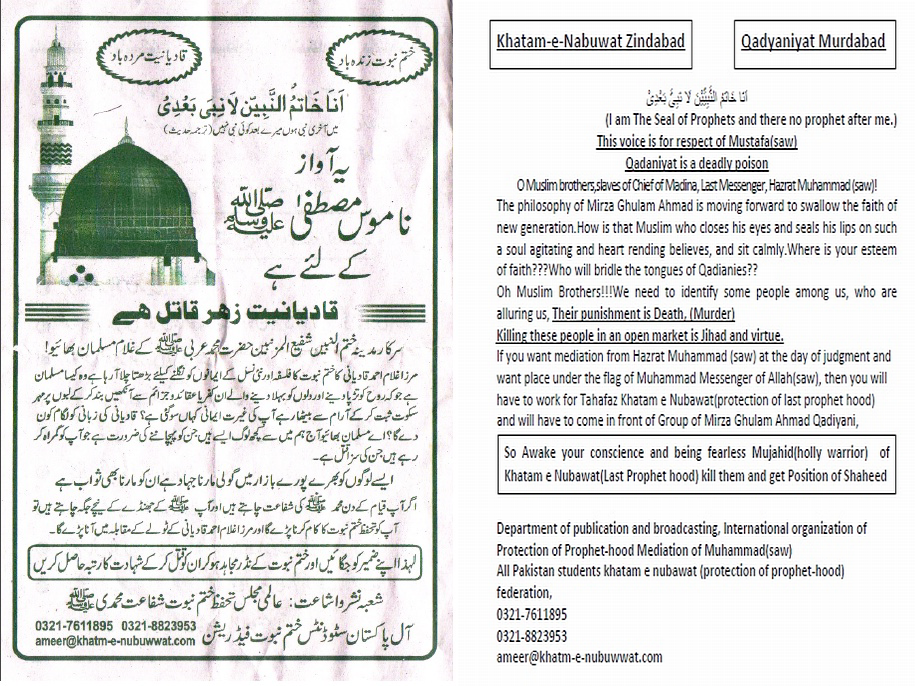
Anti-Ahmadiyya activities are rampant in Bhaun too. Provocative pamphlets were distributed here openly after the Eid prayer on September 21, 2009. It contained baseless newspaper accusations that Qadianis are not loyal to the country; 600 Qadianis are being trained in the Israeli army; and Qadianis helped the Indian army in the war against Pakistan. The pamphlet urged total boycott of Ahmadi businesses in the town. It mentioned their names as well. It bore no address.

Ahmadiyya community has lived peacefully in the area for the past 50 years. The new situation has been brought to the notice of local authorities. Shah Maskeen, District Sheikhupura: The Ahmadiyya community here has faced a total boycott in the past which lasted more than two years, from September 1974 to December 1976. Now again the communal temperature is rising. Khatme Nabuwwat agitators have distributed leaflets and done wall-chalking against the community. The local Ahmadiyya community is concerned about its security, and has taken precautions to avoid any nasty incident.

Barali, District Kotli, Azad Kashmir

The situation has been tense here for Ahmadis for a long time. Non-Ahmadis held here nominally a Milad conference in the local mosque on September 10, 2009, but their anti-Ahmadiyya intentions were no secret. Authorities were informed accordingly, well before the date. The police arrived there at the start of the conference, and stayed till the end. Mullas used abusive language against the community and its holy founder. They told Ahmadis to live like a non-Muslim minority, not to pray and not build any mosques etc. They used abusive language in the presence of the police and administration. The conference disturbed social peace of the locality.

Khuda Abad, District Badin

In this area anti-Ahmadiyya activities have persisted, and small towns and villages have been affected. Khuda Abad is a small town in district Badin, Sindh. It is home to a madrassah. They held a conference there, in which people were instigated against the Ahmadiyya community. Pamphlets containing corrupted and out-of-context writings of the founder of the community were distributed in bulk. It was written on the pamphlets that one who photo-copies it and distributes it further will get great reward from God.

Update on Dr Muhammad Asghar's blasphemy case

Dr Asghar, an elderly Ahmadi, was arrested on a fabricated charge of blasphemy in June 2008. The judge rejected his plea for release on bail. The police investigation found him innocent. Subsequently his plea for bail has been rejected by the High Court and the Supreme Court. The Supreme Court has directed his expeditious trial which is now in progress.

According to the latest information, his latest date for appearance before the Sessions Court was October 20, 2009; however no proceedings took place on that date. The fresh date given is November 7, 2009.

Dr Asghar has been in prison now for almost a year and half for a crime he would never even consider committing. No bail, either. A queer system of justice!

Roads of Rabwah - in ruin

The daily Express, Faisalabad of October 25, 2009 filed the following story:

Roads of Chenab Nagar are in ruins; cause frequent accidents.
Not a penny was spent on the construction and repair of roads for the last 15 years. People demand immediate notice.
Chenab Nagar (Express correspondent): Not a penny has been spent on the roads in Chenab Nagar during the last 15 years. As a result, all roads of the town are in ruins. The College Road, Aqsa Road, Rajeki Road, Ghordor Road, Basti Eesaiyan Road, Sahiwal Road and other roads have all become dilapidated. The main Aqsa Road of the town on which all governmental offices, banks and shopping centres are situated, likewise the College Road on which the boys’ college and high school are situated as also offices of eight major departments, are dotted with craters. Drivers trying to avoid them hit other vehicles. Several individuals have hurt themselves and lost their limbs in such accidents. Hundreds of complaints have proved futile. The Human Rights Committee and other social organizations of the town have demanded the district administration to take immediate notice.

Neglect at the PTCL office - Rabwah

The daily Din, Lahore reported the following concerning the quality of service in Rabwah of the denationalized telephone company PTCL:

Chenab Nagar: Negligence of PTCL; customers face difficulties; strong protest from the people
There are 700 DSL connections in Chenab Nagar, but no operator is available to install and maintain them.
Chenab Nagar (correspondent): Customers of the broadband face tremendous difficulties due to the PTCL’s departmental carelessness. According to the details 700 DSL connections have been provided in Chenab Nagar but no operator is available to install and maintain them. 300 devices for new connections have been distributed, but many of them have not been installed yet. The customers are tired of repeated visits to the PTCL office. They are given the phone number of the Director Broadband and are told that the task is beyond their local capacity. Hakeem Munawar Ahmad, a customer said that he has developed blood pressure due to his repeated visits to that office. Students are also affected badly due to PTCL’s inefficiency. There is none to attend to the malfunctioning old connections as well. Customers of PTCL have demanded that higher officials appoint a DSL operator immediately to resolve the people’s problems.

Ahmadis behind bars
  1. Mr. Muhammad Iqbal was imprisoned for life in a fabricated case of blasphemy. He was arrested in September 2004, and is now incarcerated in the Central Jail, Faisalabad. An appeal lies with the Lahore High Court against the decision of the Sessions Court. It is registered as Criminal Appeal No. 89/2005. He is now in the. His appeal is under process these days.
  2. Three Ahmadis namely Mr. Basharat, Mr. Nasir Ahmad and Mr. Muhammad Idrees along with 7 others of Chak Sikandar were arrested in September 2003 on a false charge of murder of a cleric, alleged by opponents of the Jamaat. The police, after due investigation found no evidence against the accused. Yet these men still faced ‘complaint trial’ for a crime they did not commit. Based on the unreliable testimony of the two alleged eye-witnesses (who were proven false in the court) the court acquitted seven of the accused, but on the evidence of the same two liars the court sentenced these three innocent Ahmadis to death. They are being held in a death row at a prison in Jehlum, while their appeal lies with the Lahore High Court. They are now in the seventh year of their incarceration. Their appeal to the Lahore High Court is registered as Criminal Appeal No. 616/2005 dated 26 April 2005.
  3. Dr. Muhammad Asghar was arrested on a fabricated charge of blasphemy in June 2008. The judge rejected his plea for bail. The police investigation found him innocent. Subsequently his plea for bail has been rejected by the High Court — and the Supreme Court. The Supreme Court has directed his expeditious trial which is now in progress.
From the Press

Bado Malhi: Qadiani arrested for preaching Mirzaiat in the open. His companion fled. Javed Ahmad and Hameed Tahir were converting the poor and destitute by offering them financial support. The Sunni and Shia Ulama requested police intervention. Police raids continue to arrest the other accused.
The daily Ausaf, Lahore; October 1, 2009


The United States will always seek to counter negative stereotypes of individuals based on their religion and will stand against discrimination and persecution.
Hillary Clinton quoted on subsbaptistpress.org; posted on October 29, 2009


Shariah penalty of death should be imposed to bury the mischief of Qadianism. — Maulvi Faqir Mohammad
Rabwah was named Chenab Nagar on my instigation, and the Muslim Colony was built up over 50 acres of (Rabwah) land.
The daily Nawa-i-Waqt, Lahore; October 26, 2009


Qadiani places of worship should be disfigured to look unlike a mosque. Shariah penalty for apostasy (death) should be imposed. — Tehrik Khatme Nabuwwat
The daily Ausaf, Lahore; October 28, 2009


The country is faced with the conspiracy to push it into blood and fire. — (Mulla) Qari Allah Yar Arshad
The daily Khabrain, Lahore; October 6, 2009


Qadianis are busy in conspiracies. The sword of PPC 295-C should continue to hang over the minorities’ heads — Mutahiddah Tehrik Khatme Nabuwwat
The daily Ausaf, Lahore; October 6, 2009


Bloodshed in the tribal areas is a result of Qadianis’ intervention. — Majlis Tahaffuz Khatme Nabuwwat
The daily Aman, Faisalabad; October 17, 2009


Residents of Chenab Nagar in grave protest over non-availability of drinking water. The Public Health Engineering (Department) started laying water pipes three years ago, but residents remain deprived of water.
The daily Jang, Lahore; October 28, 2009


Street lights disappear. Chenab Nagar roads plunge in darkness. Only 6 bulbs glimmer on six main roads. Authorities urged to take immediate notice.
The daily Express, Faisalabad; October 7, 2009


Chenab Nagar: SDO WAPDA and staff indulge in robbing the people. Bill distributors deliver the bills one day before the last date. Fresh applicants for electric connection are required to bribe the staff.
The daily Ausaf, Lahore; October 29, 2009


Chiniot: Khatme Nabuwwat march, from Aziz Sharif valley to Chenab Nagar will be held on October 4. Thousands will participate in the Khatme Nabuwwat march with Khawaja Mahboob Ilahi in the lead.
The daily Khabrain, Lahore; October 1, 2009


92 Killed in Peshawar market blast. Toll may rise as 217 injured.
The daily News, Lahore; October 29, 2009


October 09: 270 dead in 14 terrorist attacks. Explosions continue.
The daily Aman, Faisalabad; October 29, 2009


Suicide attack on D G Khan bus stand 9 months ago: J I leader, kin arrested
The daily News, Lahore; October 26, 2009


Students terrorized. All schools, colleges closed nationwide.
The Daily Times, Lahore; October 21, 2009


Lal Masjid (in Islamabad) is still training militants?
The daily Dawn, Lahore; October 25, 2009


Peshawar bleeds after suicide attack; 52 dead
The daily News, Lahore; October 5, 2009


Fazl offers to mediate between govt and Taliban.
The daily Dawn, Lahore; October 5, 2009


Madrassahs are the citadels of Islam; no power on earth can close them down. — Maulana Zahid-ur-Rashdi
The daily Ausaf, Lahore; October 27, 2009


Pro-Qadiani statements; protests all over the Punjab against Kerry-Luger Bill

…According to the details, the Jamaat Islami, Tehsil Muridke held a protest demonstration at the GT Road after the Friday prayers. The (JI) Amir of Muridke city, Syed Taed Manzoor said that the US is indulging in despicable attempts to subjugate Pakistan through drone attacks, introduction of agencies including the Black Water and the Kerry-Lugar Bill. …The Sunni Tehrik Hafizabad took out a rally from the Al Farooq Mosque (chanting) Khatme Nabuwwat Long Live and Death to Qadianis. They demonstrated in great strength. The participants raised slogans against Qadianis, Salman Taseer the Governor Punjab, Altaf Hussain the MQM leader, Aasma Jehangir and the government, and said that the Blasphemy law will be protected at all costs.
The daily Waqt, Lahore; October 3, 2009


Blasphemer sentenced to life and fined Rs. 100,000 in Bahawal Nagar. The accused Zaman was under prosecution for the past one year in the Sessions Court for false claim to prophecy.
…At this occasion (of announcement of the judgment) thousands including the Ulama participated (sic).
The daily Ausaf, Lahore; October 1, 2009


Madrassahs of all denominations will be granted the status of a Board. The students would be (thus) eligible to join the Army and the Police. — Rehman Malik (The Minister of Interior)
The daily Khabrain, Lahore; October 1, 2009


Bangla Desh: Hizb-ut-Tehrir, an Islamist organization banned.
The daily Pakistan, Lahore; October 24, 2009


Azad Kashmir (Sardar Yaqoob Khan) premier resigns.
The daily Dawn, Lahore; October 15, 2009
(Note: Sardar Yaqoob took over only a year earlier; he soon facilitated a Khatme Nabuwwat conference and declared therein: “Those who seek to ouster me as the prime minister will be disappointed. Allah who installed me as prime minister might appoint me life-time prime minister in response”. Ed.)

Op-eds

Rulers the only minority
(Note: A loaded heading of an article regarding a political truth about Pakistan)
Article by Javed Naqvi in the daily Dawn;October 15, 2009


Bring back Jinnah’s Pakistan

Had a large part of the Middle Eastern region and parts of South Asia been able to heed Jinnah’s words that religion, caste and creed “has nothing to do with the business of the state” the world may well have been in better shape today. It is possible that the extremism that has galloped away in these areas would not have taken root had various states not been allowed to force upon the world their dangerously distorted version of a religion.
Ardeshir Cowasjee in the daily Dawn, November 1, 2009


A state or fiefdom?

Also reported from Lahore is the high-handedness of police in warning the Ahmadi shopkeepers of Green Town to remove religious verses exhibited in their shops within two days. The police were obviously trying to create an alibi of themselves if the fanatics of the locality were to vandalize the Ahmadi shops or cause bodily harm to the owners. The police were thus encouraging crime rather than preventing it.

Ironically, crimes against women and minorities are showing up at their worst in a province where the chief minister is reputed to be tough both on criminals and delinquent officials. The recent murders of Christians in Gojra, Sambrial and other places call Shahbaz Sharif’s stern reputation into question. Murders of Ahmadis and the targeting of their places of worship have also taken place in Punjab.
Kunwar Idrees in the daily Dawn of October 11, 2009

Saturday, November 14, 2009

KYRGYZSTAN: Legal status applications almost impossible

---Forum 18 News, Norway
13 November 2009

KYRGYZSTAN: Legal status applications almost impossible

By Mushfig Bayram, Forum 18 News Service

Although unregistered religious activity in Kyrgyzstan is now banned, against international human rights standards, religious communities also cannot gain legal status, Forum 18 News Service has learnt. However, two mosques do appear to have been registered. The State Commission for Religious Affairs (SCRA) says that religious communities must wait for the Regulations to apply a restrictive new Religion Law, which came into force in January 2009. SCRA officials told Forum 18 that “the Regulations have been prepared but not signed into force.” Meanwhile, SCRA officials have contradicted themselves on whether or not existing registered communities need to be re-registered. Officials claim to have made the text of the Regulations available for public discussion, although no-one who Forum 18 has spoken to – apart from officials – has seen the text. For the proposed controversial new Religious Education Law, officials claimed to have invited some named religious communities to a roundtable discussion, although the same religious communities told Forum 18 they were unaware of any invitation. Some Protestant churches have decided to protest at the restrictions in the Religion Law by refusing to apply for registration.

Although unregistered religious activity is now banned under the restrictive new Religion Law which came into force in January 2009, religious communities still cannot gain legal status, Forum 18 News Service has learnt. The State Commission for Religious Affairs (SCRA) says that religious communities must wait until the Regulations to apply the New Law are in place. SCRA officials told Forum 18 that “the Regulations have been prepared but not signed into force.” Meanwhile, SCRA officials have given Forum 18 contradictory information on whether or not existing officially registered communities will need to be re-registered.

Although the officials said that the text of the Regulations enacting the Law has been made available in gov.kg, Kyrgyzstan’s state web portal, for public discussions for “more than a month,” Forum 18 could not find the text of the Regulations in the web portal. SCRA officials failed to respond to Forum 18’s request to receive the text of the Regulations.

Despite widespread protests by religious communities and human rights defenders, the controversial new Religion Law came into force on its official publication on 16 January. Officials have claimed that some provisions will be amended, but this has not happened (see F18News 27 May 2009 http://www.forum18.org/Archive.php?article_id=1301).

For several years before the new Law was adopted, registration applications were rejected as officials insisted communities wait for the new Law (see F18News 28 May 2009 http://www.forum18.org/Archive.php?article_id=1302). Religious communities have also complained that the authorities are using extra-legal property Regulations as an excuse to avoid registering them (see F18News 21 August 2009).

A group of local Protestant churches have made a joint decision not to apply for re-registration even if they are required to do so, several Protestant leaders told Forum 18 in early November.

What will happen if communities won’t register or re-register?

Lack of registration now potentially has serious consequences. The Law’s Article 8 bans all unregistered activity and subjects it to prosecution (see F18News 5 November 2008 http://www.forum18.org/Archive.php?article_id=1213).

Communities of Protestant Christians, Hare Krishna devotees and Ahmadiya Muslims have all been ordered by the authorities to stop meeting for worship (see F18News 13 August 2009).

Asked what will happen to religious communities which are unable or do not want to register or re-register, Kumar Dushenbaev, the SCRA official in charge of registering religious communities, told Forum 18 on 28 October from Bishkek: “We will deal with them in accordance with the Law of Kyrgyzstan.” He would not specify what actions the state authorities would take.

Almost no religious organisations registered since Law’s adoption

Dushenbaev of the SCRA told Forum 18 that as of late October no new religious communities had been registered since the adoption of the new Religion Law. “We have not been registering new communities, because the Regulations to apply the law have not been signed into force,” he explained.

Even if religious communities could now submit applications, groups without registration face much tougher conditions which few can meet. For instance, Jehovah’s Witnesses and many Protestant churches complained to Forum 18 that they cannot gather the 200 adult citizen founding members now required before each congregation can apply for registration.

Hare Krishna devotees had told Forum 18 earlier in August that they are not even intending to “bother the authorities on anything soon in the near future” since they were “summoned and pressured” by the National Security Service (NSS) secret police when they applied for registration in earlier years (see F18News 13 August 2009).

However, Kubat Imarov, Assistant to Rahmatulla Egemberdiyev, Deputy Head of Kyrgyzstan’s State-backed Muslim Board, told Forum 18 on 13 November that two new mosques – Ismet-Kagyr and Agturpak – in Batken region’s Kadamjay district were registered by the SCRA two days earlier. He could not explain to Forum 18 how it was possible to register the mosques while non-Muslim communities have been told to wait until after the Regulations were enacted. Asked if the mosques had collected 200 signatures, he claimed: “This rule applies only to medreses not mosques.”

Is re-registration necessary?

Unlike in other countries of the region, Kyrgyzstan’s new Religion Law does not specifically demand re-registration for all religious communities. However, Article 30 point 3 of the new Law points out that “charters and other founding documents of religious organisations and missions are effective only in that part, which is not in contradiction to this Law.” Article 9 point 3 declares that “there shall be no norms in the charter of a religious organisation or mission contravening Kyrgyzstan’s Constitution or Law.” Officials had apparently hoped that this de facto re-registration demand would not be noticed (see F18News 5 November 2008 http://www.forum18.org/Archive.php?article_id=1213).

Kanybek Osmonaliev, Head of the SCRA, and his Deputy Kanatbek Murzakhalilov have given Forum 18 contradictory information on whether religious communities registered under the old Religion Law will need to re-register. In late October Osmonaliev assured Forum 18 that “there will be no re-registration since the law is not retroactive”.

However Murzakhalilov, giving his opinion of the Religion Law, told Forum 18 that religious communities which need to make changes to their charters in order to bring them into harmony with the Law will need to be re-registered. Murzakhalilov did not say whether all the registered communities will need to re-register.

Zainiddin Kurmanov, a Parliamentary Deputy who was one of the initiators of the new Religion Law, told Forum 18 on 13 November that religious communities whose charters are not in accordance with the Law “must necessarily” amend their charters, which, in its turn, “definitely” entails re-registration.

Forum 18 notes that Article 12 Part 1 of the Law on State Registration of Legal Persons and Branches (Representations), which came into force on 1 April 2009, specifies that religious organisations are among those that require re-registration if their statute is amended.

The authorities have in the past required registered religious communities to make changes to their charters to bring them in harmony with the Religion Law (see eg. F18News 13 August 2009). This in turn, in the opinion of many religious communities, will require re-registering the amended charters.

Commenting on the contradictory remarks from SCRA officials on whether or not re-registration will be necessary, Father Igor Dronov of the Russian Orthodox Church in Bishkek told Forum 18 on 11 November: “I tend to believe Osmonaliev since he is the Head of the State Commission.” He added that he believed that the Orthodox will not need to re-register as the law is not retroactive.

His view was echoed by Imarov of the Muslim Board, who told Forum 18 that already registered mosques will not need re-registration.

Jehovah’s Witnesses lawyer Mikhail Kokhanovsky told Forum 18 from Bishkek that his organisation will not need to re-register since “their charter is in harmony with the New Law”.

One Protestant leader from Bishkek, who asked not to be identified, explained to Forum 18 that “in fact all the communities will need to re-register since they will all need to make changes to their charters.” He gave the example that under the old Law 10 founding members were needed but the new Law requires having 200 founding members.

Murzakhalilov said that there will be no deadline for re-registration process. “It will not be a hassle though, we will re-register them no problem,” he claimed.

Decision to protest by not registering

Aleksandr Shumilin of the Baptist Union told Forum 18 on 4 November that “all the evangelical churches [of Kyrgyzstan] have made a unanimous decision not to apply for re-registration or register their new congregations.”

“First of all the Bible tells us to share the good news with all people,” Shumilin said giving the reasons for the decision. “Why should we agree with the new Law, which does not allow us to freely share the good news?” he asked. “Second of all to register our many un-registered congregations we need to give the names and personal data of 200 members as founders, which we will not do.”

Several Protestant leaders, including Bishop Alfred Eicholz of the Lutheran Church, confirmed the joint decision to Forum 18.

A Protestant leader from Bishkek told Forum 18 that the agreement between the group of Protestant churches was “achieved orally but if it is necessary all the churches will sign a written paper” of refusal to register or re-register.

“If the requirements of the New Law were feasible we should have no problems re-registering,” Bishop Eicholz told Forum 18. “But for instance notarising 200 signatures of church members and giving their personal data to the State Commission is not feasible.”

Have Regulations enacting Law been published?

Murzakhalilov, Deputy Head of the SCRA said that based on the new Law on By-Laws adopted in August, any Regulations to apply new Laws must be publicly discussed for a month before being signed. “So we prepared the Regulations to the new Religion Law and they were published in the state web portal for public comments,” he told Forum 18 on 11 November from Bishkek.

Asked if he could provide Forum 18 with the link to the text of the Regulations in the web portal or the text itself, Murzakhalilov responded: “It is there in the portal. I don’t understand how you cannot find it while everybody else can easily do so.” Despite a repeated request to the SCRA, Forum 18 has received no response.

Father Dronov of the Russian Orthodox Church, Bishop Eicholz of the Lutheran Church, and several other Protestant Church leaders have told Forum 18 that they have not seen the Regulations published nor have they received the text of the Regulations to make comments.

Bishop Eicholz told Forum 18 that he believes the Regulations are not even ready. “Although we have tried but have not been able to obtain the text of the Regulations from the State Commission so far,” he told Forum 18 on 12 November.

“The State Commission promised to publish the Regulations but until recently they had not done so,” Father Dronov told Forum 18.

“We have not seen those Regulations,” the leader of a Protestant Church in Bishkek, who wished to remain unnamed for fear of reprisals from the authorities, told Forum 18 on 11 November. “Even if they were published somewhere, it would be a formal step of the State Commission. Our voices will not be heard anyway.”

Told that many religious communities were not aware of the publication, Sharsheke Usenov, Head of the Legal Support Department of the SCRA, told Forum 18 on 11 November: “We have announced about it in the media and at press conferences.” Asked if he could even say when this was announced, he said, “I don’t remember now.”

This lack of openness mirrors a similar official attitude over the controversial proposed new Religious Education Law. Only some religious communities have been invited to discuss the draft text and religious communities were only given one week to submit comments. The SCRA has so far refused to allow the legal review it requested from the Organisation for Security and Co-operation in Europe (OSCE) to be published (see F18News 6 November 2009 http://www.forum18.org/Archive.php?article_id=1373).

When will Regulations be signed?

None of the several SCRA officials Forum 18 talked to could say when the Regulations will be signed. “The State Commission itself is going through structural changes so I cannot tell you when it will happen,” Murzakhalilov explained.

However, Usenov said that the signing should take place soon. “I can’t say how soon it will happen though,” he told Forum 18. “The religious communities have had more than a month to respond, and it cannot be put on the back burner for long.” (END)

URL: www.forum18.org/Archive.php?article_id=1375

PK: State of Human Rights in 2008 - HRCP Report

State of Human Rights in 2008

Introduction

HRCP Report TitleIn the context of human rights, 2008 was a year of opportunities and challenges. After the bleak human rights situation in 2007, it was believed that things could only get better, and in some areas they did as a civilian government emerged after nine years of dictatorship.

Though many of the expectations of a civilian set up were not fulfilled, significant steps were taken.

Pakistan signed or ratified three key UN human rights treaties, though steps for their implementation remained elusive. The new government initially thought of converting all death sentences into life imprisonment, but later on seemed to back paddle and introduced more laws punishable with death.

The elected government distinguished itself from the preceding dictatorship in allowing greater freedom of assembly, expression and movement. A new law on industrial relations freed the trade unions of some of the curbs imposed by the previous legislation.

In other areas, however, things remained as bad as they had earlier been.

Women continued to suffer more than the rest of the population at the hands of Taliban extremists, and on account of inhuman customs and traditions. Even unborn girls continued to pay for quarrels of their male relatives, and were married off to settle disputes.

The lot of victims of ‘enforced disappearances’ did not change. Citizens continued to face harassment by state agents and terrorists alike. At least 67 suicide attacks across Pakistan killed 973 people and injured 2,318. During the same period, at least 289 people were killed in police encounters.

The state’s keenness to hold talks with and give concessions to Taliban engaged in terrorizing civilians, blowing up government schools and butchering civilians and security personnel also remained unchanged. The use of military might remained the preferred option for dealing with militants in Balochistan, who demand greater control over the province’s resources.

Media’s concerns about curbs by the state diminished somewhat with the new government’s emergence, but the state failed to protect media persons against violence and threats from non-state actors.

Working for human rights generally remained a dangerous proposition. The extremist elements’ growth and threats to NGOs, lawyers, government officials and artists, were largely seen as a direct result of the authorities’ policy of appeasing them.

Legislation through the exercise of the President’s power to issue ordinances was not wholly given up by the civilian government. The government was slow in securing the people’s release from grinding poverty and unemployment with due seriousness.

There was a lack of urgency to address the problems of overcrowded prisons even by the country’s top leadership, which had until recently been imprisoned in the same jails.

In many areas, the state of affairs deteriorated considerably in 2008.

While election results of 2008 made it abundantly clear that the militants enjoyed very little support amongst the population, extremist militants’ sway and religious intolerance spread unchecked.

The government seemed to have lost control of vast areas to extremist militants. Its capacity to protect lives against terrorist attacks or other criminal acts suffered severe erosion in many areas. Government response to terrorism mostly comprised meaningless gestures of issuing alerts after suicide bombing, or announcing the number of suicide bombers believed to have entered various cities, speculating whether an explosion was a suicide bombing or not, and advising the harried citizens to look after themselves.

All evidence indicated that the prevailing militancy and large-scale internal displacement would be a long-term problem, but measures to deal with the challenges were largely inadequate or inappropriate. It is a measure of their desperation and lack of any semblance of security that hundreds of internally displaced families from Pakistan’s tribal areas fled to Afghanistan in search of safety.

The society’s descent into brutalisation was manifested in shocking incidents of mobs getting hold of suspected robbers and burning them alive.

Towards the end of 2008, the main political parties were on the verge of an encore of confrontational politics of the 1990s. The government seemed incapable of achieving consensus on crucial issues or imaginative solutions to the problems facing the country.

Lack of interest by the government in effectively addressing major human rights issues and the growing threat of extremism from non-state actors dampened hopes of 2009 being a better year in terms of human rights.

-- Najam U Din
Saira Ansari

Highlights

Freedom of thought, conscience and religion
  • Members of religious minorities were targeted because of their faith. At least three Ahmadis were killed in September after a popular television channel declared that killing Ahmadis was permissible under Islamic norms.
  • In Kurram tribal agency, clashes between members of Sunni and Shia sects led to over 1,000 deaths.
Administration of justice

Cases on religious grounds


The most shocking incident in the category of cases involving allegations of offences against religion concerned Jagdish Kumar, a Hindu Pakistani, who was lynched in a factory in Korangi, the industrial area of Pakistan’s largest city, Karachi.

Some of the workers at the factory alleged that the 22-year-old Jagdish had made some blasphemous remarks against the Holy Prophet (PBUH). A large mob dragged him to a room on the factory premises and bludgeoned him to death. The police did arrive while he was alive but was unable, or unwilling, to intervene.

Another version of the cause of murder was some young workers’ jealousy at Jagdish’s intimacy with a female fellow-worker belonging to a different faith.

At least two cases of offences against religion were decided during the year, both in Punjab.

Shafique, belonging to Sialkot, was awarded death penalty and life imprisonment, by the trial court. He was accused of defiling the Holy Quran and passing derogatory remarks against the Prophet (PBUH) and was tried under sections 295-C and 295-B of the PPC. The case was registered in 2006.

In the other case, Mumtaz Husain of Hafizabad was sentenced to six years’ imprisonment.

Against Ahmedis

Two Ahmedis, Rana Khalil and Rashid Iqbal, both belonging to Kunri, Sindh, and three Ahmedis from Nankana Sahib in Punjab, were charged under section 295-C in new cases.

The 11 other new cases — 9 in Punjab, 2 in Sindh — against the Ahmedis were: (details undecipherable or missing from report).

Azad Kashmir
Three cases against the Ahmedis were instituted in Azad Kashmir. These were: (details undecipherable or missing from report).

Fundamental freedoms
Freedom of thought, conscience and religion

… It is the will of the people of Pakistan to establish an order … wherein shall be guaranteed fundamental rights, including equality of status, of opportunity and before law, social, economic and political justice, and freedom of thought, expression, belief, faith, worship and association, subject to law and public morality
Constitution of Pakistan
Preamble

Subject to law, public order and morality (a) every citizen shall have the right to profess, practise and propagate his religion; and (b) every religious denomination and every sect thereof shall have the right to establish, maintain and manage its religious institutions.
Article 20

All human beings are born free and equal in dignity and rights. They are endowed with reason and conscience and should act towards one another in a spirit of brotherhood.
Universal Declaration of Human Rights
Article 1

Everyone has the right to freedom of thought, conscience and religion; this right includes freedom to change his religion or belief, and freedom, either alone or in community with others and in public or private, to manifest his religion or belief in teaching, practice, worship and observance.
Article 18

No one shall be subject to coercion which would impair his freedom to have a religion or belief of his choice.

No one shall be subject to discrimination by any state, institution, group of persons, or person on the grounds of religion or other belief.
UN Declaration on the Elimination of All Forms of
Intolerance and of Discrimination Based on Religion or Belief
Articles 1(2) and 2(1)

The Human Rights Commission of Pakistan is guided by international human rights law, particularly while monitoring the human rights situation under freedom of thought, conscience and religion. Domestic legislation departs and at times is ambiguous regarding the principles of human rights on freedom of religion, belief and conscience.

The standard-setting norm on freedom of religion or belief was initially included in Article 18 of the Universal Declaration of Human Rights 1948. The Declaration recognised without exception the freedom of thought and conscience in matters of religion or belief. Freedom to change one’s religion or belief and the freedom to manifest a religion or belief in teaching and in practice was recognised as a right.

The International Covenant on Civil and Political Rights (ICCPR), 1966, expanded on this right but a limitation provision was also added to make manifestation of these rights subject to laws that are necessary to protect public safety, order, health, or morals or the fundamental rights and freedoms of others. Article 20 of the ICCPR obliges governments to prohibit by law, “any advocacy or national, racial or religious hatred that constitutes incitement to discrimination, hostility or violence”.

The Declaration on the Elimination of All Forms of Intolerance and of Discrimination Based on Religion or Belief, 1981, is the most important global instrument regarding the freedom of thought, conscience and religion. Although not binding, the 1981 Declaration implies an expectation of observance and has laid a solid ground for interpreting and evolving this right into a binding legal instrument of the United Nations in the future.

The 1981 Declaration follows the pattern of previous international norms on the subject by drawing a distinction between basic rights in the inner form – thought, conscience and belief – and the external manifestation of these e.g. worship, observance, practice and teaching. Only external manifestations can be limited.

Other UN instruments that also include provision for freedom of thought, conscience and religion are the Convention on the Prevention and Punishment of the Crime of Genocide, the Geneva Conventions, CEDAW and the CRC.

Freedom of thought, conscience and religion is partially recognised by the legal system of Pakistan. Article 20 of the Constitution guarantees right to profess, practise and propagate religion and grants every religious denomination and every sect the right to establish, maintain and manage its religious institutions. These rights can be limited by law and “subject” to public order and morality. Article 21 ensures that no person shall be compelled to pay any special tax the proceeds of which may be spent on the propagation or maintenance of any religion other than his/her own. Article 22 guarantees that no person attending any educational institution shall be required to receive religious instructions, or take part in any religious ceremony, or attend religious worship, if such instructions, ceremony or worship relates to a religion other than his/her own. Religious institutions are prohibited from discriminating against any community in granting exemption or concession in relation to taxation. Unless so provided by law, no religious community or denomination can be prevented from providing religious instruction for pupils of that community or denomination in any educational institution maintained wholly by that community or denomination. The Constitution prohibits denial of admission to any citizen in educational institutions receiving aid from public revenues on the basis of race, religion, caste or place of birth.

In 1988, no case law is reported under these Articles of the Constitution. Since 2005, a number of constitutional petitions were filed challenging building of a church, banning books on Christianity and appointment of a non-Muslim as judge to superior courts. The courts upheld the spirit of the Constitution and refused interference on the principle of non-discrimination. The Sindh High Court dismissed the plea that a non-Muslim could not be appointed as a judge as s/he may be required to interpret Sharia law. The courts emphasised that discrimination based on religion cannot be promoted. However, in the case of religious practices of Ahmadis the courts followed a contrary principle. The law prohibiting Ahmadis from using exclusive descriptions and titles like mosque or Azan while manifesting their religion was upheld on the principle that Ahmadis were obliged to honour the Constitution, which declared Ahmadis as non-Muslims.[1] From the constitutional declaration of defining Ahmadis as such it follows that all Muslim religious symbols are exclusive to them alone.

The Constitution of Pakistan defines citizens as “Muslims” or “Non-Muslims”. A Muslim is defined as a person who believes in the unity and oneness of God, in the finality of the Prophethood of Muhammad (peace be upon him), and does not recognise as a prophet or religious reformer any person who claimed or claims to be a prophet after Muhammad (peace be upon him). Non-Muslims are those who are not Muslims and include Christians, Hindus, Sikhs, Buddhists, Parsis, and Ahmadis. The Constitution, therefore, recognises all religions but decides the faith of any group that may believe itself to be Muslims.

Article 2 of the Constitution declares Islam as the State religion. The United Nations Special Rapporteurs on freedom of religion or belief as well as the UN Human Rights Committee have pointed out that an official or State religion in itself is not apposed to human rights. It could simply be symbolic because of historical reasons but emphasised that it must not be exploited at the expense of the rights of minorities. They have also cautioned that while in its Constitution a state may simply profess its adherence to a particular faith, yet some may see the mere profession of that faith as a form of discrimination against other ethnic or religious minorities. They have noted that it often becomes inevitable that the established religion or ideology guides the vision of society to the exclusion of others. The State religion of Pakistan is a driving force making Islam the preferred religion through laws and practices. For example Article 2(a) of the Constitution recognises principles of democracy, freedom, equality, tolerance and social justice as “enunciated by Islam”. It guarantees “adequate provisions” for the minorities to freely profess and practice their religions and develop their cultures.

A Federal Shariat Court hears appeals of certain convictions under criminal law and can declare any law repugnant to the injunctions of Islam. All eight judges of the court must be Muslims.

……
The Pakistan Penal Code prescribes penal sanctions for arousing communal unrest based on the premise of protecting public order.[2] Imprisonment for life is prescribed for “wilfully” defiling, damaging or desecrating a copy of the holy Quran. The death penalty is prescribed for anyone who “by words, either spoken or written, or by visible representation, or by any imputation, innuendo, or insinuation, directly or indirectly, defiles the sacred name of the Holy Prophet Muhammad (peace by upon him). HRCP has documented several cases and found that there is a clear trend of exploiting these provisions by religious zealots.

There are penal sanctions for Ahmadis for misusing religious “epithets” reserved for Muslims. They are prohibited from describing or copying their call to prayer as “azan” or their place of worship as a “mosque”.

HRCP remains concerned at the high level of religious persecution by religious zealots and rising threats as well as violence perpetrated by religious militant groups. The authorities, by and large, remain unconcerned and law enforcement staff is most reluctant to take any action against religious groups or militants. While women and religious minorities bear the worst brunt of religious extremist groups, men and Muslims are not spared either. Artists, musicians and those affiliated with performing arts are at risk in all parts of the country but particularly vulnerable in the province of NWFP. Sectarian violence and victimisation under the blasphemy law continues. The Ahmadi community was targeted throughout but they saw worse times after a popular television station, in a talk show, declared that killing them was permissible under Islamic norms. This was followed by the killing of three Ahmadis in Sindh in the month of September. [See the chapter ‘Administration of Justice’]

……
An editorial comment in a daily referred to some of the causes of minority persecution. It mentioned instances of discrimination, such as the kidnapping of Christians, including two priests while they were offering prayers in Peshawar, suspension of around two dozen Ahmadi students from Punjab Medical College, and the dire plight of scheduled caste Hindus in Sindh. The writer said that the blame rested on several parties: liberal and secular politicians who, in order to appease the religious right in Pakistan, did not lift a finger to mainstream the minorities; elite minority leaders, co-opted time and again by both military and civilian rulers, who compromised the rights of the minority community which was largely poor and disadvantaged; and those who had joined the rule of former president Ziaul Haq, who was responsible for pushing the minorities to the margins by introducing discriminatory legislation and by promoting a curriculum which was demeaning for the minorities. (NE, Jun 27)

Reserved seats for minorities in parliament

The system of reserved seats for minorities and women introduced by President Musharraf in 2002 failed to fulfil the required objective of giving a political voice to minorities. The minorities’ representatives in the assemblies usually followed the line of the party that got them elected and not the interest of their communities.

In early February, the World Minorities’Alliance Convener, Mr. J. Salik, said the current system did not allow any minority person to contest elections independently on the minorities’ seat. He had challenged that process in the Supreme Court in 2002 but to date no hearing had been set. (N, Feb 6) A minority representative said: “When the Hasba Bill was approved in the NWFP, two persons elected by the MMA on reserved seats also voted for it. This instance showed that representatives of religious minorities elected on reserved seats were not free to pursue private agendas”. (DT, Feb 24)

Freedom of Religion

Ahmadis

As in previous years, the spread of hatred against the Ahmadis continued. At least six Ahmadis were murdered because of their faith during 2008.

An anchorperson of a popular TV channel held a prime-hour discussion commemorating the 1974 amendment to the Constitution declaring Ahmadis as “not Muslims”. The programme ended with a verdict by a participating mufti, of an extremist school, that the Ahmadis deserved to be murdered for deviating from the view of the finality of the prophethood of the Holy Prophet (PBUH). Neither the TV channel nor the anchorperson was chastised by the government for the virulent broadcast. Following the TV discussion, three Ahmadis were shot dead in early September – Dr. Abdul Mannan Siddiqui in Mirpurkhas, Seth Yusuf, a Nawabshah trader, and Sheikh Saeed at his pharmacy in Karachi. (D, Sep 21)

In Lahore in late May the International Khatm-e-Nabuwwat Movement (IKNM) announced a moot to be held at the Aiwan-e-Iqbal. IKMN Ameer MPA Maulana Ilyas Chinoti added the moot would mark a hundred years of successfully countering Qadiyaniat. (N, May 23)

In Faisalabad in early June, a mob of 300 college students barged into the rooms of Ahmadi students, beat them up and threw their belongings out of their rooms. The boarders also stole valuables from the Ahmadi students. The Punjab Medical College (PMC) through a notification rusticated 23 Ahmadi students on the report of the disciplinary committee. It was alleged that they were preaching and distributing Ahmadi literature. (DT, Sep 9) The students suffered harassment and interruption in their studies for months before they were allowed to resume their studies. In Shabqadar, Charsadda district, local clerics refused to lead the funeral prayers for a man believed to be an Ahmadi. The local clerics issued a fatwa (decree) that the deceased had become an Ahmadi and, therefore, no one would lead his funeral prayers. (DT, Sep 23)

Recommendations
  1. The blasphemy law was promulgated in 1985 and in 1990 the punishment under this law, which sought to penalise irreverence towards the Holy Quran and insulting the Holy Prophet (PBUH), was life imprisonment. In 1992, the government introduced death penalty for a person guilty of blasphemy. Immediate abolition of ‘blasphemy’ laws is needed as these provisions are often used against non-Muslims as well as Muslims to settle personal scores.
  2. School curriculum has to be sensitised toward non-Muslim Pakistanis so that children feel safe, secure and equal.
  3. The Ahmadis have been denied the benefit of the joint electorate system which was revived in 2002. The discrimination should be ended.
  4. The Commission on Minorities should be made functional by reinforcing its independent status and providing it with the necessary resources, human as well as financial.
Freedom of assembly

Every citizen shall have the right to assemble peacefully and without arms, subject to any reasonable restrictions imposed by law in the interest of public order.
Constitution of Pakistan
Article 16

Everyone has the right to freedom of peaceful assembly and association.
Universal Declaration of Human Rights
Article 20(1)Freedom of Assembly

Ban on public gatherings

……
On May 26, the district authorities in Jhang imposed a ban on the centenary celebrations of Jamaat-e-Ahmadia in Rabwah after Muslim religious organisations and clerics pushed the authorities to do so.

Political participation

The state shall encourage local government institutions composed of elected representatives of the areas concerned and within such institutions special representation will be given to peasants, workers and women.
Constitution of Pakistan
Article 32

All human beings are born free and equal in dignity and rights. They are endowed with reason and conscience and should act towards one another in a spirit of brotherhood.
Universal Declaration of Human Rights
Article 1

Challenges for women and minorities

……
The ECP compiled a separate electoral roll just for Ahmadis, distinguishing them from the list of all other eligible voters in the country. In addition to outright religious discrimination, a separate list for Ahmadis completely disregarded the spirit of the joint electorate, the Constitution of Pakistan, and the guarantee of international human rights. As had happened in previous elections, the Ahmadis chose not to participate in the elections.
……

Appendix - II
HRCP stands

Minorities / freedom of belief and religion

July 2: HRCP has expressed its serious concern at the authorities’ failure to redress the grievance of the unlawfully expelled Ahmadi students of the Punjab Medical College, Faisalabad, and urged firm action against the trouble-makers. The rustication of 23 Ahmadi students early last month on the ground of their belief was apparently a case of extraordinary discrimination. HRCP therefore requested a senior member of its governing body to probe the matter. This inquiry shows that while rusticating the unfortunate students the college administration did not follow the rules prescribed for this extreme action; that the committee of teachers set up to examine the victims after the event included teachers who were in the body that had taken the decision to rusticate them; and that the few students who appeared before the investigating committee were unduly harassed and intimidated. There were also indications that some members of the faculty colluded with the Ahmadi-baiting trouble-makers. HRCP is therefore seriously apprehensive of justice being denied to the unlawfully expelled students. It calls upon the provincial and federal governments both to intervene immediately to protect the wronged students and deal firmly with hate-preachers and disrupters of peace because much more than the career of Ahmadi students is at stake.

Footnotes
  1. Article 260 (3) defines a “Muslim” and a “Non-Muslim”. A “Non-Muslim” is defined as a person who is not a Muslim and includes a “person belonging to the Christian, Hindu, Sikh, Budhist or Parsi community, a person of Qadiani group or the Lahori group (who call themselves “Ahmadis” or by any other name), or a Bahai and a person belonging to any of the scheduled castes”.
  2. Article 295 and 295-A

HRCP Website : http://www.hrcp-web.org/

Friday, November 6, 2009

PK: Pampering the mullah

---The News International, Pakistan
Friday, November 06, 2009, Zi`qad 17, 1430 A.H

Pampering the mullah

Friday, November 06, 2009
Talat Farooq

After the government crackdown on certain madrassas in Islamabad recently, the representatives of the Wafaq-ul-Madaris aired their indignation on TV channels. They criticised the action on the grounds that madrassas have always been weapon/terror-free – including, if you please, the Lal Masjid – and, as such, cannot be held responsible for any anti-state activities The went on to add thatif the government officials wish to visit any of the premises, they must do so with the permission of Wafaq-ul-Madaris. In answer to such defiant outbursts, the interior minister meekly assured the Wafaq that the government never meant to violate the sanctity of these great places of learning and knowledge, and is only looking for some foreign Imams residing in some madressahs illegally. One fails to understand why the government has to be apologetic in carrying out such actions against any institution in Pakistan if it has reports of illegal activity there, especially when we are in a state of war. Madressahs, even if registered, are not sacrosanct or above the law. Unfortunately, it is this obsequiousness of our rulers toward the mullah since the creation of Pakistan that has emboldened the extremists over the last six decades.

The Muslim struggle for Pakistan did not include the Deoband or the Jamiat-e-Ulema-e-Hind who opposed the idea of Pakistan tooth and nail. Nonetheless, once Pakistan became a reality the Wahabi-Deobandi groups made gradual inroads as our leaders acquiesced to their demands within a few years of independence. Since then their influence has remained unchecked by the state as it focused on short-term political goals, it is therefore not surprising that they have eventually assumed the mantle of our self-proclaimed saviours and architects of the national identity of Pakistan.

Be it the Objectives Resolution or the timing of the Anti-Ahmadiyya movement in the 50s that facilitated the first martial law; the ban on alcohol and declaration of Friday as a weekly holiday by Zulfikar Ali Bhutto, Naseerullah Babar’s Taliban idea during Benazir’s government, or Nawaz Sharif’s Shariah Bill of the 90s, staying on the right side of Maulana Fazl ur Rahman by successive governments or the on-going pampering of Wafaq-ul-Madaris by the incumbent administration, the political players of Pakistan have always put their own narrow interests before the interests of the nation.

The military dictatorships on the other hand have used the mullah to further their own specific interests. From Ayub Khan to Musharraf, all military regimes have sought the cooperation of one religious sect or the other. Zia in particular played the mullah card to promote American interests and Arab culture simultaneously, destroying national institutions in the process while Musharraf’s post-9/11 two-faced strategy ensured the continuity of extremism. Jointly, the politicians and the military dictators, with help from America and Saudi Arabia, have managed to create a monster that feeds on violence and bloodshed.

The religious clerics, whether Muslim or non Muslim, derive their political power from exploiting the insecurities of the masses by focusing on differences in religious and socio-cultural beliefs, thus leading to social divisions. In a multi-ethnic Pakistani society with a sizeable non-Muslim population, this has spelled disaster. Over the last three decades, the Deobandi/Wahabi mindset has transmuted ideological divisions into militant sectarianism that has been duly exploited by the Taliban and their domestic sympathisers that include mainstream religious-political parties.

Muslim states like Turkey, in keeping with the Ottoman tradition, have managed to keep their clerics under state control to ensure social order. In Pakistan, they have been given a free hand; what we are witnessing today in the shape of violence is the dark side of religiosity infused by religious extremists into the psyche of both the uneducated masses and the unsuspecting educated elite. This has transpired due to the manipulation of religious sentiments by vested interests and festering socio-economic and governance issues all rolled into one. But above all, this is due to the deliberate omission of critical thinking skills and philosophical knowledge from the national curricula, thus rendering a large majority of Pakistani population incapable of objective assessment. This omission is largely attributable to the direct or indirect influence of the mullah especially during and after the Zia era.

Today the same extremist elements continue to spread their hatred of one another as well as propagate against Pakistan’s national interests by promoting conspiracy theories and blind anti-Americanism from the pulpit. And while doing so, they fail to mention the negative influence of certain policies of the Saudi government toward Pakistan. The anti-American and anti-government slogans after the Islamic University bombing would have sounded more genuine had they been accompanied with anti-Taliban slogans. Pakistan will never become a self-respecting nation unless it disengages itself from not only American shackles but also the ones imported from Saudi Arabia. This requires a mature political leadership that believes in impartial analyses and practical strategies, not to mention courage and wisdom.

The Waziristan operation is in full swing and if the religious parties cannot support it for fear of life, they can at least remain quiet. By stoking the fire of anti-Americanism to garner support for the Taliban through ill-timed rallies and referendums, they are doing no service to Pakistan. The nation is being driven into a frenzy that can only spread more intolerance and spawn fear and anxiety. Furthermore, it serves as a diversion because it deflects people’s attention from the real issue of good governance and allows religious and secular leaders, whether in the government or opposition or outside the parliament, to play their petty games without having to shoulder the required responsibilities to steer the country out of the present quagmire.

Religion is a strong social phenomenon and has been employed by many in human history to serve political ends. Muslim history is no exception. The mullahs of Pakistan have employed the same dispensation since 1947 to gain political power. This has eventually led to the rise of a ferocious militant element never known in Muslim history. Not even the Hashashins of Hassan Sabah killed with such merry abandon. It is high time for the state to check the spread of unbridled hatred. It is time to stop pampering the mullah.

The writer is executive editor of Criterion, Islamabad. Email: talatfarooq11@gmail.com

Source: www.thenews.com.pk/daily_detail.asp?id=206964

Tuesday, November 3, 2009

Bring back Jinnah’s Pakistan

---Daily Dawn, Pakistan

Bring back Jinnah’s Pakistan
By Ardeshir Cowasjee
Sunday, 01 Nov, 2009


Of late, amidst the murder and mayhem accompanied by an absence of government or any signs of governance, a group of citizens has been circulating an email message exhorting whoever to ‘bring back Jinnah’s Pakistan’.

Now, to bring back something that existed for a mere moment in the life of this nation is more than difficult at a time when the national mindset is what it is.

Mohammad Ali Jinnah’s Pakistan was denounced six months after his death when the Objectives Resolution was passed, negating the words he had so eloquently spoken to his constituent assembly on Aug 11 1947: ‘… You may belong to any religion or caste or creed — that has nothing to do with the business of the state.’ Thus, willy-nilly, the state was made the custodian of religion.

In the early 1950s, the British writer Hector Bolitho was commissioned by the government to write an official biography of Jinnah. It was published in 1954. Such was the moral dishonesty and hypocrisy that had taken a firm hold and rooted itself in the country’s psyche that the ruling clique of the day perverted Jinnah’s words, and printed in the book was this version of the quoted sentence: ‘You may belong to any religion or caste or creed — that has nothing to do with the fundamental principle that we are all citizens and equal citizens of one state.’

In April 1962, the days of President Gen Ayub Khan, came a lessening of the prevailing hypocrisy and the government press department published a collection of Jinnah’s speeches as governor general of Pakistan. The Aug 11, 1947 speech was printed in full in its original version. (These speeches were reprinted by the government of Benazir Bhutto and released for sale in 1989.)

In 1984, when wily Ziaul Haq ruled, came the finest biography of Jinnah so far written. Prof Stanley Wolpert’s well-researched book, Jinnah of Pakistan, was published in the US by Oxford University Press and 500 copies were sent to Pakistan to be released for sale.

Prior to its release, two copies were sent by OUP to the information ministry seeking permission to reprint locally. The minions of this pernicious ministry, which should not exist, took exception to certain passages in the book in which our founder-maker’s personal tastes and habits were mentioned.

The 498 copies of the book lying with OUP were removed from their storeroom and reprinting of course denied. To top this crass idiocy, Wolpert was approached and asked to delete the offending passages so that it could be reprinted and sold. Naturally, Wolpert’s response was that as a scholar he was unable to compromise on basic principles and any deletion/amendment was out of the question.

Thus the book effectively remained banned in Pakistan until in 1989, when, to give full credit to Benazir and her government, permission was given to OUP to reprint and the book was released for sale. Zia’s was an exercise in pure futility.

Our large neighbour also has blinkered intolerant elements in its midst. There is a long list of books that are banned in India, amongst them Stanley Wolpert’s ‘factional’ novel on the assassination of Gandhi, Nine Hours to Rama, which was banned by the government in 1962. And now, this August, two days after its release the government of the Indian state of Gujarat saw fit to issue a notification ‘forfeiting’ and ‘prohibiting’ Jaswant Singh’s Jinnah: India-Partition-Independence (Mr Singh was also expelled by his party, the BJP).

The book was banned with immediate effect and in the wider public interest because it was alleged that its contents are highly objectionable, against the national interest, misleading, distort historical fact and that it is defamatory in regard to Sardar Vallabhbhai Patel, who is largely regarded as the architect of modern India.

Mr Singh swiftly approached the Indian Supreme Court challenging the ban on the grounds of the violation of fundamental rights. The court issued a notice to the Gujrat government. In the meantime, an appeal was submitted to the Gujrat High Court which struck down the ban. With the Gujrat government prevaricating, the matter remains before the supreme court.

Now, to the bringing back in totality of Jinnah’s Pakistan — that we can never do as half of his Pakistan was shorn by the collusion of our politicians and army generals, the deadly mixture of Zulfikar Ali Bhutto and Gen Yahya Khan who threw away East Pakistan through a lust for power coupled by incompetence and insensitivity. What can be saved, if we had the leadership to do so, is the spirit of Jinnah’s Pakistan as expressed by him on that distant August day.

Had a large part of the Middle Eastern region and parts of South Asia been able to heed Jinnah’s words that religion, caste and creed ‘has nothing to do with the business of the state’ the world may well have been in better shape today. It is possible that the extremism that has galloped away in these areas would not have taken root had various states not been allowed to force upon the world their dangerously distorted version of a religion.

As for Pakistan, the Objectives Resolution forms the preamble to ZAB’s constitution and was additionally inserted as an annex by Ziaul Haq. Then we have ZAB’s second amendment to his constitution which reinforces bigotry and intolerance. No government has been strong enough to take on the mullah fraternity whose grip has strengthened with the years. To bring us back to Jinnah’s Pakistan, we must have a revolution — a revolution of the national mindset and a latter-day Ataturk to ensure that it is successful.

arfc @ cyber.net.pk

©2009 DAWN Media Group. All rights reserved

Sunday, November 1, 2009

Testimony of Amjad Mahmood Khan in United States House of Representatives Tom Lantos Human Rights Commission

United States House of Representatives
Tom Lantos Human Rights Commission
House Committee on Foreign Affairs
Washington, D.C.
October 8, 2009
Testimony of Amjad Mahmood Khan, Esq.

Mr. Chairman and Members of the Commission:

Thank you for inviting me to testify today on the legal and constitutional issues surrounding Pakistan’s anti-blasphemy laws. I am honored to provide testimony before this body. The fact that you have commissioned a special hearing on this issue demonstrates your deep commitment to international human rights and religious freedom, and for that you are to be commended.

I am a Muslim-American attorney residing in Los Angeles. In my private practice, I litigate complex business and commercial matters for the firm Latham & Watkins, LLP. In my pro bono practice, I represent refugees and disaster victims. I have studied international and human rights law at Harvard Law School and have written about Pakistan’s anti-blasphemy laws and surrounding issues for the Harvard Human Rights Law Journal and other periodicals.

The Problem of Blasphemy

Let me begin by defining the problem. Pakistan uses its Criminal Code to prohibit and punish blasphemy. Blasphemy in Pakistan broadly refers to any spoken or written representation that directly or indirectly outrages the religious sentiments of Muslims.[1] Five of Pakistan’s current penal code provisions punish blasphemy. These are collectively referred to as the “anti-blasphemy” laws. Over the course of 25 years, approximately 1,000 individuals have been arrested under the anti-blasphemy laws.[2] These individuals were Muslims (Sunnis, Shias and Ahmadis), Christians and Hindus.[3] Their crimes ranged from wearing an Islamic slogan on a t-shirt to planning to build a Mosque to distributing Islamic literature in a public square to offering prayers in a Mosque to printing a wedding invitation card with Quranic verses to sending a text message perceived as critical of Islam.[4] Their punishments ranged from fines to indefinite detention to life imprisonment to the death sentence. Although no one to date has been executed for blasphemy, at least 32 individuals have been killed by mobs after being arrested for blasphemy.[5] One Roman Catholic bishop committed suicide outside of a Pakistani courtroom to protest the death sentence of a Christian arrested for blasphemy.[6]

Pakistan’s anti-blasphemy laws continue in full force and effect today. They incite religious extremism and silence the opinions of both Muslim and non-Muslim minorities. The U.S. State Department’s 2008 report on Pakistan points out how “authorities routinely used the [anti]-blasphemy laws to harass religious minorities and vulnerable Muslims and to settle personal scores or business rivalries.”[7] Amnesty International reports that Pakistan’s anti-blasphemy laws are “a handy tool to silence debate and dissent.”[8] Human Rights Watch reports that “Pakistan’s continued use of its blasphemy laws against religious minorities is disgraceful” and must be “repealed.”[9] The U.S. Commission on International Religious Freedom, in a recent letter to President Obama, described the anti-blasphemy laws as “restricting religious freedom” and fostering “vigilante violence.”[10]

In 2006, the National Assembly of Pakistan submitted a bill to the standing committee entitled, “The Apostasy Bill,” which proposes sentencing to death male and female apostates who do not recant their conversions from Islam.[11] If passed, the Bill would supersede the anti-blasphemy laws currently in effect.

Thus, the problem of blasphemy in Pakistan remains more precarious than ever.

How Pakistan Came to this Point

Before I elaborate about the specific abuses stemming from the anti-blasphemy laws, it may be helpful to describe briefly how the laws came into existence.

Pakistan’s early founding reflected a deep commitment to fundamental human rights. Pakistan’s most famous founder, Muhammad Ali Jinnah, spoke openly about the importance of keeping religious distinctions out of politics and promoting religious freedom and tolerance.[12] The right to religious freedom was central to the struggle for an independent Pakistan in 1947. In fact, Pakistan was one of only a handful of Muslim countries to vote in favor of the United Nations Universal Declaration of Human Rights in 1948 and fought especially hard to defend Articles 18 and 19 of that Declaration, which pertain to religious freedom.[13] For example, Pakistan’s first foreign minister, Mohammad Zafrulla Khan, who later would become President of the United Nations General Assembly and President of the International Court of Justice (The Hague), defended the Declaration against intense opposition from Saudi Arabia. Pakistan’s original 1956 constitution outlined in clear terms the right of each citizen to profess, practice, and propagate his religion (Article 20), to attend school freely without religious instruction (Article 22), to enjoy places of public entertainment without religious discrimination (Article 26), to qualify for appointment in the service of Pakistan without religious discrimination (Article 27), and to preserve and promote his own language, script, or culture without religious discrimination (Article 28).

Unfortunately, however, Pakistan’s commitment to religious freedom steadily deteriorated over the course of the next several decades. The building of a secular and inclusive state in Pakistan proved difficult in the face of rising religious fundamentalism. The inclusion of religiously-charged language in Pakistan’s Constitution eroded the vital constitutional safeguards for religious freedom. For example, in 1962, the Pakistan Advisory Council for Islamic Ideology added a “repugnancy clause” to the Constitution: “No law shall be repugnant to the teachings and requirements of Islam as set out in the Qur’an and Sunnah [actions of the Holy Prophet], and all existing laws shall be brought into conformity therewith.”[14] In 1980, President Zia-ul-Haq created a special Federal Shariat Court to scrutinize all existing laws in Pakistan to make sure they were not repugnant to Islam.[15] In 1984, President Zia-ul-Haq approved new laws by Parliament to criminalize words and conduct that could be perceived as disrespecting Islam or Muslims. These laws are now referred to as the anti-blasphemy laws. Anyone can register a blasphemy case against anyone else in Pakistan. In 1986, President Zia-ul-Haq signed the Criminal Law Act, which imposed the death penalty for blasphemy under Pakistan’s Penal Code and Press Publication Ordinance Section 298-C.[16]

In short, within a span of a few decades, Pakistan devolved from being a leading international proponent of religious freedom to enacting some of the world’s most dangerous laws against religious minorities.

The Plight of the Ahmadiyya Muslim Community in Pakistan

The anti-blasphemy laws have led to wide-ranging abuse of religious minorities in Pakistan. Perhaps the most telling example of the abuse concerns members of the Ahmadiyya Muslim Community. Approximately 4 million Ahmadi Muslims live in Pakistan.[17] The fundamental difference between the Ahmadiyya Muslim Community and the Sunni Muslim majority concerns the identity of the messiah – the reformer that the Prophet Muhammad foretold would appear after him. Ahmadis believe Mirza Ghulam Ahmad to be the messiah.[18]

Ahmadis profess to be Muslims, but their belief is irrelevant under the law. Article 260 of Pakistan’s Constitution defines who is or is not a Muslim for purposes of the law.[19] The Second Amendment to Pakistan’s Constitution, passed in 1974, amended Article 260 to say that “a person who does not believe in the absolute and unqualified finality of the Prophethood of Muhammad, the last of the Prophets or claims to be a Prophet, in any sense of the word or of any description whatsoever, after Muhammad, or recognizes such a claimant as a Prophet or religious reformer, is not a Muslim for the purposes of the Constitution or law.”[20] This amendment explicitly deprived members of the Ahmadiyya Muslim Community of their Muslim identity.

In the context of Pakistan’s Second Amendment to the Constitution, the anti-blasphemy laws have essentially criminalized the very existence of Ahmadis in Pakistan. Two of the five anti-blasphemy laws explicitly target by name the activities of the Ahmadiyya Muslim Community.[21] These two laws are part of what is known as Martial Law Ordinance XX, which amended Pakistan’s Penal Code and Press Publication Ordinance Sections 298-B and 298-C. For fear of being charged with “indirectly or directly posing as a Muslim,” Ahmadis could no longer profess their faith, either verbally or in writing. Pakistani police destroyed Ahmadi translations of the Qur’an and banned Ahmadi publications, the use of any Islamic terminology on Ahmadi wedding invitations, the offering of Ahmadi funeral prayers, and the displaying of the Kalima (the principal creed of a Muslim) on Ahmadi gravestones.[22] In addition, Ordinance XX prohibited Ahmadis from declaring their faith publicly, propagating their faith, building mosques, or making the call for Muslim prayers.[23] In short, virtually any public act of worship or devotion by an Ahmadi can be treated as a criminal offense punishable by death.

Ahmadis account for almost 40% of all arrests under the anti-blasphemy laws.[24] And the situation grows dire each passing day. For example, earlier this year, four Ahmadi school children in the Layyah District were formally charged with blasphemy for allegedly writing the name of Muhammad on the walls of a Mosque’s toilet.[25] The children (the youngest 14 years old) remained behind bars without bail for six months.[26] They continue to face blasphemy charges today and can be subject to life imprisonment or death.[27] According to BBC, the charges these children face were purely fabricated.[28] Cases like this are not uncommon in Pakistan. In prior years, elderly Ahmadi women, Ahmadi mothers and even Ahmadi babies have fallen victim to the anti-blasphemy laws.[29]

The persecution of the Ahmadiyya Muslim Community in Pakistan goes beyond individual arrests. Under the guise of the anti-blasphemy laws, Pakistani authorities have demolished, set on fire, forcibly occupied, sealed or barred the construction of over 90 Ahmadi Mosques.[30] They have also denied the cemetery burial of 41 Ahmadis and have exhumed after burial the bodies of 28 Ahmadis.[31] Finally, through a series of political maneuvers, they have also denied Ahmadis the right to vote in Pakistan.[32]

The Plight of the Christian Community in Pakistan

The anti-blasphemy laws have also been used to oppress Christian minorities in Pakistan. Over one hundred Christians have been arrested under the anti-blasphemy laws since their inception.[33] Blasphemy charges against Christians generate sectarian strife. Dozens of Christians have fallen victim to mob violence after being arrested for blasphemy. Most recently, just last month, several mobs attacked hundreds of Christian homes in the Gojra and Kasur Districts of Pakistan. Six Christians – including four women and a child of 7 years of age – were burned alive.[34] At least 11 Christians in these districts were formally charged with blasphemy and currently await sentencing.[35] The anti-blasphemy laws have been used to intimidate Christians and unjustly settle land disputes.[36] Several Christians who have been arrested under blasphemy are held in indefinite detention without charge and face grave risk.[37] For example, a Christian detainee in Sialkot was recently found dead in prison – allegedly beaten and tortured – while he awaited his trial for blasphemy.[38]

How the Anti-Blasphemy Laws Gained Legitimacy in Pakistan

Not surprisingly, having suffered under the anti-blasphemy laws for years, religious minorities in Pakistan have challenged the constitutionality of the anti-blasphemy laws under Article 20 of Pakistan’s Constitution.[39] Unfortunately, however, the anti-blasphemy laws have withstood legal scrutiny.

Just a few years after the laws were passed, the Federal Shariat Court (the highest religious court in Pakistan) was asked to exercise its jurisdiction under Article 203D of the constitution to rule whether or not Ordinance XX was contrary to the injunctions of the Qur’an and Sunnah (practice of Prophet Muhammad). The court, in the case Mujibur Rahman v. Government of Pakistan, upheld the validity of Ordinance XX and ruled that parliament had acted within its authority to declare Ahmadis as non-Muslims.[40] Ordinance XX, the court maintained, merely prohibited Ahmadis from “calling themselves what they [were] not,” namely Muslims.

On July 3, 1993, the Supreme Court of Pakistan dismissed eight appeals brought by Ahmadis who were arrested under Ordinance XX and Section 295-C. The collective complaint in the case, Zaheerudin v. State, was that the 1984 Ordinance violated the constitutional rights of religious minorities.[41] The court dismissed the complaint on two main grounds. First, the court held that Ahmadi religious practice, however peaceful, angered and offended the Sunni majority in Pakistan; to maintain law and order, Pakistan would, therefore, need to control Ahmadi religious practice. Second, Ahmadis, as non-Muslims, could not use Islamic epithets in public without violating company and trademark laws. Pakistan, the court reasoned, had the right to protect the sanctity of religious terms under these laws and the right to prevent their usage by non-Muslims. The court also pointed to the sacredness of religious terms under the Shari’a. The remarkable ruling further entrenched the anti-Ahmadi ordinances by giving the government power to freely punish Ahmadi religious practice as apostasy.

In light of these twin court decisions by the highest judicial bodies in Pakistan, the anti-blasphemy laws remain a legitimate state-approved instrument for persecution of religious minorities. Religious minorities have no further legal recourse within Pakistan to overturn the anti-blasphemy laws.

How the Anti-Blasphemy Laws Violate International Human Rights Norms

Despite their perceived legitimacy in Pakistan, the anti-blasphemy laws clearly run afoul of various international human rights instruments. First, the anti-blasphemy laws circumvent Article 55(c) of the U.N. Charter[42] and Article 18 of the Universal Declaration of Human Rights (UDHR), to which Pakistan is a signatory. This is especially troubling since Pakistan was once firmly committed to abide by the Charter and Declaration. Second, the anti-blasphemy laws circumvent Articles 18, 19, 20 and 27 of the International Covenant on Civil and Political Rights (ICCPR), to which Pakistan is a signatory.[43] The ICCPR concretized the basic freedoms of religion and conscience articulated in the UDHR and made its signatories legally bound by it. In addition to prohibiting state coercion that would impair a person’s freedom to practice or adopt a religion or belief of one’s choice, the ICCPR also prohibits states from denying religious minorities the right, in community with other group members, to enjoy their own culture, profess or practice their own religion, or to use their own language. The anti-blasphemy laws blatantly violate these principles. While Pakistan is not technically bound under the ICCPR until and unless it ratifies the covenant, it is arguably bound by the provisions therein by virtue of customary law. Finally, the anti-blasphemy laws circumvent Article 6 (c) of the U.N. Declaration on the Elimination of All Forms of Religious Intolerance and Discrimination Based on Religion and Belief[44] as well as U.N. Resolution 1985/21, which specifically condemns Ordinance XX.[45]

How Pakistani Government Officials Are Recognizing the Problem with the Anti-Blasphemy Laws

There is cause for hope. Pakistani Government officials have finally taken notice of the ever-increasing abuses emanating from the anti-blasphemy laws. Pakistan’s President, Asif Zardari, recently met with the Pope and the Archbishop of Canterbury and pledged that Pakistan would not permit the misuse of the anti-blasphemy laws.[46] Pakistan’s Prime Minister, Yousuf Gilani, recently pledged to scrutinize the anti-blasphemy laws.[47] Pakistan’s National Assembly Standing Committee on Human Rights recently requested the Pakistani Parliament re-examine the anti-blasphemy laws and scrutinize their nefarious effects on religious minorities.[48] Punjab Governor, Salmaan Taseer, recently urged Parliament to repeal the anti-blasphemy laws.[49] Pakistan’s Minister for Minority Affairs, Shahbaz Bhatti, recently stated: “The stand of the Pakistani government is to review, revisit and amend Pakistan’s anti-blasphemy laws so they will not remain a tool in the hands of extremists.”[50]

Why the United States Should Push for Repeal of the Anti-Blasphemy Laws

The United States is one of the largest investors in Pakistan’s future. It is firmly committed to assist Pakistan to combat extremism, violence and lawlessness within its borders. If Pakistan does not successfully defeat those extremists who aim to uproot democracy and use nuclear weaponry to perverse ends, the United States can face a grave security threat.

But the battle against extremists in Pakistan cannot be won unless the Pakistani Government scrutinizes and reforms the laws and policies that give ammunition to these extremists. It is simply not enough to apprehend and uproot extreme groups like the Taliban in Pakistan without first addressing the root problem. The United States must push Pakistan’s Parliament to repeal the anti-blasphemy laws in order to dismantle the extremist apparatus that endangers the world.

The time is ripe for decisive action. We cannot settle for a band aid solution to a festering sore. The House of Representatives has twice passed resolutions to condemn the anti-blasphemy laws in Pakistan – once in 1986 and once in 2002.[51] While both resolutions demonstrated the United States’ deep commitment to religious freedom in Pakistan, they could not solve the problem: the anti-blasphemy laws remain in effect and continue to victimize religious minorities. In fact, Pakistan’s anti-blasphemy laws have set a dangerous precedent for similar laws in other Muslim countries, such as Bangladesh and Indonesia.[52]

I commend this Commission for supporting the recent House Resolution Number 764, which calls for the restoration of religious freedom in Pakistan. It is an important step towards rectifying the problem of the anti-blasphemy laws in Pakistan. But more can be done. I respectfully recommend the following:

First, the Commission should urge Pakistan to ratify the ICCPR. Pakistan has only signed this treaty, but it has not ratified it. Once Pakistan firmly commits itself to upholding this treaty’s provisions for religious freedom, it will have to repeal the anti-blasphemy laws. Pakistan needs to return to its roots and become a champion of religious freedom once again.

Second, the Commission should urge Pakistan to include Ahmadis in the country’s joint electoral roll along with every other citizen of Pakistan. Ahmadis deserve the right to vote without unlawful restrictions.

Finally, the Commission should urge Pakistan to undertake a comprehensive review of all pending cases against Ahmadis under the anti-blasphemy laws. Those Ahmadis who languish in prisons without charge should be afforded basic due process.

Thank you very much for your time.

  1. Amjad Mahmood Khan, “Persecution of the Ahmadiyya Community in Pakistan: An Analysis Under International Law and International Relations,” Harvard Human Rights Journal, Vol. 16, Spring 2003, at p. 227, available at http://www.law.harvard.edu/students/orgs/hrj/iss16/khan.shtml#fnB40 (last visited on October 4, 2009).
  2. National Commission for Justice and Peace in Pakistan (NCJP) data, quoted in “NJCP Signature’s Drive Against Blasphemy Laws,” Dawn, August 28, 2009, available at www.dawn.com/wps/wcm/connect/dawn-content-library/dawn/the-newspaper/national/ncjps-signature-drive-against-blasphemy-laws-889 (last visited on October 4, 2009).
  3. Id.
  4. See Dexter Filkins, “Pakistan’s Blasphemy Law Under Heightened Scrutiny,” Los Angeles Times, May 9, 1998, at A1; Editorial, “Pakistan’s Cruel Blasphemy Law,” New York Times, August 30, 2001, at A20.
  5. NCJP data, supra, note 2.
  6. Filkins, supra note 4.
  7. Bureau of Democracy, Human Rights and Labor, U.S. Department of State, Annual Report on International Religious Freedom: Pakistan, http://www.state.gov/g/drl/rls/irf/2008/108505.htm (last visited on October 4, 2009)
  8. Amnesty International, “Pakistan: Blasphemy Laws Should Be Abolished,” August 21, 2001, available at http://www.amnesty.org/en/library/asset/ASA33/023/2001/en/6bd5700e-d8f5-11dd-ad8c-f3d4445c118e/asa330232001en.html (last visited on October 4, 2009).
  9. Human Rights Watch, “Pakistan: Pandering to Extremists Fuels Persecution of Ahmadis,” May 5, 2007, available at http://www.hrw.org/en/news/2007/05/05/pakistan-pandering-extremists-fuels-persecution-ahmadis (last visited on October 4, 2009).
  10. United States Commission on International Religious Freedom, Letter from Felice D. Gaer to President Barack H. Obama, May 5, 2009.
  11. Ahmadiyya Muslim Community, Apostasy Bill 2006 (proposed), available at http://www.thepersecution.org/50years/apostasybill.html (last visited on October 4, 2009).
  12. Mohammad Ali Jinnah, Address at the Karachi Club (Aug. 11, 1947), available at http://www.pakistani.org/pakistan/legislation/constituent_address_11aug1947.html (last visited on October 4, 2009).
  13. See Tayyab Mahmud, “Freedom of Religion and Religious Minorities in Pakistan: A Study of Judicial Practice,” Fordham International Law Journal, Vol. 19, 1995, at p. 4086, see also Mary Ann Glendon, A World Made New: Eleanor Roosevelt and the Universal Declaration of Human Rights, 2001, at p. 168.
  14. Pak. Const., pt. IX, art. 227.
  15. See David F. Forte, “Apostasy and Blasphemy in Pakistan,” Connecticut Journal of International Law, Vol. 10, 1994, at pp. 27, 35-37. By 1986, the Federal Shariat Court had invalidated fifty-five federal laws and 212 provincial laws as being contrary to Islam.
  16. See Pak. Penal Code § 295C (part of the Criminal Law Amendment Act of 1986, which amended the punishments enumerated in §§ 298B and 298C to include death). “Whoever by words, either spoken or written, or by visible representation, or by any imputation, innuendo, or insinuation, directly or indirectly, defiles the sacred name of the Holy Prophet Muhammad (peace be upon him) shall be punished with death, or imprisonment for life, and shall be also liable to fine.”
  17. See M. Nadeem Ahmad Siddiq, “Enforced Apostasy: Zaheerudin v. State and the Official Persecution of the Ahmadiyya Community in Pakistan,” Journal of Law and Inequality, Vol. 14, 1995, at pp. 275, 279.
  18. Id. Siddiq notes that, fundamentally, Ahmadis fall within the pale of Islam. They are followers of Mirza Ghulam Ahmad of Qadian, India, who claimed to be the same Messiah foretold by Prophet Muhammad and awaited eagerly by all Muslims. The Ahmadiyya Community meant to revive the “true spirit” and message of the Islam Muhammad effectuated, relieving it from all misconstrued or superstitious teachings that tainted Islam for fourteen centuries. The orthodox Muslims claim that Mirza Ghulam Ahmad had proclaimed himself a prophet, thereby rejecting a fundamental tenet of Islam: Khatem-e-Nabuwat (a belief in the “finality of Prophet Muhammad”). Ahmadis respond that Mirza Ghulam Ahmad came to illumine Islam in its pristine beauty and to reform its tainted image, as predicted by Prophet Muhammad; for Ahmad and his followers, the Arabic Khatem-e-Nabuwat does not refer to the finality of prophethood in a literal sense, that is, to prophethood’s chronological cessation, but rather to its culmination and exemplification in Prophet Muhammad.
  19. See Pak. Const. pt. XII, ch. 5, arts. 260(3)(a), 260(3)(b). “Muslim means a person who believes in the unity and oneness of Almighty Allah, in the absolute and unqualified Prophethood of Muhammad (peace be upon him), the last of the prophets, and does not believe, or recognize as a prophet or religious reformer, any person who claimed or claims to be a prophet, in any sense of the word or any description whatsoever, after Muhammad (peace be upon him).” Subsection (b) reads: “‘Non Muslim’ means a person who is not a Muslim and includes a person belonging to the Christians, Hindus, Sikh, Buddhist or Parsi community, a person of the Quadiani Group or Lahori Group (who call themselves ‘Ahmadis’ or by any other name) or a Bahai, and a person belonging to any of the Scheduled Castes.”
  20. See Pak. Const. Second Amendment.
  21. See Pak. Penal Code §§ 298B, 298C (collectively referred to as Ordinance XX). According to § 298B:
    (1) Any person of the Quadiani group or the Lahori group (who call themselves ‘Ahmadis’ or any other name) who by words, either spoken or written, or by visible representation
    a. refers to, or addresses, any person, other than a Caliph or companion of the Holy Prophet Muhammad (peace be upon him), as ‘Ameer-ul-Mumineen,’ ‘Khalifat-ul-Mumineen,’ ‘Kilafat-ul-Muslimeen’ ‘Sahaabi’ or ‘Razi Allah Anaho’;
    b. refers to, or addresses, any person, other than a wife of the Holy Prophet Muhammad (Peace be upon him), as ‘Ummul-Mumineen’;
    c. refers to, or addresses, any person, other than a member of the family (Ahle-bait) of the Holy Prophet Muhammad (peace be upon him), as Ahle-bait; or
    d. refers to, or names, or calls, his place of worship as Masjid;
    shall be punished with imprisonment of either description for a term which may extend to three years, and shall also be liable to fine.
    (2) Any person of the Quadiani group or Lahori group (who call themselves as ‘Ahmadis’ or by any other name) who by words, either spoken or written, or by visible representation, refers to the mode or form of call to prayers followed by his faith as ‘Azan’ or recites Azan as used by Muslims, shall be punished with imprisonment of either description for a term which may extend to three years, and shall also be liable to fine.
  22. Siddiq, supra note 17, at pp. 288-289.
  23. Id.
  24. NCJP data, supra note 2.
  25. United States Commission on International Religious Freedom, Letter from Felice D. Gaer to Anne C. Patterson, May 19, 2009 (citing Layyah incident).
  26. Ahmadiyya Muslim Community, Press Release, “Ahmadi Children Released on Bail After Nearing Six Months Imprisonment,” July 7, 2009, available at http://thepersecution.org/press/09/pk090707.html (last visited on October 4, 2009).
  27. Id.
  28. Ahmadiyya Muslim Community, Press Release, “Four Ahmadi school children and an adult frivolously booked and arrested by the police on false accusation of Blasphemy by extremist elements,” February 2, 2009, quoting BBC report, available at http://www.thepersecution.org/case/case009.html (last visited on October 4, 2009).
  29. Amnesty International, Report on Pakistan, September 1996, available at http://www.thepersecution.org/ai/amnst196.html (last visited on October 4, 2009).
  30. See Ahmadiyya Muslim Community, Facts and Figures on Pakistan, available at http://thepersecution.org/facts/events.html (last visited on October 4, 2009).
  31. Id.
  32. See, e.g., Barbara Crosette, “Pakistan’s Minorities Face Voting Restrictions,” New York Times, Oct. 23, 1990, at A5; David Lamb, “Non-Muslims in Pakistan Seek a Political Voice,” Los Angeles Times, Jan. 13, 2002, at A9.
    The persecution of Ahmadis emanates from their political disenfranchisement. Between 1978 and 2002, Pakistan used a separate electorate system for Muslims and non-Muslims. In order to cast their votes for minority candidates, non-Muslims had to register on “non-Muslim” electoral rolls. Ahmadis, however, base their entire ideological foundation on Islam and profess to be true Muslims. Registering as “non-Muslims” demeaned their faith and compromises their ethical standards. Registering as “Muslims” resulted in severe legal consequences, including fines and imprisonment. As a result, Ahmadis were deprived of their basic freedom of conscience and could not adequately vote in Pakistan’s elections.
    On February 27, 2002, President Musharraf issued Chief Executive’s Order No. 7 of 2002 (Conduct of General Elections Order), which called for the elimination of the separate electoral system. Non-Muslim minorities and Ahmadis hailed the Order as a step towards democratic reform in Pakistan. After several decades, Ahmadis once again voted in large numbers. Succumbing to the pressure of religious extremists, however, President Musharraf subsequently passed a series of amendments to the original Order, which stated explicitly that the “[s]tatus of Ahmadis [was] … to remain unchanged” (June 17, 2002 Amendments; Section 7-B). This, in effect, kept intact a joint electoral roll for all eligible voters, Muslim and non-Muslims, except Ahmadis. As a result, Ahmadis presently are the only group in Pakistan who do not appear on Pakistan’s joint electoral rolls and cannot legally vote without facing severe punishment.
  33. NCJP data, supra note 2.
  34. Ben Quinn, “Six Christians Burned Alive in Pakistan Riots,” The Guardian, August 2, 2009, available at http://www.guardian.co.uk/world/2009/aug/02/christians-burned-alive-pakistan (last visited on October 4, 2009).
  35. Joseph Keenan, “Mob Attacks 100 Pakistan Christian Homes on Blasphemy Charge,” Pakistan Christian Post, July 3, 2009, available at http://www.christianpost.com/article/20090703/mob-attacks-100-pakistan-christian-homes-on-blasphemy-charge/index.html (last visited October4, 2009).
  36. Michelle A. Vu, “Jailed Christian ‘Suicide’ Sparks Protests in Pakistan,” Pakistan Christian Post, September 16, 2009, available at http://www.christianpost.com/article/20090916/jailed-christian-s-suicide-sparks-protests-in-pakistan/index.html (last visited October 4, 2009).
  37. Id.
  38. Id.
  39. See Pak. Const., art. 20. “Subject to law, public order and morality:—(a) every citizen shall have the right to profess, practise and propagate his religion; and (b) every religious denomination and every sect thereof shall have the right to establish, maintain and manage its religious institutions.”
  40. See Mujibur Rehman v Gov’t of Pakistan, 1985 S.D. Vol. II (Fed. Shariat Court) 382, 473 (Pak.).
  41. Zaheerudin v. State, 26 S.C.M.R. 1718 (S.Ct. 1993) (Pak.). Zaheerudin v. State was a 4-1 ruling led by Justice Abdul Qadeer Chaudhry, holding that Ordinance XX was in accord with statutes and judicial opinions in England and the United States that protect religious freedom; the majority erroneously cited legal precedent from both jurisdictions as false support.
  42. See U.N. Charter art. 1, para. 3; U.N. Charter art. 55, para. c.
  43. See International Covenant on Civil and Political Rights, arts. 18, 27, G.A. Res. 2200A (XXI), U.N. GAOR 21st Sess., Supp. No. 16, at 52, U.N. Doc. A/6316 (1966), 999 U.N.T.S. 171 (entered into force 1976).
  44. See Declaration on the Elimination of All Forms of Intolerance and of Discrimination Based on Religion or Belief, G.A. Res. 36/55, U.N. GAOR, 36th Sess., Supp. No. 51, at 171, U.N. Doc. A/36/684 (1981).
  45. See The Situation in Pakistan, E.S.C. Res. 1985/21, reported in Report of the Sub-Commission on Prevention of Discrimination and Protection of Minorities on its Thirty-Eighth Session, U.N. ESCOR, 38th Sess., at 102, U.N. Doc. E/CN.4/1986/5 (1986).
  46. Editorial, “Blasphemy Law Misuse Won’t Be Permitted,” Daily Times of Pakistan, September 19, 2009, available at http://www.dailytimes.com.pk/default.asp?page=2009\09\19\story_19-9-2009_pg7_37 (last visited on October 4, 2009).
  47. Zarar Khan, “Pakistan May Review Blasphemy Laws Following Violence Aimed at Ahmadis,” CNS News, August 6, 2009, available at http://www.cnsnews.com/news/article/52134 (last visited on October 4, 2009).
  48. Muhammad Bilal, “NA Committee Asks Government to Re-Examine Blasphemy Law,” Daily Times of Pakistan, September 2, 2009, available at http://www.dailytimes.com.pk/default.asp?page=2009\09\02\story_2-9-2009_pg7_1 (last visited on October 4, 2009).
  49. Editorial, “Taseer for Repeal of Blasphemy Law,” The Nation, September 17, 2009, available at http://www.nation.com.pk/pakistan-news-newspaper-daily-english-online/Politics/17-Sep-2009/Taseer-for-repeal-of-blasphemy-law (last visited on October 4, 2009).
  50. Editorial, “Bhatti Vows to Revise Blasphemy Law,” Daily Times of Pakistan, September 19, 2009, available at http://www.dailytimes.com.pk/default.asp?page=2009\09\19\story_19-9-2009_pg7_35 (last visited on October 4, 2009).
  51. H.R. Res. 379, 96th Cong. (1986); H.R. Res. 348, 107th Cong. (2002).
  52. See, e.g., Amjad Mahmood Khan, “Different, Banned,” Wall Street Journal, February 20, 2004, at W4 (describing the persecution of Ahmadiyya Muslim Community in Bangladesh), available at http://www.opinionjournal.com/taste/?id=110004718 (last visited on October 4, 2009).

Tuesday, October 27, 2009

Muhammad Azam Tahir - Uch Sharif, Punjab, Pakistan - Target killing

Mr. Muhammad Azam Tahir was murdered because of his faith on September 26, 2009 in the presence of his wife and daughter in Uch Sharif Distt. Bahawalpur, Punjab, Pakistan. He was returning on his motorcycle from a family wedding at 8:30 p.m. when two unknown persons brandishing a firearm forced him to stop. The assailants pointed a gun at him. Mr. Tahir pleaded with them to take whatever they wanted and leave him and his family alone, but as he said this, one of them shot him in the temple. He died on the spot. The assailants took nothing else and fled the scene. Video by MTA - Running time: 00:16:44

 
^ Top of Page