 | Saturday, June 05, 2010, Jamadi-us-Sani 21, 1431 A.H. |
 | |
Right this wrong | |
| |
Saturday, June 05, 2010
Kashif Jahangiri
We cannot divorce the present form of terrorism from religious extremism. The terrorists are a fruit of the tree called extremism. We need to uproot the tree, as otherwise the poisonous fruit will keep on growing.
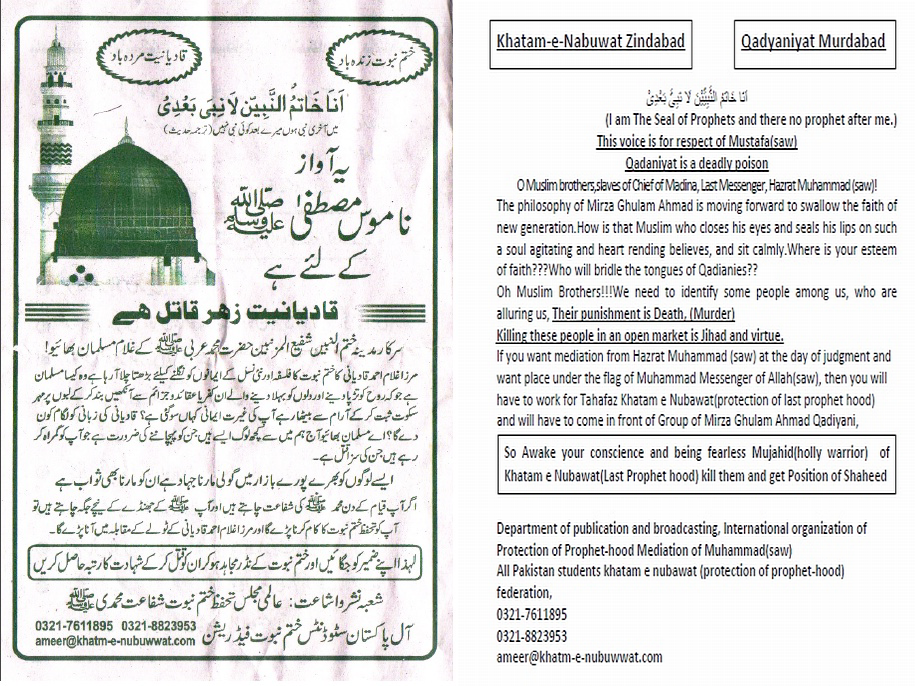
With the approval rating of the Taliban on the decline for some time, they needed to do something to regain their lost support. Their target was, therefore, a community that has been long persecuted in the name of religion; a community against whom anything can be uttered without any fear of the law; a section of society that you can declare wajibul qatl on television shows. The target chosen by the Taliban was calculated to achieve two objectives: (a) challenging the government’s writ and (b) gaining some of their lost support by carrying out a “noble” deed.
At a time when most Pakistanis had hung their heads in shame, the Lahore incident encouraged one Abid Butt in Narowal to stab two Ahmedi men, killing one of them. Reports say Abid Butt has vowed not to leave any Ahmedi alive. This follow-up incident only underscores the need to attack the real disease, because otherwise symptoms like Abid Butt will keep surfacing.
It is, therefore, important that, as a first step, we analyse the issue in retrospect. The religious parties that are so powerful in Pakistan today had opposed the country’s very creation, calling it “Na-Pakistan” and “Paleedistan” (“Land of Filth” or “Land of Immorality”) and calling the Quaid-e-Azam (Great Leader) “Kafir-e-Azam” (Great Infidel) for his secular views. Of course, they would not have reacted in this manner if Pakistan had been conceived as a theocratic state, or as a state only for Muslims.
In his speech of Aug 11, 1947, to the Constituent Assembly, the Quaid-e-Azam set out his vision in the following words: “In due course of time, Hindus will cease to be Hindus and Muslims will cease to be Muslims; not in the religious sense, because that is the personal faith of each individual, but in the political sense as citizens of the State.” Clearly, the Pakistan of today is a million miles from this vision. Today it appears that Pakistan was created by the religious parties of today for imposing on us their version of Sharia. Something has drastically changed over the past six decades that has resulted in this image of Pakistan, which is far from what was conceived by the Quaid-e-Azam. We need to revisit history to see what went wrong, and where.
The creation of Pakistan had come as a shock to the religious parties, which had lost their battle against a secular person, the Quaid-e-Azam. But they soon found an opportunity to make political gains by objecting to the Quaid-e-Azam’s appointment of Sir Zafarullah Khan, an Ahmedi, as the first foreign minister of Pakistan. They forgot that he was one of those who drafted the Lahore Resolution and served as counsel to the Muslim League before the Boundary Commission. He was even dubbed as an Indian agent, although it was his speeches before the UN General Assembly that resulted in the UN resolutions on Kashmir calling for a plebiscite in the territory.
As part of their agitation, a publication by the name ‘Ash-shahab’ (First written by Maulana Shabbir Ahmad Usmani in 1920) was reprinted in March 1950. It aimed to establish that Ahmedis were wajibul qatl. The document was constantly quoted as a fatwa by the religious leaders. In a public meeting in Rawalpindi, from 14 to 16 April 1950, almost every speaker referred to the ‘Ash-shahab’. All this built up the temperature and finally resulted in the riots of 1953 that claimed scores of innocent lives.
While Sir Zafarullah’s refusal to attend the funeral of the Quaid-e-Azam was widely talked about, people were not told the reason for this refusal: that the funeral prayers of the founder of Pakistan were led by the same Maulana who had declared Ahmedis wajibul qatl.
The 1954 report of the court of inquiry set up under Justice Munir is an eye-opener. The commission found that no two sects were in agreement on the definition of the word “Mussalman”. Certain sects said that if they came to power they would not hesitate to eliminate other sects. The approach adopted by the government in tackling the matter in the 1950s was not the best course of action, as it only swept the issue under the carpet.
Mr Bhutto wanted to become a leader of global fame. The strong personality of Indira Gandhi was a big hurdle in the formation of a South Asian bloc for him to lead. He sought an opportunity to lead the Islamic bloc instead. Building on the success of the Second Islamic Summit held in Lahore in February 1974, he decided to bring the issue of Ahmedis before parliament. Perhaps Bhutto thought that it would only be a matter of legal classification limited to the Constitution, without fully appreciating the future implications of his move. Whatever the reason, parliament assumed, and exercised, a right which it did not have in the first place, that of determining someone’s faith. We should have left such things to the Day of Judgment, but alas.
Ahmedis were excommunicated. This was followed by the draconian Ordinance XX of 1984 which was introduced by Ziaul Haq as part of his “Islamisation” project, which was deemed necessary to persuade people to participate in “jihad” across the Durand Line. The ordinance prohibited Ahmedis from propagating and preaching their faith, from calling their places of worship “mosques” and from calling themselves Muslim. Under this ordinance, scores of Ahmedis have been sentenced for “heinous crimes,” including those of reciting the Kalima Tayyaba and using the Islamic greeting of As-salaam-o-alaikum.
The Ahmedis’ excommunication was soon to be followed by Shia-Sunni tensions. The number of Shia-Sunni killings is far greater than that involving Ahmedis. Meanwhile, the divide between Deobandis and Barelvis is widening. All this is a natural consequence of what parliament did in 1974.
It is time 1974’s 2nd Amendment to the Constitution and Ziaul Haq’s Ordinance XX were reconsidered. You need not be a theologian to understand the destructive aspects of these legislations. Once you set an example of excommunicating a sect for having a belief different from yours, you encourage a sectarian mindset in people as a whole, with followers of some sects regarding other sects as being beyond the pale of Islam.
The deviation from the vision of the Quaid-e-Azam has been very costly. Today, the world sees us as a terrorists-making factory. We have mutilated the image of our religion, which for many has become a symbol of violence. The state should promote tolerance, not through empty utterances but by undoing the wrongs committed in the past. If we are to correct the wrongs, we must begin by getting our basics right.
The writer is an accountant living in Dublin. Email: kashif.jahangiri@gmail.com
URL: www.thenews.com.pk/daily_detail.asp?id=243223
Kashif Jahangiri
We cannot divorce the present form of terrorism from religious extremism. The terrorists are a fruit of the tree called extremism. We need to uproot the tree, as otherwise the poisonous fruit will keep on growing.
With the approval rating of the Taliban on the decline for some time, they needed to do something to regain their lost support. Their target was, therefore, a community that has been long persecuted in the name of religion; a community against whom anything can be uttered without any fear of the law; a section of society that you can declare wajibul qatl on television shows. The target chosen by the Taliban was calculated to achieve two objectives: (a) challenging the government’s writ and (b) gaining some of their lost support by carrying out a “noble” deed.
At a time when most Pakistanis had hung their heads in shame, the Lahore incident encouraged one Abid Butt in Narowal to stab two Ahmedi men, killing one of them. Reports say Abid Butt has vowed not to leave any Ahmedi alive. This follow-up incident only underscores the need to attack the real disease, because otherwise symptoms like Abid Butt will keep surfacing.
It is, therefore, important that, as a first step, we analyse the issue in retrospect. The religious parties that are so powerful in Pakistan today had opposed the country’s very creation, calling it “Na-Pakistan” and “Paleedistan” (“Land of Filth” or “Land of Immorality”) and calling the Quaid-e-Azam (Great Leader) “Kafir-e-Azam” (Great Infidel) for his secular views. Of course, they would not have reacted in this manner if Pakistan had been conceived as a theocratic state, or as a state only for Muslims.
In his speech of Aug 11, 1947, to the Constituent Assembly, the Quaid-e-Azam set out his vision in the following words: “In due course of time, Hindus will cease to be Hindus and Muslims will cease to be Muslims; not in the religious sense, because that is the personal faith of each individual, but in the political sense as citizens of the State.” Clearly, the Pakistan of today is a million miles from this vision. Today it appears that Pakistan was created by the religious parties of today for imposing on us their version of Sharia. Something has drastically changed over the past six decades that has resulted in this image of Pakistan, which is far from what was conceived by the Quaid-e-Azam. We need to revisit history to see what went wrong, and where.
The creation of Pakistan had come as a shock to the religious parties, which had lost their battle against a secular person, the Quaid-e-Azam. But they soon found an opportunity to make political gains by objecting to the Quaid-e-Azam’s appointment of Sir Zafarullah Khan, an Ahmedi, as the first foreign minister of Pakistan. They forgot that he was one of those who drafted the Lahore Resolution and served as counsel to the Muslim League before the Boundary Commission. He was even dubbed as an Indian agent, although it was his speeches before the UN General Assembly that resulted in the UN resolutions on Kashmir calling for a plebiscite in the territory.
As part of their agitation, a publication by the name ‘Ash-shahab’ (First written by Maulana Shabbir Ahmad Usmani in 1920) was reprinted in March 1950. It aimed to establish that Ahmedis were wajibul qatl. The document was constantly quoted as a fatwa by the religious leaders. In a public meeting in Rawalpindi, from 14 to 16 April 1950, almost every speaker referred to the ‘Ash-shahab’. All this built up the temperature and finally resulted in the riots of 1953 that claimed scores of innocent lives.
While Sir Zafarullah’s refusal to attend the funeral of the Quaid-e-Azam was widely talked about, people were not told the reason for this refusal: that the funeral prayers of the founder of Pakistan were led by the same Maulana who had declared Ahmedis wajibul qatl.
The 1954 report of the court of inquiry set up under Justice Munir is an eye-opener. The commission found that no two sects were in agreement on the definition of the word “Mussalman”. Certain sects said that if they came to power they would not hesitate to eliminate other sects. The approach adopted by the government in tackling the matter in the 1950s was not the best course of action, as it only swept the issue under the carpet.
Mr Bhutto wanted to become a leader of global fame. The strong personality of Indira Gandhi was a big hurdle in the formation of a South Asian bloc for him to lead. He sought an opportunity to lead the Islamic bloc instead. Building on the success of the Second Islamic Summit held in Lahore in February 1974, he decided to bring the issue of Ahmedis before parliament. Perhaps Bhutto thought that it would only be a matter of legal classification limited to the Constitution, without fully appreciating the future implications of his move. Whatever the reason, parliament assumed, and exercised, a right which it did not have in the first place, that of determining someone’s faith. We should have left such things to the Day of Judgment, but alas.
Ahmedis were excommunicated. This was followed by the draconian Ordinance XX of 1984 which was introduced by Ziaul Haq as part of his “Islamisation” project, which was deemed necessary to persuade people to participate in “jihad” across the Durand Line. The ordinance prohibited Ahmedis from propagating and preaching their faith, from calling their places of worship “mosques” and from calling themselves Muslim. Under this ordinance, scores of Ahmedis have been sentenced for “heinous crimes,” including those of reciting the Kalima Tayyaba and using the Islamic greeting of As-salaam-o-alaikum.
The Ahmedis’ excommunication was soon to be followed by Shia-Sunni tensions. The number of Shia-Sunni killings is far greater than that involving Ahmedis. Meanwhile, the divide between Deobandis and Barelvis is widening. All this is a natural consequence of what parliament did in 1974.
It is time 1974’s 2nd Amendment to the Constitution and Ziaul Haq’s Ordinance XX were reconsidered. You need not be a theologian to understand the destructive aspects of these legislations. Once you set an example of excommunicating a sect for having a belief different from yours, you encourage a sectarian mindset in people as a whole, with followers of some sects regarding other sects as being beyond the pale of Islam.
The deviation from the vision of the Quaid-e-Azam has been very costly. Today, the world sees us as a terrorists-making factory. We have mutilated the image of our religion, which for many has become a symbol of violence. The state should promote tolerance, not through empty utterances but by undoing the wrongs committed in the past. If we are to correct the wrongs, we must begin by getting our basics right.
The writer is an accountant living in Dublin. Email: kashif.jahangiri@gmail.com
URL: www.thenews.com.pk/daily_detail.asp?id=243223





 Posts
Posts


