Showing posts with label Lahore Resolution. Show all posts

Tuesday, November 23, 2010

Pakistan: Repeal Blasphemy Law

Human Rights Watch
Pakistan: Repeal Blasphemy Law
Legal Discrimination Emboldens Extremists
November 23, 2010
A police official takes the thumb print of Aasia Bibi, a Pakistani Christian woman who has been sentenced to death for blasphemy, on an affidavit stating her innocence after she was visited by the Governor of the Punjab Province Salman Taseer (R) at the central jail in Sheikhupura, Punjab Province, on November 20, 2010. © 2010 Reuters
A police official takes the thumb print of Aasia Bibi, a Pakistani Christian woman who has been sentenced to death for blasphemy, on an affidavit stating her innocence after she was visited by the Governor of the Punjab Province Salman Taseer (R) at the central jail in Sheikhupura, Punjab Province, on November 20, 2010.
© 2010 Reuters

The Punjab provincial government is either in denial about threats to minorities or is following a policy of willful discrimination. Provincial law enforcement authorities need to put aside their prejudices and protect religious minorities who are clearly in serious danger from both the Taliban and sectarian militant groups historically supported by the state.
Ali Dayan Hasan, senior South Asia researcher at Human Rights Watch.
(New York) — Pakistan’s government should immediately introduce legislation to repeal the country’s blasphemy law and other discriminatory legislation, Human Rights Watch said today. The government should also take legal action against Islamist militant groups responsible for threats and violence against minorities and other vulnerable groups, Human Rights Watch said.

While international and Pakistani human rights groups have long called for the repeal of the blasphemy law, it has come under renewed scrutiny in recent weeks as a consequence of a death sentence imposed on November 8, 2010, on Aasia Bibi, an illiterate farmhand from Sheikhupura district in Punjab province. She was charged under the blasphemy law after a June 2009 altercation with fellow farm workers who refused to drink water she had touched, contending it was unclean because she was a Christian. She is the first woman in Pakistan’s history to be sentenced to death for blasphemy, though others have been charged and given lesser sentences.

“Aasia Bibi has suffered greatly and should never have been put behind bars,” said Ali Dayan Hasan, senior South Asia researcher at Human Rights Watch. “The injustice and fear the blasphemy law spawns will only cease when this heinous law is repealed.”

President Asif Ali Zardari ordered a review of the case in the face of domestic and international outrage. Government officials have indicated publicly that Zardari is expected to use his constitutional authority to pardon her.

Pakistan’s “Blasphemy Law,” as section 295-C of the penal code is known, makes the death penalty mandatory for blasphemy. In 2009, authorities charged scores of people under the law, including at least 50 members of the Ahmadiyya community, a heterodox sect that claims to be Muslim but has been declared non-Muslim under Pakistani law. Many of these individuals remain in prison.

Legal discrimination against religious minorities and the failure of Pakistan’s federal and provincial governments to address religious persecution by Islamist groups effectively enables atrocities against these groups and others who are vulnerable. The government seldom brings charges against those responsible for such violence and discrimination. Research by Human Rights Watch indicates that the police have not apprehended anyone implicated in such activity in the last several years.

Social persecution and legal discrimination against religious minorities has become particularly widespread in Punjab province. Human Rights Watch urged the provincial government, controlled by former prime minister Nawaz Sharif’s Pakistan Muslim League (Nawaz) party, to investigate and prosecute as appropriate campaigns of intimidation, threats, and violence against Christians, Ahmadis, and other vulnerable groups.

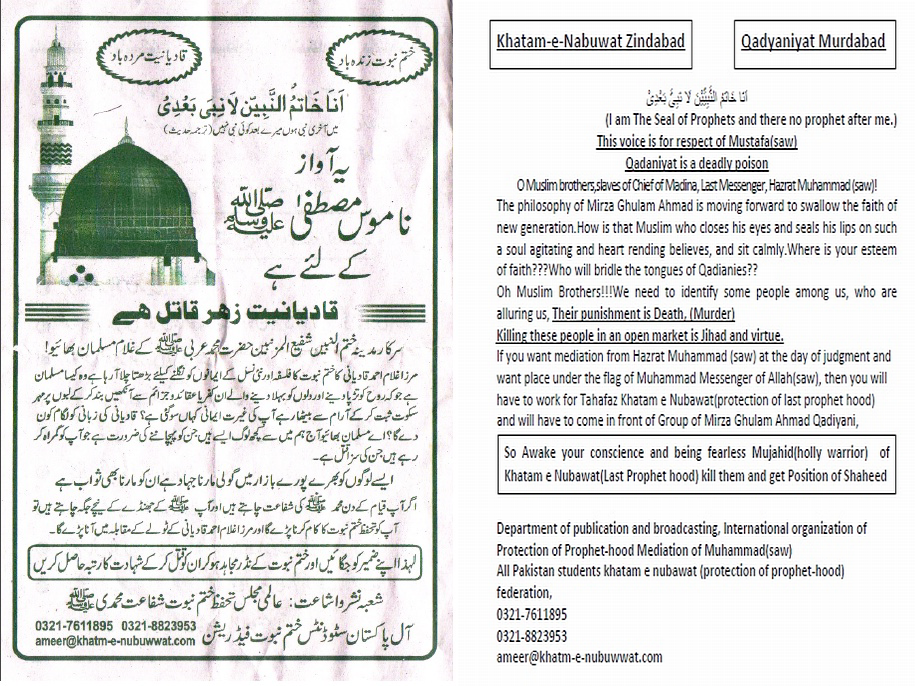
On November 18, armed assailants opened fire at an Ahmadiyya mosque in Lahore, the Punjab capital. The mosque had no police protection despite a May 28 attack on two Ahmadiyya mosques in the city that killed 94 people and injured well over a hundred. Those attacks were believed to have been carried out by groups affiliated with the Pakistani Taliban.

The November 18 attack did not result in further loss of life only because of private security provided by the mosque management. Local residents told Human Rights Watch that the police initially sought to portray the attack falsely as a consequence of a dispute within the Ahmadiyya community and only made arrests when the mosque authorities provided security camera footage identifying the attackers.

“The Punjab provincial government is either in denial about threats to minorities or is following a policy of willful discrimination,” Hasan said. “Provincial law enforcement authorities need to put aside their prejudices and protect religious minorities who are clearly in serious danger from both the Taliban and sectarian militant groups historically supported by the state.”

Since the Pakistani military government of General Zia-ul-Haq unleashed a wave of persecution in the 1980s, violence against religious minorities has never really ceased. Attackers kill and wound Christians and Ahmadis, in particular, and burn down their homes and businesses. The authorities arrest, jail, and charge members of minority communities, heterodox Muslims and others, with blasphemy and related offenses because of their religious beliefs, as a means of transacting vendettas and settling scores. In several instances, the police have been complicit in harassing and framing false charges against members of these groups or stood by as they were attacked.

Human Rights Watch urged concerned governments and intergovernmental bodies to press the Pakistani government to repeal sections 295 and 298 of the Pakistan Penal Code, which includes the blasphemy law and anti-Ahmadiyya laws. They should also urge the government to prosecute those responsible for planning and executing attacks against religious minorities.

“Continued use of the blasphemy law is abominable,” Hasan said. “As long as such laws remain on the books, Pakistan will remain plagued by abuse in the name of religion.”


Tuesday, June 8, 2010

The demand for Pakistan and Islam

Daily Times, Pakistan
Tuesday, June 08, 2010

VIEW: The demand for Pakistan and Islam

The Muslim League’s propaganda struck terror in the hearts of the Hindus and Sikhs who were told that they would be paying jazya and Islamic law will prevail in all sectors of individual and collective life. The minority Shia and Ahmediyya communities were also fearful that it would result in Sunni domination

The recent attack on a congregation of Ahmedis during prayers, which claimed more than 90 innocent lives, has revived a discussion as to whether there is a connection between the creation of Pakistan and Islam. Within the Muslim League there was always a constituency in favour of Pakistan becoming an Islamic state. One of its proponents was a close confident of Jinnah: Raja Sahib Mahmudabad, a Shia. In 1939 he wrote to the historian Mohibul Hassan:

“When we speak of democracy in Islam it is not democracy in the government but in the cultural and social aspects of life. Islam is totalitarian — there is no denying about it. It is the Quran that we should turn to. It is the dictatorship of the Quranic laws that we want — and that we will have — but not through non-violence and Gandhian truth” (Mushirul Hasan, 1997: 57-8).

If the March 23, 1940, Lahore Resolution be taken as the start of the Pakistan campaign, then Jinnah had to make a breakthrough in the Muslim-majority provinces of northwestern India — Khyber Pakhtunkhwa, Punjab and Sindh — each of which had regional parties headed by Muslims. The Muslim League had to convince the Muslim voters in these provinces that their leaders were courting Hindus and Sikhs and thus were paving the way for Hindu Raj under the Indian National Congress. That opportunity arrived in July 1945 when the British government announced provincial elections for February 1946. Punjab Governor Sir Bertrand Glancy has recorded in several secret fortnightly reports (FR) the tactics that the Muslim League adopted during the long election campaign. In the FR of December 27, 1945, Glancy noted:

“Among Muslims the Leaguers are increasing their efforts to appeal to the bigotry of the electors. Pirs and maulvis have been enlisted in large numbers to tour the province and denounce all who oppose the League as infidels. Copies of the Holy Quran are carried around as an emblem peculiar to the Muslim League. Feroz [Khan Noon] and others openly preach that every vote given to the League is a vote cast in favour of the Holy Prophet (PBUH). These deplorable tactics, as I have frequently said, were only to be expected; they provide a grim augury of the future peace of India and they are certainly not easy for the Unionists to counter” (Lionel Carter, 2006: 160).

In the FR of February 2, 1946, Glancy wrote:

“The ML [Muslim League] orators are becoming increasingly fanatical in their speeches. Maulvis and pirs and students travel all round the province and preach that those who fail to vote for the League candidates will cease to be Muslims; their marriages will no longer be valid and they will be entirely excommunicated…It is not easy to foresee what the results of the elections will be. But there seems little doubt the Muslim League, thanks to the ruthless methods by which they have pursued their campaign of ‘Islam in danger’, will considerably increase the number of their seats and Unionist representatives will correspondingly decline” (Carter, 2006: 171).

Similar tactics were adopted in the campaigns in Khyber Pakhtunkhwa and Sindh. In his doctoral dissertation, India, Pakistan or Pakhtunistan?, Erland Jansson writes:

“The pir of Manki Sharif…founded an organisation of his own, the Anjuman-us-asfia. The organisation promised to support the Muslim League on the condition that Shariat would be enforced in Pakistan. To this Jinnah agreed. As a result the pir of Manki Sharif declared jihad to achieve Pakistan and ordered the members of his anjuman to support the League in the 1946 elections” (pg 166).

Jinnah wrote in November 1945 a letter to Pir Manki Sharif in which he promised that the Shariat would apply to the affairs of the Muslim majority. He wrote:

“It is needless to emphasise that the Constituent Assembly, which would be predominantly Muslim in its composition, would be able to enact laws for Muslims, not inconsistent with the Shariat laws and the Muslims will no longer be obliged to abide by the un-Islamic laws” (Constituent Assembly of Pakistan Debates, Volume 5, 1949, pg 46).

The Muslim League’s propaganda struck terror in the hearts of the Hindus and Sikhs who were told that they would be paying jazya and Islamic law will prevail in all sectors of individual and collective life. The minority Shia and Ahmediyya communities were also fearful that it would result in Sunni domination. This is obvious from the correspondence between the Shia leader Syed Ali Zaheer and Jinnah in July 1944 (G Allana, 1977: 375-9). Although the Council of Action of the All-Parties Shia Conference passed a resolution on December 25, 1945, rejecting the idea of Pakistan (SR Bakshi, 1997: 848-9), most Shias shifted their loyalty to the Muslim League in the hope that Pakistan will be a non-sectarian state. Initially the Ahmediyya were also wary and reluctant to support the demand for a separate Muslim state (Munir Report, 1954: 196). It is only when Sir Zafarullah was won over by Jinnah that the Ahmedis started supporting the demand for Pakistan. To all such groups Jinnah gave assurances that Pakistan will not be a sectarian state.

In my forthcoming book on the partition of Punjab, now running into more than 1,000 pages but which is at last completed and for which I am now looking for a publisher, I will shed light on how the fierce Islamist propaganda impacted on the partition of Punjab. The Sikhs had more fears than anyone else about what could happen to minorities in Pakistan. In a meeting in May 1947 sponsored by Lord Mountbatten to help the Muslims and Sikhs reach an agreement on keeping Punjab united, Jinnah offered the Sikhs all the safeguards they wanted if they agreed to support Pakistan. Only in March 1947 some 2,000-10,000 Sikhs — depending on who you cite — were butchered in the Rawalpindi rural areas so the Sikhs were very wary of Jinnah’s overtures. Chief Minister of Patiala Hardit Singh Malik writes he had an inspiration and asked Jinnah: “Sir you are making all the promises but God forbid if something happens to you, what will happen then?” The exact words Jinnah used in reply will be revealed in my forthcoming book, but the reasoning was that his followers will treat his words as sacred.

Ishtiaq Ahmed is a Visiting Research Professor at the Institute of South Asian Studies (ISAS) and the South Asian Studies Programme at the National University of Singapore and Professor Emeritus of Political Science at Stockholm University. He is currently working on a book, Is Pakistan a Garrison State? He can be reached at isasia@nus.edu.sg

Saturday, June 5, 2010

Right this wrong

The News - Internet Edition
Saturday, June 05, 2010,
Jamadi-us-Sani 21, 1431 A.H.
 Right this wrong

Saturday, June 05, 2010
Kashif Jahangiri

We cannot divorce the present form of terrorism from religious extremism. The terrorists are a fruit of the tree called extremism. We need to uproot the tree, as otherwise the poisonous fruit will keep on growing.

With the approval rating of the Taliban on the decline for some time, they needed to do something to regain their lost support. Their target was, therefore, a community that has been long persecuted in the name of religion; a community against whom anything can be uttered without any fear of the law; a section of society that you can declare wajibul qatl on television shows. The target chosen by the Taliban was calculated to achieve two objectives: (a) challenging the government’s writ and (b) gaining some of their lost support by carrying out a “noble” deed.

At a time when most Pakistanis had hung their heads in shame, the Lahore incident encouraged one Abid Butt in Narowal to stab two Ahmedi men, killing one of them. Reports say Abid Butt has vowed not to leave any Ahmedi alive. This follow-up incident only underscores the need to attack the real disease, because otherwise symptoms like Abid Butt will keep surfacing.

It is, therefore, important that, as a first step, we analyse the issue in retrospect. The religious parties that are so powerful in Pakistan today had opposed the country’s very creation, calling it “Na-Pakistan” and “Paleedistan” (“Land of Filth” or “Land of Immorality”) and calling the Quaid-e-Azam (Great Leader) “Kafir-e-Azam” (Great Infidel) for his secular views. Of course, they would not have reacted in this manner if Pakistan had been conceived as a theocratic state, or as a state only for Muslims.

In his speech of Aug 11, 1947, to the Constituent Assembly, the Quaid-e-Azam set out his vision in the following words: “In due course of time, Hindus will cease to be Hindus and Muslims will cease to be Muslims; not in the religious sense, because that is the personal faith of each individual, but in the political sense as citizens of the State.” Clearly, the Pakistan of today is a million miles from this vision. Today it appears that Pakistan was created by the religious parties of today for imposing on us their version of Sharia. Something has drastically changed over the past six decades that has resulted in this image of Pakistan, which is far from what was conceived by the Quaid-e-Azam. We need to revisit history to see what went wrong, and where.

The creation of Pakistan had come as a shock to the religious parties, which had lost their battle against a secular person, the Quaid-e-Azam. But they soon found an opportunity to make political gains by objecting to the Quaid-e-Azam’s appointment of Sir Zafarullah Khan, an Ahmedi, as the first foreign minister of Pakistan. They forgot that he was one of those who drafted the Lahore Resolution and served as counsel to the Muslim League before the Boundary Commission. He was even dubbed as an Indian agent, although it was his speeches before the UN General Assembly that resulted in the UN resolutions on Kashmir calling for a plebiscite in the territory.

As part of their agitation, a publication by the name ‘Ash-shahab’ (First written by Maulana Shabbir Ahmad Usmani in 1920) was reprinted in March 1950. It aimed to establish that Ahmedis were wajibul qatl. The document was constantly quoted as a fatwa by the religious leaders. In a public meeting in Rawalpindi, from 14 to 16 April 1950, almost every speaker referred to the ‘Ash-shahab’. All this built up the temperature and finally resulted in the riots of 1953 that claimed scores of innocent lives.

While Sir Zafarullah’s refusal to attend the funeral of the Quaid-e-Azam was widely talked about, people were not told the reason for this refusal: that the funeral prayers of the founder of Pakistan were led by the same Maulana who had declared Ahmedis wajibul qatl.


The 1954 report of the court of inquiry set up under Justice Munir is an eye-opener. The commission found that no two sects were in agreement on the definition of the word “Mussalman”. Certain sects said that if they came to power they would not hesitate to eliminate other sects. The approach adopted by the government in tackling the matter in the 1950s was not the best course of action, as it only swept the issue under the carpet.

Mr Bhutto wanted to become a leader of global fame. The strong personality of Indira Gandhi was a big hurdle in the formation of a South Asian bloc for him to lead. He sought an opportunity to lead the Islamic bloc instead. Building on the success of the Second Islamic Summit held in Lahore in February 1974, he decided to bring the issue of Ahmedis before parliament. Perhaps Bhutto thought that it would only be a matter of legal classification limited to the Constitution, without fully appreciating the future implications of his move. Whatever the reason, parliament assumed, and exercised, a right which it did not have in the first place, that of determining someone’s faith. We should have left such things to the Day of Judgment, but alas.

Ahmedis were excommunicated. This was followed by the draconian Ordinance XX of 1984 which was introduced by Ziaul Haq as part of his “Islamisation” project, which was deemed necessary to persuade people to participate in “jihad” across the Durand Line. The ordinance prohibited Ahmedis from propagating and preaching their faith, from calling their places of worship “mosques” and from calling themselves Muslim. Under this ordinance, scores of Ahmedis have been sentenced for “heinous crimes,” including those of reciting the Kalima Tayyaba and using the Islamic greeting of As-salaam-o-alaikum.

The Ahmedis’ excommunication was soon to be followed by Shia-Sunni tensions. The number of Shia-Sunni killings is far greater than that involving Ahmedis. Meanwhile, the divide between Deobandis and Barelvis is widening. All this is a natural consequence of what parliament did in 1974.

It is time 1974’s 2nd Amendment to the Constitution and Ziaul Haq’s Ordinance XX were reconsidered. You need not be a theologian to understand the destructive aspects of these legislations. Once you set an example of excommunicating a sect for having a belief different from yours, you encourage a sectarian mindset in people as a whole, with followers of some sects regarding other sects as being beyond the pale of Islam.

The deviation from the vision of the Quaid-e-Azam has been very costly. Today, the world sees us as a terrorists-making factory. We have mutilated the image of our religion, which for many has become a symbol of violence. The state should promote tolerance, not through empty utterances but by undoing the wrongs committed in the past. If we are to correct the wrongs, we must begin by getting our basics right.

The writer is an accountant living in Dublin. Email: kashif.jahangiri@gmail.com

URL: www.thenews.com.pk/daily_detail.asp?id=243223

Before it’s too late

The News - Internet Edition
Saturday, June 05, 2010,
Jamadi-us-Sani 21, 1431 A.H.
 Before it’s too late

Saturday, June 05, 2010
Tasneem Noorani

We have had terrorist attacks on the police, the army, the ISI, the FIA, the FC and hotels lodging foreigners, because they are perceived to be helping the US. Our history is replete with incidents of sectarian violence. But where does the attack on the Ahmedi community come from?

The Ahmadis are neither associated with the US nor are they partners on either side of the sectarian divide. What this attack indicates is the availability of spare “troops” and reserves with the terrorist forces which can now afford to target enemies lower down in their priority list. Could it be the Hindus or the Christians next? Could it be the businessmen because they are rich? Could it be the cinemagoers because, somehow, they don’t conform to the moral values of the terrorists?

The disconcerting part of the equation is the abundant availability of the suicide bombers. While you need resources to raise regular forces, for raising suicide bombers you need a lack of resources. The deprived and the downtrodden ones, some having been groomed at madressahs, need only intelligent exploitation of any cause–be it the Afghan invasion, the tribal areas’ invasion, the drone attacks, the Lal Masjid operation–to convert a 14-year-old from a playful child into a live bomb. And there is no shortage of ‘raw material’ for this purpose in the country.

In the short term, the most effective defence against the surge in terrorism can be the police. But in our case, the police force doesn’t seem to play its role despite the disproportionate increase in the recent past, in the allocation of resources to them, through a substantial, across-the-board salary increase and provision of latest equipment. What is lacking is not the quantity but the quality. While the elite squads are raised and trained in the commando mode, their performance leaves much to be desired. The dancing and firing in the air at the end of a mission to celebrate victory is more in the mode of having won a village kabaddi match than a style befitting a commando.

We saw similar scenes in the Munawan incident. From the TV images, the body language of the elite force while it was approaching the scene of the incident was casual and non-professional. Therefore, the results are also questionable. While the TV cameras were able to spot terrorists on rooftops, there were no sharp shooters to take them on. Similarly, scores of victims died in Lahore’s Ahmedi carnage due to excessive bleeding from gunshot wounds, but our commandos could not do anything to help them. All this points to the need for better training of the elite forces.

Because the Ahmedis neither have the political clout nor the street strength, the Lahore carnage will be in the news for a few days. At best, the terrorists arrested at the crime scene will be prosecuted, but there will be no thrust for the prosecution of the handlers. If a person involved in such attacks says that he has been trained in Waziristan, there will be no effort to trace his trainers or the masterminds on the basis of the argument that this is a national issue and is being sorted out by the army.

The measures taken by the government to curb terrorism are short-term and they won’t rid us of the menace. The government needs to focus on tackling the root causes of this problem. If this nosedive is to be prevented, there are three main areas that need immediate attention. The first one is the foreign policy, second, the education system and third, the economy. We need to discuss with the US a rethink of the way forward, for the sake of the survival of Pakistan, which should serve the US interest in the long run. As far as the education system is concerned, apart from merging and bringing closer the various streams of education, we need to impose government’s writ in this sector. No state can allow uncontrolled teaching and spread of a particular ideology and the thinking and training and survive as a state. Lastly we need to work on the betterment of our economy.

Without sorting out these basic issues, we will continue to live on panadols, until one day we discover that the disease has destroyed the body structure of the state.

The writer is a former federal secretary. 
Email: tasneem.m.noorani@gmail.com

Tuesday, June 1, 2010

ROVER’S DIARY: Killing fields

Daily Times, Pakistan
Tuesday, June 01, 2010

ROVER’S DIARY: Killing fields — Babar Ayaz

Many of my writer and journalist friends are sad, angry and frustrated. Yes, sad because we are a sensitive and humane bunch and have equal love for all, without distinction of religion, sect, nationality and race

Once again I have fallen on the thorns of the killing fields of Pakistan. I am bleeding. This time over 80 Ahmedis were killed in two attacks on their places of worship in Lahore. Sorry, the law forbids me to call their worship places ‘mosques’ and the killed namazis. Such are the laws of the land of the pure, although they are in violation of the basic principle of the constitution that grants equal rights to the people and freedom of expression. And these laws conflict with the UN Charter of Human Rights.

Target killings on ethnic, political and sectarian basis in Karachi; killing of teachers in Balochistan; killing of the Baloch; missing Baloch nationalists; killing of people by the Taliban in FATA and Khyber Pakhtunkhwa; all those killed are my own people. Even the misled intolerant suicide bombers are of us. And each time a person is killed, something in me snaps.

My cardiologist who I visited for a checkup last Friday says that in Pakistan we live in depressing times. My psychiatrist friend Dr Haroon Ahmed endorses this statement. He says the number of patients who suffer from depression have almost doubled in the last few years. He is conducting a study on the rise in post-trauma mental disorders and the rise in psychosomatic physical disorder cases. Most such cases are not reported. But Dr Ahmed feels that many people in the urban society are taking tranquillisers. All lessons into positive thinking and optimism are dampened by the reigning grief on such days, which are brought live into our households.

Every time intolerance and violence wins over life, my soul is tormented and reminds me of Ghalib: Mujeh kya bura tha marna jo yeh aik bar hota. But then, perhaps, it is not only I; such killings quietly shatter the nerves of most people. It is only that different people pay different tolls. Many of my writer and journalist friends are sad, angry and frustrated. Yes, sad because we are a sensitive and humane bunch and have equal love for all, without distinction of religion, sect, nationality and race. Angry, because we have seen how the shortsighted policies of our successive rulers have sowed the seeds of intolerance and violence in this society. Frustrated, because the obscurantists who preach intolerance have access to the pulpit, madaris and air-time more than the voices of rationality in this country.

No doubt it is important to find out who did it; it is also equally essential to dig out and punish the forces behind terrorism. After every such sectarian killing, our leaders usually say that no Muslim could have done such a thing. Are we not being ostrich-headed? Or, are our leaders trying to tell people that non-Muslims are senseless killers?

In Friday’s killings, the targets were the Ahmedis. Many religious groups live on spitting fire and brimstone against them every day, and the state quietly watches them condescendingly. A large section of the media reports the statements of the hate-mongers with impunity. Of late, some blogs have been targeting them for conspiracies against Pakistan. Even some TV anchors of religious programmes declare Ahmedis as non-Muslims and condemn them for blasphemy. After one such programme, two Ahmedis were killed in Sindh. Each month there are target killings of Ahmedi and Shia doctors in Sindh and Punjab. Neither the popular news channel banned the aalim, nor the Pakistan Electronic Media Regulatory Authority (PEMRA), which is supposed to take notice of such things, took any action.

I think that brings us to the most crucial question: why? Yes, why one Muslim sect considers other Muslim sects apostate and thus liable to death? Why have they the right to decide who is Muslim and who is not? Why human life has lost its value? Why so many people tend to believe that it is the work of a foreign hand or the agencies? Why are we shy to face the reality that even many people sitting in our parliament and the judiciary are bigots? Why so many people are willing to blow themselves up?

Briefly, I can say that there is a broad consensus among the intelligentsia that, for years, the establishment has supported and nourished the extremists. Saudiaisation of our otherwise tolerant Islam in Pakistan has nourished intolerance in the country. All sects and religious minorities have the right to believe in their own interpretation of Islam, but nobody should have the right to preach hatred against another sect. It is easy to say but hard to implement unless there is broad consensus among all the institutions of the state.

Quickly, on what is to be done. First and foremost, nationalise all madaris and convert them to normal schools. Purge them of the extremist teachers who preach jihad against the state and other sects. Second, all school syllabi should be cleansed of any material that inculcates religious hatred against other religions. Third, no political or religious party should be allowed to spread hatred through the media and the mosques. Last, and most important, Pakistan should be declared a secular state. All sectarian amendments inserted by Mr Bhutto and General Ziaul Haq, which discriminate against a section of society, should be struck off.

The terrorists psyche is built on hatred. To fight it, let us take solace in Rumi’s poetry:
Let us fall in love again
and scatter gold dust all over the world
Let us become a new spring
and feel the breeze drift in the heavens’ scent.
Let us dress the earth in green
and like the sap of a young tree
let the grace from within us sustain us.
Let us carve gems out of our stony hearts
and let them light our path to love.
The glance of love is crystal clear
and we are blessed by its light.
(Are we?)
The writer can be reached at ayazbabar@gmail.com

Monday, May 31, 2010

VIEW: The Second Amendment

---Daily Times, Pakistan
Monday, May 31, 2010

VIEW: The Second Amendment — Yasser Latif Hamdani

The Second Amendment laid the foundations of intolerance and religious tyranny in Pakistan, which has manifested itself in other ways. Since then our state has been in a downward spiral

The violence against the Ahmediyya community underscores the bigotry that has become the hallmark of our beloved homeland. A community — already sacrificed at the altar of political expediency — has now been made to pay the ultimate price.

Amongst the dead, which included retired army officers and other contributors to Pakistani society, was reportedly the youngest brother of Chaudhry Zafarullah Khan. For those who are unaware of who Chaudhry Zafarullah was, he was the author of the Lahore Resolution, Pakistan’s first foreign minister and Pakistan’s advocate before the Boundary Commission. In other words, this community has paid for such crimes as their valiant contribution to the Pakistan Movement, their significant role in the development of Pakistan and the fact that Pakistan’s only Nobel Prize was bagged by them. Yet what happened on Friday was waiting to happen, given the neglect and at times outright bigotry that our governments, both federal and provincial, have been guilty of on this count starting with the PPP government in 1974.

Things were not always like this. It bears remembering that in 1944 when a group of Muslim divines approached Jinnah to persuade him unsuccessfully to turn all Ahmedis out of the Muslim League, Jinnah was resolute against such bigotry. He responded to them by saying, “Who am I to declare non-Muslim a person who calls himself a Muslim?” It was for this reason that many religious parties and even self-styled freedom fighters like Mirza Ali Khan (Faqir of Ipi) denounced the Muslim League as a “bastion of Qadiyanism”. Yet such was the force of character of our founding father that he not only stood against such bigotry but without any fear appointed the leading Ahmedi Muslim at the time to shoulder the most important responsibility for the Muslims of South Asia, i.e. of arguing Pakistan’s case before the Boundary Commission. So long as the Quaid’s colleagues were at the helm, there was some semblance of common sense that prevailed on this issue. When in 1953, the Majlis-e-Ahrar and the Jamaat-e-Islami, both groups that had opposed the creation of Pakistan, started a mass agitation movement to have Ahmedis like Chaudhry Zafarullah turned out from the government and excommunicated from Islam, Khawaja Nazimuddin, himself a devout Muslim, refused to bow under their pressure. His government fell a few weeks later and the establishment stepped in to sweep up the mullahs with extreme prejudice.

In 1974, Zulfikar Ali Bhutto was determined to hang on to power by hook or by crook. Though not a bigot himself, Bhutto was ill-advised by his law minister Abdul Hafeez Pirzada. As a result, the PPP stabbed in the back the one community that had helped them in winning the 1970 elections, by putting a question to parliament that it had no authority to determine. As a result Bhutto managed to hang on to power for another three years. The usurper who replaced Bhutto, General Ziaul Haq, took bigotry against the Ahmedis to another level altogether with his unconstitutional and inhumane Ordinance XX of 1984 specifically targeting this community. His bigotry was upheld by our independent judiciary in Zaheeruddin v The State, where the dispensers of justice compared Islamic symbols with Coca Cola’s intellectual property in an argument that defies all legal sense and logic to justify the ban on the Ahmedis from using any Islamic symbols — symbols that are central to their faith.

Martin Lau, a leading legal scholar of religious freedom in common law jurisdictions, has argued in his paper on Zaheeruddin v The State that Pakistan has abolished religious freedom for Pakistanis, Muslims and non-Muslims alike, through this judicial precedent. My own view is that the very idea of Pakistan as a bastion against the tyranny of the majority was killed the day our parliament decided to take it upon itself to excommunicate a sect from Islam. The Second Amendment laid the foundations of intolerance and religious tyranny in Pakistan, which has manifested itself in other ways. Since then our state has been in a downward spiral. The Gojra incident, violence against Shias, and now the massacre of the Ahmedis is only symptomatic of the real sickness that emerges from the 1974 Amendment. Pakistan shall continue to be on the wrong side of history as long as the Second Amendment remains in the constitution of this republic.

The time has come for the PPP government to undo this great injustice done to not just a minority sect but to Pakistan itself. All roots of Pakistan’s current existential crisis with Islam emerge from that one foul act that was brought about on the ill-advice of Abdul Hafeez Pirzada, who is now challenging parliament’s sovereignty, the same sovereignty he had argued 36 years ago as being absolute. It is now up to the PPP to make a clear choice. Will it continue to defend a dubious legacy or will it come out decisively against religious bigotry?

History beckons President Zardari and Prime Minister Gilani to clear the name of Pakistan’s largest political party by undoing what it did in 1974. In this they must be supported unwaveringly by the MQM and the ANP — for they claim to be the guardians of secular liberal politics. The Sharif brothers must also atone for their sins — of having spoken from both sides of their mouths — by supporting this move. Even the religious parties, the Jamaat-e-Islami foremost amongst them, must state unwaveringly that while they may not consider the Ahmedis Muslims, they are willing to leave this final judgement to God.

If they manage to undo this grievous injustice and act of inhumanity, the ladies and gentlemen in our parliament will secure for themselves a permanent place in Pakistan’s history as the visionaries who restored Jinnah’s Pakistan, which is to be built on the ideals of justice, fair play, impartiality and complete equality for all citizens of Pakistan.

Yasser Latif Hamdani is a lawyer based in Islamabad. He can be reached at yasser.hamdani@gmail.com

URL: www.dailytimes.com.pk/default.asp?page=2010\05\31\story_31-5-2010_pg3_5
 
^ Top of Page