Showing posts with label Nobel Prize. Show all posts

Tuesday, June 1, 2010

ROVER’S DIARY: Killing fields

Daily Times, Pakistan
Tuesday, June 01, 2010

ROVER’S DIARY: Killing fields — Babar Ayaz

Many of my writer and journalist friends are sad, angry and frustrated. Yes, sad because we are a sensitive and humane bunch and have equal love for all, without distinction of religion, sect, nationality and race

Once again I have fallen on the thorns of the killing fields of Pakistan. I am bleeding. This time over 80 Ahmedis were killed in two attacks on their places of worship in Lahore. Sorry, the law forbids me to call their worship places ‘mosques’ and the killed namazis. Such are the laws of the land of the pure, although they are in violation of the basic principle of the constitution that grants equal rights to the people and freedom of expression. And these laws conflict with the UN Charter of Human Rights.

Target killings on ethnic, political and sectarian basis in Karachi; killing of teachers in Balochistan; killing of the Baloch; missing Baloch nationalists; killing of people by the Taliban in FATA and Khyber Pakhtunkhwa; all those killed are my own people. Even the misled intolerant suicide bombers are of us. And each time a person is killed, something in me snaps.

My cardiologist who I visited for a checkup last Friday says that in Pakistan we live in depressing times. My psychiatrist friend Dr Haroon Ahmed endorses this statement. He says the number of patients who suffer from depression have almost doubled in the last few years. He is conducting a study on the rise in post-trauma mental disorders and the rise in psychosomatic physical disorder cases. Most such cases are not reported. But Dr Ahmed feels that many people in the urban society are taking tranquillisers. All lessons into positive thinking and optimism are dampened by the reigning grief on such days, which are brought live into our households.

Every time intolerance and violence wins over life, my soul is tormented and reminds me of Ghalib: Mujeh kya bura tha marna jo yeh aik bar hota. But then, perhaps, it is not only I; such killings quietly shatter the nerves of most people. It is only that different people pay different tolls. Many of my writer and journalist friends are sad, angry and frustrated. Yes, sad because we are a sensitive and humane bunch and have equal love for all, without distinction of religion, sect, nationality and race. Angry, because we have seen how the shortsighted policies of our successive rulers have sowed the seeds of intolerance and violence in this society. Frustrated, because the obscurantists who preach intolerance have access to the pulpit, madaris and air-time more than the voices of rationality in this country.

No doubt it is important to find out who did it; it is also equally essential to dig out and punish the forces behind terrorism. After every such sectarian killing, our leaders usually say that no Muslim could have done such a thing. Are we not being ostrich-headed? Or, are our leaders trying to tell people that non-Muslims are senseless killers?

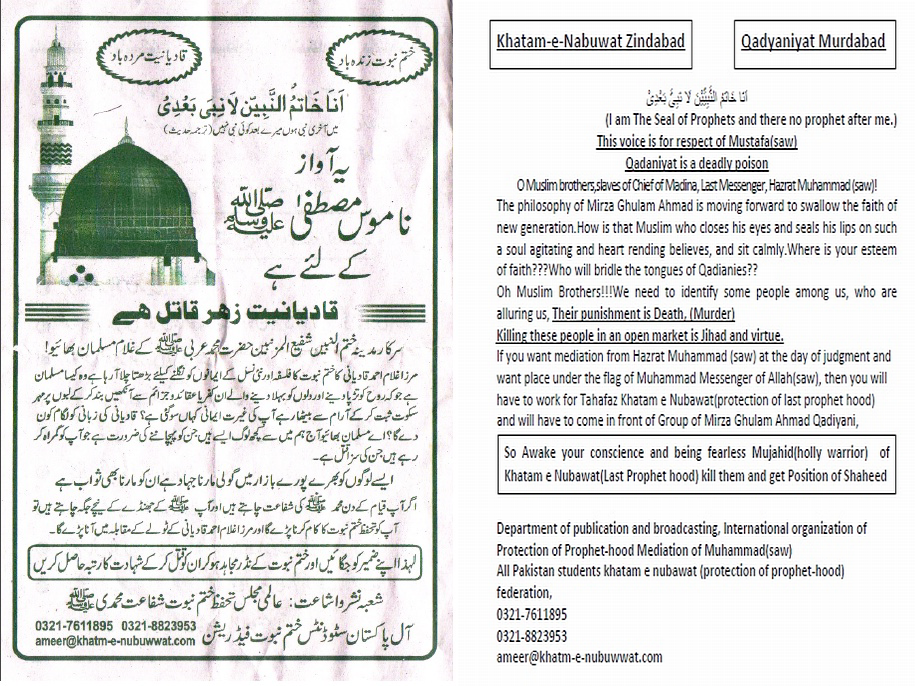
In Friday’s killings, the targets were the Ahmedis. Many religious groups live on spitting fire and brimstone against them every day, and the state quietly watches them condescendingly. A large section of the media reports the statements of the hate-mongers with impunity. Of late, some blogs have been targeting them for conspiracies against Pakistan. Even some TV anchors of religious programmes declare Ahmedis as non-Muslims and condemn them for blasphemy. After one such programme, two Ahmedis were killed in Sindh. Each month there are target killings of Ahmedi and Shia doctors in Sindh and Punjab. Neither the popular news channel banned the aalim, nor the Pakistan Electronic Media Regulatory Authority (PEMRA), which is supposed to take notice of such things, took any action.

I think that brings us to the most crucial question: why? Yes, why one Muslim sect considers other Muslim sects apostate and thus liable to death? Why have they the right to decide who is Muslim and who is not? Why human life has lost its value? Why so many people tend to believe that it is the work of a foreign hand or the agencies? Why are we shy to face the reality that even many people sitting in our parliament and the judiciary are bigots? Why so many people are willing to blow themselves up?

Briefly, I can say that there is a broad consensus among the intelligentsia that, for years, the establishment has supported and nourished the extremists. Saudiaisation of our otherwise tolerant Islam in Pakistan has nourished intolerance in the country. All sects and religious minorities have the right to believe in their own interpretation of Islam, but nobody should have the right to preach hatred against another sect. It is easy to say but hard to implement unless there is broad consensus among all the institutions of the state.

Quickly, on what is to be done. First and foremost, nationalise all madaris and convert them to normal schools. Purge them of the extremist teachers who preach jihad against the state and other sects. Second, all school syllabi should be cleansed of any material that inculcates religious hatred against other religions. Third, no political or religious party should be allowed to spread hatred through the media and the mosques. Last, and most important, Pakistan should be declared a secular state. All sectarian amendments inserted by Mr Bhutto and General Ziaul Haq, which discriminate against a section of society, should be struck off.

The terrorists psyche is built on hatred. To fight it, let us take solace in Rumi’s poetry:
Let us fall in love again
and scatter gold dust all over the world
Let us become a new spring
and feel the breeze drift in the heavens’ scent.
Let us dress the earth in green
and like the sap of a young tree
let the grace from within us sustain us.
Let us carve gems out of our stony hearts
and let them light our path to love.
The glance of love is crystal clear
and we are blessed by its light.
(Are we?)
The writer can be reached at ayazbabar@gmail.com

Monday, May 31, 2010

VIEW: The Second Amendment

---Daily Times, Pakistan
Monday, May 31, 2010

VIEW: The Second Amendment — Yasser Latif Hamdani

The Second Amendment laid the foundations of intolerance and religious tyranny in Pakistan, which has manifested itself in other ways. Since then our state has been in a downward spiral

The violence against the Ahmediyya community underscores the bigotry that has become the hallmark of our beloved homeland. A community — already sacrificed at the altar of political expediency — has now been made to pay the ultimate price.

Amongst the dead, which included retired army officers and other contributors to Pakistani society, was reportedly the youngest brother of Chaudhry Zafarullah Khan. For those who are unaware of who Chaudhry Zafarullah was, he was the author of the Lahore Resolution, Pakistan’s first foreign minister and Pakistan’s advocate before the Boundary Commission. In other words, this community has paid for such crimes as their valiant contribution to the Pakistan Movement, their significant role in the development of Pakistan and the fact that Pakistan’s only Nobel Prize was bagged by them. Yet what happened on Friday was waiting to happen, given the neglect and at times outright bigotry that our governments, both federal and provincial, have been guilty of on this count starting with the PPP government in 1974.

Things were not always like this. It bears remembering that in 1944 when a group of Muslim divines approached Jinnah to persuade him unsuccessfully to turn all Ahmedis out of the Muslim League, Jinnah was resolute against such bigotry. He responded to them by saying, “Who am I to declare non-Muslim a person who calls himself a Muslim?” It was for this reason that many religious parties and even self-styled freedom fighters like Mirza Ali Khan (Faqir of Ipi) denounced the Muslim League as a “bastion of Qadiyanism”. Yet such was the force of character of our founding father that he not only stood against such bigotry but without any fear appointed the leading Ahmedi Muslim at the time to shoulder the most important responsibility for the Muslims of South Asia, i.e. of arguing Pakistan’s case before the Boundary Commission. So long as the Quaid’s colleagues were at the helm, there was some semblance of common sense that prevailed on this issue. When in 1953, the Majlis-e-Ahrar and the Jamaat-e-Islami, both groups that had opposed the creation of Pakistan, started a mass agitation movement to have Ahmedis like Chaudhry Zafarullah turned out from the government and excommunicated from Islam, Khawaja Nazimuddin, himself a devout Muslim, refused to bow under their pressure. His government fell a few weeks later and the establishment stepped in to sweep up the mullahs with extreme prejudice.

In 1974, Zulfikar Ali Bhutto was determined to hang on to power by hook or by crook. Though not a bigot himself, Bhutto was ill-advised by his law minister Abdul Hafeez Pirzada. As a result, the PPP stabbed in the back the one community that had helped them in winning the 1970 elections, by putting a question to parliament that it had no authority to determine. As a result Bhutto managed to hang on to power for another three years. The usurper who replaced Bhutto, General Ziaul Haq, took bigotry against the Ahmedis to another level altogether with his unconstitutional and inhumane Ordinance XX of 1984 specifically targeting this community. His bigotry was upheld by our independent judiciary in Zaheeruddin v The State, where the dispensers of justice compared Islamic symbols with Coca Cola’s intellectual property in an argument that defies all legal sense and logic to justify the ban on the Ahmedis from using any Islamic symbols — symbols that are central to their faith.

Martin Lau, a leading legal scholar of religious freedom in common law jurisdictions, has argued in his paper on Zaheeruddin v The State that Pakistan has abolished religious freedom for Pakistanis, Muslims and non-Muslims alike, through this judicial precedent. My own view is that the very idea of Pakistan as a bastion against the tyranny of the majority was killed the day our parliament decided to take it upon itself to excommunicate a sect from Islam. The Second Amendment laid the foundations of intolerance and religious tyranny in Pakistan, which has manifested itself in other ways. Since then our state has been in a downward spiral. The Gojra incident, violence against Shias, and now the massacre of the Ahmedis is only symptomatic of the real sickness that emerges from the 1974 Amendment. Pakistan shall continue to be on the wrong side of history as long as the Second Amendment remains in the constitution of this republic.

The time has come for the PPP government to undo this great injustice done to not just a minority sect but to Pakistan itself. All roots of Pakistan’s current existential crisis with Islam emerge from that one foul act that was brought about on the ill-advice of Abdul Hafeez Pirzada, who is now challenging parliament’s sovereignty, the same sovereignty he had argued 36 years ago as being absolute. It is now up to the PPP to make a clear choice. Will it continue to defend a dubious legacy or will it come out decisively against religious bigotry?

History beckons President Zardari and Prime Minister Gilani to clear the name of Pakistan’s largest political party by undoing what it did in 1974. In this they must be supported unwaveringly by the MQM and the ANP — for they claim to be the guardians of secular liberal politics. The Sharif brothers must also atone for their sins — of having spoken from both sides of their mouths — by supporting this move. Even the religious parties, the Jamaat-e-Islami foremost amongst them, must state unwaveringly that while they may not consider the Ahmedis Muslims, they are willing to leave this final judgement to God.

If they manage to undo this grievous injustice and act of inhumanity, the ladies and gentlemen in our parliament will secure for themselves a permanent place in Pakistan’s history as the visionaries who restored Jinnah’s Pakistan, which is to be built on the ideals of justice, fair play, impartiality and complete equality for all citizens of Pakistan.

Yasser Latif Hamdani is a lawyer based in Islamabad. He can be reached at yasser.hamdani@gmail.com

URL: www.dailytimes.com.pk/default.asp?page=2010\05\31\story_31-5-2010_pg3_5
 
^ Top of Page