Showing posts with label democracy. Show all posts

Friday, August 20, 2010

Solidarity versus resentment

Express Tribune, Pakistan
Blogs
Solidarity versus resentment
by Taha KeharTaha Kehar
Friday, 20 August 2010
Pakistanis today need solidarity and a clear understanding of the Islamic democracy Jinnah had envisioned. PHOTO: AFP
At a Press Conference at New Delhi, on July 14, 1947, Jinnah was grilled by a correspondent who wished to inquire as to whether Pakistan would be a secular state or a theocracy.

Jinnah hinted at the absurdity of the question, adding, quite tactfully, that he did ‘not know what a theocratic state’ meant. The correspondent had then fervidly suggested that it was ‘a state where only people of a particular religion, for example, Muslims, could be full citizens and non-Muslims would not be full citizens’. Apprised with this vision of a theocracy, Jinnah aptly stated that ‘when you talk of democracy, I am afraid you have not studied Islam – we learned democracy thirteen centuries ago.’

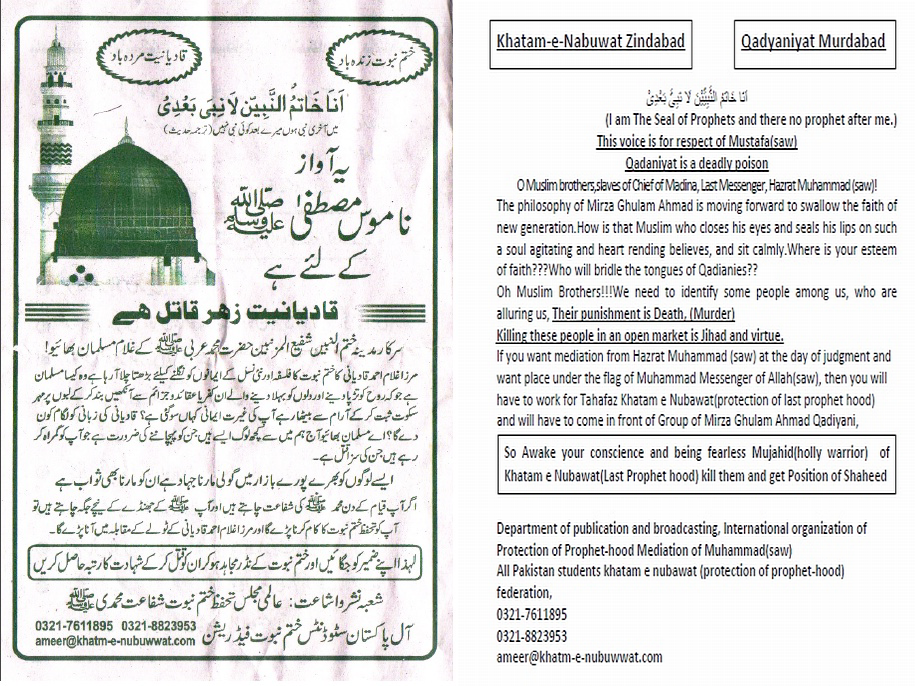
However, it seems as though Islam in Pakistan has lost its democratic appeal for even though minority rights have been safeguarded, the Muslim community has failed to preserve the rights of the Ahmadis. Glaring illustrations of this claim are the events that led up to the declaration of Martial Law in Lahore in 1953 and, more recently, the attack on an Ahmadiyya mosque in Lahore on the May 28, 2010. This exhibits the dwindling solidarity of the Muslim community and serves to further demonstrate that insurgency in the troubled North-western wing of Pakistan has taught us zilch. What ideological justification is there for those who share a creed to fight one another? An astute observer would put forth three deep-set explanations:

1) The war on terror
2) Assailing the extremist elements and providing a scope for moderation
3) Eternal Peace

What is striking to note is that all these justifications are fundamentally interlinked. The first rationale is an oft-touted ploy which ironically contradicts the second line of reason. As for the third reason, it is purely optimistic and therefore unlikely to be attained any time soon.

Then why is it that the Islamic democracy which Jinnah alluded to at that press conference all those summers ago has grown stale? Have we become theocratic in a unique sense? Are we assaulting the integrity of the minority sections within our own ravaged Muslim euphoria or have we become overly generous to the religious and cultural minorities at the expense of our own marginalised factions?

The explanation is far more intricate than one would assume. It is laden with ‘grey areas’ as opposed to the standard ‘black and white’. Hence, it is apt for the reader to have the final word. But prior to that, it is essential to note that Jinnah’s vision was one of diversity. His advocacy for religious tolerance was not purely restricted to minority groups. He wanted for us to delve deeper and understand its intrinsic worth so that one day the Muslim community can counterbalance its ideological variations and extend its acceptance of conflicting points of view to people of all religious persuasions with poise. Perhaps that would be a more suitable strategy for acquisition of world peace, moderation and the age-old democratic principles of Islam.

URL: http://blogs.tribune.com.pk/story/1137/solidarity-versus-resentment/

Monday, July 26, 2010

It's society's fault

Dawn.com Blog
.
It’s society’s fault
by SANA SALEEM on 07 27th, 2010 |
Minority BlogFor over six decades we have confused, manipulated and twisted the ideology behind the creation of our state. We denied principles that could have prevented us from reaching the brink. In February 1948 in a broadcast to the people of the US on Pakistan, Jinnah said the following:

The constitution of Pakistan has yet to be framed by the Pakistan Constituent Assembly. I do not know what the ultimate shape of this constitution is going to be, but I am sure that it will be of a democratic type, embodying the essential principle of Islam. Today, they are as applicable in actual life as they were 1,300 years ago. Islam and its idealism have taught us democracy. It has taught equality of man, justice and fair-play to everybody. We are the inheritors of these glorious traditions and are fully alive to our responsibilities and obligations as framers of the future constitution of Pakistan. In any case Pakistan is not going to be a theocratic State to be ruled by priests with a divine mission. We have many non-Muslims –Hindus, Christians, and Parsis –but they are all Pakistanis. They will enjoy the same rights and privileges as any other citizens and will play their rightful part in the affairs of Pakistan.

Today, after nearly 63 years of independence we are still struggling to accept all factions of society and grant them their due roles, rights and standing. Almost six decades after the address, the inherited traditions, practicality, and sense of justice have been replaced by fanatical theories. Over time only the faces have changed, while the fanatic ideology remains unscathed.

Last year in Gojra, when an angry mob set fire to more than 40 houses and a church, two children, their parents and 75-year-old grandfather were burnt to death. Three days later, two more Christians were killed after an unfounded accusation of blasphemy, which ultimately turned out to be a private dispute between employees. Almost a year after the tragic incident two Christian brothers accused of distributing blasphemous material were gunned down on the premises of the sessions court.

Most of these incidents bear a striking resemblance. Before the tragic attack in Gojra, mosques were used to make announcements provoking the attack. Locals were urged to ‘make mincemeat of the Christians’ before Gojra. Similarly, in Daoodnagar announcements were made from mosques asking people to come out to ‘fight rampaging’ Christians.

There seems to be no regulatory body to maintain a check on these well-planned and deadly atrocities. HRCP statistics on the misuse of the blasphemy law stress the need for immediate action in order to stop the abuse of the law.

According to reports:

Between 1927 and 1986 there were less than 10 reported cases of blasphemy. From 1986 onwards, however, as many as 4,000 cases have been reported. Between 1988 and 2005, Pakistani authorities charged 647 people, of which 50 per cent were non-Muslim, with offences under the blasphemy laws. More than 20 people have been murdered for alleged blasphemy. Two-thirds of all the cases have occurred in Punjab. A study of the cases suggests that the blasphemy laws are invoked either when the cases have been lodged merely to settle scores, or when the issue is that of expressing one’s faith, or when the accused is known to be suffering from some sort of mental illness.

The recent case of 60-year-old Zaibunnisa, is a striking example of the extent to which the law has been abused. She was held without trial for 14 years on allegations of desecrating the Holy Quran. For 16 years she was left to languish in the prison section of a mental asylum. There is absolutely no justification for all these years she spent in prison.

It is shameful that we show no scruples in accepting this system. While we fight the Taliban, the fanatic mindset, which is rampant, requires immediate action. The rights of minorities can no longer be sabotaged. Repression of basic humanitarian rights will only lead to a chaotic backlash. The blasphemy laws have imparted irreparable damage to the social fabric of the country. Until immediate action is taken to stop abuse of the law, many more lives will be lost.

Sana Saleem is a Features Editor at BEE magazine and blogs at Global Voices, Pro-Pakistan her personal blog Mystified Justice. She tweets at twitter.com/sanasaleem.

Sana Saleem is a Features Editor at BEE magazine and blogs at Global Voices, Pro-Pakistan her personal blog Mystified Justice. She tweets at twitter.com/sanasaleem.

©2010 DAWN Media Group. All rights reserved

Tuesday, June 8, 2010

The demand for Pakistan and Islam

Daily Times, Pakistan
Tuesday, June 08, 2010

VIEW: The demand for Pakistan and Islam

The Muslim League’s propaganda struck terror in the hearts of the Hindus and Sikhs who were told that they would be paying jazya and Islamic law will prevail in all sectors of individual and collective life. The minority Shia and Ahmediyya communities were also fearful that it would result in Sunni domination

The recent attack on a congregation of Ahmedis during prayers, which claimed more than 90 innocent lives, has revived a discussion as to whether there is a connection between the creation of Pakistan and Islam. Within the Muslim League there was always a constituency in favour of Pakistan becoming an Islamic state. One of its proponents was a close confident of Jinnah: Raja Sahib Mahmudabad, a Shia. In 1939 he wrote to the historian Mohibul Hassan:

“When we speak of democracy in Islam it is not democracy in the government but in the cultural and social aspects of life. Islam is totalitarian — there is no denying about it. It is the Quran that we should turn to. It is the dictatorship of the Quranic laws that we want — and that we will have — but not through non-violence and Gandhian truth” (Mushirul Hasan, 1997: 57-8).

If the March 23, 1940, Lahore Resolution be taken as the start of the Pakistan campaign, then Jinnah had to make a breakthrough in the Muslim-majority provinces of northwestern India — Khyber Pakhtunkhwa, Punjab and Sindh — each of which had regional parties headed by Muslims. The Muslim League had to convince the Muslim voters in these provinces that their leaders were courting Hindus and Sikhs and thus were paving the way for Hindu Raj under the Indian National Congress. That opportunity arrived in July 1945 when the British government announced provincial elections for February 1946. Punjab Governor Sir Bertrand Glancy has recorded in several secret fortnightly reports (FR) the tactics that the Muslim League adopted during the long election campaign. In the FR of December 27, 1945, Glancy noted:

“Among Muslims the Leaguers are increasing their efforts to appeal to the bigotry of the electors. Pirs and maulvis have been enlisted in large numbers to tour the province and denounce all who oppose the League as infidels. Copies of the Holy Quran are carried around as an emblem peculiar to the Muslim League. Feroz [Khan Noon] and others openly preach that every vote given to the League is a vote cast in favour of the Holy Prophet (PBUH). These deplorable tactics, as I have frequently said, were only to be expected; they provide a grim augury of the future peace of India and they are certainly not easy for the Unionists to counter” (Lionel Carter, 2006: 160).

In the FR of February 2, 1946, Glancy wrote:

“The ML [Muslim League] orators are becoming increasingly fanatical in their speeches. Maulvis and pirs and students travel all round the province and preach that those who fail to vote for the League candidates will cease to be Muslims; their marriages will no longer be valid and they will be entirely excommunicated…It is not easy to foresee what the results of the elections will be. But there seems little doubt the Muslim League, thanks to the ruthless methods by which they have pursued their campaign of ‘Islam in danger’, will considerably increase the number of their seats and Unionist representatives will correspondingly decline” (Carter, 2006: 171).

Similar tactics were adopted in the campaigns in Khyber Pakhtunkhwa and Sindh. In his doctoral dissertation, India, Pakistan or Pakhtunistan?, Erland Jansson writes:

“The pir of Manki Sharif…founded an organisation of his own, the Anjuman-us-asfia. The organisation promised to support the Muslim League on the condition that Shariat would be enforced in Pakistan. To this Jinnah agreed. As a result the pir of Manki Sharif declared jihad to achieve Pakistan and ordered the members of his anjuman to support the League in the 1946 elections” (pg 166).

Jinnah wrote in November 1945 a letter to Pir Manki Sharif in which he promised that the Shariat would apply to the affairs of the Muslim majority. He wrote:

“It is needless to emphasise that the Constituent Assembly, which would be predominantly Muslim in its composition, would be able to enact laws for Muslims, not inconsistent with the Shariat laws and the Muslims will no longer be obliged to abide by the un-Islamic laws” (Constituent Assembly of Pakistan Debates, Volume 5, 1949, pg 46).

The Muslim League’s propaganda struck terror in the hearts of the Hindus and Sikhs who were told that they would be paying jazya and Islamic law will prevail in all sectors of individual and collective life. The minority Shia and Ahmediyya communities were also fearful that it would result in Sunni domination. This is obvious from the correspondence between the Shia leader Syed Ali Zaheer and Jinnah in July 1944 (G Allana, 1977: 375-9). Although the Council of Action of the All-Parties Shia Conference passed a resolution on December 25, 1945, rejecting the idea of Pakistan (SR Bakshi, 1997: 848-9), most Shias shifted their loyalty to the Muslim League in the hope that Pakistan will be a non-sectarian state. Initially the Ahmediyya were also wary and reluctant to support the demand for a separate Muslim state (Munir Report, 1954: 196). It is only when Sir Zafarullah was won over by Jinnah that the Ahmedis started supporting the demand for Pakistan. To all such groups Jinnah gave assurances that Pakistan will not be a sectarian state.

In my forthcoming book on the partition of Punjab, now running into more than 1,000 pages but which is at last completed and for which I am now looking for a publisher, I will shed light on how the fierce Islamist propaganda impacted on the partition of Punjab. The Sikhs had more fears than anyone else about what could happen to minorities in Pakistan. In a meeting in May 1947 sponsored by Lord Mountbatten to help the Muslims and Sikhs reach an agreement on keeping Punjab united, Jinnah offered the Sikhs all the safeguards they wanted if they agreed to support Pakistan. Only in March 1947 some 2,000-10,000 Sikhs — depending on who you cite — were butchered in the Rawalpindi rural areas so the Sikhs were very wary of Jinnah’s overtures. Chief Minister of Patiala Hardit Singh Malik writes he had an inspiration and asked Jinnah: “Sir you are making all the promises but God forbid if something happens to you, what will happen then?” The exact words Jinnah used in reply will be revealed in my forthcoming book, but the reasoning was that his followers will treat his words as sacred.

Ishtiaq Ahmed is a Visiting Research Professor at the Institute of South Asian Studies (ISAS) and the South Asian Studies Programme at the National University of Singapore and Professor Emeritus of Political Science at Stockholm University. He is currently working on a book, Is Pakistan a Garrison State? He can be reached at isasia@nus.edu.sg

Sunday, March 28, 2010

Govt urged to work with all parties

---The Daily Star, Bangladesh
Sunday, March 28, 2010 | Front Page
Govt urged to work with all parties
US House of Representatives passes resolution

Unb, Washington

In a resolution passed on Thursday, the US House of Representatives urged the Bangladesh government to work together with all political leaders to continue and deepen reconciliation.

Congressman Joseph Crowley, the founder and co-chair of the Congressional Caucus on Bangladesh, spearheaded passage of the resolution expressing the US House of Representatives’ support for Bangladesh’s return to democracy.

“Bangladesh has become an important partner of the United States. Even as it faces challenges with serious poverty, threats from climate change and extremism, the Bangladeshi people have shown remarkable resilience, creativity and principle,” Crowley said at the US House of Representatives.

Sponsoring the resolution in the House to congratulate Bangladesh on achieving democracy, he said, “This is exactly the kind of country the United States ought to work with and do more to support, not because the situation on the ground is perfect, but because by working together we have clearly created a better path forward.”

“I hope the international community will more quickly wake up to the positive changes Bangladesh has made,” Crowley added.

The resolution was passed by the US House of Representatives by a vote of 380 to 7.

“I rise in strong support of House Resolution 1215, a measure to honour Bangladesh’s return to democracy. I would like to thank Chairman Berman and Ranking Member Ros-Lehtinen for their support of this resolution. I would also like to thank the gentleman from California, Congressman Royce, for leading this effort with me, along with other members of the House Caucus on Bangladesh,” Crowley said.

The resolution also urged the Bangladesh government to ensure the rights of religious and ethnic minorities, including Hindus and the Ahmadiya community.

It said Bangladesh is “making progress” to join the Millennium Challenge Corporation, a US aid programme that has granted billions of dollars to nations deemed as respecting political and economic freedom.

Crowley noted that a year and a half ago, the US Congress passed a resolution out of fear that Bangladesh was “creeping toward authoritarianism” after the military took charge in 2006 and cancelled elections.

URL: www.thedailystar.net/newDesign/news-details.php?nid=131886
 
^ Top of Page