Showing posts with label Zia-ul-Haq. Show all posts

Friday, August 20, 2010

Solidarity versus resentment

Express Tribune, Pakistan
Blogs
Solidarity versus resentment
by Taha KeharTaha Kehar
Friday, 20 August 2010
Pakistanis today need solidarity and a clear understanding of the Islamic democracy Jinnah had envisioned. PHOTO: AFP
At a Press Conference at New Delhi, on July 14, 1947, Jinnah was grilled by a correspondent who wished to inquire as to whether Pakistan would be a secular state or a theocracy.

Jinnah hinted at the absurdity of the question, adding, quite tactfully, that he did ‘not know what a theocratic state’ meant. The correspondent had then fervidly suggested that it was ‘a state where only people of a particular religion, for example, Muslims, could be full citizens and non-Muslims would not be full citizens’. Apprised with this vision of a theocracy, Jinnah aptly stated that ‘when you talk of democracy, I am afraid you have not studied Islam – we learned democracy thirteen centuries ago.’

However, it seems as though Islam in Pakistan has lost its democratic appeal for even though minority rights have been safeguarded, the Muslim community has failed to preserve the rights of the Ahmadis. Glaring illustrations of this claim are the events that led up to the declaration of Martial Law in Lahore in 1953 and, more recently, the attack on an Ahmadiyya mosque in Lahore on the May 28, 2010. This exhibits the dwindling solidarity of the Muslim community and serves to further demonstrate that insurgency in the troubled North-western wing of Pakistan has taught us zilch. What ideological justification is there for those who share a creed to fight one another? An astute observer would put forth three deep-set explanations:

1) The war on terror
2) Assailing the extremist elements and providing a scope for moderation
3) Eternal Peace

What is striking to note is that all these justifications are fundamentally interlinked. The first rationale is an oft-touted ploy which ironically contradicts the second line of reason. As for the third reason, it is purely optimistic and therefore unlikely to be attained any time soon.

Then why is it that the Islamic democracy which Jinnah alluded to at that press conference all those summers ago has grown stale? Have we become theocratic in a unique sense? Are we assaulting the integrity of the minority sections within our own ravaged Muslim euphoria or have we become overly generous to the religious and cultural minorities at the expense of our own marginalised factions?

The explanation is far more intricate than one would assume. It is laden with ‘grey areas’ as opposed to the standard ‘black and white’. Hence, it is apt for the reader to have the final word. But prior to that, it is essential to note that Jinnah’s vision was one of diversity. His advocacy for religious tolerance was not purely restricted to minority groups. He wanted for us to delve deeper and understand its intrinsic worth so that one day the Muslim community can counterbalance its ideological variations and extend its acceptance of conflicting points of view to people of all religious persuasions with poise. Perhaps that would be a more suitable strategy for acquisition of world peace, moderation and the age-old democratic principles of Islam.

URL: http://blogs.tribune.com.pk/story/1137/solidarity-versus-resentment/

Monday, July 5, 2010

Tolerance for our inner terrorist

Express Tribune, Pakistan
Blogs
Tolerance for our inner terrorist
Shams Hamidby Rabia Mehmood
Monday, 05 July 2010
'Data Sahib' was a place which represented religious harmony
‘Data Sahib’ was a place which represented religious harmony

I might get my share of hate mail if this piece finds it way online and people read it. Actually, I wanted to claim responsibility for the attacks. I want to share some burden. I want to say that what happened at the Data Darbar was our own doing, we the people of Pakistan brought it upon us.

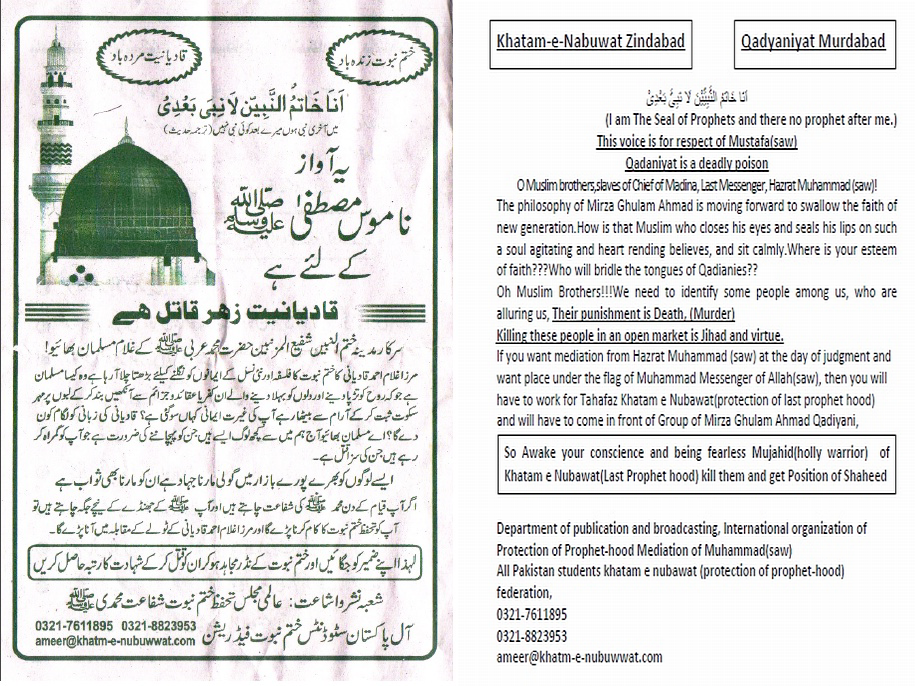
Living in a society which openly engages in discourse where those who have different religious beliefs will always be vulnerable to a death wish… where they would always be ‘waajib-ul-qatal’… what else could we possibly expect? I mean it is OK as long as the people who are victimized in the name of religion are Christians or Ahmadis for that matter. No? How many of these maulanas demanding mass resignations from the government in the aftermath of the attacks of Data Darbar actually condemned the May 28 attacks? Not even one representative of these jamaats… not even for the sake of appearances, they simply did not care, they never gave two hoots as to when those who represent the other are affected. And the only incident of violence towards Christians condemned by the maulanas was the Gojra Riots. However, the reason why Christians were attacked in the first place was never addressed by them.

So, I would say they encouraged the terrorist. They allowed him to think that he can get away with attacking others for their beliefs, even attacking the Data Sahib as we call it here in Lahore, the only place which represents the harmony of Aunnis, Deobandis, Shias, Wahabis (yes even Wahabis, I know some who go there for a prayer or two) Ahmadis, Christians and Hindus in this country.

For how long have we been persecuting people in the name of religion in this country? Decades. And known terrorist attacks are not the only incidents. Every other month in some remote or not-so-remote town of Punjab there is a 60 yr old Christian woman, a 19-year-old Christian man, a 14-year-old Ahmadi kid who is taken into police custody and tortured for alleged blasphemy.

We are a country that thrives on religious intolerance, we are insecure and indifferent to others pain. And to top it all we have discriminatory laws which are practiced religiously. I know bashing 295 C is an old tradition of the English press which has apparently never made a difference. I know so many English speaking, reading, writing people who also thought that Ahmadis ‘asked for it’ on May 28. So many among our educated class condemned the riots in Gojra but never questioned the absurdity of reason for provocation behind the instigation of the attacks i.e. alleged blasphemy by elders and children of a Christian family. That part just got lost in translating the condemnation by the governments and the so-called religious jamaats.

Now, I feel like questioning every person who, after the May 28 attacks on Ahmadis said ‘Well, now these Ahmadis will find a new to getfundingfrom theirforeign sources’ or that ‘They were involved in the campaig for lifting the facebook ban” and then those who thought they simply deserved to die… yes, hate speech but all true … or take a soundbyte from those who devotedly support the blasphemy law and say that Gojra was a foreign conspiracy or initiated by a new wave of post-9/11 terrorism. Who amongst us is innocent of the bigotry we have always directed towards the religious minorities.

I understand the popular argument that the ‘Salafi’ school has an anti-Sufism agenda. But this does not mean that the Salafi school has managed to oppress the Sufi and remaining schools of thoughts of Pakistan and forced its own supporters to measure their love for Islam by how many non-Muslims do they count as ‘wajib-ul-qatal.”

While prejudice is ingrained in most of us, the Punjab police and government appear to be very tolerant. They know all about the existence of seminaries where ‘what the Pakistani media calls terrorism and is actually jihad” is taught openly but do not conduct crackdowns. It must be tolerance, right? Last month when two low intensity bombs exploded right outside the shrine of Baba Noori Bori Waali Sarkaar in a Lahore suburbs, the SHO continued to deny the explosions and told the media that it was just a mild gas leakage. Of course, he did not think it was a big deal.

URL: http://blogs.tribune.com.pk/story/408/tolerance-for-our-inner-terrorist/

Tuesday, June 29, 2010

Pakistan history, distorted by the literalists

Express Tribune, Pakistan
Blogs
Pakistan history, distorted by the literalists
Shams Hamidby Dr.Shams Hamid
Tuesday, 29 June 2010
Literalists have always invented Islam depriving it of universalism

Recently released, the Brookings Institute report claims that the real cause of militancy in Pakistan is the public education system, and not religious schools (madrssas) because the majority of Pakistani students attend public school whereas only ten per cent attend madrassas. It states that Pakistani public schools disseminate militancy, hatred, jihad and distort history.

Until 1970, despite bureaucratic and military dictatorships, the Pakistani educational curriculum and textbooks, for example, had included the history of the Maurya and Gupta dynasties of the sub-continent conforming to the secular ideals of Pakistan clearly expressed by Mohammad Ali Jinnah in his speech to the constituent Assembly on 11th August 1947. Mohammad Ali Jinnah said:

quote
“We are starting with the fundamental principle that we are all citizens and equal Citizens of one state … Now I think we should keep that in front of us as our ideal, and you will find that in the course of time Hindus would cease to be Hindus and Muslims would cease to be Muslims, not in the religious sense, because that is the personal faith of each individual but in the sense as citizens of the state. …You may belong to any caste or creed – that has nothing to do with the business of the state.”

Mohammad Ali Jinnah never used the term ‘Ideology of Pakistan’ during the struggle for independence nor after independence. Mohammad Ali Jinnah sternly scolded a prominent leader of Muslim League Raja Sahab Mahmudabad when he wrote to the historian Mohibul Hassan in 1939 that we want the dictatorship of Koranic laws. Sharifuddin Pirzada documented another failed attempt of an Abdul Hameed Kazi to propose a bill to create Pakistan as an Islamic state in All India Muslim League’s 1943 session.

quote
“The Quaid-i-Azam never used the words ‘Ideology of Pakistan’ … For fifteen years after the establishment of Pakistan, the Ideology of Pakistan was not known to anybody until in 1962 a solitary member of the Jama’at-I-Islami used the words for the first time when the Political Parties Bill was being discussed. On this, Chaudhry Fazal Elahi, [who later became Pakistan’s president during Z. A. Bhutto’s regime], rose from his seat and objected that the ‘Ideology of Pakistan’ shall have to be defined. The member who had proposed the original amendment replied that the ‘Ideology of Pakistan was Islam’.”

The three rigid religious political parties Jamiat-i-Ulama-i-Hind, the Majlis-i-Ahrar and Jamat-e-Islami were opposed to Muslim league and the demand for an independent Pakistan. In Punjab Majlis-i-Ahrar exploited Islamic ideology to defeat Muslim League in pre-partition election of 1945 calling Muslim League leaders ‘Kafirs’ and opposing their demand for a separate state.

Ironically, the term “Ideology of Pakistan” was also first coined and used by Jamat-e-Islami who were against the creation of Pakistan and they did not participate with the Muslim League in the movement for the independence of Pakistan.

After the independence of Pakistan, Jamat-e-Islami established its Pakistan chapter claiming that Pakistan was created for Muslims to live according to Islamic Shariah. Jamat-e-Islami even forgets that the Ahmadiya community supported Independence of Pakistan after Mohammad Ali Jinnah’s assurance that Pakistan will be a modern Muslim state, neutral on sectarian matters (Report of the Court of Inquiry, 1954: 196). However, Jamat-e-Islami Pakistan still cannot justify their opposition to the creation of Pakistan if it was being created only for Muslims to practice the literalist interpretation of Islam.

In late 1970’s, after the fall of East Pakistan, the Pakistani educational system began to implement the Islamisation project based on the literalist interpretation of Islam practiced by a very small percentage of the Muslim population. Jamat-e-Islami and other religious political parties championed the Islamisation project. This is a shameful testimonial to the twisted logic of the handful of Muslim literalists.

The unholy alliance of 1980s, between the dictatorial military regime of Pakistan under General Zia-ul-Haq, the unelected literalist religious political party Jamat-e-Islami and American government, cemented Islamisation of all Pakistani institutions including public educational institutions. The national education policy was Islamised in accordance with the narrow literal interpretation of Islam. The national educational curriculum was revised and textbooks were re-written to re-invent Pakistan as a purely religious society only for Muslim citizens.

Syed Abul A’la Maudoodi of Jama’at-e-Islami prescribed that all educational subjects should be taught from the perspective of the literal interpretation of Quran. Maudoodi did not accept the distinction between the religious and the non-religious worldly disciplines of education.

quote
“In the teaching material, no concept of separation between the worldly and the religious be given; rather all the material be presented from the Islamic point of view.” (Curriculum Document, Primary Education, Class K-V, 1995, p. 41.)

The Sustainable Development Policy Institute found four major themes emerging strongly from their analysis of the curricula and textbooks of the three compulsory subjects:

quote
“1. that Pakistan is for Muslims alone;
2. that Islamic teachings, including a compulsory reading and memorisation of Qur’an, are to be included in all the subjects, hence to be forcibly taught to all the students, whatever their faith;
3. that Ideology of Pakistan is to be internalized as faith, and that hate be created against Hindus and India; and
4. students are to be urged to take the path of Jehad and Shahadat.”

Literalists have always invented Islam depriving it of universalism and divesting its teachings of its historic context. ‘Pakistan ideology’ is also a case of their figment of imagination that has no basis in Pakistani history.

Islam has multiple interpretations and only one of those interpretations, i.e., the literalist interpretation of Islam, is fatalistic and anti-humanistic. However, there are only a few Muslims who accept or live by the literalists’ interpretation of Islam, whereas more than 95 per cent of Muslims consciously reject the literalist interpretation of Islam.

Literalists themselves fail in avoiding contradictions in their own literal interpretation in their attitude and lifestyle. Zakir Naik, an Indian Muslim preacher of these parochial views of unequal human rights for men, women and for people of different faith has recently been restricted from giving a speech in UK and Canada but he is fighting against this verdict on the grounds of freedom of speech and equal human rights. They are not ready to allow equal human rights in their society while shamelessly demanding it from the secular societies.

These literalists simultaneously benefit from all the modern technologies, like getting photographed, using phones, watching television, flying in airplane, using western banking and so on; and criticise them all for being ‘non-Islamic’ and ‘secular’.

Literalists have a very small following because most people find it difficult to live in bad faith with a false consciousness, i.e. believing in one thing and doing its opposite. They have changed already, they should understand and accept it. The idea of a return is impossible; you cannot travel back in history.

Pakistani public education needs to focus on re-designing its curriculum, re-writing and reconstructing teaching material including textbooks and constructing a non-violent, democratic learning environment in the public schools to disseminate tolerant views and employment-oriented education.

 
^ Top of Page