Showing posts with label Militancy. Show all posts

Monday, July 5, 2010

Tolerance for our inner terrorist

Express Tribune, Pakistan
Blogs
Tolerance for our inner terrorist
Shams Hamidby Rabia Mehmood
Monday, 05 July 2010
'Data Sahib' was a place which represented religious harmony
‘Data Sahib’ was a place which represented religious harmony

I might get my share of hate mail if this piece finds it way online and people read it. Actually, I wanted to claim responsibility for the attacks. I want to share some burden. I want to say that what happened at the Data Darbar was our own doing, we the people of Pakistan brought it upon us.

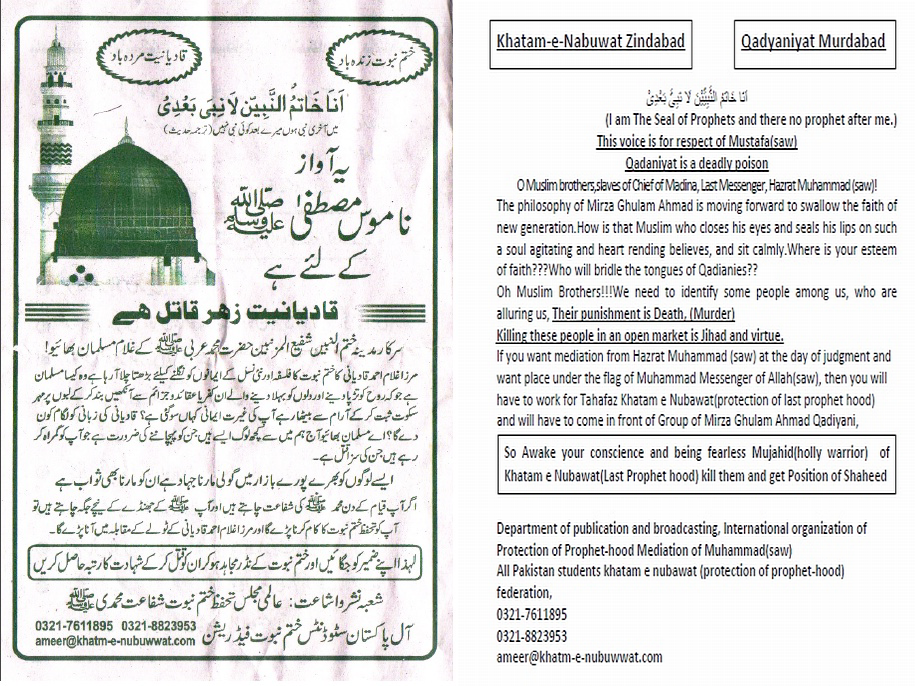
Living in a society which openly engages in discourse where those who have different religious beliefs will always be vulnerable to a death wish… where they would always be ‘waajib-ul-qatal’… what else could we possibly expect? I mean it is OK as long as the people who are victimized in the name of religion are Christians or Ahmadis for that matter. No? How many of these maulanas demanding mass resignations from the government in the aftermath of the attacks of Data Darbar actually condemned the May 28 attacks? Not even one representative of these jamaats… not even for the sake of appearances, they simply did not care, they never gave two hoots as to when those who represent the other are affected. And the only incident of violence towards Christians condemned by the maulanas was the Gojra Riots. However, the reason why Christians were attacked in the first place was never addressed by them.

So, I would say they encouraged the terrorist. They allowed him to think that he can get away with attacking others for their beliefs, even attacking the Data Sahib as we call it here in Lahore, the only place which represents the harmony of Aunnis, Deobandis, Shias, Wahabis (yes even Wahabis, I know some who go there for a prayer or two) Ahmadis, Christians and Hindus in this country.

For how long have we been persecuting people in the name of religion in this country? Decades. And known terrorist attacks are not the only incidents. Every other month in some remote or not-so-remote town of Punjab there is a 60 yr old Christian woman, a 19-year-old Christian man, a 14-year-old Ahmadi kid who is taken into police custody and tortured for alleged blasphemy.

We are a country that thrives on religious intolerance, we are insecure and indifferent to others pain. And to top it all we have discriminatory laws which are practiced religiously. I know bashing 295 C is an old tradition of the English press which has apparently never made a difference. I know so many English speaking, reading, writing people who also thought that Ahmadis ‘asked for it’ on May 28. So many among our educated class condemned the riots in Gojra but never questioned the absurdity of reason for provocation behind the instigation of the attacks i.e. alleged blasphemy by elders and children of a Christian family. That part just got lost in translating the condemnation by the governments and the so-called religious jamaats.

Now, I feel like questioning every person who, after the May 28 attacks on Ahmadis said ‘Well, now these Ahmadis will find a new to getfundingfrom theirforeign sources’ or that ‘They were involved in the campaig for lifting the facebook ban” and then those who thought they simply deserved to die… yes, hate speech but all true … or take a soundbyte from those who devotedly support the blasphemy law and say that Gojra was a foreign conspiracy or initiated by a new wave of post-9/11 terrorism. Who amongst us is innocent of the bigotry we have always directed towards the religious minorities.

I understand the popular argument that the ‘Salafi’ school has an anti-Sufism agenda. But this does not mean that the Salafi school has managed to oppress the Sufi and remaining schools of thoughts of Pakistan and forced its own supporters to measure their love for Islam by how many non-Muslims do they count as ‘wajib-ul-qatal.”

While prejudice is ingrained in most of us, the Punjab police and government appear to be very tolerant. They know all about the existence of seminaries where ‘what the Pakistani media calls terrorism and is actually jihad” is taught openly but do not conduct crackdowns. It must be tolerance, right? Last month when two low intensity bombs exploded right outside the shrine of Baba Noori Bori Waali Sarkaar in a Lahore suburbs, the SHO continued to deny the explosions and told the media that it was just a mild gas leakage. Of course, he did not think it was a big deal.

URL: http://blogs.tribune.com.pk/story/408/tolerance-for-our-inner-terrorist/

Tuesday, June 29, 2010

Pakistan history, distorted by the literalists

Express Tribune, Pakistan
Blogs
Pakistan history, distorted by the literalists
Shams Hamidby Dr.Shams Hamid
Tuesday, 29 June 2010
Literalists have always invented Islam depriving it of universalism

Recently released, the Brookings Institute report claims that the real cause of militancy in Pakistan is the public education system, and not religious schools (madrssas) because the majority of Pakistani students attend public school whereas only ten per cent attend madrassas. It states that Pakistani public schools disseminate militancy, hatred, jihad and distort history.

Until 1970, despite bureaucratic and military dictatorships, the Pakistani educational curriculum and textbooks, for example, had included the history of the Maurya and Gupta dynasties of the sub-continent conforming to the secular ideals of Pakistan clearly expressed by Mohammad Ali Jinnah in his speech to the constituent Assembly on 11th August 1947. Mohammad Ali Jinnah said:

quote
“We are starting with the fundamental principle that we are all citizens and equal Citizens of one state … Now I think we should keep that in front of us as our ideal, and you will find that in the course of time Hindus would cease to be Hindus and Muslims would cease to be Muslims, not in the religious sense, because that is the personal faith of each individual but in the sense as citizens of the state. …You may belong to any caste or creed – that has nothing to do with the business of the state.”

Mohammad Ali Jinnah never used the term ‘Ideology of Pakistan’ during the struggle for independence nor after independence. Mohammad Ali Jinnah sternly scolded a prominent leader of Muslim League Raja Sahab Mahmudabad when he wrote to the historian Mohibul Hassan in 1939 that we want the dictatorship of Koranic laws. Sharifuddin Pirzada documented another failed attempt of an Abdul Hameed Kazi to propose a bill to create Pakistan as an Islamic state in All India Muslim League’s 1943 session.

quote
“The Quaid-i-Azam never used the words ‘Ideology of Pakistan’ … For fifteen years after the establishment of Pakistan, the Ideology of Pakistan was not known to anybody until in 1962 a solitary member of the Jama’at-I-Islami used the words for the first time when the Political Parties Bill was being discussed. On this, Chaudhry Fazal Elahi, [who later became Pakistan’s president during Z. A. Bhutto’s regime], rose from his seat and objected that the ‘Ideology of Pakistan’ shall have to be defined. The member who had proposed the original amendment replied that the ‘Ideology of Pakistan was Islam’.”

The three rigid religious political parties Jamiat-i-Ulama-i-Hind, the Majlis-i-Ahrar and Jamat-e-Islami were opposed to Muslim league and the demand for an independent Pakistan. In Punjab Majlis-i-Ahrar exploited Islamic ideology to defeat Muslim League in pre-partition election of 1945 calling Muslim League leaders ‘Kafirs’ and opposing their demand for a separate state.

Ironically, the term “Ideology of Pakistan” was also first coined and used by Jamat-e-Islami who were against the creation of Pakistan and they did not participate with the Muslim League in the movement for the independence of Pakistan.

After the independence of Pakistan, Jamat-e-Islami established its Pakistan chapter claiming that Pakistan was created for Muslims to live according to Islamic Shariah. Jamat-e-Islami even forgets that the Ahmadiya community supported Independence of Pakistan after Mohammad Ali Jinnah’s assurance that Pakistan will be a modern Muslim state, neutral on sectarian matters (Report of the Court of Inquiry, 1954: 196). However, Jamat-e-Islami Pakistan still cannot justify their opposition to the creation of Pakistan if it was being created only for Muslims to practice the literalist interpretation of Islam.

In late 1970’s, after the fall of East Pakistan, the Pakistani educational system began to implement the Islamisation project based on the literalist interpretation of Islam practiced by a very small percentage of the Muslim population. Jamat-e-Islami and other religious political parties championed the Islamisation project. This is a shameful testimonial to the twisted logic of the handful of Muslim literalists.

The unholy alliance of 1980s, between the dictatorial military regime of Pakistan under General Zia-ul-Haq, the unelected literalist religious political party Jamat-e-Islami and American government, cemented Islamisation of all Pakistani institutions including public educational institutions. The national education policy was Islamised in accordance with the narrow literal interpretation of Islam. The national educational curriculum was revised and textbooks were re-written to re-invent Pakistan as a purely religious society only for Muslim citizens.

Syed Abul A’la Maudoodi of Jama’at-e-Islami prescribed that all educational subjects should be taught from the perspective of the literal interpretation of Quran. Maudoodi did not accept the distinction between the religious and the non-religious worldly disciplines of education.

quote
“In the teaching material, no concept of separation between the worldly and the religious be given; rather all the material be presented from the Islamic point of view.” (Curriculum Document, Primary Education, Class K-V, 1995, p. 41.)

The Sustainable Development Policy Institute found four major themes emerging strongly from their analysis of the curricula and textbooks of the three compulsory subjects:

quote
“1. that Pakistan is for Muslims alone;
2. that Islamic teachings, including a compulsory reading and memorisation of Qur’an, are to be included in all the subjects, hence to be forcibly taught to all the students, whatever their faith;
3. that Ideology of Pakistan is to be internalized as faith, and that hate be created against Hindus and India; and
4. students are to be urged to take the path of Jehad and Shahadat.”

Literalists have always invented Islam depriving it of universalism and divesting its teachings of its historic context. ‘Pakistan ideology’ is also a case of their figment of imagination that has no basis in Pakistani history.

Islam has multiple interpretations and only one of those interpretations, i.e., the literalist interpretation of Islam, is fatalistic and anti-humanistic. However, there are only a few Muslims who accept or live by the literalists’ interpretation of Islam, whereas more than 95 per cent of Muslims consciously reject the literalist interpretation of Islam.

Literalists themselves fail in avoiding contradictions in their own literal interpretation in their attitude and lifestyle. Zakir Naik, an Indian Muslim preacher of these parochial views of unequal human rights for men, women and for people of different faith has recently been restricted from giving a speech in UK and Canada but he is fighting against this verdict on the grounds of freedom of speech and equal human rights. They are not ready to allow equal human rights in their society while shamelessly demanding it from the secular societies.

These literalists simultaneously benefit from all the modern technologies, like getting photographed, using phones, watching television, flying in airplane, using western banking and so on; and criticise them all for being ‘non-Islamic’ and ‘secular’.

Literalists have a very small following because most people find it difficult to live in bad faith with a false consciousness, i.e. believing in one thing and doing its opposite. They have changed already, they should understand and accept it. The idea of a return is impossible; you cannot travel back in history.

Pakistani public education needs to focus on re-designing its curriculum, re-writing and reconstructing teaching material including textbooks and constructing a non-violent, democratic learning environment in the public schools to disseminate tolerant views and employment-oriented education.

Monday, May 4, 2009

Reviving Pakistan’s Pluralist Traditions to Fight Extremism

---The Heritage Foundation

ISSUES > Asia and the Pacific


May 4, 2009
Reviving Pakistan’s Pluralist Traditions to Fight Extremism
by Lisa Curtis


Pakistan is in the midst of rapid political shifts that are challenging the leadership’s ability to maintain cohesion within the country and even raising questions about Pakistan’s ability to survive as a viable nation-state over the next few years. Pakistan has long suffered from ethnic and sectarian divisions. However, the recent threat from a well-armed and well-organized Islamist insurgency pushing to establish strict Islamic law in the entire country, beginning with the North West Frontier Province (NWFP), adds a new and more dangerous dimension to the country’s challenges. Although the collapse of the Pakistani state may not be imminent, as some have recently argued, the government’s surrender of the Swat Valley is a major victory for Islamist extremists seeking to carve out pockets of influence within the country.

The establishment of a parallel Islamic courts system in the Malakand region of the NWFP (including Swat Valley) will have dire human rights consequences for average Pakistanis, especially women and girls. The pro-Taliban militants have already destroyed numerous girls’ schools and engaged in brutal public punishments to instill fear in the population and quell dissent from their harsh interpretation of Islam. In early April, Pakistani Chief Justice Iftikhar Ali Chaudhry raised several questions regarding a public flogging of a young woman in Swat. The flogging had been aired on Pakistan’s major media outlets, prompting many Pakistanis to express outrage over worsening human rights conditions in the region since the Taliban takeover.

The contrast between the Taliban “justice” and the justice that so many Pakistanis recently demanded in street protests is striking. Pakistanis were jubilant in March 2009 when Chief Justice Chaudhry was reinstated after he had been unconstitutionally removed two years ago by then-President Pervez Musharraf. Yet the independence of the judiciary that Pakistanis fought so hard to restore is again at risk–this time from terrorist violence and intimidation. Swat militant leader Sufi Mohammed’s recent criticism of the Pakistani Supreme Court and high courts for not operating under strict Sharia (Islamic law) reveals the militants’ broader goal of undermining Pakistan’s democratic institutions.

For Pakistan to fend off the growing extremist influence in the country, its leadership will need to do a better job of highlighting the brutality of the pro-Taliban militants. They need to demonstrate that the pro-Taliban insurgents are imposing a way of life on Pakistani citizens that is alien to their own traditions of Islam and aspirations toward constitutional democracy. This is Pakistan’s fight, but the U.S. can support those Pakistanis seeking to promote religious tolerance and pluralism and to develop a civil society and democratic institutions, including the parliament, judiciary, and free press.

Rise of Militancy Erodes Culture of Tolerance

Muhammed Ali Jinnah, Pakistan’s founding father, envisioned a predominantly Muslim, yet secular and multiethnic democratic state. Indeed, Jinnah’s struggle to achieve independence from the British Empire was a democratic one. Most South Asian historians agree that the political movement that persuaded the departing British Empire to split the Indian subcontinent into Pakistan and India was colored with religious exclusiveness, but the ultimate goal was not to establish Pakistan as a theocratic state. Jinnah believed that Pakistan, which has a 95 percent Muslim population and is the world’s second largest Muslim country, would eventually evolve into a hybrid system with a benign Sharia guiding civil law decisions on issues, such as marriage and inheritance, and a quasi-secular constitution governing all matters involving criminal law, foreign relations, public policy, and the economy. [1]

After four military dictatorships and several periods of ineffective civilian rule, religious intolerance and support for militancy has increased in Pakistan. The erosion of respect for religious pluralism in Pakistan has been abetted by exclusionary laws and the proliferation of minority-hate material in public and private school curriculums. The Pakistan Army’s support for militancy as an instrument of foreign policy has also eroded religious tolerance. [2] Religious and social discrimination against Christians, Hindus, Sikhs, Ahmadis, and Shi’ites has led to a threefold increase in religious and sectarian violence between 1980 and 2008. (See Table 1.) The rise in religious intolerance is a disturbing trend that will impede Pakistan’s development into a stable democracy and facilitate the rise of Islamist terrorism.


Background

Muhammad Ali Jinnah famously supported religious freedom in his historic speech to the constituent assembly in 1947, asking the new Pakistani citizens to feel free “to go to your temples…mosques or any other places of worship in the State of Pakistan. You may belong to any religion or caste or creed—that has nothing to do with the business of the State.” [3] However, in the years that followed independence from the British, Pakistan’s civil and criminal laws and societal norms became more intolerant of religious diversity. In addition to increasing discrimination against religious minorities, such as Christians and Sikhs, intra-religious conflicts among Sunnis, Shi’ites, and Ahmadis have also been on the rise. [4] Several major constitutional and policy milestones in Pakistani history have contributed to this backsliding on religious freedom.

Ahmadis. The Ahmadiyya Jamaat has approximately 10 million followers in the world, including approximately 3 million to 4 million in Pakistan. Toward the end of the 19th century, Mirza Ghulam Ahmad (1835-1908), founder of the Ahmadiyya Jamaat, broke with centuries-old Islamic dogma by claiming to be an Islamic prophet. (Mainstream Muslims believe that the Prophet Mohammad was the last prophet.) Six years after Pakistan’s independence, Islamists led by Anjuman-i-ahrar-i-Islam (Society of Free Muslims) started a mass movement to declare the Ahmadi sect as non-Muslim and called for the removal of Pakistani Foreign Minister Chaudhry Zafrulla Khan, an Ahmadi follower. Syed Abul Ala Mawdudi, founder of the Jamaat-i-Islami, a prominent Islamist political party, supported the movement by publishing his controversial pamphlet The Qadiani [Ahmadi] Question and book The Finality of Prophethood. [5] Both argue that Ahmadiyya was an entirely new religion that should not be associated with Islam.

Twenty years later, in 1974, President Zulfikar Ali Bhutto passed a resolution declaring Ahmadis as non-Muslims. [6] The legislation barred Ahmadis from calling themselves Muslims, calling their places of worship mosques, or worshipping in public prayer rooms open to Muslims. Ahmadis were also prohibited from performing the Muslim call to prayer, using the traditional Islamic greeting in public, or publicly quoting from the Koran.

Military dictator and Islamist-leaning Muhammad Zia-ul-Haq introduced additional legislation that fostered an atmosphere of religious intolerance and led to discrimination against religious minorities in military service, education, and the civilian bureaucracy. In 1984, Zia introduced an ordinance that added sections 298(b) and 298(c) to the Pakistani Penal Code, which made it a crime punishable by up to three years in prison for any Ahmadi to pose as a Muslim or propagate his or her religion as Islam in any forum, including in one’s own home. Two years later Zia introduced further restrictions on Ahmadis and non-Muslims by introducing the blasphemy laws under article 295(c), which stated that any person found to have disrespected the Prophet Mohammad or the Koran would face death or life imprisonment.

Over the past two decades, hundreds of Ahmadis have been convicted under the blasphemy laws. The U.S. Department of State reported that at least 25 Ahmadis were arrested on blasphemy charges in 2007. In 2002, Akbar S. Ahmed, an eminent scholar of Islam at American University, received a letter from a death-row inmate awaiting execution under the blasphemy laws. His crime was examining Mohammad’s life before he became a prophet. [7]

Christians. While Ahmadis have borne the heaviest religious persecution, Christians have also faced religious intolerance, albeit sporadically. According to the Pakistan Census Organization, 2.8 million Christians live in Pakistan, the majority in Punjab province. [8] There have been numerous incidents of violence against Christians and their worship areas. In 2002, Islamist militants attacked a Christian church in Murree, killing seven. The same year 20 worshipers were killed in a church in Taxila. [9] CLAAS, a Pakistani Christian nongovernmental organization, stated in 2002 that Christians were living under constant fear of their life and property and that their rights were either curtailed or not protected. [10] According to the Minority Rights Group International, Pakistan was among the 10 worst of 200 states in violating minority rights. The independent U.S. Commission on International Religious Freedom recommended in its 2008 annual report that the U.S. State Department designate Pakistan a “country of particular concern” because of mounting concerns about religious freedom. [11]

Similar to the Ahmadis, Christians have faced legal persecution under the blasphemy laws, the Hudood Ordinance,[12] and the Qanoon-e-Shahadat (Law of Evidence). Under these laws the government has the right to regulate social behavior inside and outside the home, including intimate matters such as extramarital sex and crimes such as rape. While Muslim women also face discrimination under these laws, women from minority groups face the dual obstacles of religion and gender. In practice under the Hudood Ordinance, a non-Muslim’s testimony is not equal to a Muslim’s testimony, and two women are equal to one man in rape cases.

The 2006 Women’s Protection Bill signed by former President Musharraf marked a major milestone in rolling back discriminatory legislation by shifting cases of rape and adultery from Sharia courts to secular courts and by amending the Hudood Ordinance. Musharraf also ordered the release of 2,500 women imprisoned under the Hudood Ordinance. Some of the cases against the women will now be heard under the Women’s Protection Bill.

Musharraf’s government passed the Women’s Protection Bill with the support of his political party, the Pakistan Muslim League (Quaid-e-Azam); the Pakistan Peoples Party Parliamentarians, the party of the late Prime Minister Benazir Bhutto; and other smaller parties. The law was consistent with Musharraf’s policy of social liberalism and reversed some of Zia-ul-Haq’s Islamist laws. However, Musharraf was unable to fully repeal the Hudood Ordinance because of pressure from the religious parties. Musharraf also encouraged a burgeoning media, music, and film industry that has strengthened support for a more open and progressive society.

Parallel Legal Systems

To fully understand the anti-Ahmadi, blasphemy, and Hudood laws requires understanding Pakistan’s complex legal system. Pakistan has had three major constitutions (1956, 1962, and 1973). The current one has survived the longest, albeit with significant amendments and incidents of abeyances. Articles 20, 21, 22, 25, and 36 protect minority rights and the freedom to practice and preach all religions.

However, in the late 1970s different variations of Sharia were introduced, challenging Pakistan’s British common law. Zia-ul-Haq introduced a parallel legal system that created Sharia benches in all high courts to declare any law disrespectful of Islam as unconstitutional. In 1985, a separate electorate system was created in which non-Muslims could vote only for candidates of their own religion. President Musharraf overturned this law at the local level for some reserved seats, but non-Muslims are still barred from voting for Muslim candidates who run in the general elections. The parallel legal system also continues with a Federal Shariat Court and Sharia bench inside the Supreme Court often competing against secular courts in civil, criminal, and Islamic jurisprudence.

The Federal Shariat Court, created in 1980, has jurisdiction to challenge any decision by a secular court, a provincial legislature, or the national legislature that violates “the Injunctions of Islam as laid down in the Holy Quran and Sunnah” [13] or relates to the Hudood Ordinance and anti-blasphemy laws. This gives the Shariat Court tremendous power and leeway in interpreting laws. In practice, however, the Shariat Court has only occasionally interfered with the secular courts. One of the most famous clashes occurred in 2005 when a Lahore High Court’s decision in favor of Mukhtar Mai, a gang rape victim, was suspended by the Federal Shariat Court. [14] After strong international and national pressure from lawyers and human rights activists, the Supreme Court eventually stepped in and upheld the Lahore High Court’s decision.

On other occasions when Christians, Ahmadis, or Shi’ites are charged with defaming or disrespecting the Koran or Sunnah, the Shariat Court has stepped in and offered an opinion. For example, in 2007, the Shariat Court sentenced Younis Masih, a Pakistani Christian, to death under the anti-blasphemy laws. Masih was reportedly tortured in jail, while his lawyer survived an assassination plot. [15] The Supreme Court eventually overturned the verdict.

Pakistani Shi’ites are also not immune to the anti-blasphemy laws. In May 2007, a district judge in Karachi convicted several Shi’ites after their neighbors registered cases against them under the anti-blasphemy laws. The judge stated that he gave the judgment under death threats from Islamist clergymen waiting outside the courthouse. [16]

There is a debate over whether the Federal Shariat Court’s influence will increase as Pakistan continues to grapple with strengthening its fragile democratic institutions, including the judiciary. Created to control social, economic, and political behavior of citizens under strict Islamic law, the Shariat Court has failed to win battles against the more powerful Supreme Court. For example, it could not stop passage of the 2006 Women Protection Bill or the continuation of riba (interest) in the Pakistani banking system. The 2007 secular lawyers’ movement, which became a determining factor in President Musharraf’s political decline and eventual resignation, provided no voice to Sharia-imposing lawyers and backed Pakistan’s predominantly secular constitution.

Intrareligious Discrimination: Sunni vs. Shi’ites

Around 25 percent of Pakistan’s Muslims are Shi’ites, giving Pakistan the world’s second largest Shi’a population, after Iran. The difference between Sunnis and Shi’ites is one of interpretation and the right to lead the Muslim community. [17] Many Sunni hardliners in Pakistan would like to declare Shi’ites as non-Muslims, just as the Ahmadis. In fact, sectarianism in Pakistan has its roots in the anti-Ahmadi movement. For example, the head of Sipah-e-Sahaba-e-Pakistan (SeP, a Sunni terrorist group) began his career in the late 1970s opposing the Ahmadis. [18]

Sunni-Shia sectarian violence has claimed more than 4,000 lives since the late 1980s. [19] Retaliatory assassinations of Sunni and Shia leaders have started long-lasting blood feuds that spread across rural and urban areas of Pakistan. Growing Taliban influence in parts of the North West Frontier Province and tribal border areas is also contributing to increased sectarian violence in these regions. In Dera Ismail Khan, which borders the tribal areas, 540 Shi’ites have died in sectarian violence since 2006. Sectarian violence also erupted in the Kurram agency of the tribal border areas in 2007, killing 548 Shi’ites. The government responded with aggressive diplomacy with local tribal Sunni and Shia leaders and was able to quell the violence by mid-2008. Analysts believe incidents of sectarian violence in Pakistan are increasingly committed by Sunni militants inspired by al-Qaeda’s ideology. [20] According to a Daily Times report in 2007, an al-Qaeda operative in Peshawar killed Shia leader Syed Ali Imam Jafri.

Teaching Intolerance

While observers agree that scrapping some of Pakistan’s draconian laws, such as the blasphemy laws, will help to reduce religious intolerance, they also point to Pakistan’s education system as a major contributor to the overall problem. The U.S. State Department observes in its 2008 International Religious Freedom Report that “[t]he public school curriculum included derogatory remarks in textbooks against minority religious groups, particularly Hindus and Jews.” [21] Pakistani professor Pervez Hoodbhoy recently noted, “Pakistan’s education system demands that Islam be understood as a complete code of life, and creates in the mind of the schoolchild a sense of siege and constant embattlement by stressing Islam is under threat everywhere.” [22] Public education reform, especially curriculum reform, is essential.

The U.S. Agency for International Development (USAID) has requested $163 million to support Pakistan’s education sector, [23] but not for curriculum reform—a sensitive topic for any country. USAID education programs help to educate teachers, provide input on education policy reforms, improve enrollment, provide facilities in schools, and equip parents and siblings with basic literacy. Any genuine effort to reform the curriculum must come from within Pakistan.

The real engine for hate material against religious minorities comes from a wide net of radical madrassahs (Islamic religious seminaries) spread throughout Pakistan, including the cities of Karachi, Lahore, Quetta, and Islamabad and the Federally Administered Tribal Areas (FATA). Reforming the curriculum of these madrassahs must be at the center of any Pakistani effort to eradicate religious discrimination. A number of these madrassahs are financed and operated by Pakistani Islamist parties, such as the Jamaat-e-Ulema Islam (JUI), and by Pakistani expatriates and other foreign entities, including many in Saudi Arabia. [24]

Sunni Schools of Thought in Pakistan

The several Sunni schools of thought in Pakistan range across a spectrum in terms of their tolerance for other religions and varying interpretations and religious practices within Sunni Islam. An increasingly important question in Pakistan is how the government’s democratic institutions, namely the judiciary, will deal with issues that raise questions about the relationship of basic human rights to interpretations of Islamic law and religious practices. The main Sunni schools of thought include Barelvi, Deoband, and Ahl-e-Hadith.

Barelvi. The Barelvis were founded by Ahmed Raza Khan of Bareilli (1856-1921). Most Pakistanis adhere to this school of thought, which also draws from Sufi traditions. Barelvis appeal through saints and venerate graves and share a special respect and connection with shrines of Sufi saints. [25] Sufism has strong links to South Asia dating back to the eighth and ninth century and preaches religious tolerance, encourages spiritual over ritualistic practicing of Islam, and encourages diversity. Sufi shrines attract the majority of Pakistanis, but are also under constant attack from the Deobandi, Wahabi, Salafi, and Ahl-e-Hadith sects (and more recently by Taliban militants). President Asif Ali Zardari has noted the importance of Sufi shrines to Pakistani traditions of Islam and has made efforts to restore and repair them and to empower their leadership. [26]

Deoband. Deobandis are closely linked with a religiously intolerant interpretation of Islam and have established several hundred Islamic seminaries in Pakistan, many of which abet militancy. [27] This Sunni sect originated in the city of Deoband in the Indian state of Uttar Pradesh, where the largest Deoband madrassah still operates. Deobandism was a reformist movement that developed in reaction to British colonialism and from the belief among Muslim theologians that British influence on the Indian subcontinent was corrupting the religion of Islam. The Deobandis solidified a puritanical perspective toward Islam for South Asian Muslims, much as the Wahhabis and Salafis have done in present-day Saudi Arabia. Some Deobandi Islamic schools engage in sectarian militancy by encouraging and facilitating anti-Shia sectarian groups, such as Lashkar-e-Jhangvi (LeJ) and SeP.

On June 2, 2008, Darul Uloom, a Deoband madrassah in India, issued a fatwa (Islamic edict) against terrorism calling it “the most inhumane crime.” Pakistan political party Jamiat Ulema-e-Islam-Fazlur Rehman (JUI-F), which is ideologically linked to Darul Uloom, endorsed the fatwa. [28] Darul Uloom is one of the most important Islamic schools in the world, but has become notorious in recent years because many Pakistani extremist groups and the Taliban claim to be Deobandi adherents. Scholars of Islam have pointed out that a significant divide separates Deobandi scholars and clerics from militant groups such as the Taliban. Observers say the Taliban has oversimplified the original Deobandi teachings and note that Deobandis living in India support the secular government, while the Taliban support a violent anti-state agenda. [29]

Ahl-e-Hadith. The Ahl-e-Hadith share most of the Deobandi beliefs and trace their origins to 19th-century Bhopal (present-day India). In addition to rejecting heterodox beliefs, Ahl-e-Hadith strongly support the notion of jihad (participation in military campaigns designed to defend Muslim nations against non-Muslims). [30] Lashkar-e-Tayyiba (LeT), a Pakistan-based terrorist group responsible for the November 2008 attacks in Mumbai, subscribes to the Ahl-e-Hadith school of thought. The Ahl-e-Hadith tradition is the South Asian variant of the theological tradition motivating core al-Qaeda ideologues. [31] The Ahl-e-Hadith were represented in the most recent Pakistani national parliament (2002-2007) under an umbrella of religious parties. The Ahl-e-Hadith madrassahs emphasize the Koran and Hadith (sayings of the Prophet Muhammad) and oppose folk Islam and practices, such as celebrating the anniversaries of saints or distributing food on religious occasions. [32]

Talibanization and the Swat Valley Peace Deal

Islamabad’s decision to allow a parallel Islamic court system in the Malakand Division of the NWFP demonstrates the weakness of the Pakistan government and military against Taliban-backed extremists who seek to take over parts of the province. The government’s capitulation to the Tehrik Nifaz-i-Shariat Muhammadi (TNSM) in the Swat Valley following its campaign of violence and intimidation— which included shuttering dozens of girls’ schools,murdering women who declined to stop working, and publicly beheading accused spies—has raised concern in Washington about the Pakistani state’s ability to stop Talibanization in the province.

The recent closing of the civil courts in Swat Valley has belied the government’s earlier claim that establishing Islamic courts in the region would not usurp state authority. TNSM Chief Sufi Mohammad declared the civil courts were against Sharia and asked civil judges not to hold court. He also declared in a recent interview that democracy is not permissible under Sharia law.

The Madrassahs: Breeding Grounds for Religious Intolerance

Many of the Deoband and Ahl-e-Hadith madrassahs in Pakistan support militancy and foster a way of thinking that leads to acts of terrorism. Even madrassahs that do not openly support militancy continue to teach concepts of religious intolerance that fuel extremism. In a survey of 488 10th-grade Pakistani students in public, private, and madrassah schools, Tariq Rahman explored the propensity of madrassah curriculum toward violence. [33]

According to the survey results, madrassah students show a tendency toward sectarian and gender intolerance and a preference toward militancy to resolve contentious issues such as Kashmir. When madrassah students were asked if they supported an open war with India to solve the Kashmir matter, 60 percent responded in the affirmative. In sharp contrast, 65 percent of students in the private schools answered negatively. When asked about militancy in Kashmir, 53 percent of madrassah students supported militancy, compared to only 22 percent of private school students. The results were similar in the categories of sectarian, gender, and religious tolerance. This study demonstrates a broad-based connection between madrassah education and the propensity toward gender, religious, and sectarian intolerance and militant violence.

A study by Saleem Ali supports Tariq Rahman’s survey in making a connection between madrassahs and religious militancy. Ali concentrated his work on Ahmedpur, a rural area in east Punjab province with a substantial concentration of madrassahs and a history of sectarian violence. According to Ali, Ahmedpur is the birthplace of Harkat-ul-Ansar and Jaish-e-Mohammad, which are Deoband Kashmir-focused, Sunni sectarian terrorist organizations that have targeted Westerners. Ahmedpur has 363 madrassahs, of which 98 percent are Sunni and more than 50 percent are Deobandi. Only 11 percent are registered with the federal government. [34] Ali calculated that more than half were actively involved in sectarian militancy.

These two studies identify strong links between interreligious and intrareligious violence. While madrassah reform is essential, broad-based interfaith harmony initiatives by the Pakistani government can also help to create an environment that will facilitate reforms. A good example is the Pakistani government’s backing of the Allama Inayat Ali Shakir’s organization, Tehrik-e-Akhuwat-e-Islami (Movement for the Brotherhood of Islam), which conducts seminars, conferences, and workshops on interfaith cooperation. The organization has recently worked with the Council of Islamic Ideology and religious parties toward a joint declaration against religious discrimination and using religion to justify terrorism.

Policy Recommendations

Reversing the trends toward religious intolerance and extremism in Pakistan will take strong leadership and commitment from both the military establishment and civilian politicians. The military’s support for religious extremists to achieve its foreign policy objectives vis-à-vis Afghanistan and India has had far-reaching negative consequences for Pakistani society and the country’s stability. Continued links between Islamist extremists and retired military and intelligence officials has led to confusion within the security establishment about the genuine threat to the nation’s future.

In turn, the security establishment’s ambivalence toward extremist groups fuels conspiracy theories against outsiders (mainly India or the U.S.), which are aired in the Pakistani media and lead to a public discourse that plays down the terrorist threat. To survive as a unified and stable institution, the Pakistan Army needs to fully break its links with extremist groups and rein in individuals who are pressing an Islamist agenda.

In the current environment of Islamist terrorism, Pakistani secular politicians are often powerless to bring change for fear of violent retaliation. The assassination of former Prime Minister Benazir Bhutto on December 27, 2007, is a stark example of the dangerous forces currently at play in Pakistan. The NWFP government’s capitulation to the pro-Taliban forces in the Swat Valley is another example of the violent intimidation of secular forces in the country. Prior to the Swat Valley agreement, several Awami National Party politicians, including party leader Asfandyar Wali Khan, were targeted for assassination.

Until the security situation improves in Pakistan, politicians and civil society leaders will have difficulty making bold policy moves to increase religious tolerance and freedom. However, civilians can begin to effect change at the grassroots level through smaller-scale initiatives. The U.S. should support local leaders seeking to promote religious pluralism and find ways to program more aid toward such endeavors.

In this environment, the U.S. should:
  • Support development of civil society and democratic institutions. The U.S. should strongly support the development of Pakistan’s democratic institutions, including the parliament, judiciary, and free press. Steps to increase non-military aid to Pakistan are welcome and will contribute to strengthening civil society and civil institutions, which should facilitate freer discourse on issues of religious freedom and pluralism. The lawyers’ movement has attuned the Pakistani people to the importance of a free judiciary as a cornerstone of democracy. Pakistanis’ excitement for establishing a freer and stronger judiciary should also catalyze discussions on individual liberty and religious freedom. The U.S. appears to have played the role of honest broker in encouraging the Zardari government to reinstate the country’s top justice, thereby defusing a public confrontation between the government and opposition led by Nawaz Sharif. It is crucial that the U.S. continue to deemphasize relationships with individual Pakistani leaders and instead consistently support the development of Pakistani democratic institutions.
  • Support Pakistani efforts to form a public-private education watchdog agency. Religious intolerance declines when a community nurtures a culture of tolerance. While laws, civil society organizations, and a break from discriminatory practices and traditions is significant, any long-term impact on religious tolerance in Pakistan will require changing the curriculum of public and private schools, especially the madrassahs. The system of federal, provincial, and local boards of education that manages and implements curriculums in public schools, colleges, and universities — including the federal board for madrassahs—lacks the resources, coordination, accountability, and clear guidance to implement a liberal, yet culturally sensitive educational philosophy. With U.S. support, Pakistan could create an independent nonpartisan public-private education watchdog agency to monitor public education. The agency could coordinate federal, provincial, and local efforts to purge religious and ethnic hate material from the national curriculum.
  • Support nongovernmental efforts to promote religious tolerance and pluralism. U.S. officials should recognize and support important work by nongovernmental organizations in promoting religious pluralism. For example, the LibforAll Foundation has done groundbreaking work in Indonesia by building networks among educators, religious leaders, celebrities, and opinion leaders in promoting religious pluralism. This approach could also be applied in Pakistan. The U.S.-based International Center for Religion and Diplomacy has been conducting a Madrassah Enhancement Program, which encourages Pakistani madrassahs to expand their curriculum to include the social and scientific disciplines, with an emphasis on religious tolerance and human rights. It also seeks to motivate madrassah leaders to use religious principles in peacefully resolving conflict.
  • Speak out against cases of religious persecution and repression and oppose punishment for religion-related offenses, such as apostasy or blasphemy. In 2005, the international attention on the case of Mukhtar Mai, a Pakistani woman who was gang-raped as part of an honor settlement for a tribal dispute, likely contributed to the Musharraf government’s decision to pass the Women’s Protection Bill of 2006. Raising the profile of cases involving religious intolerance and persecution in Pakistan can spotlight policy and legal deficiencies in the system that contribute to religious intolerance. U.S. officials should not shy away from raising public concern over cases of religious intolerance or persecution as a matter of principle.
  • Integrate policies promoting religious tolerance into Pakistan’s counterinsurgency policy. In the past two years, sectarian violence fanned by Taliban and Sunni extremist groups linked to al-Qaeda has increased in Pakistan’s northwest, notably in the Kurram agency and Dera Ismail Khan and Tank districts. Through aggressive diplomacy and brute force, the Pakistani military has brokered temporary ceasefires, but sustainable peace depends on implementing a long-term multifaceted counterinsurgency campaign. The clear, hold, and build school of counterinsurgency advocates a three-step policy of winning the population over by providing security (clearing), managing governance (holding), and creating socioeconomic opportunities (building). After succeeding on the first two steps, the Pakistani military also needs to push education reform to fight religious intolerance in Pakistan’s northwest and to reduce future terrorist recruitment.
Conclusion

One of the most important ways to fight Islamist extremism is to demonstrate the importance of respect for other religious traditions and the benefits to society of developing a culture of religious freedom and pluralism. The Pakistani people have a deep culture of pluralist traditions dating back centuries, which their founding leader sought to preserve in order to strengthen Pakistan as a nation-state, while maintaining the country’s Muslim identity. Pakistanis need to nurture this pluralist, tolerant tradition in order to stabilize and develop the country as it faces extremists that wish to destroy Pakistan’s South Asian identity, retard overall growth and development, and isolate the country from the global community.

Lisa Curtis is Senior Research Fellow for South Asia in the Asian Studies Center at The Heritage Foundation. Haider A. H. Mullick is Senior Fellow at the U.S. Joint Special Operations University and Research Associate at Pakistan Security Research Unit, University of Bradford.
-------------------------------------------------------


[1]Pakistan is an Islamic republic. Islam is the state religion, and its constitution requires that laws be consistent with Islam.

[2]Pervez Amirali Hoodbhoy, "Towards Theocracy?" Frontline, March 14–27, 2009, at http://www.frontlineonnet.com/fl2606/stories/20090327260601600.htm (April 27, 2009).

[3]See Muhammad Ali Jinnah, address to the Constituent Assembly of Pakistan, August 11, 1947, at http://www.pakistani.org/pakistan/legislation/
constituent_address_11aug1947.html (April 27, 2009).

[4]According to Freedom House's Freedom in the World 2007, Pakistan had a score of 6 on a scale of 1 to 10 with 1 being the highest level and 10 being the lowest level of religious freedom in the world. Freedom House, Freedom in the World 2007, s.v. "Pakistan," at http://www.freedomhouse.org/template.cfm?
page=22&country=7247&year=2007 (April 27, 2009).

[5]Ibid.

[6]Constitution of Pakistan, Art. 260, at http://www.pakistani.org/pakistan/constitution (April 27, 2009).

[7]Akbar S. Ahmed, "Pakistan's Blasphemy Law: Words Fail Me," The Washington Post, May 19, 2002, p. B1, at http://www.washingtonpost.com/ac2/wp-dy
n/A36108-2002May17 (April 27, 2009).

[8]Shaun Gregory, "The Christian Minority in Pakistan: Issues and Options," University of Bradford (U.K.), Pakistan Security Research Unit Brief No. 37, July 17, 2008, p. 4, at http://spaces.brad.ac.uk:8080/download/attachments/748/ Brief+37.pdf (April 27, 2009).

[9]Azaz Syed, "56 Suicide Attacks Occurred Since 2002," The Daily Times (India), October 22, 2007, at http://www.dailytimes.com.pk/default.asp?page=200
7\10\22\story_22-10-2007_pg7_24 (April 27, 2009).

[10]Nasir Saeed, "Faith Under Fire," CLAAS-UK, 2002, p. 17, quoted in Gregory, "The Christian Minority in Pakistan," p. 13.

[11]U.S. Commission on International Religious Freedom, Annual Report 2008, May 2008, pp. 7 and 146–153, at http://www.uscirf.gov/images/AR2008/ann
ual%20report%202008-final%20edition.pdf (April 29, 2009).

[12]The Hudood Ordinance was enacted under General Zia-ul-Haq's martial law regime in 1979 to legislate the moral behavior of citizens—such as extramarital sex, rape, theft, and prohibition of alcohol—under strict Islamic law. For an authoritative study, see Katherine M. Weaver, "Women's Rights and Sharia Law: A Workable Reality? An Examination of Possible International Human Rights Approaches Through the Continuing Reform of the Pakistani Hudood Ordinance," Duke Journal of Comparative and International Law, Vol. 48, No. 2 (Spring 2007), p. 483,at http://www.law.duke.edu/shell/cite.pl?17+Duke+J.+Comp.+&
+Int%27l+L.+483 (April 27, 2009).

[13]Constitution of Pakistan, Art. 227 (1).

[14]"Shariat Court on Mai Case: Defense Counsel Criticizes Decision," The Daily Times, March 13, 2005, at http://www.dailytimes.com.pk/default.asp?page=story_
13-3-2005_pg7_27 (April 27, 2009).

[15]Amnesty International, "Pakistan: Further Information on Death Threats/Fear for Safety/Possible Death Penalty/Prisoner of Conscience. New Concern: Death Penalty," June 18, 2007, at http://www.amnesty.org/en/library
/info/ASA33/012/2007/en (April 27, 2009).

[16]Editorial, "‘Islamic' Laws Gone Wrong," The Daily Times, May 29, 2007, at http://www.dailytimes.com.pk/default.asp?page=2007\05\29\story_2
9-5-2007_pg3_1 (April 27, 2009).

[17]In early Islamic history, the Shi'ites were a political faction that supported the power of Ali, son-in-law of the Prophet Muhammed and the fourth Caliph (spiritual ruler) of the Muslim community. Ali was murdered in 661 AD and replaced by his chief opponent, Muawiya, leading to the schism between Sunnis and Shi'ites.

[18]Muhammad Qasim Zaman, "Sectarianism in Pakistan: The Radicalization of Shiia and Sunni Identities," Modern Asian Studies, Vol. 32, Issue 3 (July 1998), p. 642.

[19]Human Rights Commission of Pakistan, State of Human Rights in 2007, p. 105, at http://www.hrcp-web.org/hrcpDetail_pub3.cfm?proId=528 (April 27, 2009).

[20]Alastair Lawson, "Pakistan's Evolving Sectarian Schism," BBC News, February 20, 2009, at http://news.bbc.co.uk/2/hi/south_asia/7901094.stm (April 27, 2009).

[21]U.S. Department of State, 2008 Report on International Religious Freedom, s.v. Pakistan, September 2008, at http://www.state.gov/g/drl/rls/irf/2008/108505.htm (April 29, 2009).

[22]Hoodbhoy, "Towards Theocracy?"

[23]U.S. Department of State, Congressional Budget Justification: Foreign Operations, Fiscal Year 2009, p. 588, at http://www.usaid.gov/policy/budget/cbj2009/101468.pdf (April 29, 2009).

[24]K. Alan Kronstadt, "Education Reform in Pakistan," Congressional Research Service Report for Congress, December 23, 2004, at http://fpc.state.gov/documents/organization/40145.pdf (April 28, 2009).

[25]See Christine C. Fair, The Madrassah Challenge: Militancy and Religious Education in Pakistan (Washington, D.C.: United States Institute of Peace Press, 2008).

[26]Amar Guriro, "Skeletons in Cupboard," The Daily Times, November 25, 2008.

[27]See S. M. Khalid, Deeni madaaris main taleem (Education in religious schools) (Islamabad: Institute of Policy Studies, 2002).

[28]Zakir Hussnain, "JUI-F Endorses Indian Madrassa Fatwa," The Daily Times, June 5, 2008.

[29]Muhammad Qasim Zaman, The Ulama in Contemporary Islam: Custodians of Change (Princeton, N.J.: Princeton University Press, 2002), pp. 139–140.

[30]The term "jihad" can also apply to a Muslim's inner struggle against his/her own immoral desires.

[31]C. Christine Fair, "Antecedents and Implications of the November 2008 Lashkar-e-Taiba (LeT) Attack upon Several Targets in the Indian Mega-City of Mumbai," testimony before the Subcommittee on Transportation Security and Infrastructure Protection, Committee on Homeland Security, U.S. House of Representatives, March 11, 2009, at http://homeland.house.gov/SiteDocuments/
20090311141119-80354.pdf (April 27, 2009).

[32]Lisa Curtis, "U.S. Aid to Pakistan: Countering Extremism Through Education Reform," Heritage Foundation Lecture No. 1029, June 8, 2007, at http://www.heritage.org/Research/AsiaandthePacific/hl1029.cfm.

[33]Tariq Rahman, "Pluralism and Intolerance in Pakistani Society: Attitudes of Pakistani Students Towards the Religious ‘Other,'" 2007, p. 29, at http://www.tariqrahman.net/language/Pluralism%20and%20Intolerance%20
in%20Pakistani%20Society.htm (April 30, 2009).

[34]Saleem H. Ali, "Islamic Education and Conflict: Understanding the Madrassahs of Pakistan," unpublished working draft, University of Vermont, retrieved December 14, 2007, p. 69.

URL: http://www.heritage.org/Research/AsiaandthePacific/bg2268.cfm
 
^ Top of Page