---Human Rights Commission of Pakistan
Introduction
Dastardly terrorist attacks, resulting in the killing of innocent citizens and law-enforcement personnel across the country, throughout the year 2009, constituted the greatest threat to fundamental rights of the citizens. Coming under attack from the security forces in their bastions in Swat and South Waziristan, the militant groups became desperate; they did not spare mosques, bazaars, religious minorities and educational institutions in their obvious bid to paralyse the state and all civilian life. The acts of terrorism and the state’s response to it are discussed in the chapter on Law and order.
………
The sad fact, however, was that the parliament did not pay adequate attention to the vital issues, quite a few of which affected national security, except for an initiative it took to address the uprising in Balochistan towards the end of the year. However, the so-called relief package, too, was yet to be implemented. The matters related to militancy and IDPs drew little attention from the law-makers. During the entire year, they did little law-making, passing only four acts while most of the legislation was done through Presidential ordinances. [See the chapters on ‘Laws and Law-making’ and ‘Political participation’]
The parliament and the executive also failed to take notice of the issues causing distress to the masses, allowing the superior judiciary to expand its jurisdiction and pass verdicts on a variety of subjects, such as determination of the prices of sugar and petrol etc. The Judiciary, on its part, was found short on its promises of expeditious disposal of cases and eradication of corruption in the judicial system. More than 1.5 million cases were pending in the courts at the end of 2009. The chapter on ‘Administration of Justice’ provides details.
In fact, the administration of justice required more than additional judges in courts and higher salaries for the judges. The other two organs of the justice system, police and jails, also needed to be overhauled. Jails were over-crowded and poorly administered. The police was short of personnel. It was also thoroughly corrupt and poorly trained. To check the crime rate, it relied on shortcuts like extra legal killings of the accused in the so-called encounters.……
An outright disrespect for fundamental rights, both by the state and the communal elements, was also visible in the crimes and excesses perpetrated against religious minorities. While the gangsters went on rampage in Gojra against Christians and in Karachi against Shias and looted or destroyed the properties of innocent businessmen, the police force apparently looked the other way. A factory-owner in Muridke was brutally murdered by a mob in the presence of policemen who stood by helplessly. This is obviously due to a lack of professionalism in the police force and absence of an effective institutional mechanism to supervise its functioning, which could ensure public safety and protection of fundamental rights of the citizens.
The Gojra and Muridke incidents, and dozens of cases implicating Ahmedis, also highlighted the misuse of the blasphemy laws, which over the years have been exploited by fanatics and vested interests to perpetuate a reign of terror against the minorities. The government was again too timid to take on the obscurantist elements and make amendments in the law. It could not even enforce the law banning the misuse of loudspeakers that the miscreants employed with impunity to incite the people to violence in both the gory incidents.
The state’s abdication of its responsibilities towards the welfare of the masses could be seen in areas of social and human development. At the end of the year under review, more than 3.5 million children were working as labour in the country in sheer violation of the law and the Constitution. The chapters on Education, Children and Labour provide the details. Public education sector stood ruined as a result of neglect over past several decades. The government did not even care to regulate the private sector schools in order to bring them under some regulatory framework. The same was the state of public healthcare, public transport and housing for the low-income groups. In Punjab, the alleged instances of neglect by private hospitals in providing treatment to patients triggered public protest, but the provincial assembly did not even discuss this issue of public concern.
In recent years, environmental degradation emerged as an issue of survival for Pakistanis, especially owing to acute water shortage, but no serious longterm planning was in sight. The year 2009 witnessed mass protests on the shortage of electricity and natural gas and the emerging trend indicated that in the coming years the people could be up in arms on the issue of water shortage if this issue was not tackled on time.
The media, despite all its shortcomings, played a major role in raising the issues of public interest and highlighted the lackadaisical performance of the government. In doing so, it earned the ire of the rulers. The politicians, who had benefitted from the media in the past during the harsh military regimes, found it hard to stomach its criticism. The media remained under attack from both the state and non-state actors and faced restrictions on free reporting in Balochistan and the tribal region. [The chapter on ‘Freedom of expression’ gives the details]
These issues of public interest on 18 different subjects were monitored and documented by HRCP all along the year as per its tradition since 1990. This book provides an overview of the human rights situation in 2009 besides a digest of the commission.s activities and stands during this period.
Promotion of Ahmedi officer
Shaukat Ali Wahla, an Ahmedi employed at the Auqaf Department, was promoted as superintendent in BPS 16. In August 1996, the order of his promotion was recalled on the ground that the Punjab Waqf properties Ordinance did not allow the promotion of a non-Muslim as an officer. Wahla came to the Lahore High Court and it granted him relief on the ground that he had been penalised without being heard. Following the Court judgement, the Auqaf Department withdrew its impugned order and promoted Wahla to BPS 17 and also allowed him selection grade. In 2001, the department again started proceedings against him and to meet the requirement of giving him a hearing, issued him a show cause notice. In January 2002, the Department held that Wahla.s promotion as Superintendent was illegal and the order of his promotion was withdrawn. Wahla again appealed to the Lahore High Court and the court again held the order of the department illegal. In 2009, LHC held the recall illegal saying discrimination on the basis of religion was against Article 27(1) of the Constitution. Auqaf Department moved the SC against the LHC judgement.
Fundamental freedoms
Freedom of thought, conscience and religion
UN Declaration on the Elimination of All Forms of
Intolerance and of Discrimination Based on Religion or Belief
Articles 1(2) and 2(1)
In an xenophobic atmosphere, created and promoted by conservative clerics and a section of the media religious minorities are viewed with suspicion and mistrust. They are seen as constantly conspiring against Islam, Muslims and Pakistan in cahoot with the infidel foreign powers, especially the West. An imaginary combine of Hunud-o-Yahud-o-Nasara (Hindus, Jews and Christians) is supposed to be conspiring against Pakistani Muslims all the time in collaboration with the local minorities. This world view propagated on a large scale, coupled with an unfavourable legal regime, has made life difficult for the non-Muslim citizens. They cannot freely practise their religion and present their point of view without risking their life, honour and property as is evident from attacks on them.
The year 2009 saw an increase in violent attacks on religious minorities while the government failed to take effective preventive measures. The growing intolerance of religious minorities. rights, increased frequency of vigilante actions against them and attacks on non-Muslims over allegations of blasphemy and desecration of religious scriptures caused serious hardships to them. As the Pakistan army and paramilitary forces conducted military operations against the Taliban networks in Swat and other tribal areas including South Waziristan, the militants struck with vengeance, in other parts of the country, at non-Muslim minorities, as well as the Muslim minority Shia sect.
The systematic manner in which the Christian colony in Gojra and the shops in Bolton Market in Karachi were burnt down indicated the involvement of organized and trained militants. It was widely believed that indigenous militant organizations (already banned) were behind these attacks. That these organizations had close connections with the Taliban militants and al-Qeada was no secret. The role of main religio-political parties was mostly inimical to religious minorities. These parties did not condemn the violence against the minorities and often advanced conspiracy theories about foreign hands being behind violence against minorities. In some cases, the seminaries closely connected with religio-political parties were used to foment trouble against the minority communities. On the other hand, the government response, mostly in the form of belated announcements of financial compensation and some attempts at encouraging reconciliation at the local level, had usually been insufficient and reactive.
Freedom of Religion
Ahmadis
As the most vulnerable community in Pakistan the Ahmadis continued to face discrimination and violence throughout the year. The blasphemy laws were widely used against them as five Ahmedi citizens were murdered in target killings in 2009, raising to 100 their casualties since the introduction of anti-Ahmadiya laws by the Ziaul Haq regime in 1984.
The blasphemy law proved to be a major contributor to the minorities. woes during the year as the Gojra carnage demonstrated. In 2009, a total of 41 complaints of blasphemy were registered by police. Some 37 Ahmedis were booked under blasphemy laws and 57 Ahmedis were charged under Ahmedi-specific laws. However, many cases were registered against Muslims as the rival sects of Islam increasingly used the blasphemy law against each other, as may be seen in the account given below:
January 2: The Sargodha police booked two men, Mushtaq Ahmed and Muhammad Ali, on the charges of erasing kalma from the wall of a village mosque.
January 12: A man named Liaquat, was arrested by the police for allegedly burning the Quran in Panwan village near Manawala, Sheikhupura district.
January 17: Chichawatni police booked two men, Pir Syed Athar Shah Naqvi and Syed Ismail Shah, on the charge of committing blasphemy in their speeches on the occasion of the birth anniversary of Hazrat Ali. A cleric belonging to Sunni-Deobandi sect, Mufti Muhammad Usman, had filed a complaint against the two men belonging to the Sunni-Barelvi sect. Two days later, the workers of Jamaat Ahle Sunnat and the Anjuman Tajiran Chichawatni staged a protest demonstration outside the office of the district police officer in Sahiwal against wrongly implicating Pir Athar Shah. The sessions judge at Khanewal dismissed the bail application of the accused and the police arrested one of them.
 January 19: A petition was moved in the Lahore High Court against Qurban Ali, the principal of a private education trust in Lahore, for allegedly committing blasphemy by writing a book, titled ‘Hero and Role Model’ in which he listed his six top heroes of the world including Prophet Muhammad (PBUH) and himself. Muhammad Younas, Khateeb at a mosque moved the police for the registration of a case. On 18 February, an additional sessions judge, ordered police to register a case against the accused on blasphemy charges.
January 28: Five Ahmedis, including four children, were charged with blasphemy under section 295-C in Chak 172-TDA, in Layyah district. However, the police foiled an attempt by the members of a banned organisation to torch the houses of the people belonging to the Ahmediya community. The four children remained behind the bars for six months.
January 30: Businesses were closed down and protest demonstrations were staged in Mandi Bhauddin (Punjab) against the alleged defiling of the Quran a day earlier.
January 31: Ahsan Tahami, a librarian at the Quaid-e-Azam Library, Lahore, was booked for uttering blasphemous words in a discussion. He fled his home along with his family and went into hiding.
February 5: Muntazirul Haq Shahjehan, a police officer and station house officer (SHO) at Raja Jang police station, was booked on blasphemy charges on the complaint of a local journalist.
February 6: Several political and religious parties staged a demonstration in Quetta against alleged desecration of Holy Quran in Zhob and urged the government to probe the incident.
February 9: Muazaffarabd police registered a case against the sellers of a book allegedly containing blasphemy material. The accused got pre-arrest bail from a court.
February 16: The District and Sessions Judge, Jhelum, heard a case relating to blasphemy charges against one, Khalid Naqash, who had written a book titled, ‘Quran aur Hum’. It was alleged that the book contained blasphemous content about Prophet Muhammad (PBUH). Another man, Muhammad Afzal, who had written the preamble of the book, was also arrested along with the author.
February 18: Clerics in Raiwind called upon the government to register a case and punish those responsible for alleged desecration of Holy Quran in a private hospital at Syeda Waheeda Memorial Nursing College, Raiwind Road Lahore, run by Fatima Memorial Hospital Lahore. It was alleged that some Christian students had placed Quran in shoe boxes. As the clerics protest mounted, the college administration closed down the institution for fear of unrest and violence.
March 1: The Kasur police arrested two Christian men, Wilayat Masih and Mushtaq Masih, on blasphemy charges in Malloki village. The accused were charged that they had covered the grave of a Christian relative with a cloth inscribed with Quranic verses.
March 11: Police booked 25 people on blasphemy charges and arrested four of them in Chak 33 in Kanganpur area, Kasur district. The accused belonged to Ahl-e-Hadith sect and the complainant to Sunni-Barelvi sect.
March 12: Police registered a case under section 295 and 295-A of the PPC against unidentified people for writing blasphemous words on street walls of Umerkot and Mirwah Gorchani on March 10. Hundreds of people protested against the alleged blasphemy, attacked petrol pumps and shops and blocked main highways.
March 23: Police booked four Muslim men for attacking a religious congregation of a different sect and allegedly uttering blasphemous words against Prophet Muhammad (PBUH) in Pattoki, Kasur district. Two of the accused, Rana Naeem and Rana Zahoor, were arrested.
March 27: One Irfan was arrested by the police on the charge of burning a Quran in Mohallah Sabri Colony, Okara.
April 4: Anees Mallah, (25) who was facing blasphemy charges, was found dead in Sanghar jail. He had been moved there only a day earlier from Mirpur Khas, where he had spent almost a year in prison. Anees’s lawyer said he was subjected to torture, shot and afterwards slaughtered brutally in the jail by some jail inmates. His elder brother, Ghulam Rasool Mallah, said Anees was wrongly implicated in a blasphemy case in March 2008 and murdered inside the jail. He said even medico-legal officers were afraid to issue a report about the cause of the death. He said on March 21 2008, his brother’s motorbike had crashed into a gate erected for a Milad function which angered the organisers and they implicated him in a blasphemy case.
April 7: Lahore High Court’s Bahawalpur bench rejected a bail plea of Haider Zaman, accused of blasphemy, and sent him to prison. A mob of baton-wielding students of local seminaries surrounded the court during the hearing and chanted slogans asking the court to award death sentence to the accused. Afterwards, on 30 June, a threemember bench of the Supreme Court also rejected his bail plea and ordered the Bahawalnagar trial court to complete the hearing within three months.
April 8: Police registered a case against a Muslim woman, Ameera Bibi, on blasphemy charges, under sections 290-A and 295-C of PPC, on the direction of a court in Chowk Azam, Layyah district for saying derogatory remarks against God and Prophet Muhammad (PBUH). A local man, Shabbir Shah, was the complainant.
April 10: An additional district and sessions judge at Kamalia (Punjab) ordered the city police to register a case against two Shia clerics, Imran Rizvi and Asif Raza Alvi, on blasphemy charges on the complaint of clerics from a rival Sunni sect.
April 13: Police booked and arrested Bilal Tahir Khawaja, owner of a football manufacturing factory, on blasphemy charge under section 295-A for printing holy Islamic names on footballs. No lawyer represented the accused in the court as Daska lawyers association assured the complainant clerics that the bar would not provide legal assistance to the accused.
April 14: Clerics belonging to Tehreek-e-Tahfuzz-e-Namoos-e-Risalat (Movement for the protection of sanctity of Prophet (PBUH), moved Lahore High Court to get a blasphemy case registered against the owner of a textile mills in Faisalabad. The petitioners alleged the factory had printed the name of Prophet Muhammad (PBUH) on bed sheets and thus committed blasphemy.
April 21: The Supreme Court (Shariat Appellate Bench) rejected an appeal against a Federal Shariat Court (FSC) ruling that death is the only punishment that the Islamic law provides for blasphemy. The appeal had been filed by Bishop Dani L. Tasleem 18 years ago after the FSC gave the judgment in exercise of its powers to determine if the existing laws conformed to Sharia. The appellant could not pursue the petition as he had died.
April 25: Twelve Christian families in Chak 190/AL village of Sahiwal left their homes in a bid to save their lives on receiving life threats from other Christians and Muslims — who alleged that these families had committed blasphemy by throwing ink on the Holy Quran. The village had a huge Christian population. Unidentified people had broken into Harappa Government Community Model Girls Primary School in the village. In the morning, students found on the ground a page of the Holy Quran smeared with black ink and gum. The words on the blackboard led to the assumption that a Christian was responsible for what had happened.
May 9: The Pasrur Police registered a case against a Shia cleric who was accused of saying something derogatory about the companions of the Prophet (PBUH) during a speech.
May 30: A mob staged a protest demonstration in Sukkur against a doctor belonging to Hindu faith. A medical representative, Asghar Channa, complained that assistant professor Pawan Kumar of Ghulam Muhammad Medical College had allegedly uttered blasphemous words against Prophet Muhammad (PBUH). The protesters dispersed after the police assured them that a case would be registered against the accused. Afterwards, the police registered a case on blasphemy charges against him. On 23 June, a Sukkur magistrate ordered the police to present the challan against the accused.
June 27: Bashir Ahmed, imprisoned in Dera Ghazi Khan Jail and facing trial on the charges of saying disrespectful words against the companions of Prophet Muhammad (PBUH), was slaughtered by another prisoner with a sharp razor inside the jail.
July 1: A young man, Imran Masih, was captured by a mob and tortured on the charge of burning the Quran and Islamic books in Faisalabad. Police arrested the man and registered a case against him.
July 9: The Talagang police in Chakwal district registered a case on blasphemy charges, under sections 295-A and 295-C, against a man, Pir Muhammad Ishaq, who allegedly claimed to be God and Prophet Muhammad (PBUH).
July 18: FIA Karachi arrested a man, Murad, resident of Gizri, on the complaint of journalist Ansar Abbasi who allegedly received hate mails from him. The accused was also charged with publishing blasphemous material against Prophet Muhammad (PBUH) on a website.
July 26: Workers belonging to Sunni Tehreek staged a protest demonstration and blocked the main Sheikhupura highway in Khararianwala area in Faisalabad district to pressurise the local police for registering a case against 32 Ahmedis, of 194 RB village, on the charge of writing Quranic verses on the outer walls of their houses. The Police registered a case under sections 295-A and 295-C.
July 27: The Sambrial police registered a case under section 295-B, against a man named Maqsood Ahmed, on the charges of desecrating the Quran in Chak Ikhtiar near Sambrial in Sialkot district. The next day, a civil judge sent the accused on 14-day judicial remand.
July 28: Police arrested a man, Amir Haider, on the charge of sending a message allegedly derogatory against the companions of Prophet Muhammad (PBUH).
August 5: A mob surrounded the house of a middle aged woman, Akhtari Malkani, in a katchi abadi in Sanghar, Sindh on the charge that she had desecrated the Quran. Police took the woman into custody to save her from the mob and assured protesters that if evidence was found it would register a case against her. Angry protesters, demanding the custody of the woman, threw stones at the police station and burnt tyres on the road. Police shot in the air to disperse the crowd. Afterwards, the complainant, Siddique Arain, a shopkeeper, who had some monetary dispute with the accused, disappeared when the police contacted him to file a complaint against Ms Malkani. The woman told the police she had thrown an account book on the ground, not the Quran as the complainant initially accused her, provoking the protests. A 10 member committee headed by the Sanghar Taluka Nazim, absolved the woman of the blasphemy charge after initial investigation and interviews with the witnesses.
September 4: A couple was booked and arrested in Jamber village in Phoolnagar, Kasur district, on the charge of declaring their 10-month-old son Imam Mehdi. More than 500 villagers protested against Abdullah and his wife, Shazia, and blocked the main highway demanding a blasphemy case be registered under 295-C against them.
September 11: A mob torched a local Catholic church in Jaithikey-Sambrial, in Sambrial Tehsil of Daska district over alleged desecration of the Holy Quran in the village. A Christian young man, Robert Fanish Masih, 25, was accused of snatching a chapter of the Holy Quran from a local girl and throwing it into a drain. After the alleged incident, local Muslims armed with bricks, stones and sticks attacked the church. They set it ablaze by sprinkling petrol and kerosene oil on it. As no person was present in the church, no casualty took place. Meanwhile, the agitators led by local clerics took out rallies demanding immediate arrest of the accused persons. All the shops and markets remained closed in the village and its surrounding areas while thousands of scared villagers locked themselves up in their homes. The Christian community left the troubled area immediately to save their lives. One day later, the police arrested the accused who was found dead on 15 September in Sialkot Jail. When his family took his body for burial in the native village, a mob attacked the funeral procession, snatched the body and dragged it on the road. He was finally buried in Sialkot district.
October 30: Police registered a blasphemy case against Qaisar Ali Haideri, the author of a book, on the complaint of Mumtaz Ahmed Dar in Kotla Arab Ali, Gujrat district. On 11 November, hundreds of people brought out a procession against the police for not arresting the accused.
November 1: Police arrested a man, Sadiq Abbas, and registered a case against him on the charge of burning dozens of copies of Quran in a mosque in Chak 302 JB, Noorpur in Toba Tek Singh district.
November 11: Gojra Additional District and Sessions Judge handed down death sentence and fined Rs100,000 to a blasphemy accused, Muhammad Aslam of Shahabad Colony, on the charge of using blasphemous language publicly on Oct 5, 2008. The court allowed the convict to file an appeal against the sentence before the Lahore High Court within a week.
……
In June, an Ahmediya graveyard in Pir Mahal, Toba Tek Singh, was attacked and desecrated by rioters following which the authorities cancelled the land allotment order issued to the Ahmedis 20 years ago.
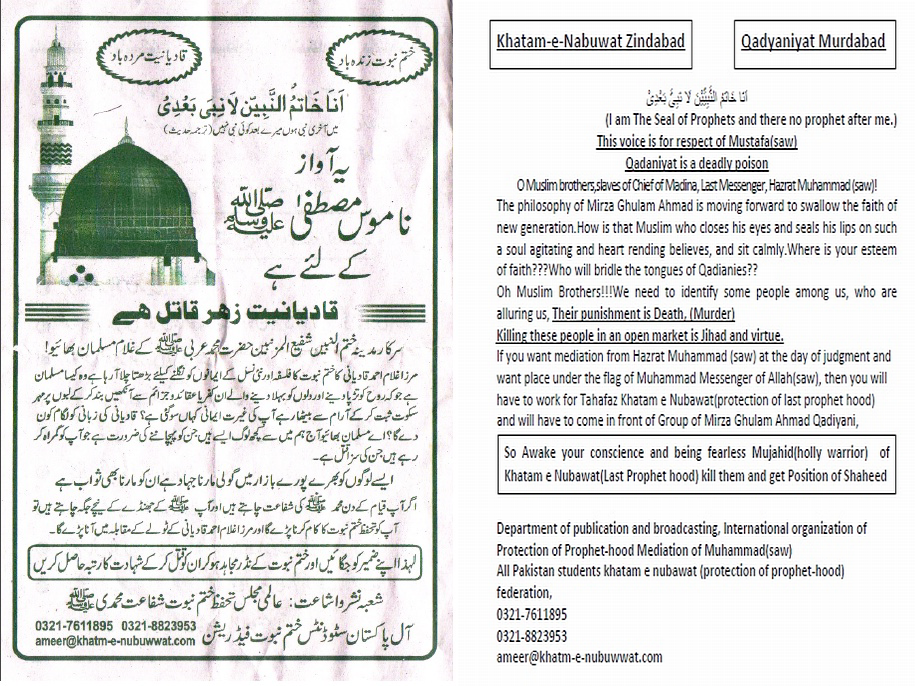
During 2009, in Lahore, Ahmedi worship places in Model Town repeatedly received threats from the conservative religious groups and hate campaigns were conducted against the community through wall-chalking, posters and pamphlets.
Violence against Ahmedis
January 19: An Ahmedi, Saeed Ahmad, was killed in Kotri (Sindh).
February 20: Mubashir Ahmed was shot dead in Karachi.
February 25: A murder attempt was made on Muhammad Iqbal Abid, an Ahmedi religious teacher in Vehari.
March 14: Shiraz Bajwa and his wife Noreen Bajwa, both doctors, were brutally murdered in Multan.
April 1: Bashir Ahmed, Advocate, President of the local Ahmadiyya community, Achini Payan, near Peshawar, was abducted and had not been recovered till Dec 31 2009.
May 8: A well known Ahmedi trader, Mian Laiq Ahmad, was attacked in Faisalabad by three armed men while sitting in his car. The armed men blocked the road to his house and shot him dead.
May 9: Rashid Karim, a well-known Ahmedi in Faisalabad, was abducted and released after five months on the payment of a heavy ransom.
June 24: Two Ahmedis, Khalid Rasheed and Zafar Iqbal, were shot dead in Quetta.
July 6: Rana Ata-ul-Karim was murdered in Multan.
August 6: An Ahmedi, Rana Ata-ul Karim, was shot dead after his wife was harassed by three Muslim extremists in Multan.
August 7: Two Ahmedis were assaulted for their faith in Nankana Sahab near Lahore.
August 12: Javed Ahmed escaped a murder attempt in Kunri (Sindh).
September 11: Zulfiquar Mansur was abducted in Quetta and a month later his dead body was found on the roadside on the city.s outskirts.
September 26: Ahmed Farooqi was shot dead in Uch Sharif, Bahawalpur.
November 25: Dr Pervaiz Zareef of Bhati Gate, Lahore narrowly escaped an attempt on his life.
November 26: Rana Saleem Ahmad, the Deputy Amir of Jamaat Ahmediya Sanghar, was shot at and killed.

On January 28, a case under Section 295-C of the Penal Code was registered against five men belonging to the Ahmediya community at Kot Sultan police station of Layyah district where around half a dozen Ahmediya families lived.
Four of the accused were boys studying at matriculation level. They were accused of writing the name of Prophet Muhammad (PBUH) on the walls of a mosque’s toilet in village 172/TDA. Although the accused denied the allegation made against them, they were arrested and detained. The fifth accused was a labourer.
According to the Human Rights Commission of Pakistan (HRCP) fact-finding mission sent to Layyah on February 1, 2009, a few days prior to the lodging of the FIR, a resident of Chak 173/TDA named Muhammad Safdar saw the name of Prophet Muhammad (PBUH) written on the mosque’s toilet. He told the prayer leader, Qari Muhammad Saeed, about the writing. According to Masood Ahmed, representative of the Ahmadiyya community in Layyah, six Ahmadi families had been living in village 172/TDA for over 50 years and had had no dispute or enmity with any other community member.
The nazim of the area was asked to probe the matter. It was learnt that four students from the Ahmediya community, namely, Mohammad Irfan, Tahir Imran, Tahir Mehmood and Naseeb Ahmed, used to offer prayers in the mosque and also used its toilets. After the investigation, the Ahmedis were stopped from offering prayers in the mosque, and it was said the villagers believed that the Ahmedis, being the only non-Muslims coming to the mosque, must have committed the sacrilege.
After the registration of the case with the police, the Ahmediya community voluntarily handed over all those nominated in the FIR to the police. The students assured the authorities that they had not written the Prophet’s name in the mosque’s toilets nor had committed any other crime. The students told the authorities that their matriculation examination was due to begin on March 4 and requested to be released.
However, the accused were transferred from Kot Sultan police station, around 20 kilometers from the village, to Saddar police station in Layyah city. The HRCP team went to the police station and requested permission to talk to the accused, but the SHO turned down the request and said he was only responsible for the custody of the accused as it was not his police station.s case. However, the police and villagers conceded that there was no witness or evidence of the Ahmadis’ involvement in the alleged blasphemy and as required by law, no investigation was carried out by the SP investigation prior to the arrest of the accused. The bail applications of the boys were rejected quite a few times and they had to take their examination while in confinement. Eventually, they were granted bail after six months of their arrest.
……
Recommendations
HRCP stands
Freedom of belief and religion
February 12: Five Ahmadis detained on charges of blasphemy in Layyah district have been held virtually without any proof or witnesses, HRCP has said.
The commission, which had sent a fact-finding team to Layyah district last week, said its findings concluded that an investigation, mandated by law prior to the registration of a blasphemy case, was also not held.
The HRCP team learned that a prayer leader in the village had allowed Ahmadi students from a nearby tuition centre to offer prayers in his mosque. The students were later threatened by a government schoolteacher and never went to the mosque again. Around 10 days later, some villagers claimed finding blasphemous writings in the mosque’s toilet.
In the First Information Report (FIR), the complainant said: “Since these Ahmadis are the only non-Muslims coming to the mosque, therefore they must have committed the offence”. The ‘argument’ was heard time and again during the HRCP team’s interviews with the mosque administration, some villagers and the local police.
The police and villagers conceded that there were no witnesses or evidence of the Ahmadis’ involvement. The HRCP team found elements belonging to banned extremist organisations and a relative of the National Assembly member from the area had pressurised the police to register a case. “It is clear that a local politician has also used his influence” to book the Ahmadis, the Commission’s report said.
HRCP said the complainant and his extremist supporters are adamant that the Ahmadis should be punished on the basis of presumption.
HRCP has demanded a prompt and transparent investigation into the matter to ensure that innocent people are not victimised. It has also demanded the government ensure that the Ahmadiyya community in the village is not harassed or ostracised. The Commission has also asked the government to take prompt measures to rule out misuse of the blasphemy law.
Introduction
Dastardly terrorist attacks, resulting in the killing of innocent citizens and law-enforcement personnel across the country, throughout the year 2009, constituted the greatest threat to fundamental rights of the citizens. Coming under attack from the security forces in their bastions in Swat and South Waziristan, the militant groups became desperate; they did not spare mosques, bazaars, religious minorities and educational institutions in their obvious bid to paralyse the state and all civilian life. The acts of terrorism and the state’s response to it are discussed in the chapter on Law and order.
………
The sad fact, however, was that the parliament did not pay adequate attention to the vital issues, quite a few of which affected national security, except for an initiative it took to address the uprising in Balochistan towards the end of the year. However, the so-called relief package, too, was yet to be implemented. The matters related to militancy and IDPs drew little attention from the law-makers. During the entire year, they did little law-making, passing only four acts while most of the legislation was done through Presidential ordinances. [See the chapters on ‘Laws and Law-making’ and ‘Political participation’]
The parliament and the executive also failed to take notice of the issues causing distress to the masses, allowing the superior judiciary to expand its jurisdiction and pass verdicts on a variety of subjects, such as determination of the prices of sugar and petrol etc. The Judiciary, on its part, was found short on its promises of expeditious disposal of cases and eradication of corruption in the judicial system. More than 1.5 million cases were pending in the courts at the end of 2009. The chapter on ‘Administration of Justice’ provides details.
In fact, the administration of justice required more than additional judges in courts and higher salaries for the judges. The other two organs of the justice system, police and jails, also needed to be overhauled. Jails were over-crowded and poorly administered. The police was short of personnel. It was also thoroughly corrupt and poorly trained. To check the crime rate, it relied on shortcuts like extra legal killings of the accused in the so-called encounters.……
An outright disrespect for fundamental rights, both by the state and the communal elements, was also visible in the crimes and excesses perpetrated against religious minorities. While the gangsters went on rampage in Gojra against Christians and in Karachi against Shias and looted or destroyed the properties of innocent businessmen, the police force apparently looked the other way. A factory-owner in Muridke was brutally murdered by a mob in the presence of policemen who stood by helplessly. This is obviously due to a lack of professionalism in the police force and absence of an effective institutional mechanism to supervise its functioning, which could ensure public safety and protection of fundamental rights of the citizens.
The Gojra and Muridke incidents, and dozens of cases implicating Ahmedis, also highlighted the misuse of the blasphemy laws, which over the years have been exploited by fanatics and vested interests to perpetuate a reign of terror against the minorities. The government was again too timid to take on the obscurantist elements and make amendments in the law. It could not even enforce the law banning the misuse of loudspeakers that the miscreants employed with impunity to incite the people to violence in both the gory incidents.
The state’s abdication of its responsibilities towards the welfare of the masses could be seen in areas of social and human development. At the end of the year under review, more than 3.5 million children were working as labour in the country in sheer violation of the law and the Constitution. The chapters on Education, Children and Labour provide the details. Public education sector stood ruined as a result of neglect over past several decades. The government did not even care to regulate the private sector schools in order to bring them under some regulatory framework. The same was the state of public healthcare, public transport and housing for the low-income groups. In Punjab, the alleged instances of neglect by private hospitals in providing treatment to patients triggered public protest, but the provincial assembly did not even discuss this issue of public concern.
In recent years, environmental degradation emerged as an issue of survival for Pakistanis, especially owing to acute water shortage, but no serious longterm planning was in sight. The year 2009 witnessed mass protests on the shortage of electricity and natural gas and the emerging trend indicated that in the coming years the people could be up in arms on the issue of water shortage if this issue was not tackled on time.
The media, despite all its shortcomings, played a major role in raising the issues of public interest and highlighted the lackadaisical performance of the government. In doing so, it earned the ire of the rulers. The politicians, who had benefitted from the media in the past during the harsh military regimes, found it hard to stomach its criticism. The media remained under attack from both the state and non-state actors and faced restrictions on free reporting in Balochistan and the tribal region. [The chapter on ‘Freedom of expression’ gives the details]
These issues of public interest on 18 different subjects were monitored and documented by HRCP all along the year as per its tradition since 1990. This book provides an overview of the human rights situation in 2009 besides a digest of the commission.s activities and stands during this period.
Adnan Adil
Editor
HighlightsEditor
- Freedom of thought, conscience and religion
- The year 2009 saw increasing frequency of organised violent attacks on religious minorities while the government failed to take proactive measures to prevent such violence in Gojra and Karachi.
- More than 41 complaints of blasphemy were reported during the year.
- At least five members of the Ahmadi sect were murdered in target killings in 2009, raising to 100 the number of killings since the introduction of anti-Ahmadiyya laws by the Ziaul Haq government in 1984.
- In 2009, 15 incidents of sectarian violence took place in Balochistan in which 26 men were killed and two others injured.
- As the militancy surged in the northwestern parts of the country, enforced migration and displacement of thousands of people belonging to Christians, Sikhs and Hindu communities from Swat, Kohat and FATA was reported following threats by Islamist elements.
- A majority of Hindu women did not possess CNIC cards because of legal complications in registration of marriages.
- 37 Ahmadis were booked under the blasphemy laws during the year and fifty-seven Ahmadis were charged under Ahmadi-specific laws.
- Nearly 80 per cent of the minority population falls below the poverty line and it has usually been ignored during the various government support programmes.
Promotion of Ahmedi officer
Shaukat Ali Wahla, an Ahmedi employed at the Auqaf Department, was promoted as superintendent in BPS 16. In August 1996, the order of his promotion was recalled on the ground that the Punjab Waqf properties Ordinance did not allow the promotion of a non-Muslim as an officer. Wahla came to the Lahore High Court and it granted him relief on the ground that he had been penalised without being heard. Following the Court judgement, the Auqaf Department withdrew its impugned order and promoted Wahla to BPS 17 and also allowed him selection grade. In 2001, the department again started proceedings against him and to meet the requirement of giving him a hearing, issued him a show cause notice. In January 2002, the Department held that Wahla.s promotion as Superintendent was illegal and the order of his promotion was withdrawn. Wahla again appealed to the Lahore High Court and the court again held the order of the department illegal. In 2009, LHC held the recall illegal saying discrimination on the basis of religion was against Article 27(1) of the Constitution. Auqaf Department moved the SC against the LHC judgement.
Fundamental freedoms
Freedom of thought, conscience and religion
… It is the will of the people of Pakistan to establish an order … wherein shall be guaranteed fundamental rights, including equality of status, of opportunity and before law, social, economic and political justice, and freedom of thought, expression, belief, faith, worship and association, subject to law and public morality
Constitution of Pakistan
Preamble
Constitution of Pakistan
Preamble
Subject to law, public order and morality (a) every citizen shall have the right to profess, practise and propagate his religion; and (b) every religious denomination and every sect thereof shall have the right to establish, maintain and manage its religious institutions.
Article 20
Article 20
All human beings are born free and equal in dignity and rights. They are endowed with reason and conscience and should act towards one another in a spirit of brotherhood.
Universal Declaration of Human Rights
Article 1
Universal Declaration of Human Rights
Article 1
Everyone has the right to freedom of thought, conscience and religion; this right includes freedom to change his religion or belief, and freedom, either alone or in community with others and in public or private, to manifest his religion or belief in teaching, practice, worship and observance.
Article 18
Article 18
No one shall be subject to coercion which would impair his freedom to have a religion or belief of his choice.
No one shall be subject to discrimination by any state, institution, group of persons, or person on the grounds of religion or other belief.
No one shall be subject to discrimination by any state, institution, group of persons, or person on the grounds of religion or other belief.
UN Declaration on the Elimination of All Forms of
Intolerance and of Discrimination Based on Religion or Belief
Articles 1(2) and 2(1)
In an xenophobic atmosphere, created and promoted by conservative clerics and a section of the media religious minorities are viewed with suspicion and mistrust. They are seen as constantly conspiring against Islam, Muslims and Pakistan in cahoot with the infidel foreign powers, especially the West. An imaginary combine of Hunud-o-Yahud-o-Nasara (Hindus, Jews and Christians) is supposed to be conspiring against Pakistani Muslims all the time in collaboration with the local minorities. This world view propagated on a large scale, coupled with an unfavourable legal regime, has made life difficult for the non-Muslim citizens. They cannot freely practise their religion and present their point of view without risking their life, honour and property as is evident from attacks on them.
The year 2009 saw an increase in violent attacks on religious minorities while the government failed to take effective preventive measures. The growing intolerance of religious minorities. rights, increased frequency of vigilante actions against them and attacks on non-Muslims over allegations of blasphemy and desecration of religious scriptures caused serious hardships to them. As the Pakistan army and paramilitary forces conducted military operations against the Taliban networks in Swat and other tribal areas including South Waziristan, the militants struck with vengeance, in other parts of the country, at non-Muslim minorities, as well as the Muslim minority Shia sect.
The systematic manner in which the Christian colony in Gojra and the shops in Bolton Market in Karachi were burnt down indicated the involvement of organized and trained militants. It was widely believed that indigenous militant organizations (already banned) were behind these attacks. That these organizations had close connections with the Taliban militants and al-Qeada was no secret. The role of main religio-political parties was mostly inimical to religious minorities. These parties did not condemn the violence against the minorities and often advanced conspiracy theories about foreign hands being behind violence against minorities. In some cases, the seminaries closely connected with religio-political parties were used to foment trouble against the minority communities. On the other hand, the government response, mostly in the form of belated announcements of financial compensation and some attempts at encouraging reconciliation at the local level, had usually been insufficient and reactive.
Freedom of Religion
Ahmadis
As the most vulnerable community in Pakistan the Ahmadis continued to face discrimination and violence throughout the year. The blasphemy laws were widely used against them as five Ahmedi citizens were murdered in target killings in 2009, raising to 100 their casualties since the introduction of anti-Ahmadiya laws by the Ziaul Haq regime in 1984.
Cases on religious grounds and blasphemy victims
The blasphemy law proved to be a major contributor to the minorities. woes during the year as the Gojra carnage demonstrated. In 2009, a total of 41 complaints of blasphemy were registered by police. Some 37 Ahmedis were booked under blasphemy laws and 57 Ahmedis were charged under Ahmedi-specific laws. However, many cases were registered against Muslims as the rival sects of Islam increasingly used the blasphemy law against each other, as may be seen in the account given below:
January 2: The Sargodha police booked two men, Mushtaq Ahmed and Muhammad Ali, on the charges of erasing kalma from the wall of a village mosque.
January 12: A man named Liaquat, was arrested by the police for allegedly burning the Quran in Panwan village near Manawala, Sheikhupura district.
January 17: Chichawatni police booked two men, Pir Syed Athar Shah Naqvi and Syed Ismail Shah, on the charge of committing blasphemy in their speeches on the occasion of the birth anniversary of Hazrat Ali. A cleric belonging to Sunni-Deobandi sect, Mufti Muhammad Usman, had filed a complaint against the two men belonging to the Sunni-Barelvi sect. Two days later, the workers of Jamaat Ahle Sunnat and the Anjuman Tajiran Chichawatni staged a protest demonstration outside the office of the district police officer in Sahiwal against wrongly implicating Pir Athar Shah. The sessions judge at Khanewal dismissed the bail application of the accused and the police arrested one of them.

January 28: Five Ahmedis, including four children, were charged with blasphemy under section 295-C in Chak 172-TDA, in Layyah district. However, the police foiled an attempt by the members of a banned organisation to torch the houses of the people belonging to the Ahmediya community. The four children remained behind the bars for six months.
January 30: Businesses were closed down and protest demonstrations were staged in Mandi Bhauddin (Punjab) against the alleged defiling of the Quran a day earlier.
January 31: Ahsan Tahami, a librarian at the Quaid-e-Azam Library, Lahore, was booked for uttering blasphemous words in a discussion. He fled his home along with his family and went into hiding.
February 5: Muntazirul Haq Shahjehan, a police officer and station house officer (SHO) at Raja Jang police station, was booked on blasphemy charges on the complaint of a local journalist.
February 6: Several political and religious parties staged a demonstration in Quetta against alleged desecration of Holy Quran in Zhob and urged the government to probe the incident.
February 9: Muazaffarabd police registered a case against the sellers of a book allegedly containing blasphemy material. The accused got pre-arrest bail from a court.
February 16: The District and Sessions Judge, Jhelum, heard a case relating to blasphemy charges against one, Khalid Naqash, who had written a book titled, ‘Quran aur Hum’. It was alleged that the book contained blasphemous content about Prophet Muhammad (PBUH). Another man, Muhammad Afzal, who had written the preamble of the book, was also arrested along with the author.
February 18: Clerics in Raiwind called upon the government to register a case and punish those responsible for alleged desecration of Holy Quran in a private hospital at Syeda Waheeda Memorial Nursing College, Raiwind Road Lahore, run by Fatima Memorial Hospital Lahore. It was alleged that some Christian students had placed Quran in shoe boxes. As the clerics protest mounted, the college administration closed down the institution for fear of unrest and violence.
March 1: The Kasur police arrested two Christian men, Wilayat Masih and Mushtaq Masih, on blasphemy charges in Malloki village. The accused were charged that they had covered the grave of a Christian relative with a cloth inscribed with Quranic verses.
March 11: Police booked 25 people on blasphemy charges and arrested four of them in Chak 33 in Kanganpur area, Kasur district. The accused belonged to Ahl-e-Hadith sect and the complainant to Sunni-Barelvi sect.
March 12: Police registered a case under section 295 and 295-A of the PPC against unidentified people for writing blasphemous words on street walls of Umerkot and Mirwah Gorchani on March 10. Hundreds of people protested against the alleged blasphemy, attacked petrol pumps and shops and blocked main highways.
March 23: Police booked four Muslim men for attacking a religious congregation of a different sect and allegedly uttering blasphemous words against Prophet Muhammad (PBUH) in Pattoki, Kasur district. Two of the accused, Rana Naeem and Rana Zahoor, were arrested.
March 27: One Irfan was arrested by the police on the charge of burning a Quran in Mohallah Sabri Colony, Okara.
April 4: Anees Mallah, (25) who was facing blasphemy charges, was found dead in Sanghar jail. He had been moved there only a day earlier from Mirpur Khas, where he had spent almost a year in prison. Anees’s lawyer said he was subjected to torture, shot and afterwards slaughtered brutally in the jail by some jail inmates. His elder brother, Ghulam Rasool Mallah, said Anees was wrongly implicated in a blasphemy case in March 2008 and murdered inside the jail. He said even medico-legal officers were afraid to issue a report about the cause of the death. He said on March 21 2008, his brother’s motorbike had crashed into a gate erected for a Milad function which angered the organisers and they implicated him in a blasphemy case.
April 7: Lahore High Court’s Bahawalpur bench rejected a bail plea of Haider Zaman, accused of blasphemy, and sent him to prison. A mob of baton-wielding students of local seminaries surrounded the court during the hearing and chanted slogans asking the court to award death sentence to the accused. Afterwards, on 30 June, a threemember bench of the Supreme Court also rejected his bail plea and ordered the Bahawalnagar trial court to complete the hearing within three months.
April 8: Police registered a case against a Muslim woman, Ameera Bibi, on blasphemy charges, under sections 290-A and 295-C of PPC, on the direction of a court in Chowk Azam, Layyah district for saying derogatory remarks against God and Prophet Muhammad (PBUH). A local man, Shabbir Shah, was the complainant.
April 10: An additional district and sessions judge at Kamalia (Punjab) ordered the city police to register a case against two Shia clerics, Imran Rizvi and Asif Raza Alvi, on blasphemy charges on the complaint of clerics from a rival Sunni sect.
April 13: Police booked and arrested Bilal Tahir Khawaja, owner of a football manufacturing factory, on blasphemy charge under section 295-A for printing holy Islamic names on footballs. No lawyer represented the accused in the court as Daska lawyers association assured the complainant clerics that the bar would not provide legal assistance to the accused.
April 14: Clerics belonging to Tehreek-e-Tahfuzz-e-Namoos-e-Risalat (Movement for the protection of sanctity of Prophet (PBUH), moved Lahore High Court to get a blasphemy case registered against the owner of a textile mills in Faisalabad. The petitioners alleged the factory had printed the name of Prophet Muhammad (PBUH) on bed sheets and thus committed blasphemy.
April 21: The Supreme Court (Shariat Appellate Bench) rejected an appeal against a Federal Shariat Court (FSC) ruling that death is the only punishment that the Islamic law provides for blasphemy. The appeal had been filed by Bishop Dani L. Tasleem 18 years ago after the FSC gave the judgment in exercise of its powers to determine if the existing laws conformed to Sharia. The appellant could not pursue the petition as he had died.
April 25: Twelve Christian families in Chak 190/AL village of Sahiwal left their homes in a bid to save their lives on receiving life threats from other Christians and Muslims — who alleged that these families had committed blasphemy by throwing ink on the Holy Quran. The village had a huge Christian population. Unidentified people had broken into Harappa Government Community Model Girls Primary School in the village. In the morning, students found on the ground a page of the Holy Quran smeared with black ink and gum. The words on the blackboard led to the assumption that a Christian was responsible for what had happened.
May 9: The Pasrur Police registered a case against a Shia cleric who was accused of saying something derogatory about the companions of the Prophet (PBUH) during a speech.
May 30: A mob staged a protest demonstration in Sukkur against a doctor belonging to Hindu faith. A medical representative, Asghar Channa, complained that assistant professor Pawan Kumar of Ghulam Muhammad Medical College had allegedly uttered blasphemous words against Prophet Muhammad (PBUH). The protesters dispersed after the police assured them that a case would be registered against the accused. Afterwards, the police registered a case on blasphemy charges against him. On 23 June, a Sukkur magistrate ordered the police to present the challan against the accused.
June 27: Bashir Ahmed, imprisoned in Dera Ghazi Khan Jail and facing trial on the charges of saying disrespectful words against the companions of Prophet Muhammad (PBUH), was slaughtered by another prisoner with a sharp razor inside the jail.
July 1: A young man, Imran Masih, was captured by a mob and tortured on the charge of burning the Quran and Islamic books in Faisalabad. Police arrested the man and registered a case against him.
July 9: The Talagang police in Chakwal district registered a case on blasphemy charges, under sections 295-A and 295-C, against a man, Pir Muhammad Ishaq, who allegedly claimed to be God and Prophet Muhammad (PBUH).
July 18: FIA Karachi arrested a man, Murad, resident of Gizri, on the complaint of journalist Ansar Abbasi who allegedly received hate mails from him. The accused was also charged with publishing blasphemous material against Prophet Muhammad (PBUH) on a website.
July 26: Workers belonging to Sunni Tehreek staged a protest demonstration and blocked the main Sheikhupura highway in Khararianwala area in Faisalabad district to pressurise the local police for registering a case against 32 Ahmedis, of 194 RB village, on the charge of writing Quranic verses on the outer walls of their houses. The Police registered a case under sections 295-A and 295-C.
July 27: The Sambrial police registered a case under section 295-B, against a man named Maqsood Ahmed, on the charges of desecrating the Quran in Chak Ikhtiar near Sambrial in Sialkot district. The next day, a civil judge sent the accused on 14-day judicial remand.
July 28: Police arrested a man, Amir Haider, on the charge of sending a message allegedly derogatory against the companions of Prophet Muhammad (PBUH).
August 5: A mob surrounded the house of a middle aged woman, Akhtari Malkani, in a katchi abadi in Sanghar, Sindh on the charge that she had desecrated the Quran. Police took the woman into custody to save her from the mob and assured protesters that if evidence was found it would register a case against her. Angry protesters, demanding the custody of the woman, threw stones at the police station and burnt tyres on the road. Police shot in the air to disperse the crowd. Afterwards, the complainant, Siddique Arain, a shopkeeper, who had some monetary dispute with the accused, disappeared when the police contacted him to file a complaint against Ms Malkani. The woman told the police she had thrown an account book on the ground, not the Quran as the complainant initially accused her, provoking the protests. A 10 member committee headed by the Sanghar Taluka Nazim, absolved the woman of the blasphemy charge after initial investigation and interviews with the witnesses.
September 4: A couple was booked and arrested in Jamber village in Phoolnagar, Kasur district, on the charge of declaring their 10-month-old son Imam Mehdi. More than 500 villagers protested against Abdullah and his wife, Shazia, and blocked the main highway demanding a blasphemy case be registered under 295-C against them.
September 11: A mob torched a local Catholic church in Jaithikey-Sambrial, in Sambrial Tehsil of Daska district over alleged desecration of the Holy Quran in the village. A Christian young man, Robert Fanish Masih, 25, was accused of snatching a chapter of the Holy Quran from a local girl and throwing it into a drain. After the alleged incident, local Muslims armed with bricks, stones and sticks attacked the church. They set it ablaze by sprinkling petrol and kerosene oil on it. As no person was present in the church, no casualty took place. Meanwhile, the agitators led by local clerics took out rallies demanding immediate arrest of the accused persons. All the shops and markets remained closed in the village and its surrounding areas while thousands of scared villagers locked themselves up in their homes. The Christian community left the troubled area immediately to save their lives. One day later, the police arrested the accused who was found dead on 15 September in Sialkot Jail. When his family took his body for burial in the native village, a mob attacked the funeral procession, snatched the body and dragged it on the road. He was finally buried in Sialkot district.
October 30: Police registered a blasphemy case against Qaisar Ali Haideri, the author of a book, on the complaint of Mumtaz Ahmed Dar in Kotla Arab Ali, Gujrat district. On 11 November, hundreds of people brought out a procession against the police for not arresting the accused.
November 1: Police arrested a man, Sadiq Abbas, and registered a case against him on the charge of burning dozens of copies of Quran in a mosque in Chak 302 JB, Noorpur in Toba Tek Singh district.
November 11: Gojra Additional District and Sessions Judge handed down death sentence and fined Rs100,000 to a blasphemy accused, Muhammad Aslam of Shahabad Colony, on the charge of using blasphemous language publicly on Oct 5, 2008. The court allowed the convict to file an appeal against the sentence before the Lahore High Court within a week.
Damages to and acquisition of places of worship
……
In June, an Ahmediya graveyard in Pir Mahal, Toba Tek Singh, was attacked and desecrated by rioters following which the authorities cancelled the land allotment order issued to the Ahmedis 20 years ago.
During 2009, in Lahore, Ahmedi worship places in Model Town repeatedly received threats from the conservative religious groups and hate campaigns were conducted against the community through wall-chalking, posters and pamphlets.
Violence against Ahmedis
January 19: An Ahmedi, Saeed Ahmad, was killed in Kotri (Sindh).
February 20: Mubashir Ahmed was shot dead in Karachi.
February 25: A murder attempt was made on Muhammad Iqbal Abid, an Ahmedi religious teacher in Vehari.
March 14: Shiraz Bajwa and his wife Noreen Bajwa, both doctors, were brutally murdered in Multan.
April 1: Bashir Ahmed, Advocate, President of the local Ahmadiyya community, Achini Payan, near Peshawar, was abducted and had not been recovered till Dec 31 2009.
May 8: A well known Ahmedi trader, Mian Laiq Ahmad, was attacked in Faisalabad by three armed men while sitting in his car. The armed men blocked the road to his house and shot him dead.
May 9: Rashid Karim, a well-known Ahmedi in Faisalabad, was abducted and released after five months on the payment of a heavy ransom.
June 24: Two Ahmedis, Khalid Rasheed and Zafar Iqbal, were shot dead in Quetta.
July 6: Rana Ata-ul-Karim was murdered in Multan.
August 6: An Ahmedi, Rana Ata-ul Karim, was shot dead after his wife was harassed by three Muslim extremists in Multan.
August 7: Two Ahmedis were assaulted for their faith in Nankana Sahab near Lahore.
August 12: Javed Ahmed escaped a murder attempt in Kunri (Sindh).
September 11: Zulfiquar Mansur was abducted in Quetta and a month later his dead body was found on the roadside on the city.s outskirts.
September 26: Ahmed Farooqi was shot dead in Uch Sharif, Bahawalpur.
November 25: Dr Pervaiz Zareef of Bhati Gate, Lahore narrowly escaped an attempt on his life.
November 26: Rana Saleem Ahmad, the Deputy Amir of Jamaat Ahmediya Sanghar, was shot at and killed.

Activities inciting religious intolerance were ignored rather than punished, often leading to serious consequences
Major incidents of violence against religious minorities
The Layyah incident
On January 28, a case under Section 295-C of the Penal Code was registered against five men belonging to the Ahmediya community at Kot Sultan police station of Layyah district where around half a dozen Ahmediya families lived.
Four of the accused were boys studying at matriculation level. They were accused of writing the name of Prophet Muhammad (PBUH) on the walls of a mosque’s toilet in village 172/TDA. Although the accused denied the allegation made against them, they were arrested and detained. The fifth accused was a labourer.
According to the Human Rights Commission of Pakistan (HRCP) fact-finding mission sent to Layyah on February 1, 2009, a few days prior to the lodging of the FIR, a resident of Chak 173/TDA named Muhammad Safdar saw the name of Prophet Muhammad (PBUH) written on the mosque’s toilet. He told the prayer leader, Qari Muhammad Saeed, about the writing. According to Masood Ahmed, representative of the Ahmadiyya community in Layyah, six Ahmadi families had been living in village 172/TDA for over 50 years and had had no dispute or enmity with any other community member.
The nazim of the area was asked to probe the matter. It was learnt that four students from the Ahmediya community, namely, Mohammad Irfan, Tahir Imran, Tahir Mehmood and Naseeb Ahmed, used to offer prayers in the mosque and also used its toilets. After the investigation, the Ahmedis were stopped from offering prayers in the mosque, and it was said the villagers believed that the Ahmedis, being the only non-Muslims coming to the mosque, must have committed the sacrilege.
After the registration of the case with the police, the Ahmediya community voluntarily handed over all those nominated in the FIR to the police. The students assured the authorities that they had not written the Prophet’s name in the mosque’s toilets nor had committed any other crime. The students told the authorities that their matriculation examination was due to begin on March 4 and requested to be released.
However, the accused were transferred from Kot Sultan police station, around 20 kilometers from the village, to Saddar police station in Layyah city. The HRCP team went to the police station and requested permission to talk to the accused, but the SHO turned down the request and said he was only responsible for the custody of the accused as it was not his police station.s case. However, the police and villagers conceded that there was no witness or evidence of the Ahmadis’ involvement in the alleged blasphemy and as required by law, no investigation was carried out by the SP investigation prior to the arrest of the accused. The bail applications of the boys were rejected quite a few times and they had to take their examination while in confinement. Eventually, they were granted bail after six months of their arrest.
……
Recommendations
- A transparent and fair investigation must be carried out soon after any attacks on minorities in order to enforce justice and ensure that innocent people are not victimized.
- The prevailing blasphemy law is arbitrary and should be repealed. The allegations of blasphemy or defiling of religious scriptures, irrespective of their veracity, do not warrant vigilante attacks. Nor do they absolve the government of its primary duty to protect all citizens. Effective prosecution of offenders would serve as a deterrent to future attacks, while a lack of it would encourage impunity. The federal government must take action to ensure that laws on the statute books are not abused to harass or ostracize citizens.
- Workshops should be held for school teachers and administrators to sensitise them to the issue of religious tolerance as they play a key role in building the school.s atmosphere and exercise considerable influence over their pupils. The government should adopt a policy of promoting extra-curricular activities to promote religious understanding and tolerance in schools. For example, Muslim students may be taken to places of worship of other religions like churches and temples to familiarize themselves with religious practices and customs of minority groups.
- A strict check must be kept on the dissemination of literature and audio-visual material promoting hatred against any religious communities or sects.
- Special steps are needed to check the persecution of Ahmadis.
HRCP stands
Freedom of belief and religion
February 12: Five Ahmadis detained on charges of blasphemy in Layyah district have been held virtually without any proof or witnesses, HRCP has said.
The commission, which had sent a fact-finding team to Layyah district last week, said its findings concluded that an investigation, mandated by law prior to the registration of a blasphemy case, was also not held.
The HRCP team learned that a prayer leader in the village had allowed Ahmadi students from a nearby tuition centre to offer prayers in his mosque. The students were later threatened by a government schoolteacher and never went to the mosque again. Around 10 days later, some villagers claimed finding blasphemous writings in the mosque’s toilet.
In the First Information Report (FIR), the complainant said: “Since these Ahmadis are the only non-Muslims coming to the mosque, therefore they must have committed the offence”. The ‘argument’ was heard time and again during the HRCP team’s interviews with the mosque administration, some villagers and the local police.
The police and villagers conceded that there were no witnesses or evidence of the Ahmadis’ involvement. The HRCP team found elements belonging to banned extremist organisations and a relative of the National Assembly member from the area had pressurised the police to register a case. “It is clear that a local politician has also used his influence” to book the Ahmadis, the Commission’s report said.
HRCP said the complainant and his extremist supporters are adamant that the Ahmadis should be punished on the basis of presumption.
HRCP has demanded a prompt and transparent investigation into the matter to ensure that innocent people are not victimised. It has also demanded the government ensure that the Ahmadiyya community in the village is not harassed or ostracised. The Commission has also asked the government to take prompt measures to rule out misuse of the blasphemy law.






 Posts
Posts


