Showing posts with label Jinnah Hospital. Show all posts

Monday, June 14, 2010

Reaction: the response to the Ahmedi massacre

Dawn.com Blog
.
Reaction: the response to the Ahmedi massacre
   by SADAF on 06 14th, 2010 |
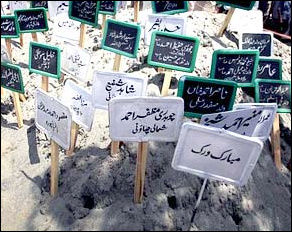
Graves of Martyrs“We are all under threat. They will kill us. They will kill us,” claimed Rubina Saigol, repeating the conversation with members of the Ahmedi community a few months ago. Saigol, an independent social researcher, said that the community members wanted to show her some case files on Ahmedis and talk about the threats publicly.

“I feel guilty and terrible that I didn’t write – partly because of fear.”

But before Saigol could gather up any courage to take any action – the threats had become a reality.

On May 28, militants attacked two Ahmedi houses of worship in Lahore, which resulted in the tragic death of more than 80 people and left more than a 100 injured. Within days, other militants attacked Lahore’s Jinnah Hospital where the injured were still recovering from the first attack.

The Ahmedi massacre has left everyone in shock and the Ahmedi community crippled with grief.

The Ahmedis have struggled for rights within India, Pakistan, Bangladesh, Egypt, and Indonesia for many years.

Although the majority of the Pakistani population is Sunni – there is a growing percentage of people who are seriously questioning the Sharia laws and the constitution. The trend can be followed on local blogs and even the op-ed pages of local newspapers – the rhetoric challenges Sharia laws against the basic rights of a citizen.

Pakistan’s Sharia laws are based mainly on the Hanafi school of thought.

According to Sharia Law, an Ahmedi cannot be accepted as a Muslim or as part of an Islamic sect because one of the basic fundamentals of Islam is to accept Prophet Muhammad (pbuh) as the last prophet in Islam – in Quranic verses he is referred to as the “Final Seal” (al-azhab:40).

In several interviews with religious scholars, from Sunni and Shia schools of thought in Cairo and Q’um in Iran agreed that Ahmedis were not a Muslim sect. They went as far as calling them, “heretics” and “infidels.” As well as, if a non-Muslim shows and preaches under a Muslim façade, then he or she must be charged, proven guilty, and punished in court according to Sharia law, a crime which is punishable by death (wajib-ul-qatl).

But one of the scholars in Cairo, who requested to stay anonymous, was quick to add that if a non-believer is a citizen of an Islamic state then he or she becomes the zami (responsibility) of the state. Therefore, it is the state’s responsibility to protect them more than the Muslim citizen, out of fear for violence against them.

“They should be treated with the utmost respect, because we, as Muslims, need to set an example for them,” he said. “As a Muslim, your responsibility is to follow the basics of Islam and lead a good life – violence of any type against anyone is not an example of leading a good life.”

This one scholar, who remains anonymous out of fear for the repercussions he could face, is not alone.

As soon as the attack hit the news, blogs went up everywhere in an uproar; some immediately condemned the brutal attack, others wrote malicious comments about Ahmedis claiming them to be wajib-ul-qatl (deserving of death), and some tried to explain the causes of the attack through religious, political and social analyses.

On the blog pkpolitics there were many harsh comments and the owners of the blog removed those comments and posted a warning to respondents on abusive language.

One of the more kinder comments on pkpolitics was, “Brother, The Qadyani religion should not be even be called ‘Ahemdi religion’, for you know that the Last Prophet Muhammad is exclusively mentioned by the name ‘Ahmed’ both in the Holy Quran and in the Bible (sic).”

Another respondent scolded back, “I cant believe my eyes, Instead of completely condemning the attack and humiliating the attackers, some are debating on the words used and about Qadyani sect or religion whatever…. no wonder Pakistan is heading towards its doom day by day… shame on us (sic).”

Tazeen Javed, winner of Best Humor Blog category for Pakistan’s first Annual Blog Awards, blogs at A Reluctant Mind wrote, a social aspect of the attack holding everyone accountable, event the public, for the attack in “We all have blood on our hands.”

The Waking Life blog posted, “Is it all worth?” questioning Muslims who asked for tolerance in other parts of the world, wrote, “Time to put things in perspective…Facebook may have partaken in blasphemy but there’s plenty of it going on in our cities and society. How about cleaning our own house first? (sic)”

The popular and controversial blog, Café Pyala, which sometimes uses profanity, condemned the attack in the political analysis “Original Sin:” “Truly, if ever there was short-sightedness among Pakistan’s establishment (and there are plenty of examples of it) this was it…The nurturing of extremist thought during Zia ul Haq’s (mis)rule and its repercussions in the shape of today’s barbaric attacks (and earlier targeting of Shias, Hindus and Christians) are a logical continuation of the original sin. (sic)”

Most editorials and columnists for print media did not have to directly respond to profanity like some online media blogs, however they condemned the attack, pointing out the government’s blatant disregard for protecting minorities, and feeding a culture of bigotry.

The Dawn editorial “Culture of Intolerance” wrote, “Religious minorities in Pakistan have not only been shunted to the margins of society but also face outright persecution on a regular basis…the state, meanwhile, remains largely unmoved by the plight of minorities — and that isn’t surprising either for it is a party to this persecution.”

Columnists did not try to hide the humiliation the government as well as the public should feel over the attacks.

Columnist Kamran Shafi, who writes for Dawn, wrote in A sad place, indeed that he recalled a time when there was no religious distinction, just Pakistani citizens. He stated, “The Ahmedis might be considered non-Muslim by the state; surely they are still Pakistani?”

Shafi added that an important member of the Ahmedi community told him that the compensation that was offered to the victims of the attack would be kindly refused and asked to be transferred over to the people of Hunza-Gojal for the relief work.

These voices of different generations and backgrounds of growing tolerance are currently at a grass-roots level, but they can still be heard, even in some political circles.

On the day of the attack, Punjab’s Chief Minister Shahbaz Sharif held a press conference addressing the attack and the efforts of the police. Even though his offices had received reports on a threat to the Ahmedis several days prior to the attack.

While soon after the attacks, Interior Minister Rehman Malik was the only government official who personally went to visit the Ahmedi community to give condolences

Shahbaz Sharif has yet to visit the Ahmedi community since the attacks.

Although most recently, PML-N party leader Nawaz Sharif did condemn the attacks and named Ahmedis as “brothers” and “sisters.” Only for him to be threatened by religious leaders with an anti-Sharif campaign in the region.

If the public’s reaction has mobilised the government to react at all then it leads to the most important question: What is the next step?

Imam Shamsi Ali might have the answer.

“It is very difficult to accept the nature of the world we live in – part of this world is the freedom of expression. I oppose the idea (Ahmedi movement) but I cannot impose my ideas on anyone. I have no right to impose my ideas on anyone,” said Imam Ali.

Ali, who lived and studied Islamic Studies in Islamabad for seven years, is the leader for the 96th street mosque and runs the Islamic Cultural Center in New York.

“We need engagement. If we oppose those claims then we must have intellectual discourse. If we engage with Hindus, Christians, Jews, or Buddhists, then why cannot we talk to them?”

Ali, ultimately, feels that restricting the freedoms of a people is not the way of Islam, rather allowing people their freedom and showing tolerance is way for people to find the path to Islam.

Sadef A. Kully is a Reporter/Associate Producer for Dawn.com

©2010 DAWN Media Group. All rights reserved

Tuesday, June 8, 2010

Not an eye-opener: time to act

Daily Times, Pakistan
Tuesday, June 08, 2010

VIEW: Not an eye-opener: time to act —Daud Khattak


Daud KhattakThe current set up of militants is the amalgamation of many diverse elements from different areas and backgrounds with the apparent patronage of the Wahabi-dominated al Qaeda out to carry forward its religious-political agenda in the region

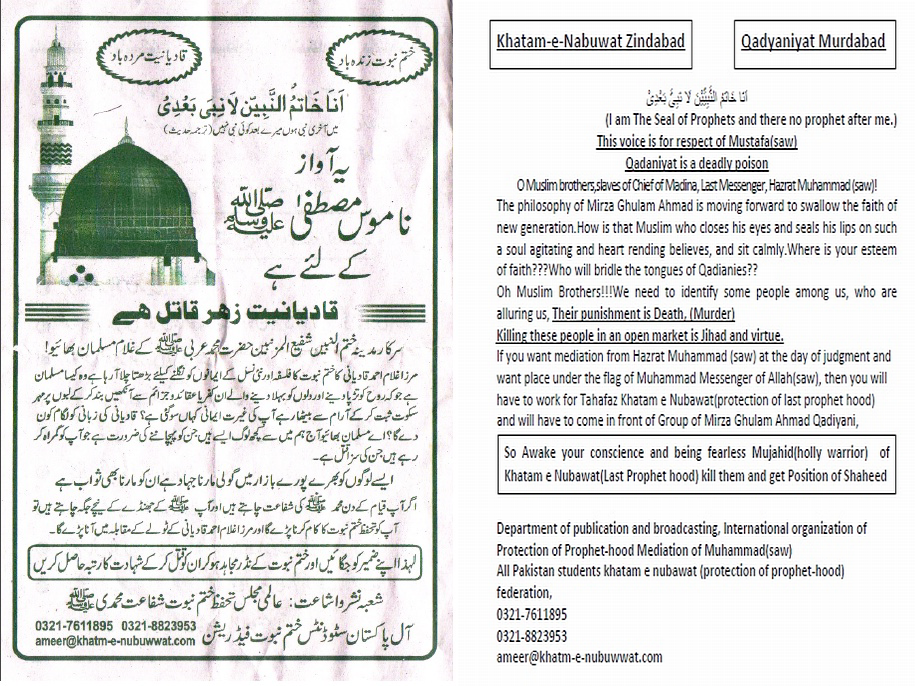
Few countrymen rejoiced as the military high command announced victory against militants in the Orakzai tribal agency the other day mainly because the bleeding sore is finally emerging in the heartland of Pakistan now.

Friday’s blatant attack on the Ahmedis’ places of worship in Lahore followed by an audacious attack on the ICU of Jinnah Hospital in the same city just two days after, and that too at a time when the so-called ‘stepped up’ security measures were in place, is anything but an eye-opener for the Punjab government to do away with its compromising stance towards the religious bigots operating in the name of Jaishs, Lashkars, Tehriks, Hezbs or anything of the sort.

Alarm bells have been ringing about the breeding grounds, training facilities and presence of leadership of various sectarian, jihadi and other banned militant outfits in southern Punjab over the past few years, but criminal negligence on part of the previous and current government emboldened religious extremists to challenge the government and security agencies in the provincial capital of Lahore, the most secure and peaceful of Pakistani cities.

The Friday and Monday night brazen strikes are not the first in this eastern city. Rather, those were par for the course underway in Lahore or other cities of Punjab and even Azad Kashmir since early 2009.

The first of the series was the March 3, 2009, attack on the visiting Sri Lankan cricket team that killed eight people, besides tarnishing the image of Pakistan and blocking the way of international cricket in the country for many years to come.

On March 30, 2009, armed men attacked the Manawan police station killing eight people. That same year, on October 15, three simultaneous terrorist attacks were carried out in Lahore killing 30 people. And the twin suicide attacks in the same city on March 12, 2010, killed 45 more people.

Besides, two major and daring attacks were also carried out in Rawalpindi, home to the headquarters of the Pakistan army, on the GHQ and a high-profile mosque in October and December 2009 respectively.

But, to the dismay of many, the Punjab government, instead of picking up the gauntlet, continued with its compromising attitude and occupied a reactionary position instead of advancing with action.

While sectarian groups were already holding all the aces in southern Punjab, jihadi outfits started camping there following the withdrawal of support by former president Pervez Musharraf for their armed struggle in Indian Occupied Kashmir in 2006 and 2007.

Finding no other way to quench their jihadi hysteria and thirst, these young misguided men, numbering in the hundreds and later multiplying into the thousands, started pouring into the tribal region, where the predominantly Pashtun Tehrik-i-Taliban Pakistan (TTP) was spreading its offshoots with full impunity and attracting youth from the lawless region through its heroic statements and videos about fighting against the Afghan and ‘infidel’ forces in neighbouring Afghanistan.

The mishandling of the Laal Masjid episode proved to be a catalyst. The Punjabi Taliban, mainly belonging to banned sectarian and jihadi outfits, got so much leverage in the TTP that they were given seats in the 40-member Shura of the Pashtun-dominated umbrella of Taliban groups.

It was during their stay in the TTP — an associate of the US-declared terrorist network of al Qaeda — that those dubbed the Punjabi Taliban discovered new recruitment vistas, financial backup and technical and planning support, mainly from al Qaeda. As their bases remained intact in southern Punjab, while the number of religious seminaries multiplied over the years there, members of the jihadi and sectarian outfits returned to their old bases along with some of their TTP leaders and colleagues, following the increasing attacks by CIA-operated spy planes and the launching of operations by the Pakistani security forces in the tribal areas.

The obvious case, in this connection, is that of one Dr Osman who was allegedly involved in the October 2009 attack on the GHQ. In the first stage, Osman was a member of the sectarian outfit Lashkar-e-Jhangvi, who then went on to join the TTP and later became a member of the al Qaeda network.

Though an investigation spanning some years has yet to bring something to the fore, some recent statements from top government functionaries revealed that the Lashkar-e-Jhangvi was involved in the 2008 bombing of a five-star hotel in Islamabad.

It is depressing, at least for the peace-loving citizens of Pakistan, to see that a militant outfit that once used pistols, AK-47s and hand-grenades at worship places or gatherings of rival sects, could assume that much power, men, material and technical expertise to target high-profile places like a five-star hotel and the GHQ by using truckloads of explosives and several armed men without the knowledge of nearly half a dozen intelligence agencies, the police force and the all powerful army.

The current set up of militants full of religious frenzy is not as simple as to be called only the TTP, Lashkar-e-Jhangvi, Jaish, etc. It is the amalgamation of many diverse elements from different areas and backgrounds with the apparent patronage of the Wahabi-dominated al Qaeda out to carry forward its religious-political agenda in the region.

In the words of Rohan Gunaratna, author of Inside al Qaeda, “Jhangvi is now the eyes, ears and operational arm of al Qaeda and the TTP (based in Waziristan). It is hard to distinguish between the three.”

The fresh attacks in Lahore left no room for a second thought for the government in going all out against all these groups, their patrons and supporters, both materially and financially, in southern and the rest of Punjab.

The attacks per se should not be taken as an eye-opener to think over what to do. It is time to act and act decisively, lest it be too late to force the army to open another unending front like the ill-fated tribal region.

The writer can be reached at daud_72@yahoo.com

Saturday, June 5, 2010

State of denial

The News - Internet Edition
Saturday, June 05, 2010,
Jamadi-us-Sani 21, 1431 A.H.
 State of denial

Saturday, June 05, 2010
Arif Nizami

The simultaneous attacks on two places of worship of the Ahmedi community in Lahore, which claimed at least 95 lives, and the subsequent attack on the Jinnah Hospital to free an injured suicide attacker were perhaps not enough to wake the provincial government from its deep slumber. Despite the gravity of the situation, there is a state of denial and a pervading sense of complacency. The PML-N leadership is simply not willing to concede that the province has become a hub of terrorism.

On the night of the attack on Jinnah Hospital, a dishevelled, visibly shaken chief minister of Punjab was seen at the scene. Until then Mian Shahbaz Sharif had been hiding behind the vituperative statements of his law minister, Rana Sanaullah, who attacked anyone who even remotely suggested that the provincial government should get its act together and go after the Taliban sanctuaries spread all over southern Punjab.

The callous disregard towards a minority that is perceived as anathema to the obscurantist vote bank that the PML-N so assiduously cultivates, is evident from the fact that Mian Shahbaz Sharif chose not to visit the site of the massacres in Model Town and Gari Shahu. Nor did he bother to meet or offer compensation to the bereaved families.

The saddest part of this most unfortunate incident is that it has become a subject for point scoring. The war of words between Governor Salmaan Taseer and Rana Sanaullah, bordering on their use of abusive language against each other, has gone beyond ridiculous.

Interior Minister Rehman Malik visited Lahore on Sunday. Instead of meeting the chief minister to discuss the grave situation and the measures necessary to tackle it, he decided to go public about his own perceptions on the matter. He said that it was no disclosure, nor was the fact sensational, that terrorists from southern Punjab had now become active. He hinted to a section of the media that there was a possibility of army action in southern Punjab on the pattern of operations in the tribal areas, for which he drew a sharp reaction from the provincial government.

The very next day, the interior minister came up with the ludicrous statement that he was not aware that the terrorist Muaz was under treatment in the same hospital Mr Malik had visited a day earlier. Unless Mr Malik was suffering from another bout of Orwellian doublespeak, it was the job of the interior minister to inquire about the whereabouts of the injured terrorist.

The Punjab government’s attitude towards the sharp increase of jihadist activity in the province is a mixture of naiveté, ambivalence and opportunistic politics. The ruling party in the province is willing to go to any length in its eagerness to be the sole beneficiary of the perceived vote bank of the religious parties.

To say the least, it was criminal negligence on the part of the government to house the terrorist in a public hospital. They might as well have put him in a five-star hotel of the city, where at least security is better and more reliable.

On the very day of the terrorist incidents in Lahore, Rana Sanaullah, who was participating in a discussion with this writer in a programme on Geo Television, vociferously defended his party’s politicking together with members of the leadership of the banned Sipah-e-Sahaba in the recent by-elections in Jhang. He was simply of the view that if such elements have the right to vote, why should the PML-N not bank on them?

What the foulmouthed Rana and his bosses conveniently overlook is the fact that Sipah-e-Sihaba was declared a terrorist organisation and banned under the Anti-Terrorist Act legislated by Prime Minister Nawaz Sharif himself in 1997. His claim that the PML-N by hobnobbing with such elements is bringing them into mainstream politics sounds hollow.

To claim that the problem lies not in southern Punjab but in North and South Waziristan where terrorists receive training is a travesty of truth. The cannon fodder, the militants, come from Punjab, and go on to receive training and indoctrination in Fata.

Not only are a large number of madressahs based in southern Punjab, but the origin of many jihadist organisations can be traced to the province. For example, Sipah-e-Sihaba, which is based in Jhang, was a reaction to the proxy war between Iran and the Gulf countries in the seventies and the eighties. Along with Lashkar-e-Jhangvi, it has become a mainstay of jihadist elements in Punjab.

Similarly, the founder of Jaish-e-Muhammad is Maulana Masood Azhar, who hails from Bahawalnagar. He was released from an Indian prison in 1999 in a prisoner swap as a result of the hijacking of an Indian Airlines plane to Kandahar. Interestingly, it happened on Gen Musharraf’s watch, the hero of Kargil who at that time was willing to go to any limits in pursuit of his anti-India agenda.

Lashkar-e-Taiba, under the tutelage of Hafiz Saeed based in Muridke, was formed in 1989 to replicate the Afghan jihad in occupied Kashmir. Thankfully, the LeT believes only in state-approved jihad and is Kashmir-specific

The Tablighi Jamaat headed by Bhai Abdul Wahab is based in Raiwind on the outskirts of Lahore. Ostensibly non-militant, over the years it has become the largest congregation of jihadists from all over the world. VIPs like Prime Minister Mian Nawaz Sharif, followed by then-president Farooq Leghari, would regularly visit its “Salana Ijtamah” (annual congregation). Interestingly, according to Rana Sanaullah, the terrorists who attacked the Ahmedi worship places lodged themselves there.

Maulana Abdul Aziz of Islamabad’s Lal Masjid, a stone’s throw away form the ISI headquarters, belongs to Rajanpur. The mosque was besieged during Musharraf’s rule and the operation launched to lift the siege resulted in massive casualties inside the mosque, including that of Maulana Abdul Rashid Ghazi. Maulana Aziz, his brother managed to escape.

It is high time the Punjab government recognised the grim situation, instead of sharply reacting to anyone critical of its policies, and got its act together to tackle the problem head-on. Admittedly, there is no quick fix solution to the problem. The jihadists cannot be eliminated in a day.

Talk of an army action in southern Punjab is certainly premature. It is neither desirable nor feasible. The terrain does not require an army action on the lines of operations conducted in Swat and South Waziristan. However, if things go completely wrong in this area, a military operation there will have to be contemplated because there will be no other option left.

The PML-N has decided to form a special anti-terrorism war cell to deal with the problem, instead of spending its meagre resources on training, equipping and improving the existing police force. This is tantamount to creating another tier of bureaucracy. The proposed setup could result in further lowering the effectiveness of the police and provincial intelligence network without creating a better alternative.

Socioeconomic measures must be taken to improve the lot of those who live in abject poverty and have no recourse but to send their children to madressahs for education. There is the need to beef up the intelligence and security apparatus. But the political will to take these actions is lacking.

The Elite Force was formed with a lot of fanfare by Mian Shahbaz Sharif in his previous stint as chief minister. The bulk of these smartly-turned-up and well-trained policemen are now being used to protect the political elite and their families.

The PML-N leadership needs to end its ostrich-like attitude. The stark reality that there must be no nexus with those who want to undo the system needs to sink in sooner than later.

The writer is a former newspaper editor. Email: arifn51@hotmail.com

URL: www.thenews.com.pk/daily_detail.asp?id=243222
 
^ Top of Page