Showing posts with label blasts. Show all posts

Saturday, September 25, 2010

After the attack: a victim of the Lahore attack remembers

Express Tribune, Pakistan
Blogs
After the attack: a victim of the Lahore attack remembers
Sonya Rehmanby Sonya Rehman
A graduate from the Columbia University Graduate School of Journalism who works as a freelance journalist for The Express Tribune and various publications in Lahore.
Saturday, 25 September 2010
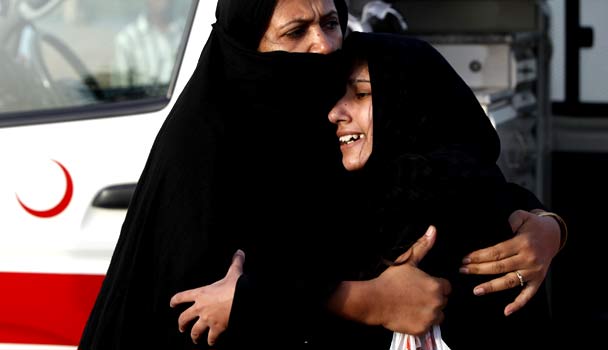
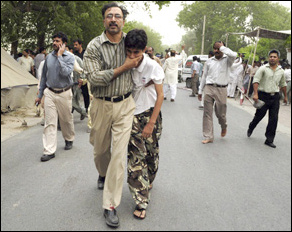
Women mourn the loss of relatives after the attack on May 28 PHOTO: REUTERS
You read stories of violence and atrocities committed on faceless Pakistanis in your local newspapers on a daily basis. You absorb the news as detached consumers. Empathy and even hints of grief might stir your heart while reading a poignant story every once in a while, but try as you might, you will never be able to relate to the victims and those directly involved – because you were never there. It didn’t happen to you or, anyone you know. And for that, you’re almost relieved. Yet guiltily so.

But what would happen, if one day, you or your loved ones were victims of a cruel, intolerant act of violence? And what if, someone you knew and loved deeply was taken away from you, within a mere few agonising hours?

What then? How would you survive the horror?

Settled abroad with her husband, Irum received a phone call from her distraught sibling. It was the 28 day of May – this year – a Friday. Back home in Pakistan, it was 2:30pm. Two Ahmadi places of worship in Lahore were under siege by terrorists, and Irum’s father was in one of them – Darul Zikar, a place that Irum for many years, used to frequent with her family on Friday for prayers, and over Eid, as a young girl.

Prior to her sibling’s phone call, “Abu” had called Irum’s mother and told his wife that he was injured. He’d been shot in his left foot. After telling his wife to remain calm, Irum’s mother heard a series of gun shots. Then, the line went dead.

Abroad, Irum watched the television in horror – live visuals of the attack were being shown on the BBC. Three hours later, after the attack was over, Irum’s father could not be found. Family members searched hospitals, but to no avail.

Hours later at 10:00pm, Irum’s father had been located. His body was found at a local hospital. “I was half expecting it since there had been no news,” Irum said, “But when my brother-in-law called me, I fell to the floor and wept. God knows how many hours I wept for.”

Irum immediately left for Pakistan. The journey home was wretched.“For many nights which followed, I had haunting nightmares that I was in there too, and that a bullet had hit my leg,” she stated, “A few times I dreamt that I was in there and that I had covered my father and the bullet had hit my back instead of his foot, and that he was safe.”

In the days, weeks and months that have followed after the incident, Irum and her family, in their grief, gain strength from the fact that along with them, eighty-five other families suffer the loss of their loved ones. It is in this grief that they have sought some resilience and patience to endure their personal tragedy.

“After my father’s death,” Irum said, “My first reaction was that I didn’t want to live here anymore. Lahore has always been my favourite place in the world. But now it has become a place where my father was brutally killed. And no one came to help. Imagine how the mother of those two brothers killed in Sialkot must be feeling about her city and her fellow citizens. That’s how I feel. No one helped; they all gathered around their TV sets and watched the show – just like the mob in Sialkot.”

After speaking with an uncle, who was in Darul Zikr at the time of the attack, Irum informed me that there were five to six terrorists in the building. “They first burned the cars outside,” she said, “Then they came inside, opening fire on anyone in sight. One guy climbed up on the minaret and remained there till the end – he would shoot anyone he saw below in the courtyard.”

In the hall where her father was, two men broke in, spraying bullets. Then, one of them went to the hall on the first floor and started throwing hand-grenades from above, into the hall below. At one point, one of the attacker’s placed a grenade at the feet of an old man. “He was sitting on a chair,” Irum said, “My uncle watched from a distance as the grenade went off.”

“This entire incident has scarred us badly,” Irum stated. “Three Ahmadis have been killed since the attack on the May 28. One in Narowal, and two in Sindh. So you can imagine how unsafe we feel.”

After the tragedy, Irum and her family have begun to follow strict safety measures. “There are many Ahmadis in Lahore who are getting threatening phone calls and their homes have been marked with red ink as targets,” she said, “Basically every Ahmadi in Pakistan is practicing his/her faith under the dark shadow of terror, at the risk of their lives…but we’re holding on.”

Thursday, July 15, 2010

Pakistani Bombings Highlight Theological Tensions

Illume Magaine, USA
Feature
Pakistani Bombings Highlight Theological Tensions
Posted in:  Feature
Sameea Kamal
| Jul 15, 2010 | 1:53 PM
Pakistani Bombings Highlight Theological Tensions
Police officials take bribes to file false blasphemy charges against Ahmadis, Christians, Hindus, and occasionally Muslims

In a series of deadly attacks around Pakistan, a suicide bombing in Northwest Pakistan on last week killed at least 105 people, and injured at least 115 — the deadliest attack in the country this year.

Two suicide bombers struck two areas seconds apart in the village of Yakaghund — a northwest tribal region called Mohmand- near a government office.

The Pakistani Taliban claimed responsibility for the attack, saying they were targeting a gathering of pro-government tribal elders — including those setting up militias to fight against the Taliban.

Though the elders were in the government building, none was hurt, said Mohmand chief administrator Amjad Ali Khan.

Women and children were among the victims.

About 70 to 80 shops were damaged or destroyed, and a damaged prison building allowed 28 criminals to flee, said local government official Rasool Khan. None of the escaped prisoners were militants, however.

The latest attack comes shortly after the bombing at a Sufi shrine in Lahore ,when two suicide bombers attacked the famous Data Darbar shrine in the country’s cultural hub. At least 43 people were killed, including women and children, and about 180 were injured in a continued streak of violence against minority Muslim groups.

The attack occurred while visitors were in the midst of worship and ablution late on Thursday night at about 10:50 p.m. at the burial site of Sufi saint Syed Abul Hassan bin Usman bin Ali al-Hajweri, where many worshippers come to pay respect.

While the two bombers have not been identified with any group, a rise in attacks by the Taliban and other pro-militant groups has occurred against groups deemed heretics according to extremist thought. Similar attacks have been carried out against Sufi Shrines in the northwest Pakistan as well.

Footage from Pakistan’s CCTV showed the suicide bombers rushing into the shrine complex after evading police guards and volunteers standing at a gate.

Since the attack, the CCPO Lahore admitted there was a lapse in the security arrangements that were revealed through preliminary reports of the incident. Five police officers were dismissed after the incident due to negligence of their duty.

43 bodies had been received at the city’s morgue the day after the attack, according to Salman Kazmi, a senior official at Mayo Hospital in Lahore. Several of the victims died as a result of their wounds in the hospital, he said.

Of the 180 injured, doctors described 20 as being in serious condition.

In another attack on May 28, a group identifying itself as the Punjab provincial chapter of the Pakistan Taliban attacked two mosques each filled with about 1,500 people during Friday prayers, killing at least 80 people and injuring at least 78.

At least seven men armed with grenades, high-powered rifles and suicide vests stormed the mosques at the end of the Friday congregational prayers. The group was described by the Washington Post as an “amorphous Sunni Muslim organization” based in the mountainous tribal regions.

The attacks showed the Taliban’s ability to “strike forcefully in urban centers and pointed to rising sectarian tensions in Sunni-majority Pakistan,” reported the Washington Post.

The May 28 attacks, which took place minutes apart, targeted mosques of the Ahmadi sect of Islam, a minority group that was declared non-Muslim by Pakistan law in 1974 due to differences of opinion on religious matters, according to Dr. Ahmad Chaudhry, spokesperson of the Ahmadiyya Muslim Community, USA and a member of the Executive Board of the Ahmadiyya Muslim Community Youth Organization.

Prior to the law, these differences were always kept in the religious sphere and not brought into the sphere of the State, Chaudhry said.

In 1984, Ordinance XX was passed, titled the “Anti-Islamic Activities of the Quadiani Group, Lahori Group and Ahmadis (Prohibition and Punishment) Ordinance.”

The act “prohibits Any person of the Quadiani group or the Lahori group (who call themselves ‘Ahmadis’ or by any other name), who, directly or indirectly, poses himself as Muslim, or calls, or refers to, his faith as Islam, or preaches or propagates his faith, or invites others to accept his faith, by words, either spoken or written, or by visible representations, or in any manner whatsoever outrages the religious feelings of Muslims.”

Violation of the law, and the specific “Anti-Islamic activity” it outlies, may result in imprisonment of up to three years and may also be fined.

Religious minorities in Pakistan- including Christians, Hindus, Sikhs, and Shiites, say the blasphemy laws are “widely misused” against them. A report written by human rights organization Minorities Concern of Pakistan states that, “it is evident that in majority of cases the charges are mala fides – such as personal enmity, religious rivalry, property disputes etc.”

The organization has repeatedly demanded that the Pakistani government repeal the laws, “as soon as possible to save the lives of many innocent people and to bring harmony in the society which has been shattered since the promulgation of these contentious laws,” said Aftab Alexander, Mughal of Minorities Concern of Pakistan

“Blasphemy laws provide harsh sentences, including the death penalty, and injuring the ‘religious feelings’ of individual citizens is prohibited. Incidents in which police officials take bribes to file false blasphemy charges against Ahmadis, Christians, Hindus, and occasionally Muslims continue to occur, with several dozen cases reported each year,” says the Freedom House Report “Freedom in the World — Pakistan (2010)”, issued this month.

The report says that while no convictions have withstood appeal to date, the charges alone can lead to lengthy detentions, ill-treatment in custody, and persecution by religious extremists.

“The anti-Blasphemy laws have essentially made it impossible for a member of the Ahmadiyya Muslim Community to publicly practice their faith,” said Chaudhry.

“These laws, which are regularly enforced, have led to men, women and children being imprisoned for doing nothing more than practicing Islam,” he said.

“For a State to officially declare a group, by name, as non-Muslims when they themselves claim to be Muslims defied logic,” he said. “This was not the way of the Prophet (saw) of Islam.”

Ahmadi Muslims differ from Sunni Muslims primarily in their belief that the Messiah, Mirza Ghulam Ahmad of Qadian, came 100 years ago.

“Ahmad came to simply revive the teaching of true Islam, not to add or subtract a single thing from the Law of the Prophet Muhammad (saw),” Chaudhry said. “This revival was of a moderate Islam where Jihad through violence was no longer applicable but rather a Jihad of the Pen and ideas was promoted.”

His writings promoted separation of State and religion, universal human rights, and protection of the rights of minorities — nothing new to Islam, Chaudhry said.

Saad Karamat, a southern Califiornia resident whose uncle was gunned down and killed in one of the May 28 attacks, said the institutionalized discrimination has resulted in hatred against Ahmadis, and acts of violence.

“We’re not allowed to call the mosques mosques, they’re called places of worship,” Karamat said. “If I identify myself as Ahmadi and say ‘Asalam-u-alaikum’, or recite a verse from the Holy Quran, I could be put into jail according to the Pakistani constitution.”

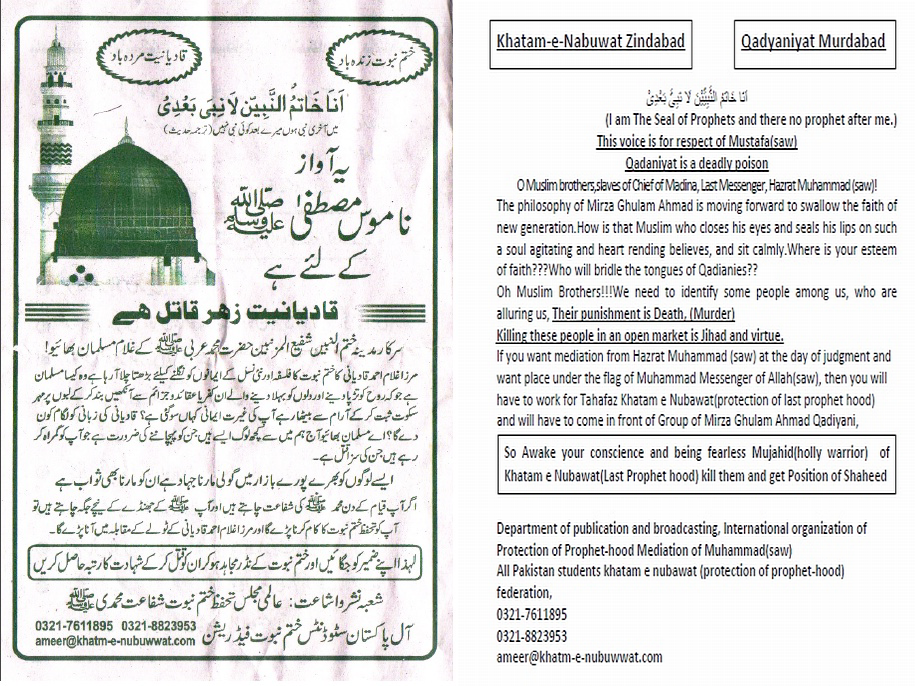
There are many examples of the discrimination in Lahore, including billboards that say Ahmadis, Christians and Jews are worthy of death, according to Karamat.

“Authorities have come with hammer and chisel to our mosques to forcefully remove stone that had the kalima carved in it. Can the government really believe it is doing Islam a favor by desecrating mosques?” Chaudhry said. “When open declarations that members of the Ahmadiyya Muslim Community are worthy of death are made in newspapers, on television and on billboards, what else do people expect? The situation is made worse when the government offers no real protection to the Ahmadiyya Muslim Community despite repeated threats.”

Extremists are only exposed to one narrow perspective, Karamat said.

“Their (religious leaders) are misguided, they’re preaching nothing but hate,” he said. “I don’t know how it could be justified, but they actually feel they’re going to attain heaven by killing minorities.”

“I’ve always been taught that the way to defend Islam is through the propagation of pen, the jihad of the pen - that’s one of the primary things the founder of the community advocated for,” Karamat said. “He strongly condemned any form of violence in the name of Islam.”

The UC Berkeley senior said that despite the inclination to “perpetuate the state of violence and chaos,” the community has not reacted to the attacks with violence.

“Our khalifa (caliph), on that (Friday), said the only thing we can do is pray, for our community and the perpetrators of these heinous acts,” he said. “I’m not giving up faith, in certain situations people may totally give up faith, and start taking up arms, but if you look at all the past Prophets -Moses, Jesus, and the life Muhammad, peace be upon him, their communities had to endure so much persecution during their times.”

The attacks have been denounced by the international community, and leaders worldwide have vowed to support Pakistan against people who wish to destabilize the country.

“We condemn this brutal crime and reaffirm our commitment to support the Pakistani people in their efforts to defend their democracy from the violent extremists who seek to destroy it,” US Secretary of State Hillary Clinton said in a statement.

UN chief Ban Ki-moon, British Foreign Secretary William Hague, and EU foreign affairs chief Catherine Ashton all spoke out against the attacks.

In Pakistan, the Pakistan People’s Party Punjab and Lahore chapters strongly condemned the terrorist attacks at the shrine.

Acting president Samiullah Khan Durrani, Deputy Secretary Malik Muhammad Usman and Media Secretary Iqbal Sialvi told the Daily Times that the attack on the Data Darbar “clearly reveals that the terrorists have no consideration for any religion, faith or belief.”

The leaders said that terrorists neither respect human values nor care for human lives, and that terrorists were the real enemies of Pakistan who wanted to destabilize the country to fulfill their agendas.

“Ahmadi Muslims have been single out in the law, specifically by name, but all minority religious views are under constant threat in Pakistan,” Chaudhry said.

Despite the recent violent activity, there have been fewer attacks in Pakistan this year than in previous years, particularly in the northwest.

In the last three months of 2009, more than 500 people were killed in a surge of attacks in the country.

Monday, June 14, 2010

Reaction: the response to the Ahmedi massacre

Dawn.com Blog
.
Reaction: the response to the Ahmedi massacre
   by SADAF on 06 14th, 2010 |

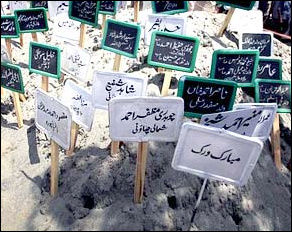
Graves of Martyrs“We are all under threat. They will kill us. They will kill us,” claimed Rubina Saigol, repeating the conversation with members of the Ahmedi community a few months ago. Saigol, an independent social researcher, said that the community members wanted to show her some case files on Ahmedis and talk about the threats publicly.
“I feel guilty and terrible that I didn’t write – partly because of fear.”

But before Saigol could gather up any courage to take any action – the threats had become a reality.

On May 28, militants attacked two Ahmedi houses of worship in Lahore, which resulted in the tragic death of more than 80 people and left more than a 100 injured. Within days, other militants attacked Lahore’s Jinnah Hospital where the injured were still recovering from the first attack.

The Ahmedi massacre has left everyone in shock and the Ahmedi community crippled with grief.

The Ahmedis have struggled for rights within India, Pakistan, Bangladesh, Egypt, and Indonesia for many years.

Although the majority of the Pakistani population is Sunni – there is a growing percentage of people who are seriously questioning the Sharia laws and the constitution. The trend can be followed on local blogs and even the op-ed pages of local newspapers – the rhetoric challenges Sharia laws against the basic rights of a citizen.

Pakistan’s Sharia laws are based mainly on the Hanafi school of thought.

According to Sharia Law, an Ahmedi cannot be accepted as a Muslim or as part of an Islamic sect because one of the basic fundamentals of Islam is to accept Prophet Muhammad (pbuh) as the last prophet in Islam – in Quranic verses he is referred to as the “Final Seal” (al-azhab:40).

In several interviews with religious scholars, from Sunni and Shia schools of thought in Cairo and Q’um in Iran agreed that Ahmedis were not a Muslim sect. They went as far as calling them, “heretics” and “infidels.” As well as, if a non-Muslim shows and preaches under a Muslim façade, then he or she must be charged, proven guilty, and punished in court according to Sharia law, a crime which is punishable by death (wajib-ul-qatl).

But one of the scholars in Cairo, who requested to stay anonymous, was quick to add that if a non-believer is a citizen of an Islamic state then he or she becomes the zami (responsibility) of the state. Therefore, it is the state’s responsibility to protect them more than the Muslim citizen, out of fear for violence against them.

“They should be treated with the utmost respect, because we, as Muslims, need to set an example for them,” he said. “As a Muslim, your responsibility is to follow the basics of Islam and lead a good life – violence of any type against anyone is not an example of leading a good life.”

This one scholar, who remains anonymous out of fear for the repercussions he could face, is not alone.

As soon as the attack hit the news, blogs went up everywhere in an uproar; some immediately condemned the brutal attack, others wrote malicious comments about Ahmedis claiming them to be wajib-ul-qatl (deserving of death), and some tried to explain the causes of the attack through religious, political and social analyses.

On the blog pkpolitics there were many harsh comments and the owners of the blog removed those comments and posted a warning to respondents on abusive language.

One of the more kinder comments on pkpolitics was, “Brother, The Qadyani religion should not be even be called ‘Ahemdi religion’, for you know that the Last Prophet Muhammad is exclusively mentioned by the name ‘Ahmed’ both in the Holy Quran and in the Bible (sic).”

Another respondent scolded back, “I cant believe my eyes, Instead of completely condemning the attack and humiliating the attackers, some are debating on the words used and about Qadyani sect or religion whatever…. no wonder Pakistan is heading towards its doom day by day… shame on us (sic).”

Tazeen Javed, winner of Best Humor Blog category for Pakistan’s first Annual Blog Awards, blogs at A Reluctant Mind wrote, a social aspect of the attack holding everyone accountable, event the public, for the attack in “We all have blood on our hands.”

The Waking Life blog posted, “Is it all worth?” questioning Muslims who asked for tolerance in other parts of the world, wrote, “Time to put things in perspective…Facebook may have partaken in blasphemy but there’s plenty of it going on in our cities and society. How about cleaning our own house first? (sic)”

The popular and controversial blog, Café Pyala, which sometimes uses profanity, condemned the attack in the political analysis “Original Sin:” “Truly, if ever there was short-sightedness among Pakistan’s establishment (and there are plenty of examples of it) this was it…The nurturing of extremist thought during Zia ul Haq’s (mis)rule and its repercussions in the shape of today’s barbaric attacks (and earlier targeting of Shias, Hindus and Christians) are a logical continuation of the original sin. (sic)”

Most editorials and columnists for print media did not have to directly respond to profanity like some online media blogs, however they condemned the attack, pointing out the government’s blatant disregard for protecting minorities, and feeding a culture of bigotry.

The Dawn editorial “Culture of Intolerance” wrote, “Religious minorities in Pakistan have not only been shunted to the margins of society but also face outright persecution on a regular basis…the state, meanwhile, remains largely unmoved by the plight of minorities — and that isn’t surprising either for it is a party to this persecution.”

Columnists did not try to hide the humiliation the government as well as the public should feel over the attacks.

Columnist Kamran Shafi, who writes for Dawn, wrote in A sad place, indeed that he recalled a time when there was no religious distinction, just Pakistani citizens. He stated, “The Ahmedis might be considered non-Muslim by the state; surely they are still Pakistani?”

Shafi added that an important member of the Ahmedi community told him that the compensation that was offered to the victims of the attack would be kindly refused and asked to be transferred over to the people of Hunza-Gojal for the relief work.

These voices of different generations and backgrounds of growing tolerance are currently at a grass-roots level, but they can still be heard, even in some political circles.

On the day of the attack, Punjab’s Chief Minister Shahbaz Sharif held a press conference addressing the attack and the efforts of the police. Even though his offices had received reports on a threat to the Ahmedis several days prior to the attack.

While soon after the attacks, Interior Minister Rehman Malik was the only government official who personally went to visit the Ahmedi community to give condolences

Shahbaz Sharif has yet to visit the Ahmedi community since the attacks.

Although most recently, PML-N party leader Nawaz Sharif did condemn the attacks and named Ahmedis as “brothers” and “sisters.” Only for him to be threatened by religious leaders with an anti-Sharif campaign in the region.

If the public’s reaction has mobilised the government to react at all then it leads to the most important question: What is the next step?

Imam Shamsi Ali might have the answer.

“It is very difficult to accept the nature of the world we live in – part of this world is the freedom of expression. I oppose the idea (Ahmedi movement) but I cannot impose my ideas on anyone. I have no right to impose my ideas on anyone,” said Imam Ali.

Ali, who lived and studied Islamic Studies in Islamabad for seven years, is the leader for the 96th street mosque and runs the Islamic Cultural Center in New York.

“We need engagement. If we oppose those claims then we must have intellectual discourse. If we engage with Hindus, Christians, Jews, or Buddhists, then why cannot we talk to them?”

Ali, ultimately, feels that restricting the freedoms of a people is not the way of Islam, rather allowing people their freedom and showing tolerance is way for people to find the path to Islam.

Sadef A. Kully is a Reporter/Associate Producer for Dawn.com

©2010 DAWN Media Group. All rights reserved

Life after the attacks

Dawn.com Blog

Life after the attacks
   by GUEST on 06 14th, 2010 |

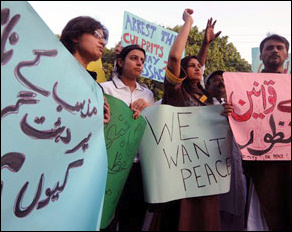
Protests against religious lawsLife in the neighbourhood, where two Ahmedi places of worship in Lahore were attacked by terrorists on May 28, goes on but under a shadow of fear.

The presence of gun-toting policemen and other community members (including the Ahmedis) guarding the gates of the places of worship in Garhi Shahu and Model Town’s C Block, indicates the level of fear in the neighbourhood. The Jamaat-i-Ahmedi centre, Darul Zikr is located on one end of Garhi Shahu and although bunkers have been placed in front of the main entrance, people are still terrified to enter.

The observance of the death anniversary of Dr. Sarfaraz Naeemi on Saturday (June 12) was a grim reminder of the terrorist attacks the area has witnessed in the past one year. Dr. Nameei, the principal of Jamia Naeemia madressah was killed on June 12, 2009 in a suicide attack at the seminary’s office. A section of the road leading to the madressah was cordoned off as police and volunteers frisked each person before allowing them to enter to pay their respects.

“We are sitting on gunpowder,” said Shahzad, the supervisor of Faizan Filling Station located near the main entrance of Darul Zikr. Shahzad said the filling station remained safe during the attack because of pure luck. “But I shudder to think the extent of damage the fuel station could cause if it came directly under attack,” he said.

Sales have declined considerably as people avoid coming near the vicinity of Darul Zikr, mindful of another potential attack. “We have no choice because this is our source of livelihood.”

Malik Mehmood owns a rent-a-car business in a plaza across from Darul Zikr. Mehmood was witness to the attacks and claims how apprehensive everyone in the community has become. Usman lives in the street adjacent to where the attacks took place. According to him, people are now using alternate routes to avoid going near Darul Zikr. He said fear escalated particularly on Friday June 11, as the Ahmedi community gathered for prayers. “The street remained deserted almost the entire day,” he said.

Those living within the barricaded streets are subjected to scrutiny by armed guards at the street entrance. Faqir Mohammad, a chowkidar at a house adjacent to the place of worship, talked from behind a small window in the huge gate but before doing so, he carefully scrutinised this reporter. “We are safe here,” he said. “Our children do not go out.” he snapped. In the background, a few guards with guns could be seen.

An employee (wishing to remain anonymous} of an office set up in a house at the corner of the street said that the police allowed entries to the company vehicles whose registration numbers they knew. He wondered whether life was safe anywhere else in the city – Lahore has been subjected to at least four terrorist attacks (safe houses of security agencies were the earlier targets) in the past year.

The place of worship in Garhi Shahu is located next to huge parks (between blocks C and D). But the attacks have not deterred the children from playing; matches were being held on the two cricket grounds and preparations were underway for a football game in the third ground when this reporter visited the area.

“Yes, these are hard times. But life must go on, we cannot continue living in fear,” said the gardener of the football field.

Intikhab Hanif contributed for Dawn.com

©2010 DAWN Media Group. All rights reserved

Saturday, June 12, 2010

Clarification — 86 Ahmadis died in the Lahore attacks

Ahmadiyya Muslim Jamaat International
12th June 2010
PRESS RELEASE

Clarification — 86 Ahmadis died in
the Lahore attacks
Pakistan’s High Commissioner to the UK came of his own volition

In a Press Release issued by this office on 7 June 2010 it was stated that Pakistan’s High Commissioner to the UK, Mr Wajid Shamsul Hasan visited the Head of the Ahmadiyya Muslim Jamaat, Hadhrat Mirza Masroor Ahmad on 2nd June 2010 to offer condolences over the Lahore terrorist attacks.

Subsequently a report was published by a particular news organisation that Hadhrat Mirza Masroor Ahmad had ‘summoned Pakistani delegates to his office in London’. For clarification purposes it is noted that the High Commissioner came of his own volition and his visit was appreciated by His Holiness.

It is also clarified that in a Press Release issued by this office on 30 May 2010 it was stated that 94 Ahmadis were killed in the Lahore terrorist attacks. It later emerged that the number of deaths were fewer and so it is now hereby confirmed that 86 Ahmadis died in the Lahore attacks. Currently there are still a few who remain injured in hospital but thankfully none are considered critical at this time.

22 Deer Park Road, London, SW19 3TL UK
Tel/Fax: 020 8544 7613 Mob: 077954 90682
Email: press at ahmadiyya.org.uk
Press Secretary AMJ International

Thursday, June 10, 2010

Plight of the Pakistani Ahmedi: a timeline

Dawn.com Blog
.
Plight of the Pakistani Ahmedi: a timeline
    by SADEF on 06 10th, 2010 |

The persecution of Ahmedis is deep-rooted and dates back to pre-Partition India. Even so, the massacre in Lahore on May 28 was one of the worst in the history of the Ahmedi Movement since 1953. Here is a timeline of important events that took place since the beginning of the Ahmedi Movement:

March 1889: The Ahmedi Movement, founded by Mirza Ghulam Ahmad, began in northern India in the city of Qadian, and spread across northern India (including present-day Pakistan’s Punjab province).

1890: In Delhi, religious scholars sign a fatwa against Mirza Ghulam Ahmad and his beliefs.

May 1908: Mirza Ghulam Ahmad, founder of the Ahmedi Movement, passes away.

October 1947: Muhammad Zafrulla Khan, an Ahmedi who was influential during the separation, became Pakistan’s first Foreign Minister. Khan went later onto become the first Asian judge to sit on the International Court of Justice at the Hague.

March 1953: Post-Partition, the backlash against Ahmedis became violent in Pakistan. Riots broke out in Lahore after the leader of Jamaat-e-Islami Maulana Abul Ala Maududi, criticised the Ahmedi movement. As a result, an estimated 300 people died and a disputed number were injured, and martial law was imposed in Lahore for 70 days to stabilise civil unrest.

1954: The Munir Report – a historic state-run investigation stirred by the riots – concluded that if the state left the decision of who is or isn’t a Muslim than according to the ulemas and fatwas, every citizen would be declared a non-Muslim.

1962: Religio-political groups gained ground when the ulema and Advisory Council of Islamic Ideology added a clause in the constitution, which stated that no future and existing laws should contradict the teaching and requirements of the Quran and Sunnah.

1974: In a response to the backlash from religious groups and pressure for votes, Prime Minister Zulfikar Ali Bhutto’s regime amended the constitution to include the definition of a Muslim and listed groups that were consider non-Muslim, explicitly listing the followers of the Ahmedi Movement as non-Muslims.

1979: Dr. Mohammad Abdus Salam, an Ahmedi and a Pakistani citizen, won the Nobel Prize for Physics for his work on the Electroweak Theory. Dr. Salam became instrumental for Pakistan’s nuclear plants as well as outer space projects. After Dr. Salam passed away his tombstone which had “Muslim” carved in it was scratched out by officials.

April 1984: The constitution was amended yet again when President Zia-ul-Haq included the full Sharia Law. Ordinance XX included restrictions on religious minority groups. Ahmedis were restricted to: the misuse of epithets, descriptions, titles, etc reserved for certain holy personages or places of Islamic origins. Ahmedis could not call themselves Muslim or propagate their faith – these practices were punishable by death, life imprisonment, and a fine. The public was also refrained from referring to Ahmedis as part of a ‘Muslim sect’ or their places or worship as ‘mosques.’ If a person was found guilty, they could serve up to three years in prison and pay a fine.

1993: Ahmedis who were charged with blasphemy appealed the law eight times but the court maintained that Sharia Law was to be upheld, and even likened them to notorious writer Salman Rushdie.

April 1995: In the town of Shab Qadar in Peshawar, two members of the Ahmedi community were stoned – one of whom died, the body was stripped and dragged through the town, while the second was critically injured – all while the police watched the debacle with the rest of the town.

October 2000: Gunmen opened fire during prayers; five worshippers were killed as several others were injured.

October 2005: Eight people were killed and 18 injured when three men on motorbikes opened fire on them as they were offering prayers. Two of the attackers entered the place where prayers were being offered and sprayed the 26 worshippers with bullets.

June 2005: All Ahmedi students expelled from a medical college in Faisalabad. Dr. Asghar Ali Randhawa, Principal of Punjab Medical College rusticated all Ahmedi students, 15 female and eight males, from the college as well as hostels.

September 2008: “Aalim Online,” a show hosted by Aamir Liaqat Hussain on GEO TV, incited religious hatred and violence against Ahmedis along with two guest panelists, Maulana Mohammad Ameen and Dr Saeed Inayatulla, who referred to members of the Ahmadiyya community as kafir (infidel) and maintained that anyone who holds beliefs as Ahmadi Muslims is wajib-ul-qatl (deserving of death). As a result, religious zealots murdered two eminent leading members of the Ahmedi community.

May 2010: Militants attacked two Ahmedi places of worship during the Friday prayer service. According to government officials the death toll was 80, while the Jamaat-i-Ahmadiya Pakistan spokesman put the toll at 95. More than a 100 parishioners were injured.

Sadef A. Kully is an Reporter/Associate Producer for Dawn.com.

©2010 DAWN Media Group. All rights reserved

We decide whether you’re Muslim or not

The Economist
Thursday
June 10th 2010
Asian politics - Banyan's notebook
We decide whether you’re Muslim or not
Jun 10th 2010, 8:26 by Banyan

ON MAY 28th, during Friday prayers, two squads of gunmen entered a pair of mosques belonging to the Ahmadis, a minority Islamic sect, in Pakistan’s eastern city of Lahore. Methodically, they emptied AK-47s into the assembled worshippers, lobbed grenades and exploded suicide vests. Their rampage has claimed 95 lives to date. Our Pakistan correspondent writes about the perpetrators, the Punjabi Taliban.

The deaths were shocking, but so was the response by officialdom, the media and the public. Yes, the attacks aroused a deal of concern in Pakistan. Lahore, after all, is the Punjabi capital and Pakistan’s cultural heart, a place of sophistication far removed from the country’s lawless frontiers, where extremism tends to have its breeding ground.

Yet the concern was palpably not for the Ahmadi victims. Politicians have shunned the bereaved. Punjab’s chief minister, Shahbaz Sharif, has not shown his face at either mosque, despite living down the road from them. Admittedly, an admirable trio of women in parliament pushed through a motion abhorring the attacks, but it only just squeaked through, and that because it was hitched to another motion condemning Israel’s deadly commando raid on the Gaza aid convoy.

On television, pundits have failed to call for solidarity with the beleagured Ahmadi community, who number 4m-odd in Pakistan. At street protests called in Lahore, Karachi and Islamabad, meagre numbers showed up. To understand better what a fellow journalist, Declan Walsh of the Guardian, calls a conspiracy of silence, I joined the Ahmadis for their Friday prayers exactly a week after the attacks, at the Darul Zikr mosque that bore the brunt of the violence.

I had been invited by Shahid Ata-ullah, an active Ahmadi elder with the pep and twinkling energy that comes with being a retired Pakistani military man. I had met his daughter earlier that week at dinner in Islamabad. She told me how sick with worry for her father she and her family had been, as the story of the attacks unfolded live on television. But a week later Mr Ata-ullah could chuckle about it. “When I came out and checked my phone, I had 103 voice messages! Could be something of a record, eh?”

At the mosque most evidence of the carnage had been cleaned up. There remained only a few pockmarks on pillars and a pile of mangled metal in the courtyard, the remains of a door by which an attacker had detonated his vest. By the look of things, nothing much might have happened.

Most striking was the community’s outward calm. Young Ahmadis frisked the worshippers, admittedly more thoroughly than usual, as they entered the mosque. A dozen men stood silent guard about the compound, armed with submachine guns against repeat attacks; every one of the guards had lost a father, brother or son. Mr Ata-ullah embraced one young man, the son of the late leader of Lahore’s Ahmadis, Munir Ahmad Sheikh, who had been shot as he led the prayers. Just a few months ago Mr Sheikh had sat down with one of my colleagues and explained how anti-Ahmadi thuggery was on the rise. Very quickly it was clear to me that this was a community not just used to persecution, but determined to continue their faith in the face of it.

The Ahmadiyya Muslim Community was founded by a 19th-century cleric, Mirza Ghulam Ahmad, who claimed divine revelation in restoring a corrupted Islam to a purer form. His revivalist teachings were an eclectic mix of Sufism and other Islamic and Christian elements. His claim to be a prophet sent by God, albeit not a “law-bearing” prophet, has enraged more orthodox Muslims. Ahmad was also convinced that Jesus survived his ordeal on the cross to die at a ripe old age–in Kashmir. This also challenges orthodox Islam, which holds that Jesus was raised alive to heaven.

Reasonable men ought to be able to differ. (I confess, so strike me God, that my early Roman Catholic catechism of Jesus’s crucifixion, burial and resurrection seems no less implausible than the Kashmiri version.) But from the start, of all Islam’s many sects, Ahmadis have been singled out for persecution.

Worse, from the 1970s the Pakistani state has officially sanctioned it. In response to anti-Ahmadi riots in 1974 parliament passed a constitutional amendment to define what it was to be Muslim. Ahmadis were pointedly excluded. Then in 1984 General Zia ul Haq, Pakistan’s Sunni dictator, amended the laws again. Henceforth Ahmadis were prohibited from professing their faith, and banned from “indirectly or directly posing as a Muslim”. In other words, even saying asalaam aleikum was out of bounds, though Pakistan has no other common greeting.

Ahmadis henceforth could not call the faithful to prayer. They could not display Koranic inscriptions. They could not build new mosques, repair old ones or even refer to their “mosques” as such–they were now “places of worship”, if you please. Indeed belief in the prophethood of Mirza Ghulam Ahmad itself was blasphemous, because it defiled the name of the Prophet Muhammad–a capital crime.

Ali Dayan Hasan of Human Rights Watch points out that while the government persecutes Ahmadi–some 400 Ahmadis have been charged in the past decade–it rarely brings cases against the perpetrators of anti-Ahmadi violence. In Lahore when I was there, banners flew from some of main thoroughfares proclaiming death to the “Qadianis”, a derogatory term for Ahmadis. The Punjab government of Mr Sharif refuses to pull them down, on the grounds that removing them might generate an “adverse reaction”.

Mr Ata-ullah and colleagues–gentle, cultured men–can laugh at what they call the “mischief of the law”, the multiple absurdities of their persecution. Mr Ata-ullah points to an engraving of the Kalima that the government has crudely boarded over. Anywhere else, covering up that profession of the Muslim faith would be a shocking act. The Ahmadis maintain thick volumes that keep a tally of the persecution. In one instance, the entire Ahmadi population of nearby Rabwah town, about 60,000 people, was booked for dressing up smartly and distributing sweets to children on the centenary of the community’s founding.

During the first Friday prayers after the massacre, there was no sign of anger at the perpetrators, nor of self-pity. But as the worshippers knelt with their heads to the ground, a low keening like the sound of a rushing wind ran through the mosque, and shoulders suddenly shook in grief. “In our prayers we always weep,” Mr Ata-ullah said afterwards. “The milk does not rise in the mother’s breast until the baby cries. Before Allah we must cry like babies if we want his blessing. We cry like a whole pot on the boil.”

© The Economist Newspaper Limited 2010.

Tuesday, June 8, 2010

Foreign-made arms used in attacks on Ahmedis

Daily Times, Pakistan
Tuesday, June 08, 2010

Foreign-made arms used in attacks on Ahmedis
AK47
*
Investigators shifting focus to imported weapons’ suppliers active in provincial capital
By Shahnawaz Khan

LAHORE: Investigators probing the terrorist attacks on the worship places of the Ahmedis have discovered that all the weapons and ammunitions used in the attacks were foreign made, sources told Daily Times on Monday.

Following the discovery, the investigators have turned their focus on imported weapons’ suppliers in the provincial metropolis, sources said, adding that the investigators were collecting information on the suppliers of AK-47s, its ammunition and hand grenades.

“Besides that, the personnel are also collecting information and questioning a large number of people who are or have at any time been involved in the business of importing weapons,” the sources said, adding that reports of forensic experts confirmed that the terrorists had used Indian-made hand grenades and Russian-made AK-47s.

“Only a few dealers, around seven, in the provincial metropolis are in the business of selling Russian-made AK-47s and its ammunition,” the sources said.

However, the sources said that it was disclosed during investigations that some people are also involved in supplying Israeli-made weapons, adding that the trade of Israeli-made weapons was actively being conducted in Lahore since the last few years.

“Now the personnel are questioning few history sheeters, who were involved in the illegal supply of imported weapons from provincial metropolis to other parts of the country,” the sources added.

It is worth noting that it was disclosed in March that a few gangs in the provincial metropolis were partaking in the illegal trade of imported weapons. This was disclosed after the arrest of a weapons’ smuggler, who supplied imported weapons from Lahore to other cities. Law enforcers nabbed the head of an inter-provincial gang, Muhammad Naeem Khan, who was exporting foreign-made weapons from Lahore to other parts of the country. During investigations, the arrested Naeem confessed that some other weapons’ dealers in Lahore were also involved in the trade.

Following such links, the law enforcers who were investigating the attacks on the Ahmedis’ worship places shifted their focus to weapons’ dealers who were involved in the business of importing weapons, especially those that were Indian and Russian made.

According to the sources, investigators had also taken into account reports – compiled by the Special Branch a few months earlier – on the illegal weapons’ trade being carried out in the city. The reports had revealed that weapons’ dealers were using Lahore as a launching pad for the distribution of illegal weapons to other parts of the country and they are using small railway stations in the city’s outskirts, Lari Addahs and Truck Addahs for smuggling weapons.

Monday, June 7, 2010

High Commissioner offers condolences to Head of Ahmadiyya Muslim Jama'at

Ahmadiyya Muslim Jamaat International
7th June 2010
PRESS RELEASE

High Commissioner offers condolences to Head of Ahmadiyya Muslim Jama’at
Pakistan’s long term well being was honesty and justice

Pakistan’s High Commissioner to the UK, Mr Wajid Shamsul Hasan visited His Holiness, Hadhrat Mirza Masroor Ahmad at the Fazl Mosque in London on 2nd June 2010 to offer his condolences for the terrorist attacks that took place at two Ahmadi Mosques in Lahore on May 28.

During the forty minute meeting the prevailing political situation in Pakistan was discussed. His Holiness commented that all the attacks taking place in Pakistan were a direct result of mixing religion with politics. He expressed a hope that some leaders in Pakistan would stand up to the fanatical extremists who were the cause of so much pain and suffering in the country.

His Holiness also expressed the need for electoral reform so that all minorities had the right to vote freely and without discrimination. The Ahmadiyya Muslim Jamaat did not seek any special or favourable treatment, merely that its citizens were afforded their basic civil rights.

His Holiness said the key to Pakistan’s long term well being was honesty and justice. If those in power adopted these attributes then Pakistan could still emerge from its current anarchic state and move towards prosperity. His Holiness commented with regret that despite Pakistan having vast resources it was unable to look after the needs of its own people and so the gap between the rich and poor was ever increasing.

The meeting ended as His Holiness thanked the High Commissioner for taking the time to come and express his condolences and regret.

Mr Mohammed Nafees Zakaria the Consul General also attended the meeting.

22 Deer Park Road, London, SW19 3TL UK
Tel/Fax: 020 8544 7613 Mob: 077954 90682
Email: press at ahmadiyya.org.uk
Press Secretary AMJ International

Pakistan’s Ahmadi killings and the conscience of a nation

Reuters Blogs, USA
Pakistan: Now or Never?
Perspectives on Pakistan
Pakistan’s Ahmadi killings and the conscience of a nation
Jun 7, 2010 14:23 EDT

The fierce debate about the nature of Pakistani society triggered by the killing of more than 80 Ahmadis in two mosques in Lahore last month continues to run and run.

Much of the discussion is about why the government had failed to stop the religious right from preaching hatred against the Ahmadis, who are considered non-Muslims in Pakistan because they revere their 19th century founder Mirza Ghulam Ahmad, breaching – according to Pakistani law – a requirement that Muslims accept the finality of the Prophet Mohammad.

While authorities had been willing to shut down Facebook over a competition to draw the Prophet, it had not dared take action to remove banners preaching hatred against the Ahamdis, fearing a backlash from the religious right, Dawn newspaper complained in an editorial.

In a chronicle of deaths foretold, Professor C.M. Naim tracks the earlier killing of an Ahmadi, a retired teacher, in January in the town of Ferozewal. In an article in India’s Outlook magazine (h/t Chapati Mystery) he notes that not only did the police fail to take adequate action against the man’s killers, but also that the media paid very little attention, barring one persistent reporter. He also reproduces a picture of a huge billboard in Ferozewal preaching hatred against the Ahmadis.

“Judging from the image, the sign must have dominated the roundabout where it was set up to exhort the 97.21 percent of Ferozewala’s population against the unfortunate 0.25. It had stayed up for weeks. Thousands, including any number of men with power and authority, saw it but chose to do nothing. Finally a retired schoolteacher victimized by the sign and fearing worse approached the police for relief. A few days later, he ended up dead,” he writes.

He adds: “The following too went unnoticed:
On January 14, an Ahmadi mosque built in1982 near Rabwah was taken away from them by court orders and handed to anti-Ahmadis, “in order to pre-empt extreme law and order disturbances”.
On January 28, a court at Vehari, Punjab, sentenced three Ahmadis to imprisonment and fines on trumped up charges of preaching their religion to “simple Muslims”.
On February 3, an Ahmadi was similarly killed at Shehdadpur, Sindh.
On April 1, three Ahmadi traders were ambushed and killed near Faisalabad.

“Then, on May 28, 2010, in well-organized attacks on two Ahmadi mosques in Lahore, just a few miles away from Ferozewala, more than 90 Ahmadis were killed and scores wounded. We can only hope it was the worst such incident, for unfortunately it was not the last. On June 1, just three days later, the Daily Times reported another killing: an Ahmadi man was stabbed to death in his home and his son seriously wounded in Narowal, Punjab. The assailant, who reportedly threatened not to leave any Ahmadi alive, escaped.”

“Here’s a question,” writes Nadeem Paracha at Dawn. “How come whenever there’s a drone attack … or a case of perceived obscenity or blasphemy surfaces, street corners are at once filled with burqa-clad women and bearded men chanting slogans like ‘Death to infidels’? But none of these fine, sensitive Muslims can be seen protesting when there’s an attack on innocent civilians —Ahmadis or others — by the extremists?”

Former Prime Minister Nawaz Sharif, whose brother Shahbaz Sharif is chief minister of Punjab province where the killings took place, this weekend spoke in defence of the Ahmadis, calling them ”our brethren and an asset of the country”, according to The News. The Sharif brothers in the past have been accused of sympathising with the Islamists and were criticised after newspapers published pictures of the law minister in Punjab – who is loyal to the two – campaigning in a by-election in February with leaders of the outlawed sectarian Sipah e Sahaba.

The post-mortem on the Ahmadi mosque killings is now turning into a bigger discussion of whether secular liberals have any real influence on Pakistani society as it grows more religious and conservative.

“The problem is that there aren’t nearly enough of us for this to matter,” complains the blog Five Rupees. “There are a few scattered in the blogosphere and Twitterverse, and a couple of columnists for Dawn, and the Daily Times editorial board, but that’s it. There are, functionally speaking, no liberals in Pakistan. Oh, there’s plenty of scotch-drinking social liberals (think Salman Taseer). But liberalism and progressivism is not about drinking scotch or wearing jeans. Liberalism is about equality and freedom and personal choice and rationality and the privileging of the individual, and no one believes in those things.”

“We’ve been talking about the dangers of militancy for a long, long time — well before 9/11. That no one bothers listening is not an indictment of the “failed politics of Pakistani liberals”. It’s an indictment of everyone else. If mainstream Pakistan wants to ignore us, fine, that’s their prerogative. But don’t blame us when shit goes bad.”

And in Britain’s Guardian newspaper, Mustafa Qadri notes that more and more Pakistanis are turning to prayer given the failure of the state to provide a credible, secular alternative.

“Uncertainty is an inherent part of the human experience, but in Pakistan much of what a reader in Britain might take for granted is far from certain. How long will the electricity last today? Where will the next bomb go off? And, for most who do not inhabit my privileged world, will I be able to afford the right medication if I fall ill? The profound loss of control felt by long-term illness sufferers and their loved ones has become a countrywide phenomenon in Pakistan.

”The situation has exacerbated our cultural tendency to avow causation in favour of fate and the rewards of prayer. Whether looking for a job, waiting anxiously for exam results or willing the national cricket team to victory, prayer has become a kneejerk source of solace and comfort in difficult times. Holy men, or pirs, and local soothsayers have for generations made a career out of selling their prayers to those in need.

“And why not? Doing the right thing, like expecting to get a plum job without working family contacts, rarely seems to lead to results in our country. During my travels I have met several academically bright students from middle-class backgrounds who complain they cannot get into top university courses because wealthier classmates have paid to gain entrance. The experience for the millions below the middle class, who could never dream of a university education, is even more dire.”

At the very least, the killings of the Ahmadis has prompted a real discussion about the direction Pakistan is headed in. And even, some poetry. One day, looking back, it may well be seen as a turning point.

Dangerous Repurcussions of Relgious Extremism in the Punjab

The Huffington Post, USA
June 7, 2010
Saad KhanSaad Khan
Freelance journalist and activist from Islamabad.
Posted: June 7, 2010 04:50 PM
Dangerous Repurcussions of Relgious Extremism in the Punjab

More bloodshed that claimed the lives of more than 95 innocent worshipers. It has become an unfortunate reality in Pakistan to see attacks on mosques and places of worship. In fact, it is not just the last nine years that Pakistan has seen a cataclysmic increase in religious violence. Interestingly, religious violence waned after 9/11 and the subsequent Afghan invasion. The Taliban started hitting innocent civilians without even thinking once about their caste, creed or religion. Shopping centers, hotels and bus stops became their primary targets. Although the number of attacks — and subsequently causalities — rose to an an unprecedented level, there was little hint of victimization of any single religious group, or minority.

This impartiality of the Taliban — and their associated groups — has seen a major dip in recent years. There could be many reasons for that but the joining of Punjab-based sectarian groups, who were wielding immense support from the ISI during the Kashmir Jihad, in the Taliban ranks has exacerbated this problem.

Sectarian violence is not a recently emerged issue in Pakistan. It is now an open fact that sectarian groups started slitting the throats of their rival factions during the dictatorial rule of General Zia ul Haq. Saudi Arabia and Iran also jumped into the fray with their covert — and open — support of the Sunni and Shiite extremist groups, respectively.

Violence between these two factions took a turn for the worse in the 1990s when they started attacking each others’ mosques. That was the first time when mosque committees started hiring guards for protection; government provided police guards in large places of worship.

Violence against the Ahmadis, however, was not that blatant up until now. They are, of course, subjected to grave discrimination and are treated with contempt but only 109 people had lost their lives (Link in Urdu) before this attack since the declaration of the Ahmadi sect as non-Muslim in 1974, by the secular Bhutto government.

Now the total Ahmadi casualties are in between 160 and 180 as many dead in the recent attacks were policemen and bystanders and thus not from the community. If compared with the casualties between the warring Sunni-Shiite factions in Pakistan, this figure is minuscule. However, if compared with the total population of Ahmadis in Pakistan — at 0.22% — this death toll is astounding.

Ahmadis have remained a peaceful minority in Pakistan and have not taken up arms. Chances of them turning to the guns are still low despite this carnage. The repercussions of this attack, however, can be great with a serious fallout. These attacks will encourage other militant groups to attack the Ahmadis. Thus a minority, which is already living on the fringes with threats of violence, and people who are regularly subjected to tyrannical blasphemy laws, will be hard pressed to retaliate.

Punjab remains the center of most religious attacks and it also serves as the operational nerve center of sectarian groups. Christians, who are living relatively peacefully in Karachi and Islamabad, are subjected to harassment and blatant discrimination in the Punjab. Violent attacks are not uncommon and church burnings are not unheard of.

One wonders why these attacks are mostly concentrated in the Punjab when all provinces have Muslim majority populations. The answer lies in the blatant Islamization carried out by extremist organizations. They have instilled this false notion among common Punjabis that they are the protectors of Islam and Pakistan. Interestingly, the same notion is present among the Punjabi middle classes that constitute the major chunk of Pakistan’s armed forces. A blatant hatred for India and a delusion about the grandeur of Islam and them being its protectors has muddied the political and religious landscape in the province, and in Pakistan.

The same mentality resulted in Punjabis condoning the brutal military operations in Balochistan and before that, in Karachi and Sindh. Pakistani army merely reflects this notion of silencing every voice that it deems as a threat to Pakistan, without analyzing the parallels between treason and political repression.

Nawaz Sharif, the ex prime minister and the most popular opposition leader, has not said anything concrete against the rising militancy. His power base is in the Punjab and his reluctance to tackle the militancy and sectarian issue raises serious doubts about his policies. His party is already in power in the province and has failed to do anything about this issue. They are in cahoots with the militants? Nobody knows but yes they are afraid to stir up this hornet’s nest.

There needs to be something done about this false notion of superiority and the acceptance of militant organizations. Nawaz Sharif, who many say is counting his days to become the next PM of Pakistan, needs to tackle this issue without hesitation. There is already enough hatred of Punjab in other provinces and in Balochistan, Punjabis are being attacked. These innocent Punjabis, who are working as teachers, doctors and nurses, are victimized because an average Baloch thinks that they are responsible for his destitution. In actuality, it is the political leadership of Punjab, and more importantly, the military leadership that is responsible.

It is high time that both issues should be dealt with accordingly. Military leadership needs to stop political maneuvering and military operations in Balochistan. There is also a need for equal representation of other ethnic groups in the officers’ cadre of the armed forces. Similarly, it should start operations against the militant organizations in the Punjab, which it is hesitant to do so.

As for the political leadership of the Punjab, they need to educate their supporters to embrace and not disgrace. Blasphemy laws need to be repealed and religious organizations need to be reined in if they really want to stop this violence. Otherwise, we all are sitting on a volcano that is about to explode.

Saturday, June 5, 2010

Investigators suspect police of helping Ahmedis’ attackers

Daily Times, Pakistan
Saturday, June 05, 2010

Investigators suspect police of helping Ahmedis’ attackers


* Terrorists carrying weapons bypass police to reach targets

By Shahnawaz Khan

LAHORE: Investigations into the Garhi Shahu and Model Town attacks have taken an important turn after information gathered during the interrogation of the arrested terrorist, Muaaz, and clues from various sources, Daily Times has learnt.

Sources said following the information, investigators now suspect police officials and officers deputed at both worship places of the Ahmedis and have started monitoring them as well. Investigators believe certain police officials are acting as facilitators to the terrorists, which is the reason they have been moving around with such ease during the recent attacks.

They said during interrogation, Muaaz revealed that their high command had directed them to work under one Rana, adding that Rana was the one who had led them during the Friday attacks.

Muaaz further revealed that Rana left him and his accomplices a few yards from the worship place in Model Town and told them he will return soon. He said Rana returned in less than 10 minutes and was carrying two sacks full of weapons on his motorcycle, which he handed over to them with the directions to start the operation.

The sources added that during investigation, it was also ascertained that a man named Hafeez had dropped the terrorists at the Garhi Shahu worship place and gave directions the same way, however, Hafeez returned with weapons after more than 20 minutes.

The sources question the role of police officials, considering that the terrorists commuted to and from the target places in such a less time and with such ease, bypassing several police pickets on their way.

The investigation also revealed that during the Jinnah Hospital attack, terrorists used only one entrance to barge in the ICU – one that opened in front of the hospital’s SDO’s office, the sources said. It was also revealed that as soon as the terrorists entered the ICU, they started firing indiscriminately, while a nurse switched off the lights and hid under a bed and informed the police.

Darkness misguided the terrorists, however, security guards accompanying a politician present in the hospital retaliated, due to which one of the terrorists received a bullet injury in his leg.

After the “action”, the terrorists fled from the same entrance they had entered from. Two of the four terrorists, including the injured one, left the hospital from the main gate, while the remaining jumped over the hospital’s iron bars and fled. The sources added that the investigators are also trying to ascertain who had washed the bloodstains of the injured terrorist from the road.

Thursday, June 3, 2010

Five steps to sanity

Daily Dawn, Pakistan
Columnist
Five steps to sanity
    By I.A. Rehman
    Thursday, 03 Jun, 2010

The moment the custodians of state power start treating some of the people as second-class citizens they push the latter into a high-risk alley. - Photo on file

The priority demands of sanity (dictionary meaning: reasonable and rational behaviour) are determined by the challenges a society faces. Today Pakistan’s supreme need is the adoption of a rational response to the menace of extremist elements operating, without due sanction, under the banner of belief.

The horrific dimensions of last Friday’s carnage in Lahore can be judged from the fact that even those who never take notice of atrocities against the Ahmadi community as well as those who never protest against the militants’ excesses could not help feeling uneasy at the foul happening. What does sanity now demand from government and society alike?

The more than 90 Ahmadis wantonly cut down in their prayer houses were citizens of Pakistan entitled to the protection of their right to life. If they must be treated as zimmies in a supposedly Islamic state they had an additional reason to be protected by the state and the people. The assault on their prayer houses was not wholly unexpected; the authorities had been aware of the activities of the professional Ahmadi-bashers and their threats for months.

The first step towards reasonable and rational behaviour is that the state must fulfil all three of its legal obligations, namely, a thorough investigation into the obvious failure to ensure security of the prayer houses, a relentless prosecution of the culprits, especially those that are routinely described by the police and the media as ‘masterminds’, and adoption of effective strategies for the protection of communities that are vulnerable because of their belief.

It is not possible to ignore the fact that the higher authorities directly answerable for the Lahore massacre, who normally rush to hospitals or private abodes of victims of relatively less horrible incidents, could not muster the courage to console the injured Ahmadis. Whether this was due to any sympathy for the militants’ creed or to a fear of attracting their hostility, the deviation from the routine points to the roots of discrimination and prejudice against the Ahmadis.

The extirpation of the deep-rooted bias against holders of beliefs different from that of the majority’s orthodoxy is the second essential step towards sanity. The moment the custodians of state power start treating some of the people as second-class citizens they push the latter into a high-risk alley.

The official explanation for not taking action against hate-preachers, some of whom are allowed privileges as rewards for spewing calls to murder and worse, is the fear of breach of peace. The same excuse is touted to explain failure to remove banners and posters that explicitly call for violence against the Ahmadis or other vulnerable groups.

A shopkeeper in a town near Lahore is free to present each of his customers an anti-Ahmadi poster. Tolerance of criminal mischief so as to avoid breach of peace has been formalised into a theory that is used to justify the Ahmadi-specific provisions of the penal code arbitrarily inserted into it by Gen Zia. The denial of Ahmadis’ right to hold meetings, especially their annual congregation, also is premised on this theory.

A critical review of this excuse has long been overdue. No such effort has been made because the victims, Ahmadis especially, are not considered entitled to enjoy their basic rights. But the consequences of overlooking mischief by some elements out of fear for their potential to cause disorder are now evident even to the purblind. Will no action be taken against gangsters who establish a state within the state because they might disrupt peace?

Most criminal acts fall within the definition of breach of peace. Must they go unchallenged? A state loses its title to wield authority if it blinks at criminal acts out of fear of repercussions of its intervention. The demolition of the theory of appeasing disrupters of peace is the third important step towards sanity.

The next step necessary for evolving reasonable and rational behaviour is elimination of discrimination on the basis of belief in practically all walks of life. This is going to be a long haul even after the state has acquired the will and the capacity required for the task, because this will involve not only a review of the 1974 amendment and the Zia ordinance XX but also the nature of the polity. What should receive immediate attention is the need to end the Ahmadis’ exclusion from political life.

When Gen Zia revived the apartheid-like scheme of communal voting the Ahmadis declined to register themselves as non-Muslims. Whatever one may think of that decision the result is that the Ahmadis have been out of the political mainstream. The most striking illustration of their disenfranchisement is the fact that they have no say in the affairs of their town, Rabwah, forcibly renamed Chenab Nagar, and the local body functions have been assumed by a minority of land-grabbers/officially patronised settlers occupying the fringes of the town.

The 2002 election law abolished separate electorates but under a totally illegal and anti-democratic decision the Ahmadis are still denied inclusion in joint/common electoral rolls. This discrimination must end as, among other things, it strengthens discrimination in services, in educational institutions, in housing even.

Finally, the fifth step to sanity demands a critical appraisal of the theoretical foundations of religious extremism. Tomes have been written on tolerance in general, and often perfunctory, terms. Many have devoted time and resources to talks on inter-faith harmony. But very little has been done to protect Islam against its manifestly wrong interpretation by the high priests of militancy. The advocates of the liberal traditions of Islam have been forced into exile or silenced otherwise. There is no intra-Islam discourse in Pakistan, not even to the extent it is going on in many parts of the world, including a few Muslim societies. The effort to rescue belief from the clutches of hate-preachers can be delayed only at the risk of grave peril to Pakistan.

Moving away, for the time being, from the on-again off-again and largely tepid plans to regulate the working of madressahs, a commission may be set up to probe the contents of the so-called religious publications, which are believed to account for three-fourths of all publications in Pakistan every year. The objective should be compilation of the material used to brainwash young boys and convince them of the urgency of not only killing Ahmadis, the Shias, and even Sunnis for sectarian or political differences, but also of treating attacks on hospitals as a holy mission on the route to paradise.

For a people who have allowed raw emotions to rule their minds for decades the trek back to sanity will be neither easy nor painless.

©2010 DAWN Media Group. All rights reserved

Wednesday, June 2, 2010

The Ahmadiyyas: Pakistan’s silent sufferers

Rediff News
The Ahmadiyyas: Pakistan’s silent sufferers
Last updated on: June 02, 2010 12:04 IST

The Ahmadis who were killed in a terrorist attack on two Lahore mosques last week were innocent people and by not raising our voice for their rights, we as a nation are collectively guilty of their murder, writes Mehmal Sarfraz from Lahore, in the first of her despatches from across the border

The people of Pakistan witnessed two simultaneous terror attacks in Lahore on May 28, 2010. Thousands of worshippers had gathered for Friday prayers at two Ahmadi mosques, ‘Baitul Noor’ in Model Town and ‘Darul Zikr’ in Garhi Shahu, when they were attacked by the terrorists donning suicide vests, wielding Kalashnikovs and hand grenades. More than 90 people lost their lives while hundreds more were injured. The most horrendous aspect of these twin attacks was that they both targeted the Ahmadiyya community, a religious minority that has suffered in silence for far too long.

The Punjab wing of the Tehrik-e-Taliban Pakistan claimed responsibility for the Friday attacks. In a text message sent to journalists, the terrorists warned that if the Ahmadis do not leave Pakistan, they should be ready to face death at the hands of the lovers of Prophet Mohammed (Peace Be Upon Him). It was a grim reminder of how the religious bigots have succeeded in promoting sectarianism and also pointed towards the vulnerability of the Ahmadiyya community in Pakistan.

A couple of months ago, a friend wrote something so strong on Twitter that it immediately caught my attention. She tweeted, ‘Three Ahmadis killed in Faisalabad on Thursday (April 1, 2010). They were ambushed by a car with multiple shooters and were shot at (presumably with semi-automatic or automatic weapons) more than 80 times. They died before reaching the hospital. Is this your Islamic Republic of Pakistan? I curse thee, I curse thee, I curse thee!‘ Chilling words indeed! And coming from someone who never loses her cool, it made me realise what a mockery we have made of the fundamental rights of citizens in this ‘land of the pure’.

The Ahmadis hold different views on the finality of prophethood from that of other Muslim sects. Muslims commonly believe that Prophet Mohammed (PBUH) is the last prophet of Islam while the Ahmadis believe that Prophet Mohammed (PBUH) was the last of the law-giving prophets in the tradition of Moses and Jesus. They believe that Mirza Ghulam Ahmad (1835-908) was an ‘ummati’ prophet (a subordinate prophet) and that he was the promised messiah and Imam Mahdi rolled into one. The Lahori Ahmadis believe that Mirza Ghulam Ahmad was just a religious reformer and not a prophet. Whatever the beliefs of the Ahmadis, the real issue lies with the clerics in Pakistan who have always had a problem with the Ahmadis for giving reverence to Mirza Ghulam Ahmad.

To understand the plight of the Ahmadis, we have to revisit the 1950s. Some Pakistani politicians and most religious parties took to the streets in 1953 leading to the anti-Ahmadi riots. They demanded that the Ahmadis be declared non-Muslims and the then foreign minister of Pakistan, Chaudhry Zafrullah Khan, be removed from office since he was an Ahmadi and the same should be done with other Ahmadis who held any key positions in the government. The government did not give in to these demands.

But all this changed in 1974 when Prime Minister Zulfikar Ali Bhutto, a secular and progressive man otherwise, declared the Ahmadiyya community non-Muslims. In an attempt to appease the Islamists, ZA Bhutto crucified secularism at the altar of political expediency by adding the Second Amendment to the Pakistani Constitution. Pakistan’s only Nobel Laureate, Dr Abdus Salam, an Ahmadi, left the country for London in protest.

Bhutto’s folly opened the door for the right-wingers to further persecute a peace-loving community. General Ziaul Haq, a military dictator who ruled Pakistan for 11 years and was one of the most bigoted rulers in the country’s history, promulgated Ordinance XX in 1984, which was specific to the Ahmadiyya community. This anti-Ahmadi ordinance prohibited them from ‘posing’ as Muslims, calling their places of worship ‘mosques’ or their call to prayer ‘azan’ like the Muslims do.

The Blasphemy Law together with this ordinance made it an actual curse for the Ahmadis to live in Pakistan. Many of them migrated elsewhere in the 1980s. Pakistan is the only Muslim country that has declared the Ahmadiyya community non-Muslims and where the identity card forms and passport forms make a clear distinction between Muslims and Ahmadis. Many Ahmadis have been harassed and killed in the name of Islam by fanatics over the years; they have also been targeted by the media. Famous anchorpersons and televangelists have given sermons against the Ahmadiyya community.

After the May 28 attacks, an Ahmadi leader, Mirza Khurshid Ahmad, said, “We are also the citizens of Pakistan. If the government wanted to protect us, it would have stopped the hateful propaganda that goes on against us every single day. Anti-Ahmadi posters and banners are published and put out in open view, conferences are held, statements issued that we should leave Pakistan, we are wajib-ul-qatl (worthy of death), we should either convert to Islam or we would be lined up and shot dead? This goes on right under the nose of the government. Incitement to violence is a punishable offence under the law of the land but nobody takes notice of these things.”

It was painful to see the terrorists laying siege to the two Ahmadi mosques for hours and spilling so much blood, but it was even more shameful to be politically correct and calling or writing ‘places of worship’ instead of mosques. It was appalling to see that no politician had the courage to call the slain Ahmadis ‘shaheed’ (martyrs) as is usually done after other terror attacks and that none of them went to the funerals of the dead either. Intolerance has overtaken our sensibilities. The Ahmadis who died on Friday were innocent people and by not raising our voice for their rights, we as a nation are collectively guilty of their murder. I hang my head in shame.

Mehmal Sarfraz is Op-Ed Editor, Daily Times, Lahore, and Joint General Secretary, South Asian Women in Media. She can be reached at mehmal.s@gmail.com

 
^ Top of Page