Showing posts with label terrorist attacks. Show all posts

Saturday, June 12, 2010

Clarification — 86 Ahmadis died in the Lahore attacks

Ahmadiyya Muslim Jamaat International
12th June 2010
PRESS RELEASE

Clarification — 86 Ahmadis died in
the Lahore attacks
Pakistan’s High Commissioner to the UK came of his own volition

In a Press Release issued by this office on 7 June 2010 it was stated that Pakistan’s High Commissioner to the UK, Mr Wajid Shamsul Hasan visited the Head of the Ahmadiyya Muslim Jamaat, Hadhrat Mirza Masroor Ahmad on 2nd June 2010 to offer condolences over the Lahore terrorist attacks.

Subsequently a report was published by a particular news organisation that Hadhrat Mirza Masroor Ahmad had ‘summoned Pakistani delegates to his office in London’. For clarification purposes it is noted that the High Commissioner came of his own volition and his visit was appreciated by His Holiness.

It is also clarified that in a Press Release issued by this office on 30 May 2010 it was stated that 94 Ahmadis were killed in the Lahore terrorist attacks. It later emerged that the number of deaths were fewer and so it is now hereby confirmed that 86 Ahmadis died in the Lahore attacks. Currently there are still a few who remain injured in hospital but thankfully none are considered critical at this time.

22 Deer Park Road, London, SW19 3TL UK
Tel/Fax: 020 8544 7613 Mob: 077954 90682
Email: press at ahmadiyya.org.uk
Press Secretary AMJ International

Monday, June 7, 2010

High Commissioner offers condolences to Head of Ahmadiyya Muslim Jama'at

Ahmadiyya Muslim Jamaat International
7th June 2010
PRESS RELEASE

High Commissioner offers condolences to Head of Ahmadiyya Muslim Jama’at
Pakistan’s long term well being was honesty and justice

Pakistan’s High Commissioner to the UK, Mr Wajid Shamsul Hasan visited His Holiness, Hadhrat Mirza Masroor Ahmad at the Fazl Mosque in London on 2nd June 2010 to offer his condolences for the terrorist attacks that took place at two Ahmadi Mosques in Lahore on May 28.

During the forty minute meeting the prevailing political situation in Pakistan was discussed. His Holiness commented that all the attacks taking place in Pakistan were a direct result of mixing religion with politics. He expressed a hope that some leaders in Pakistan would stand up to the fanatical extremists who were the cause of so much pain and suffering in the country.

His Holiness also expressed the need for electoral reform so that all minorities had the right to vote freely and without discrimination. The Ahmadiyya Muslim Jamaat did not seek any special or favourable treatment, merely that its citizens were afforded their basic civil rights.

His Holiness said the key to Pakistan’s long term well being was honesty and justice. If those in power adopted these attributes then Pakistan could still emerge from its current anarchic state and move towards prosperity. His Holiness commented with regret that despite Pakistan having vast resources it was unable to look after the needs of its own people and so the gap between the rich and poor was ever increasing.

The meeting ended as His Holiness thanked the High Commissioner for taking the time to come and express his condolences and regret.

Mr Mohammed Nafees Zakaria the Consul General also attended the meeting.

22 Deer Park Road, London, SW19 3TL UK
Tel/Fax: 020 8544 7613 Mob: 077954 90682
Email: press at ahmadiyya.org.uk
Press Secretary AMJ International

Saturday, June 5, 2010

Hate and horror in Lahore

Daily Dawn, Pakistan
Columnist 

Hate and horror in Lahore
   By Irfan Husain
   Saturday, 05 Jun, 2010
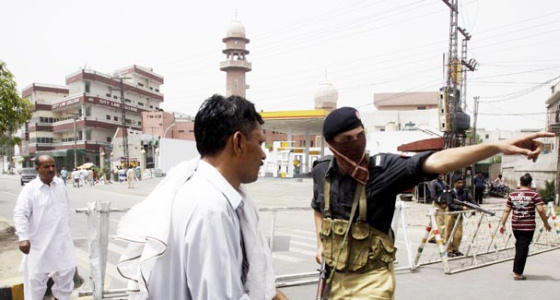
A Pakistani police officer bars a cyclist from entering a street near the Garhi Shahu mosque belongs to minority sect, which was targeted by gunmen last Friday killing nearly 100 worshippers and left many injured, in Lahore, Pakistan on Friday, June 4, 2010. Authorities beefed up security around the mosque to avert any terrorist attempt. - AP Photo
A Pakistani police officer bars a cyclist from entering a street near the Garhi Shahu mosque belongs to minority sect, which was targeted by gunmen last Friday killing nearly 100 worshippers and left many injured, in Lahore, Pakistan on Friday, June 4, 2010. Authorities beefed up security around the mosque to avert any terrorist attempt. — AP Photo

A day after the slaughter of nearly 100 Ahmadis in Lahore last week, Britain’s Channel 4 aired a programme on Iraq in its ‘Unreported World’ series.

The narrator described the plight of the Christians and other minorities in the north who were being regularly targeted by Sunni militias.

One ancient community that had been living there for the last 4,000 years was being especially persecuted. Out of the million Christians who lived in Iraq as equal citizens before the war began, half have now fled the country.

If such a concerted pogrom had been launched against Muslims anywhere in the world by non-Muslims, we would have been up in arms. Russia’s brutal treatment of Muslim Chechens and the Serbian ethnic cleansing of Muslim Bosnians have been widely condemned. So how is Pakistan’s treatment of its minorities any different?

I was sent a video clip of the reaction of a senior Ahmadi cleric to the Lahore massacre in which he was asked what his demand to the government was in the wake of the terrorist attacks. He replied: “We demand nothing and expect nothing but what is our due as citizens of Pakistan.” I was deeply moved by the stark simplicity of his answer.

That Ahmadis are at risk in the Islamic Republic is hardly a secret: they have been attacked, killed and harassed without any protection from the state for years. Surely the Punjab government should have posted policemen to protect their houses of prayer especially on Friday.

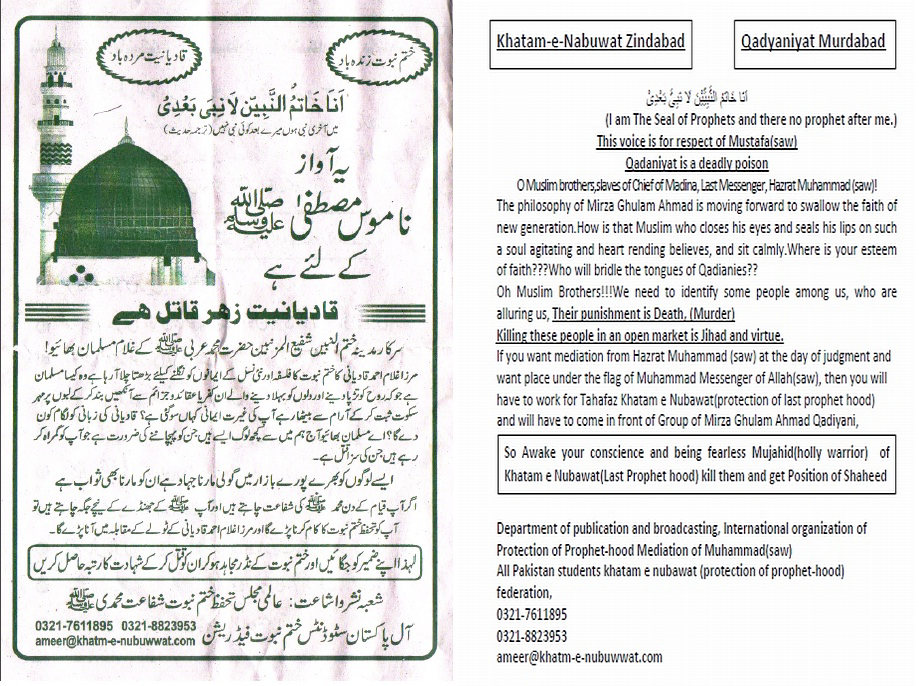
However, this is expecting too much from a government that did not take down hoardings on the streets of Lahore bearing the message “Friends of Ahmadis are enemies of Islam”. When its law minister Rana Sanaullah consorts openly with leaders of banned terrorist organisations, and its chief minister pleads with jihadi groups not to attack targets in Punjab — implying they are free to murder people in other provinces — little good can be expected of such a government.

Currently, instead of providing security for his beleaguered people, Chief Minister Shahbaz Sharif is engaging in a war of words over the fact that a large number of extremist terrorists are now active in Punjab. He objects to the term ‘Punjabi Taliban’ as though their ethnic origin is of any concern to the victims: the fact that they are terrorists who are killing mostly fellow Muslims in the name of Islam seems to mean little to him.

For several years now, the presence and proliferation of militant groups in southern Punjab has been common knowledge. The emergence of Ajmal Kasab, the terrorist found guilty of his role in the attacks on Mumbai in 2008, from the same area is not without significance.

Two days after the Lahore massacre, a man in Narowal entered a house, stabbed an Ahmadi to death and wounded another, shouting that he would kill every Ahmadi he could find before he escaped. The fact is that the police do not bother to investigate crimes against Ahmadis seriously, and to my knowledge, hardly anyone has been prosecuted for attacks against any minority community.

This callous attitude in officialdom can be expected in a country where popular TV anchors openly profess their anti-Ahmadi bias. One of them was allegedly caught on tape urging a terrorist to ‘interrogate’ a hostage because he was supposed to be ‘an agent of the Ahmadis’, although the newsman in question later denied it. The prisoner was found executed a few days later. Another famous anchor on a religious talk show encouraged a guest to declare Ahmadis ‘wajib-ul-qatal’, or deserving of murder. A few days later, two Ahmadis were duly killed. No action or public outcry followed either event.

At the heart of this indifference to the fate of our fellow citizens is a deeply rooted intolerance. Somehow, the fact that they follow beliefs other than the majority faith makes them unworthy of full and equal citizenship. Many mullahs fulminate regularly and openly against Ahmadis from the pulpit after Friday prayers. Many have called for their expulsion from the country. One has even demanded that they be given the choice between conversion or death.

And yet these very people hold forth incessantly about the injustice Muslims supposedly face in non-Muslim countries, denouncing perceived Islamophobia in the West. Were Muslims to face even a small fraction of the prejudice in non-Muslim countries that Pakistani minorities do every day of their lives, I cannot begin to imagine the hysteria on our streets, our mosques and — most of all — our TV channels.

So why is our sympathy and our humanity reserved only for those who follow the same beliefs we do? Surely there is no contradiction between faith and compassion for all people everywhere? I can understand an ignorant young jihadi, brainwashed by cynical, cruel clerics and terrorists into turning himself into a human bomb, and blowing up whoever they designate as a target. But how to explain the hard-hearted attitude of millions of Muslims who form the majority in Pakistan, many of them educated and sensible in other matters?

Contributing to a New York Times blog, Samra Habib writes after the Lahore massacre: “In 1991, I left Pakistan with my family and moved to Canada. We feared attacks by Muslim extremists and packed our bags in the middle of the night and managed to leave. Hiding our religion from non-Ahmadis had become part of our daily lives….

“I’ve spent most of my life here in Toronto and have become accustomed to being accepted by my friends and peers and sharing my thoughts and beliefs without fear of repercussion. I often forget that years ago, things were different for me and I, too, feared identifying myself as an Ahmadi. People I love in Pakistan still don’t have the luxury to celebrate their religious differences or even publicly greet friends in a traditional Arabic greeting….”

In the West, religious differences are accepted in a way that few Muslims are capable of doing. For us, faith is the defining element in our identity. Over the years, I have met many fine people who happened to be Ahmadis. Many of them have become friends, and I value these friendships. I suppose this makes me ‘an enemy of Islam’ in the eyes of those whose hoardings were not taken down by the Punjab government.

irfanhusain@gmail.com

©2010 DAWN Media Group. All rights reserved

Wednesday, August 26, 2009

13 Militants Arrested in Pakistan

---The New York Times, USA

13 Militants Arrested in Pakistan
By SALMAN MASOOD
Published: August 24, 2009


ISLAMABAD, Pakistan — The Pakistani police have arrested 13 suspects in two raids that they said foiled several terrorist attacks, security officials said Monday.

Pakistani police officers escorted suspected militants into court in Karachi on Monday.Six men were arrested Monday who belonged to a banned militant group, Sipah-e-Sahaba, and had links with the Taliban militant group linked to Baitullah Mehsud, said Tahir Gujjar, the deputy superintendent of police in Sargodha, a city in northern Punjab Province. Mr. Mehsud is the Taliban leader who is believed to have been killed this month.

The militants who were arrested, Mr. Gujjar said, were planning to attack several places of worship in the Pakistani heartland of Punjab: Shiite mosques, churches and a place of worship of the Ahmadiyya sect, which the government considers not Muslim. The authorities also said the men wanted to blow up broadcast towers of Telenor, a Norwegian telecommunications company.

Seven other suspects were arrested in the southern port city of Karachi on Sunday. The police, acting on a tip from intelligence sources about an imminent terrorist attack, arrested seven men from the outlawed group Lashkar-e-Jhangvi, security officials said Monday.

In the Monday arrests, the police, acting on intelligence information, captured three men in a predawn raid at a bus terminal, and under interrogation, they disclosed the location of others, Mr. Gujjar said. One of the arrested, Hafiz Abu Bakar, was the main leader of Sipah-e-Sahaba (Army of the Companions of the Prophet) in a town near Sargodha, he said. Sargodha is the base of two squadrons of Pakistan Air Force F-16s.

Private television news networks broadcast the images of the men arrested Monday. The authorities presented the heavily bearded men to the media, blindfolded and with hands tied behind their backs. A cache of weapons the authorities said had been recovered from them was displayed on a table.

Saud Mirza, a senior Karachi police official, said the raid in Karachi recovered 3 suicide jackets; 4 Kalashnikov automatic rifles; 2 gas masks; 33 pounds of explosives; and about 5 pounds of heroin. Mr. Mirza said the suspects were involved in drug trafficking to finance their activities.

One of the men arrested, Muhammad Shahzad, who is known as Phelavan, or the Wrestler, is believed by Pakistani intelligence to have been a close associate of Amjad Hussain Farooqi, a well-known militant leader involved in an assassination attempt against the former president of Pakistan, Pervez Musharraf.

Mr. Farooqi, who was killed in a shootout in southern Pakistan in 2004, was implicated in the beheading of Daniel Pearl, a reporter for The Wall Street Journal, two years earlier.

Lashkar-e-Jhangvi, a sectarian group founded in the mid-1990s with close ties to Al Qaeda, has often singled out Shiite Muslims using suicide attacks. More recently, it has been active in recruiting suicide bombers. A report this month from Jane’s intelligence group called Lashkar-e-Jhangvi “perhaps the country’s most extreme and feared militant group.”

“LeJ members have traditionally assumed new identities and operated in small cells that disperse after completing their missions, making it difficult for the Pakistani authorities to completely eradicate the group,” the Jane’s report said. “However, many of its leaders and members have been killed or jailed in recent years and there is little evidence that it remains a coherent organization with centralized structures.”

In an attack on Monday, gunmen killed an Afghan television journalist and severely wounded another in northwestern Pakistan, The Associated Press reported. Janullah Hashim Zada, who worked for the Afghanistan-based Shamshad TV, was gunned down as he traveled on a public minibus from Torkham in the Khyber tribal region to the northwestern frontier city of Peshawar, The A.P. reported, citing a Khyber Agency official, Omair Khan.

Mark McDonald contributed reporting from Hong Kong.

 
^ Top of Page