Showing posts with label heretic. Show all posts

Monday, October 24, 2011

Debate Over Indonesian Religion Bill Heats Up

Jakarta Globe, Indonesia
HOME
Debate Over Indonesian Religion Bill Heats Up
Ulma Haryanto & Anita Rachman | October 24, 2011

Rahmat Rahmadijaya, an Ahmadiyah leader living in Jatibening, Bekasi, has been anxious for a few weeks now.

At first he didn’t want to talk, but he later changed his mind. “If I speak out, maybe I can get people to support us, to pray for us,” he told the Jakarta Globe in a recent interview.

He is anxious because of a decree signed by Bekasi’s acting mayor, Rahmat Effendi, that bans the Muslim minority group from conducting activities that may be interpreted as an effort to spread its beliefs.

The ban went into effect on Oct. 13. Since then, Rahmat and other members of the Ahmadiyah community in his neighborhood have started holding Friday prayers under tight security from Bekasi Police.

“Our second Friday prayers went relatively normally, about 60 people joined in,” said another resident, Abdul Rohim.

“We don’t know about next week, though.”

In Need of a Law?

The fear appears to be justified. Several violent incidents have targeted Ahmadiyah communities throughout the country.

One of the worst — an attack in February by a mob of at least a thousand on an Ahmadi group in Cikeusik that left three members of the sect dead — spurred a discussion over a long-delayed bill on religious harmony.

At the time, the bill was presented by lawmakers as a long-term solution to the religious conflicts plaguing the country and to give a stronger legal basis to joint ministerial decrees that regulate religious matters in the country today.

Last week, Coordinating Minister for People’s Welfare Agung Laksono, Religious Affairs Minister Suryadharma Ali and Home Affairs Minister Gamawan Fauzi reiterated their endorsement of the bill.

“We need a regulation that contains both conflict prevention and solutions to the problems obstructing religious harmony,” Agung said.

The current draft of the bill regulates various religious rights and obligations such as proselytizing, celebrating religious holidays, constructing places of worship, funerals and religious education.

“The original version of the draft, written by the staff of the Religious Affairs Ministry, dated back to 2003,” said Ismail Hasani, a researcher at Setara Institute for Peace and Democracy. “The current draft is more or less the same.”

The bill is part of the 2011 National Legislation Program (Prolegnas), or the list of priority bills for the year, but it has been delayed as the House of Representatives has turned its attention to other bills.

Will It Help?

Setara deputy chairman Bonar Tigor Naipospos, an advocate of pluralism, isn’t looking forward to the religious harmony bill being passed into law.

He said it would only legitimize existing discriminatory regulations within the 1965 Anti-Blasphemy Law and a 2006 joint ministerial decree on places of worship, which has contributed to a number of conflicts.

In Bogor, for instance, Mayor Diani Budiarto has used the ministerial decree to continue to defy a Supreme Court ruling ordering the reopening of the GKI Yasmin Church.

The 2006 joint ministerial decree requires 60 signatures from local residents in support of the construction of a place of worship, but the mayor has claimed that GKI Yasmin forged the signatures.

The tension in Bogor came to a head two weeks ago, when churchgoers and public order officers (Satpol PP) clashed in front of the sealed building.

West Java Police are now investigating complaints filed by both camps against each other. A Satpol PP chief is accusing GKI Yasmin churchgoers of hitting him in the jaw and knocking him unconscious, while the church is countersuing Satpol PP for disrupting its service.

Bonar said the bill would be unhelpful to the cause of the Ahmadiyah as well. “The spirit of the law that condemns their belief, the 1965 Anti-Blasphemy Law, is still incorporated in the bill,” he said.

Fears and Worries

Abdul Kadir Karding, chairman of House Commission VIII, which oversees social affairs, urged the public to think positively about what the lawmakers in the commission were doing.

He said the House wanted to give protection to minorities.

“For instance, when there is a non-Muslim person living in a Muslim community, he or she has the right to use the same public cemetery like the majority,” he said. “In the Cikeusik case, we want this future law to ensure that the guilty will get punished.”

Activists were outraged that most of the 12 people convicted in the Cikeusik attack were sentenced to just six months in jail — the same sentence given to one of the Ahmadi victims convicted of violent assault and disobeying police officers who had ordered him and about a dozen other Ahmadis to evacuate ahead of the attack.

Karding acknowledges that unless the bill is carefully constructed, it risks becoming a tool for “hard-line groups to limit freedom of religion.”

Fajar Riza Ul Haq, executive director of the Maarif Institute, asked the House to be more open in the drafting and deliberation.

He said it should learn from the recently passed Intelligence Law, when both the House and government ignored public criticism.

One critical point, he said, was how the House would define “harmony” in the bill. “They should have drafted a religious freedom bill instead of this one.”

Harmony vs Freedom

Harmony, for instance, could be used to justify the recently issued Bekasi ban on the Ahmadiyah’s activities, which states the ban is needed to “preserve and maintain the stability of conduciveness and security, peace and order in Bekasi.”

Bonar views the religious harmony bill as the “middle way” after the Constitutional Court rejected a judicial review of the 1965 Anti-Blasphemy Law.

“Because even though the court rejected the request because the law itself is not unconstitutional, it stated in its ruling that a revision or an update of the law was needed,” Bonar said.

“Principally, we can’t agree with the law since it reflects the fact that this government thinks religious harmony is something that should be engineered, rather than grow naturally.”

If the government really wanted “harmony,” Fajar said it should start addressing the prevalence of hate speech.

In Jatibening, just before the ban on the Ahmadiyah was issued, members of the notorious hard-line group Islamic Defenders Front (FPI) were in the area.

“They came to Jatibening and intimidated people, telling us to shut down our mosque about three weeks ago,” Rahmat said.

Additional reporting by Vento Saudale

Copyright 2010 The Jakarta Globe
URL: www.thejakartaglobe.com/home/debate-over...up/473591

Saturday, October 22, 2011

We’re not safe living anywhere: Ahmadis

Jakarta Post, Indonesia
CITYSat, 10/22/2011 12:37 PM
We’re not safe living anywhere: Ahmadis
The Jakarta Post, Bekasi
The imam of the Al-Misbah Ahmadiyah mosque in Jatibening, Bekasi, recently called on members not to congregate for Friday prayers for safety reasons following an official ban on Ahmadiyah religious practices in Bekasi.

Rahmat Rahmadijaya, the imam, said, “It’s up to them if they want to pray here anyway. I won’t send them home,” he said, adding that about 50 of the 200 registered followers were regulars at the mosque.

However, dozens of Ahmadiyah members still went to the mosque on Friday — a week after the Bekasi municipality officially banned the sect — and conducted Friday prayers under police guard.

“[Intimidation] makes us stronger. Members are even more determined to go to the mosque,” Vera, a member, told The Jakarta Post.

Congregation members later left the mosque peacefully after the weekly service concluded.

The Bekasi municipality ruled last week that the decree banning Ahmadiyah religious practices had been passed in order to meet the demands of local people.

The Ahmadiyah are not considered a Muslim group by mainstream Muslims, as the sect’s teachings are considered to deviate from mainstream Islam.

However, residents of Jatibening told the Post that there had never been any conflict between Ahmadiyah members, who mostly live outside the housing complex, and them.

Hartinah, who has lived in the neighborhood since before the mosque was built in the 1980s, said there had been no problems between Ahmadiyah followers and residents.

“As a child, I, along with neighbors, often joined Koran recitations or breaking of the fast events at the mosque. They are friendly and have never forced us to follow their beliefs, so we have no problems with their presence,” she said.

Hartinah said that people had started to leave the mosque following the spike in reports of violence against Ahmadiyah members throughout the country.

“I’m not sure who is right, but the presence of vigilante group members around here scares me more,” Hartinah said.

Imam Rahmat said that after the Bekasi decree issuance, he had been intensively communicating with the police. “When there are rumors that certain groups will come, the police deploy officers to guard the mosque,” he said.

Ahmadiyah members have not been holding regular events other than weekly Friday prayers and sermons.

Firdaus Mubarik, public relations officer of the Ahmadiyah Indonesia Congregation, told the Post that the organization had stopped holding national events after thousands attacked the Ahmadiyah Indonesia Congregation in Parung, Bogor, in 2005.

“We are no longer safe anywhere in Indonesia,” Firdaus said.

Concerning the appointment of Nasaruddin Umar as the religious affairs deputy minister tasked with “eliminating possible religious conflicts” during the recent Cabinet reshuffle, Mubarik said he was pessimistic that it would have any impact on the Ahmadis.

“As far as I know, Nasaruddin was involved in the drafting of the 2008 joint ministerial decree banning Ahmadiyah religious practices. Besides, [the problem solving] is not in the hands of ministers, but of the President [Susilo Bambang Yudhoyono],” he said.

Firdaus pointed out that the incidence of violence against Ahmadis had increased and worsen during Yudhoyono’s leadership.

“Before Yudhoyono came to power, the eviction of 300 Ahmadis living in Lombok [West Nusa Tenggara] in 2002 was the biggest tragedy for us. During Yudhoyono’s leadership, we’ve seen worse and even lost several members, who were killed during the incidents,” Firdaus said. (swd)

Copyright © 2008 The Jakarta Post - PT Bina Media Tenggara. All Rights Reserved
URL: www.thejakartapost.com/news/2011/10/22/we-re...ahmadis.html

Friday, October 14, 2011

New Religion Law Will Help: Minister

Jakarta Globe, Indonesia
NEWS
New Religion Law Will Help: Minister
Camelia Pasandaran & Antara | October 14, 2011

A proposal for a new law on religious issues that may soon make its way to the House of Representatives has been welcomed by some, but others warn that it may restrict religious freedom.

Ministers have responded to a perceived rise in radicalism and religious intolerance by announcing that a new “bill on religious harmony” is being discussed.

According to Agung Laksono, coordinating minister for people’s welfare, the bill, which was suggested after a meeting between Religious Affairs Minister Suryadharma Ali and Home Affairs Minister Gamawan Fauzi, would “legislate for better religious understanding on the ground.” He added that the bill was intended to head off potential sectarian conflicts, which have been on the rise.

“To maintain harmony, we need a regulation that contains both conflict prevention and solutions to the problems obstructing religious harmony,” he said.

While Agung said that discussions were at an early stage, another lawmaker, Abdul Kadir Karding, chairman of House Commission VIII, which oversees social affairs, said the bill had been on the table for some time.

Karding warned that unless the bill was carefully constructed, it would become a tool of “hard-line groups to limit freedom of religion.”

He said that current laws have led to violence against religious groups not recognized by the government, citing the cases of the Tegal in Central Java, the dismantling of a Buddha statue in North Sumatra, attacks on the minority Ahmadiyah sect and intimidation of Christians in Bogor.

Ahmadiyah officially banned [by Bekasi municipality]

Jakarta Post, Indonesia
HEADLINESFri, 10/14/2011 6:54 AM
Ahmadiyah officially banned [by Bekasi municipality]
Hans David Tampubolon, The Jakarta Post, Jakarta
The Bekasi municipality has officially banned the religious practice of the Ahmadiyah sect on Thursday, a move pluralists deemed as the legitimation of a violation of the spirit of the Constitution.

The head of the Bekasi Agency for State Unity, Politics and Community Protection, Agus Dharma, said that the issuance of the decree banning Ahmadiyah’s religious practices was passed in order to meet the demands of local people.

“Ahmadiyah activity has caused unrest among Bekasi residents. [The decree was] issued to prevent conflicts resulting from different beliefs among local residents,” Agus said.

The decree was signed by acting Bekasi mayor Rahmat Effendi, and involved all city institutions contained under the Regional Consultative Council (Muspida).

The decree accentuated a 2008 joint ministerial decree, and an Indonesian Ulema Council (MUI) edict from 2005, demanding Ahmadiyah be disbanded because it was heretic and blasphemous.

There are around 200 Ahmadiyah followers in Bekasi, according to the city administration.

Commenting on this latest development in Bekasi, the Commission for Missing Persons and Victims of Violence (Kontras) coordinator Usman Hamid said it was time for all civilians to rise up and conduct forms of civil disobedience in protest against a government that has legitimazed a discriminative regulation that basically violated the spirit of the Constitution, which guarantees people’s religious freedoms and rights.

“Civil disobedience is not intended as a violation of the law but as a [peaceful] protest. The law, right now, no longer represents the rights of minorities,” Usman told The Jakarta Post on Thursday.

Usman also said that the Bekasi administration’s move was a sign that the values of democracy in the country have faded away.

“The main pillars of democracy are equal citizenship and human rights. Without them, there can be no democracy. Democracy does not stop with the ballot box.”

Separately, Ahmadiyah spokesman Mubarik said that the nation’s legal system had done little to support minorities.

“The most horrific example is the fact that the murderers of three Ahmadiyah followers have not been brought to trial until now,” Mubarik said, in referring to an incident that occurred earlier this year when three Ahmadiyah followers were brutally murdered by a mob of fundamentalists in Cikeusik, Banten.

Mubarik, however, stressed that for the time being, Ahmadiyah followers would comply with the Bekasi decree, banning their activities.

“Our compliance does not mean that we are not going to fight back.

We will fight for our rights through our legal representatives, who have submitted a judicial review to the Supreme Court on every discriminative decree and regulation issued in the country,” he said.

“It will be a long fight. But people need to realize that Ahmadiyah followers are basically free citizens. Their right to freedom [of religion] must not be curtailed. Any decree or regulation that curtails citizens’ rights is a violation of the Constitution and, therefore, for the sake of the law, such decrees and regulations must be annulled,” he added.

Copyright © 2008 The Jakarta Post - PT Bina Media Tenggara. All Rights Reserved
URL: http://www.thejakartapost.com/news/2011/...banned.html

Monday, October 3, 2011

The dying canary and Indonesia’s religious freedom

Jakarta Post, Indonesia
OPINIONMon, 10/03/2011 7:57 PM
The dying canary and Indonesia’s religious freedom
Tobias Basuki, Jakarta
“Religious liberty is the proverbial canary in the mine,” according to Doug Bandouw, a senior fellow at the Cato Institute. Canaries are often used by miners as an early-warning signal for poisonous gases. When the small birds stop singing and suffocate, miners know toxic gases have polluted the area and something is wrong.

The right of religious freedom for small groups within a country is a vital indicator of the health of society. Religious freedom is the most basic freedom. Without it, it is doubtful that the lives and dignity of its citizens is truly respected.

Religious minorities in Indonesia have recently been systematically and aggressively silenced. Repression is allegedly perpetrated by religious extremists. The state is not without blame either.

The state partakes in the oppression of its own citizens, first through oversight and omission, and second by undertaking discriminatory actions and policies. The Blasphemy Law and a joint ministerial regulation on the Ahmadiyah minority Islamic sect are proof.

Two cases illustrate the dire condition of religious freedom in Indonesia.

First is the plight of the Ahmadis. The Ahmadis were part of our archipelago’s society even before independence and partook in the independence movement. The sect has now been cast aside and discriminated against.

Physical and verbal attacks against them have intensified in the past five years. One attack culminated in the slaughter of three members in Cikeusik, Banten.

Adding greater madness to the brutality was the gross injustice of our judiciary.

Those who participated in the vicious attacks were sentenced to jail for terms as little as three to six months. Deden Sudjana, whose house the Ahmadis were protecting, received a harsher sentence than those convicted of instigating the violence, who were hailed as heroes upon their release.

The Ahmadis understandably decided not to pursue and prolong the case considering the amount of prejudice and unfair treatment they have had to endure.

It was the first sign that the canary was not doing well.

The Blasphemy Law and the logic used to apply it is schizophrenic. Here is an example: The Blasphemy Law prohibits the existence of religions that resemble a major religion and also prohibits programming based on such religions from being broadcast.

In one city, an Ahmadiyah mosque was attacked and closed because it had a sign identifying it as an Ahmadiyah place of worship. The sign was considered “broadcasting” under the law. In another city, an Ahmadiyah mosque was attacked and closed because it had no signs on it and was accused of luring Muslims inside for conversion.

There are some well-intentioned arguments that state the Ahmadis should declare a new religion to avoid further prosecution. But the same logic would immediately put them in the crosshairs again.

The sect’s similarity to Islam puts it at odds with the law and prejudice against them. Labeling is not the issue; it is the bigoted view and actions of the few that are the main problems.

Another poignant example is the case of GKI Taman Yasmin. The congregation obtained a permit to build a church in July 2006. The construction, however, was stopped in 2008 by the head of Bogor’s Urban Planning and Landscaping Agency.

The church challenged the decision in court, which annulled the suspension issued by the city.

The annulment was disregarded and the church took its plight to the Supreme Court, which also ruled in favor of the church. Obstinately, the Bogor government under Mayor Diani Budiarto has chosen to blatantly disobey the Supreme Court’s ruling.

Opposition to the church’s construction is based on feeble grounds and outright ridiculous statements involving alleged counterfeit signatures, obstructing businesses and the infamous “no church should be on a street named after a Muslim”.

The reasoning proposed by the officials begs a serious question about the real motives behind the church ban. I attended one of the outdoor services conducted by the congregation in front of the sealed church.

None of the “public inconvenience” accusations held true. Even with a large number of visitors and an outdoor service, traffic was barely disturbed. There were no visible or plausible disturbances to businesses or the community.

However, one thing is clear. The mayor has broken the law on several accounts. First, he ignored court rulings, including a ruling from the Supreme Court. Second, the city violated the Regional Autonomy Law, which states that religion is the jurisdiction of the central government, not the local government.

Last but most flagrantly, Diani violated the Constitution and his oath of office. His repeated disregard of a court decision has made him a law breaker. The mayor should be impeached at the very least.

The canary is not dead … yet.

Indonesia as a nation faces two towers of evil. The first is epidemic corruption. It is like anemia. It is fatal, widespread and will kill us slowly. The second is radicalism and narrow-minded bigotry. Many say the radicals are few. It is true, but these few let loose will wound the nation and bleed us.

It is like a flesh wounds. It may not necessarily be fatal, but with a cancer draining our blood, a small wound can worsen and break us apart.

The writer is a graduate of Northern Illinois University and a lecturer at Pelita Harapan University, Tangerang.

Copyright © 2008 The Jakarta Post - PT Bina Media Tenggara. All Rights Reserved
URL: www.thejakartapost.com/news/2011/10/03/the-dying...freedom.html

Friday, September 9, 2011

Indonesians Feel Ahmadis Should Be Protected as Fellow Countrymen: Poll

Jakarta Globe, Indonesia
NEWS
Indonesians Feel Ahmadis Should Be Protected as Fellow Countrymen: Poll
Ronna Nirmala | September 09, 2011

FPI members protesting in front of Ahmadiyah secretariat in Makassar. They urged the Ahmadiyah members to stop their activities. (Antara Photo/Yusran Uccang)
Most Indonesians oppose the use of violence against the minority Muslim sect Ahmadiyah and think its followers here are their compatriots and should not be facing oppression, a survey by a human rights watchdog showed on Thursday.

Many respondents also said the deadly February attack in Cikeusik, Banten, occured because the government allowed it to happen, the Setara Institute for Freedom and Democracy said.

When asked who should be held accountable for the Cikeusik attack, in which three Ahmadis were killed, 33 percent of respondents said: “I don’t know.”

Another 32 percent blamed the government and security officials for doing little to prevent it, and 18 percent blamed the Ahmadiyah as they spread “blasphemous teachings.” The remaining 17 percent blamed the hard-line Muslims who carried out the attack, the survey said.

“The poll also indicates that almost 70 percent of the respondents consciously said that whatever happened, Ahmadiyah members are their fellow countrymen — aside from their differences in interpreting religion,” said Ismail Hasani, a researcher with Setara.

The survey was conducted among about 3,000 respondents in 27 districts in nine provinces, including Jakarta, West Java, Yogyakarta, East Java and West Nusa Tenggara.

A majority of respondents, about 60 percent, said they had no idea about what Ahmadiyah teachings entailed.

“Although some [Muslim] respondents refused to call Ahmadiyah followers their brothers, they agreed the attack in Cikeusik should never have happened,” said Bonar Tigor Naipospos, the deputy chairman of Setara. In fact, only a small portion of those questioned said the Cikeusik incident was caused by differences over religious beliefs.

“Some of them believed that it happened because of a fabricated issue from a third party, not related to religious interests,” Bonar said.

Two months ago, the Serang District Court in Banten convicted 12 hard-line Muslims for the Cikeusik attack but sentenced them to a maximum of just six months in jail.

Deden Sujana, the former head of security for the Indonesian Ahmadiyah Congregation (JAI), was a sentenced to six months in jail by the same court last month. He was found guilty of disobeying police officers who had ordered him and about a dozen other Ahmadis to leave the house they occupied just before the violence broke out. Deden was badly injured in the attack.

Thursday, September 8, 2011

Attack on Ahmadiyah condemned by most, survey reveals

Jakarta Post, Indonesia
NATIONALThu, 09/08/2011 8:26 PM
Attack on Ahmadiyah condemned by most, survey reveals
The Jakarta Post
According to Setara Institute, most Indonesians condemn the attack on Ahmadiyah in Cikeusik, Banten, West Java, which occurred earlier this year.

“As many as 82.3 percent of the respondents said they disapproved the attack, 7.9 were in favor, while 9.8 did not give a statement,” Setara Institute researcher Ismail Hasani told The Jakarta Post on Thursday.

The research on people’s perception of Ahmadiyah was conducted in 47 regencies of 10 provinces in the country from July 10 to 25. It comprised 3,000 respondents from various religions, but 90 percent were Muslims

Ismail said the research also found out that 68.2 respondents regarded Ahmadiyah as fellow citizens, 11.9 percent did not regard them as fellow citizens. Twenty percent did not respond.

“The results bring us a hope that tolerance still exists in this country,” he said.

Yet, he said the research also found that more than 40 percent of respondents were in favor of a joint ministerial decree (SKB) and the Indonesian Ulema Councils (MUI) edict declaring Ahmadiyah be disbanded because it was heretic and blasphemous.

The joint decree was issued by the religious affairs and home ministers, and the attorney general in 2008 in efforts to regulate Ahmadiyah followers’ religious practice.

Ismail said people’s inter-religious tolerance in this country was at a good level, “But they can hardly accept others of the same religion, because of a slight variation in beliefs.”

On February 6, Ahmadiyah followers were set upon by angered residents who objected to their beliefs, which they say go against “pure” Islam.

Hundreds of people attacked 21 Ahmadis, killing three of them and injuring at least five, while ransacking and setting a house belonging to Ahmadis on fire.

Copyright © 2008 The Jakarta Post - PT Bina Media Tenggara. All Rights Reserved
URL: www.thejakartapost.com/news/2011/09/08/attack-ahmadiyah...reveals.html

Friday, July 15, 2011

In Ahmadis’s desert city, Pakistan closes in

Reuters, USA
Edition US
In Ahmadis’s desert city, Pakistan closes in
Rabwah
By Myra MacDonald
RABWAH, Pakistan | Fri Jul 15, 2011 9:04am EDT
(Reuters) — At the office of what claims to be one of Pakistan’s oldest newspapers, workers scan copy for words it is not allowed to use – words like Muslim and Islam.

“The government is constantly monitoring this publication to make sure none of these words are published,” explains our guide during a visit to the offices of al Fazl, the newspaper of the Ahmadiyya sect in Pakistan.

This is Rabwah, the town the Ahmadis built when they fled the killings of Muslims in India at Partition in 1947, and believing themselves guided by God, chose a barren stretch of land where they hoped to make the Punjab desert bloom.

Affluent and well-educated, they started out camping in tents and mud huts near the river and the railway line.

Now they have a town of some 60,000 people, a jumble of one- and two-storey buildings, along with an Olympic size swimming pool, a fire service and a world class heart institute.

Yet declared by the state in the 1970s to be non-Muslims, they face increasing threats of violence across Pakistan as the country strained by a weakening economy, an Islamist insurgency and internecine political feuds, fractures down sectarian and ethnic lines.

“The situation is getting worse and worse,” says Mirza Khurshid Ahmed, amir of the Ahmadi community in Pakistan. “The level of religious intolerance has increased considerably during the last 10 years.”

The town, renamed Chenabnagar by the state government since “Rabwah” comes from a verse in the Koran, is now retreating behind high walls and razor wire, awaiting the suicide bombers and fedayeen gunmen who police tell them are plotting attacks.

Last May, 86 people were killed in two Ahmadi mosques in Lahore, capital of Punjab; others were attacked elsewhere in the province. Many fled to Rabwah where the community gives them cheap housing and financial support.

Among them is 15-year-old Iqra from Narewal, whose shopkeeper father was stabbed to death last year as the family slept. “I was sleeping in another room when my father was attacked,” she begins in a small voice, pulling a black scarf across her face to cover her mouth in the style of Ahmadi women.

“The attacker wanted to kill all the Ahmadis in Narewal,” her brother Zeeshan continues. “My elder brother tried to help my father and he was stabbed and wounded too.”

Later police found the attacker hiding in a mosque. He had believed the mullahs when they told him that all Ahmadis were “wajib ul qatl”, or deserving of death.

BATTLEGROUND FOR POWER

The Ahmadis follow the teachings of Mirza Ghulam Ahmad, who in the town of Qadian in late 19th century British India called for a revival of a “true Islam” of peace and justice. His teachings were controversial with Muslims and Christians alike.

He argued that Jesus did not die on the cross but escaped and travelled to India and was buried in Kashmir. And he claimed to be the metaphorical second coming of Jesus, destined to put Muslims back on the true path.

Many Muslims were offended by the suggestion he had come as a prophet, breaching a basic tenet of Islam that there can be no prophet after Mohammad, whose teachings are believed to be based literally on the word of God, perfect and therefore final.

Yet his call for peace, hard work, temperance, education and strong community bonds resonated, and over the years the proselytizing movement acquired millions of followers worldwide.

At home, however, their history has been intimately bound up in Pakistan’s own descent from its relatively optimistic birth.

Lacking a coherent national identity, it has become a battleground for competing political, religious and ethnic groups seeking power by attacking others.

“The mistake of the Ahmadis was that they showed their political strength,” said an Ahmadi businessman in Lahore.

Better education he said, meant they obtained good positions in the army and civil service at first; strong community bonds made them an influential force in politics up to the 1970s.

But they also made an easy target for the religious right who could whip up anti-Ahmadi sentiment for political gain.

Ahmadis follow two different schools of thinking, but will argue, often with detailed references to the Koran in both Arabic and English, that they do not dispute the finality of the Prophet Mohammad. Their erudite theological arguments, however, had little chance against the power of the street.

After anti-Ahmadi violence, they were declared non-Muslims in 1974. In the 1980s, their humiliation was completed when legal provisions barred them from associating themselves with Islam, for example by using the call to prayer or naming their place of worship a “masjid” or mosque.

“You can say you don’t consider me to be a Muslim but you can’t force me to also say I am not a Muslim,” complains Ahmed, the amir, the pain clear in his voice.

Yet in the newspaper office in Rabwah, a white board displays the words they are not allowed to use – they could be accused of blasphemy, which carries the death penalty.

SPREADING TO OTHER SECTS

Many Pakistanis, if you ask about treatment of the Ahmadis, shrug it off – it’s an old story, they say, dredged up by westerners who do not appreciate the importance of the finality of the Prophet.

Yet there are signs the attitudes first directed toward Ahmadis are spreading to other sects. In a country which is majority Sunni, and where insurgents follow Sunni Islam, Shi’ites and even Sufi shrines have been bombed.

A 2010 study by Pakistani analyst Ayesha Siddiqa of students in elite colleges found that while 60 percent said the government was right to declare Ahmadis non-Muslims, a sizeable 18 percent believed Shi’ites were also non-Muslims.

These and other findings led her to conclude that radicalism was growing even among the educated youth – it is often, wrongly, blamed on poverty – which in its extreme form could lead people into violence.

Their tendency, she wrote, to see different groups with an unquestioned bias, she wrote, “especially coated with religious overtones or padded with religious belief prepares the mind to accept the message from militant organizations.”

In the nearest town to Rabwah, the central square as been renamed “Khatme Nubuwwat” Chowk, meaning the finality of the Prophet. Beyond, low jagged hills spike up above the dusty land, the summits of much bigger rock formations below the surface.

Many of the Ahmadis had been active supporters of the movement which created Pakistan and when they first came here they were inspired by a verse in the Koran, describing “an elevated land of green valleys and springs of running water.”

Now they are surrounded by a very different country.

Rabwah itself is open to the outside world – despite the high walls guarding individual houses, it is not a walled town.

“Under the circumstances we try to take the best measures we can to protect ourselves,” says the amir. “But what we can do is very limited. We don’t have a mindset or training for that.

And in any case, he adds, “How many people can leave Pakistan or Rabwah?“

Monday, February 21, 2011

MUI Denies Ahmadiyah Attacks a Result of Its Fatwa

Jakarta Globe, Indonesia
NEWS
MUI Denies Ahmadiyah Attacks a Result of Its Fatwa
Dessy Sagita & Camelia Pasandaran | February 21, 2011

Police officers inspecting the damaged house of an Ahmadi after it was attacked by a Muslim mob in Pandeglang, Banten, earlier this month. (AP Photo)
Two weeks after a deadly attack on Ahmadiyah followers in Banten, the Indonesian Council of Ulema has called on the government to investigate cases of religious violence.

The group, known as the MUI, also defended itself against critics who say its edict denouncing Ahmadiyah has contributed to the violence against the minority sect.

“There’s not one religion in this world that teaches violence,” Amidhan, chairman of the MUI, said on Sunday.

He said many people had misunderstood the council’s 2005 fatwa labeling Ahmadiyah a deviant Muslim sect and its followers as apostates.

“Indeed, point No. 1 of that edict calls for a ban on Ahmadiyah,” he said, “but point No. 3 clearly states that any violence against Ahmadiyah followers is strictly prohibited.”

He said the misinterpretation had damaged the MUI’s reputation, making it a target for critics who claim the organization has incited hatred and encouraged attacks on the sect.

“No belief, whether it is heretical or not, deserves to be treated violently, and we are fully aware of that fact,” he said. “Therefore, I don’t understand why the MUI is linked to these violent acts.”

On Friday, hard-line Muslim groups rallied in Jakarta to demand the government disband Ahmadiyah. The chairman of the Islamic Defenders Front (FPI), Habib Riziq, said that “Ahmadiyah must not exist in Indonesia” and should be dismantled at all costs.

He warned of a revolution if the president failed to disband the sect, going as far as to call for the government to be toppled.

Amidhan dismissed such threats and said the Feb. 6 attack in Banten, which left three Ahmadis dead, and the government’s response, had led some groups to believe they were above the law. He urged the government to punish those responsible.

“The government and the police need to act fast to find the real culprits and provocateurs behind the incident . They must investigate both the attackers and the Ahmadiyah members who were at the scene,” he said, adding that the only way to properly resolve the issue was through the courts.

Meanwhile, in response to an outpouring of criticism over its slow response to a spate of attacks on minority groups, the government plans to revise the Law on Mass Organizations to make it easier to disband groups that advocate violence.

Home Affairs Minister Gamawan Fauzi said the revision would be part of this year’s national legislative program.

“The new law is expected to be more strict and shorten the time it takes to disband an organization,” he told the Jakarta Globe in Mamuju, West Sulawesi, on Saturday.

The law currently requires a lengthy process of collecting evidence of illegal behavior, followed by a freezing of the organization, before it can be disbanded.

Gamawan said the law made it difficult to disband organizations, even ones like the FPI that have openly called for revolution.

“We need evidence, because if we did it without evidence, the government would be accused of breaking the law,” he said.

President Susilo Bambang Yudhoyono on Feb. 9, three days after the Banten attack, called for organizations that advocate violence to be shut down.

Copyright 2010 The Jakarta Globe
URL: www.thejakartaglobe.com/news/mui...its-fatwa/423827

Saturday, February 19, 2011

Government to Simplify Disbanding Mass Organizations

Jakarta Globe, Indonesia
NEWS
Government to Simplify Disbanding Mass Organizations
Camelia Pasandaran | February 19, 2011

Little boy sells 'Suara Islam' ('Islamic Voice') tabloid during the FPI rally at Hotel Indonesia traffic circle on Friday. (Beritasatu Photo/Ulin Yusron)
Little boy sells “Suara Islam” (“Islamic Voice”) tabloid during the FPI rally at Hotel Indonesia traffic circle on Friday. (Beritasatu Photo/Ulin Yusron)
Mamuju, West Sulawesi. In response to concerns over attacks on minority religious groups, the government is drafting a law that will make it easier to disband violent mass organizations, according to Home Affairs Minister Gamawan Fauzi.

“We’re revising the law, and this year it will be part of the national legislation program,” Gamawan told the Jakarta Globe on Saturday. “The new law is expected to be more strict and to shorten the time it takes to disband an organization.”

Under the current Mass Organization Law, there is a lengthy process required of collecting evidence of illegal behavior, followed by freezing the organization before disbanding it.

In increasingly harsh language, groups like the Islamic Defenders Front (FPI) have issued ultimatums to the government demanding the disbanding of the minority Ahmadiyah sect and a halt to the building of Christian churches in many areas. Critics have said the FPI and others incite their followers to violence.

On Friday, FPI chairman Habib Riziq sadi in his weekly sermon that “Ahmadiyah must not exist in Indonesia.” He warned that unless the president forces Ahmadiyah out of existence there would be “revolution.”

Gamawan said that under the current law the government cannot not easily disband an organization, including ones like the FPI that plan to oust the president.

“It needs evidence, because if we did it without evidence, the government would be blamed for violating the law,” Gamawan said.

President Susilo Bambang Yudhoyono recently called for the disbanding of violent organization following the deadly Feb. 6 attack on Ahmadiyah in West Java and a mob attack two days later in Central Java that burned churches.

Gamawan said the new law would give the government more authority to disband violent organizations quickly.

Copyright 2010 The Jakarta Globe
URL: www.thejakartaglobe.com/news/government.../423637

Blasphemy Law Review Demanded Amid Strife

Jakarta Globe, Indonesia
HOME
Blasphemy Law Review Demanded Amid Strife
Ulma Haryanto | February 19, 2011

The Constitutional Court should now consider the consequences of upholding the 1965 Blasphemy Law, a top human rights watchdog has said, arguing that it should go, based on the recent evidence of the law’s complete failure to protect social harmony.

The Human Rights Working Group pointed out that recent nationwide displays of religious intolerance in the form of attacks and demonstrations since the start of the year alone were enough to once again review whether or not the Blasphemy Law was actually serving its purpose of keeping peace among Indonesians.

Last year, the Constitutional Court rejected a motion to revise or annul the 1965 law, saying the request had “no legal basis.”

The ruling was made by the nine-member panel of judges with one dissenting opinion.

The demand for a judicial review was filed by several human rights organizations, who had argued that the state should not restrict people’s right to freedom of worship.

Religious Affairs Minister Suryadharma Ali had publicly opposed the petitioners at the time, and warned that the law was needed to “maintain social harmony and prevent an explosion of new religions.”

The law was used in 2008 to force followers of the Islamic Ahmadiyah sect to go underground and has regularly been cited by minority groups as a justification for discrimination and intimidation.

“We want to appeal to the consciences of the Constitutional Court judges, who at one time said in their ruling that the law was necessary to keep the peace,” HRWG deputy chairperson Choirul Anam told the Jakarta Globe. “Look what’s happened. Attacks on religious minorities have instead increased, and continue to rise.”

Under the Constitution, six religions are officially recognized and protected by the state — Islam, Buddhism, Hinduism, Catholicism, Protestantism and Confucianism. The 1965 Blasphemy Law makes it illegal to “publicize, recommend or organize public support” for unorthodox versions of those six religions or other faiths.

Almost a year after the court’s ruling, representatives from a number of human rights organizations on Friday invited the public to discuss the impact of the ruling and the future of Indonesia’s struggle to express religious freedom.

Speaking alongside Choirul were Islamic scholar Azyumardi Azra, Rumadi from the Wahid Institute, Mansyur Zaini from the Coordinating Board for Monitoring Mystical Beliefs in Society (Bakor Pakem) and Zainal Abidin of the Institute for Policy Research and Advocacy (Elsam).

“It’s difficult to have unbiased public officers serving the public for the nation’s interests, and not their own religious beliefs, Choirul said.

“Even the Constitutional Court judges could not remain impartial during the hearing. Some judges referred to Koranic verses and hadiths [words and deeds of the Prophet Muhammad] at the time, which should not have been allowed since it was a discourse in the Constitutional Court, not [a recital of] religious scriptures,” Choirul said.

There have been a number of attacks against religious minorities in recent weeks. Most notably the killing of three Ahmadiyah followers in Banten, West Java, and attacks on churches in the Temanggung area of Central Java.

Azyumardi pointed to a recent dialog held between leaders of the Ahmadiyah community with House of Representatives VIII, which oversees religious affairs.

“I could see that a lot of political party members who claim to be secular turned out to be religiously biased,” Azyumardi said, adding that through those sessions alone he could see that not just major bodies like the Religious Affairs Ministry and the Indonesian Council of Ulema (MUI) had been infiltrated by hard-liners but also political parties.

Jakarta Legal Aid Foundation director Nurkholis Hidayat told of when he was attacked in March by the Islamic Defenders Front (FPI), following one of the Constitutional Court hearings.

“We were chased off. They asked us what our religion was. Even though I am a Muslim, they kept on shouting that we were infidels,” he said.

The gloomy outlook however, would not stop the organizations from advocating religious freedom at various levels, Choirul said.

“The next step will be to push the government and the legislative to draft a law on religious freedom, not religious harmony as has been discussed until now,” he said.

Copyright 2010 The Jakarta Globe
URL: www.thejakartaglobe.com/news/blasphemy...strife/423571

Disband Ahmadiyah or Else, Hard-Liners Warn

Jakarta Globe, Indonesia
HOME
Disband Ahmadiyah or Else, Hard-Liners Warn
Elisabeth Oktofani, Ronna Nirmala & Rahmat | February 19, 2011

A protester shouts slogans as he holds a placard reading 'Ban Ahmadiyah or Revolution' during a rally against the minority Muslim Ahmadiyah sect in Jakarta on Friday. (JG Photo/Safir Makki)
A protester shouts slogans as he holds a placard reading “Ban Ahmadiyah or Revolution” during a rally against the minority Muslim Ahmadiyah sect in Jakarta on Friday. (JG Photo/Safir Makki)
More than 1,000 Islamic hard-liners gathered at an anti-Ahmadiyah rally in Jakarta on Friday, issuing fresh threats to topple the government if officials did not disband the minority Muslim sect.

The Islamic Defenders Front (FPI), which organized the rally at the Hotel Indonesia traffic circle, claimed Ahmadis wanted all other Muslims dead, “so they must be eliminated first.”

The protesters also called President Susilo Bambang Yudhoyono a banci , or transvestite, saying he was a coward for not dissolving the sect, which has been deemed deviant by mainstream Muslims for its divergent views on Islamic prophets.

Awid Mashuri, deputy secretary general of the FPI, demanded that the government “stand for us instead of for Ahmadiyah.”

“[The president] should act faster on this,” he said. “If he keeps silent, we’ll assume that he supports the existence of Ahmadiyah in Indonesia, and that’s a humiliation to Islam, so if it happens, we demand [he] resign.”

His call prompted the crowd to shout: “We want an Islamic revolution!”

In Makassar, FPI chairman Habib Riziq in his Friday sermon said he would exhaust all means to dismantle Ahmadiyah.

“In the name of Allah, I swear that until the last drop of my blood, whatever the risks, Ahmadiyah must not exist in Indonesia,” he said.

In Jakarta, protesters marched to the office of the National Commission on Human Rights (Komnas HAM), which they accused of “violating Islam” by calling for the protection of Ahmadis.

Misbakhul Hanan, an FPI member, said a much bigger rally would be held on March 1.

“All Muslims will join us, we’ll stay all night in front of the State Palace until [Yudhoyono] issues the order to disband Ahmadiyah,” he said. “That’s his deadline. If he misses it, the revolution that took place in Egypt will happen in Indonesia too.”

However, the government brushed off the threats, with Home Affairs Minister Gamawan Fauzi saying he had built a rapport with the FPI.

“I feel this brotherly bond with Habib and [FPI spokesman] Munarman,” he said. “I’ve been good acquaintances with Munarman since I was at the LBH [Legal Aid Foundation] with him.”

But Yudhoyono’s Democratic Party did not take the threats lightly, with lawmaker Ramadhan Pohan accusing the FPI of abusing freedom of speech.

He called on the police to respond to the threats seriously and said the FPI was damaging the authority of the state.

Additional reporting by Camelia Pasandaran & Markus Sihaloho

Copyright 2010 The Jakarta Globe
URL: www.thejakartaglobe.com/home/disband...warn/423579

Friday, February 18, 2011

FPI Vows to Disband Ahmadiyah ‘Whatever It Takes’

Jakarta Globe, Indonesia
HOME
FPI Vows to Disband Ahmadiyah ‘Whatever It Takes’
Rahmat & Markus Junianto Sihaloho | February 18, 2011

Makassar. The Islamic Defenders Front (FPI) is threatening to disband Ahmadiyah, regardless of the risks, if the government does not take action against the Islamic sect.

Speaking in Makassar, South Sulawesi, on Friday, FPI leader Habib Riziq said that Ahmadiyah was deviant and “must be disbanded.”

“On that basis, the government must know which one is freedom of religion and which one is desecration [of religion]. In the name of Allah, I swear that until the last drop of my blood, whatever the risks, Ahmadiyah must not exist in Indonesia,” Riziq said while giving a sermon before Friday prayers at the Al Markaz Al Islam mosque.

Riziq said he was not afraid of anyone who supported or defended Ahmadiyah, be it the police, the military, nongovernmental organizations, ministers or the government.

“We are not afraid of them,” he claimed.

Riziq said Ahmadiyah was a form of desecration of Islam and the government had to know the difference.

Ahmadiyah, he said, did not admit that Muhammad was the last prophet. That alone was enough reason to disband the sect and guide its followers to return to Islam, he said.

“If fake money is destroyed, if fake policemen are arrested, why shouldn’t we destroy fake religion?” he said, adding that Islam accepted plurality but not pluralism.

“Ahmadiyah copied Islam and changed its teachings. Don’t forget that no matter how similar, Ahmadiyah is not Islam just like apes and men are similar but do not push the similarities too far,” he said.

Lawmakers said the FPI’s actions were an outrageous abuse of the principle of freedom of expression.

Democratic Party Secretary General Ramadhan Pohan said the government recognized freedom of expression and political freedom as mandated by the Constitution.

“But the principle has been excessively used by FPI, which tends to abuse it,” he said.

He called for security agencies to defend the president, stressing they should not left the FPI injure the president’s dignity.

National Mandate Party (PAN) official Teguh Juwarno said the FPI’s claim that it would oust the president was unacceptable.

“It’s true that the president has many weaknesses, but ousting him is not a solution,” he said.

He said a culture of violence was flourishing because the government had failed to ensure fair enforcement of the law.

Most people believed the government only strictly enforced the law when it dealt with the weak and poor.

It had sparked beliefs in many people’s minds that they must seek there own justice together in numbers, Teguh said.

“That’s what happened with the FPI. So we need firmness from the government to stand up for law enforcement. So, the people know what can or cannot be donet, including with FPI and Ahmadiyah matters,” Teguh said.

Priyo Budi Santoso, a senior official from the Golkar Party, said any threat against the president breached the Constitution.

Such threats were a threat to democracy at the same time, he said.

“If we followed such threats, then the political cost and the social cost are too expensive for us. We don’t agree with it,” Priyo said.

But a senior official from the Indonesian Democratic Party of Struggle (PDI-P), Andreas Pareira, said the government should not take the FPI’s threat seriously.

Rather than taking excessive actions against it, Andreas said it was better for the government to ensure security agencies carried out their responsibilities fairly and firmly.

“FPI is not that big to get so much attention. Just do the legal enforcement,” Andreas said.

FPI Threatens to Oust SBY if He Doesn’t Disband Ahmadiyah

Jakarta Globe, Indonesia
HOME
FPI Threatens to Oust SBY if He Doesn’t Disband Ahmadiyah
February 18, 2011

Around 500 people join the FPI rally in Jakarta, urging the government to disband Ahmadiyah. (Beritasatu Photo/Ulin Yusron)
Hundreds of people from the Islamic Community Forum or FUI, rallying for the disbandment of Ahmadiyah sect at Hotel Indonesia traffic circle in May 2009. (JG Photo/Safir Makki)
About 500 people at an anti-Ahmadiyah rally led by the Islamic Defenders’ Front (FPI) at the Hotel Indonesia traffic circle on Friday demanded the government disband the controversial sect, or else they will attempt to oust the president.

FPI clerics at the rally called on Indonesian Muslims to join their ranks against the Ahmadis.

“Ahmadiyah teachings say that non-Ahmadis must be killed, so they must be eliminated first,” Mishabhul Anam from FPI told the crowd.

Another orator accused the Ahmadis of being the cause of riots. “Therefore, to stop the riots they must be disbanded,” he said.

Awid Mashuri, the deputy secretary general of FPI, said there was no other option but for the government to disband Ahmadiyah.

A man sells books titled 'Mengapa Saya Keluar dari Ahmadiyah' ('Why I Left Ahmadiyah') during FPI rally in Jakarta on Friday. (Beritasatu Photo/Ulin Yusron))
A man sells books titled ‘Mengapa Saya Keluar dari Ahmadiyah’ (‘Why I Left Ahmadiyah’) during FPI rally in Jakarta on Friday. (Beritasatu Photo/Ulin Yusron)
“There is no other choice,” he said. “Government officials, most of whom are Muslim, must stand for us instead of for the Ahmadiyah. There is already a joint ministerial decree on the Ahmadiyah, the president only needs to turn it into a presidential decree.”

The protesters called President Susilo Bambang Yudhoyono “banci,” which literally translates to transvestite, saying he was a coward for not disbanding Ahmadiyah.

Therefore, Awid said if the government does not disband the sect right away, they will force the president to step down.

“Ahmadiyah is a Western representation in Indonesia, which is our enemy,” Awid said.

Little boy sells 'Suara Islam' ('Islamic Voice') tabloid during the FPI rally at Hotel Indonesia traffic circle on Friday. (Beritasatu Photo/Ulin Yusron)
Little boy sells “Suara Islam” (“Islamic Voice”) tabloid during the FPI rally at Hotel Indonesia traffic circle on Friday. (Beritasatu Photo/Ulin Yusron)
He also accused the National Commission on Human Rights (Komnas HAM) of “violating Islam” for protecting the Ahmadiyah.

The Islamic People’s Forum (FUI) leader, Muhammad Al Khaththat, said he demanded the government to take a number of actions.

“The first and foremost is SBY (Yudhoyono) must issue a decree to disband Ahmadiyah and arrest Abdul Basith, the leader of Ahmadiyah followers in Indonesia,” he said.

The rally was also seen as opportunity by some people to make money by selling books and tabloids related to Ahmadiyah.

A man was seen carrying a stack of books titled “Why I Left Ahmadiyah,” and it was sold for Rp 65,000 a piece.

A boy was also seen selling the “Suara Islam (“Islamic Voice”) tabloid, featuring FPI leader Habib Rizieq on the front page and the quote “Disband Ahmadiyah or SBY Steps Down.” The price of the tabloid is Rp 6,000 a piece but most people who bought it paid Rp 10,000.

“Keep the change, it’s my donation,” they said.

The rally is ongoing.

With reports from Beritasatu

MUI Won’t Back Down on Ahmadiyah Fatwa

Jakarta Globe, Indonesia
HOME
MUI Won’t Back Down on Ahmadiyah Fatwa
February 18, 2011

The Indonesian Council of Ulema says it has no intention of backing down from its position outlined in a 2005 fatwa issued against the Ahmadiyah sect.

Ma’ruf Amin, head of the fatwa division at the council, or MUI, said on Thursday that the 2005 edict clearly identified the minority sect as a heretical one, adding that followers of the Ahmadiyah were apostates.

“Ahmadiyah exists outside the correct path of Islam. To all those who have followed this sect, we ask them to return to the right path, as laid out by the Koran and the Hadith [words and deeds of the Prophet Muhammad],” Ma’ruf said.

“This sect has made many Muslims feel uneasy. The government must ban the sect and disband the organization,” Ma’ruf said, adding that the Ahmadiyah had previously been banned elsewhere following the 1985 Organization of the Islamic Conference in Jeddah.

Indonesian ministers and a string of lawmakers have insisted that the only way for the violence to end is for the Ahmadiyah to disband themselves.

The outgoing National Defense Agency (Lemhanas) governor, Muladi, said on Thursday that the existence of the Ahmadiyah here would cease to be a problem if followers of the sect declared their faith a new religion separate from Islam.

“They should form a new religion. One outside Islam,” Muladi said, shortly after the swearing-in ceremony of Budi Susilo Soepandji, his successor as the new governor of Lemhanas.

“Disbanding the Ahmadiyah would be a violation of human rights — unless the Ahmadiyah themselves had violated the joint decree [SKB] of three ministers [referring to the 2008 decree banning Ahmadiyah from spreading its faith], in which case the government could lawfully sanction the disbandment.

“But if not, Ahmadiyah should declare that it is not part of Islam, or be declared as being outside Islam,” Muladi added.

But Ahmadiyah leaders insisted on Wednesday night that the sect was a branch of Islam and would not declare itself a new and separate religion.

“Ahmadiyah is still part of Islam and cannot be separated from Islam because Ahmadiyah was born from Islam,” Ahmadiyah leader Ahmad Basij said in a hearing with House Commission VIII, which oversees religious affairs.

He said the sect recognized the core tenet of Islam: that there is no God but Allah and Muhammad is his prophet.

In the aftermath of a recent deadly attack on the Ahmadiyah in Banten province, Deputy House Speaker Priyo Budi Santoso said last week that the group should “leave Islam and declare a new religion” if its followers could not “repent, recognize their mistake and come back to mainstream Islam.”

Mainstream Muslim groups have accused Ahmadiyah members of heresy, saying that they profess their founder, Mirza Ghulam Ahmad, to be the final prophet of Islam — a tenet that runs directly against Islamic beliefs that reserve that claim for Muhammad.

The accusation is disputed by the Ahmadiyah community.

Syamsi Ali, a senior member of Ahmadiyah, said it was wrong to believe that the sect follow any holy book other than the Koran.

“Please understand that our holy book is the Koran, not the Tazkirah,” Syamsi said.

Ahmad Basij further denied claims that Ahmadis were socially insular and exclusive.

Meanwhile, presidential spokesman Julian Aldrin Pasha said President Susilo Bambang Yudhoyono would not react to threats made by the hard-line Islamic Defenders Front (FPI) against his administration, in response to the president’s call that violent groups be disbanded.

“We will monitor the activities of the existing mass organization. There is no direct response or comment [from the president],” Julian Aldrin said.

He said every organization was obliged to adhere to the 1985 Law on Mass Organizations, adding that legal action would be taken against any groups violating the law. Nurfika Osman & Markus Junianto Sihaloho

Wednesday, June 16, 2010

Why Pakistan's Ahmadi community is officially detested

Page last updated at 15:01 GMT, Wednesday, 16 June 2010 16:01 UK
Why Pakistan’s Ahmadi community is officially detested
By Mohammed Hanif
BBC News, Karachi

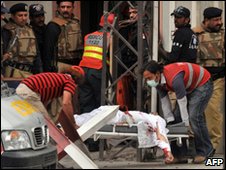
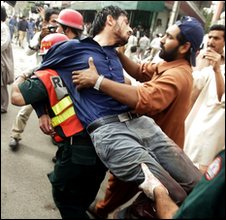
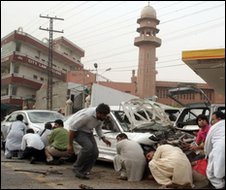
More than 80 Ahmadis were killed last months in two atacks in Lahore
When a Pakistani Muslim applies for a passport or national ID card, they are asked to sign an oath that no Muslim anywhere in the world is asked to sign.

The oath goes like this: “I consider Mirza Ghulam Ahmad an impostor prophet. And also consider his followers, whether belonging to the Lahori or Qadiani group, to be non-Muslims.”

Like millions of other Pakistanis, I have signed this oath several times without giving much thought to exactly what Mr Ahmad stands for, or what the technical difference between Lahoris or Qadianis is. I want my passport, and if I have to sign up to a fatwa to get it, so be it.

But like millions of people from my generation I also remember that when I was growing up, the minority Ahmadi sect were considered just another Muslim sect.

Non-Muslims

Like scores of others I had friends who were Ahmadis. We played cricket together, and sometimes, when our parents ordered us off to the mosque, we even prayed side by side.

Ahmadis are despised by many Pakistanis
Last month, when more than 90 Ahmadis were massacred in two mosques in Lahore, I remembered the precise moment in 1974 when it all began to change.

There were street protests by religious parties against Ahmadis demanding that they should be declared non-Muslims.

One day I saw some bearded activists standing outside a clothes merchant’s shop in our town, chanting anti-Ahmadi slogans and turning customers away, telling them that buying clothes from Ahmadis was haram - forbidden.

At the time I was learning to memorise the Koran from a very kind, mild-mannered teacher.

I asked him what exactly was wrong with the Ahmadis.

He explained to me that they didn’t believe that the Prophet Muhammad was the last and the final messenger.

I said OK, maybe that makes them kafirs, infidels, but who says that kafirs can’t sell cloth?

My teacher’s response was a full-handed slap, so sudden, so unexpected that it rang in my ears for days to come.

That same year Pakistan’s first elected parliament declared Ahmadis non-Muslims.

Then in 1984 Pakistan’s military dictator and self-appointed guardian of the faith General Zia-ul-Haq inserted that oath in the constitution that we are all required to sign.

Because of the new laws, Ahmadis have been sent to prison simply for using the Muslim greeting Assalamu alaikum, or putting a Koranic verse in a greeting card.

Heretic

Over the last three decades the hatred against Ahmadis has become so widespread that Pakistan is now embarrassed by the only Nobel laureate it has ever produced.

Attacks on Ahmadis are beconing increasingly commonplace
Dr Abdus Salam Khan won the Nobel Prize for physics and, as a proud Pakistani, accepted his award in national dress.

But he was an Ahmadi so there is no monument to celebrate him, no universities named after him.

The word “Muslim” on his gravestone has been erased. Even the town he is buried in has been renamed in an attempt to erase our collective memory.

This hatred was evident in the reactions to the massacre.

TV channels were more obsessed with making sure that in their broadcasts Ahmadi mosques were called “places of worship”.

When you refuse to call a place of worship by its proper name, you are implying that it’s not a mosque, it’s not a church, it’s not a synagogue, it’s a place where godless people do godless things.

And all the various Islamic political parties, whose leaders often refuse to pray together, are united on this.

When Pakistan’s main opposition leader Nawaz Sharif used the phrase “our brothers” for the murdered Ahmadis, leaders from 11 political parties came together to condemn him and threatened to issue a fatwa declaring him a heretic.

Over the last three decades the siege has been so palpable that those Ahmadis who couldn’t afford to emigrate have taken to hiding their identity.

If you want to destroy someone in public life it’s enough to drop a hint that they are Ahmadi.

In the 1980s, the former chief minister of Punjab and current federal minister didn’t attend his own mother’s funeral because there were rumours that she was an Ahmadi.

When the funerals of the massacred Ahmadis took place there were no officials, no politicians present.

Pakistan’s liberal bloggers and some English-language columnists did write along the lines that Ahmadi blood is on our hands.

Others were adamant that it was yet another Friday, yet another massacre by the Pakistani Taliban, and we should just fight this sort of terrorism and leave the sectarian debates alone.

Two incidents in the past week made me realise how pathological our response was. At a vigil to mark the massacre, where a handful of people had turned up, a passer-by asked me “Are you an Ahmadi?” My own loud and aggressive denial surprised me.

Then an Ahmadi friend whose father survived the Lahore massacre wrote to me saying: “You know we have been living like this for decades. [Did] something like this have to happen for you to speak up?”

Monday, June 7, 2010

Pakistan’s Ahmadi killings and the conscience of a nation

Reuters Blogs, USA
Pakistan: Now or Never?
Perspectives on Pakistan
Pakistan’s Ahmadi killings and the conscience of a nation
Jun 7, 2010 14:23 EDT

The fierce debate about the nature of Pakistani society triggered by the killing of more than 80 Ahmadis in two mosques in Lahore last month continues to run and run.

Much of the discussion is about why the government had failed to stop the religious right from preaching hatred against the Ahmadis, who are considered non-Muslims in Pakistan because they revere their 19th century founder Mirza Ghulam Ahmad, breaching – according to Pakistani law – a requirement that Muslims accept the finality of the Prophet Mohammad.

While authorities had been willing to shut down Facebook over a competition to draw the Prophet, it had not dared take action to remove banners preaching hatred against the Ahamdis, fearing a backlash from the religious right, Dawn newspaper complained in an editorial.

In a chronicle of deaths foretold, Professor C.M. Naim tracks the earlier killing of an Ahmadi, a retired teacher, in January in the town of Ferozewal. In an article in India’s Outlook magazine (h/t Chapati Mystery) he notes that not only did the police fail to take adequate action against the man’s killers, but also that the media paid very little attention, barring one persistent reporter. He also reproduces a picture of a huge billboard in Ferozewal preaching hatred against the Ahmadis.

“Judging from the image, the sign must have dominated the roundabout where it was set up to exhort the 97.21 percent of Ferozewala’s population against the unfortunate 0.25. It had stayed up for weeks. Thousands, including any number of men with power and authority, saw it but chose to do nothing. Finally a retired schoolteacher victimized by the sign and fearing worse approached the police for relief. A few days later, he ended up dead,” he writes.

He adds: “The following too went unnoticed:
On January 14, an Ahmadi mosque built in1982 near Rabwah was taken away from them by court orders and handed to anti-Ahmadis, “in order to pre-empt extreme law and order disturbances”.
On January 28, a court at Vehari, Punjab, sentenced three Ahmadis to imprisonment and fines on trumped up charges of preaching their religion to “simple Muslims”.
On February 3, an Ahmadi was similarly killed at Shehdadpur, Sindh.
On April 1, three Ahmadi traders were ambushed and killed near Faisalabad.

“Then, on May 28, 2010, in well-organized attacks on two Ahmadi mosques in Lahore, just a few miles away from Ferozewala, more than 90 Ahmadis were killed and scores wounded. We can only hope it was the worst such incident, for unfortunately it was not the last. On June 1, just three days later, the Daily Times reported another killing: an Ahmadi man was stabbed to death in his home and his son seriously wounded in Narowal, Punjab. The assailant, who reportedly threatened not to leave any Ahmadi alive, escaped.”

“Here’s a question,” writes Nadeem Paracha at Dawn. “How come whenever there’s a drone attack … or a case of perceived obscenity or blasphemy surfaces, street corners are at once filled with burqa-clad women and bearded men chanting slogans like ‘Death to infidels’? But none of these fine, sensitive Muslims can be seen protesting when there’s an attack on innocent civilians —Ahmadis or others — by the extremists?”

Former Prime Minister Nawaz Sharif, whose brother Shahbaz Sharif is chief minister of Punjab province where the killings took place, this weekend spoke in defence of the Ahmadis, calling them ”our brethren and an asset of the country”, according to The News. The Sharif brothers in the past have been accused of sympathising with the Islamists and were criticised after newspapers published pictures of the law minister in Punjab – who is loyal to the two – campaigning in a by-election in February with leaders of the outlawed sectarian Sipah e Sahaba.

The post-mortem on the Ahmadi mosque killings is now turning into a bigger discussion of whether secular liberals have any real influence on Pakistani society as it grows more religious and conservative.

“The problem is that there aren’t nearly enough of us for this to matter,” complains the blog Five Rupees. “There are a few scattered in the blogosphere and Twitterverse, and a couple of columnists for Dawn, and the Daily Times editorial board, but that’s it. There are, functionally speaking, no liberals in Pakistan. Oh, there’s plenty of scotch-drinking social liberals (think Salman Taseer). But liberalism and progressivism is not about drinking scotch or wearing jeans. Liberalism is about equality and freedom and personal choice and rationality and the privileging of the individual, and no one believes in those things.”

“We’ve been talking about the dangers of militancy for a long, long time — well before 9/11. That no one bothers listening is not an indictment of the “failed politics of Pakistani liberals”. It’s an indictment of everyone else. If mainstream Pakistan wants to ignore us, fine, that’s their prerogative. But don’t blame us when shit goes bad.”

And in Britain’s Guardian newspaper, Mustafa Qadri notes that more and more Pakistanis are turning to prayer given the failure of the state to provide a credible, secular alternative.

“Uncertainty is an inherent part of the human experience, but in Pakistan much of what a reader in Britain might take for granted is far from certain. How long will the electricity last today? Where will the next bomb go off? And, for most who do not inhabit my privileged world, will I be able to afford the right medication if I fall ill? The profound loss of control felt by long-term illness sufferers and their loved ones has become a countrywide phenomenon in Pakistan.

”The situation has exacerbated our cultural tendency to avow causation in favour of fate and the rewards of prayer. Whether looking for a job, waiting anxiously for exam results or willing the national cricket team to victory, prayer has become a kneejerk source of solace and comfort in difficult times. Holy men, or pirs, and local soothsayers have for generations made a career out of selling their prayers to those in need.

“And why not? Doing the right thing, like expecting to get a plum job without working family contacts, rarely seems to lead to results in our country. During my travels I have met several academically bright students from middle-class backgrounds who complain they cannot get into top university courses because wealthier classmates have paid to gain entrance. The experience for the millions below the middle class, who could never dream of a university education, is even more dire.”

At the very least, the killings of the Ahmadis has prompted a real discussion about the direction Pakistan is headed in. And even, some poetry. One day, looking back, it may well be seen as a turning point.

 
^ Top of Page