Showing posts with label radicalism. Show all posts

Monday, October 24, 2011

Debate Over Indonesian Religion Bill Heats Up

Jakarta Globe, Indonesia
HOME
Debate Over Indonesian Religion Bill Heats Up
Ulma Haryanto & Anita Rachman | October 24, 2011

Rahmat Rahmadijaya, an Ahmadiyah leader living in Jatibening, Bekasi, has been anxious for a few weeks now.

At first he didn’t want to talk, but he later changed his mind. “If I speak out, maybe I can get people to support us, to pray for us,” he told the Jakarta Globe in a recent interview.

He is anxious because of a decree signed by Bekasi’s acting mayor, Rahmat Effendi, that bans the Muslim minority group from conducting activities that may be interpreted as an effort to spread its beliefs.

The ban went into effect on Oct. 13. Since then, Rahmat and other members of the Ahmadiyah community in his neighborhood have started holding Friday prayers under tight security from Bekasi Police.

“Our second Friday prayers went relatively normally, about 60 people joined in,” said another resident, Abdul Rohim.

“We don’t know about next week, though.”

In Need of a Law?

The fear appears to be justified. Several violent incidents have targeted Ahmadiyah communities throughout the country.

One of the worst — an attack in February by a mob of at least a thousand on an Ahmadi group in Cikeusik that left three members of the sect dead — spurred a discussion over a long-delayed bill on religious harmony.

At the time, the bill was presented by lawmakers as a long-term solution to the religious conflicts plaguing the country and to give a stronger legal basis to joint ministerial decrees that regulate religious matters in the country today.

Last week, Coordinating Minister for People’s Welfare Agung Laksono, Religious Affairs Minister Suryadharma Ali and Home Affairs Minister Gamawan Fauzi reiterated their endorsement of the bill.

“We need a regulation that contains both conflict prevention and solutions to the problems obstructing religious harmony,” Agung said.

The current draft of the bill regulates various religious rights and obligations such as proselytizing, celebrating religious holidays, constructing places of worship, funerals and religious education.

“The original version of the draft, written by the staff of the Religious Affairs Ministry, dated back to 2003,” said Ismail Hasani, a researcher at Setara Institute for Peace and Democracy. “The current draft is more or less the same.”

The bill is part of the 2011 National Legislation Program (Prolegnas), or the list of priority bills for the year, but it has been delayed as the House of Representatives has turned its attention to other bills.

Will It Help?

Setara deputy chairman Bonar Tigor Naipospos, an advocate of pluralism, isn’t looking forward to the religious harmony bill being passed into law.

He said it would only legitimize existing discriminatory regulations within the 1965 Anti-Blasphemy Law and a 2006 joint ministerial decree on places of worship, which has contributed to a number of conflicts.

In Bogor, for instance, Mayor Diani Budiarto has used the ministerial decree to continue to defy a Supreme Court ruling ordering the reopening of the GKI Yasmin Church.

The 2006 joint ministerial decree requires 60 signatures from local residents in support of the construction of a place of worship, but the mayor has claimed that GKI Yasmin forged the signatures.

The tension in Bogor came to a head two weeks ago, when churchgoers and public order officers (Satpol PP) clashed in front of the sealed building.

West Java Police are now investigating complaints filed by both camps against each other. A Satpol PP chief is accusing GKI Yasmin churchgoers of hitting him in the jaw and knocking him unconscious, while the church is countersuing Satpol PP for disrupting its service.

Bonar said the bill would be unhelpful to the cause of the Ahmadiyah as well. “The spirit of the law that condemns their belief, the 1965 Anti-Blasphemy Law, is still incorporated in the bill,” he said.

Fears and Worries

Abdul Kadir Karding, chairman of House Commission VIII, which oversees social affairs, urged the public to think positively about what the lawmakers in the commission were doing.

He said the House wanted to give protection to minorities.

“For instance, when there is a non-Muslim person living in a Muslim community, he or she has the right to use the same public cemetery like the majority,” he said. “In the Cikeusik case, we want this future law to ensure that the guilty will get punished.”

Activists were outraged that most of the 12 people convicted in the Cikeusik attack were sentenced to just six months in jail — the same sentence given to one of the Ahmadi victims convicted of violent assault and disobeying police officers who had ordered him and about a dozen other Ahmadis to evacuate ahead of the attack.

Karding acknowledges that unless the bill is carefully constructed, it risks becoming a tool for “hard-line groups to limit freedom of religion.”

Fajar Riza Ul Haq, executive director of the Maarif Institute, asked the House to be more open in the drafting and deliberation.

He said it should learn from the recently passed Intelligence Law, when both the House and government ignored public criticism.

One critical point, he said, was how the House would define “harmony” in the bill. “They should have drafted a religious freedom bill instead of this one.”

Harmony vs Freedom

Harmony, for instance, could be used to justify the recently issued Bekasi ban on the Ahmadiyah’s activities, which states the ban is needed to “preserve and maintain the stability of conduciveness and security, peace and order in Bekasi.”

Bonar views the religious harmony bill as the “middle way” after the Constitutional Court rejected a judicial review of the 1965 Anti-Blasphemy Law.

“Because even though the court rejected the request because the law itself is not unconstitutional, it stated in its ruling that a revision or an update of the law was needed,” Bonar said.

“Principally, we can’t agree with the law since it reflects the fact that this government thinks religious harmony is something that should be engineered, rather than grow naturally.”

If the government really wanted “harmony,” Fajar said it should start addressing the prevalence of hate speech.

In Jatibening, just before the ban on the Ahmadiyah was issued, members of the notorious hard-line group Islamic Defenders Front (FPI) were in the area.

“They came to Jatibening and intimidated people, telling us to shut down our mosque about three weeks ago,” Rahmat said.

Additional reporting by Vento Saudale

Copyright 2010 The Jakarta Globe
URL: www.thejakartaglobe.com/home/debate-over...up/473591

Friday, October 14, 2011

New Religion Law Will Help: Minister

Jakarta Globe, Indonesia
NEWS
New Religion Law Will Help: Minister
Camelia Pasandaran & Antara | October 14, 2011

A proposal for a new law on religious issues that may soon make its way to the House of Representatives has been welcomed by some, but others warn that it may restrict religious freedom.

Ministers have responded to a perceived rise in radicalism and religious intolerance by announcing that a new “bill on religious harmony” is being discussed.

According to Agung Laksono, coordinating minister for people’s welfare, the bill, which was suggested after a meeting between Religious Affairs Minister Suryadharma Ali and Home Affairs Minister Gamawan Fauzi, would “legislate for better religious understanding on the ground.” He added that the bill was intended to head off potential sectarian conflicts, which have been on the rise.

“To maintain harmony, we need a regulation that contains both conflict prevention and solutions to the problems obstructing religious harmony,” he said.

While Agung said that discussions were at an early stage, another lawmaker, Abdul Kadir Karding, chairman of House Commission VIII, which oversees social affairs, said the bill had been on the table for some time.

Karding warned that unless the bill was carefully constructed, it would become a tool of “hard-line groups to limit freedom of religion.”

He said that current laws have led to violence against religious groups not recognized by the government, citing the cases of the Tegal in Central Java, the dismantling of a Buddha statue in North Sumatra, attacks on the minority Ahmadiyah sect and intimidation of Christians in Bogor.

Wednesday, June 8, 2011

Could Indonesia ‘Pakistanize’?

   Wednesday, June 8, 2011
Wall Street Journal, USA
REVIEW & OUTLOOK ASIA
Could Indonesia ‘Pakistanize’?
The present tepid leadership hasn’t done enough to halt the rise of militant Islam.

By BENEDICT ROGERS

Four men, traumatized, terrorized and stigmatized, sat in a Jakarta apartment and described to me how they were almost killed by a Muslim mob earlier this year.

One was stripped naked, beaten to a pulp, a machete held at his throat with a threat to cut off his penis. He was dragged through the village and dumped in a truck like a corpse. Another fled into a fast-flowing river, pursued by attackers throwing rocks and shouting “kill, kill, kill.” He hid in a bush, dripping wet and extremely cold, for four hours. A third suffered a broken jaw, while a fourth, pursued by men armed with sickles, machetes and spears, was detained by the police for three days, treated as a suspect not a victim.

The four were members of Indonesia’s Ahmadiyya community, a Muslim sect regarded by other Muslims as heretical. They were victims of an attack in Cikeusik, Banten province, on February 6. More than 1,500 Muslims attacked 21 Ahmadis, killing three. President Susilo Bambang Yudhoyono has called for a full investigation.

If Cikeusik was an isolated incident, it could be dismissed as a tragedy. Sadly, such tragedies are increasingly frequent. Last month I visited Cisalada, West Java, the scene of a similarly violent attack in October. Houses had broken windows boarded up, and some had been burned. A mob had thrown Molotov cocktails at the Ahmadi mosque and carried samurai swords. Anti-Ahmadi abuse was scrawled on the walls.

Indonesia’s tradition of pluralism, enshrined in its state ideology “pancasila,” is now under increasing threat. The world’s largest Muslim-majority nation has won applause for its religious tolerance and remarkable transition from authoritarianism to democracy, but these achievements are undermined by an increasingly vocal, violent Islamist minority. Under pressure from Islamists, the government banned the dissemination of Ahmadiyya teachings in 2008.

The rise of militant Islam has caused some in Indonesia to warn of “Pakistanization.” As a term to describe Indonesia today it is an exaggeration, but as a warning of what may come if action is not taken, it is valid. Pakistan’s path to extremism accelerated when the Ahmadiyya were banned in 1984; their treatment is a barometer of tolerance in a Muslim society.

It’s not just the Ahmadiyya. Christians are also under pressure. Radical Islamists have stirred tensions and forced churches to close. Even churches that have legal registration and secured Supreme Court rulings in their favor have remained sealed, their congregations forced to worship in the street. According to the Setara Institute in Indonesia, 91 violations of religious freedom were documented in 2010, at least 75 of which affected Christians.
A police officer stand guards at the damaged house of a member of Ahmadiyah after it was attacked by Muslim mob in Pandeglang, Banten province, Indonesia, Monday, Feb. 7, 2011.

A police officer stand guards at the damaged house of a member of Ahmadiyah after it was attacked by Muslim mob in Pandeglang, Banten province, Indonesia, Monday, Feb. 7, 2011.
AFP/Getty Images
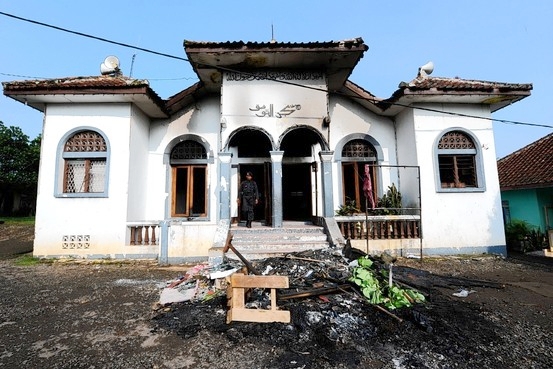
A mob damaged this Ahmadiyya mosque in Cisalada, West Java, last year.
“The radicals want to push us to the limit, to see how long we are prepared to worship [out on the street] before we surrender,” Rev. Palti Panjetan, pastor of the HKBP Filadelfia church in Bekasi, West Java, told me. Local Muslims who have supported the church have also faced intimidation from Islamists.

Both Ahmadis and Christians warn that if their persecution continues, Indonesia could fracture. The victims of Cikeusik talk of seeking asylum overseas for their entire community. “We still love our country, but one day Christians and Ahmadis will decide we want to separate from Indonesia, if the situation does not change,” Rev. Panjetan says. “It is only a matter of time before there is ‘Sudan-ization,’ a separation of Indonesia between Muslims and minorities, like north and south Sudan. We don’t want that.”

Indonesia does have constitutional and legal protections for minorities. In fact, United Nations High Commissioner for Human Rights Navanethem Pillay, in a letter to Indonesia’s foreign minister in April, called for a review of all laws restricting religious freedom, to “ensure they comply” with Indonesia’s own constitution and international covenants.

The core problem is the weakness of the government. President Yudhoyono makes tepid statements condemning violence, but takes no action to protect minorities. Perpetrators of violence are arrested, but face minor charges and paltry punishments.

There are some signs that leaders are waking up. Last week former presidents B.J. Habibie and Megawati Sukarnoputri expressed concern that pancasila had lost its prominence. Last month, leading political and judicial figures, including the president, warned that “pancasila has been sidelined from people’s way of life.” Such statements are welcome, but rhetoric alone will not stop Indonesia’s slide toward Islamization.

Instead there are concrete steps Mr. Yudhoyono should take. Domestically, he can ensure that perpetrators of violence are brought to justice, that victims and witnesses receive proper protection, and that more investment is made in counter-extremism initiatives like the Wahid Institute, a liberal Muslim think tank founded by former President Abdurrahman Wahid. Jakarta could revise a blasphemy law on the books since the Sukarno era—often used by radicals to stir up hatred—and repeal the Ahmadiyya decree.

These recent events have tarnished Indonesia’s international reputation as a tolerant society. President Yudhoyono could start to repair it by inviting the U.N. Special Rapporteur on freedom of religion and belief to visit the country, as suggested by Ms. Pillay in her letter. Since Mr. Yudhoyono seems to care about Indonesia’s stature abroad—evidenced by Jakarta’s willingness to take on leadership roles in the region—the international community is in the right place to urge him to act.

Appeals from people like Rev. Panjetan must be heard. “We need support from the international community… . The rise of radicalism is not only a problem between Indonesians. There is an international agenda. Wahhabi influence is growing. We need the international community to be a watchdog. If there is no help from the international community, we are hopeless, we will be destroyed.”

If Indonesia abandons pluralism, the geopolitical consequences will be significant. The democratic success of the largest Muslim-majority country will be in jeopardy. The world will have lost a role model of tolerant, moderate Islam, which doesn’t bode well for the success of democratic revolutions in the Middle East. It is in all our interests to ensure that does not happen.

Mr. Rogers is East Asia Team Leader at Christian Solidarity Worldwide, a human rights organization based in London.

Copyright ©2011 Dow Jones & Company, Inc. All Rights Reserved
URL: http://online.wsj.com/article/SB10001...824805736.html

Wednesday, March 23, 2011

Peaceful Lives, Violent Deaths: The Silent Cries of the Ahmadis

The Huffington Post, USA
Joseph K. GrieboskiJoseph K. Grieboski
Founder, The Institute on Religion and Public Policy
Posted: March 23, 2011 02:49 PM
Peaceful Lives, Violent Deaths: The Silent Cries of the Ahmadis
On March 13, three Ahmadiiyya Muslims were brutally attacked in the Banten province of Java, Indonesia. Video footage taken during the ambush demonstrates the victims being beaten to death by sticks.

On February 6, over 1,000 anti-Ahmadiyya extremists attacked the home of cleric Ismail Suparman in Cikeusik Village. The Indonesian Ahmadiyah Congregation (JAI) reportedly possesses footage of this travesty, which shows 21 Ahmadis savagely attacked with sticks, rocks, tools and machetes.

Ahmadis live by the motto “Love for All, Hatred for None,” and have no history of engaging in violence. Because they don’t fight back, they are an easy target for Muslim extremists who have been taught they will go to heaven if they murder someone who practices the Ahmadiyya faith.

There are millions of practicing Ahmadis worldwide, with established branches in 190 countries in North and South America, Europe, Asia, Africa, and Australia. Established in India in 1889 by Hadrat Mirza Ghulam Ahmad, The Ahmadiyya community was founded by a man who believed in universal brotherhood, opposed violence as a means of advancing religion, and rejected all forms of terrorism.

Ahmadis adhere to all practices as advised for Muslims in the Quran and present a progressive vision of Islam, which is in tune with modernity. Despite their small size, Ahmadis have distinguished themselves as trailblazers by translating the Quran more than any other group of Muslims.

Internationally regarded as a peaceful people, Ahmadis are theologically considered a “sect” because they reject a central doctrine in Islam: the belief that Muhammad is the last prophet. Because of this, they are under constant threat of persecution by fundamentalists who view Ahmadis as heretics. And the attacks are rapidly increasing in violence and number around the globe.

In 2008 Indonesia issued a joint ministerial decree prohibiting the country’s 200,000 Ahmadis from spreading their beliefs. This law has led many extremist Muslims to believe they have license to take matters into their own hands. In an aggressive hate campaign fueled by Indonesian authorities, extremist Muslims are calling for Ahmadis’ businesses to be boycotted, properties destroyed and clerics assassinated.

The Ahmadiyya community fares no better in Pakistan, where there have been more murders in the last three years than the previous 20. In 1974, Prime Minister Zulfikar Ali Bhutto declared Ahmadis a “Non-Muslim minority,” thus publicly labeling them as second-rate citizens. He orchestrated violent, countrywide riots, which culminated in getting the Ahmadis classified as “Non-Muslims” via a constitutional amendment. This legal status creates an atmosphere of intolerance and persecution, thereby establishing a standard with government permission that Ahmadis can be discriminated or persecuted.

Pakistan’s military dictator General Ziaul Haq proclaimed the notorious anti-Ahmadiyya Ordinance XX in 1984, which states that Ahmadis can be fined and imprisoned for three years just for expressing their faith. The ordinance made it illegal for Ahmadis to say Assalamu Alaikum, to practice particular religious rights, or to proselytize. By doing so, Haq gave Pakistani extremist Muslims free reign to terrorize Ahmadis without fear of retribution. And so, like Indonesia, the violence continues.

Since the 1984 ordinance, hundreds of Ahmadis have been subjected to looting of property, desecration of mosques and murder attempts - and 3,500 have faced court prosecutions due to their faith. In May 2010 in Lahore, sectarian terrorists assassinated 86 Amadis while they were gathered to worship. While this incident drew the condemnation of human rights organizations around the world, international pressure has made no impact on the current laws or on the attitude of the government.

Ahmadis must denounce the founder of the Ahmadiyya community if they apply for a national identity card or passport in Pakistan. They are denied entry to colleges and access to jobs. Thousands have been forced to leave their communities due to violence that continues to go unchecked by authorities.

Ahmadis are good, peaceful, law-abiding people. Their faith - like all religious believers - is a central part of their identity. While only reviewing Indonesia and Pakistan, their community faces hardship and discrimination, persecution and murder in many other countries.

Christians can find many similarities with their Ahmadi brothers, as one time Protestants faced similar treatment. But regardless of faith or identity, we cannot remain deaf to their silent cries. For by doing so, we sanction the actions of their slayers.

It is my hope that the international community recognizes its duty to protect the rights of all people to believe according to the dictates of their hearts, their minds and their consciences, and that the silent permission of persecution by the absence of response, the lack of concern, the attitude of indifference quickly comes to an end.

Copyright © 2011 TheHuffingtonPost.com, Inc.
URL: www.huffingtonpost.com/joseph-k-grieboski/...

Monday, March 21, 2011

The fate of minorities in Pakistan

READERS FORUM
Mon, 03/21/2011
10:04 PM
The fate of minorities in Pakistan [Letter]
This is in reference to “Pakistan, Ahmadiyah and democracy, (the Post, March 16) by Sanaullah, the Ambassador of Pakistan.

Sanaullah is ambassador of Pakistan and it’s his duty to paint a glorified picture. But the reality is too bleak. Living in Pakistan is altogether different from what Sanaullah states.

As far as the economy is concerned, I am not an economist but the figures available on the Internet indicate Pakistan’s GDP Growth rate is now at 2 percent as compared to 6.8 percent in 2007.

Minorities, in fact, are treated as second-grade citizens. Constitutionally, they are free to worship but practically an Ahmadi cannot worship freely; thanks to blasphemy laws. Minorities are not allowed to build places of worship according to their needs.

Hindus are fleeing to India. According to a recent report published in media, more than 50,000 have fled in recent years, including legislator Ram Singh Sodho. The plight of the Ahmadis is even worse.

Let alone building new places of worship, they are not allowed to repair their old and dilapidated ones. They are routinely bullied in their neighborhoods, discriminated in government jobs, and the education and business sectors.

Their headquarters town (Rabwah; forcibly re-named Chenab Nagar by the government under pressure from radical mullahs), which is built on purchased land, is practically under siege by fanatics who have forcibly occupied their land.

They are not allowed to purchase land around the town to expand their housing.

Wake up Indonesia. Religion-related laws are a bad omen of radicalism/Talibanization, which have plagued Pakistan where no place/community and sect is safe. It all started with just a constitutional amendment.

Anwar Ahmad
Karachi


Copyright © 2008 The Jakarta Post - PT Bina Media Tenggara. All Rights Reserved
URL: www.thejakartapost.com/news/2011/03/21/the-fate...

Sunday, March 20, 2011

Jakarta Journo: SBY’s Legacy Soiled On Freedom of Faith

Jakarta Globe, Indonesia
LIFE & TIMES
Jakarta Journo: SBY’s Legacy Soiled On Freedom of Faith
Armando Siahaan | March 20, 2011

President Susilo Bambang Yudhoyono will be remembered for a lot of things, but being a bastion of pluralism is definitely not one of them. Just look at the recent spate of religious violence — chaos left nearly unchecked by the national government, which seems afraid to touch issues such as the Ahmadiyah with a 10-foot pole. It’s enough to make me question if things have actually improved at all since the Suharto era.

Suharto’s New Order regime severely curtailed religious freedoms, tearing apart the 1945 Constitution, which guaranteed citizens the freedom to adopt any religion, thus changing Indonesia into a country that recognizes just five official faiths. Then in 1978, the Ministry of Home Affairs issued a directive obligating all Indonesians to disclose their religious affiliations on their identity cards and, bizarrely, forcing us to pick from one of five recognized religions.

But the real root of the country’s religious intolerance is the 1965 Blasphemy Law, which was drafted under Sukarno, but adopted and enforced by Suharto.

The law prohibits any alternative interpretations of the official religions, giving the government the right to restrict and ban deviant sects, and imprison their followers for faith crimes. The Blasphemy Law effectively destroys the separation between church and state, which many argue is a necessary component to a functioning democracy.

Moreover, through totalitarianism and his draconian foot soldiers, Suharto made sure that religious groups, including Muslim hard-liners, were never given the chance to grow into influential forces in society.

Post-Suharto Indonesia has been praised by many foreign commentators as a poster child for democracy in Southeast Asia and the Muslim world. But as recent events suggest, religious freedom has been left in the dust on our glorious march to democracy. A truly democratic Indonesia would revoke the 1965 Blasphemy Law, but reality suggests institutional support for the law will not wane anytime soon.

In fact, instead of rescinding the law, the administration issued a 2008 joint ministerial decree on the Ahmadiyah, based on the law, which severely curbs the minority Islamic sect’s rights.

A series of violent attacks against the Ahmadis followed the decree, and hard-liners felt the attacks were completely justified because of the law. Yudhoyono repeatedly condemned the attacks, but consistently defended the 2008 anti-Ahmadiyah decree.

In the latest development, dozens of Ahmadis in East and West Java converted to mainstream Islam, with widespread rumors that the military pressured the sect’s followers into renouncing their faith. The government and the military denied this claim.

The conversions may represent a triumph for hard-liners, but they are certainly a massive blow to our country’s democratic image.

The corrosion of our religious freedoms has generated criticism both here and abroad. The United States and the European Union have conveyed concern over the escalation of religious tensions in light of the recent killings of three Ahmadis in Banten and the burning of churches in Central Java. Furthermore, a group of 27 US lawmakers last week sent a letter to Yudhoyono demanding that the government overturn the 2008 decree on the Ahmadiyah, as it “runs contrary to the principles of international human rights.”

Suharto severely limited religious freedom, but also prevented religious extremists from harassing minority groups. Yudhoyono’s administration has not only failed to repeal Suharto’s discriminatory laws, but has also given unchecked freedom of speech to all major religious groups, giving hard-liners a megaphone to voice their hate speech and a free pass to act on it.

If Suharto’s era was marked by out-and-out tyranny, it seems Yudhoyono’s era will be remembered for allowing the tyranny of the majority. He still has three years left to make things better, but I’m not holding my breath.

Copyright 2010 The Jakarta Globe
URL: www.thejakartaglobe.com/lifeandtimes/sbys-legacy...

Monday, February 14, 2011

Indonesia — Land of Tolerance or Terror?

The Huffington Post, USA
February 14, 2011
Harris ZafarHarris Zafar
National Spokesperson & Director of Youth Outreach, Ahmadiyya Muslim Community USA
Posted: February 14, 2011 06:03 PM
Indonesia — Land of Tolerance or Terror?
Indonesia once hailed itself as a moderate, diverse nation that protects freedom of religion for all its citizens, with a national motto “Bhinneka Tunggal Ika,” meaning unity in diversity. Three months ago, President Obama praised Indonesia as a model of religious tolerance when he said that Indonesia and the United States share principles of unity and tolerance.

An image from Ahmadi lynching video in Indonesia

The grim reality, however, is that Indonesia is losing the right to call itself a tolerant nation that promotes or protects diversity. Instead, due to failed policies, its government has allowed a real militant threat to grow within its borders.

Just last week, in a span of three days, mobs in Indonesia attacked two different religious groups, with the police unable to stop them. On February 8th, a mob of 1,000 militants attacked the police and burned two churches to protest what they considered a far too-lenient sentence given to a Christian for allegedly blaspheming Islam. The mob is calling for his death.

Two days earlier, on Sunday, a mob of more than 1,000 extremists wielded machetes and attacked 18 peaceful members of the Ahmadiyya Muslim Community staying in a house. Three have been confirmed dead and five critically injured. A gruesome video of the attack has surfaced, showing two bloodied young men of this community being hacked to death as the crowd cheers and pelts the lifeless bodies with stones. Meanwhile, the police idly stand by. This footage can be found online, if you have the stomach to watch the brutality.

Hard-line extremists are literally getting away with murder, as their vile attacks result in no punishment. At the root of the problem is Indonesia ‘s misused 1965 Blasphemy Law, which makes it unlawful, “to, intentionally, in public, communicate, counsel, or solicit public support for an interpretation of a religion or a form of religious activity that is similar to the interpretations or activities of an Indonesian religion but deviates from the tenets of that religion.”

Since hardliners disagree with the reformative interpretation of the Ahmadiyya Muslim Community, they are able to use the Blasphemy Law to justify attacks against them. The Blasphemy Law makes it illegal to advocate “deviations from teachings of religion considered fundamental by scholars of the relevant religion.” So forget about separation of religion and state. This law gives ultimate control to religious “scholars” in deciding who should be punished for holding variant interpretations of their religion.

Sunday’s attack against the Ahmadiyya Muslim Community is not a coincidence; rather, it is a direct result of a focused, organized effort to silence this peaceful community. Thirty years ago, the top Muslim clerical body in Indonesia declared that the Ahmadiyya Muslim Community is not a legitimate Muslim community, resulting in the Ahmadiyya Muslim Community’s activities being outlawed in several areas of Indonesia. Astonishingly, the Indonesian government funds this clerical body and appoints its members.

In 2008, Indonesia ‘s Minister of Religious Affairs, Attorney General and Minister of the Interior issued a joint decree ordering Ahmadi Muslims to discontinue the proclamation of their faith. Since this 2008 decree, extremists have used this decree to justify acts of terrorism against the Ahmadiyya Muslim Community.

The Setara Institute – an NGO that monitors religious freedom – reports that violence against the Ahmadiyya Muslim Community has significantly increased from just three incidents in 2006 to 50 in 2010 – amounting to more than 100 recorded attacks against the community since 2008.

Historically, any form of a blasphemy law – meant to punish those accused of insulting a faith – gets misused to persecute and strike terror into the hearts of minority religious groups. The sheer barbarity of Sunday’s attack illustrates how far Indonesia has drifted from being a tolerant nation. It is time for Indonesia to start becoming more intolerant of militants seeking to spread terror.

Indonesia pledged to endorse Article 18 of the Universal Declaration of Human Rights, which guarantees, “freedom of thought, conscience and religion” and “freedom, either alone or in community with others and in public or private, to manifest his religion or belief in teaching, practice, worship and observance.” It is time for Indonesia to live up to this pledge.

President Obama has indicated a possibility of strengthening ties with Indonesia . I call on our President to leverage this bond to urge the Indonesian Government to bring those behind Sunday’s attack to justice and ensure no future attacks are levied on the Ahmadiyya Muslim Community or the Christian community. Militant groups like Islam Defenders Front (FPI) have already threatened to initiate “sweeping raids” of Ahmadi Muslim properties in other areas of Indonesia in the near future, which indicates a continued threat to the community. It is time for the Indonesian Government to ensure that Ahmadi Muslims, Christians and other religious minorities remain safe.

It is time for the Indonesian Government to revoke the June 9, 2008 Joint Decree against Ahmadi Muslims. It is time for the Indonesian Government to repeal the 1965 Blasphemy Law. It is time to stand for your citizens; not for terrorists. It is time to stop these callous attacks against Christians, Ahmadi Muslims, or anyone else. It is time to live up to your motto of unity in diversity.

Indonesia, it is time. Are you truly that model of religious tolerance our President said you are? Do you respect and protect diversity? The whole world is watching, and it’s your move.

Copyright © 2011 TheHuffingtonPost.com, Inc.
URL: www.huffingtonpost.com/harris-zafar/indonesia..._b_821180.html

Tuesday, October 14, 2008

Fears radicals penetrating leading Indonesian religious body

--- ABC Radio Australia

Updated October 13, 2008 14:13:11

Fears are emerging that Indonesia’s highest Muslim authority is being infiltrated by Islamic radicals.

The Council of Muslim Scholars, or Majelis Ulama, is a prominent player on the Indonesian political scene and plays an influential role as an advisor to the government on religious matters.

But recent pronouncements, such as the discussion of a ban on smoking, a ruling against vasectomies, and the role played by the council in the debate on a controversial pornography bill, have led some observers to worry that the organisation is being infiltrated by radical groups.

This is coupled with a perceived increase in the council’s influence.

In late September, the council issued a fatwa, or religious opinion, against the Ahmadiyah group and urged the government to ban the group and freeze its operations.

Head of the graduate school at the State Islamic University in Jakarta, Azyumardi Azra, told Radio Australia’s Connect Asia program he has been warning of the growth of radicalism within the council for some time.

“There are some tiny Islamic groups, or Muslim groups who have a literal understanding of Islam,” he said.

“These groups have a growing influence on MUI because they are very active.

“And of course this has a lot to do with the passivity of the moderate Muslim organisations like Nahdlatul Ulama and Muhammadiyah.”

Abdul Mu’ti from Indonesia’s second largest Muslim group, Muhammadiyah, agrees but says that international politics has helped fuel these groups.

“The international developments might lead to the emotional response from certain Islamic groups including those who are associated with Indonesia Ulama council, for example, on their reponse to cases happening in Iraq and Paleistine.”

However, the politicisation of fatwas could mean decreasing influence for the council.

Abdul Mu’ti says as people become more rational they will be more critical on the issuing of Fatwas.

URL: www.radioaustralia.net.au/news/stories/200810/s2389163.htm?tab=latest

 
^ Top of Page