 |
Showing posts with label pluralism. Show all posts
Showing posts with label pluralism. Show all posts
Tuesday, August 16, 2011
Yudhoyono says Indonesia is tolerant nation
Yudhoyono says Indonesia is tolerant nation
President Susilo Bambang Yudhoyono on Tuesday defended Indonesia’s reputation for pluralism, as his government faces growing criticism over its failure to respond to a spate of religious hate crimes.

In an Independence Day speech, the ex-general accepted that the mainly Muslim country was facing “threats” to religious harmony but offered little to reassure minorities which have come under frequent attack in recent months.
“Even though there are challenges and threats to pluralism, tolerance and social harmony, we cannot move from our belief that Indonesia is a nation that is able to live in pluralism,” he said in a televised address.
“We have to defend this belief without any doubt.”
Local and international human rights groups have expressed outrage recently over sentences handed out to members of a religious lynch mob who killed three Muslim minority sect members in February.
A court jailed 12 members of the Sunni Muslim mob for three to six months each, even though they were caught on film viciously attacking Ahmadiyah sect members in front of police officers.
The same court on Monday jailed one of the Ahmadiyah survivors of the attack, a man who almost lost his hand in the violence, for six months for defending himself and his friends, prompting criticism from the United States.
“We are disappointed by today’s sentencing of Deden Sudjana who was a victim of the February 6 attacks,” State Department spokeswoman Victoria Nuland told reporters.
“We again encourage Indonesia to defend its tradition of tolerance for all religions, a tradition praised by President (Barack) Obama in his November 2010 visit to Jakarta.”
A panel of judges found Sudjana guilty of ill-treatment and ignoring an order to evacuate the sect’s property in Cikeusik, western Java, as the 1,500-strong mob arrived.
Earlier, the court gave a teenager who was filmed crushing one victim’s head with a stone only three months’ jail. That individual is already free and has been welcomed back to his village as a hero.
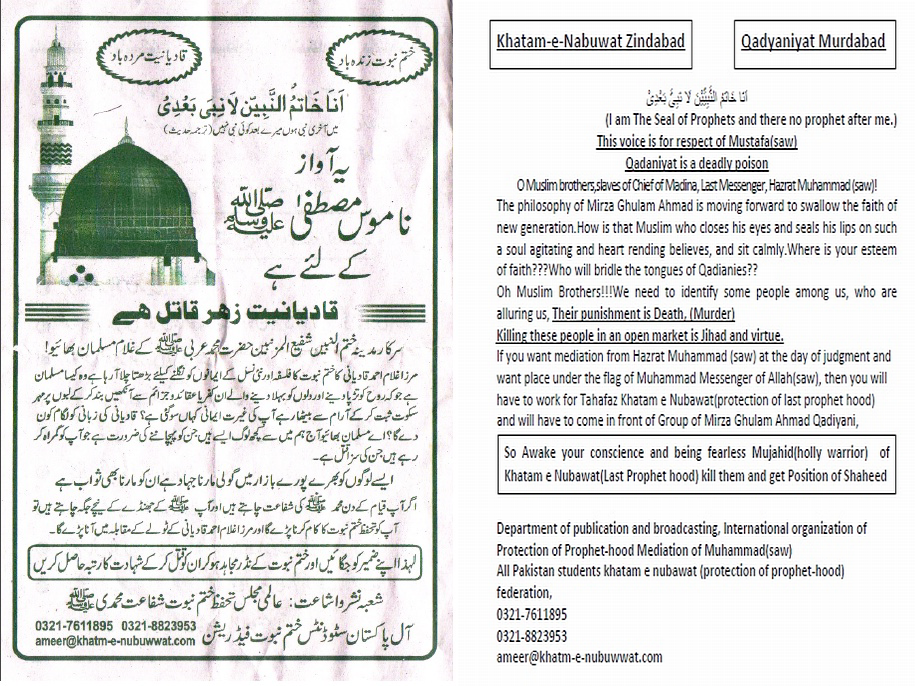
Anti-Ahmadiyah violence erupted again this week in Makassar, Sulawesi, when hundreds of Sunni extremists raided one of the sect’s places of worship on Sunday in front of police, who did nothing to intervene, rights groups said.
One sect member suffered severe head injuries and three local human rights workers who tried to stop the attack were badly beaten, Amnesty International said.
“The Ahmadiyah are not receiving adequate protection from the security forces or the courts,” Amnesty Internationals Asia-Pacific deputy director, Donna Guest, said in a statement.
“We fear that some groups now think that they can attack religious minorities and human rights defenders without any fear of serious consequences.”
The Ahmadiyah community claims to have some 500,000 followers in Indonesia, where it has been established since the 1920s after originating in South Asia.
It is regarded as heretical by mainstream Muslims because it teaches followers to regard the sect’s Indian founder as the last prophet of Islam, instead of Mohammed.
“Even though there are challenges and threats to pluralism, tolerance and social harmony, we cannot move from our belief that Indonesia is a nation that is able to live in pluralism,” he said in a televised address.
“We have to defend this belief without any doubt.”
Local and international human rights groups have expressed outrage recently over sentences handed out to members of a religious lynch mob who killed three Muslim minority sect members in February.
A court jailed 12 members of the Sunni Muslim mob for three to six months each, even though they were caught on film viciously attacking Ahmadiyah sect members in front of police officers.
The same court on Monday jailed one of the Ahmadiyah survivors of the attack, a man who almost lost his hand in the violence, for six months for defending himself and his friends, prompting criticism from the United States.
“We are disappointed by today’s sentencing of Deden Sudjana who was a victim of the February 6 attacks,” State Department spokeswoman Victoria Nuland told reporters.
“We again encourage Indonesia to defend its tradition of tolerance for all religions, a tradition praised by President (Barack) Obama in his November 2010 visit to Jakarta.”
A panel of judges found Sudjana guilty of ill-treatment and ignoring an order to evacuate the sect’s property in Cikeusik, western Java, as the 1,500-strong mob arrived.
Earlier, the court gave a teenager who was filmed crushing one victim’s head with a stone only three months’ jail. That individual is already free and has been welcomed back to his village as a hero.
Anti-Ahmadiyah violence erupted again this week in Makassar, Sulawesi, when hundreds of Sunni extremists raided one of the sect’s places of worship on Sunday in front of police, who did nothing to intervene, rights groups said.
One sect member suffered severe head injuries and three local human rights workers who tried to stop the attack were badly beaten, Amnesty International said.
“The Ahmadiyah are not receiving adequate protection from the security forces or the courts,” Amnesty Internationals Asia-Pacific deputy director, Donna Guest, said in a statement.
“We fear that some groups now think that they can attack religious minorities and human rights defenders without any fear of serious consequences.”
The Ahmadiyah community claims to have some 500,000 followers in Indonesia, where it has been established since the 1920s after originating in South Asia.
It is regarded as heretical by mainstream Muslims because it teaches followers to regard the sect’s Indian founder as the last prophet of Islam, instead of Mohammed.
© Agence France-Presse
URL: http://news.malaysia.msn.com/regional/article.aspx?cp-documentid=5164728
URL: http://news.malaysia.msn.com/regional/article.aspx?cp-documentid=5164728

Friday, March 25, 2011
Bombs Provide Ammo for Preaching Tolerance
 |
HOME |
Bombs Provide Ammo for Preaching Tolerance
Zubaidah Nazeer- Straits Times Indonesia | March 25, 2011
Last week’s string of mail bombs sent to several moderate Muslim leaders in Indonesia have helped to highlight their work, even as loud noises made by radicals continue to chip away at the country’s heritage of tolerance.
These leaders say they are stepping up their activities and working with other groups to emphasise religious diversity and tolerance, and they do not want to rely on the government.
Some have been quietly engaging the Ahmadiyah sect, whose believers were attacked by a mob last month in Cikeusik, Banten province, West Java.
Said Mr Zuhairi Misrawi, chairman of the Muslim Moderate Society: ‘We have been working behind the scenes with other organisations which support pluralism, and engaging our grassroots through our leaders in all provinces. So we know that on the ground, the majority do not think and feel the same way as the radicals.’
He will be meeting representatives of the Ahmadis in Bogor today.
His organization has previously fanned out to the provinces to train young religious teachers, and distributed sermons to mosques with contents that counter radical ideas.
Others like Mr Hashim Muzadi, a former chairman of Nahdlatul Ulama, the largest moderate Muslim group in Indonesia, also oppose the use of force against minority groups. He said: ‘Islamic clerics across Indonesia need to work harder… to enlighten the Ahmadis so they come back to the right path. Whatever the reason is, violence is not allowed… not by Islam, by Indonesian national law, by human rights principles.’
Three Ahmadis were killed in the mob attack last month. Since then, there has been other news of attacks against them.
Though such incidents have sparked fears that Indonesia’s Muslims are increasingly becoming intolerant, several religious leaders remain optimistic that the silent majority will not be swayed by the ideology of hate. Instead, moderate Muslim leaders criticised the government for its handling of religious conflicts.
Mr Luthfi Assyaukanie, co-founder of the Liberal Islamic Network, told The Jakarta Post: ‘Religious intolerance and the radicalisation of Islam are getting worse. The government is failing.’
Added Mr Zuhairi: ‘The government inaction shows its weakness and ignorance in dealing with religious tensions.’
The Muslim Moderate Society is a member of the Alliance for Diversity and Religious Freedom, a band of 25 organisations from different faiths, including Christianity, Buddhism and Hinduism.
Pastor Johannes Hariyanto, secretary-general of the Indonesian Conference on Religion and Peace, said: ‘A lot of us who advocate pluralism have been engaged in regular dialogues for some time but… we should push to make the majority voice louder.’
He added: ‘Indonesia has a rich history of religious diversity and tolerance, but since the mid-1990s some groups have brought back rigid and extreme versions of Islam they were exposed to while studying in some Arab countries. These are not suitable for a secular, multi-religious society like ours.’
The mail bombs jolted many Indonesians as they were sent to those seen to be advocating religious pluralism, observers say. One was sent to Mr Ulil Abshar-Abdalla, founder of the Liberal Islamic Network. Another was sent to the youth chief of a nationalist organisation, while a third was sent to a rock musician who sings songs about Indonesia’s pluralism and diversity.
‘Yes, I am worried that pluralist Muslims are targeted, but we should not be discouraged,’ said Mr Zuhairi. ‘We should continue our work of spreading tolerance and reminding everyone that the Indonesian Constitution protects the rights of everyone to practise their beliefs peacefully.’
Reprinted courtesy of Straits Times Indonesia…
These leaders say they are stepping up their activities and working with other groups to emphasise religious diversity and tolerance, and they do not want to rely on the government.
Some have been quietly engaging the Ahmadiyah sect, whose believers were attacked by a mob last month in Cikeusik, Banten province, West Java.
Said Mr Zuhairi Misrawi, chairman of the Muslim Moderate Society: ‘We have been working behind the scenes with other organisations which support pluralism, and engaging our grassroots through our leaders in all provinces. So we know that on the ground, the majority do not think and feel the same way as the radicals.’
He will be meeting representatives of the Ahmadis in Bogor today.
His organization has previously fanned out to the provinces to train young religious teachers, and distributed sermons to mosques with contents that counter radical ideas.
Others like Mr Hashim Muzadi, a former chairman of Nahdlatul Ulama, the largest moderate Muslim group in Indonesia, also oppose the use of force against minority groups. He said: ‘Islamic clerics across Indonesia need to work harder… to enlighten the Ahmadis so they come back to the right path. Whatever the reason is, violence is not allowed… not by Islam, by Indonesian national law, by human rights principles.’
Three Ahmadis were killed in the mob attack last month. Since then, there has been other news of attacks against them.
Though such incidents have sparked fears that Indonesia’s Muslims are increasingly becoming intolerant, several religious leaders remain optimistic that the silent majority will not be swayed by the ideology of hate. Instead, moderate Muslim leaders criticised the government for its handling of religious conflicts.
Mr Luthfi Assyaukanie, co-founder of the Liberal Islamic Network, told The Jakarta Post: ‘Religious intolerance and the radicalisation of Islam are getting worse. The government is failing.’
Added Mr Zuhairi: ‘The government inaction shows its weakness and ignorance in dealing with religious tensions.’
The Muslim Moderate Society is a member of the Alliance for Diversity and Religious Freedom, a band of 25 organisations from different faiths, including Christianity, Buddhism and Hinduism.
Pastor Johannes Hariyanto, secretary-general of the Indonesian Conference on Religion and Peace, said: ‘A lot of us who advocate pluralism have been engaged in regular dialogues for some time but… we should push to make the majority voice louder.’
He added: ‘Indonesia has a rich history of religious diversity and tolerance, but since the mid-1990s some groups have brought back rigid and extreme versions of Islam they were exposed to while studying in some Arab countries. These are not suitable for a secular, multi-religious society like ours.’
The mail bombs jolted many Indonesians as they were sent to those seen to be advocating religious pluralism, observers say. One was sent to Mr Ulil Abshar-Abdalla, founder of the Liberal Islamic Network. Another was sent to the youth chief of a nationalist organisation, while a third was sent to a rock musician who sings songs about Indonesia’s pluralism and diversity.
‘Yes, I am worried that pluralist Muslims are targeted, but we should not be discouraged,’ said Mr Zuhairi. ‘We should continue our work of spreading tolerance and reminding everyone that the Indonesian Constitution protects the rights of everyone to practise their beliefs peacefully.’
Reprinted courtesy of Straits Times Indonesia…
Copyright 2010 The Jakarta Globe
URL: www.thejakartaglobe.com/home/bombs.../431556
URL: www.thejakartaglobe.com/home/bombs.../431556
Sunday, March 20, 2011
Jakarta Journo: SBY’s Legacy Soiled On Freedom of Faith
|
LIFE & TIMES |
Jakarta Journo: SBY’s Legacy Soiled On Freedom of Faith
Armando Siahaan | March 20, 2011
President Susilo Bambang Yudhoyono will be remembered for a lot of things, but being a bastion of pluralism is definitely not one of them. Just look at the recent spate of religious violence — chaos left nearly unchecked by the national government, which seems afraid to touch issues such as the Ahmadiyah with a 10-foot pole. It’s enough to make me question if things have actually improved at all since the Suharto era.
Suharto’s New Order regime severely curtailed religious freedoms, tearing apart the 1945 Constitution, which guaranteed citizens the freedom to adopt any religion, thus changing Indonesia into a country that recognizes just five official faiths. Then in 1978, the Ministry of Home Affairs issued a directive obligating all Indonesians to disclose their religious affiliations on their identity cards and, bizarrely, forcing us to pick from one of five recognized religions.
But the real root of the country’s religious intolerance is the 1965 Blasphemy Law, which was drafted under Sukarno, but adopted and enforced by Suharto.
The law prohibits any alternative interpretations of the official religions, giving the government the right to restrict and ban deviant sects, and imprison their followers for faith crimes. The Blasphemy Law effectively destroys the separation between church and state, which many argue is a necessary component to a functioning democracy.
Moreover, through totalitarianism and his draconian foot soldiers, Suharto made sure that religious groups, including Muslim hard-liners, were never given the chance to grow into influential forces in society.
Post-Suharto Indonesia has been praised by many foreign commentators as a poster child for democracy in Southeast Asia and the Muslim world. But as recent events suggest, religious freedom has been left in the dust on our glorious march to democracy. A truly democratic Indonesia would revoke the 1965 Blasphemy Law, but reality suggests institutional support for the law will not wane anytime soon.
In fact, instead of rescinding the law, the administration issued a 2008 joint ministerial decree on the Ahmadiyah, based on the law, which severely curbs the minority Islamic sect’s rights.
A series of violent attacks against the Ahmadis followed the decree, and hard-liners felt the attacks were completely justified because of the law. Yudhoyono repeatedly condemned the attacks, but consistently defended the 2008 anti-Ahmadiyah decree.
In the latest development, dozens of Ahmadis in East and West Java converted to mainstream Islam, with widespread rumors that the military pressured the sect’s followers into renouncing their faith. The government and the military denied this claim.
The conversions may represent a triumph for hard-liners, but they are certainly a massive blow to our country’s democratic image.
The corrosion of our religious freedoms has generated criticism both here and abroad. The United States and the European Union have conveyed concern over the escalation of religious tensions in light of the recent killings of three Ahmadis in Banten and the burning of churches in Central Java. Furthermore, a group of 27 US lawmakers last week sent a letter to Yudhoyono demanding that the government overturn the 2008 decree on the Ahmadiyah, as it “runs contrary to the principles of international human rights.”
Suharto severely limited religious freedom, but also prevented religious extremists from harassing minority groups. Yudhoyono’s administration has not only failed to repeal Suharto’s discriminatory laws, but has also given unchecked freedom of speech to all major religious groups, giving hard-liners a megaphone to voice their hate speech and a free pass to act on it.
If Suharto’s era was marked by out-and-out tyranny, it seems Yudhoyono’s era will be remembered for allowing the tyranny of the majority. He still has three years left to make things better, but I’m not holding my breath.
Suharto’s New Order regime severely curtailed religious freedoms, tearing apart the 1945 Constitution, which guaranteed citizens the freedom to adopt any religion, thus changing Indonesia into a country that recognizes just five official faiths. Then in 1978, the Ministry of Home Affairs issued a directive obligating all Indonesians to disclose their religious affiliations on their identity cards and, bizarrely, forcing us to pick from one of five recognized religions.
But the real root of the country’s religious intolerance is the 1965 Blasphemy Law, which was drafted under Sukarno, but adopted and enforced by Suharto.
The law prohibits any alternative interpretations of the official religions, giving the government the right to restrict and ban deviant sects, and imprison their followers for faith crimes. The Blasphemy Law effectively destroys the separation between church and state, which many argue is a necessary component to a functioning democracy.
Moreover, through totalitarianism and his draconian foot soldiers, Suharto made sure that religious groups, including Muslim hard-liners, were never given the chance to grow into influential forces in society.
Post-Suharto Indonesia has been praised by many foreign commentators as a poster child for democracy in Southeast Asia and the Muslim world. But as recent events suggest, religious freedom has been left in the dust on our glorious march to democracy. A truly democratic Indonesia would revoke the 1965 Blasphemy Law, but reality suggests institutional support for the law will not wane anytime soon.
In fact, instead of rescinding the law, the administration issued a 2008 joint ministerial decree on the Ahmadiyah, based on the law, which severely curbs the minority Islamic sect’s rights.
A series of violent attacks against the Ahmadis followed the decree, and hard-liners felt the attacks were completely justified because of the law. Yudhoyono repeatedly condemned the attacks, but consistently defended the 2008 anti-Ahmadiyah decree.
In the latest development, dozens of Ahmadis in East and West Java converted to mainstream Islam, with widespread rumors that the military pressured the sect’s followers into renouncing their faith. The government and the military denied this claim.
The conversions may represent a triumph for hard-liners, but they are certainly a massive blow to our country’s democratic image.
The corrosion of our religious freedoms has generated criticism both here and abroad. The United States and the European Union have conveyed concern over the escalation of religious tensions in light of the recent killings of three Ahmadis in Banten and the burning of churches in Central Java. Furthermore, a group of 27 US lawmakers last week sent a letter to Yudhoyono demanding that the government overturn the 2008 decree on the Ahmadiyah, as it “runs contrary to the principles of international human rights.”
Suharto severely limited religious freedom, but also prevented religious extremists from harassing minority groups. Yudhoyono’s administration has not only failed to repeal Suharto’s discriminatory laws, but has also given unchecked freedom of speech to all major religious groups, giving hard-liners a megaphone to voice their hate speech and a free pass to act on it.
If Suharto’s era was marked by out-and-out tyranny, it seems Yudhoyono’s era will be remembered for allowing the tyranny of the majority. He still has three years left to make things better, but I’m not holding my breath.
Copyright 2010 The Jakarta Globe
URL: www.thejakartaglobe.com/lifeandtimes/sbys-legacy...
URL: www.thejakartaglobe.com/lifeandtimes/sbys-legacy...
Tuesday, March 1, 2011
E. Java Ahmadiyah decree violates constitution, harms pluralism
 | NATIONAL Tue, 03/01/2011 6:52 PM |
E. Java Ahmadiyah decree violates constitution, harms pluralism
The Jakarta Post, Makassar
A decree regulating restrictions on Ahmadiyah activities issued by the East Java governor is against the Constitution and harms the nation’s value of pluralism, noted lawyer Todung Mulya Lubis on Tuesday.
“The decree is a violation of the Constitution,” he said as quoted by tempointeraktif.com.
The Constitution guarantees the freedom of religion, including people’s right to practice their beliefs, he added.
East Java governor Soekarwo on Monday issued a decree that prohibited all Ahmadis in the province from conducting activities related to Ahmadiyah.
Soekarwo’s decree prohibits Ahmadis from distributing pamphlets and placing signs at their offices and mosques. They are also not allowed to wear anything to indicate that they are Ahmadiyah members.
The decree is a bad precedent that may be followed by other regions, Todung said. He urged Home Minister Gamawan Fauzi to immediately annul the decree.
Todung also said he suspected that the decree was issued without careful consideration and was a result of pressure from certain groups.
“That’s one of the risks of being a public official,” he said, adding that he would challenge the decree at the State Administrative Court.
“The decree is a violation of the Constitution,” he said as quoted by tempointeraktif.com.
The Constitution guarantees the freedom of religion, including people’s right to practice their beliefs, he added.
East Java governor Soekarwo on Monday issued a decree that prohibited all Ahmadis in the province from conducting activities related to Ahmadiyah.
Soekarwo’s decree prohibits Ahmadis from distributing pamphlets and placing signs at their offices and mosques. They are also not allowed to wear anything to indicate that they are Ahmadiyah members.
The decree is a bad precedent that may be followed by other regions, Todung said. He urged Home Minister Gamawan Fauzi to immediately annul the decree.
Todung also said he suspected that the decree was issued without careful consideration and was a result of pressure from certain groups.
“That’s one of the risks of being a public official,” he said, adding that he would challenge the decree at the State Administrative Court.
Copyright © 2008 The Jakarta Post - PT Bina Media Tenggara. All Rights Reserved
URL: www.thejakartapost.com/news/2011/03/01/e-java...pluralism.html
URL: www.thejakartapost.com/news/2011/03/01/e-java...pluralism.html
Tuesday, July 13, 2010
Interfaith Relations in Indonesia Put to the Litmus Test
 | July 13, 2010 |
 Endy Bayuni
Chief editor of The Jakarta Post and United Nations Global Expert
Posted: July 13, 2010 10:51 AM
Interfaith Relations in Indonesia Put to the Litmus Test
The tension between Muslims, the dominant religion, and Christians, the largest religious minority group, in Indonesia is coming to the fore with the open accusations by Islamic organizations in Bekasi, a town outside Jakarta, that churches have been aggressively converting Muslims in droves.
The Muslim groups, which include the local branch of the traditionally moderate Nahdlatul Ulama (NU) as well as the militant Front for Islamic Defenders (FPI), declared war against evangelism at the end of their congress in June. They set up a task force empowered to stop “Christianization” of Muslims in the township.
The congress would not have raised so much of an eyebrow if this was an affair involving the usual suspects like the FPI, which have of late been waging a “jihad” against people of other religions, including razing and vandalizing churches, harassing Christian masses, and attacking “misguided” Islamic sects like the Ahmadiyah. Militant, and at times destructive, these groups have never been seen as representing the mainstream Muslims in Indonesia, and most people would applaud if and when police stopped them from their violent behavior.
But the presence of NU representatives in the Bekasi congress, and the virtual silence of its national leaders as well as of other Muslim leaders who have taken part in many interfaith dialogues in the past, suggests their complicity if not of their shared concern about the activities of Christian evangelism in the country.
This could spell trouble for the relations between the religious communities in Indonesia, and raises questions about the effectiveness and sincerity of these interfaith dialogues, which were supposedly designed to build understandings and dispel mutual fears and suspicions between people of different faiths.
One of the criticisms about these dialogues is that they almost always involved the same leaders. Familiarity certainly helps to improve their communication but these dialogues have mostly excluded leaders of the more vocal or radical groups.
But any notion that the dialogues merely serve to preach the converted may also be far-fetching, as the Bekasi episode now shows. What guarantees do we have that those who participated in interfaith dialogues had seriously carried the message of peace when they went back to their flocks?
The Bekasi affair has opened up the Pandora Box of the fierce competition between different religious organizations in the battle for the soul of Indonesians, particularly between Islam and Christianity. With the 1945 Constitution guaranteeing freedom of faith, there isn’t any law that can stop any religious organizations from conducting their propagation activities with the aim of saving human souls.
A government regulation issued in 1978 forbids any attempt to convert people who already have a religion. This virtually limits evangelism in Indonesia to the eastern province of Papua, where Christian missionaries have been most active. But the regulation does not carry weight as it contravenes the constitution and it has been virtually ignored by all religious organizations, Christians and Muslims alike.
Mosques, churches, and to a lesser extent, temples, have seen their share of converting people into their religions without any interference from the state, in Jakarta as in most other cities across the archipelago. There are no statistics to show who is winning the battle, but Muslim groups lately seem bent on stopping the conversion out of their religion. Religious conversions happen for many reasons, whether through the acts of propagation, through daily contacts or marriages, but there is nothing that the state can do about what is constitutionally regarded as the rights of individuals.
Religious propagation is mostly conducted discretely rather than openly, and this allowed the leaders of different religions to remain courteous with one another as they meet in the interfaith dialogues. Leaders of mainstream Islamic organizations were also able to distance themselves from the violent behavior by the likes of the FPI.
But the Bekasi affair, in which the Muslim groups have declared war against Christianity, and the complicity, if not the silence, of the traditionally moderate Muslim organizations, has now raised the stake. The last thing Indonesia needs is a religious war on a larger scale than the one we saw erupting in Maluku 2000.
While dialogue remains the best and probably the only course to avoid a religious confrontation in Indonesia, it is time that these religious leaders start addressing the serious issues and have a hard and serious discussion, instead of avoiding them. It would help if they were also sincere and honest in these dialogues.
The Muslim groups, which include the local branch of the traditionally moderate Nahdlatul Ulama (NU) as well as the militant Front for Islamic Defenders (FPI), declared war against evangelism at the end of their congress in June. They set up a task force empowered to stop “Christianization” of Muslims in the township.
The congress would not have raised so much of an eyebrow if this was an affair involving the usual suspects like the FPI, which have of late been waging a “jihad” against people of other religions, including razing and vandalizing churches, harassing Christian masses, and attacking “misguided” Islamic sects like the Ahmadiyah. Militant, and at times destructive, these groups have never been seen as representing the mainstream Muslims in Indonesia, and most people would applaud if and when police stopped them from their violent behavior.
But the presence of NU representatives in the Bekasi congress, and the virtual silence of its national leaders as well as of other Muslim leaders who have taken part in many interfaith dialogues in the past, suggests their complicity if not of their shared concern about the activities of Christian evangelism in the country.
This could spell trouble for the relations between the religious communities in Indonesia, and raises questions about the effectiveness and sincerity of these interfaith dialogues, which were supposedly designed to build understandings and dispel mutual fears and suspicions between people of different faiths.
One of the criticisms about these dialogues is that they almost always involved the same leaders. Familiarity certainly helps to improve their communication but these dialogues have mostly excluded leaders of the more vocal or radical groups.
But any notion that the dialogues merely serve to preach the converted may also be far-fetching, as the Bekasi episode now shows. What guarantees do we have that those who participated in interfaith dialogues had seriously carried the message of peace when they went back to their flocks?
The Bekasi affair has opened up the Pandora Box of the fierce competition between different religious organizations in the battle for the soul of Indonesians, particularly between Islam and Christianity. With the 1945 Constitution guaranteeing freedom of faith, there isn’t any law that can stop any religious organizations from conducting their propagation activities with the aim of saving human souls.
A government regulation issued in 1978 forbids any attempt to convert people who already have a religion. This virtually limits evangelism in Indonesia to the eastern province of Papua, where Christian missionaries have been most active. But the regulation does not carry weight as it contravenes the constitution and it has been virtually ignored by all religious organizations, Christians and Muslims alike.
Mosques, churches, and to a lesser extent, temples, have seen their share of converting people into their religions without any interference from the state, in Jakarta as in most other cities across the archipelago. There are no statistics to show who is winning the battle, but Muslim groups lately seem bent on stopping the conversion out of their religion. Religious conversions happen for many reasons, whether through the acts of propagation, through daily contacts or marriages, but there is nothing that the state can do about what is constitutionally regarded as the rights of individuals.
Religious propagation is mostly conducted discretely rather than openly, and this allowed the leaders of different religions to remain courteous with one another as they meet in the interfaith dialogues. Leaders of mainstream Islamic organizations were also able to distance themselves from the violent behavior by the likes of the FPI.
But the Bekasi affair, in which the Muslim groups have declared war against Christianity, and the complicity, if not the silence, of the traditionally moderate Muslim organizations, has now raised the stake. The last thing Indonesia needs is a religious war on a larger scale than the one we saw erupting in Maluku 2000.
While dialogue remains the best and probably the only course to avoid a religious confrontation in Indonesia, it is time that these religious leaders start addressing the serious issues and have a hard and serious discussion, instead of avoiding them. It would help if they were also sincere and honest in these dialogues.
Friday, May 14, 2010
Displaced Ahmadiyah followers take part in national census
---The Jakarta Post, Indonesia
Displaced Ahmadiyah followers take part in national census
Panca Nugraha, The Jakarta Post, Mataram, West Nusa Tenggara
URL: www.thejakartapost.com/news/2010/04/21/discourse-blas...99.html
Archipelago | Fri, 05/14/2010 9:48 PM
Displaced Ahmadiyah followers take part in national census
Panca Nugraha, The Jakarta Post, Mataram, West Nusa Tenggara
Around 120 Ahmadiyah followers taking shelter at Wisma Transito building took part in the national census and were listed as residents of Mataram city in West Nusa Tenggara (NTB), although many had no valid identification.
Head of the Mataram Central Bureau of Statistics (BPS), Peter Willem, said Friday the followers of the controversial sect had taken part in the census, which ends May 31.
“We registered them as residents of Mataram since they have lived in the city for the last six months,” Peter told The Jakarta Post.
He said the refugees were registered using the regular form just like other residents.
The form, he said, did not mention their status as refugees.
“It’s because the census does not query data on the status of refugees”.
Peter said the BPS did not single out the census pattern and treatment between Ahmadiyah refugees and other residents.
Some 136 families or 157 people of the Ahmadiyah sect, considered heretical by the Indonesian Ulema Council, have been living in the shelter for four years since being evicted from their homes in West Lombok by angry mobs.
Some had left or moved to other provinces but some 33 families of 126 people remain.
URL: www.thejakartapost.com/news/2010/04/21/discourse-blas...99.html
Saturday, May 8, 2010
Indonesia’s Blasphemy Law: The Regulation of Faith by the State
---Qantara, Germany
Indonesia’s Blasphemy Law
The Regulation of Faith by the State
 Targeted by the radical Islamic Defender Front:
Religious minorities like the Ahmadis, who do not
conform to orthodox concepts of Islam, are
particularly affected by the blasphemy law
Validation for the hardliners
Persecution of the Ahmadi
 “The blasphemy law is not going to solve the
religious conflicts in this country!“ - Masdar Farid
Mas’udi, legal expert for the Nahdlatul Ulama (NU)
No resolution of religious conflicts
Christina Schott
© Qantara.de 2010
Translated from the German by Charlotte Collins
Editor: Lewis Gropp/Qantara.de
Indonesia’s Blasphemy Law
The Regulation of Faith by the State
The Indonesian Constitutional Court has endorsed the country’s controversial blasphemy law, which many liberal politicians and human rights activists regard as a relic of the past that could further exacerbate religious tensions. Christina Schott reports from Jakarta

Religious minorities like the Ahmadis, who do not
conform to orthodox concepts of Islam, are
particularly affected by the blasphemy law
“Infidel!” “Let us spill his blood!” These were the kind of threats Indonesian director Garin Nugroho had to endure in early April this year.
In his capacity as a cultural expert, he testified before the highest constitutional court of his country that a 45-year-old blasphemy law wholly discouraged Indonesians from discussing religion, as it did not allow them the freedom to hold their own opinions.
“This law is the biggest setback for democracy and pluralism in the history of our nation,” the internationally-acclaimed filmmaker declared. The followers of various radical Islamic organizations, such as the Islamic Defender Front (FPI) or Hizb-ut Tahrir Indonesia (HTI), who were waiting outside the courthouse, were able to follow his testimony on a screen. They were clearly of a different opinion.
Validation for the hardliners
Nugroho got off lightly, however, in that he was only verbally abused. Four other experts were beaten and kicked on their way to court. The judges upheld the disputed paragraphs nonetheless. With only one vote against, the nine-person body decided in April that the old law was not unconstitutional and was “indispensable for religious harmony in the country”.
A coalition of Indonesian human rights groups under the leadership of the Wahid Institute had applied for a legal revision of the blasphemy law. In their opinion, the law, introduced after a coup attempt in 1965, contradicts the Indonesian constitution, which guarantees religious freedom.
Six religions are officially recognized in Indonesia, which has the largest Muslim population in the world: Islam, Protestantism, Catholicism, Hinduism, Buddhism and Confucianism. Followers of minority religions, such as Sikhs or animists, are tolerated, but those who do not profess one of the six official religions cannot hold an identity card or obtain a marriage certificate.
In practice, it is not possible to be an atheist in Indonesian society. Divergent religious orientations within the recognized religions also face difficulties. According to the blasphemy law it is illegal to publish, recommend or even seek public support for non-orthodox interpretations of faith.
As a result, interpretations of Islam that do not accord with either the Sunni or the Shia faiths are subject to legal prosecution – and all too often they are also persecuted outside the law.
Persecution of the Ahmadi
Adherents of the Ahmadiyya movement, who consider themselves Muslims but do not believe that Mohammed was the last prophet, have been particularly badly affected.
Many Ahmadis had to go into hiding after violent attacks by radical Islamists. On the island of Lombok hundreds of families are still living in refugee camps because they daren’t return to their home villages. Instead of punishing the attackers, the government forbade all public activities related to Ahmadiyya Islam.
“Religious freedom will always be restricted, because if it is unrestricted it could compromise the freedom of the majority,” says Saleh Daulay, the secretary for law and human rights of Muhammadiyah, the second-largest Islamic organization in the country. “It is our duty to protect the established belief of a majority from interference. If we didn’t have the blasphemy law, we would no longer have any basis from which to prevent social unrest.”

religious conflicts in this country!“ - Masdar Farid
Mas’udi, legal expert for the Nahdlatul Ulama (NU)
In practice, the law has primarily been applied in Indonesia to punish offences against the main streams of Islam. As well as sect-like groups like the Ahmadis, individuals have also increasingly been targeted. In May 2006, for example, the Muslim woman governor of Banyuwangi in East Java was nearly ousted from office after being accused of practising a religion other than Islam. The background to this was that she was married to a Hindu.
In December 2008 a Christian primary school teacher was arrested on the Moluccas because she was said to have made disparaging remarks about Islam during class. On the basis of this rumour alone, hundreds of furious Muslims destroyed 67 houses, a church, and a meeting hall. Five people were injured. Only two of the rioters were arrested.
No resolution of religious conflicts
“The blasphemy law is not going to solve the religious conflicts in this country,” stated legal expert Masdar Farid Mas’udi of the Nahdlatul Ulama (NU), Indonesia’s largest Islamic organization, in the daily newspaper Jakarta Post.
“The court should have defined the terms blasphemy and heresy more precisely. If you follow the current interpretation, Islamic preachers should in fact also be criminalized for their diatribes against other religions.”
Mas’udi, however, is pretty much alone in his opinion. Both his own organization, the NU, which is regarded as moderate, and Muhammadiyah joined the radical Islamists in speaking out against a repeal of the blasphemy law. The Parisada Hindu Dharma Indonesia (PHDI), Indonesia’s highest Hindu council, and the Indonesian Buddhist Council (Walubi) were also in favour of retaining it.
The only vote against the court’s decision came from constitutional judge Maria Farida Indrati, who one month earlier was also the only one in the body to oppose another highly controversial law, that against pornography.
In her opinion, the blasphemy law is a product of the past and is no longer compatible with today’s constitution – especially in respect of the preservation of human rights and religious freedom.
“Officially, we have religious freedom in Indonesia, but in reality it’s not that free,” says Dwi Nurdianto (not his real name), who works for a social organization in Yogyakarta on Java.
“On paper I am a Muslim, although I am in fact an atheist. But I’m not allowed to be an atheist here. If I don’t belong to any religion, I can’t get official papers. And if certain people came to know my true beliefs, what would happen would be something like the scenes in front of the constitutional court. The state should really be protecting minorities from persecution. Instead, it’s arguing that it has to protect the majority.”
Christina Schott
© Qantara.de 2010
Translated from the German by Charlotte Collins
Editor: Lewis Gropp/Qantara.de
Wednesday, April 28, 2010
Indonesian Blasphemy Act Restricts Free Religious Expression
---The Huffington Post, USA
April 28, 2010
Asma Uddin
Founder and editor-in-chief, Altmuslimah.com
Asma Uddin
Founder and editor-in-chief, Altmuslimah.com
Posted: April 27, 2010 08:12 PM
Indonesian Blasphemy Act Restricts Free Religious ExpressionLast Monday, as I stood in the Indonesian Constitutional Court, the Court released its eight-to-one decision to uphold the Law on the Prevention of Blasphemy and Abuse of Religion, also known as the Blasphemy Act. My colleagues and I at the Becket Fund for Religious Liberty had submitted an amicus brief in the case, urging the Court to repeal the Act, which has been used in the past to persecute devout members of a variety of religions. The Court’s decision was deeply disappointing for us and our human rights colleagues in Indonesia and across the world, as it not only failed to repeal a problematic law but also legitimated, if not encouraged, future government incursions into matters of conscience.
The Blasphemy Act makes it unlawful “to, intentionally, in public, communicate, counsel, or solicit public support for an interpretation of a religion … that is similar to the interpretations or activities of an Indonesian religion but deviates from the tenets of that religion.” One of the purposes of the Act is to help the government protect Indonesia’s six recognized religions – Islam, [Protestant] Christianity, Catholicism, Hinduism, Buddhism, and Confucianism – by punishing those who encourage conversion away from one of these religions or preach “deviant” interpretations of those religions. The six official religions each have government-funded religious bodies who decide what an acceptable belief for that religion is and what is not.
The Act establishes civil and criminal penalties, including up to five years imprisonment, for violators. In the past, it has been used to impose criminal penalties on groups like the Ahmadiyya, which most Muslims do not recognize because they believe it deviates from mainstream Islamic teachings. In 2008, the Indonesian Minister of Religious Affairs, the Attorney General, and the Minister of Interior issued the Joint Decree on the Ahmadiyya, which orders Ahmadiyya adherents “as long as they consider themselves to hold to Islam, to discontinue the promulgation of interpretations and activities that are deviant from the principal teachings of Islam.”
Similarly, in 2009, police arrested the leader of the Sion City of Allah Christian sect and six of his followers for straying from “correct Christian teachings.” Because the Sect is based on only one book of the Bible (the Book of Jeremiah), the government banned it as an unacceptable branch of Christianity and forbade its followers from attending church till 2011.
These cases underscore the problematic nature of the Blasphemy Act. While private citizens and religious groups should be able to decide among themselves what does or does not constitute the essence of a religion, and while they should be able to exclude certain individuals from membership on the basis of such disagreements, the Act appoints the state, with all of its police power, as arbiter of what a particular group believes and what it should be allowed to propagate.
In some cases, the state will deem a group blasphemous even when the allegedly blasphemed group disagrees. For instance, in the Sion City case, the government charged the sect with blaspheming the Timor Evangelical Church, despite the Church’s statements to the contrary. Instead of ceding autonomy to the Church and allowing it to determine religious questions, including blasphemy, for itself, the state stated, “We hope the church will not interfere in the case.”
Religion, regulated as such, is defined by the state and is necessarily politicized by the state’s involvement. The state-approved version of religion often tempers social justice components of faith, especially in the case of authoritarian regimes, which use religion to protect and legitimate their own power. Religious matters in this way become intertwined with questions of national security and public order.
Indeed, the public order argument played a big role in the Court’s decision to uphold the Blasphemy Act. The idea is that blasphemy – real or supposed, intentional or unintentional – would anger adherents of a given religion, who will then cause destruction or otherwise act violently. This is different from regulating incitement to violence because it limits peaceful, not violent, speech. According to the Court, the state has to control potentially blasphemous statements, peacefully expressed, in order to increase societal harmony.
However, the court’s reasoning in this regard is deeply flawed as it protects the wrong party and provides the wrong incentives. The Blasphemy Act appeases rather than controls violent extremists, giving them license to continue bullying religious minorities while the police look the other way. It creates a culture of impunity where increasingly egregious crimes are committed with little or no consequences for the criminals.
Instead of penalizing the speaker in order to prevent violence, the law should compel potentially violent actors to regulate their own behavior – even, indeed especially, in the face of insults. Violence is far more effectively controlled if states enforce those laws which punish criminal behavior.
This sort of legal scheme makes sense not simply because it’s more effective, but also because it protects the fundamental human right to free religious expression. Individuals have the right to not only hold particular beliefs but also to express them openly in public – as long as they are peaceful and do not contravene the rights of others. This works in favor of the larger society rather than against it, as only in a free marketplace of ideas can those ideas with greater utility or persuasive power prevail.
In upholding the Blasphemy Act, the Court affirmed the power of the state to compel individuals to abide by certain beliefs against their own conscience – all for the sake of keeping at bay a presumably uncontrollable public. The decision is both logically and morally flawed, and a major setback for human rights in Indonesia.
The Blasphemy Act makes it unlawful “to, intentionally, in public, communicate, counsel, or solicit public support for an interpretation of a religion … that is similar to the interpretations or activities of an Indonesian religion but deviates from the tenets of that religion.” One of the purposes of the Act is to help the government protect Indonesia’s six recognized religions – Islam, [Protestant] Christianity, Catholicism, Hinduism, Buddhism, and Confucianism – by punishing those who encourage conversion away from one of these religions or preach “deviant” interpretations of those religions. The six official religions each have government-funded religious bodies who decide what an acceptable belief for that religion is and what is not.
The Act establishes civil and criminal penalties, including up to five years imprisonment, for violators. In the past, it has been used to impose criminal penalties on groups like the Ahmadiyya, which most Muslims do not recognize because they believe it deviates from mainstream Islamic teachings. In 2008, the Indonesian Minister of Religious Affairs, the Attorney General, and the Minister of Interior issued the Joint Decree on the Ahmadiyya, which orders Ahmadiyya adherents “as long as they consider themselves to hold to Islam, to discontinue the promulgation of interpretations and activities that are deviant from the principal teachings of Islam.”
Similarly, in 2009, police arrested the leader of the Sion City of Allah Christian sect and six of his followers for straying from “correct Christian teachings.” Because the Sect is based on only one book of the Bible (the Book of Jeremiah), the government banned it as an unacceptable branch of Christianity and forbade its followers from attending church till 2011.
These cases underscore the problematic nature of the Blasphemy Act. While private citizens and religious groups should be able to decide among themselves what does or does not constitute the essence of a religion, and while they should be able to exclude certain individuals from membership on the basis of such disagreements, the Act appoints the state, with all of its police power, as arbiter of what a particular group believes and what it should be allowed to propagate.
In some cases, the state will deem a group blasphemous even when the allegedly blasphemed group disagrees. For instance, in the Sion City case, the government charged the sect with blaspheming the Timor Evangelical Church, despite the Church’s statements to the contrary. Instead of ceding autonomy to the Church and allowing it to determine religious questions, including blasphemy, for itself, the state stated, “We hope the church will not interfere in the case.”
Religion, regulated as such, is defined by the state and is necessarily politicized by the state’s involvement. The state-approved version of religion often tempers social justice components of faith, especially in the case of authoritarian regimes, which use religion to protect and legitimate their own power. Religious matters in this way become intertwined with questions of national security and public order.
Indeed, the public order argument played a big role in the Court’s decision to uphold the Blasphemy Act. The idea is that blasphemy – real or supposed, intentional or unintentional – would anger adherents of a given religion, who will then cause destruction or otherwise act violently. This is different from regulating incitement to violence because it limits peaceful, not violent, speech. According to the Court, the state has to control potentially blasphemous statements, peacefully expressed, in order to increase societal harmony.
However, the court’s reasoning in this regard is deeply flawed as it protects the wrong party and provides the wrong incentives. The Blasphemy Act appeases rather than controls violent extremists, giving them license to continue bullying religious minorities while the police look the other way. It creates a culture of impunity where increasingly egregious crimes are committed with little or no consequences for the criminals.
Instead of penalizing the speaker in order to prevent violence, the law should compel potentially violent actors to regulate their own behavior – even, indeed especially, in the face of insults. Violence is far more effectively controlled if states enforce those laws which punish criminal behavior.
This sort of legal scheme makes sense not simply because it’s more effective, but also because it protects the fundamental human right to free religious expression. Individuals have the right to not only hold particular beliefs but also to express them openly in public – as long as they are peaceful and do not contravene the rights of others. This works in favor of the larger society rather than against it, as only in a free marketplace of ideas can those ideas with greater utility or persuasive power prevail.
In upholding the Blasphemy Act, the Court affirmed the power of the state to compel individuals to abide by certain beliefs against their own conscience – all for the sake of keeping at bay a presumably uncontrollable public. The decision is both logically and morally flawed, and a major setback for human rights in Indonesia.
URL: www.huffingtonpost.com/asma-uddin/the-indonesian-constituti_b_554463.html
Wednesday, April 21, 2010
Discourse: Blasphemy law ‘has not prevented conflict’
---The Jakarta Post, Jakarta
Todung Mulya Lubis
Question: What is your comment on the Constitutional Court’s ruling which rejected the judicial review request on the Blasphemy Law?
URL: www.thejakartapost.com/news/2010/04/21/disc...E2%80%99.html
Headlines | Wed, 04/21/2010 9:03 AM
Discourse: Blasphemy law ‘has not prevented conflict’Todung Mulya Lubis
The Constitutional Court (MK) ruled Monday to uphold the 45-year-old Blasphemy law after a judicial review request was filed last October by human rights groups and backers of pluralism who said the law violated religious freedom. The Jakarta Post talks to renowned lawyer Todung Mulya Lubis, who said the Court tends to lean “to the right” in certain issues.
Question: What is your comment on the Constitutional Court’s ruling which rejected the judicial review request on the Blasphemy Law?
Answer: I regret the decision because it disregards the diversity and plurality of our nation. We have to respect the court’s authority to conduct a judicial review, but this decision has distorted freedom of worship which is acknowledged as a basic human right.
The law allows ample room for misuse. The court said this law is needed to prevent horizontal and vertical conflicts. Conflicts occur when there are coercive actions (to prohibit someone or a group) from worshipping according to their religion and belief.
If there was no intimdiation against the Ahmadiyah congregation, for instance, they would be free to worship. So the law has been disturbing this and has not prevented conflict.
Coercion which disregards diversity and people’s religious rights cause conflicts. The logic of the court is misleading when it says that the law prevents conflicts.
On the contrary, conflicts happen when there repressive actions by groups which believe that only the state-sanctioned religions (the “standard” forms of Islam, Christianity, Protestantism, Hinduism, Buddhism, and Confucianism) are legal while the others have to be eradicated. Such actions are a source of conflict.
Doesn’t the Blasphemy Law contradict the 2008 Law Prohibiting Racial and Ethnic Discrimination which says nobody can be discriminated against due to his or her religion and belief?
It’s against that law. It’s also against the International Convention on the Elimination of All Forms of Racial Discrimination and the International Covenant on Civil and Political Rights. So the Blasphemy Law has fundamentally violated international and national laws.
The Constitutional Court’s ideology tends to the right. Many have expressed concerns about this. When the court faces issues of religion and freedom of speech and expression, it becomes conservative and fundamentalist.
This disregards human rights, pluralism and reform efforts. So we must face the fact that the court is dominated by conservatives and fundamentalists.
We are forced to acknowledged formal religions while we actually have freedom of choice.
The Constitutional Court’s ruling is final but it doesn’t mean we can tolerate its excessive implementation.
However, we don’t know yet how far the implementation will go. But this is obviously a setback.
What are the possible implications of the court’s ruling?
Groups like the Islamic Defenders Front (FPI) and the Hizbut Tahrir Indonesia (HTI) will be happy with this.
When new religious groups or thoughts emerge, they can be considered as defaming formal (forms of) religions. FPI and HTI will have legal justification for their coercive actions violating human rights. They act as if they are the private religious police.
What are the further plans of human rights groups to anticipate the impact of the ruling?
We will arrange a meeting to look at the Constitutional Court’s ruling because it potentially could cause divisions. We are going to try to limit its divisive impacts while continuing to promote diversity and pluralism. (rdf)
URL: www.thejakartapost.com/news/2010/04/21/disc...E2%80%99.html
Thursday, February 11, 2010
Who and what defines blasphemy?
---The Jakarta Post, Jakarta
Headlines Thu, 02/11/2010 10:01 AM
Who and what defines blasphemy?
Arghea Desafti Hapsari, The Jakarta Post, Jakarta
Religious leaders and experts testified Wednesday on what and who defines blasphemy, in the second hearing of a judicial review request of the 1965 Blasphemy Law.
Rev. Franz Magnis Suseno, a Catholic intellectual and professor, was the only expert witness from the petitioners’ side.
While blasphemy refers to “deviant teachings” in the law, Franz Magnis said it was “relative”.
“It means that one has gone from the right path to another that is not.
“Those who use this word are people who feel they are right.
“One group may find another group’s teaching as deviant, but the latter may also affirm it is the former’s teaching that is deviant,” he said.
Franz argued that the state should not have a say in determining whether a teaching was deviant.
“The state cannot say which is true between, for example, Catholics and the Jehovah Witnesses, even if the Catholics have a hundred more followers than the latter,” he said.
The government’s meddling in religious affairs was among issues raised by petitioners of the judicial review request, which comprise of several NGOs and promoters of pluralism.
In January, they requested the Constitutional Court review several articles that they said discriminate d against minority religious groups.
The articles, they said, regulate the government’s authority to dissolve religious groups whose beliefs and practices were deemed blasphemous by religious authorities.
Under the law, the government also has the authority to charge leaders and followers of suspected heretical groups with an article in the Criminal Code, which carries a maximum penalty of a five-year jail term.
Article 1 of the law stipulates that it is illegal to “intentionally publicize, recommend or organize public support for a different interpretation of a religion practiced in Indonesia or engage in a religious ritual resembling another’s religion”.
It also says that “practicing an interpretation of a religion that deviates from the core of that religion’s teachings” is illegal.
The chairman of the country’s largest Muslim organization Nahdlatul Ulama, Hasyim Muzadi, who came as the government’s expert witness, said the law did not violate freedom of religion, as petitioners feared.
“In fact, the minority [among religious communities] will be the ones who will suffer more if the law is revoked,” Hasyim said.
Revoking the law would likely lead to national instability, he said.
“Religious tolerance, which we have been building for a long time, will be disrupted,” he told the court.
Outside, hundreds of people from Muslim mass organizations staged a rally against the request for the judicial review.
Another testimony was from senior journalist Arswendo Atmowiloto, who spent four and a half years in jail after the Monitor tabloid, where he was editor-in-chief, released in 1990 results of a popularity poll that ranked Prophet Muhammad in 11th place, below himself.
“That’s in the past,” he said.
“But what is pertinent is the interpretation of ‘blasphemy’ in Indonesia.
“I did not know then that comparing Muhammad to other humans was blasphemous.”
URL: www.thejakartapost.com/news/2010/02/11/wh...s-blasphemy.html
Friday, February 5, 2010
Militant groups ready to defend controversial law
--- The Jakarta Post, Jakarta
National Thu, 02/04/2010 10:15 AM
Militant groups ready to defend controversial law
The Jakarta Post, Jakarta
The Islamic Defenders Front (FPI) and Hizbut Tahrir Indonesia (HTI) said they would defend the controversial blasphemy law, calling the move to scrap the 45-year-old law as an attempt to “liberalize” and destroy Islam.
The two radical groups have met with Religious Affairs Minister Suryadharma Ali to lend their support to the government to fight against the plan of human rights groups to have the law reviewed by the Constitutional Court.
The review is backed by promoters of pluralism, including recipient of the Magsasay Award and Muhammadiyah patron Ahmad Syafii Maarif and the late Abdurrahman “Gus Dur” Wahid, widely respected in the Nahdlatul Ulama.
FPI lawyer Munarman said the judicial review request had no legal standing because the NGOs are not religious organizations.
The individuals joining the petition were not those whose Constitutional rights had been denied, and therefore had no right to file a judicial review, he said on the group’s website.
HTI spokesman Ismail Yusanto called on Muslims to support the government to defend Islam from any assaults, including the judicial review of the blasphemy law.
The group had appointed the Muslim Lawyers Team, or TPM, as its representative in the hearing at the Constitutional Court, scheduled to commence on Thursday.
They had filed a request at the court to be given a say in the hearing. “The MK has not responded to our request yet,” Mahendradatta of TPM told The Jakarta Post.
The TPM, which also represent a group called the Peace Alliance Against Blasphemy of Islam (ADA API), accused the petitioners of using the slogan of freedom of religion as a cover to discredit religions.
“They are actually seeking ‘freedom to insult religions’,” Mahendradatta said.
He said Hizbut Tahrir members and other Muslim groups will attend the hearings to show their support for the government.
“Thousands of Muslims are apprehensive about the review. They may be curious and want to attend the hearings,” claimed Mahendradtta, who was also a defense lawyer for the Bali bombers.
Uli Parulian Sihombing, a lawyer for the review petitioners, deplored the meeting between the religious minister and the militant groups. “A minister should not conduct such a meeting. The worst thing is, we are also informed that the meeting used state funds,” he told the Post.
Suryadharma Ali said his ministry and the Law and Human Rights Ministry have made preparations to counter the arguments of the rights activists.
He blasted the judicial review request as “irrational”, saying that it would only hurt the existing six officially recognized religions — Islam, Catholicism, Protestanism, Hinduism, Buddhism and Confucianism — and create disharmony.
The minister said freedom of religion as guaranteed in the Constitution should be practiced in accordance with the existing regulations, which he said were made to protect other people’s rights to freedom of religion.
The minister took the view that the emergence of religious sects was a form of blasphemy against existing religions.
The government, he said as quoted by Antara, had the responsibility to do whatever it could do to maintain religious harmony.
Monday, January 25, 2010
PAKISTAN — Ahmadi property grab alarms minorities
---Union of Catholic Asian News, Hong Kong
PAKISTAN - Ahmadi property grab alarms minorities
Published Date: January 25, 2010
PAKISTAN - Ahmadi property grab alarms minorities
Published Date: January 25, 2010
 |
| Ahmadis outside their place of worship in Rabwah |
RABWAH, Pakistan (UCAN) — An Ahmadi place of worship has been seized by authorities in what minority religious communities fear is a further erosion of pluralism in the country.
Concerns were raised after a large police contingent handed over a disputed worship venue in Rabwah to the majority Sunni Muslims on Jan. 14.
The place called Bait Noor had been sealed in 2003 to prevent clashes between the two Islamic groups over its ownership.
Many Muslims regard the Ahmadis as a heretical Islamic sect.
Catholic human rights activists have condemned the recent anti-Ahmadi move.
“It is a sad happening under the elected government of Punjab province. The sheer negligence of authorities is threatening the freedom of religion,” said Alvin Murad, executive secretary of the major religious superiors’ justice and peace commission.
Peter Jacob, executive secretary the Catholic bishop’s National Commission for Justice and Peace, agreed.
“We disapprove of such treatment of minorities. Some political figures, belonging to the mainstream, are accused of backing this decision,” he said, adding that the authorities have once again proven to be insensitive to religious diversity.
“It is indeed the whittling of pluralism in the country. Extremism has many manifestations and discrimination is being institutionalized,” Jacob told UCA News.
Saleem-ud-din, the Ahmadi community spokesperson, demanded justice from authorities in a Jan. 21 press release.
“This is a blatant display of the weakness of administration, and lawlessness. We had presented legal documents of the late Ahmadi who built [the worship venue] on a piece of land he owned and various local politicians had submitted written statements supporting our stand,” he said.
“The management of Bait Noor was under the Ahmadi community for 20 years after it was built in 1983,” he told UCA News. This was the 15th forcible occupation of an Ahmadi place of worship since the promulgation of Ahmadi-specific laws by President General Zia ul-Haq in 1984.
Under these laws, Ahmadis are prohibited from engaging in “anti-Islamic activities,” including propagating their faith, and using Muslim worship practices and greetings.
The Ahmadi movement was founded in the late 19th century by Mirza Ghulam Ahmad.
While all Muslims hold Jesus Christ in high regard as a prophet, the Ahmadis have the unique belief that he survived the crucifixion and traveled to India to continue his ministry among the Lost Tribes of Israel. They claim that a tomb containing his body has been discovered in India.
URL: www.ucanews.com/2010/01/25/ahmadi-property-seizure-alarms-minorities
Concerns were raised after a large police contingent handed over a disputed worship venue in Rabwah to the majority Sunni Muslims on Jan. 14.
The place called Bait Noor had been sealed in 2003 to prevent clashes between the two Islamic groups over its ownership.
Many Muslims regard the Ahmadis as a heretical Islamic sect.
Catholic human rights activists have condemned the recent anti-Ahmadi move.
“It is a sad happening under the elected government of Punjab province. The sheer negligence of authorities is threatening the freedom of religion,” said Alvin Murad, executive secretary of the major religious superiors’ justice and peace commission.
Peter Jacob, executive secretary the Catholic bishop’s National Commission for Justice and Peace, agreed.
“We disapprove of such treatment of minorities. Some political figures, belonging to the mainstream, are accused of backing this decision,” he said, adding that the authorities have once again proven to be insensitive to religious diversity.
“It is indeed the whittling of pluralism in the country. Extremism has many manifestations and discrimination is being institutionalized,” Jacob told UCA News.
Saleem-ud-din, the Ahmadi community spokesperson, demanded justice from authorities in a Jan. 21 press release.
“This is a blatant display of the weakness of administration, and lawlessness. We had presented legal documents of the late Ahmadi who built [the worship venue] on a piece of land he owned and various local politicians had submitted written statements supporting our stand,” he said.
“The management of Bait Noor was under the Ahmadi community for 20 years after it was built in 1983,” he told UCA News. This was the 15th forcible occupation of an Ahmadi place of worship since the promulgation of Ahmadi-specific laws by President General Zia ul-Haq in 1984.
Under these laws, Ahmadis are prohibited from engaging in “anti-Islamic activities,” including propagating their faith, and using Muslim worship practices and greetings.
The Ahmadi movement was founded in the late 19th century by Mirza Ghulam Ahmad.
While all Muslims hold Jesus Christ in high regard as a prophet, the Ahmadis have the unique belief that he survived the crucifixion and traveled to India to continue his ministry among the Lost Tribes of Israel. They claim that a tomb containing his body has been discovered in India.
URL: www.ucanews.com/2010/01/25/ahmadi-property-seizure-alarms-minorities
Subscribe to:
Posts (Atom)




 Posts
Posts


