Showing posts with label judicial review. Show all posts

Saturday, May 8, 2010

Indonesia’s Blasphemy Law: The Regulation of Faith by the State

---Qantara, Germany

Indonesia’s Blasphemy Law
The Regulation of Faith by the State

The Indonesian Constitutional Court has endorsed the country’s controversial blasphemy law, which many liberal politicians and human rights activists regard as a relic of the past that could further exacerbate religious tensions. Christina Schott reports from Jakarta

Targeted by the radical Islamic Defender Front:
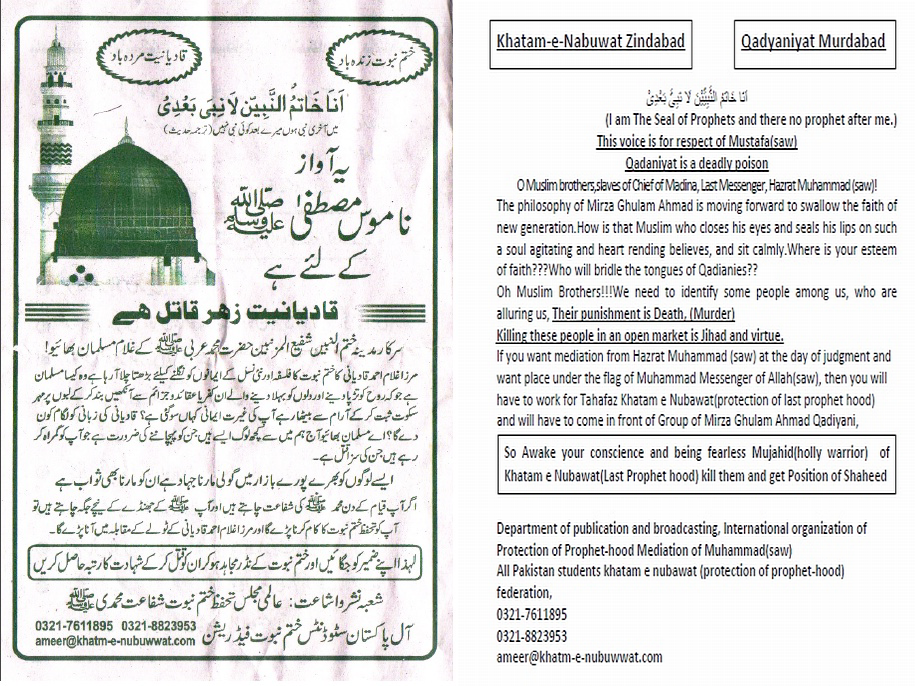
Religious minorities like the Ahmadis, who do not
conform to orthodox concepts of Islam, are
particularly affected by the blasphemy law
“Infidel!” “Let us spill his blood!” These were the kind of threats Indonesian director Garin Nugroho had to endure in early April this year.

In his capacity as a cultural expert, he testified before the highest constitutional court of his country that a 45-year-old blasphemy law wholly discouraged Indonesians from discussing religion, as it did not allow them the freedom to hold their own opinions.

“This law is the biggest setback for democracy and pluralism in the history of our nation,” the internationally-acclaimed filmmaker declared. The followers of various radical Islamic organizations, such as the Islamic Defender Front (FPI) or Hizb-ut Tahrir Indonesia (HTI), who were waiting outside the courthouse, were able to follow his testimony on a screen. They were clearly of a different opinion.

Validation for the hardliners

Nugroho got off lightly, however, in that he was only verbally abused. Four other experts were beaten and kicked on their way to court. The judges upheld the disputed paragraphs nonetheless. With only one vote against, the nine-person body decided in April that the old law was not unconstitutional and was “indispensable for religious harmony in the country”.

A coalition of Indonesian human rights groups under the leadership of the Wahid Institute had applied for a legal revision of the blasphemy law. In their opinion, the law, introduced after a coup attempt in 1965, contradicts the Indonesian constitution, which guarantees religious freedom.

Six religions are officially recognized in Indonesia, which has the largest Muslim population in the world: Islam, Protestantism, Catholicism, Hinduism, Buddhism and Confucianism. Followers of minority religions, such as Sikhs or animists, are tolerated, but those who do not profess one of the six official religions cannot hold an identity card or obtain a marriage certificate.

In practice, it is not possible to be an atheist in Indonesian society. Divergent religious orientations within the recognized religions also face difficulties. According to the blasphemy law it is illegal to publish, recommend or even seek public support for non-orthodox interpretations of faith.

As a result, interpretations of Islam that do not accord with either the Sunni or the Shia faiths are subject to legal prosecution – and all too often they are also persecuted outside the law.

Persecution of the Ahmadi


Adherents of the Ahmadiyya movement, who consider themselves Muslims but do not believe that Mohammed was the last prophet, have been particularly badly affected.

Many Ahmadis had to go into hiding after violent attacks by radical Islamists. On the island of Lombok hundreds of families are still living in refugee camps because they daren’t return to their home villages. Instead of punishing the attackers, the government forbade all public activities related to Ahmadiyya Islam.

“Religious freedom will always be restricted, because if it is unrestricted it could compromise the freedom of the majority,” says Saleh Daulay, the secretary for law and human rights of Muhammadiyah, the second-largest Islamic organization in the country. “It is our duty to protect the established belief of a majority from interference. If we didn’t have the blasphemy law, we would no longer have any basis from which to prevent social unrest.”

“The blasphemy law is not going to solve the
religious conflicts in this country!“ - Masdar Farid
Mas’udi, legal expert for the Nahdlatul Ulama (NU)

In practice, the law has primarily been applied in Indonesia to punish offences against the main streams of Islam. As well as sect-like groups like the Ahmadis, individuals have also increasingly been targeted. In May 2006, for example, the Muslim woman governor of Banyuwangi in East Java was nearly ousted from office after being accused of practising a religion other than Islam. The background to this was that she was married to a Hindu.

In December 2008 a Christian primary school teacher was arrested on the Moluccas because she was said to have made disparaging remarks about Islam during class. On the basis of this rumour alone, hundreds of furious Muslims destroyed 67 houses, a church, and a meeting hall. Five people were injured. Only two of the rioters were arrested.

No resolution of religious conflicts

“The blasphemy law is not going to solve the religious conflicts in this country,” stated legal expert Masdar Farid Mas’udi of the Nahdlatul Ulama (NU), Indonesia’s largest Islamic organization, in the daily newspaper Jakarta Post.

“The court should have defined the terms blasphemy and heresy more precisely. If you follow the current interpretation, Islamic preachers should in fact also be criminalized for their diatribes against other religions.”

Mas’udi, however, is pretty much alone in his opinion. Both his own organization, the NU, which is regarded as moderate, and Muhammadiyah joined the radical Islamists in speaking out against a repeal of the blasphemy law. The Parisada Hindu Dharma Indonesia (PHDI), Indonesia’s highest Hindu council, and the Indonesian Buddhist Council (Walubi) were also in favour of retaining it.

The only vote against the court’s decision came from constitutional judge Maria Farida Indrati, who one month earlier was also the only one in the body to oppose another highly controversial law, that against pornography.

In her opinion, the blasphemy law is a product of the past and is no longer compatible with today’s constitution – especially in respect of the preservation of human rights and religious freedom.

“Officially, we have religious freedom in Indonesia, but in reality it’s not that free,” says Dwi Nurdianto (not his real name), who works for a social organization in Yogyakarta on Java.

“On paper I am a Muslim, although I am in fact an atheist. But I’m not allowed to be an atheist here. If I don’t belong to any religion, I can’t get official papers. And if certain people came to know my true beliefs, what would happen would be something like the scenes in front of the constitutional court. The state should really be protecting minorities from persecution. Instead, it’s arguing that it has to protect the majority.”

Christina Schott
© Qantara.de 2010
Translated from the German by Charlotte Collins
Editor: Lewis Gropp/Qantara.de

Wednesday, April 28, 2010

Indonesian Blasphemy Act Restricts Free Religious Expression

---The Huffington Post, USA
April 28, 2010
Asma Uddin
Founder and editor-in-chief, Altmuslimah.com
Posted: April 27, 2010 08:12 PM
Indonesian Blasphemy Act Restricts Free Religious Expression

Last Monday, as I stood in the Indonesian Constitutional Court, the Court released its eight-to-one decision to uphold the Law on the Prevention of Blasphemy and Abuse of Religion, also known as the Blasphemy Act. My colleagues and I at the Becket Fund for Religious Liberty had submitted an amicus brief in the case, urging the Court to repeal the Act, which has been used in the past to persecute devout members of a variety of religions. The Court’s decision was deeply disappointing for us and our human rights colleagues in Indonesia and across the world, as it not only failed to repeal a problematic law but also legitimated, if not encouraged, future government incursions into matters of conscience.

The Blasphemy Act makes it unlawful “to, intentionally, in public, communicate, counsel, or solicit public support for an interpretation of a religion … that is similar to the interpretations or activities of an Indonesian religion but deviates from the tenets of that religion.” One of the purposes of the Act is to help the government protect Indonesia’s six recognized religions – Islam, [Protestant] Christianity, Catholicism, Hinduism, Buddhism, and Confucianism – by punishing those who encourage conversion away from one of these religions or preach “deviant” interpretations of those religions. The six official religions each have government-funded religious bodies who decide what an acceptable belief for that religion is and what is not.

The Act establishes civil and criminal penalties, including up to five years imprisonment, for violators. In the past, it has been used to impose criminal penalties on groups like the Ahmadiyya, which most Muslims do not recognize because they believe it deviates from mainstream Islamic teachings. In 2008, the Indonesian Minister of Religious Affairs, the Attorney General, and the Minister of Interior issued the Joint Decree on the Ahmadiyya, which orders Ahmadiyya adherents “as long as they consider themselves to hold to Islam, to discontinue the promulgation of interpretations and activities that are deviant from the principal teachings of Islam.”

Similarly, in 2009, police arrested the leader of the Sion City of Allah Christian sect and six of his followers for straying from “correct Christian teachings.” Because the Sect is based on only one book of the Bible (the Book of Jeremiah), the government banned it as an unacceptable branch of Christianity and forbade its followers from attending church till 2011.

These cases underscore the problematic nature of the Blasphemy Act. While private citizens and religious groups should be able to decide among themselves what does or does not constitute the essence of a religion, and while they should be able to exclude certain individuals from membership on the basis of such disagreements, the Act appoints the state, with all of its police power, as arbiter of what a particular group believes and what it should be allowed to propagate.

In some cases, the state will deem a group blasphemous even when the allegedly blasphemed group disagrees. For instance, in the Sion City case, the government charged the sect with blaspheming the Timor Evangelical Church, despite the Church’s statements to the contrary. Instead of ceding autonomy to the Church and allowing it to determine religious questions, including blasphemy, for itself, the state stated, “We hope the church will not interfere in the case.”

Religion, regulated as such, is defined by the state and is necessarily politicized by the state’s involvement. The state-approved version of religion often tempers social justice components of faith, especially in the case of authoritarian regimes, which use religion to protect and legitimate their own power. Religious matters in this way become intertwined with questions of national security and public order.

Indeed, the public order argument played a big role in the Court’s decision to uphold the Blasphemy Act. The idea is that blasphemy – real or supposed, intentional or unintentional – would anger adherents of a given religion, who will then cause destruction or otherwise act violently. This is different from regulating incitement to violence because it limits peaceful, not violent, speech. According to the Court, the state has to control potentially blasphemous statements, peacefully expressed, in order to increase societal harmony.

However, the court’s reasoning in this regard is deeply flawed as it protects the wrong party and provides the wrong incentives. The Blasphemy Act appeases rather than controls violent extremists, giving them license to continue bullying religious minorities while the police look the other way. It creates a culture of impunity where increasingly egregious crimes are committed with little or no consequences for the criminals.

Instead of penalizing the speaker in order to prevent violence, the law should compel potentially violent actors to regulate their own behavior – even, indeed especially, in the face of insults. Violence is far more effectively controlled if states enforce those laws which punish criminal behavior.

This sort of legal scheme makes sense not simply because it’s more effective, but also because it protects the fundamental human right to free religious expression. Individuals have the right to not only hold particular beliefs but also to express them openly in public – as long as they are peaceful and do not contravene the rights of others. This works in favor of the larger society rather than against it, as only in a free marketplace of ideas can those ideas with greater utility or persuasive power prevail.

In upholding the Blasphemy Act, the Court affirmed the power of the state to compel individuals to abide by certain beliefs against their own conscience – all for the sake of keeping at bay a presumably uncontrollable public. The decision is both logically and morally flawed, and a major setback for human rights in Indonesia.

URL: www.huffingtonpost.com/asma-uddin/the-indonesian-constituti_b_554463.html

Wednesday, April 21, 2010

Discourse: Blasphemy law ‘has not prevented conflict’

---The Jakarta Post, Jakarta
Headlines | Wed, 04/21/2010 9:03 AM
Discourse: Blasphemy law ‘has not prevented conflict’
Todung Mulya Lubis

The Constitutional Court (MK) ruled Monday to uphold the 45-year-old Blasphemy law after a judicial review request was filed last October by human rights groups and backers of pluralism who said the law violated religious freedom. The Jakarta Post talks to renowned lawyer Todung Mulya Lubis, who said the Court tends to lean “to the right” in certain issues.

Question: What is your comment on the Constitutional Court’s ruling which rejected the judicial review request on the Blasphemy Law?

Answer: I regret the decision because it disregards the diversity and plurality of our nation. We have to respect the court’s authority to conduct a judicial review, but this decision has distorted freedom of worship which is acknowledged as a basic human right.

The law allows ample room for misuse. The court said this law is needed to prevent horizontal and vertical conflicts. Conflicts occur when there are coercive actions (to prohibit someone or a group) from worshipping according to their religion and belief.

If there was no intimdiation against the Ahmadiyah congregation, for instance, they would be free to worship. So the law has been disturbing this and has not prevented conflict.

Coercion which disregards diversity and people’s religious rights cause conflicts. The logic of the court is misleading when it says that the law prevents conflicts.

On the contrary, conflicts happen when there repressive actions by groups which believe that only the state-sanctioned religions (the “standard” forms of Islam, Christianity, Protestantism, Hinduism, Buddhism, and Confucianism) are legal while the others have to be eradicated. Such actions are a source of conflict.

Doesn’t the Blasphemy Law contradict the 2008 Law Prohibiting Racial and Ethnic Discrimination which says nobody can be discriminated against due to his or her religion and belief?

It’s against that law. It’s also against the International Convention on the Elimination of All Forms of Racial Discrimination and the International Covenant on Civil and Political Rights. So the Blasphemy Law has fundamentally violated international and national laws.

The Constitutional Court’s ideology tends to the right. Many have expressed concerns about this. When the court faces issues of religion and freedom of speech and expression, it becomes conservative and fundamentalist.

This disregards human rights, pluralism and reform efforts. So we must face the fact that the court is dominated by conservatives and fundamentalists.

We are forced to acknowledged formal religions while we actually have freedom of choice.

The Constitutional Court’s ruling is final but it doesn’t mean we can tolerate its excessive implementation.

However, we don’t know yet how far the implementation will go. But this is obviously a setback.

What are the possible implications of the court’s ruling?

Groups like the Islamic Defenders Front (FPI) and the Hizbut Tahrir Indonesia (HTI) will be happy with this.

When new religious groups or thoughts emerge, they can be considered as defaming formal (forms of) religions. FPI and HTI will have legal justification for their coercive actions violating human rights. They act as if they are the private religious police.

What are the further plans of human rights groups to anticipate the impact of the ruling?

We will arrange a meeting to look at the Constitutional Court’s ruling because it potentially could cause divisions. We are going to try to limit its divisive impacts while continuing to promote diversity and pluralism. (rdf)

URL: www.thejakartapost.com/news/2010/04/21/disc...E2%80%99.html

Court justices accused of ‘distorting’ testimonies

---The Jakarta Post, Jakarta
Headlines | Wed, 04/21/2010 9:03 AM
Court justices accused of ‘distorting’ testimonies
Arghea Desafti Hapsari, The Jakarta Post, Jakarta

The Constitutional Court has again become the target of criticism following its ruling on the controversial Blasphemy Law, with plaintiffs accusing the judges of distorting the opinions of expert witnesses.

Just weeks after giving the nod to the divisive pornography law in late March, the Court on Monday ruled to uphold the 45-year-old law on religious blasphemy. Only one judge, Maria Farida Indrati, had a dissenting opinion.

But this held no sway in the final outcome as the Court turned down a judicial review request by human rights groups and high-profile figures such as late former president Abdurrahman Wahid and progressive Muslim scholar Siti Musdah Mulia.

A lawyer for the plaintiffs, Uli Parulian Sihombing, on Tuesday criticized the way judges had claimed that the National Commission on Human Rights (Komnas HAM) had recommended keeping the law when in fact the latter had requested revisions to be made to it.

The panel of judges in its argument said that of the 24 parties whose testimonies were heard, two — Komnas HAM and the Indonesia Confucianism High Assembly (Matakin) — had said that the contested articles in the law were still needed and should not be revoked before a new and more comprehensive regulation was enacted.

Chief justice Mahfud MD did not return numerous calls from The Jakarta Post on Tuesday.

Komnas HAM chairman Ifdhal Kasim, who testified in February, said several articles in the law needed to be revised. He argued that the law “rests on the old Constitution, which opposes the new [amended] Constitution”.

“That’s why, based on the new Constitution, there needs to be a review [of laws] produced by former administrations,” he said.

The law stipulates criminal penalties for those who intentionally publicize, recommend or organize public support for a different interpretation of the six officially recognized religions.

Opponents say the law has been used to persecute members of religious minorities and of traditional beliefs, including when members of the Ahmadiyah sect were forced to take refuge after enduring violent attacks against them. The Court, however, said the law was needed to maintain public order.

On Tuesday, Uli also said that judges had not made an objective decision based on facts and evidence.

Indonesian Ulema Council (MUI) chairman Amidhan, on the other hand, expressed his support for the Court ruling. He said that the law was needed to maintain harmony among religions. “Without the law, there would be chaos. I fear people would take the law into their own hands,” he added.

Amidhan also said that the law could be revoked only if Indonesians were “wiser”. “But the people are not as wise as in the US, where religion is a personal matter,” he told the Post.

Masdar Farid Mas’udi from Nahdlatul Ulama, the country’s largest Muslim organization, voiced a different opinion, despite the organization’s official position supporting the court’s ruling.

He said that by keeping the law, the numerous Islamic preachers who criticized other religions and therefore broke the law “would now have to be prepared to be arrested and face criminal charges”.

“They are the ones who supported this law and they cannot be above it,” he said.

URL: www.thejakartapost.com/news/2010/04/21/cour...80%99-testimonies.html

Tuesday, April 20, 2010

Indonesia under fire for upholding scripture over rights

---Yahoo News (via AFP)

Indonesia under fire for upholding scripture over rights
by Stephen Coates Stephen Coates – Tue Apr 20, 2:16 am ET

JAKARTA (AFP) – Human rights groups pilloried Indonesia’s constitutional court Tuesday after it upheld a 1965 blasphemy law, ruling in favour of orthodox religions over basic freedoms.

The court on Monday rejected a petition by moderate Muslims, religious minorities, democracy advocates and rights groups against the law, in a case seen as a major test of the mainly Muslim country’s pluralism.

By a margin of eight to one, the judges ruled that the law was imperfect but did not contravene the constitution of the world’s most populous Muslim-majority country, which guarantees freedoms of belief and expression.

The law carries a maximum punishment of five years for beliefs that deviate from the orthodox versions of six sanctioned faiths: Islam, Buddhism, Hinduism, Catholicism, Protestantism and Confucianism.

The US Commission on International Religious Freedom, a non-partisan body that advises the US government, said the ruling may embolden religious extremists and foster sectarian strife.

“Hopefully, the Indonesian government will recognise that overturning the blasphemy decree advances its fight against terrorism and extremism, and enhances its reputation for religious tolerance and pluralism,” commission chairman Leonard Leo said.

The law – which effectively outlaws blasphemy as well as heresy – was used in 2008 to force followers of the Islamic Ahmadiyah sect to go underground and is often cited by minorities as a source of discrimination and intimidation.

Islamic extremists packed the court throughout the hearings, heckled witnesses for the petitioners and allegedly assaulted their lawyers on the last day. They greeted the ruling with shouts of “Allahu Akbar” (God is greater).

About 500 police were deployed around the court due to concerns that a ruling against the law would trigger violence by militants from the Islamic Defenders Front (FPI), a vigilante group.

Several of the judges said they agreed with the testimony of Religious Affairs Minister Suryadharma Ali and Justice and Human Rights Minister Patrialis Akbar that the law was needed to protect minorities from violence.

FPI official Sobri Lubis also claimed the law was vital to maintain religious harmony in the vast archipelago of 234 million people, 90 percent of whom are Muslims.

“We’re very happy with the verdict… This will bring peace of mind to the people,” he said.

US-based Human Rights Watch (HRW) however said the ruling “dealt a severe blow to religious freedom” in the world’s third-largest democracy, which President Barack Obama is scheduled to visit in June.

“Indonesia?s laws should protect those who peacefully express religious views and punish those who threaten to use violence against others, not the other way around,” HRW deputy Asia director Elaine Pearson said.

“If the government wants to prevent violence, it should send a message by punishing violent behaviour.”

US expert Professor Cole Durham, who testified via videolink on behalf of the petitioners, said the decision “represents a missed opportunity” to reconcile the law with Indonesia’s international treaty obligations on human rights and bring the country into line with the trend in other democratic countries.

“This legislation empowers those in dominant religions to persecute and discriminate against those holding divergent views, and this in turn will exacerbate religious tensions in society,” he told AFP.

Moderate Muslim scholar Ulil Abshar Abdallah said the court did not seem to understand the constitution.

“Our constitution clearly guarantees freedom of expression. The law will become a time bomb in the future as it will muzzle minority groups that are different from the six mainstream religions,” he said.

Indonesia court upholds blasphemy law

---Yahoo News (via AP)

Indonesia court upholds blasphemy law
By CHRIS BLAKE, Associated Press Writer – Tue Apr 20, 12:19 am ET

JAKARTA, Indonesia – A decision by Indonesia’s constitutional court to uphold a controversial blasphemy law has dealt a severe blow to religious freedom in the world’s largest Muslim-majority country, a rights group said Tuesday.

The court ruled Monday that the 1965 law, which allows for criminal penalties and bans on people or groups that “distort” the central tenets of six officially recognized religions, was in line with the constitution and was vital to religious harmony.

The law was challenged by a coalition of rights groups and civil society organizations who consider it discriminatory. But it is supported by religious conservatives, including the radical Islamic Defenders Front, which had gathered at the court and threatened to protest if the judges didn’t uphold it.

Although the law recognizes six official religions in the country — the standard forms of Islam, Catholicism, Protestantism, Buddhism, Hinduism and Confucianism — rights activists say it discriminates against minority religions, including Muslims whose beliefs differ from the mainstream.

The vast majority of Indonesia’s 235 million people are moderate Sunni Muslims.

Opponents say the law, which carries penalties of up to 5 years in jail, should be struck down because it limits religious freedom — which is constitutionally protected in this secular country.

The court rejected those concerns in its 8-1 decision. The majority said the law was in place to protect all religions from desecration and to ensure religious harmony between faiths. They said the law did not bar other religions such as Judaism from being practiced, but simply protected those covered by the law.

“The law should be upheld because if it is annulled … Islam and the Quran could be interpreted at will and people and figures could declare new prophets and establish new religions,” Minister of Religious Affairs Suryadharma Ali said ahead of the ruling.

Critics say the law is vague, allowing authorities to interpret and enforce it how they choose. It has largely been used against those seen as offending mainstream Islam.

They also say hard-line Islamic groups have used the law as justification for violent attacks on minority religious groups.

The government has used the blasphemy law in the past to outlaw religious groups, including Ahmadiyah, a minority Islamic sect banned in 2008 whose members identify themselves as Muslims but don’t believe in the core tenet of Islam that Muhammad is the last prophet.

Elaine Pearson, deputy Asia director at Human Rights Watch, said in a statement Tuesday that the court decision “poses a real threat to the beliefs of Indonesia’s religious minorities.”

“The blasphemy law criminalizes the peaceful expression of certain religious beliefs,” she added.

The dissenting judge called the law weak, saying it could be interpreted in multiple ways that lead to discrimination. The judge said the law was written during a revolutionary era when Indonesia’s authoritarian rulers were worried about social unrest and that the law wasn’t needed in modern Indonesia.

“The judges closed their eyes and hearts,” said Chairul Annam, one of the lawyers arguing for the law’s repeal. “We are very sorry that discrimination suffered by minorities in this country was not recognized by the court.”
___
Associated Press writer Niniek Karmini contributed to this report.

URL: http://news.yahoo.com/s/ap/20100420/ap_on_re_as/as_indonesia_blasphemy

Monday, April 19, 2010

Indonesian court upholds blasphemy law

---MSN News, Malaysia

By Agence France-Presse, Updated: 4/19/2010

 
Indonesian court upholds blasphemy law

Indonesia’s Constitutional Court on Monday rejected a petition by moderate Muslims, minorities and rights groups against a 1965 blasphemy law, in a ruling seen as a test of the country’s pluralism.

The court ruled that the law was imperfect but did not contravene the constitution of the world’s most populous Muslim-majority country.

“The application has been rejected entirely as the reasons given by the applicants… have no legal basis and are completely unfounded,” chief judge Mahfud MD told the court.

“It’s not contrary to the basic articles in the constitution but it needs to be made clearer.”

The law makes it illegal to “publicise, recommend or organise public support” for any religion other than or different to the orthodox versions of six sanctioned faiths: Islam, Buddhism, Hinduism, Catholicism, Protestantism and Confucianism.

It was used in 2008 to force followers of the Islamic Ahmadiyah sect to go underground and is regularly cited by minority groups as a source of discrimination and intimidation.

Rights groups and civil society organisations that value the country’s secular traditions say it forces people to adhere to government-sanctioned faiths and limits religious freedom.

About 500 police were deployed around the court due to concerns about violence by Islamist extremists should the judges rule in favour of the petition.

Militants from the Islamic Defenders Front (FPI), a vigilante group, had jeered witnesses for the petitioners during the hearings and clashed with their lawyers on the last day, leading to complaints of intimidation.

One of the witnesses, US legal expert Professor Cole Durham, told the court by videolink that “except in most repressive regimes, apostasy and heresy fall under religious, not civil, jurisdiction”.

Speaking on behalf of the petitioners, Setara Institute chairman Hendardi told AFP the court’s decision was disappointing but expected.

“The existence of this law will continue to snatch away the rights of the people to embrace any religion they believe in and to practise it freely,” he said.

FPI secretary-general Sobri Lubis applauded the court’s decision and said the law was needed to maintain religious harmony in the vast archipelago of 234 million people, 90 percent of whom are Muslims.

“We’re very happy with the verdict. This shows the commitment from the government and the religious groups to maintain the religious purity of the recognised faiths in Indonesia including Islam,” he said.

“This will bring peace of mind to the people.”

Religious Affairs Minister Suryadharma Ali and Justice and Human Rights Minister Patrialis Akbar publicly opposed the petition.

Ali warned that the law was needed to maintain social harmony and prevent an explosion of “new religions”.

URL: http://news.malaysia.msn.com/regional/article.aspx?cp-documentid=4038366

Court beefs up security ahead of ruling

---The Jakarta Post, Jakarta
Headlines | Mon, 04/19/2010 9:28 AM
Court beefs up security ahead of ruling
Arghea Desafti Hapsari, The Jakarta Post, Jakarta


To prepare for possible clashes when it announces its verdict on a judicial review petition on the Blasphemy Law, the Constitutional Court is beefing up security at the building.

The court’s general bureau chief, Noor Sidharta, told The Jakarta Post on Sunday that he had requested Jakarta Police deploy 500 officers to guard the court building complex this afternoon when judges will read out their much-awaited verdict.

Previous hearings of the controversial judicial review request of the law were guarded by 300 officers.

“We learned from [the incident] the other day. Now we are preparing twice the usual number of police officers,” Noor said, referring to an altercation during recess at the last hearing between followers of the hard-line Islamic Defenders Front (FPI) and several members of a team of lawyers for the petitioners.

Officials fear violence could break out, especially in the wake of last week’s deadly brawl in Koja, North Jakarta, where the FPI and other organizations joined hundreds of local residents in street battles with security officers over an Islamic shrine.

FPI supporters also attacked activists from the National Alliance for the Freedom of Faith and Religion who had gathered at Monas Park in the middle of 2008.

The activists were conducting a peace rally supporting religious pluralism. A court found an FPI leader guilty of the violence and sentenced him to 18 months in prison.

Muslim scholar Azyumardi Azra warned of a repeat of the attacks by hard-line groups.“Those involved in any demonstrations should refrain from breaking the law,” he said.

He also called on the police to be extra vigilant.


“Those [hard-line] organizations have leaders. The police have to grow a pair and take action against them if they get violent. Don’t let them walk away without being held responsible for their deeds. If police let them off the hook, they will keep doing it,” he told the Post.

He criticized the fact that members of Muslim organizations were too easily mobilized in the name of Islam.

Nahdlatul Ulama (NU), the country’s largest Muslim organization, is among those who have voiced concern over possible violence if the court rules in favor of the petitioners and repeals the 45-year-old law.

“Violence should not be a means to force one’s viewpoint on others. Everyone has to view the ruling with an open mind, regardless of the ruling,” Masdar Farid Mas’udi, a member of NU’s lawmaking body, said.

Indonesians, Masdar added, trusted the court to solve the legal dispute, so “we must respect its decisions”. Islamic organization Hizbut Tahrir Indonesia (HTI) said it would not stage a rally ahead of Monday’s ruling, although it would object to a ruling in favor of the petitioners.

“We understand the [court’s] decision will be based on facts presented in the hearings,” HTI spokesman Ismail Yusanto said.

URL: http://beta.thejakartapost.com/news/2010/04/19/...head-ruling.html

Wednesday, March 24, 2010

Religion Minister Defends Indonesia’s Blasphemy Law

---Jakarta Globe, Indonesia    

March 24, 2010
Anita Rachman & Ulma Haryanto
Religion Minister Defends Indonesia’s Blasphemy Law
Makassar, South Sulawesi. Minister of Religious Affairs Suryadharma Ali on Wednesday sought the support of the country’s largest Islamic organization, the Nahdlatul Ulama, in maintaining the country’s 1965 Blasphemy Law, which is under review at the Constitutional Court.

“The consequences [if the law is annulled] are that people, figures, could establish new religions, declare new prophets, new angels,” Suryadharma told thousands of NU followers during the group’s 32nd national congress.

“It could be one that could trigger a harmony breakdown. I expect that NU could also [work] together to solve this problem,” he said.

Suryadharma shared a stage with Minister of National Education Mohammad Nuh in Wednesday’s congress to discuss religion and education issues in the country and in NU. He took the opportunity to enlist its support over the law.

The 1965 law recognizes only six religions: Islam, Protestantism, Catholicism, Buddhism, Hinduism and Confucianism. Others are officially banned. It also prohibits alternative interpretations of recognized religions, including Islam.

In 2008, the government used the law to formally ban Ahmadiyah, a minority Islamic sect, because members held that its founder, Mirza Ghulam Ahmad, was the last prophet of Islam, a claim that contradicts mainstream Muslim beliefs. [*]

The Constitutional Court is currently reviewing the law following a demand for a review filed by human rights groups and the late former President Aburrahman “Gus Dur” Wahid, who was also a longtime former NU chairman.

The law “should be secured,” he told the plenary to the cheers of NU members attending the session. “Freedom doesn’t have to be absolute. There must still be rules.”

Suryadharma depicted a gloomy picture of conditions if the law was annulled. He said Islam and the Koran could be interpreted at will.

“Maintaining religious harmony is essential, and maintaining harmony within the same religion is already difficult nowadays. Maintaining NU is difficult. There are some that are [moving to the] left and some to the right,” he said, provoking laughter from audience members. “And it will be even more so if there are new religions.”

Meanwhile, at the Constitutional Court, W. Cole Durham Jr., a professor of law and director of the International Center for Law and Religion Studies at Brigham Young University in the United States, testified via video conference. He noted that Indonesia had agreed to the International Covenant on Civil and Political Rights.

“Indonesia thereby also accepted the obligation to protect freedom of expression, freedom of association, and equal protection under law, as well as to extend these protections to religious minorities,” Durham said.

He agreed that the challenged provisions in the law were not only inconsistent with international human rights standards, but also open to multiple interpretations.

Also testifying in favor of the plaintiffs were a host of legal and religious scholars and experts and former officials. A verdict will be delivered in mid-April.

The statement is erroneous. Hadhrat Mirza Ghulam Ahmad of Qadian did not make any such claim of being last prophet. Please visit Alislam.org/messiah for further info.

Copyright 2010 The Jakarta Globe

Saturday, March 13, 2010

Blasphemy law violates women’s rights: Commission

---The Jakarta Post, Indonesia
Headlines - Sat, 03/13/2010 11:06 AM
Blasphemy law violates women’s rights: Commission

Arghea Desafti Hapsari, The Jakarta Post, Jakarta

The law on blasphemy tramples on the rights of women, the National Commission on Violence Against Women (Komnas Perempuan) testified Friday in the judicial review of the 1965 law.

Commission chairwoman Yunianti Chuzzifah told the Constitutional Court her organization had received several reports from women who had been discriminated against because they were followers of religious sects and traditional beliefs not officially recognized by the government.

“The implementation of the 1965 Blasphemy Law … violates women’s constitutional right not to be discriminated against,” Yunianti said.

“Female members of some faiths and beliefs that aren’t recognized by the state can’t obtain an ID card unless they list one of the official religions [on the ID], which is done against their will.”

The commission testified in the review as a related party.

The Constitutional Court has so far held seven hearing in the review, filed by petitioners from NGOs and self-proclaimed supporters of pluralism in October last year.

Yunianti said many women from these unrecognized faiths had also been deprived of the right to a registered marriage.

“Children borne from the union are denied birth certificates because the mother isn’t considered an individual before the law,” she said.

“As the result, the children are denied the right to an education, or worse, suffer the stigma of being labeled illegitimate children.”

Such a situation, she added, clearly violated children’s right to grow and be free from violence and discrimination.

Yunianti cited cases of women from the Ahmadiyah sect bringing their case to her commission to tell of the hardship they endured with every attack on the group.

“They reported of being threatened with rape, and of being sexually harassed during attacks and when they took refuge,” she said.

“They also told of being fired from their jobs as teachers, and of their children getting second-class treatment from teachers.”

Her testimony was met with loud jeers from the gallery, mostly members of hard-line Islamic groups. The Ahmadiyah are deemed heretics by mainstream Muslims for recognizing sect founder Mirza Ghulam Ahmad as a prophet.

Islamic teaching holds up Muhammad as the final prophet.

For years, Ahmadis have suffered attacks from various hard-line Muslim groups, including the fire-bombing of their mosques and homes.

Also testifying Wednesday was Jakarta Interfaith Communication Forum chairman Ahmad Syafi’i Mufid, who said that even in democracies, human rights and freedom of religion had their boundaries.

“One’s freedom to embrace a religion or belief is limited by the law, which prevails to maintain security, order, health and public morality, and to protect other people’s basic rights and freedom,” he said.

He called on the court to dismiss the review of the law, adding that if it were revised, the government must immediately issue a regulation-in-lieu-of-law of greater clarity and detail “so as to avoid misinterpretation which could lead to chaos and vigilantism”.

Culture analyst Emha Ainun Nadjib, testifying as an expert witness, said rescinding or retaining the law could both prove dangerous.

“If the law is repealed, it will create new conflicts and generate hatred,” he said. “But if it’s retained, there will always be anxiety.”

He added he would not recommend either choice unless “all of us pledge not to threaten one another”.

URL: www.thejakartapost.com/news/2010/03/13/blasphemy-...hts-commission.html

Thursday, March 11, 2010

Raucous Crowd Churns Court at Hearing on Blasphemy Law

---Jakarta Globe, Indonesia    
Ulma Haryanto  - March 11, 2010

Raucous Crowd Churns Court at Hearing on Blasphemy Law
 

Heated debate and cries from a rowdy crowd marked Wednesday’s hearing in the judicial review of the 1965 Blasphemy Law, as leaders of the hardline Islamic Defenders Front and the conservative Hizbut Tahrir Indonesia took to the podium at the Constitutional Court to deliver their arguments in support of the law.

Packed with people wearing the uniforms of the Islamic Defenders Front, also known as the FPI, and Arabic-style outfits, the courtroom was filled with shouts of joy each time an Islamic leader took to the stand in support of the law, and jeers for plaintiffs who supported the review of the law.

Outside the courtroom at least 100 people from a number of conservative Islamic groups, calling themselves part of the Islamic People’s Forum (FUI), declared that they were against the judicial review, saying it was an effort by the court to “harass Islam.”

“I disagree with the view that the state should not interfere with religious matters. If it were left only to the people, it would be dangerous,” FPI leader Habib Rizieq Shihab told the court.

Habib said that prior violence toward followers of Ahmadiyah, a minority Islamic sect, was simply a result of “tardiness” on the part of the state, which had failed to act against the group in time.

“Look at Lia Eden. The government detained her immediately. But with the Ahmadiyah, the government did not do anything. So do not be surprised that the public took matters into their own hands with street justice,” he said. He was referring to jailed Kingdom of Eden sect leader Lia Aminuddin, who claimed to be the bride of the biblical figure Archangel Gabriel, who she said ordered that Islam and other religions be disbanded.

Indonesian law recognizes only six religions: Islam, Protestantism, Catholicism, Buddhism, Hinduism and Confucianism. All others are officially banned.

In 2008, the government used the Blasphemy Law to formally ban Ahmadiyah because the sect held that its founder, Mirza Ghulam Ahmad, was the last prophet of Islam, a claim that contradicts mainstream Muslim beliefs. [*]

Habib also claimed that the judicial review was being used by more liberal Islamic followers to publish their own “critical interpretation” of the Koran.

“This is a big project for them. They are going to use Islamic hermeneutics to interpret the Koran, when hermeneutics is a method that is used to interpret the Bible,” he said.

Thahir Azhary, from the Islamic organization Al Irsyad Al Islamiyyah, also questioned the purpose of the judicial review.

“Are there foreign political interests at work here? Zionists? We cannot just import freedom from the Western world. Those non-Muslim Westerners only want to mislead us,” Thahir said.

At the hearing, the sixth in the review process, the Constitutional Court invited their own witnesses for the first time. They included Azyumardi Azra, dean of the graduate program at Jakarta’s Syarif Hidayatullah State Islamic University, and sociologist Thamrin Amal Tomagola, from the University of Indonesia.

According to Thamrin, sociology holds that religion is based on the fascination of everything mighty.

“Then it is institutionalized in three forms — religious teachings, ideologies and social groups. As a revelation, a religion is final, but as an ideological understanding, there can be multiple interpretations. It can never be final. Those forms are within the public realm and not under the state,” Thamrin said.

Thamrin said he doubted Habib’s opinion that eliminating the law would trigger rioting.

“This will not happen if the police are assertive in keeping public order, security and public convenience. The destruction of mosques, churches and other places of worship is about the security of people. It doesn’t have to be about religion,” he said.

Thamrin also stressed the importance of freedom in following their religion and faith.

“If there is someone who prays using Bahasa Indonesia, then let them. Everybody is entitled to perform their beliefs, as stated by the law. What is not allowed is if you ask other people, and they refuse, and then you use force,” he said.
The statement is erroneous. Hadhrat Mirza Ghulam Ahmad of Qadian did not make any such claim of being last prophet. Please visit Alislam.org/messiah for further info.

Copyright 2010 The Jakarta Globe
URL: www.thejakartaglobe.com/news/raucous-...blasphemy-law/363172

Thursday, February 11, 2010

Who and what defines blasphemy?

---The Jakarta Post, Jakarta
Headlines  Thu, 02/11/2010 10:01 AM

Who and what defines blasphemy?

Arghea Desafti Hapsari, The Jakarta Post, Jakarta

Religious leaders and experts testified Wednesday on what and who defines blasphemy, in the second hearing of a judicial review request of the 1965 Blasphemy Law.

Rev. Franz Magnis Suseno, a Catholic intellectual and professor, was the only expert witness from the petitioners’ side.

While blasphemy refers to “deviant teachings” in the law, Franz Magnis said it was “relative”.

“It means that one has gone from the right path to another that is not.

“Those who use this word are people who feel they are right.

“One group may find another group’s teaching as deviant, but the latter may also affirm it is the former’s teaching that is deviant,” he said.

Franz argued that the state should not have a say in determining whether a teaching was deviant.

“The state cannot say which is true between, for example, Catholics and the Jehovah Witnesses, even if the Catholics have a hundred more followers than the latter,” he said.

The government’s meddling in religious affairs was among issues raised by petitioners of the judicial review request, which comprise of several NGOs and promoters of pluralism.

In January, they requested the Constitutional Court review several articles that they said discriminate d against minority religious groups.

The articles, they said, regulate the government’s authority to dissolve religious groups whose beliefs and practices were deemed blasphemous by religious authorities.

Under the law, the government also has the authority to charge leaders and followers of suspected heretical groups with an article in the Criminal Code, which carries a maximum penalty of a five-year jail term.

Article 1 of the law stipulates that it is illegal to “intentionally publicize, recommend or organize public support for a different interpretation of a religion practiced in Indonesia or engage in a religious ritual resembling another’s religion”.

It also says that “practicing an interpretation of a religion that deviates from the core of that religion’s teachings” is illegal.

The chairman of the country’s largest Muslim organization Nahdlatul Ulama, Hasyim Muzadi, who came as the government’s expert witness, said the law did not violate freedom of religion, as petitioners feared.

“In fact, the minority [among religious communities] will be the ones who will suffer more if the law is revoked,” Hasyim said.

Revoking the law would likely lead to national instability, he said.

“Religious tolerance, which we have been building for a long time, will be disrupted,” he told the court.

Outside, hundreds of people from Muslim mass organizations staged a rally against the request for the judicial review.

Another testimony was from senior journalist Arswendo Atmowiloto, who spent four and a half years in jail after the Monitor tabloid, where he was editor-in-chief, released in 1990 results of a popularity poll that ranked Prophet Muhammad in 11th place, below himself.

“That’s in the past,” he said.

“But what is pertinent is the interpretation of ‘blasphemy’ in Indonesia.

“I did not know then that comparing Muhammad to other humans was blasphemous.”

URL: www.thejakartapost.com/news/2010/02/11/wh...s-blasphemy.html

Blasphemy law, a shackle to the Indonesian people

---The Jakarta Post, Indonesia
Opinion   Thu, 02/11/2010 11:16 AM

Blasphemy law, a shackle to the Indonesian people

Tobias Basuki, Jakarta

Indonesia, the third-largest democracy in the world, may be facing gloomy days ahead. In December 2009, the late former president Abdurrahman “Gus Dur” Wahid led a coalition of civil society organizations in filing a judicial review against the archaic blasphemy law (PNPS No. 1/1965). A move to abolish this problematic law would expectedly further consolidate Indonesia’s democracy, freedom and harmony.

Unfortunately there is strong resistance from the government and several religious and social groups against this move. Religious Affairs Minister Suryadharma Ali and Justice and Human Rights Minister Patrialis Akbar officially rejected this judicial review.

On Feb. 4, Suryadharma Ali met with leaders of the Islamic Defenders Front (FPI) and Hizbut Tahrir Indonesia (HTI) to talk about the judicial review.

This is an unbelievably disappointing move by a government official of his stature.

The FPI is a militant organization and the HTI is a global organization whose aim is to combine all Muslim countries into a unitary Islamic state or caliphate. The HTI is an organization that is even banned and proscribed in many Arab and Islamic countries.

The FPI, and particularly the HTI, should not have a say on matters of the Indonesian people. The HTI does not represent the interests of the Indonesian people and our nation.

The argument proposed by defenders of this blasphemy law, is that the law is meant to maintain harmony and peace among religions. Forgive me for saying this: “It is complete baloney!”

This PNPS No. 1/1965 has been the ground on which the Criminal Code (KUHP), article 156a, rests. This KUHP, instead of maintaining peace and harmony, has been the umbrella under which various militant groups attack, burn and destroy others.

A recent example is the case of Welhelmina Holle in Masohi, Central Maluku, in December 2008. There were accusations and rumors that Holle, an elementary school teacher, had been offensive about a religion in one of his lectures in class.

As a result, a mob ran amok and destroyed 67 houses, a house of worship, and a community building. Hole was put on trial under the pretext of that law.

It is the existence of the blasphemy law that ignites conflict. It does not maintain harmony and peace.

The blasphemy law is just problematic on so many levels. Ironically it appears that many support it.

Newspaper reports regarding the blasphemy law may seem to picture a widespread rejection to the judicial review. But it is important to take this with a grain of salt. Opposition to the judicial review is only proclaimed by heads of institutions and a mob of “radical” groups with loud voices.

Most Indonesians are perhaps rather oblivious or rather ignorant regarding the case. Considering it is not on the headlines and the complicity of jargons used in the case.

However, we can be sure if explained properly, the public will want the abolition of the blasphemy law.

Not only is this law problematic sociologically as illustrated above. It is in direct contradiction to our Constitution.

Indonesia is a unitary state. The highest law of the land is the Constitution (UUD 1945), and all the laws under it should be in line with the Constitution.

On the same token all the lower laws of the land should also not contradict each other.

An important point to note is: our Constitution protects religious freedom to its citizens as individuals, not the freedom for religious groups to bash on others.

Article 28E on freedom of religion clearly states that each person/human/citizen has the right to choose and believe according to their conscience.

In 2008, Indonesia ratified an International Convention on discrimination and passed a law to abolish Racial and Ethnic Discrimination (UU PDRE).

This law rules that no one can be discriminated based on their beliefs, values or rituals that belongs to their group (articles 3, 4).

In short, the antiquated blasphemy law is no longer needed. It violates the Constitution and is also in contradiction to a law of equal stature (UU PDRE).

In 2007, Hudson Institute published a comprehensive study on freedom of religion around the world. The study ranked countries in the same manner as Freedom House’s rankings. A country is ranked from 1 to 7, 1 being most free and 7 not free or repressed. Indonesia was ranked at 5 (partly free).

A surprise and disappointment, particularly considering Malaysia was ranked at 4. At that time I did not agree with the classification given by Hudson Institute.

Regardless of the various horizontal conflicts (cited by Hudson as reason for the low ranking of Indonesia), it did not make sense that Indonesia is less free in terms of religious freedom compared to Malaysia.

But today, I think Hudson Institute was accurate after all.

Although the blasphemy law case has not hit headlines in local newspapers, the International Community observes us closely. For example, the Beckett Fund for Religious Liberty has submitted an amicus brief in support of the judicial review to the Constitutional Court.

The deterioration or progress of freedom in Indonesia is important not only to Indonesians but also to the world.

We do not and should no longer live in the Dark Ages where blasphemy laws, inquisitions and burning of heretics are part of society. Indonesia is a religious country based on harmony, peace, multiculturalism and acceptance of differences.

It is important for our leaders to realize that without religious freedom, Indonesia cannot move forward.

Many academic studies show the strong correlation between economic growth and religious freedom. The works of Ilan Alon and Gregory Chase “Religious Freedom and Economic Prosperity” and the extensive studies of Grim and Finke are only a tip of the iceberg of evidences showing that religious freedom is important for a country’s growth and prosperity.

The decision by the Constitutional Court under Mahfud M.D. will be an immensely important one regarding the future of the nation. It will be a very tough decision, considering the amount of political and organizational pressure on the Constitutional Court.

It should have the courage to make a decision based on what is right, rather than submit to pressure. After all Malcolm Muggeridge once said: “only dead fish swim with the current!”

The writer, an alumnus from Northern Illinois University, Department of Political Science, is Director of Research and Studies at Institut Leimena.

URL: www.thejakartapost.com/news/2010/02/11/blas...ckle-indonesian-people.html

Saturday, February 6, 2010

Court to stage debate on religious freedom

--- The Jakarta Post, Jakarta
Headlines    Fri, 02/05/2010 9:22 AM

Court to stage debate on religious freedom

Ary Hermawan, The Jakarta Post, Jakarta


The Constitutional Court will see one of its longest hearings as it becomes a forum for clerics, activists, pundits and artists to debate whether the country should revoke a 45-year-old blasphemy law to uphold freedom of religion.

The court opened Thursday the first hearing of a judicial review filed by a number of human rights groups against the 1965 Blasphemy Law, which they said was adverse to human rights principles and irrelevant to a democratic Indonesia.

The review has been strongly opposed by the government and major Muslim organizations as well as hardline groups including the Islam Defender’s Front (FPI), whose members staged a rally outside the court Thursday.

The court is set to present 31 experts, including sociologist Imam Prasodjo, poet Emha Ainun Nadjib, novelist Andrea Hirata and filmmaker Garin Nugroho, to share their opinions on the issue.

“The examination will be extensive,” court chief Mahfud M.D said. “We usually hold a hearing every fourteen days, but in this case, we will hold it weekly.” The examination will take at least four months.

The petitioners will present experts including Ahmad Syafii Maarif, Franz Magnis-Suseno, Luthfi Assyaukanie and Cole Durham, professor of law from the US, who will speak at the court via a teleconference.

Syafii will be speaking against his colleagues in Muhammadiyah, which, like Nahdlatul Ulama (NU), officially expressed its opposition to the judicial review. Ten Islamic organizations, including Hizbut Tahrir Indonesia, will also be given a say in court.

The government and the House of Representatives are against the judicial review.

In Thursday’s hearing, Religious Affairs Minister Suryadharma Ali demanded the court reject the activists’ request on the grounds that no petitioners had their constitutional rights denied because of the law.

“We ask the court to decide if the judicial review request is unacceptable,” the minister said Suryadharma also said the law had for decades served to maintain harmony in religiously diverse Indonesia. “Annulling the law will create conflict, instability and disharmony. It is urgently needed to endorse religious tolerance.”

Justice and Human Rights Minister Patrialis Akbar argued that religious freedom did not mean people could practice their beliefs regardless of existing laws.

Chairuman Harahap, representing the legislators, concurred with Patrialis, saying the law remained relevant though it was created decades ago. “From a sociological perspective, a law should be in line with the will of the people,” he said.

Uli Parulian Sihombing, a lawyer for petitioners, said they were not asking for absolute freedom, but assurance that religious interpretation on certain religious teachings were not subject to prosecution by the state. Uli referred to the case of Jamaah Ahmadiyah, an Islamic sect that has been declared heretical and banned by the government.

In 2008, a pro-Ahmadiyah group called the National Alliance for the Freedom of Faith and Religion, was attacked by FPI and Hizbut Tahrir members, who strongly supported the government’s move to ban Ahmadiyah.

URL: www.thejakartapost.com/news/2010/02/05/cour...ligious-freedom.html
 
^ Top of Page