Showing posts with label diversity. Show all posts

Monday, April 18, 2011

Indonesia Risks Taking Pakistan’s Path to Intolerance

Jakarta Globe, Indonesia
OPINION
Indonesia Risks Taking Pakistan’s Path to Intolerance
Ali Dayan Hasan | April 18, 2011

Radical cleric Abu Bakar Bashir, currently on trial on terrorism charges, is a symbol of religious intolerance in Indonesia. (Reuters Photo/Beawiharta)
Were a hundred Indonesians to die in a suicide bombing, one would expect Indonesian politicians, political parties and religious groups to condemn it no matter who the victims were. But when such an attack occurred last year in Pakistan, silence ruled the day. The one political leader who spoke out was the target of vitriol from religious parties and groups. Frighteningly, the series of events that led Pakistan down this path appears to be repeating itself in Indonesia.

On May 28, 2010, Islamist militants attacked two Ahmadiyah mosques in the central Pakistani city of Lahore with guns, grenades and suicide bombs, killing 94 people and injuring well over a hundred. The Punjabi Taliban, a local affiliate of the Pakistani Taliban, Tehrik-e-Taliban Pakistan, claimed responsibility. The Taliban have targeted not just Ahmadis but all Pakistanis — regardless of religious or sectarian affiliation. The Pakistani opposition leader Nawaz Sharif condemned this attack on “brothers and sisters who are Pakistani citizens.”

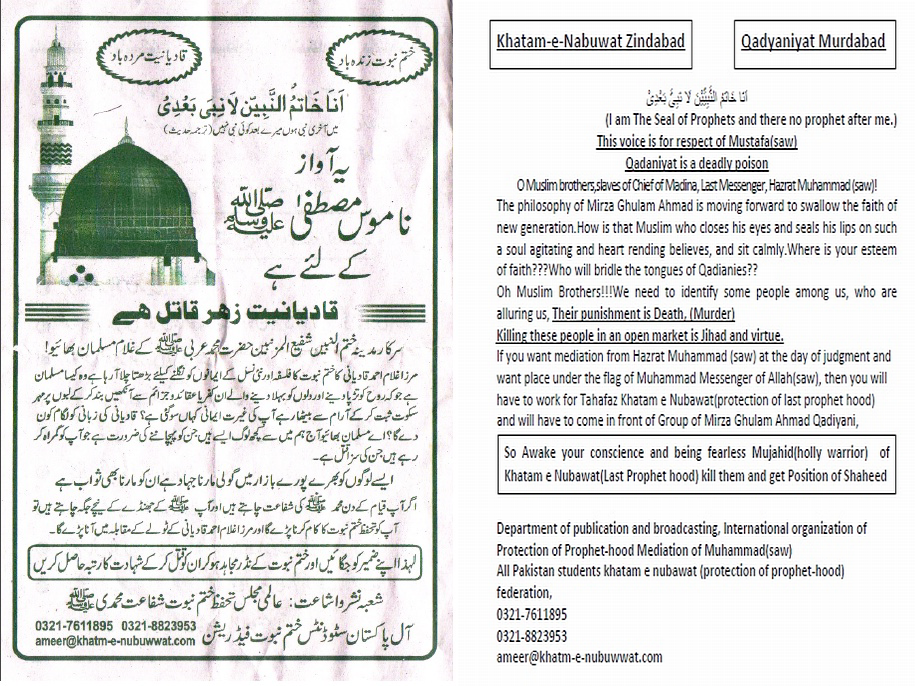
Yet his statement was greeted with anger by religious political parties and groups led by the Jamaat-e-Islami and the Pakistan branch of the Khatm-e-Nabuwat — an international Islamist umbrella organization dedicated to the “preservation of the finality of the Prophet Muhammad’s prophethood,” which considers Ahmadis heretics. It was a very ugly moment for Pakistani society.

The Ahmadiyah community has long been persecuted in Pakistan. What has happened in Pakistan is instructive in understanding the nature and potential objectives of those attacking — verbally and physically — the Ahmadiyah community in Indonesia. The situation for Ahmadis in Indonesia suggests a similar pattern of systematic persecution and a similar trend toward legalized discrimination against all Ahmadis for their religious beliefs and practices. Moreover, there are clear and specific ideological links between anti-Ahmadi organizations in Pakistan and Indonesia.

In 1974, Pakistan’s Parliament introduced constitutional amendments that defined the term “Muslim” in the Pakistani context and listed groups that were, under the law, to be considered non-Muslim. The amendment, which went into effect on Sept. 6, 1974, explicitly deprived Ahmadis of their identity as Muslims.

In 1984, five ordinances in Pakistan’s penal code were amended to explicitly target religious minorities: a law against blasphemy; a law punishing the defiling of the Koran; a prohibition against insulting the wives, family or companions of the Prophet of Islam; and two laws specifically restricting the Ahmadis’ activities. On April 26, 1984, Pakistani dictator Gen. Zia ul-Haq issued these last two laws as part of Martial Law Ordinance XX.

Ordinance XX undercut the activities of religious minorities generally, but struck at Ahmadis in particular by prohibiting them from “indirectly or directly posing as a Muslim.”

Ahmadis thus could no longer profess their faith, either orally or in writing. Pakistani police destroyed Ahmadi translations of and commentaries on the Koran and banned Ahmadi publications, the use of any Islamic terminology on Ahmadi wedding invitations, the offering of Ahmadi funeral prayers and the displaying of the Kalima — the statement that “there is no god but Allah, Muhammad is Allah’s prophet,” the principal creed of Muslims — on Ahmadi gravestones.

In addition, Ordinance XX prohibited Ahmadis from declaring their faith publicly, propagating their faith, building mosques or making the call for Muslim prayer. In short, virtually any public act of worship or devotion by an Ahmadi could be treated as a criminal offense.

With the passage of the Criminal Law Act of 1986, Parliament added Section 295-C to the Pakistan Penal Code. The “Blasphemy Law,” as it came to be known, prescribed the death penalty for blasphemy. With Section 295-C, Zia and the Pakistani government institutionalized the persecution of Ahmadis as well as other minorities in Pakistan. The Ahmadi belief in the prophethood of Mirza Ghulam Ahmad is considered blasphemous insofar as it “defiled the name of Prophet Muhammad.” Therefore, theoretically, Ahmadis can be sentenced to death for simply professing their faith.

As a consequence, Ahmadi mosques have been burned, their graves desecrated and their very existence criminalized. Since the 1980s, hundreds of Ahmadis have been formally charged in criminal cases for professing their religion. Scores of Ahmadis have been specifically charged with blasphemy; several have been convicted and face life imprisonment or death sentences, pending appeal. The offenses included wearing an Islamic slogan on a shirt, planning to build an Ahmadi mosque in Lahore and distributing Ahmadi literature in a public square. As a result, thousands of Ahmadis have fled Pakistan to seek asylum abroad.

Not surprisingly, anti-Ahmadiyah prejudice remains widespread in Pakistan. The foundation of legalized discrimination laid by the Pakistani state has played into the hands of the Taliban and other militant sectarian groups. The suicide bombings and other attacks on Ahmadis by these groups in recent times are only a deadly extension of the Pakistani state’s legal regime against its Ahmadi citizens since 1974. And all Pakistanis are affected: the Taliban demand that either Pakistanis accept their version of Islam as the true faith or face discrimination, flee or live in fear for their lives.

The horrific example of Pakistan should instill fear in the heart of every Indonesian. Last week’s suicide bombing attack on the Cirebon Police mosque in West Java provides an ominous foretaste of what lies ahead unless extremism nurtured by bigotry is checked before it consumes Indonesian society. For, much like their Pakistani counterparts, those who espouse extremism in Indonesia are turning on their own state and its security forces.

In Indonesia, as in Pakistan, Ahmadis are easy targets in times of religious and political insecurity. Following the June 2008 national decree that bans the Ahmadiyah from publicly practicing their faith, punishable by up to five years in prison, provincial governments have increasingly issued anti-Ahmadiyah bans —16 provinces and regencies have done so since 2006.

These provincial bans on Ahmadiyah activities breed intolerance, discrimination and, as the increasing attacks against Ahmadis in Indonesia show, violence. In February, Islamist militants beat three Ahmadis to death in Cikeusik village, Banten. President Susilo Bambang Yudhoyono should immediately void the 2008 national decree and all the provincial decrees. He should ensure that the police act quickly to protect the Ahmadiyah from violence and hold perpetrators accountable. Indonesia’s reputation as a tolerant society is at grave risk.

Today it’s the Ahmadis, tomorrow, as in Pakistan, it could be you.

Ali Dayan Hasan is the senior South Asia researcher at Human Rights Watch.

Banten Wants Tolerance, Bogor Bans Christians

Jakarta Globe, Indonesia
HOME
Banten Wants Tolerance, Bogor Bans Christians
April 18, 2011

The governor of Banten called on Sunday for greater tolerance in her province and across the nation after ethnic and religious violence flared up in recent months.

“Differences in ethnicity and religion should not be an obstacle to building the Banten we all love,” Ratu Atut Chosiyah said. “With all its potential, Banten is a [microcosm] of Indonesia’s diversity.”

“We should safeguard this [diversity] so peace can prevail,” she added.

The governor said 11 years of peace had prevailed in the province until recent attacks.

In February, three members of minority Muslim sect Ahmadiyah were killed by a mob after they refused to leave a cleric’s house in Cikeusik subdistrict, Pandeglang.

“[Harmony] has been sullied a little bit,” the governor said. “I hope this kind of incident will not repeat itself in the future. This has become a valuable lesson.”

Ratu was speaking at a Chinese cultural program in Tangerang, Banten, which saw violent clashes between law enforcement officers and residents last year when the local government tried to evict more than 1,000 people from a poor community in Neglasari.

Residents of Cina Benteng have been in mediated talks with the Tangerang administration over the eviction attempts, which are part of a bid to reclaim land along the Cisadane riverbank.

Ratu, who toured the settlement on Sunday, said the problems faced by ethnic Chinese residents in Neglasari should be settled through peaceful dialogue.

However, Tangerang officials have so far failed to appear in the dialogues, which were initiated by the central government and the National Commission for Human Rights (Komnas HAM) to resolve the issue.

Nevertheless, Edi Lim, head of the Cina Benteng Community Forum, thanked Ratu on Sunday for her support in the long-running land dispute and her efforts to bring back peace in the province.

On the same day, however, protesters in Bogor, West Java, rallied against a ban against worshipping that was enforced against the Indonesian Christian Church (GKI) Yasmin congregation.

Hundreds of demonstrators claiming to belong to the Forum for Bhinneka Tunggal Ika (Forbathin), a group advocating unity in diversity, held the rally in front of the Bogor State Palace on Sunday.

“This ban on worship on the Yasmin church is no longer a local problem,” one of the protesters said. “This is only an example of the intolerance that is taking place under the administration of President Susilo Bambang Yudhoyono.”

GKI Yasmin has been fighting with Bogor authorities, who have closed down its churches and banned followers from practicing their faith, despite a Supreme Court verdict affirming the group’s right to worship.

In moves that further fueled religious tensions, the governors of West and East Java have issued decrees banning Ahmadiyah from proselytizing.

Critics say such policies encourage attacks against minority faiths and hamper efforts to foster religious tolerance.

Antara

Copyright 2010 The Jakarta Globe
URL: www.thejakartaglobe.com/home/banten-wants.../436062

Friday, April 15, 2011

Over 400 Ahmadis ‘On Right Path,’ West Java Governor Says

Jakarta Globe, Indonesia
HOME
Over 400 Ahmadis ‘On Right Path,’ West Java Governor Says
Yuli Krisna | April 15, 2011

More than 400 members of the beleaguered Ahmadiyah have converted to mainstream Islam since a ban on their activities was issued in West Java, officials claimed on Thursday.

West Java Governor Ahmad Heryawan said encouraging conversions was the main objective of the ban, which he ordered on March 3.

The ban followed a series of attacks against the minority sect by mainstream Muslims and hard-liners.

“This is a truly historic moment,” Ahmad said.

“More than 400 Ahmadis have rushed to embrace true Islam. Our aim is to put these people on the right path.”

He added that in order to renounce their faith, there was a 12-point program that the Ahmadis had to follow, including acknowledging Muhammad as the last prophet in Islam.

The animosity toward the Ahmadis stems from the sect’s belief that its founder, Mirza Gulam Ahmad, was a prophet, albeit subordinate to Muhammad.

This difference in opinion has resulted in Ahmadiyah followers being subjected to attacks and other forms of persecution.

However, the governor defended the decree banning the sect’s activities as a means of ensuring an end to the violent attacks. “There’s more security with the decree in place,” he said.

Rafiq Ahmad Sumadi Gandakusuma, a spokesman for the Ahmadiyah congregation in the province, however, disputed that claim. He pointed out that on April 3, a mob attacked five homes belonging to sect members in Bogor.

“Besides, the decree is unconstitutional,” he told the Jakarta Globe.

He also said the mass conversion of Ahmadis to mainstream Islam was not significant given that most of them “weren’t really believers, so it was always going to be easy to sway them.”

Copyright 2010 The Jakarta Globe
URL: www.thejakartaglobe.com/home/over-400-ahmadis.../435520

Thursday, April 7, 2011

RI media playing up Ahmadiyah issues: expert

NATIONAL
Thu, 04/07/2011
7:19 PM
RI media playing up Ahmadiyah issues: expert
The Jakarta Post
A communications expert from Surabaya’s Airlangga University has accused the Indonesian media of playing up the issues of Islamic minority sect Ahmadiyah, saying there is actually no such thing as religious conflict in Indonesia.

Rachmah Ida, a lecturer in communication science, further said that the Indonesian media were “politicizing” religious issues for the sake of business and political interests.

“They play up more or less the same issues, such as religious and ethnic conflicts, unity in diversity issues, the failed state … “Rachmah said as she addressed a workshop of the Asia Journalism Forum (AJF) in Singapore on Thursday.

“The Indonesian media have never changed their stance on Ahmadiyah, and that speaks a lot about how much they’re playing with the issue,” she added, as quoted by Antara.

Rachmah cited as an example how a major Indonesian publication group publishes two newspapers in Maluku, which was plagued with religious conflicts between Muslims and Christians in the past.

One of the newspapers sided with the Muslims and the other with the Christians.

She said the group tried to appear balanced, but actually it only did that for the sake of its business.

Copyright © 2008 The Jakarta Post - PT Bina Media Tenggara. All Rights Reserved
URL: www.thejakartapost.com/news/2011/04/07/ri-media-playing...

Wednesday, March 23, 2011

Peaceful Lives, Violent Deaths: The Silent Cries of the Ahmadis

The Huffington Post, USA
Joseph K. GrieboskiJoseph K. Grieboski
Founder, The Institute on Religion and Public Policy
Posted: March 23, 2011 02:49 PM
Peaceful Lives, Violent Deaths: The Silent Cries of the Ahmadis
On March 13, three Ahmadiiyya Muslims were brutally attacked in the Banten province of Java, Indonesia. Video footage taken during the ambush demonstrates the victims being beaten to death by sticks.

On February 6, over 1,000 anti-Ahmadiyya extremists attacked the home of cleric Ismail Suparman in Cikeusik Village. The Indonesian Ahmadiyah Congregation (JAI) reportedly possesses footage of this travesty, which shows 21 Ahmadis savagely attacked with sticks, rocks, tools and machetes.

Ahmadis live by the motto “Love for All, Hatred for None,” and have no history of engaging in violence. Because they don’t fight back, they are an easy target for Muslim extremists who have been taught they will go to heaven if they murder someone who practices the Ahmadiyya faith.

There are millions of practicing Ahmadis worldwide, with established branches in 190 countries in North and South America, Europe, Asia, Africa, and Australia. Established in India in 1889 by Hadrat Mirza Ghulam Ahmad, The Ahmadiyya community was founded by a man who believed in universal brotherhood, opposed violence as a means of advancing religion, and rejected all forms of terrorism.

Ahmadis adhere to all practices as advised for Muslims in the Quran and present a progressive vision of Islam, which is in tune with modernity. Despite their small size, Ahmadis have distinguished themselves as trailblazers by translating the Quran more than any other group of Muslims.

Internationally regarded as a peaceful people, Ahmadis are theologically considered a “sect” because they reject a central doctrine in Islam: the belief that Muhammad is the last prophet. Because of this, they are under constant threat of persecution by fundamentalists who view Ahmadis as heretics. And the attacks are rapidly increasing in violence and number around the globe.

In 2008 Indonesia issued a joint ministerial decree prohibiting the country’s 200,000 Ahmadis from spreading their beliefs. This law has led many extremist Muslims to believe they have license to take matters into their own hands. In an aggressive hate campaign fueled by Indonesian authorities, extremist Muslims are calling for Ahmadis’ businesses to be boycotted, properties destroyed and clerics assassinated.

The Ahmadiyya community fares no better in Pakistan, where there have been more murders in the last three years than the previous 20. In 1974, Prime Minister Zulfikar Ali Bhutto declared Ahmadis a “Non-Muslim minority,” thus publicly labeling them as second-rate citizens. He orchestrated violent, countrywide riots, which culminated in getting the Ahmadis classified as “Non-Muslims” via a constitutional amendment. This legal status creates an atmosphere of intolerance and persecution, thereby establishing a standard with government permission that Ahmadis can be discriminated or persecuted.

Pakistan’s military dictator General Ziaul Haq proclaimed the notorious anti-Ahmadiyya Ordinance XX in 1984, which states that Ahmadis can be fined and imprisoned for three years just for expressing their faith. The ordinance made it illegal for Ahmadis to say Assalamu Alaikum, to practice particular religious rights, or to proselytize. By doing so, Haq gave Pakistani extremist Muslims free reign to terrorize Ahmadis without fear of retribution. And so, like Indonesia, the violence continues.

Since the 1984 ordinance, hundreds of Ahmadis have been subjected to looting of property, desecration of mosques and murder attempts - and 3,500 have faced court prosecutions due to their faith. In May 2010 in Lahore, sectarian terrorists assassinated 86 Amadis while they were gathered to worship. While this incident drew the condemnation of human rights organizations around the world, international pressure has made no impact on the current laws or on the attitude of the government.

Ahmadis must denounce the founder of the Ahmadiyya community if they apply for a national identity card or passport in Pakistan. They are denied entry to colleges and access to jobs. Thousands have been forced to leave their communities due to violence that continues to go unchecked by authorities.

Ahmadis are good, peaceful, law-abiding people. Their faith - like all religious believers - is a central part of their identity. While only reviewing Indonesia and Pakistan, their community faces hardship and discrimination, persecution and murder in many other countries.

Christians can find many similarities with their Ahmadi brothers, as one time Protestants faced similar treatment. But regardless of faith or identity, we cannot remain deaf to their silent cries. For by doing so, we sanction the actions of their slayers.

It is my hope that the international community recognizes its duty to protect the rights of all people to believe according to the dictates of their hearts, their minds and their consciences, and that the silent permission of persecution by the absence of response, the lack of concern, the attitude of indifference quickly comes to an end.

Copyright © 2011 TheHuffingtonPost.com, Inc.
URL: www.huffingtonpost.com/joseph-k-grieboski/...

Monday, February 14, 2011

Indonesia — Land of Tolerance or Terror?

The Huffington Post, USA
February 14, 2011
Harris ZafarHarris Zafar
National Spokesperson & Director of Youth Outreach, Ahmadiyya Muslim Community USA
Posted: February 14, 2011 06:03 PM
Indonesia — Land of Tolerance or Terror?
Indonesia once hailed itself as a moderate, diverse nation that protects freedom of religion for all its citizens, with a national motto “Bhinneka Tunggal Ika,” meaning unity in diversity. Three months ago, President Obama praised Indonesia as a model of religious tolerance when he said that Indonesia and the United States share principles of unity and tolerance.

An image from Ahmadi lynching video in Indonesia

The grim reality, however, is that Indonesia is losing the right to call itself a tolerant nation that promotes or protects diversity. Instead, due to failed policies, its government has allowed a real militant threat to grow within its borders.

Just last week, in a span of three days, mobs in Indonesia attacked two different religious groups, with the police unable to stop them. On February 8th, a mob of 1,000 militants attacked the police and burned two churches to protest what they considered a far too-lenient sentence given to a Christian for allegedly blaspheming Islam. The mob is calling for his death.

Two days earlier, on Sunday, a mob of more than 1,000 extremists wielded machetes and attacked 18 peaceful members of the Ahmadiyya Muslim Community staying in a house. Three have been confirmed dead and five critically injured. A gruesome video of the attack has surfaced, showing two bloodied young men of this community being hacked to death as the crowd cheers and pelts the lifeless bodies with stones. Meanwhile, the police idly stand by. This footage can be found online, if you have the stomach to watch the brutality.

Hard-line extremists are literally getting away with murder, as their vile attacks result in no punishment. At the root of the problem is Indonesia ‘s misused 1965 Blasphemy Law, which makes it unlawful, “to, intentionally, in public, communicate, counsel, or solicit public support for an interpretation of a religion or a form of religious activity that is similar to the interpretations or activities of an Indonesian religion but deviates from the tenets of that religion.”

Since hardliners disagree with the reformative interpretation of the Ahmadiyya Muslim Community, they are able to use the Blasphemy Law to justify attacks against them. The Blasphemy Law makes it illegal to advocate “deviations from teachings of religion considered fundamental by scholars of the relevant religion.” So forget about separation of religion and state. This law gives ultimate control to religious “scholars” in deciding who should be punished for holding variant interpretations of their religion.

Sunday’s attack against the Ahmadiyya Muslim Community is not a coincidence; rather, it is a direct result of a focused, organized effort to silence this peaceful community. Thirty years ago, the top Muslim clerical body in Indonesia declared that the Ahmadiyya Muslim Community is not a legitimate Muslim community, resulting in the Ahmadiyya Muslim Community’s activities being outlawed in several areas of Indonesia. Astonishingly, the Indonesian government funds this clerical body and appoints its members.

In 2008, Indonesia ‘s Minister of Religious Affairs, Attorney General and Minister of the Interior issued a joint decree ordering Ahmadi Muslims to discontinue the proclamation of their faith. Since this 2008 decree, extremists have used this decree to justify acts of terrorism against the Ahmadiyya Muslim Community.

The Setara Institute – an NGO that monitors religious freedom – reports that violence against the Ahmadiyya Muslim Community has significantly increased from just three incidents in 2006 to 50 in 2010 – amounting to more than 100 recorded attacks against the community since 2008.

Historically, any form of a blasphemy law – meant to punish those accused of insulting a faith – gets misused to persecute and strike terror into the hearts of minority religious groups. The sheer barbarity of Sunday’s attack illustrates how far Indonesia has drifted from being a tolerant nation. It is time for Indonesia to start becoming more intolerant of militants seeking to spread terror.

Indonesia pledged to endorse Article 18 of the Universal Declaration of Human Rights, which guarantees, “freedom of thought, conscience and religion” and “freedom, either alone or in community with others and in public or private, to manifest his religion or belief in teaching, practice, worship and observance.” It is time for Indonesia to live up to this pledge.

President Obama has indicated a possibility of strengthening ties with Indonesia . I call on our President to leverage this bond to urge the Indonesian Government to bring those behind Sunday’s attack to justice and ensure no future attacks are levied on the Ahmadiyya Muslim Community or the Christian community. Militant groups like Islam Defenders Front (FPI) have already threatened to initiate “sweeping raids” of Ahmadi Muslim properties in other areas of Indonesia in the near future, which indicates a continued threat to the community. It is time for the Indonesian Government to ensure that Ahmadi Muslims, Christians and other religious minorities remain safe.

It is time for the Indonesian Government to revoke the June 9, 2008 Joint Decree against Ahmadi Muslims. It is time for the Indonesian Government to repeal the 1965 Blasphemy Law. It is time to stand for your citizens; not for terrorists. It is time to stop these callous attacks against Christians, Ahmadi Muslims, or anyone else. It is time to live up to your motto of unity in diversity.

Indonesia, it is time. Are you truly that model of religious tolerance our President said you are? Do you respect and protect diversity? The whole world is watching, and it’s your move.

Copyright © 2011 TheHuffingtonPost.com, Inc.
URL: www.huffingtonpost.com/harris-zafar/indonesia..._b_821180.html

Monday, July 26, 2010

Toward a more open society

OPINION
Mon, 07/26/2010
9:37 AM

Toward a more open society
Usman Hamid, Bogor

On July 7, I had a chance to meet Switzerland President Doris Leuthard during her visit to Indonesia.

The topic of the meeting was about today’s world’s most important issue: Islam and pluralism. Leuthard’s visit was crucial because the minaret referendum in Switzerland had become a controversy in Indonesia sometime ago.

Other participants, included prominent scholars such as Franz Magnis Suseno, Yenny Wahid and Goenawan Mohammad.

We expressed concern about the development of the issues of freedom of religion and of the tendency to disrespect principles of the rule of law, equality for all citizens and human dignity.

Religious intolerance seems to be growing stronger in our society, particularly here in Indonesia, although the context of history and politics and the threat to religious minority groups in our respective countries are very different.

Indonesia has a long history in recognizing diversity and promoting tolerance. It is unacceptable for the differences that have emerged to result in acts of violence for the benefit of a particular religion or group and to the detriment of all others.

Indonesia has developed into a stable democratic country and has begun to promote respect and recognition of universal human rights values.

In a democratic government, every citizen is allowed to choose their religious beliefs. The government should protect them, instead of interfering in such a domain.

However, the threats endangering freedom of religion have sometimes been generated through democratic institutions and mechanisms, including voting or polling. In this stage, democracy needs more values such as humanism to protect the weak, the minority, the marginalized and the oppressed.

Indonesia has seen a deficit in terms of constitutional democracy and freedom of religion such as sectarian conflict in Ambon and Poso. In other cases, hard-line groups have committed violence against minorities, both the internal and the outsiders, in which women have fallen victims.

The adoption and implementation of several new laws has contributed such to the deteriorating situation of freedom of religion in Indonesia. As an example, the imposition of a bylaw (Qanun) on Sharia in Aceh, which is followed by Islamic-centered policies at district or regency levels. The interest groups in Aceh use justification saying that the special autonomy law had become “the legal umbrella” to endorse the bylaw, let alone the Indonesian Constitution as the highest legal basis.

Another situation is found in the Constitutional Court’s ruling in 2010. The Court refused to annul the 1965 Prevention of Blasphemy and the Abuse of Religions Law that has been used to encourage persecution against non-mainstream religious groups, such as Ahmadiyah.

Using this contextual prism, we observe similar problems faced by Switzerland in relation to the Minaret referendum controversy. Such controversy also gave negative implications in religious freedom in Indonesia. Should such controversy, which indicates disrespect toward the freedom of religion happening even in a country like Switzerland, where human rights are well-established in its constitution; radical Muslim groups here would undermine democracy and human rights in Indonesia’s agenda.

In 2010 alone, eight cases of religious vigilante are recorded, including intimidation, physical assaults such as beating, and the illegal moves taken to dissolve meetings held by or for the minorities.

Recently, hard-line group claimed to be defenders of Islam dissolved a workshop on transgender issues, organized by the National Human Rights Commission and attended by legislators from the Indonesian Democratic Party of Struggle (PDI-P), using fake argumentation that communist followers attended the meeting.

Violent activities could easily happen because of the absence of law enforcement, in particular, omission by the police. Therefore, national authorities must take firm action against any incitement to violence committed by extreme groups. Last week, the National Police chief Gen. Bambang Hendarso Danuri promised there would be no raid by mass organizations during Ramadan.

Apart from lack of law enforcement, peace education for all sectors of the young generation is essential.

Cultural education is an important precondition to take care of freedom. Like what our founding fathers often emphasized, freedom is not only political freedom, but also openness of mind and spirit, regarding the world without prejudice, unhampered by restrictions and narrow-minded distrust.

We hope that Leuthard’s visit to Jakarta will always remind us to give serious attention to the issues of religious tolerance. By promoting the Covenant on Civil and Political Rights, this issue should be discussed in every human rights dialogue held between Indonesia and Switzerland, as well as inside the human rights framework of the European Union Comprehensive Partnership Agreement (CPA) so that we all move further toward a more open society.

The writer is the coordinator for the Commission for Missing Persons and Victims of Violence (Kontras).

Saturday, May 8, 2010

Indonesia’s Blasphemy Law: The Regulation of Faith by the State

---Qantara, Germany

Indonesia’s Blasphemy Law
The Regulation of Faith by the State

The Indonesian Constitutional Court has endorsed the country’s controversial blasphemy law, which many liberal politicians and human rights activists regard as a relic of the past that could further exacerbate religious tensions. Christina Schott reports from Jakarta

Targeted by the radical Islamic Defender Front:
Religious minorities like the Ahmadis, who do not
conform to orthodox concepts of Islam, are
particularly affected by the blasphemy law
“Infidel!” “Let us spill his blood!” These were the kind of threats Indonesian director Garin Nugroho had to endure in early April this year.

In his capacity as a cultural expert, he testified before the highest constitutional court of his country that a 45-year-old blasphemy law wholly discouraged Indonesians from discussing religion, as it did not allow them the freedom to hold their own opinions.

“This law is the biggest setback for democracy and pluralism in the history of our nation,” the internationally-acclaimed filmmaker declared. The followers of various radical Islamic organizations, such as the Islamic Defender Front (FPI) or Hizb-ut Tahrir Indonesia (HTI), who were waiting outside the courthouse, were able to follow his testimony on a screen. They were clearly of a different opinion.

Validation for the hardliners

Nugroho got off lightly, however, in that he was only verbally abused. Four other experts were beaten and kicked on their way to court. The judges upheld the disputed paragraphs nonetheless. With only one vote against, the nine-person body decided in April that the old law was not unconstitutional and was “indispensable for religious harmony in the country”.

A coalition of Indonesian human rights groups under the leadership of the Wahid Institute had applied for a legal revision of the blasphemy law. In their opinion, the law, introduced after a coup attempt in 1965, contradicts the Indonesian constitution, which guarantees religious freedom.

Six religions are officially recognized in Indonesia, which has the largest Muslim population in the world: Islam, Protestantism, Catholicism, Hinduism, Buddhism and Confucianism. Followers of minority religions, such as Sikhs or animists, are tolerated, but those who do not profess one of the six official religions cannot hold an identity card or obtain a marriage certificate.

In practice, it is not possible to be an atheist in Indonesian society. Divergent religious orientations within the recognized religions also face difficulties. According to the blasphemy law it is illegal to publish, recommend or even seek public support for non-orthodox interpretations of faith.

As a result, interpretations of Islam that do not accord with either the Sunni or the Shia faiths are subject to legal prosecution – and all too often they are also persecuted outside the law.

Persecution of the Ahmadi


Adherents of the Ahmadiyya movement, who consider themselves Muslims but do not believe that Mohammed was the last prophet, have been particularly badly affected.

Many Ahmadis had to go into hiding after violent attacks by radical Islamists. On the island of Lombok hundreds of families are still living in refugee camps because they daren’t return to their home villages. Instead of punishing the attackers, the government forbade all public activities related to Ahmadiyya Islam.

“Religious freedom will always be restricted, because if it is unrestricted it could compromise the freedom of the majority,” says Saleh Daulay, the secretary for law and human rights of Muhammadiyah, the second-largest Islamic organization in the country. “It is our duty to protect the established belief of a majority from interference. If we didn’t have the blasphemy law, we would no longer have any basis from which to prevent social unrest.”

“The blasphemy law is not going to solve the
religious conflicts in this country!“ - Masdar Farid
Mas’udi, legal expert for the Nahdlatul Ulama (NU)

In practice, the law has primarily been applied in Indonesia to punish offences against the main streams of Islam. As well as sect-like groups like the Ahmadis, individuals have also increasingly been targeted. In May 2006, for example, the Muslim woman governor of Banyuwangi in East Java was nearly ousted from office after being accused of practising a religion other than Islam. The background to this was that she was married to a Hindu.

In December 2008 a Christian primary school teacher was arrested on the Moluccas because she was said to have made disparaging remarks about Islam during class. On the basis of this rumour alone, hundreds of furious Muslims destroyed 67 houses, a church, and a meeting hall. Five people were injured. Only two of the rioters were arrested.

No resolution of religious conflicts

“The blasphemy law is not going to solve the religious conflicts in this country,” stated legal expert Masdar Farid Mas’udi of the Nahdlatul Ulama (NU), Indonesia’s largest Islamic organization, in the daily newspaper Jakarta Post.

“The court should have defined the terms blasphemy and heresy more precisely. If you follow the current interpretation, Islamic preachers should in fact also be criminalized for their diatribes against other religions.”

Mas’udi, however, is pretty much alone in his opinion. Both his own organization, the NU, which is regarded as moderate, and Muhammadiyah joined the radical Islamists in speaking out against a repeal of the blasphemy law. The Parisada Hindu Dharma Indonesia (PHDI), Indonesia’s highest Hindu council, and the Indonesian Buddhist Council (Walubi) were also in favour of retaining it.

The only vote against the court’s decision came from constitutional judge Maria Farida Indrati, who one month earlier was also the only one in the body to oppose another highly controversial law, that against pornography.

In her opinion, the blasphemy law is a product of the past and is no longer compatible with today’s constitution – especially in respect of the preservation of human rights and religious freedom.

“Officially, we have religious freedom in Indonesia, but in reality it’s not that free,” says Dwi Nurdianto (not his real name), who works for a social organization in Yogyakarta on Java.

“On paper I am a Muslim, although I am in fact an atheist. But I’m not allowed to be an atheist here. If I don’t belong to any religion, I can’t get official papers. And if certain people came to know my true beliefs, what would happen would be something like the scenes in front of the constitutional court. The state should really be protecting minorities from persecution. Instead, it’s arguing that it has to protect the majority.”

Christina Schott
© Qantara.de 2010
Translated from the German by Charlotte Collins
Editor: Lewis Gropp/Qantara.de

Wednesday, April 28, 2010

Indonesian Blasphemy Act Restricts Free Religious Expression

---The Huffington Post, USA
April 28, 2010
Asma Uddin
Founder and editor-in-chief, Altmuslimah.com
Posted: April 27, 2010 08:12 PM
Indonesian Blasphemy Act Restricts Free Religious Expression

Last Monday, as I stood in the Indonesian Constitutional Court, the Court released its eight-to-one decision to uphold the Law on the Prevention of Blasphemy and Abuse of Religion, also known as the Blasphemy Act. My colleagues and I at the Becket Fund for Religious Liberty had submitted an amicus brief in the case, urging the Court to repeal the Act, which has been used in the past to persecute devout members of a variety of religions. The Court’s decision was deeply disappointing for us and our human rights colleagues in Indonesia and across the world, as it not only failed to repeal a problematic law but also legitimated, if not encouraged, future government incursions into matters of conscience.

The Blasphemy Act makes it unlawful “to, intentionally, in public, communicate, counsel, or solicit public support for an interpretation of a religion … that is similar to the interpretations or activities of an Indonesian religion but deviates from the tenets of that religion.” One of the purposes of the Act is to help the government protect Indonesia’s six recognized religions – Islam, [Protestant] Christianity, Catholicism, Hinduism, Buddhism, and Confucianism – by punishing those who encourage conversion away from one of these religions or preach “deviant” interpretations of those religions. The six official religions each have government-funded religious bodies who decide what an acceptable belief for that religion is and what is not.

The Act establishes civil and criminal penalties, including up to five years imprisonment, for violators. In the past, it has been used to impose criminal penalties on groups like the Ahmadiyya, which most Muslims do not recognize because they believe it deviates from mainstream Islamic teachings. In 2008, the Indonesian Minister of Religious Affairs, the Attorney General, and the Minister of Interior issued the Joint Decree on the Ahmadiyya, which orders Ahmadiyya adherents “as long as they consider themselves to hold to Islam, to discontinue the promulgation of interpretations and activities that are deviant from the principal teachings of Islam.”

Similarly, in 2009, police arrested the leader of the Sion City of Allah Christian sect and six of his followers for straying from “correct Christian teachings.” Because the Sect is based on only one book of the Bible (the Book of Jeremiah), the government banned it as an unacceptable branch of Christianity and forbade its followers from attending church till 2011.

These cases underscore the problematic nature of the Blasphemy Act. While private citizens and religious groups should be able to decide among themselves what does or does not constitute the essence of a religion, and while they should be able to exclude certain individuals from membership on the basis of such disagreements, the Act appoints the state, with all of its police power, as arbiter of what a particular group believes and what it should be allowed to propagate.

In some cases, the state will deem a group blasphemous even when the allegedly blasphemed group disagrees. For instance, in the Sion City case, the government charged the sect with blaspheming the Timor Evangelical Church, despite the Church’s statements to the contrary. Instead of ceding autonomy to the Church and allowing it to determine religious questions, including blasphemy, for itself, the state stated, “We hope the church will not interfere in the case.”

Religion, regulated as such, is defined by the state and is necessarily politicized by the state’s involvement. The state-approved version of religion often tempers social justice components of faith, especially in the case of authoritarian regimes, which use religion to protect and legitimate their own power. Religious matters in this way become intertwined with questions of national security and public order.

Indeed, the public order argument played a big role in the Court’s decision to uphold the Blasphemy Act. The idea is that blasphemy – real or supposed, intentional or unintentional – would anger adherents of a given religion, who will then cause destruction or otherwise act violently. This is different from regulating incitement to violence because it limits peaceful, not violent, speech. According to the Court, the state has to control potentially blasphemous statements, peacefully expressed, in order to increase societal harmony.

However, the court’s reasoning in this regard is deeply flawed as it protects the wrong party and provides the wrong incentives. The Blasphemy Act appeases rather than controls violent extremists, giving them license to continue bullying religious minorities while the police look the other way. It creates a culture of impunity where increasingly egregious crimes are committed with little or no consequences for the criminals.

Instead of penalizing the speaker in order to prevent violence, the law should compel potentially violent actors to regulate their own behavior – even, indeed especially, in the face of insults. Violence is far more effectively controlled if states enforce those laws which punish criminal behavior.

This sort of legal scheme makes sense not simply because it’s more effective, but also because it protects the fundamental human right to free religious expression. Individuals have the right to not only hold particular beliefs but also to express them openly in public – as long as they are peaceful and do not contravene the rights of others. This works in favor of the larger society rather than against it, as only in a free marketplace of ideas can those ideas with greater utility or persuasive power prevail.

In upholding the Blasphemy Act, the Court affirmed the power of the state to compel individuals to abide by certain beliefs against their own conscience – all for the sake of keeping at bay a presumably uncontrollable public. The decision is both logically and morally flawed, and a major setback for human rights in Indonesia.

URL: www.huffingtonpost.com/asma-uddin/the-indonesian-constituti_b_554463.html

Wednesday, April 21, 2010

Discourse: Blasphemy law ‘has not prevented conflict’

---The Jakarta Post, Jakarta
Headlines | Wed, 04/21/2010 9:03 AM
Discourse: Blasphemy law ‘has not prevented conflict’
Todung Mulya Lubis

The Constitutional Court (MK) ruled Monday to uphold the 45-year-old Blasphemy law after a judicial review request was filed last October by human rights groups and backers of pluralism who said the law violated religious freedom. The Jakarta Post talks to renowned lawyer Todung Mulya Lubis, who said the Court tends to lean “to the right” in certain issues.

Question: What is your comment on the Constitutional Court’s ruling which rejected the judicial review request on the Blasphemy Law?

Answer: I regret the decision because it disregards the diversity and plurality of our nation. We have to respect the court’s authority to conduct a judicial review, but this decision has distorted freedom of worship which is acknowledged as a basic human right.

The law allows ample room for misuse. The court said this law is needed to prevent horizontal and vertical conflicts. Conflicts occur when there are coercive actions (to prohibit someone or a group) from worshipping according to their religion and belief.

If there was no intimdiation against the Ahmadiyah congregation, for instance, they would be free to worship. So the law has been disturbing this and has not prevented conflict.

Coercion which disregards diversity and people’s religious rights cause conflicts. The logic of the court is misleading when it says that the law prevents conflicts.

On the contrary, conflicts happen when there repressive actions by groups which believe that only the state-sanctioned religions (the “standard” forms of Islam, Christianity, Protestantism, Hinduism, Buddhism, and Confucianism) are legal while the others have to be eradicated. Such actions are a source of conflict.

Doesn’t the Blasphemy Law contradict the 2008 Law Prohibiting Racial and Ethnic Discrimination which says nobody can be discriminated against due to his or her religion and belief?

It’s against that law. It’s also against the International Convention on the Elimination of All Forms of Racial Discrimination and the International Covenant on Civil and Political Rights. So the Blasphemy Law has fundamentally violated international and national laws.

The Constitutional Court’s ideology tends to the right. Many have expressed concerns about this. When the court faces issues of religion and freedom of speech and expression, it becomes conservative and fundamentalist.

This disregards human rights, pluralism and reform efforts. So we must face the fact that the court is dominated by conservatives and fundamentalists.

We are forced to acknowledged formal religions while we actually have freedom of choice.

The Constitutional Court’s ruling is final but it doesn’t mean we can tolerate its excessive implementation.

However, we don’t know yet how far the implementation will go. But this is obviously a setback.

What are the possible implications of the court’s ruling?

Groups like the Islamic Defenders Front (FPI) and the Hizbut Tahrir Indonesia (HTI) will be happy with this.

When new religious groups or thoughts emerge, they can be considered as defaming formal (forms of) religions. FPI and HTI will have legal justification for their coercive actions violating human rights. They act as if they are the private religious police.

What are the further plans of human rights groups to anticipate the impact of the ruling?

We will arrange a meeting to look at the Constitutional Court’s ruling because it potentially could cause divisions. We are going to try to limit its divisive impacts while continuing to promote diversity and pluralism. (rdf)

URL: www.thejakartapost.com/news/2010/04/21/disc...E2%80%99.html
 
^ Top of Page