Showing posts with label 1965 Blasphemy Law. Show all posts

Monday, March 21, 2011

Hesitant government a loophole for radicalism

OPINION
Mon, 03/21/2011
9:39 PM
Hesitant government a loophole for radicalism
Al Makin, Yogyakarta
The recent bombs delivered in packages disguised as books sent to Ulil Abshar Abdalla, an activist of liberal Islamic network (JIL), and other prominent figures last week cannot be explained in plain and simple language.

Nor can it be pinpointed what caused someone to intimidate the public with the acts of terror. Although the perpetrators may be arrested, the root cause of the problem remains unaddressed.

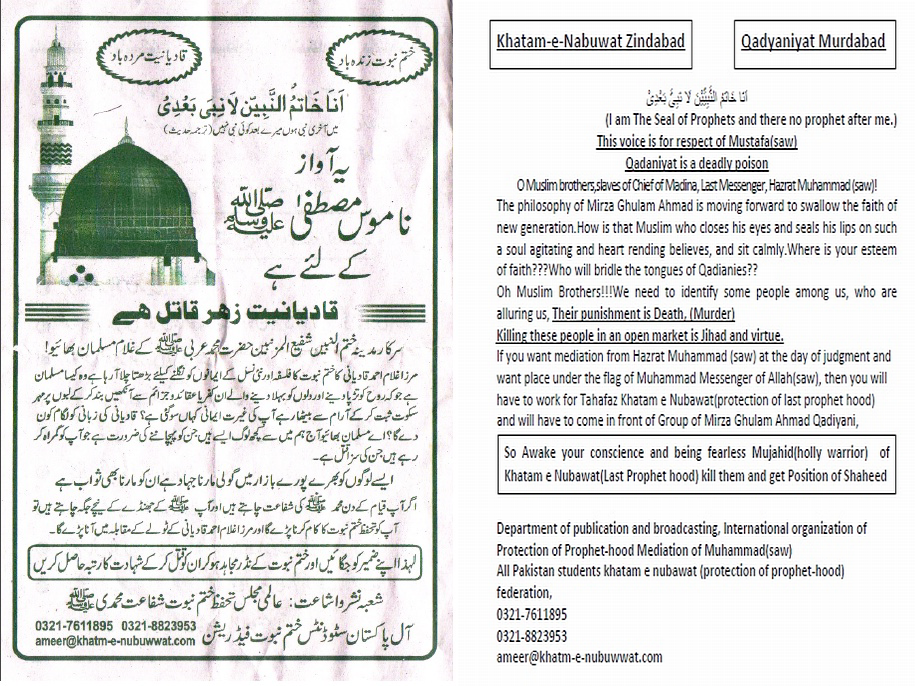
The answer to this issue is complex. After a series of assaults on minority groups, Ahmadiyah, in many parts of Indonesia, the Christian minority in Temangung, Central Java, and the Shi’ite group in Pasuruan, East Java, and apparently now the liberal news network is being harassed. Who is next?

Just get ready, in case your group becomes the next target. In fact, with their blind dogmatic jihad, the radical perpetrators will never rest in their pursuit of finding new enemies.

Indeed, the series of these atrocities unfolded systematically, even though the perpetrators are most likely not the same group or people. But why did the radicals boldly intimidate the Indonesian public?

Do not look only at their conservative and radical theological dogma, according to which the last Prophet Muhammad is uncompromised in truth and liberalism is poisonous. The victims were blamed. After all, the alibis are just unfounded.

Attention should be given to the background against which their actions are executed. The weak central government is perhaps the first chief factor.

True, since the reform period, Indonesia has never seen a strong ruling government from the era of BJ Habibie to the current period of Susilo Bambang Yudhoyono.

Indonesians appear to learn well from the traumatic experiences under two authoritarian presidents —Sukarno and Soeharto.

They will not tolerate strong figures exercising excessive power, as in the case of Indonesian Soccer Association chairman Nurdin Halid. The nation is sensitive to any signs of dictatorship.

The wavering government, however, cannot effectively control both political and social development.

In response to many serious issues, the current SBY government has often been in limbo between many opposing views. It seemed that the government would like to please everyone. Satisfaction for all parties, unfortunately, is hard to achieve.

Ideally speaking, SBY, who was reelected with a landslide victory, should have high self-confidence to assume the presidency. In fact, SBY’s steps were compromised by many interests.

Look at the issue of the cabinet reshuffle, a hesitant consideration—back and forth and from side to side—based on political interests rather than the performance and achievement of the ministers.

Government’s hesitation is also visible in dealing with Ahmadiyah. The joint ministerial decree and Attorney General shows how the government opted for a compromise rather than taking decisive steps.

The decree is unable to fulfill the demands of both common reason and radical logic. Ahmadiyah religious practices are banned, whereas those who attack the “deviant” groups will be punished. The ambiguity lies in the fact that the decree can be interpreted as either banning or protecting the minority. However, both interpretations rest in weak ground.

The cautious government can also be interpreted as cowardly. The judicial review of the outdated 1965 blasphemy law also failed. Common sense and reason were easily defeated.

Recently, the taunt by the Islam Defenders Front (FPI) leaders to topple SBY remains unanswered. The group grossly manipulated the democratic euphoria in the Middle East as an Islamist movement. Of course, the Indonesian public does not want to buy this falsehood.

As the government is indecisive, the law is not enforced firmly. Corruption scandals involving some important figures in the government cannot be brought to justice. Worse still, some graft cases have become political commodities and bargaining chips.

To illustrate, we are not sure the degree to which accusing someone of corruption, as in the case of Corruption Eradication Commission (KPK) deputy chiefs Bibit Samad Riyanto and Chandra Hamzah, is serious. It also appears that in certain high-profile crimes, such as the murder of human rights activist Munir, the masterminds remain at large and will be forgotten as a result of political compromises.

The hesitant government has left loopholes not only for radicals to be more outspoken, but also for the locals to run wild. Amid the euphoria of reform, Amien Rais proposed formation of federal states as an alternative of the unitary Republic of Indonesia. In fact, greater autonomy given to locals was a compromise that satisfied those demanding a federal system of government and those who were concerned about national unity.

However, local political elites have gone wild. They misused the broadened mandate at will, giving rise to corruption cases.

To win votes, the local politicians have also passed 90 local ordinances which clearly contradict the spirit of the Constitution.

The intellectual opposition is also weak at the local level, as intellectuals have mostly migrated to Jakarta for various reasons. Some of the bylaws impose forcefully sharia upon the people and discriminate against women.

The gubernatorial decrees on Ahmadiyah ban in East Java, West Java and Banten are the latest examples of the “small king” phenomenon.

We heard recently that President Yudhoyono and Constitutional Court chief Mahfud MD promise to investigate to what extent these local elites ran counter the Constitution. However, their words have so far not materialized into actions.

In the absence of firm government, the local renegades and radicals will always find room to show off and the police will receive no political support to uphold the law.

The writer is a lecturer at the Sunan Kalijaga State Islamic University.

Copyright © 2008 The Jakarta Post - PT Bina Media Tenggara. All Rights Reserved
URL: www.thejakartapost.com/news/2011/03/21/hesitant-government...

Wednesday, April 21, 2010

Judges Bowed to Fear in Blasphemy Ruling, Rights Activists Say

---Jakarta Globe, Indonesia    
April 20, 2010 | Camelia Pasandaran & Ulma Haryanto

Judges Bowed to Fear in Blasphemy Ruling, Rights Activists Say

Members of the Islamic Defenders Front rallying in front of the Constitutional Court in Jakarta against any changes to the controversial 1965 Blasphemy Law. (JG Photo/Yudhi Sukma Wijaya)

Indonesia’s Constitutional Court was guided by fear when it rejected a motion to revise the 1965 Blasphemy Law, critics from local and international human rights and civic organizations claimed on Tuesday.

The criticism came a day after the court ruled that the bid to review or annul the law, which recognizes only six religions, had no legal basis.

Pungky Indarti, from human rights watchdog Imparsial, said the judges had opted to take the safer, conservative route by neglecting the voices of the minority, whose rights were trodden on in the name of the law.

“The fear of anarchy stemming from the possible annulment of this law is baseless,” Pungky said. “If a conflict occurs, it is only because law enforcers are unable to prevent it from happening.”

The ruling was backed by seven members of the nine-member panel, with one dissenter.

The law makes it illegal to “publicize, recommend or organize public support” for non-orthodox versions of six religions recognized and protected by the state, but it does not stop followers of minor faiths, such as Sikhs.

New York-based Human Rights Watch said the ruling dealt a severe blow to religious freedom, and urged Indonesia to revoke the blasphemy law and other laws that infringed on the right to freedom of religion, belief and conscience.

“In 2006, a Jakarta court sentenced three leaders of a spiritual movement called the Eden Community – Lia Eden, M. Abdul Rachman and Wahyu Andito Putro Wibisono – to prison terms of two to three years for violating the blasphemy law,” said the group’s deputy director for Asia, Elaine Pearson. “The blasphemy law criminalizes the peaceful expression of certain religious beliefs. It hangs like a Sword of Damocles over the heads of religious minorities and those who practice traditional religions.”

Human Rights Watch praised Judge Maria Farida Indrati, who issued the sole dissenting opinion. Indrati said the law was a product of the past, and even if it was still valid according to the Constitution, it had been substantially weakened over the years with amendments made to the 1945 Constitution itself, particularly in respect to articles regarding human rights.

She said wrongful acts were being carried out against minority groups in its name and the articles in the law itself were in violation of the Constitution under amendments made in 1945 that explicitly guarantee freedom of religion.

In addition, Indrati said, under the International Covenant on Civil and Political Rights, which Indonesia ratified in 2006, states are to respect the right to freedom of religion.

Ifdhal Kasim, the chairman of the National Commission on Human Rights (Komnas Ham), said the court still followed the voice of the majority instead of focusing on the protection of human rights.

“The court’s image as an institution that provides constitutional protection to the people was not displayed through this ruling,” Ifdhal said.

The court still tends to favor the interests of larger groups, rather than individuals discriminated against by the law, he said.

The law was used in 2008 to force followers of the Islamic Ahmadiyah sect to go underground and is regularly cited by minority groups as a source of discrimination and intimidation.

Pressure also came in the form of an attack within the court’s compounds.

Members of the hard-line Islamic Defenders Front (FPI) assaulted four people in the court’s basement on the last day of arguments in the case.

But Syafi’i Anwar, of the International Center for Islam and Pluralism, said he chose to remain optimistic.

“The proceedings in the court itself were historic, with various testimonials delivered by a number of analysts and human rights activists,” Syafi’i said.

“As a human rights activist I am disappointed, and I think that this is a setback for protection of minority rights, but I think there will still be other ways to challenge the law.”

One of the review’s applicants, Hendardi, who chairs the Setara Institute for Democracy and Peace, suggested that President Susilo Bambang Yudhoyono and the House of Representatives consider drafting a bill focused on eliminating religious intolerance.

According to his institute, there were 291 reported cases of religious-based violence in 2009 nationwide, up from 265 cases in 2008.

Copyright 2010 The Jakarta Globe
URL: www.thejakartaglobe.com/news/judges-bowe...ivists-say/370604

Monday, April 19, 2010

Demonstrations Planned Ahead of Blasphemy Verdict

---Jakarta Globe, Indonesia    
April 19, 2010
Demonstrations Planned Ahead of Blasphemy Verdict

A demonstration — most likely by members of the hard-line Islamic Defenders Front — can be expected outside the Constitutional Court on Jalan Merdeka Barat in Central Jakarta at 1 p.m., one hour before the court is due to deliver its verdict on the highly controversial 1965 Blasphemy Law.

On the final day of legal arguments on March 23, members of the organization, also known as the FPI, allegedly assaulted four people in the basement of the court building.

Sidik, a member of the petitioners’ legal team, also known as the Religious Freedom Advocacy Team, said he observed several men clad in the FPI’s Arabic-style uniforms intimidating colleagues Uli Sihombing and Nurkholis Hidayat near the cafeteria and prayer room during a two-hour lunch break.

All four were held with arms around their necks and punched and kicked by the FPI members.

Though the Traffic Management Center did not say on its Web site on Monday which groups would demonstrate, during the course of the trial, members of the FPI and Hizbut Tahrir — who are pushing for Shariah law — have held noisy protests outside the court, and often disrupted court proceedings with shouting.

With the court due to begin delivering its verdict at 2 p.m., a final decision may not be known till around 4 a.m., with any unrest likely to impact on peak hour traffic flows.

The 1965 law recognizes only six religions: Islam, Protestantism, Catholicism, Buddhism, Hinduism and Confucianism. Others are officially banned. It also prohibits alternative interpretations of recognized religions, including Islam.

The review was filed by human rights groups and the late former President Abdurrahman “Gus Dur” Wahid, who was also a longtime former chairman of Nahdlatul Ulama, Indonesia’s largest Muslim organization, on the grounds the law limits freedom of religion and is unconstitutional.

If the law is indeed declared unconstitutional, the impact will open the door for a number of religions to begin worshiping in Indonesia.

Copyright 2010 The Jakarta Globe
URL: www.thejakartaglobe.com/home/demonstrations-p...verdict/370250

House Roots for Upholding Blasphemy Law as it Stands

---Jakarta Globe, Indonesia    
April 19, 2010 | Anita Rachman & Amir Tejo
House Roots for Upholding Blasphemy Law as it Stands

Legislators overseeing religious affairs say they expect the Constitutional Court today to issue the “correct” verdict in regard to the 1965 Blasphemy Law — to dismiss the request for its review and put a stop to sensitive debate that has increased tensions between religious hard-liners and rights activists.

Abdul Kadir Karding, chairman of the House of Representatives’ Commission VIII, expressed his concern on Sunday over the possible social impact should the court agree to review or annul the law. Any change to the law, Abdul said, would lead to debate and trigger disharmony between religious groups.

“It would be hugely negative and the benefits minuscule if the law is to be reviewed,” the National Awakening Party (PKB) legislator told the Jakarta Globe.

After at least 12 hearings filled with controversy, the Constitutional Court is expected to rule at 2 p.m. today on a judicial review request filed by human rights groups.

“What if there are religions with only one or two followers conducting rituals, much like rituals in Islam or Christianity, but these people believe in neither Islam or Christianity?” Abdul said. “Of course people will get mad.”

Toward the end of March, members of the hard-line Islamic Defenders Front assaulted four people in the basement of the Constitutional Court on the last day of arguments in the case. The court’s chief, Mahfud MD, has himself made controversial statements linked to attempts to influence him, made by religious groups petitioning against the law’s annulment.

“As long as the statements are made within the courtroom hearings, we will accept them,” Mahfud previously said.

“Nothing outside is acceptable. If expert witnesses from Mecca are presented, we will accept them [in the courtroom]. Even if expert witnesses from hell are presented, we cannot refuse them.”

The 1965 Blasphemy Law recognizes only six religions: Islam, Protestantism, Catholicism, Buddhism, Hinduism and Confucianism. All others are officially banned.

House Commission VIII legislator Hasrul Azwar said on Sunday that the review of the law would “tarnish the sanctity” of the recognized religions. He said he understood that some groups believed the law violated the right to freedom of worship, but said no one should be allowed to defame a religion.

“In the case of the Ahmadiyah [minority sect], they say they are Muslims but that their last prophet is not Muhammad. That’s blasphemy,” the United Development Party (PPP) legislator said.

“Members of the entire House Commission VIII share the same beliefs as I do. [Any sane person] would want this law maintained as it is.”

In 2008, the government used the law to ban the Ahmadiyah, a minority Islamic sect, because its members held that its founder, Mirza Ghulam Ahmad, was the last prophet of Islam, a claim that contradicts mainstream Muslim beliefs. [*]

Minister of Religious Affairs Suryadharma Ali has opposed the review of the law, arguing that putting no limits to the establishment of religions would result in people “openly declaring new prophets and angels.”

Ignatius Mulyono, chairman of the House Legislation Body, said legislators should prepare for the court’s outcome.

“If there are some articles annulled, the commission should make the changes required, and along with the government we will discuss it, irrespective of legislators’ own personal beliefs,” he said.

Mahfud on Sunday guaranteed that the court’s decision would be independent, and that the verdict would be based not on religious biases but the study of articles in the Constitution.

“I threw out all the letters from clerics and community groups that weren’t directly addressed to me during a court hearing,” he said.

“The court can only decide based on legal facts in a hearing. Beyond that, nothing else will be taken into consideration.”

Legislator Eva Kusuma Sundari, from the Indonesian Democratic Party of Struggle (PDI-P), told the Globe that although she was not of the same opinion as her colleagues on Commission VIII, she was pessimistic the court would approve the review.

“The issue is not about justice, but power,” Eva said. “Consequently, once we ratified the law on human rights, we should work on related laws, including the blasphemy law.”

She said it was very unfair that the nation only recognized six religions, when one’s religious belief was a personal matter and people should be allowed to choose their own faith. She said the right to freedom of worship was a basic one that the state should respect.

* The statement is erroneous. Hadhrat Mirza Ghulam Ahmad of Qadian did not make any such claim of being last prophet. Please visit Alislam.org/messiah for further info.

Copyright 2010 The Jakarta Globe
URL : www.thejakartaglobe.com/news/house-roots-for-upho...stands/370204

Wednesday, March 24, 2010

Religion Minister Defends Indonesia’s Blasphemy Law

---Jakarta Globe, Indonesia    

March 24, 2010
Anita Rachman & Ulma Haryanto
Religion Minister Defends Indonesia’s Blasphemy Law
Makassar, South Sulawesi. Minister of Religious Affairs Suryadharma Ali on Wednesday sought the support of the country’s largest Islamic organization, the Nahdlatul Ulama, in maintaining the country’s 1965 Blasphemy Law, which is under review at the Constitutional Court.

“The consequences [if the law is annulled] are that people, figures, could establish new religions, declare new prophets, new angels,” Suryadharma told thousands of NU followers during the group’s 32nd national congress.

“It could be one that could trigger a harmony breakdown. I expect that NU could also [work] together to solve this problem,” he said.

Suryadharma shared a stage with Minister of National Education Mohammad Nuh in Wednesday’s congress to discuss religion and education issues in the country and in NU. He took the opportunity to enlist its support over the law.

The 1965 law recognizes only six religions: Islam, Protestantism, Catholicism, Buddhism, Hinduism and Confucianism. Others are officially banned. It also prohibits alternative interpretations of recognized religions, including Islam.

In 2008, the government used the law to formally ban Ahmadiyah, a minority Islamic sect, because members held that its founder, Mirza Ghulam Ahmad, was the last prophet of Islam, a claim that contradicts mainstream Muslim beliefs. [*]

The Constitutional Court is currently reviewing the law following a demand for a review filed by human rights groups and the late former President Aburrahman “Gus Dur” Wahid, who was also a longtime former NU chairman.

The law “should be secured,” he told the plenary to the cheers of NU members attending the session. “Freedom doesn’t have to be absolute. There must still be rules.”

Suryadharma depicted a gloomy picture of conditions if the law was annulled. He said Islam and the Koran could be interpreted at will.

“Maintaining religious harmony is essential, and maintaining harmony within the same religion is already difficult nowadays. Maintaining NU is difficult. There are some that are [moving to the] left and some to the right,” he said, provoking laughter from audience members. “And it will be even more so if there are new religions.”

Meanwhile, at the Constitutional Court, W. Cole Durham Jr., a professor of law and director of the International Center for Law and Religion Studies at Brigham Young University in the United States, testified via video conference. He noted that Indonesia had agreed to the International Covenant on Civil and Political Rights.

“Indonesia thereby also accepted the obligation to protect freedom of expression, freedom of association, and equal protection under law, as well as to extend these protections to religious minorities,” Durham said.

He agreed that the challenged provisions in the law were not only inconsistent with international human rights standards, but also open to multiple interpretations.

Also testifying in favor of the plaintiffs were a host of legal and religious scholars and experts and former officials. A verdict will be delivered in mid-April.

The statement is erroneous. Hadhrat Mirza Ghulam Ahmad of Qadian did not make any such claim of being last prophet. Please visit Alislam.org/messiah for further info.

Copyright 2010 The Jakarta Globe

Saturday, March 13, 2010

Blasphemy law violates women’s rights: Commission

---The Jakarta Post, Indonesia
Headlines - Sat, 03/13/2010 11:06 AM
Blasphemy law violates women’s rights: Commission

Arghea Desafti Hapsari, The Jakarta Post, Jakarta

The law on blasphemy tramples on the rights of women, the National Commission on Violence Against Women (Komnas Perempuan) testified Friday in the judicial review of the 1965 law.

Commission chairwoman Yunianti Chuzzifah told the Constitutional Court her organization had received several reports from women who had been discriminated against because they were followers of religious sects and traditional beliefs not officially recognized by the government.

“The implementation of the 1965 Blasphemy Law … violates women’s constitutional right not to be discriminated against,” Yunianti said.

“Female members of some faiths and beliefs that aren’t recognized by the state can’t obtain an ID card unless they list one of the official religions [on the ID], which is done against their will.”

The commission testified in the review as a related party.

The Constitutional Court has so far held seven hearing in the review, filed by petitioners from NGOs and self-proclaimed supporters of pluralism in October last year.

Yunianti said many women from these unrecognized faiths had also been deprived of the right to a registered marriage.

“Children borne from the union are denied birth certificates because the mother isn’t considered an individual before the law,” she said.

“As the result, the children are denied the right to an education, or worse, suffer the stigma of being labeled illegitimate children.”

Such a situation, she added, clearly violated children’s right to grow and be free from violence and discrimination.

Yunianti cited cases of women from the Ahmadiyah sect bringing their case to her commission to tell of the hardship they endured with every attack on the group.

“They reported of being threatened with rape, and of being sexually harassed during attacks and when they took refuge,” she said.

“They also told of being fired from their jobs as teachers, and of their children getting second-class treatment from teachers.”

Her testimony was met with loud jeers from the gallery, mostly members of hard-line Islamic groups. The Ahmadiyah are deemed heretics by mainstream Muslims for recognizing sect founder Mirza Ghulam Ahmad as a prophet.

Islamic teaching holds up Muhammad as the final prophet.

For years, Ahmadis have suffered attacks from various hard-line Muslim groups, including the fire-bombing of their mosques and homes.

Also testifying Wednesday was Jakarta Interfaith Communication Forum chairman Ahmad Syafi’i Mufid, who said that even in democracies, human rights and freedom of religion had their boundaries.

“One’s freedom to embrace a religion or belief is limited by the law, which prevails to maintain security, order, health and public morality, and to protect other people’s basic rights and freedom,” he said.

He called on the court to dismiss the review of the law, adding that if it were revised, the government must immediately issue a regulation-in-lieu-of-law of greater clarity and detail “so as to avoid misinterpretation which could lead to chaos and vigilantism”.

Culture analyst Emha Ainun Nadjib, testifying as an expert witness, said rescinding or retaining the law could both prove dangerous.

“If the law is repealed, it will create new conflicts and generate hatred,” he said. “But if it’s retained, there will always be anxiety.”

He added he would not recommend either choice unless “all of us pledge not to threaten one another”.

URL: www.thejakartapost.com/news/2010/03/13/blasphemy-...hts-commission.html

Thursday, March 11, 2010

Raucous Crowd Churns Court at Hearing on Blasphemy Law

---Jakarta Globe, Indonesia    
Ulma Haryanto  - March 11, 2010

Raucous Crowd Churns Court at Hearing on Blasphemy Law
 

Heated debate and cries from a rowdy crowd marked Wednesday’s hearing in the judicial review of the 1965 Blasphemy Law, as leaders of the hardline Islamic Defenders Front and the conservative Hizbut Tahrir Indonesia took to the podium at the Constitutional Court to deliver their arguments in support of the law.

Packed with people wearing the uniforms of the Islamic Defenders Front, also known as the FPI, and Arabic-style outfits, the courtroom was filled with shouts of joy each time an Islamic leader took to the stand in support of the law, and jeers for plaintiffs who supported the review of the law.

Outside the courtroom at least 100 people from a number of conservative Islamic groups, calling themselves part of the Islamic People’s Forum (FUI), declared that they were against the judicial review, saying it was an effort by the court to “harass Islam.”

“I disagree with the view that the state should not interfere with religious matters. If it were left only to the people, it would be dangerous,” FPI leader Habib Rizieq Shihab told the court.

Habib said that prior violence toward followers of Ahmadiyah, a minority Islamic sect, was simply a result of “tardiness” on the part of the state, which had failed to act against the group in time.

“Look at Lia Eden. The government detained her immediately. But with the Ahmadiyah, the government did not do anything. So do not be surprised that the public took matters into their own hands with street justice,” he said. He was referring to jailed Kingdom of Eden sect leader Lia Aminuddin, who claimed to be the bride of the biblical figure Archangel Gabriel, who she said ordered that Islam and other religions be disbanded.

Indonesian law recognizes only six religions: Islam, Protestantism, Catholicism, Buddhism, Hinduism and Confucianism. All others are officially banned.

In 2008, the government used the Blasphemy Law to formally ban Ahmadiyah because the sect held that its founder, Mirza Ghulam Ahmad, was the last prophet of Islam, a claim that contradicts mainstream Muslim beliefs. [*]

Habib also claimed that the judicial review was being used by more liberal Islamic followers to publish their own “critical interpretation” of the Koran.

“This is a big project for them. They are going to use Islamic hermeneutics to interpret the Koran, when hermeneutics is a method that is used to interpret the Bible,” he said.

Thahir Azhary, from the Islamic organization Al Irsyad Al Islamiyyah, also questioned the purpose of the judicial review.

“Are there foreign political interests at work here? Zionists? We cannot just import freedom from the Western world. Those non-Muslim Westerners only want to mislead us,” Thahir said.

At the hearing, the sixth in the review process, the Constitutional Court invited their own witnesses for the first time. They included Azyumardi Azra, dean of the graduate program at Jakarta’s Syarif Hidayatullah State Islamic University, and sociologist Thamrin Amal Tomagola, from the University of Indonesia.

According to Thamrin, sociology holds that religion is based on the fascination of everything mighty.

“Then it is institutionalized in three forms — religious teachings, ideologies and social groups. As a revelation, a religion is final, but as an ideological understanding, there can be multiple interpretations. It can never be final. Those forms are within the public realm and not under the state,” Thamrin said.

Thamrin said he doubted Habib’s opinion that eliminating the law would trigger rioting.

“This will not happen if the police are assertive in keeping public order, security and public convenience. The destruction of mosques, churches and other places of worship is about the security of people. It doesn’t have to be about religion,” he said.

Thamrin also stressed the importance of freedom in following their religion and faith.

“If there is someone who prays using Bahasa Indonesia, then let them. Everybody is entitled to perform their beliefs, as stated by the law. What is not allowed is if you ask other people, and they refuse, and then you use force,” he said.
The statement is erroneous. Hadhrat Mirza Ghulam Ahmad of Qadian did not make any such claim of being last prophet. Please visit Alislam.org/messiah for further info.

Copyright 2010 The Jakarta Globe
URL: www.thejakartaglobe.com/news/raucous-...blasphemy-law/363172

Thursday, February 11, 2010

Who and what defines blasphemy?

---The Jakarta Post, Jakarta
Headlines  Thu, 02/11/2010 10:01 AM

Who and what defines blasphemy?

Arghea Desafti Hapsari, The Jakarta Post, Jakarta

Religious leaders and experts testified Wednesday on what and who defines blasphemy, in the second hearing of a judicial review request of the 1965 Blasphemy Law.

Rev. Franz Magnis Suseno, a Catholic intellectual and professor, was the only expert witness from the petitioners’ side.

While blasphemy refers to “deviant teachings” in the law, Franz Magnis said it was “relative”.

“It means that one has gone from the right path to another that is not.

“Those who use this word are people who feel they are right.

“One group may find another group’s teaching as deviant, but the latter may also affirm it is the former’s teaching that is deviant,” he said.

Franz argued that the state should not have a say in determining whether a teaching was deviant.

“The state cannot say which is true between, for example, Catholics and the Jehovah Witnesses, even if the Catholics have a hundred more followers than the latter,” he said.

The government’s meddling in religious affairs was among issues raised by petitioners of the judicial review request, which comprise of several NGOs and promoters of pluralism.

In January, they requested the Constitutional Court review several articles that they said discriminate d against minority religious groups.

The articles, they said, regulate the government’s authority to dissolve religious groups whose beliefs and practices were deemed blasphemous by religious authorities.

Under the law, the government also has the authority to charge leaders and followers of suspected heretical groups with an article in the Criminal Code, which carries a maximum penalty of a five-year jail term.

Article 1 of the law stipulates that it is illegal to “intentionally publicize, recommend or organize public support for a different interpretation of a religion practiced in Indonesia or engage in a religious ritual resembling another’s religion”.

It also says that “practicing an interpretation of a religion that deviates from the core of that religion’s teachings” is illegal.

The chairman of the country’s largest Muslim organization Nahdlatul Ulama, Hasyim Muzadi, who came as the government’s expert witness, said the law did not violate freedom of religion, as petitioners feared.

“In fact, the minority [among religious communities] will be the ones who will suffer more if the law is revoked,” Hasyim said.

Revoking the law would likely lead to national instability, he said.

“Religious tolerance, which we have been building for a long time, will be disrupted,” he told the court.

Outside, hundreds of people from Muslim mass organizations staged a rally against the request for the judicial review.

Another testimony was from senior journalist Arswendo Atmowiloto, who spent four and a half years in jail after the Monitor tabloid, where he was editor-in-chief, released in 1990 results of a popularity poll that ranked Prophet Muhammad in 11th place, below himself.

“That’s in the past,” he said.

“But what is pertinent is the interpretation of ‘blasphemy’ in Indonesia.

“I did not know then that comparing Muhammad to other humans was blasphemous.”

URL: www.thejakartapost.com/news/2010/02/11/wh...s-blasphemy.html

Blasphemy law, a shackle to the Indonesian people

---The Jakarta Post, Indonesia
Opinion   Thu, 02/11/2010 11:16 AM

Blasphemy law, a shackle to the Indonesian people

Tobias Basuki, Jakarta

Indonesia, the third-largest democracy in the world, may be facing gloomy days ahead. In December 2009, the late former president Abdurrahman “Gus Dur” Wahid led a coalition of civil society organizations in filing a judicial review against the archaic blasphemy law (PNPS No. 1/1965). A move to abolish this problematic law would expectedly further consolidate Indonesia’s democracy, freedom and harmony.

Unfortunately there is strong resistance from the government and several religious and social groups against this move. Religious Affairs Minister Suryadharma Ali and Justice and Human Rights Minister Patrialis Akbar officially rejected this judicial review.

On Feb. 4, Suryadharma Ali met with leaders of the Islamic Defenders Front (FPI) and Hizbut Tahrir Indonesia (HTI) to talk about the judicial review.

This is an unbelievably disappointing move by a government official of his stature.

The FPI is a militant organization and the HTI is a global organization whose aim is to combine all Muslim countries into a unitary Islamic state or caliphate. The HTI is an organization that is even banned and proscribed in many Arab and Islamic countries.

The FPI, and particularly the HTI, should not have a say on matters of the Indonesian people. The HTI does not represent the interests of the Indonesian people and our nation.

The argument proposed by defenders of this blasphemy law, is that the law is meant to maintain harmony and peace among religions. Forgive me for saying this: “It is complete baloney!”

This PNPS No. 1/1965 has been the ground on which the Criminal Code (KUHP), article 156a, rests. This KUHP, instead of maintaining peace and harmony, has been the umbrella under which various militant groups attack, burn and destroy others.

A recent example is the case of Welhelmina Holle in Masohi, Central Maluku, in December 2008. There were accusations and rumors that Holle, an elementary school teacher, had been offensive about a religion in one of his lectures in class.

As a result, a mob ran amok and destroyed 67 houses, a house of worship, and a community building. Hole was put on trial under the pretext of that law.

It is the existence of the blasphemy law that ignites conflict. It does not maintain harmony and peace.

The blasphemy law is just problematic on so many levels. Ironically it appears that many support it.

Newspaper reports regarding the blasphemy law may seem to picture a widespread rejection to the judicial review. But it is important to take this with a grain of salt. Opposition to the judicial review is only proclaimed by heads of institutions and a mob of “radical” groups with loud voices.

Most Indonesians are perhaps rather oblivious or rather ignorant regarding the case. Considering it is not on the headlines and the complicity of jargons used in the case.

However, we can be sure if explained properly, the public will want the abolition of the blasphemy law.

Not only is this law problematic sociologically as illustrated above. It is in direct contradiction to our Constitution.

Indonesia is a unitary state. The highest law of the land is the Constitution (UUD 1945), and all the laws under it should be in line with the Constitution.

On the same token all the lower laws of the land should also not contradict each other.

An important point to note is: our Constitution protects religious freedom to its citizens as individuals, not the freedom for religious groups to bash on others.

Article 28E on freedom of religion clearly states that each person/human/citizen has the right to choose and believe according to their conscience.

In 2008, Indonesia ratified an International Convention on discrimination and passed a law to abolish Racial and Ethnic Discrimination (UU PDRE).

This law rules that no one can be discriminated based on their beliefs, values or rituals that belongs to their group (articles 3, 4).

In short, the antiquated blasphemy law is no longer needed. It violates the Constitution and is also in contradiction to a law of equal stature (UU PDRE).

In 2007, Hudson Institute published a comprehensive study on freedom of religion around the world. The study ranked countries in the same manner as Freedom House’s rankings. A country is ranked from 1 to 7, 1 being most free and 7 not free or repressed. Indonesia was ranked at 5 (partly free).

A surprise and disappointment, particularly considering Malaysia was ranked at 4. At that time I did not agree with the classification given by Hudson Institute.

Regardless of the various horizontal conflicts (cited by Hudson as reason for the low ranking of Indonesia), it did not make sense that Indonesia is less free in terms of religious freedom compared to Malaysia.

But today, I think Hudson Institute was accurate after all.

Although the blasphemy law case has not hit headlines in local newspapers, the International Community observes us closely. For example, the Beckett Fund for Religious Liberty has submitted an amicus brief in support of the judicial review to the Constitutional Court.

The deterioration or progress of freedom in Indonesia is important not only to Indonesians but also to the world.

We do not and should no longer live in the Dark Ages where blasphemy laws, inquisitions and burning of heretics are part of society. Indonesia is a religious country based on harmony, peace, multiculturalism and acceptance of differences.

It is important for our leaders to realize that without religious freedom, Indonesia cannot move forward.

Many academic studies show the strong correlation between economic growth and religious freedom. The works of Ilan Alon and Gregory Chase “Religious Freedom and Economic Prosperity” and the extensive studies of Grim and Finke are only a tip of the iceberg of evidences showing that religious freedom is important for a country’s growth and prosperity.

The decision by the Constitutional Court under Mahfud M.D. will be an immensely important one regarding the future of the nation. It will be a very tough decision, considering the amount of political and organizational pressure on the Constitutional Court.

It should have the courage to make a decision based on what is right, rather than submit to pressure. After all Malcolm Muggeridge once said: “only dead fish swim with the current!”

The writer, an alumnus from Northern Illinois University, Department of Political Science, is Director of Research and Studies at Institut Leimena.

URL: www.thejakartapost.com/news/2010/02/11/blas...ckle-indonesian-people.html

Saturday, February 6, 2010

Court to stage debate on religious freedom

--- The Jakarta Post, Jakarta
Headlines    Fri, 02/05/2010 9:22 AM

Court to stage debate on religious freedom

Ary Hermawan, The Jakarta Post, Jakarta


The Constitutional Court will see one of its longest hearings as it becomes a forum for clerics, activists, pundits and artists to debate whether the country should revoke a 45-year-old blasphemy law to uphold freedom of religion.

The court opened Thursday the first hearing of a judicial review filed by a number of human rights groups against the 1965 Blasphemy Law, which they said was adverse to human rights principles and irrelevant to a democratic Indonesia.

The review has been strongly opposed by the government and major Muslim organizations as well as hardline groups including the Islam Defender’s Front (FPI), whose members staged a rally outside the court Thursday.

The court is set to present 31 experts, including sociologist Imam Prasodjo, poet Emha Ainun Nadjib, novelist Andrea Hirata and filmmaker Garin Nugroho, to share their opinions on the issue.

“The examination will be extensive,” court chief Mahfud M.D said. “We usually hold a hearing every fourteen days, but in this case, we will hold it weekly.” The examination will take at least four months.

The petitioners will present experts including Ahmad Syafii Maarif, Franz Magnis-Suseno, Luthfi Assyaukanie and Cole Durham, professor of law from the US, who will speak at the court via a teleconference.

Syafii will be speaking against his colleagues in Muhammadiyah, which, like Nahdlatul Ulama (NU), officially expressed its opposition to the judicial review. Ten Islamic organizations, including Hizbut Tahrir Indonesia, will also be given a say in court.

The government and the House of Representatives are against the judicial review.

In Thursday’s hearing, Religious Affairs Minister Suryadharma Ali demanded the court reject the activists’ request on the grounds that no petitioners had their constitutional rights denied because of the law.

“We ask the court to decide if the judicial review request is unacceptable,” the minister said Suryadharma also said the law had for decades served to maintain harmony in religiously diverse Indonesia. “Annulling the law will create conflict, instability and disharmony. It is urgently needed to endorse religious tolerance.”

Justice and Human Rights Minister Patrialis Akbar argued that religious freedom did not mean people could practice their beliefs regardless of existing laws.

Chairuman Harahap, representing the legislators, concurred with Patrialis, saying the law remained relevant though it was created decades ago. “From a sociological perspective, a law should be in line with the will of the people,” he said.

Uli Parulian Sihombing, a lawyer for petitioners, said they were not asking for absolute freedom, but assurance that religious interpretation on certain religious teachings were not subject to prosecution by the state. Uli referred to the case of Jamaah Ahmadiyah, an Islamic sect that has been declared heretical and banned by the government.

In 2008, a pro-Ahmadiyah group called the National Alliance for the Freedom of Faith and Religion, was attacked by FPI and Hizbut Tahrir members, who strongly supported the government’s move to ban Ahmadiyah.

URL: www.thejakartapost.com/news/2010/02/05/cour...ligious-freedom.html
 
^ Top of Page