Showing posts with label religious hard-liners. Show all posts

Wednesday, April 21, 2010

Judges Bowed to Fear in Blasphemy Ruling, Rights Activists Say

---Jakarta Globe, Indonesia    
April 20, 2010 | Camelia Pasandaran & Ulma Haryanto

Judges Bowed to Fear in Blasphemy Ruling, Rights Activists Say

Members of the Islamic Defenders Front rallying in front of the Constitutional Court in Jakarta against any changes to the controversial 1965 Blasphemy Law. (JG Photo/Yudhi Sukma Wijaya)

Indonesia’s Constitutional Court was guided by fear when it rejected a motion to revise the 1965 Blasphemy Law, critics from local and international human rights and civic organizations claimed on Tuesday.

The criticism came a day after the court ruled that the bid to review or annul the law, which recognizes only six religions, had no legal basis.

Pungky Indarti, from human rights watchdog Imparsial, said the judges had opted to take the safer, conservative route by neglecting the voices of the minority, whose rights were trodden on in the name of the law.

“The fear of anarchy stemming from the possible annulment of this law is baseless,” Pungky said. “If a conflict occurs, it is only because law enforcers are unable to prevent it from happening.”

The ruling was backed by seven members of the nine-member panel, with one dissenter.

The law makes it illegal to “publicize, recommend or organize public support” for non-orthodox versions of six religions recognized and protected by the state, but it does not stop followers of minor faiths, such as Sikhs.

New York-based Human Rights Watch said the ruling dealt a severe blow to religious freedom, and urged Indonesia to revoke the blasphemy law and other laws that infringed on the right to freedom of religion, belief and conscience.

“In 2006, a Jakarta court sentenced three leaders of a spiritual movement called the Eden Community – Lia Eden, M. Abdul Rachman and Wahyu Andito Putro Wibisono – to prison terms of two to three years for violating the blasphemy law,” said the group’s deputy director for Asia, Elaine Pearson. “The blasphemy law criminalizes the peaceful expression of certain religious beliefs. It hangs like a Sword of Damocles over the heads of religious minorities and those who practice traditional religions.”

Human Rights Watch praised Judge Maria Farida Indrati, who issued the sole dissenting opinion. Indrati said the law was a product of the past, and even if it was still valid according to the Constitution, it had been substantially weakened over the years with amendments made to the 1945 Constitution itself, particularly in respect to articles regarding human rights.

She said wrongful acts were being carried out against minority groups in its name and the articles in the law itself were in violation of the Constitution under amendments made in 1945 that explicitly guarantee freedom of religion.

In addition, Indrati said, under the International Covenant on Civil and Political Rights, which Indonesia ratified in 2006, states are to respect the right to freedom of religion.

Ifdhal Kasim, the chairman of the National Commission on Human Rights (Komnas Ham), said the court still followed the voice of the majority instead of focusing on the protection of human rights.

“The court’s image as an institution that provides constitutional protection to the people was not displayed through this ruling,” Ifdhal said.

The court still tends to favor the interests of larger groups, rather than individuals discriminated against by the law, he said.

The law was used in 2008 to force followers of the Islamic Ahmadiyah sect to go underground and is regularly cited by minority groups as a source of discrimination and intimidation.

Pressure also came in the form of an attack within the court’s compounds.

Members of the hard-line Islamic Defenders Front (FPI) assaulted four people in the court’s basement on the last day of arguments in the case.

But Syafi’i Anwar, of the International Center for Islam and Pluralism, said he chose to remain optimistic.

“The proceedings in the court itself were historic, with various testimonials delivered by a number of analysts and human rights activists,” Syafi’i said.

“As a human rights activist I am disappointed, and I think that this is a setback for protection of minority rights, but I think there will still be other ways to challenge the law.”

One of the review’s applicants, Hendardi, who chairs the Setara Institute for Democracy and Peace, suggested that President Susilo Bambang Yudhoyono and the House of Representatives consider drafting a bill focused on eliminating religious intolerance.

According to his institute, there were 291 reported cases of religious-based violence in 2009 nationwide, up from 265 cases in 2008.

Copyright 2010 The Jakarta Globe
URL: www.thejakartaglobe.com/news/judges-bowe...ivists-say/370604

Monday, April 19, 2010

Demonstrations Planned Ahead of Blasphemy Verdict

---Jakarta Globe, Indonesia    
April 19, 2010
Demonstrations Planned Ahead of Blasphemy Verdict

A demonstration — most likely by members of the hard-line Islamic Defenders Front — can be expected outside the Constitutional Court on Jalan Merdeka Barat in Central Jakarta at 1 p.m., one hour before the court is due to deliver its verdict on the highly controversial 1965 Blasphemy Law.

On the final day of legal arguments on March 23, members of the organization, also known as the FPI, allegedly assaulted four people in the basement of the court building.

Sidik, a member of the petitioners’ legal team, also known as the Religious Freedom Advocacy Team, said he observed several men clad in the FPI’s Arabic-style uniforms intimidating colleagues Uli Sihombing and Nurkholis Hidayat near the cafeteria and prayer room during a two-hour lunch break.

All four were held with arms around their necks and punched and kicked by the FPI members.

Though the Traffic Management Center did not say on its Web site on Monday which groups would demonstrate, during the course of the trial, members of the FPI and Hizbut Tahrir — who are pushing for Shariah law — have held noisy protests outside the court, and often disrupted court proceedings with shouting.

With the court due to begin delivering its verdict at 2 p.m., a final decision may not be known till around 4 a.m., with any unrest likely to impact on peak hour traffic flows.

The 1965 law recognizes only six religions: Islam, Protestantism, Catholicism, Buddhism, Hinduism and Confucianism. Others are officially banned. It also prohibits alternative interpretations of recognized religions, including Islam.

The review was filed by human rights groups and the late former President Abdurrahman “Gus Dur” Wahid, who was also a longtime former chairman of Nahdlatul Ulama, Indonesia’s largest Muslim organization, on the grounds the law limits freedom of religion and is unconstitutional.

If the law is indeed declared unconstitutional, the impact will open the door for a number of religions to begin worshiping in Indonesia.

Copyright 2010 The Jakarta Globe
URL: www.thejakartaglobe.com/home/demonstrations-p...verdict/370250

House Roots for Upholding Blasphemy Law as it Stands

---Jakarta Globe, Indonesia    
April 19, 2010 | Anita Rachman & Amir Tejo
House Roots for Upholding Blasphemy Law as it Stands

Legislators overseeing religious affairs say they expect the Constitutional Court today to issue the “correct” verdict in regard to the 1965 Blasphemy Law — to dismiss the request for its review and put a stop to sensitive debate that has increased tensions between religious hard-liners and rights activists.

Abdul Kadir Karding, chairman of the House of Representatives’ Commission VIII, expressed his concern on Sunday over the possible social impact should the court agree to review or annul the law. Any change to the law, Abdul said, would lead to debate and trigger disharmony between religious groups.

“It would be hugely negative and the benefits minuscule if the law is to be reviewed,” the National Awakening Party (PKB) legislator told the Jakarta Globe.

After at least 12 hearings filled with controversy, the Constitutional Court is expected to rule at 2 p.m. today on a judicial review request filed by human rights groups.

“What if there are religions with only one or two followers conducting rituals, much like rituals in Islam or Christianity, but these people believe in neither Islam or Christianity?” Abdul said. “Of course people will get mad.”

Toward the end of March, members of the hard-line Islamic Defenders Front assaulted four people in the basement of the Constitutional Court on the last day of arguments in the case. The court’s chief, Mahfud MD, has himself made controversial statements linked to attempts to influence him, made by religious groups petitioning against the law’s annulment.

“As long as the statements are made within the courtroom hearings, we will accept them,” Mahfud previously said.

“Nothing outside is acceptable. If expert witnesses from Mecca are presented, we will accept them [in the courtroom]. Even if expert witnesses from hell are presented, we cannot refuse them.”

The 1965 Blasphemy Law recognizes only six religions: Islam, Protestantism, Catholicism, Buddhism, Hinduism and Confucianism. All others are officially banned.

House Commission VIII legislator Hasrul Azwar said on Sunday that the review of the law would “tarnish the sanctity” of the recognized religions. He said he understood that some groups believed the law violated the right to freedom of worship, but said no one should be allowed to defame a religion.

“In the case of the Ahmadiyah [minority sect], they say they are Muslims but that their last prophet is not Muhammad. That’s blasphemy,” the United Development Party (PPP) legislator said.

“Members of the entire House Commission VIII share the same beliefs as I do. [Any sane person] would want this law maintained as it is.”

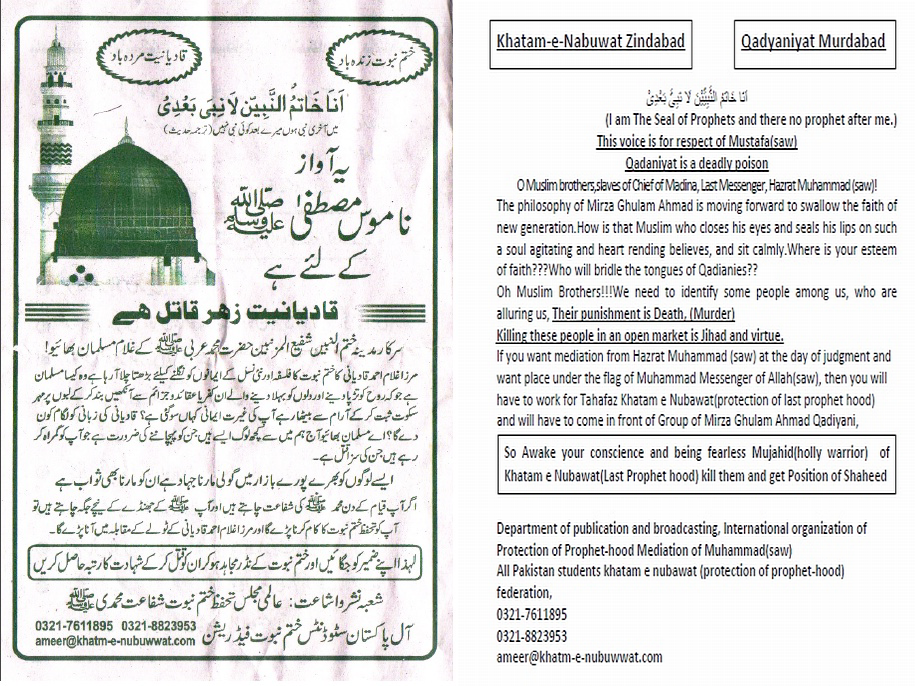
In 2008, the government used the law to ban the Ahmadiyah, a minority Islamic sect, because its members held that its founder, Mirza Ghulam Ahmad, was the last prophet of Islam, a claim that contradicts mainstream Muslim beliefs. [*]

Minister of Religious Affairs Suryadharma Ali has opposed the review of the law, arguing that putting no limits to the establishment of religions would result in people “openly declaring new prophets and angels.”

Ignatius Mulyono, chairman of the House Legislation Body, said legislators should prepare for the court’s outcome.

“If there are some articles annulled, the commission should make the changes required, and along with the government we will discuss it, irrespective of legislators’ own personal beliefs,” he said.

Mahfud on Sunday guaranteed that the court’s decision would be independent, and that the verdict would be based not on religious biases but the study of articles in the Constitution.

“I threw out all the letters from clerics and community groups that weren’t directly addressed to me during a court hearing,” he said.

“The court can only decide based on legal facts in a hearing. Beyond that, nothing else will be taken into consideration.”

Legislator Eva Kusuma Sundari, from the Indonesian Democratic Party of Struggle (PDI-P), told the Globe that although she was not of the same opinion as her colleagues on Commission VIII, she was pessimistic the court would approve the review.

“The issue is not about justice, but power,” Eva said. “Consequently, once we ratified the law on human rights, we should work on related laws, including the blasphemy law.”

She said it was very unfair that the nation only recognized six religions, when one’s religious belief was a personal matter and people should be allowed to choose their own faith. She said the right to freedom of worship was a basic one that the state should respect.

* The statement is erroneous. Hadhrat Mirza Ghulam Ahmad of Qadian did not make any such claim of being last prophet. Please visit Alislam.org/messiah for further info.

Copyright 2010 The Jakarta Globe
URL : www.thejakartaglobe.com/news/house-roots-for-upho...stands/370204
 
^ Top of Page