Showing posts with label Deden Sudjana. Show all posts

Thursday, August 25, 2011

Cleansing Indonesia

Front Page Magazine

Cleansing Indonesia

Posted by Frank Crimi on Aug 25th, 2011
.
A shocking verdict rendered by an Indonesian court underscores the rising tide of violence and discrimination against religious minorities in Indonesia, long purported to be the world’s most tolerant Muslim nation.

In February 2011, Deden Sudjana, a 48-year old Indonesian male, was one of twenty members of a Muslim minority sect called the Ahmadiyah who were violently attacked by an enraged Muslim mob while they gathered in a house in the Indonesian village of Cikeusik.

The fury of the mob attack — which ironically occurred during Indonesia’s Interfaith Harmony Week — was engendered by the presence of Ahmadiyah in Cikeusik. The Ahmadiyah, with 200,000 followers in Indonesia, is considered heretical by many Muslims because of its belief that Muhammad was not the final prophet.

While Sudjana and a handful of Ahmadiyah men tried to defend the property with stones and slingshots, they were quickly overwhelmed by nearly 1,500 Muslims, all armed with clubs, machetes and rocks.

In a terrifying scene caught on video, three Ahmadiyah men were killed and the others badly beaten. As the mob danced around the dead men, laughing and chanting “God is Great,” Indonesian police merely stood and watched.

However, the Indonesian police did manage to arrest Sudjana — whose hand was nearly severed by a machete in the attack — for ostensibly inciting the mob to violence by not leaving the home upon the mob’s arrival.

While that action may have been surprising, it was overshadowed in early August when an Indonesian court sentenced Sudjana to six months in jail. It was a verdict that understandably shocked Sudjana, given the fact that 12 members of the attacking mob had been given sentences between three to six months.

In fact, one of those attackers who had crushed in the skull of an Ahmadiyah man with a rock was released from prison days before Sudjana’s sentencing. Upon his return to Cikeusik, he was treated as a conquering hero by his fellow villagers. As one man said of the attack, “I do feel bad people had to die, but we had to clean our village.”

So, as he was being escorted from the courtroom, an incredulous Sudjana asked aloud, “I’m the victim. Why am I getting a higher sentence than some of the perpetrators?”

Mistreatment of the Ahmadiyah has escalated dramatically since 2008 when the Indonesian government decreed the Ahmadiyah to be a deviant sect whose followers could face up to five years in prison for practicing their faith. Since then, over a hundred violent incidents against the Ahmadiyah have been recorded, incidents which include the torching of mosques and homes.

One of the bigger driving forces behind those attacks has been the Islamic Defenders Front (FPI), a violent and hard-line Islamic militant group founded in 1998 whose stated goal is the implementation of Sharia law in Indonesia.

Unfortunately, the Ahmadiyah are not the only ones to offend the religious sensibilities of the FPI and other Muslim groups. Christians have also seen a dramatic escalation of discrimination and violence launched against them.

In 2011 alone, the Indonesian Community of Churches reported at least 20 churches were forced to suspend services due to mob threats and government intervention, with scores more torched and vandalized.

Unfortunately, replacing a destroyed church or building a new one is highly problematic as Indonesian law requires that construction of a new church must have the support of 60 percent of a community’s residents, an often impossible task for Christians who make up less than nine percent of Indonesia’s total population.

In one notable example, local authorities in Bogor, a suburb of the capital city of Jakarta, have prevented the Indonesian Christian Church (GKI) from moving into a new building for over two years despite a ruling from Indonesia’s Supreme Court that the church be unsealed.

Yet, Bogor’s mayor, Diani Budiarto, has refused to comply with the order and has recently come up with a new excuse for not opening the church, reasoning that the street the church was built on has an Islamic name and is thus an offense to Muslims.

Unfortunately, the Indonesian government has refused to intervene in the case. According to Indonesia’s Home Affairs Minister Gamawan Fauzi, “this is the political reality in the field and it could cause disturbances to security and peace. It would not be healthy in the long run, even for the congregation members themselves.”

Unfortunately, Fauzi’s concern for Christian well-being is well-placed as Muslim intolerance has grown more overt. It’s a trend perhaps best expressed in June 2010, at the second Bekasi Islamic Congress in Bekasi, West Java, when Muslims were instructed to form Islamic paramilitary forces in readiness for a jihad against Christians.

Another more recent example of that intolerance occurred in February 2011 when a Christian man accused of blasphemy for distributing pamphlets that apparently insulted Islam received a sentence of five years in prison. However, a mob of over 1,000 Muslims, believing the verdict required a death sentence, went on a rampage, storming the courthouse and setting several local Christian churches on fire.

Yet, despite Muslims making up over ninety percent of Indonesia’s 240 million citizens, the Indonesian government insists it is committed to promoting religious tolerance, citing its constitutional guarantee of freedom of religion.

Instead, some have laid the blame for the rise in religious intolerance squarely at the doorstep of Indonesian President Susilo Bambang Yudhoyono. Critics say that because Yudhoyono relies on the support of Islamic parties in parliament, he has been reluctant to condemn or act upon religiously-motivated violence and thus has emboldened the FPI and other Islamist groups.

While Yudhoyono hasn’t been a profile in courage in dealing with the issue, others say it is the Indonesian government’s own laws and its selective enforcement that are actually fueling the continued harassment and persecution of religious minorities.

Specifically, Indonesia’s blasphemy law grants local governments the freedom to charge and detain members of religious minorities that are considered deviant. In fact, in April 2010 Indonesia’s Supreme Court ruled that that it was constitutional to ban religious groups that “distort” or “misrepresent” official faiths.

While Indonesia officially recognizes six religions (Islam, Protestantism, Catholicism, Buddhism, Hinduism and Confucianism) in practice, the blasphemy law is applied primarily to perceived offenses against Islam.

Unfortunately, the punishment for those offenses, whether carried out by the Indonesian government or by an enraged mob, can be quite severe. As he lingers alone in his jail cell, it’s a fact Deden Sudjana understands all too well.

Frank Crimi is a writer living in San Diego, California. You can read more of Frank's work at his blog www.politicallyunbalanced.com.

Copyright © 2011 FrontPageMagazine.com
URL: http://frontpagemag.com/2011/08/25/cleansing-indonesia/

Tuesday, August 16, 2011

Yudhoyono says Indonesia is tolerant nation

MSN News, Malaysia
By Agence France-Presse, Updated: 8/16/2011
Yudhoyono says Indonesia is tolerant nation
President Susilo Bambang Yudhoyono on Tuesday defended Indonesia’s reputation for pluralism, as his government faces growing criticism over its failure to respond to a spate of religious hate crimes.

Susilo Bambang Yodhoyono
In an Independence Day speech, the ex-general accepted that the mainly Muslim country was facing “threats” to religious harmony but offered little to reassure minorities which have come under frequent attack in recent months.

“Even though there are challenges and threats to pluralism, tolerance and social harmony, we cannot move from our belief that Indonesia is a nation that is able to live in pluralism,” he said in a televised address.

“We have to defend this belief without any doubt.”

Local and international human rights groups have expressed outrage recently over sentences handed out to members of a religious lynch mob who killed three Muslim minority sect members in February.

A court jailed 12 members of the Sunni Muslim mob for three to six months each, even though they were caught on film viciously attacking Ahmadiyah sect members in front of police officers.

The same court on Monday jailed one of the Ahmadiyah survivors of the attack, a man who almost lost his hand in the violence, for six months for defending himself and his friends, prompting criticism from the United States.

“We are disappointed by today’s sentencing of Deden Sudjana who was a victim of the February 6 attacks,” State Department spokeswoman Victoria Nuland told reporters.

“We again encourage Indonesia to defend its tradition of tolerance for all religions, a tradition praised by President (Barack) Obama in his November 2010 visit to Jakarta.”

A panel of judges found Sudjana guilty of ill-treatment and ignoring an order to evacuate the sect’s property in Cikeusik, western Java, as the 1,500-strong mob arrived.

Earlier, the court gave a teenager who was filmed crushing one victim’s head with a stone only three months’ jail. That individual is already free and has been welcomed back to his village as a hero.

Anti-Ahmadiyah violence erupted again this week in Makassar, Sulawesi, when hundreds of Sunni extremists raided one of the sect’s places of worship on Sunday in front of police, who did nothing to intervene, rights groups said.

One sect member suffered severe head injuries and three local human rights workers who tried to stop the attack were badly beaten, Amnesty International said.

“The Ahmadiyah are not receiving adequate protection from the security forces or the courts,” Amnesty Internationals Asia-Pacific deputy director, Donna Guest, said in a statement.

“We fear that some groups now think that they can attack religious minorities and human rights defenders without any fear of serious consequences.”

The Ahmadiyah community claims to have some 500,000 followers in Indonesia, where it has been established since the 1920s after originating in South Asia.

It is regarded as heretical by mainstream Muslims because it teaches followers to regard the sect’s Indian founder as the last prophet of Islam, instead of Mohammed.

Monday, August 15, 2011

Indonesia Ahmadi attack victim jailed for 6 months

The Straits Times, Singapore
BREAKING NEWS
Home > Breaking News > SE Asia > Story
Aug 15, 2011
Indonesia Ahmadi attack victim jailed for 6 months

JAKARTA (AP) — An Indonesian man wounded when Muslim hard-liners attacked members of his minority Islamic sect was sentenced on Monday to six months in jail, more than some of the actual attackers who were caught on video.

Human rights groups blasted the ruling as encouraging growing religious intolerance in Indonesia, the world’s largest Muslim-majority country.

The Serang District Court said Deden Sudjana - whose hand was nearly severed by a machete - resisted police orders to leave the scene and then attacked one of the leaders of the mob that killed three members of the Ahmadiyah sect.

The Feb 6 attack - captured on video and widely circulated on the Internet - showed a frenzied crowd of around 1,500 descending on members of Ahmadiyah in the village of Cikeusik with machetes, wooden clubs and rocks to try to prevent them from worshipping.

Copyright © 2011 Singapore Press Holdings Ltd. Co. All rights reserved.
URL: www.straitstimes.com/BreakingNews/SEAsia/Story/STIStory_702361.html

Victim of Indonesian mob attack sent to jail

The Associated Press August 15, 2011 
Victim of Indonesian mob attack sent to jail
By ALI KOTARUMALOS, Associated Press

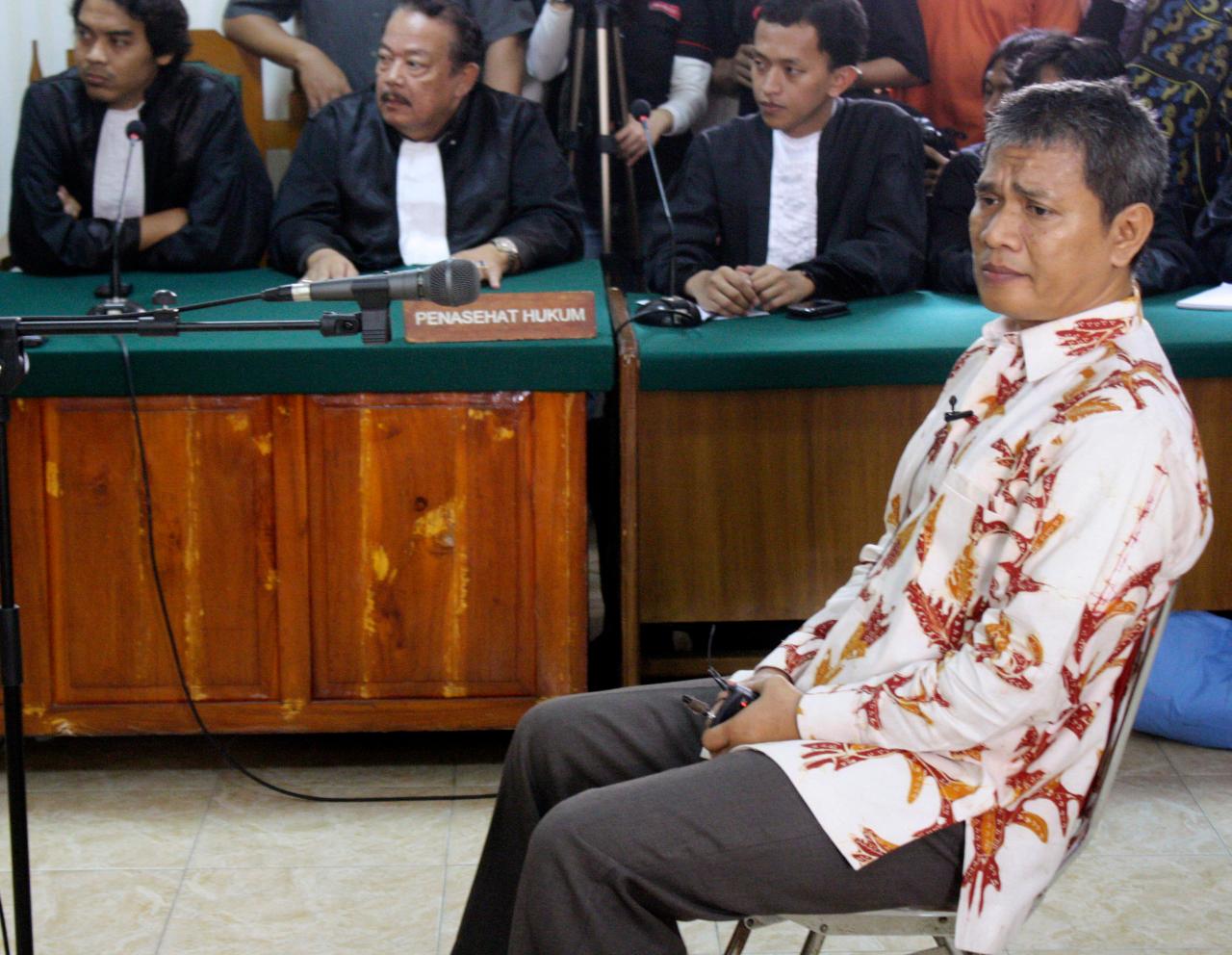
Member of Ahmadiyah sect Deden Sudjana, sits on the defendant's chair during his trial at a district court in Serang, Banten, Indonesia, Monday, Aug. 15, 2011. The man injured when Muslim hard-liners attacked members of his minority Islamic sect was sentenced Monday to six months in jail, more than some of the actual attackers. (AP Photo)
Member of Ahmadiyah sect Deden Sudjana, sits on the defendant’s chair during his trial at a district court in Serang, Banten, Indonesia, Monday, Aug. 15, 2011. The man injured when Muslim hard-liners attacked members of his minority Islamic sect was sentenced Monday to six months in jail, more than some of the actual attackers. (AP Photo)
JAKARTA, Indonesia (AP) — An Indonesian man wounded when Islamic hard-liners launched a deadly attack on his minority sect was sentenced Monday to six months in prison — more than some of those caught on video taking part in the lynching.

Human rights groups blasted the ruling, saying 48-year-old Deden Sudjana was acting in self-defense. They said it showed how the police, the judicial system and the government are helping fuel religious intolerance in the world’s most populous Muslim nation.

Sudjana was convicted of inciting violence because he defied police orders to leave the scene when the attackers arrived at a meeting of the minority Ahmadiyah sect. Sudjana instead fought back during the Feb. 6 incident in the village of Cikeusik in central Indonesia.

Member of Ahmadiyah sect Deden Sudjana, right, is greeted by his lawyer Nurcholis Hidayat, after the judge delivered his verdict during his trial at a district court in Serang, Banten, Indonesia, Monday, Aug. 15, 2011. The man injured when Muslim hard-liners attacked members of his minority Islamic sect was sentenced Monday to six months in jail, more than some of the actual attackers. (AP Photo)
Footage of the attack, which circulated widely on the Internet, showed 1,500 hard-liners descending on a house where 20 members of the sect had gathered. The attackers, carrying wooden clubs, machetes and rocks, killed three people and continued to pummel their lifeless bodies, chanting “God is Great!“ as police looked on.

Sumartono, presiding judge of the Serang District Court, gave Sudjana six months for resisting police orders and then beating one of the mob’s leaders.

Sudjana — whose hand was nearly severed by a machete during the attack — looked stunned as the verdict was read out.

“I’m the victim,” he told reporters as he was escorted from the courtroom. “Why am I getting a higher sentence than some of the perpetrators?“

Indonesia, a predominantly Muslim and secular nation of 240 million, has a long history of religious tolerance.

But a small, extremist fringe has grown more vocal and violent in recent years. They’ve been emboldened by the inaction of President Susilo Bambang Yudhoyono, who relies on the support of Islamic parties in Parliament, and does not want to offend conservative Muslims by taking sides.

Perpetrators of such violence often go unpunished.

Member of Ahmadiyah sect Deden Sudjana, center, speaks to the press after his trial at a district court in Serang, Banten, Indonesia, Monday, Aug. 15, 2011. The man injured when Muslim hard-liners attacked members of his minority Islamic sect was sentenced Monday to six months in jail, more than some of the actual attackers. (AP Photo)
Human rights groups say police, under pressure by hard-liners, did not carry out a proper investigation into the Feb. 6 attacks and that prosecutors, claiming the Ahmadis were instigators, didn’t call key eyewitnesses.

Andreas Harsono, of the New York-based Human Rights Watch, called it the Talibanization of Indonesia.

“We have the impression that the Indonesian justice system has surrendered to (those) who have decided to take the law into their own hands,” he said.

The decision to punish one of the victims will only encourage more such violence, he added.

So far, 12 members of the mob have been convicted, including one man who was captured on camera smashing in an Ahmadi member’s skull with a rock.

They were given between three to six months in jail.

The Ahmadiyah, which has followers around the world, is considered heretical by many Muslims and banned in many Islamic countries because of its belief that Muhammad was not the final prophet.

In recent years, hard-liners in Indonesia have attacked the sect’s mosques and intimidated some of its 200,000 followers, but the lynching in Cikeusik was by far the most brutal.

The latest attack occurred over the weekend in the South Sulawesi town of Makassar, where 30 members of the hardline Islamic Defenders Front attacked a mosque.

Two people also were beaten, sect members and a lawyer who tried to interfere, rights groups said.

Associated Press writers Niniek Karmini and Michael Holtz contributed to this report from Jakarta.

Copyright © 2011 The Associated Press. All rights reserved
URL: www.google.com/hostednews/ap/article/ALeqM5ihZBh...
 
^ Top of Page