Showing posts with label atttack. Show all posts

Tuesday, September 13, 2011

Indonesia’s Ahmadiyah Sect Fears Religious Violence

VOA News
Asia
Indonesia’s Ahmadiyah Sect Fears Religious Violence
Brian Padden | Jakarta September 13, 2011
Members of the Ahmadiyah community attend Friday prayers at the An-Nur Mosque in Manis Lor village, in Kuningan, West Java. Indonesian Foreign Minister Marty Natalegawa defended the country's judicial system after a court sentenced Muslim radicals to a few months in jail for killing members of the minority sect (File photo, August 5, 2011).Photo: AFP
Members of the Ahmadiyah community attend Friday prayers at the An-Nur Mosque in Manis Lor village, in Kuningan, West Java. Indonesian Foreign Minister Marty Natalegawa defended the country's judicial system after a court sentenced Muslim radicals to a few months in jail for killing members of the minority sect (File photo, August 5, 2011).

Last month, an Indonesian court sparked outrage over the light sentences handed out to 12 people accused of a deadly riot. The accused were part of a mob that targeted members of the Ahmadiyah Muslim minority sect, killing three of them.

Analysts say the light sentences were an example of what they say is Indonesia’s uneven justice system that can hand down unpredictable sentences.

An example is the case of Irwan Kristanto, who has been locked behind the doors of Pondok Rajeg prison for five months now. He is allowed to have visitors, but can not give a recorded interview.


The frail 29 year-old looks like he is barely 20. He explains that life here has been tough.

As a thief, the shy young man is forbidden to work in the orchard garden that stands in the middle of the concrete block. That is a job only accessible for those on a narcotics-related offense. But Irwan’s case is different from the murderers serving 20 year sentences. His crime was stealing two computer memory cards from an Internet café. Net value: $40.

Antonius Badar follows the Irwan case for the Indonesian legal aid group LBH Masyarakat. On Monday, he is visited Irwan’s parents, Hendri and Siti, to make sure they managed to get a copy of their son’s judgment.

“Sometimes, the district court doesn’t give this letter to the prison,” Badar says. “And the prison doesn’t know how long the prisoner should be in the prison. If Irwan didn’t have this letter, he could stay longer in prison.”

Irwan’s father, Hendri, describes a case that, he says, should not have ended with a young man with no prior police record sent to a hardcore jail.

Last February, he says, Irwan was spending time in an internet café, wondering how to better provide for his newly pregnant wife. In the spur of the moment he steals the two memory cards and leaves. But he forgot his cell phone and when he later returns to retrieve it, he is caught and sent to the police. A court later sentences him to 6 months in jail.

Rizal, owner of the Internet café, says that he now regrets having called the police. After a few hours Irwan apologized and his parents reimbursed the cost of the memory cards. Rizal says there was no real damage done and that should have been taken into account by the court.

Leopold Sudaryono, a researcher for the Asia Foundation, says the police have a quota system with financial incentives to prosecute such petty crimes.

“They have very limited amount of budget to process cases every month while at the same time each police station has quotas, a minimum amount of cases they have to bring to justice,” Sudaryono says. “Meaning what they are doing, they have to press charges for very petty crimes which will not require many operational costs to investigate. And usually the prosecutors just carry on with the cases.”

But there are other factors that contribute to uneven sentencing, which are highlighted in the Ahmadiyah case.

The maximum sentence given to the 12 people accused of taking part of the deadly attack on the minority sect was 6 months in jail. That is the same sentence Irwan received for his petty theft offense.

Leopold Sudaryono blames the police for the stark difference in the two sentences. He says police undermined the Ahmadiyah case after officers were widely accused of failing to stop the mob attack.

“So it is in the interest of the police, in the investigation of the case, not to substantiate that the violence is orchestrated,” he says.”If they investigate the case and provide the evidence otherwise, they will cut their own neck! That’s why they refer the case to the prosecutor as a weak case.”

Last week, Indonesia’s foreign minister refused to comment on the verdict or whether such light sentences would encourage more violence. Foreign Minister Marty Natalegawa told reporters the problem of religious intolerance is not Indonesia’s alone.

“I’m afraid when we speak of, for example, the whole issue of now outside the domain of the court, about the whole issue of religious intolerance or intolerance in general and all kinds of phobia, I’m afraid Indonesia doesn’t have a monopoly on that, unfortunately,” he said.

Indonesian public opinion polls indicate that law enforcement agencies are the least trusted institutions.

Irwan, the convicted thief, says as harsh as his sentence was, he has fared relatively well. He should be released on August 27, just in time he hopes, to be home for the birth of his first child, a baby girl, due on the same day.


Monday, August 15, 2011

Indonesia’s FPI Leader Detained

HeadlinesVIVA News
Indonesia’s FPI Leader Detained
Abdurrahman was detained at the police station for investigation process.
Senin, 15 Agustus 2011, 16:35 WIBAries Setiawan

FPI Attackers
VIVAnews — The Makassar District Police named Islamic Defenders Front (FPI) leader, Abdurrahman, a suspect in a riot case committed by the FPI South Sulawesi.

Abdurrahman was detained at the police station for investigation process.

Makassar District Police Crime and Investigation Division Head, AKBP Himawan Sugeha asserted, Abdurrahman, was arrested during the attack at the Jamaah Ahmadiyah Indonesia (JAI) Secretariat, early Sunday morning. Abdurrahman’s act allegedly violated Article 160 on sedition, for inciting others to commit unlawful acts.

“Abdurrahman did not set out the destruction, but he incited (FPI members of the destruction). He faces criminal imprisonment of maximum six years,” said AKBP Himawan Sugeha in his press statement.

In addition to Abdurahman, the police were still pursuing three other unidentified FPI members who promoted vandalism during the fasting month. They were identified in the case of destructions of restaurants and JAI secretariat on Jalan Anuang.

“We hope that FPI will not do it again because it is police authority to conduct raids,” said Himawan.

Coverage by : Rahmat Zeena | Makassar
• VIVAnews

FPI Attacks Ahmadiyah Complex and Restaurants

Jakarta Globe, Indonesia
HOME
FPI Attacks Ahmadiyah Complex and Restaurants
Rahmat | August 15, 2011

Makassar. Police in the South Sulawesi capital have named the head of the armed wing of the hard-line Islamic Defenders Front a suspect in an attack on Sunday against the beleaguered Ahmadiyah sect.

Adj. Sr. Comr. Himawan Sugeha, the Makassar Police chief of detectives, said that Abdurrahman, the head of the Islamic Defenders Force (LPI), had been arrested and would be charged with incitement to violence for the early morning attack on the Indonesian Ahmadiyah Congregation (JAI) secretariat.

“Abdurrahman himself didn’t take part in the vandalism, but he incited it, for which he could face up to six years in prison,” Himawan said.

In the attack, the LPI, a unit of the Islamic Defenders Front (FPI), smashed several windows at the JAI complex, including at its mosque, and damaged a car and a motorcycle parked in the compound.

The 30-strong mob also attacked Ahmad, the lone person guarding the JAI secretariat, and two paralegals from the Legal Aid Foundation (LBH) who tried to stop the attack. None of the three victims suffered serious injuries. LPI members also scuffled with riot police sent to the scene to restore order.

The mob began its rampage on Saturday night, attacking and shutting down food stalls and restaurants in the city.

Himawan said the police were tracking down three FPI members involved in those attacks. He added the police were annoyed by the FPI’s vigilantism.

“We hope they stop carrying out these raids because that’s the police’s job,” he said. “If they just preach then we have no problem with that.”

Copyright 2010 The Jakarta Globe
URL: www.thejakartaglobe.com/home/fpi-attacks.../459311

Indonesia Ahmadi attack victim jailed for 6 months

The Straits Times, Singapore
BREAKING NEWS
Home > Breaking News > SE Asia > Story
Aug 15, 2011
Indonesia Ahmadi attack victim jailed for 6 months

JAKARTA (AP) — An Indonesian man wounded when Muslim hard-liners attacked members of his minority Islamic sect was sentenced on Monday to six months in jail, more than some of the actual attackers who were caught on video.

Human rights groups blasted the ruling as encouraging growing religious intolerance in Indonesia, the world’s largest Muslim-majority country.

The Serang District Court said Deden Sudjana - whose hand was nearly severed by a machete - resisted police orders to leave the scene and then attacked one of the leaders of the mob that killed three members of the Ahmadiyah sect.

The Feb 6 attack - captured on video and widely circulated on the Internet - showed a frenzied crowd of around 1,500 descending on members of Ahmadiyah in the village of Cikeusik with machetes, wooden clubs and rocks to try to prevent them from worshipping.

Copyright © 2011 Singapore Press Holdings Ltd. Co. All rights reserved.
URL: www.straitstimes.com/BreakingNews/SEAsia/Story/STIStory_702361.html

Victim of Indonesian mob attack sent to jail

The Associated Press August 15, 2011 
Victim of Indonesian mob attack sent to jail
By ALI KOTARUMALOS, Associated Press

Member of Ahmadiyah sect Deden Sudjana, sits on the defendant's chair during his trial at a district court in Serang, Banten, Indonesia, Monday, Aug. 15, 2011. The man injured when Muslim hard-liners attacked members of his minority Islamic sect was sentenced Monday to six months in jail, more than some of the actual attackers. (AP Photo)
Member of Ahmadiyah sect Deden Sudjana, sits on the defendant’s chair during his trial at a district court in Serang, Banten, Indonesia, Monday, Aug. 15, 2011. The man injured when Muslim hard-liners attacked members of his minority Islamic sect was sentenced Monday to six months in jail, more than some of the actual attackers. (AP Photo)
JAKARTA, Indonesia (AP) — An Indonesian man wounded when Islamic hard-liners launched a deadly attack on his minority sect was sentenced Monday to six months in prison — more than some of those caught on video taking part in the lynching.

Human rights groups blasted the ruling, saying 48-year-old Deden Sudjana was acting in self-defense. They said it showed how the police, the judicial system and the government are helping fuel religious intolerance in the world’s most populous Muslim nation.

Sudjana was convicted of inciting violence because he defied police orders to leave the scene when the attackers arrived at a meeting of the minority Ahmadiyah sect. Sudjana instead fought back during the Feb. 6 incident in the village of Cikeusik in central Indonesia.

Member of Ahmadiyah sect Deden Sudjana, right, is greeted by his lawyer Nurcholis Hidayat, after the judge delivered his verdict during his trial at a district court in Serang, Banten, Indonesia, Monday, Aug. 15, 2011. The man injured when Muslim hard-liners attacked members of his minority Islamic sect was sentenced Monday to six months in jail, more than some of the actual attackers. (AP Photo)
Footage of the attack, which circulated widely on the Internet, showed 1,500 hard-liners descending on a house where 20 members of the sect had gathered. The attackers, carrying wooden clubs, machetes and rocks, killed three people and continued to pummel their lifeless bodies, chanting “God is Great!“ as police looked on.

Sumartono, presiding judge of the Serang District Court, gave Sudjana six months for resisting police orders and then beating one of the mob’s leaders.

Sudjana — whose hand was nearly severed by a machete during the attack — looked stunned as the verdict was read out.

“I’m the victim,” he told reporters as he was escorted from the courtroom. “Why am I getting a higher sentence than some of the perpetrators?“

Indonesia, a predominantly Muslim and secular nation of 240 million, has a long history of religious tolerance.

But a small, extremist fringe has grown more vocal and violent in recent years. They’ve been emboldened by the inaction of President Susilo Bambang Yudhoyono, who relies on the support of Islamic parties in Parliament, and does not want to offend conservative Muslims by taking sides.

Perpetrators of such violence often go unpunished.

Member of Ahmadiyah sect Deden Sudjana, center, speaks to the press after his trial at a district court in Serang, Banten, Indonesia, Monday, Aug. 15, 2011. The man injured when Muslim hard-liners attacked members of his minority Islamic sect was sentenced Monday to six months in jail, more than some of the actual attackers. (AP Photo)
Human rights groups say police, under pressure by hard-liners, did not carry out a proper investigation into the Feb. 6 attacks and that prosecutors, claiming the Ahmadis were instigators, didn’t call key eyewitnesses.

Andreas Harsono, of the New York-based Human Rights Watch, called it the Talibanization of Indonesia.

“We have the impression that the Indonesian justice system has surrendered to (those) who have decided to take the law into their own hands,” he said.

The decision to punish one of the victims will only encourage more such violence, he added.

So far, 12 members of the mob have been convicted, including one man who was captured on camera smashing in an Ahmadi member’s skull with a rock.

They were given between three to six months in jail.

The Ahmadiyah, which has followers around the world, is considered heretical by many Muslims and banned in many Islamic countries because of its belief that Muhammad was not the final prophet.

In recent years, hard-liners in Indonesia have attacked the sect’s mosques and intimidated some of its 200,000 followers, but the lynching in Cikeusik was by far the most brutal.

The latest attack occurred over the weekend in the South Sulawesi town of Makassar, where 30 members of the hardline Islamic Defenders Front attacked a mosque.

Two people also were beaten, sect members and a lawyer who tried to interfere, rights groups said.

Associated Press writers Niniek Karmini and Michael Holtz contributed to this report from Jakarta.

Copyright © 2011 The Associated Press. All rights reserved
URL: www.google.com/hostednews/ap/article/ALeqM5ihZBh...

Tuesday, August 9, 2011

‘Hero’? No shame for religious killings in small town

Today News
‘Hero’? No shame for religious killings in small town
Once the preserve of hard-line preachers, hatred toward Muslim sect now appears to be spreading among pockets of ordinary Indonesians
Dani bin Misra was a member of the frenzied mob who killed three Ahmadis in February.
Dani bin Misra was a member of the frenzied mob who killed three Ahmadis in February. (AP File)
By NINIEK KARMINI
Source AP
updated 8/9/2011 7:02:45 AM ET

CIKEUSIK, Indonesia — When Dani bin Misra was released from prison last week after serving just three months for smashing in the skull of a member of a Muslim sect, this conservative Indonesian town let out a triumphant cry.

“He’s a hero!“ Rasna bin Wildan said of the teenage killer.

The ferociousness of the attack, captured on video and circulated widely on the Internet, guaranteed no one from the Ahmadiyah group would dare set foot in Cikeusik again, the 38-year-old farmer said as others nodded in agreement.

Their reaction is part of a wider wave of intolerance against religious minorities that is challenging Indonesia’s image as a beacon of how Islam and liberalism can coexist.

Once the preserve of hard-line preachers, the hatred of Ahmadis now seems to be spreading among ordinary people in pockets of the world’s most populous Muslim nation. Whether the government can check this and other intolerance could be key to how Indonesia, home to 240 million people and one of the world’s fastest growing economies, evolves in the 21st century.

There are reasons to worry, analysts say.

Mosques torched
President Susilo Bambang Yudhoyono, who relies heavily on Islamic parties for support in parliament, has remained silent as hard-liners shuttered Christian churches, threw Molotov cocktails at one of their theology schools, and attacked worshippers and priests with knives and clubs as they headed to morning prayers.

These members of the Ahmadiyah sect fled their homes after the lynching that killed three fellow followers in February. (Dita Alangkara/AP)
A string of attacks on the Ahmadiyah — including the torching of mosques and homes — only got worse after a 2008 government decree that said those who follow their practices or proselytize could face up to five years in prison.

Soon after, residents in Cikeusik, a rough-and-tumble farming community less than 120 miles from Jakarta, elected a new village chief, Muhammad Johar — the only candidate pledging to take a tough stand against the sect.

Many mainstream Muslims consider the Ahmadis heretics because they do not believe Muhammad was the final prophet. (**)

In the eyes of the villagers, Dani and other members of the frenzied mob who killed three Ahmadis in February were just helping get the job done. Six were wounded, and the others fled with only the clothes on their backs, their houses destroyed and looted.

“I do feel bad people had to die,” said Asep Setiadi, 40, as he headed out to his rice field. “But I’m grateful that they’re finally gone.”

‘We had to clean our village’
Holding her baby girl in a sling as she chatted with a neighbor, 28-year-old Siti Zubaidah had nothing but praise for Dani.

Members of Ahmadiyah sect who fled their homes following the lynching that killed three of the sect followers in February, sit inside their safe house in Banten in the outskirt of Jakarta, Indonesia. (Photo AP)
“We had to clean our village,” added Wildan bin Satim, 72. “This is no place for the followers of a cult.”

The Ahmadiyah, established in 1889 in India, consider its founder Mirza Ghulam Ahmad to be a savior and messiah, counter to traditional Islamic teaching. They have tens of millions of members worldwide and around 200,000 in Indonesia.

They were not always unwelcome in Cikeusik, where men carry swords as they walk the dusty, potholed roads after nightfall to ward off beggars, thieves and other potential troublemakers.

Matori Abdullah was the first Ahmadi to arrive.

He, his wife and eight children lived peacefully alongside other Muslims in the 1980s and early ‘90s, attending the same mosque and religious ceremonies.

But the situation began to deteriorate after the ouster in 1998 of longtime dictator Suharto, who had suppressed hard-liners and even discouraged the wearing of headscarves by women.

Conservatives in Cikeusik used a newfound freedom of expression to insult the Ahmadiyah, who by then numbered about 35, most of them part of Abdullah’s extended family.

Clerics raised questions during sermons about the validity of their faith, and residents whispered as they passed in the streets.

“Sometimes teachers would tell the class the Ahmadis are heretics,” said 15-year-old Arief Muhammad Zainal, now living in fear in the outskirts of Jakarta with others from the village. “The other students would point and stare. Other times kids would pinch or slap me, muttering ‘Ahmadiyah boy’ as they passed.”

Over time, the Ahmadis started to withdraw. In 2009, they used a $15,000 donation to build a concrete house for their religious ceremonies and stopped going to the mosque.

“They refused to pray with us,” said Johar, the village chief. “So how should we consider them as Muslim?“

Visitors would flock to the house from neighboring towns, sparking rumors they were trying to recruit new members.

‘Kill! Kill!‘
On Feb. 6, as the Ahmadis were preparing to entertain guests from Jakarta, a mob of 1,500 from Cikeusik and neighboring villages approached with machetes, rocks and wooden clubs.

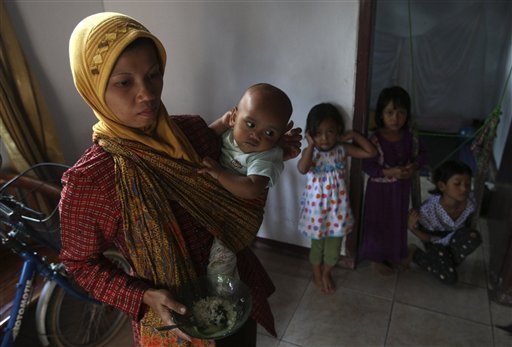
Nurhayati, a member of Ahmadiyah sect, who had to flee her home following the lynching that killed three of the sect followers in February, carries her 9-month-old baby in a safe house in Banten in the outskirt of Jakarta, Indonesia. (Photo AP)
They surrounded the house and set it ablaze.

Women and children fled, screaming. Some of the men stood firm, fighting back with whatever they could grab, but they were far outnumbered.

“Kill! Kill!“ the crowd chanted. “Burn! Burn!“

By the time a video camera was rolling, two men lay naked and lifeless in the mud. The attackers continued to hammer their bodies with bamboo sticks, each thud met with a cheer.

Dani, wearing a black leather jacket and a white skull cap, was the most brutal. The 17-year-old smashed a rock repeatedly into the skull of Roni Pasaroni as the crowd yelled “Allahu Akbar” or God is Great.

Global condemnation
The attack, just a few months after U.S. President Barack Obama held up Indonesia as an example of religious tolerance, sparked global condemnation.

In a rare departure, Yudhoyono called for the perpetrators to be caught and punished, leading to the arrest and trial of Dani and 11 other suspects.

But human rights groups say police, under pressure by hard-liners, did not carry out a proper investigation. Prosecutors, claiming the Ahmadis were instigators, didn’t call key eyewitnesses.

The relatively lenient sentences handed down last week — three to six months — surprised even Dani’s family. Taking into account time served, the teen was released almost immediately. He returned to the nearby village of Cikadu, where he was shielded from the media by his parents.

The Ahmadis from Cikeusik are in hiding. “We live in fear now,” said Nayati, a mother of four. “Everyday we are afraid they’ll find us and kill us all.”

The statement is erroneous. Hadhrat Mirza Ghulam Ahmad of Qadian did not make any such claim of being last prophet. Please visit Alislam.org/messiah for further info.

Copyright 2011 The Associated Press. All rights reserved.
URL: http://today.msnbc.msn.com/id/....killings-small-town/

Setara Accuses Police, Courts of Engineering Ahmadiyah Verdicts

Jakarta Globe, Indonesia
NEWS
Setara Accuses Police, Courts of Engineering Ahmadiyah Verdicts
Elisabeth Oktofani | August 09, 2011

The lenient sentences handed down to the killers of three Ahmadiyah followers were the result of “manipulated” legal proceedings, which began when police launched their preliminary investigation, a human rights group said on Monday.

Police limited the scope of the investigation and distracted the core issue to the point that Ahmadiyah members were blamed for the Feb. 6 attack, when they should have been recognized as victims, the Setara Institute for Peace and Democracy said.

“Instead of providing justice for the victims and getting the facts surrounding the incident, police constructed a story in which Ahmadiyah followers provoked the mob to attack them,” said Ismail Hasani, a researcher at the institute.

Police were too busy to defending their reputation, he said, to launch a fair and professional probe into the case.

Ismail said that during the incident in Cikeusik, Banten, officers were present at the scene but said they couldn’t control the mob or prevent them from assaulting the members of the minority Islamic sect. In order to avoid accusations of criminal negligence, he continued, police argued they had asked the Ahmadis to flee but the call was ignored.

From that point on, right up to the point the court verdicts were read, the Ahmadis were blamed for the attack, Ismail said.

Police arrested and charged 12 suspects in relation to the attack. Despite facing sentences of up to 12 years in jail, prosecutors recommended prison sentences of between five and seven months for the defendants.

On the other hand, prosecutors recommended nine months in jail for Deden Sujana, the head of security for the Indonesian Ahmadiyah Congregation (JAI), for allegedly provoking the attack.

The Serang District Court sentenced the attackers to between three and six months in jail, with the judge saying repeatedly that the Ahmadiyah members triggered the violence.

“We cannot blame the judicial system itself for the result because it might have been manipulated by the law enforcers, from the police to the prosecutors and the judge,” Ismail said.

Bonar Tigor Naipospos, Setara’s deputy chairman, said sectarian conflict would soon become a daily occurrence unless the government took serious measures against extremism.

“The main problem here is that there is no significant regulation to deal with the perpetrators of sectarian conflicts, especially if the perpetrators are coming from an Islamic group led by influential clerics,” Bonar said. “In such cases, law enforcement officials are hesitant to take serious action.”

According to the group, there were 99 sectarian conflicts or attacks in 13 provinces during the first half of the year. West Java experienced the most clashes, with 30 incidents.

“There were three major attacks in February, including in Cikeusik, Temanggung [Central Java] and Pasuruan [East Java],” Ismail said.

A violent mob burned down three churches in Temanggung, demanding that a Christian man be sentenced to death for insulting Islam. Also in February, hundreds of people set on the Yapi pesantren, or Islamic boarding school, which was accused of spreading Shiite teachings, injuring four students.

“Those three major clashes in February actually triggered more attacks in March and April,” he said. “Our reports show there were 24 incidents of religious violence in March and another 24 in April.”

Most of the incidents involved destruction of places of worship, accusations of apostasy, discriminatory regulations toward minority religions and forced conversions, particularly of Ahmadiyah members, the group said.

In March, 33 Ahmadiyah members living in Bogor decided to convert to mainstream Islam, following the wave of attacks and intimidation against sect members.

Copyright 2010 The Jakarta Globe
URL: www.thejakartaglobe.com/news/setara-accuses.../458073

Monday, August 8, 2011

Activists: Indonesia Hands Down Uneven, Unpredictable Justice

VOA News
Asia
Activists: Indonesia Hands Down Uneven, Unpredictable Justice
Solenn Honorine | Jakarta August 08, 2011
A group of Indonesian Muslims accused of attacking Ahmadiyah followers wait in a cell at a court room in Serang, Indonesia's Banten province July 28, 2011.Photo: Reuters
A group of Indonesian Muslims accused of attacking Ahmadiyah followers wait in a cell at a court room in Serang, Indonesia's Banten province July 28, 2011.

Last month, an Indonesian court sparked outrage over the light sentences handed out to 12 people accused of a deadly riot. The accused were part of a mob that targeted members of the Ahmadiyah Muslim minority sect, killing three of them.

Analysts say the light sentences were an example of what they say is Indonesia’s uneven justice system that can hand down unpredictable sentences.

An example is the case of Irwan Kristanto, who has been locked behind the doors of Pondok Rajeg prison for five months now. He is allowed to have visitors, but can not give a recorded interview.

The frail 29 year-old looks like he is barely 20. He explains that life here has been tough.

As a thief, the shy young man is forbidden to work in the orchard garden that stands in the middle of the concrete block. That is a job only accessible for those on a narcotics-related offense. But Irwan’s case is different from the murderers serving 20 year sentences. His crime was stealing two computer memory cards from an Internet café. Net value: $40.

Antonius Badar follows the Irwan case for the Indonesian legal aid group LBH Masyarakat. On Monday, he is visited Irwan’s parents, Hendri and Siti, to make sure they managed to get a copy of their son’s judgment.

“Sometimes, the district court doesn’t give this letter to the prison,” Badar says. “And the prison doesn’t know how long the prisoner should be in the prison. If Irwan didn’t have this letter, he could stay longer in prison.”

Irwan’s father, Hendri, describes a case that, he says, should not have ended with a young man with no prior police record sent to a hardcore jail.

Last February, he says, Irwan was spending time in an internet café, wondering how to better provide for his newly pregnant wife. In the spur of the moment he steals the two memory cards and leaves. But he forgot his cell phone and when he later returns to retrieve it, he is caught and sent to the police. A court later sentences him to 6 months in jail.

Rizal, owner of the Internet café, says that he now regrets having called the police. After a few hours Irwan apologized and his parents reimbursed the cost of the memory cards. Rizal says there was no real damage done and that should have been taken into account by the court.

Leopold Sudaryono, a researcher for the Asia Foundation, says the police have a quota system with financial incentives to prosecute such petty crimes.

“They have very limited amount of budget to process cases every month while at the same time each police station has quotas, a minimum amount of cases they have to bring to justice,” Sudaryono says. “Meaning what they are doing, they have to press charges for very petty crimes which will not require many operational costs to investigate. And usually the prosecutors just carry on with the cases.”

But there are other factors that contribute to uneven sentencing, which are highlighted in the Ahmadiyah case.

The maximum sentence given to the 12 people accused of taking part of the deadly attack on the minority sect was 6 months in jail. That is the same sentence Irwan received for his petty theft offense.

Leopold Sudaryono blames the police for the stark difference in the two sentences. He says police undermined the Ahmadiyah case after officers were widely accused of failing to stop the mob attack.

“So it is in the interest of the police, in the investigation of the case, not to substantiate that the violence is orchestrated,” he says.”If they investigate the case and provide the evidence otherwise, they will cut their own neck! That’s why they refer the case to the prosecutor as a weak case.”

Last week, Indonesia’s foreign minister refused to comment on the verdict or whether such light sentences would encourage more violence. Foreign Minister Marty Natalegawa told reporters the problem of religious intolerance is not Indonesia’s alone.

“I’m afraid when we speak of, for example, the whole issue of now outside the domain of the court, about the whole issue of religious intolerance or intolerance in general and all kinds of phobia, I’m afraid Indonesia doesn’t have a monopoly on that, unfortunately,” he said.

Indonesian public opinion polls indicate that law enforcement agencies are the least trusted institutions.

Irwan, the convicted thief, says as harsh as his sentence was, he has fared relatively well. He should be released on August 27, just in time he hopes, to be home for the birth of his first child, a baby girl, due on the same day.

Accepting Others Is Indonesia’s Homework

Jakarta Globe, Indonesia
OPINION
Accepting Others Is Indonesia’s Homework
Nicholaus Prasetya | August 08, 2011

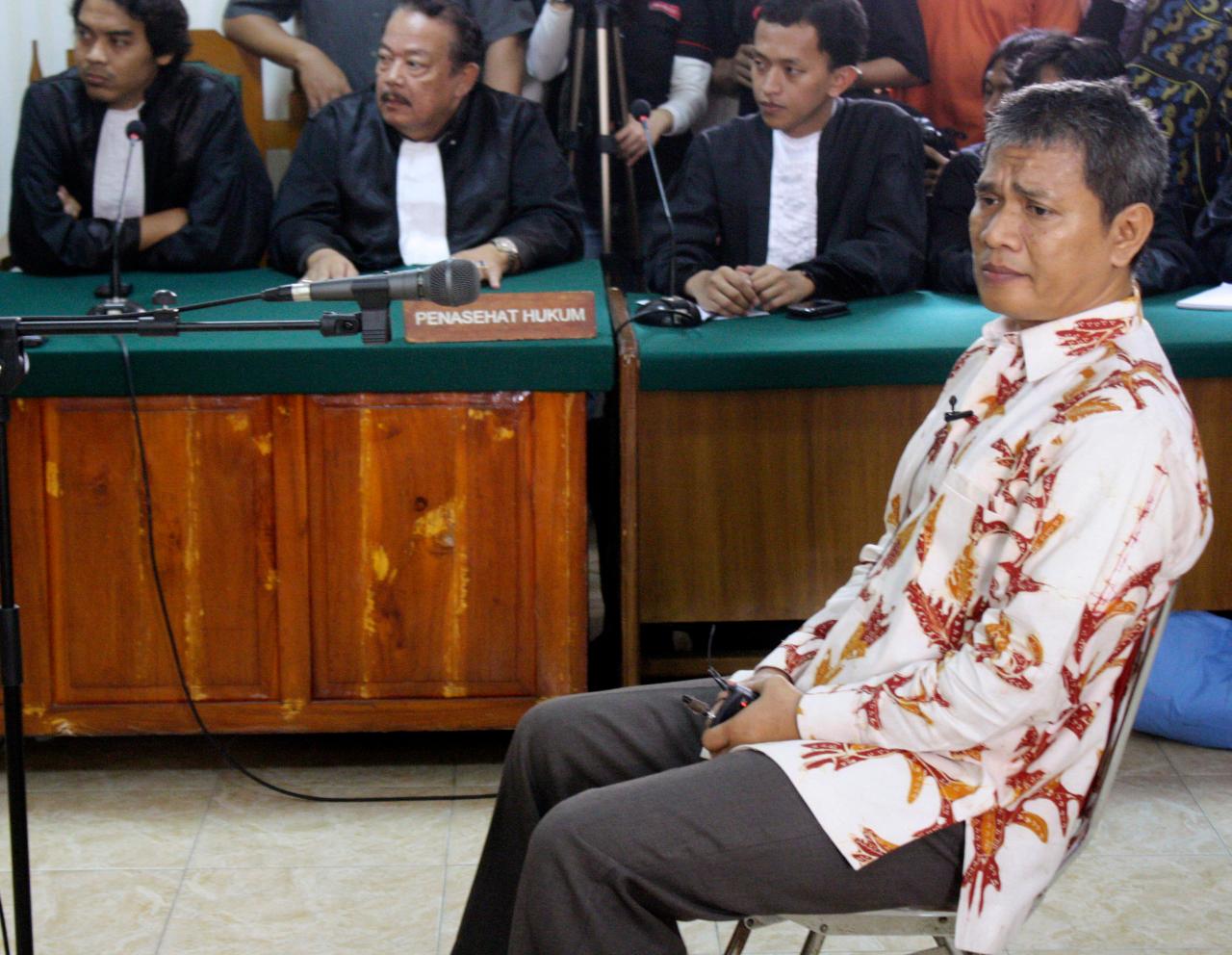
A police talks with three defendants of Ahmadiyah attack in Cikeusik during the first trial at Serang District Court, Banten, April 26, 2011. (Antara Photo/Asep Fathulrahman)
Sadly, the barometer of intolerance continues to rise. While the perpetrators of the latest incident — in which two houses used as churches in Riau were burned to the ground — have not been found, it seems to be in line with many other acts of intolerance happening across Indonesia.

What makes the Riau incident worse is that it happened during the holy month of Ramadan, a time of peace and devotion recognized by Muslims around the world.

The attack also served to keep other similar events in the front of Indonesians’ minds. It was only about a week ago when the people who led the mob that attacked and killed members of the Ahmadiyah sect in Cikeusik were sentenced to just a few months in prison. One of the Ahmadiyah followers, meanwhile, was given a nine-month prison sentence. It also recalled the Temanggung rampage, when a Catholic church there suffered damage from a mob inflamed by religious intolerance.

Another lingering indication that intolerance is become the norm in Indonesia is the GKI Yasmin Church in Bogor. There is still no agreement on where the GKI members may conduct their services, since the local authorities have barred them from their church. They have been forced to pray on the side of the road, making them an easy target for passers-by, who shout in protest, objecting to the public display of a minority religion.

While church members are harassed for standing up for their beliefs, hard-line Islamic groups in Jakarta easily conducted protests and marches in advance of Ramadan, causing traffic chaos. The Islamic Defenders Front (FPI) met no resistance with their protest several days ago, where they demanded that the government ban Ahmadiyah. Indeed, the FPI seems to be able to do whatever it wants, wherever and whenever it wants, with no intervention by police or authorities. How is this justified?

What is at stake in all these incidents is Indonesia’s reputation for tolerance, which is often praised but in reality is no longer deserved. If we are a tolerant country, what, exactly, are we tolerating?

It appears that tolerance in Indonesia has come to mean tolerance based upon loyalty among people who share the same values. Or taking it further, tolerance is only for those who have power and dominate a given area or region.

This fact is clearly seen in the case of the FPI. Do the police “tolerate” the FPI simply because it has a large following and powerful leaders? Looking at it the other way, should Indonesia “tolerate” those who attacked and killed Ahmadiyah followers simply because the Ahmadiyah are a tiny minority? Does that justify the lenient court verdicts?

This is the paradox when it comes to discussing tolerance. On the one hand, tolerance is easily applied to members of the majority, even in cases where the law has been broken. On the other hand, people from religious minorities consistently bear the brunt of intolerance.

Real tolerance for minorities cannot come about just by listening to the words of our leaders. It has to take root in reality. Only talking about tolerance is nonsense, as can be seen from so many recent cases. Sadly, there is often simply no room for minorities.

This is also part of the paradox of a democratic country: the majority can easily control the law, and minorities, who are supposedly equal, are often repressed. This is a paradox that goes back as far as Socrates and is not easily resolved. In a democracy, what should be right can be made wrong, simply because enough people demand it. Those with the power and the numbers can enforce their will.

As a diverse country with a large Muslim majority, we must have the courage to not allow our many minorities to be dominated by the majority. Religious tolerance should not be based on power. But this seems hard to achieve given the existence of extremists who undoubtedly also play an important role in our democratic society. As a result, the Indonesian government fails to protect minorities and develop and promote the values of real tolerance. At a time when these values are most needed, the virtues of tolerance are being neglected.

Two things are lacking here. One is communication. As the philosopher Jurgen Habermas has noted, in a diverse democratic community, effective communication is vital because without it consensus cannot be reached.

But a consensus must be reached in Indonesia free of coercion and domination. The nature of the extremist groups in our society shows that they cannot share their ideology and thoughts in a peaceful manner; they will not engage in reasoned debate and discussion. Their manner is rigid and cagey — they feel they are always right. If they are opposed by anyone, they resort to intimidation.

We need to change our perception of the limits of freedom. Our social contract with one another imposes limits on our absolute freedom and those limits are what allow society to function. What one group believes is absolutely correct may not be consistent with the rights of others, especially religious minorities.

This is why people need to practice tolerance through communication in their daily lives. We need to build not simple relativism but a real appreciation of differing views.

This is the great homework that has to be done immediately by the Indonesian government and its people. If intolerance cannot be stopped, diversity in Indonesia will be lost.

Nicholaus Prasetya is currently a student at the Bandung Institute of Technology (ITB).

Saturday, August 6, 2011

Pluralism, Tolerance in Indonesia Under Growing Threat

Jakarta Globe, Indonesia
HOME
Pluralism, Tolerance in Indonesia Under Growing Threat
Zubaidah Nazeer-Straits Times Indonesia | August 06, 2011

Groups like Nahdlatul Ulama (above) and Muhammadiyah are being squeezed out by the raucous voices of radical organisations such as the Islamic Defenders Front. (AFP Photo)
Indonesia’s two largest Muslim groups count a third of the country’s population as followers, but appear to be losing ground in shaping the national conversation about Islam.

Drowned out by the raucous voices of Islamic political parties and confrontational hardline groups, Nahdlatul Ulama (NU) and Muhammadiyah are being squeezed out of the picture, which analysts fear could ultimately damage Indonesia’s brand of pluralism and tolerance.

The two groups boast a combined membership of 80 million and share a common goal of upholding Islamic teachings, but increasingly, it is the political parties and radical groups that are pushing the boundaries and setting the pace in trying to define what Islam stands for with their attacks on what they deem immoral behavior and deviant practices.

In 2008, for instance, the Prosperous Justice Party (PKS) lobbied for an anti-pornography law which banned some traditional cultural dances that were considered too sexy. Meanwhile, radical groups like the Islamic Defenders Front (FPI) and Hizbut Tahrir have made the headlines for attacking religious minorities such as the Ahmadiyah sect.

‘The order now has changed,’ said Broto Wardoyo, an analyst in terrorism studies at the University of Indonesia.

‘Political parties have taken on greater weight while groups like the Hizbut Tahrir have grown louder. They are easily heard, seem to attract an audience and can be remembered better.’

This development worries some Islamic scholars such as Zuhairi Misrawi, chairman of the Moderate Muslim Society, who fear an erosion of religious freedom if groups like NU and Muhammadiyah fail to speak up loudly enough and do more to put their stamp on community issues.

Zuhairi’s non-governmental organisation comprises mainly academics and intellectuals.

Agreeing, Syafi’i Anwar of the International Centre for Islam and Pluralism, added that sensational acts by radicals tend to grab attention.

NU and Muhammadiyah ‘need to find a way to remain in people’s minds’, he said.

That could prove challenging for the two organisations which were founded with relatively simple aims: to preserve Islamic teachings and provide community services.

NU, which turned 85 years old just three weeks ago, was set up by religious leaders, while Muhammadiyah, which is 99 years old, was founded by a Muslim scholar.

Together, they run more than 30,000 mostly religious schools across Indonesia.

NU is the bigger of the two, is seen as more traditional and has a large network of village boarding schools. Muhammadiyah, with 30 million members, draws a more middle-class crowd. It runs orphanages, hospitals and charity foundations.

With 80 per cent of the country’s 240 million people identifying themselves as Muslims - making Indonesia home to the world’s largest Muslim population - the role of these two organizations in shaping Islamic thought is crucial: Their messages are seen as able to influence even Muslims who are not their members.

Once they too had formidable political clout.

After the fall of President Suharto in 1998, NU and Muhammadiyah leaders set up rival political parties. Amien Rais, leader of Muhammadiyah, formed the National Mandate Party while Abdurrahman Wahid, better known as Gus Dur, set up the National Awakening Party, and later became president between 1999 and 2001.

However, in the past few years, especially after Gus Dur’s death in 2009 and as civil society blossomed, the political influence of both groups has waned even as extremist voices become louder.

Ms Robin Bush of the Asia Foundation in an opinion piece noted: ‘There is a perception expressed within both organisations that they are facing an identity crisis as the country modernizes.’

Added Mr Broto: ‘In the past, we used to identify people by their membership of the NU or Muhammadiyah. Now we say this person is PKS, this person is FPI, that other person is Hizbut Tahrir.’

The radical groups have also become emboldened by their seeming ability to get away with little or no punishment for acts like raiding stalls selling alcoholic beverages and killing Ahmadiyah sect members.

The authorities’ weak response, said Syafi’i, is ‘allowing such radical groups to hog the limelight’.

The numbers of hardliners are small, estimated at less than 1 per cent of the population, but their voices are louder because their extreme acts draw media coverage.

Some observers believe that a number of these groups are funded by political or military elites for their own interests. Law enforcers, meanwhile, hesitate to rein them in for fear of being seen as anti-Islam.

To be sure, both Muhammadiyah chairman Din Syamsudin and NU chairman Said Aqil Siraj have done their bit to condemn the actions of radicals. ‘We have been doing a lot of work such as preaching the positive side of Islam in our schools, holding seminars and talks, but they are not reported,’ said Said.

‘It does not mean we are not doing such work. Our plans are still running and we remain relevant.’

Analysts agreed that Muhammadiyah and NU still have an important role to play in nurturing the moderate ground, given their huge grassroots networks.

But to make sure their message gets through, the NU youth wing last month formed a new unit. Called Densus 99 - after the crack Densus 88 anti-terror squad - its mission is to counter the spread of radical views among the young.

Reprinted courtesy of Straits Times Indonesia.

Friday, August 5, 2011

Foreign Minister Defends Indonesian Judiciary in the Wake of Ahmadiyah Verdicts

Jakarta Globe, Indonesia
NEWS
Foreign Minister Defends Indonesian Judiciary in the Wake of Ahmadiyah Verdicts
August 05, 2011

Foreign Minister Marty Natalegawa on Friday defended the country’s judicial system after a court sentenced Muslim radicals to a few months in jail for killing members of a minority sect.

The sentences handed down last month to 12 defendants over a deadly lynch mob attack on members of the Ahmadiyah community in February shocked human rights groups and drew criticism from the United States and the European Union.

But in his first public response to the outrage, Natalegawa defended the independence of Indonesia’s courts and said the mainly Muslim archipelago was not the only country to suffer from religious intolerance.

“There is an obvious delineation between the executive, the judiciary and legislative branches,” he said in response to a reporter’s question.

The Cambridge-educated minister said “heinous acts” were being committed all over the world due to religious intolerance, but he did not address concerns that light sentences for hate crimes only encourage more killings.

“I’m afraid when you speak of the whole issue of religious intolerance and all kinds of phobia … Indonesia doesn’t have a monopoly on that unfortunately,” he said.

A secretly filmed video of the rampage in Cikeusik, western Java, sparked international concern when it appeared online within days of the attack.

The footage shows police fleeing the scene as the enraged mob – armed with machetes and knives and shouting abuse at the “infidels” – launch an unprovoked attack on a house owned by an Ahmadiyah follower.

A handful of Ahmadiyah men tried to defend the property with stones and slingshots but they were quickly overwhelmed.

The mob then clubbed, hacked and stoned three defenseless men to death in front of police, and stood around joking over their bodies. Several Ahmadiyah tried to flee but were hunted down and badly beaten.

None of the 12 men punished over the incident was charged with murder, and none received more than six months in jail, including the ringleader and a 17-year-old who was filmed smashing a victim’s skull with a stone.

Prosecutors managed to convince the court that the video and the victims’ refusal to flee the property justified a reduced sentence for the killers. In the end the sentences were even lighter than requested by the state.

Ahmadiyah, unlike mainstream Muslims, do not believe Mohammed was the last prophet and are regarded as heretics and blasphemers by conservatives in countries such as Indonesia and Pakistan.

AFP

British MP’s Call Indonesia to Uphold Human Rights

Jakarta Globe, Indonesia
NEWS
British MP’s Call Indonesia to Uphold Human Rights
Jakarta Globe | August 05, 2011

Ujang, a defendant in the Feb.6 attack on Ahmadiyah followers in Cikeusik, jokes with supporters as codefendants greet and receive encouragement from visitors during their trial. (JG Photo/Heru Andriyanto)
In the latest wave of international condemnation over the ‘lenient sentences’ handed out to a extremist mob, British MPs are calling for Indonesia to uphold human rights and squash religious intolerance.

British MP Siobhain Mcdonagh, who is also chair of the UK All Party Parliamentary Group for the Ahmadiyya Muslim Community said the light sentences was in stark contrast with Indonesia’s “reputation for tolerance.

“I am shocked at the sentences given to the perpetrators of these brutal murders. These verdicts show a disturbing shift in the country’s commitment to freedom of religion and justice.”

The light sentences, which raged from three to six months, were issued last week by a court in Serang District Court, Banten to 12 men found guilty of attacking members of Ahmadiyah community in Cikeusik, West Java.

The attack was captured on video, shocking the world, as it showed the mob hacking three of the members to death.

Now the trivial sentences have once again attracted global condemnation.

The National President of the Muslim Community in the UK, Rafiq Hayat said the “ineffectual sentences” handed out by the Indonesian justice system had essentially condoned mob violence and religious intolerance by extremists.

“Victims of recent attacks also include Christians and members of other faiths, but can include anyone who may disagree with the extremists.”

Rafiq said Indonesia must become the leading light for the Muslim world and permit true freedom of religion.

“It must not fall prey to the extremist mindset that will fan the flames of intolerance and will eventually consume the nation.”

Vice-Chair of the UK All Party Parliamentary Group for Human Rights Lord Eric Avebury commented that the verdict was a huge setback for Indonesia in particular its justice system.

“The fact that a longer sentence is being sought by prosecutors for an Ahmadi Muslim who defended his property during the attacks than for those who killed three innocent Ahmadi Muslims is deplorable.”

Lord Eric said what was more frightening was the ‘legal shadow’ cast over the whole of the Ahmadiyah community ever since extremists have attempted to make the faith illegal.

“We see where this has led in Pakistan, with wholesale massacres, assassinations, destruction of mosques and exclusion from public life,” he said. “Indonesia for its own sake must avoid going down the same path.”

As a signatory to the International convention on Civil and Political rights, Lord Eric said Indonesia must uphold its obligations.

“Its constitution guarantees freedom of expression but the reality seems to be that the government is caving in to pressure from religious extremists under the threat of violence,” he said.” The Ahmadiyah community must be given full freedom of religion as must Christians and all citizens of Indonesia.”

The Ahmadiyah community is a global Islamic religious movement that despite being in Indonesia since its creation has remained a minority group.

It numbers around 200,000 out of Indonesia’s population of 220 million.

In 2008 the minority group became subject to the Joint Ministerial decree which forbids Ahmadiyah followers from promoting their activities and spreading their faith.

Critics of the degree have blamed it for inciting religious intolerance and attacks on the minority group.

Siobhan said in the aftermath of the Cikeusik attacks she summoned Indonesia to honor its commitments to freedom of religion, and to repeal its 2008 Joint Ministerial decree against the Ahmadiyah community and to hold those committing acts of violence against religious communitis to be held to account.

“This motion has been widely supported with 45 MPs signing up,” she said. “Indonesia must step up to the challenge of tackling extremists who threaten the peace of the country.”

 
^ Top of Page