Jakarta. Weddings in Indonesia often are elaborate feasts with at least 500 guests and the best food and drinks money can buy. But this wasn’t the case for 21-year-old Nur (not her real name).
Nur is a member of the controversial sect of Ahmadiyah, considered by many to be outside of mainstream Islam. Her wedding took place in secrecy and was attended by only six people — three members of her family, and three from her husband’s.
Although there is no formal instruction from the Ministry of Religious Affairs, there seems to be an unspoken rule prohibiting Indonesia’s Religious Affairs Office (KUA) from marrying a couple from the Ahmadiyah sect.
When she was applying for a marriage license, Nur was sent all over West Java, from one KUA office to another. “Like all brides and grooms from my village, I had to go to different districts [before I could] get my marriage license. We were asked to change our residency to the district [where we could get married], but we needed to have a sponsor living there before we could change our ID card,” Nur told the Jakarta Globe.
“I begged and I begged. Thankfully, because of the goodness of one KUA official, we were eventually able to get married. But everything had to be done in secrecy.”
After six months, the KUA official called Nur’s family to say it was safe to choose a venue and perform the wedding ceremony. A small mosque far away from the issuing KUA office was chosen to avoid detection.
But Nur was told not to hold a wedding reception. “But if we insisted, it had to be held months after the actual marriage, again to avoid detection,” she said.
“The official that oversaw our wedding could get into trouble if we did [get detected] and that would mean every Ahmadiyah couple after us could forget about getting married.”
Marriage is only one of the things made more difficult for members of Ahmadiyah, decreed a deviant sect in 2008 after mounting pressure on the government from mainstream Muslim organizations. Though the decree stopped short of banning the sect completely, it banned its members from publicly practicing their faith and spreading their beliefs, or proselytizing.
Not Always an Issue
Members of Ahmadiyah, founded in India in 1889, hold that the group’s founder, Mirza Ghulam Ahmad, was the last prophet, a belief that contradicts a tenet of Islam that reserves that position for the Prophet Muhammad.
But the sect wasn’t always a religious pariah.Ahmadiyah once lived in harmony with other Muslim groups. It traces its roots in Indonesia to 1925, when two Muslim scholars in Sumatra began spreading their beliefs upon their return from their studies in India.
Separately in Yogyakarta in 1929, several former members of the mainstream Muhammadiyah organization established their own Ahmadiyah group. This group, however, adopted a less controversial view already popular in Lahore, Pakistan, which maintains that Mirza Ghulam Ahmad was not a prophet but a reformer of Islam.
In 1953, the Indonesian government acknowledged Ahmadiyah as an Islamic organization, and it ranks of followers grew.
For the most part, the government managed to suppress calls for the Ahmadiyah to disband, though in 1980 several mainstream Muslim groups decided to consider the sect both deviant and blasphemous.
It was not until the end of former President Suharto’s regime, in 1998, that mainstream Muslim groups began to actively call for a prohibition of the sect.
After former President Abdurrahman Wahid — seen by many as a champion of religious tolerance — stepped down in 2001, the call intensified and the sect became the target of violent actions.
In 2005, the nation’s leading Islamic authority, the Indonesian Council of Ulema (MUI), issued a fatwa, or religious edict, against Ahmadiyah, calling its teachings blasphemous and deviant.
The increasing tension eventually led to the joint issuance of the 2008 decree by the Religious Affairs Ministry, the Home Affairs Ministry and the Attorney General’s Office.
Endless Intimidation
Zafrullah Pontoh, the president of the Indonesian Ahmadiyah Congregation (JAI), said that while the decree was a form of oppression directed against the estimated 600,000 members of the sect, it still left room for multiple interpretations.
“Members of Ahmadiyah face constant harassment both from the government and members of the public,” he said.
“The longer the government stays quiet about this, the harsher the intimidation against Ahmadiyah members.”
In February 2006, thousands of mainstream Muslims in West Nusa Tenggara province burned homes belonging to Ahmadiyah members in West Lombok district. The incidents left as many as 137 people homeless, all of whom had to be escorted by police officers to a temporary shelter in the provincial capital, Mataram.
Four years after the incident, more than 40 Ahmadiyah families still live in the shelter without electricity or any certainty about whether they will be able to return home. Most are traumatized and fear a repeat of the incident.
“Some families insisted on returning home to their village, although they know that police and the government have refused to vouch for their safety if they do,” Saeful Uyun, secretary of the provincial chapter of the JAI, told the Globe. “The conditions in the shelter are unbearable to some, so many have reluctantly ventured to other cities and provinces.”
Saeful added that one of the countless forms of discrimination that members of Ahmadiyah in Mataram had to endure was the fact that the local government had been refusing to grant members of the sect ID cards that are obligatory for all Indonesian citizens.
Without an ID card it is almost impossible for the Ahmadiyah members — having already lost virtually all their belongings in the attack — to apply for jobs, obtain a driver’s license or a passport for the Hajj pilgrimage.
“The city of Mataram refuses to give the refugees ID cards because officially they are listed as residents of West Lombok district, while the district argues that they should apply for Mataram residency because they have been living in Mataram for years,” he said. “They are left in limbo over their status and fate.”
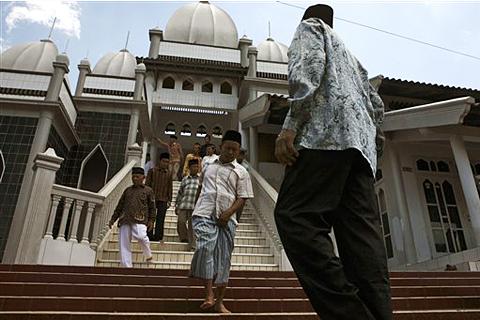
For Ahmadiyah members in Manis Lor village, in Kuningan, West Java, the threat of violence returns almost every year. It comes from the local government and hard-line Muslim groups, both seeking the closure of an Ahmadiyah mosque and seven prayer facilities, or musholla, in the village.
“It seems like there is an agenda every year just before Ramadan to scare us off,” said Nurahim, the secretary of the An Nur Mosque in Manis Lor. “This is our home. The Ahmadiyah have existed in Manis Lor since 1953. We will fight for our rights until the end.”
Violent scenes erupted between July 26 and 29 in Kuningan when hundreds of police and public order officers tried to seal off the mosque and musholla.
The closures were met with resistance from members of the sect, with protesters blocking attempts to shut down the facilities. But a number of hard-line Muslim groups soon flocked to the village carrying wooden planks, knives and slingshots, and scuffles quickly broke out.
Nurahim said that the July confrontation was fairly minor compared to a 2006 incident in the village, when dozens of Ahmadiyah members were left heavily injured after being pelted with rocks and beaten.
Muslim Sect or Other Religion?
Witnesses have singled out the hard-line Islamic Defenders Front (FPI) as the force behind the string of attacks in Kuningan.
The FPI was also believed to be behind another attack on an Ahmadiyah mosque in Surabaya, East Java, on Aug. 9.
Around 200 people rallied in front of the mosque at that time, demanding the government shut it down. They ended up vandalizing the mosque by dismantling the signage at its gate.
Muhammad Shobri Lubis, an FPI leader, did not deny that members of his organization had participated in the attacks. “Even if they did attack an Ahmadiyah member it was because the FPI was provoked,” he said.
“The Ahmadiyah are a menace. Their members are hard-headed. They refuse to follow the MUI fatwa. They have also ignored calls from the government to cease their activities. We are merely urging them to respect the government, to respect Islam, the Koran and the Hadith [the narrated teachings of the Prophet Muhammad].”
Malik Madani, one of the leaders of Nahdlatul Ulama, the largest Islamic organization in the country, said that although the NU believed in peaceful dialogue to resolve differences with the sect, the organization’s standpoint was that Ahmadiyah should not be seen as an Islamic sect, but as a religion distinct from Islam, as is the case in places like Pakistan.
“People are anxious because most within the Muslim community feel that Ahmadiyah has disgraced Islam and the Prophet Muhammad. Muhammad is the final prophet and there is no negotiating that,” Malik said.
“The longer Ahmadiyah is allowed to practice its faith, the more the Islamic ideals and fundamentals will suffer.”
‘Muslims Just Like Us’
But Nuniek Susilowati disagrees. Although not an Ahmadiyah member herself, she lives in close proximity to the Ahmadiyah community in the Kebayoran Lama area of South Jakarta. She said that as a mainstream Muslim, she never felt that Ahmadiyah’s religious activities were disgracing her faith.
“They’re quite friendly and open about their beliefs. In fact, they are quite generous. They participate in a lot of community activities and social occasions. You can ask anyone here, they’re not troublemakers,” she said.
Ahmadiyah members in Kebayoran are a clear minority. The Ahmadiyah mosque there is completely surrounded by residents adhering to mainstream Islam. Just a few meters from the mosque is a secretariat of the Betawi Community Forum (FBR), which is considered by many to be an organization of very conservative and devout Muslims.
Nuniek also dismissed claims from hard-line Muslim groups that Ahmadiyah members performed different prayer rituals.
“Growing up, I was told that Ahmadiyah had a different version of the Koran, that their prayers were different, that their adhan [call to prayer] was different and that they didn’t believe Muhammad was a prophet. None of it is true,” she said.
“When I first moved here, I prayed at their mosque by mistake. My husband scolded me and told me that I had just prayed at a mosque of infidels. But after a while, I noticed that there were no differences. They’re Muslims just like us. Since then, I’ve often prayed at their mosque even though I’m not a member.”
Bonar Tigor Naipospos, deputy chairman of the Setara Institute for Peace and Democracy, said that Ahmadiyah members in major cities faced less intimidation than those in remote villages across the country.
“Mainstream Muslim groups in the rural areas have a more conservative and narrower view of Ahmadiyah. They hold greater prejudices toward Ahmadiyah because of their lack of understanding of the sect,” Bonar said.
Witnesses alleged that those attacking the Ahmadiyah mosque in Kuningan were not locals, but came from Cirebon in West Java, and places as far as Ponorogo in East Java. Those who burned down houses of the Ahmadiyah community in West Lombok are said to have come from the adjacent district of Central Lombok.
“Those who live in close proximity to Ahmadiyah members and those who often interact with them know that they’re just like other Muslims,” Bonar said.
Government (In)action
Nasarudin Umar, the Religious Affairs Ministry’s director general of Islamic affairs, claims that although the government no longer recognizes Ahmadiyah as part of Islam, Indonesia protects the human rights of the sect’s members and their privileges as Indonesian citizens.
“The government certainly never bars Ahmadiyah members from marrying at the KUA nor does it deny their rights as citizens, such as the right to obtain an ID card, to receive education and health care and to hold public office. The Religious Affairs Ministry even helps them if they want to perform the Hajj pilgrimage,” Nasarudin told the Globe.
“As far as intimidation goes, the government always tries to protect Ahmadiyah members’ civil rights. The government always prevents violence from escalating and facilitates peaceful talks between members of the sect and the wider Muslim population.”
These statements, though, do not seem to reflect the situation on the ground, as Ahmadiyah members in Lombok and Kuningan said that police were at the scene when the violence broke out but did very little to bring the situation under control.
Andreas Harsono, a representative of Human Rights Watch in Indonesia, said that there had never been any police investigation into the alleged human rights abuses against Ahmadiyah members or any record of the perpetrators being arrested.
“Ahmadiyah members in Lombok lost their homes and some were beaten until they were seriously injured. I know of one man in Lombok who was left permanently crippled from the injuries he sustained,” Andreas said.
“There are witnesses to the attack, the evidence is there, but the police have never arrested anyone. The same goes for the attacks against Ahmadiyah members in Garut, Bogor and Kuningan.”
Setara’s Bonar said the government itself was discriminating against Ahmadiyah members. He said his institute had discovered instances where Ahmadiyah members were dismissed from public office or discriminated against at public schools.
Siti Hafizah, a member of Ahmadiyah in Kuningan, said that because of her beliefs she was discriminated against during her high school years, particularly during classes on Islamic studies.
One of her teachers, Siti said, discovered that she was from Manis Lor, where 90 percent of the 4,500 residents are members of Ahmadiyah.
“I wasn’t allowed to participate in classes unless I denounced my beliefs and embraced mainstream Islam,” she said.
“All I could do was cry at the library each time we had a class on Islamic studies. Thank God my parents intervened so that I could at least take the tests. But still, although I knew I did well during the tests, the teacher kept giving me bad grades.”
Other Ahmadiyah students said that they were not allowed to take their final examination (part of the National Final Examination, or UAN) in the subject.
Legitimized Hostility?
Bonar said attackers have always been able to use the 1965 Blasphemy Law to legitimize hostilities against Ahmadiyah.
“Clearly the law, which is out of date and no longer relevant in today’s world, is being utilized as a weapon. The law creates an opportunity for the attackers to intimidate Ahmadiyah members and take the law into their own hands,” Bonar said.
The law forbids blasphemy and desecration of religions. Violators face lengthy jail terms.
Several groups have challenged the law and filed for a judicial review with the Constitutional Court, arguing the law is contradictory to the Constitution, as the latter guarantees freedom of worship. However, the court in April rejected the motion to annul the law.
Human Rights Watch said the government should annul both the Blasphemy Law and the 2008 joint decree against Ahmadiyah.
“Indonesia is a secular state and the government should not make laws and regulations that inhibit religious freedom. The Indonesian Constitution makes it clear that it is the government’s job to ensure that all citizens can exercise their religion freely,” Andreas said.
Bonar added that the only way to end the ongoing discriminatory acts against Ahmadiyah was for the government to enforce the rule of law. “The government must ensure impartial legal treatment and human rights protection for all citizens,” he said.
Copyright 2010 The Jakarta Globe










 Posts
Posts


