Showing posts with label Kuningan. Show all posts

Tuesday, January 25, 2011

Indonesia Clerics Alleging Ahmadiyah Ties Protest Candidates

Jakarta Globe, Indonesia
NEWS
Indonesia Clerics Alleging Ahmadiyah Ties Protest Candidates
Yuli Krisna | January 25, 2011

Bandung. In yet another blow to the beleaguered Ahmadiyah community, a group of Islamic clerics in Garut, West Java, have formally objected to the three candidates for district secretary on the grounds that they may be from the sect.

In a hearing at the district legislature on Monday, dozens of clerics and community elders said the three men nominated for the post by the district head — Iman Ali Rahman, Hermanto and Indriana Soemarto — were “suspected of following Ahmadiyah teachings.”

Ahmad Hidayat, one of the clerics, said this was grounds for the district head to “repeal all the nominations made earlier.”

Legislative speaker Irfan Suryanagara pointed out that there were no provisions forbidding members of the minority Islamic sect from seeking office.

“All citizens are guaranteed equal legal standing. That’s the law,” he said.

However, he conceded to demands that candidates be questioned about their backgrounds.

“If they’re believed to be from a certain element of society, we have to look into whether the allegations are true,” he said.

District head Aceng Fikri labeled the allegations by the clerics questionable, but he declined to comment on whether he would nominate an Ahmadiyah follower to his administration.

“I’m not going to comment on it because I’m bound to be accused of discrimination,” he told the Jakarta Globe.

He stressed none of the candidates were Ahmadis.

“They’ve been accused of being Ahmadiyah, but there’s nothing to indicate this, so we could be dealing with a baseless accusation here,” he said.

He added that one of the candidates, Iman, had even gone so far as to sign a sworn statement before a group of clerics to deny he was an Ahmadi.

He said all three candidates had met the requirements to become district secretary, a post second in command to the district head and his deputy.

“For that reason, I refuse to withdraw their candidacies and will stick with my decision,” Aceng said.

Members of the Ahmadiyah continue to face acts of discrimination and outright oppression by mainstream and hard-line Muslims across much of the country, including West Java.

In October, a mob of 200 looted homes and burned down a mosque and school belonging to an Ahmadiyah community in Bogor.

Similar attacks have also occurred recently in Cianjur, Sukabumi, Garut, Tasikmalaya, Ciamis and Kuningan, while in West Nusa Tenggara, an Ahmadiyah community purged from its village in 2006 has been forced to live in a “temporary” shelter and denied permission to return home.

Thursday, January 20, 2011

Indonesian Prosecutors ‘Dead’ Wrong in Sect Stabbing Claim in Bogor

Jakarta Globe, Indonesia
NEWS
Indonesian Prosecutors ‘Dead’ Wrong in Sect Stabbing Claim in Bogor
Ulma Haryanto | January 20, 2010

Ahmad Nuryamin, 35, was arrested and accused of a stabbing he says he was forced to confess to during torture. (JG Photo/ Nivell Rayda)
Indonesia. Prosecutors in Bogor on Wednesday admitted making a big mistake in their indictment of an Ahmadiyah sect member who was accused of stabbing a teenager during a mob attack on an Ahmadi settlement in October.

The indictment against Ahmad Nuryamin, 35, said a forensic test done on the victim’s “dead body” had shown stab wounds. But the defense counsel had argued that the victim, 15-year-old Rendi Apriansyah from neighboring Pasar Salasa village, was alive and only wounded — not dead.

In their response to last week’s defense statement at the court in Cibinong, Bogor, the team of prosecutors on Wednesday admitted to the mistake. “We admit that we were careless,” Prosecutor Nuraeni Aco told the court.

However, Nuraeni said the defendant was carrying a knife at the time of the incident and that the prosecutors would leave it to the court to decide whether he stabbed the victim or not.

“We believe it was suspicious for Nuryamin to have a knife with him at nighttime, because farmers don’t work at night,” she said.

Nuryamin has argued that, as a farmer, he carried the knife every day and that the victim had bumped into him in the confusion and darkness during the Oct. 1 attack by a mob of mainstream Muslims on Cisalada, a village that is home to some 600 members of the Ahmadiyah community. He said his knife had still been in its sheath at the time of the alleged attack.

“Rendi himself could not rightly identify the suspect,” Muhammad Isnur, a member of the Jakarta Legal Aid Foundation (LBH) and Nuryamin’s legal counsel, told reporters after the hearing. “First he said it was a long-bearded old man with a white shirt. The police arrested two elderly men, neither of whom carried a sharp weapon,” he said.

Police attention fell upon Nuryamin after a boy’s report that he had overheard him saying that he might have stabbed someone.

Nuryamin was arrested for questioning three days later.

He signed a confession that he had stabbed Rendi during the night of the attack when hundreds of assailants burned and looted homes, schools and a mosque in Cisalada.

But the defendant, who faces up to 10 years in jail for assault on a minor, claims he only signed the confession after being tortured by two police officers.

Nuryamin’s mother, Rohmatika, said that after he had been interrogated by the police, “I saw his face was full of bruises, his lips were bleeding and he had difficulty hearing.”

Judge Eddy Wibisono adjourned the trial to Jan. 27 to hear the prosecutors’ reply.

A different panel of judges at the same court on Wednesday heard the case of three teenagers who allegedly destroyed property during the same attack on Cisalada. Judge Atriwati adjourned their trial until Jan 26.

Authorities have declared the Ahmadiyah religion to be a deviant sect, and its followers have been the repeated target of attacks, especially in West Java and West Nusa Tenggara, by mainstream Muslim neighbors.

Copyright 2010 The Jakarta Globe
URL: www.thejakartaglobe.com/home/indonesian...in-bogor/417964

Monday, January 17, 2011

The Thinker: Faith Talks Silenced

Jakarta Globe, Indonesia
OPINION
The Thinker: Faith Talks Silenced
Nicholaus Prasetya | January 17, 2011
Last week, Religious Affairs Minister Suryadharma Ali sparked debate when he said “there were no religious conflicts during 2010” in Indonesia.

But it doesn’t take much to see that the minister’s comment was far from the truth.

Last week, for instance, members of a hard-line Muslim group forced 15 people in Surabaya to halt a discussion on religious tolerance.

The Surabaya incident was a continuation of religious tussles from last year, including disputes over permits to worship and the forced closure of churches.

It had the look of numerous conflicts before it, having been perpetrated by intolerant groups whose moves were, in the end, supported by local authorities. In this case, police in Surabaya ultimately forced the meeting to end.

The forum was disbanded for two main reasons.

First, members of the Ahmadiyah community, a minority Muslim sect, were at the talks, according to news portal Detik.com. Their mere presence anywhere is enough for critics to launch protests or other forms of intimidation.

The other reason is an old excuse: The 15 participants apparently lacked a permit to hold such a forum.

The country is supposed to celebrate diversity, even when it comes to religion. Ahmadiyah members have rights that should be protected by the government.

However, many of the sect’s members live in fear — and they’re not the only ones.

The Setara Institute for Democracy and Peace recorded 28 attacks and rights violations against Christian communities across the archipelago in the first seven months of last year, up from 18 cases in 2009 and 17 in 2008.

The Wahid Institute cited 196 cases last year of violence based on intolerance and religious discrimination, an increase of almost 50 percent from a year earlier.

The Moderate Muslim Society, moreover, said at least 81 cases of religious conflict occurred last year — an increase of more than 30 percent from 2009.

In such a country where the government fails to ensure the rights of all its citizens, communication becomes integral to avoiding clashes such as the ones we have seen or heard about in the news.

But is there still room for religious tolerance if criticism is often silenced?

The German sociologist and philosopher Jurgen Habermas theorized that a rational society would evolve through the development of economy, technology or capital.

But he also said communication and information exchange — not the economy, as others such as Marx posited — was the true driving force of society.

Seen in this context, the Surabaya forum’s dispersal is particularly regrettable because participants were trying to engage in discourse on the very subject of engaging in discourse.

Ideally, peaceful communication means no group dominates the dialogue, giving all participants — with the goal of reaching a consensus — the chance to speak their minds, regardless of their status in the community.

Before the breakup of the talks, the Ahmadiyah members at the Surabaya forum were given a fair chance to share their thoughts. For once, they were not silenced by rowdy protests or government sanctions. They were not forced to follow what other groups wanted them to do.

The Ahmadis were there to talk about how to foster a better environment for interfaith harmony in the country.

Surely the meeting in Surabaya was a welcome break from the world where stigmatization, threats and repression are part of their daily lives. They are Indonesians, but strangers in their own land.

This begs the question: Why is it that groups of hard-liners do not participate in such forums instead of cracking down on such peaceful initiatives?

It is clear that, as a country with a Muslim majority, mainstream Islamic groups should be involved in the dialogue.

But resisting the urge to advance their own interests should be a prerequisite before they can take part. Ideal communication eschews the supremacy of one group over another and focuses on finding long-term solutions to conflicts through building consensus.

Interreligious conflicts should be bridged by communication.

They cannot be solved by force.

Thus, it is everyone’s duty to protect open lines of communication wherever they have been established.

Last year, it was clear to all — save perhaps for our religious affairs minister — just how common acts of intolerance were.

Should we expect the same this year?

We will if the rights to free speech and religious freedom are at the mercy of those who shut out ideas and beliefs contrary to their own.

Nicholaus Prasetya is currently a student at the Bandung Institute of Technology (ITB)

Copyright 2010 The Jakarta Globe
URL: www.thejakartaglobe.com/news/hard...activists/416885

Thursday, January 13, 2011

Hard-Liners, Police Shut Down Tolerance Talk in Surabaya: Activists

Jakarta Globe, Indonesia
NEWS
Hard-Liners, Police Shut Down Tolerance Talk in Surabaya: Activists
Amir TejoAmir Tejo | December 15, 2010

Members of the Islamic Defenders Front (FPI) protesting against the Q! Film Festival in Jakarta last year. Pluralism advocates said hard-liners also disrupted a talk on religious tolerance in Surabaya on Thursday. (AP Photo/Irwin Fedriansyah)
Surabaya. Police and Islamic hard-liners on Thursday disbanded a discussion on religious tolerance in Surabaya, said members of a humanitarian watchdog who were in attendance.

Members of the Setara Institute for Peace and Democracy, a group that advocates for pluralism and freedom of worship, said they were participating in the discussion at a coffee shop in the Inna Simpang Hotel with groups including Surabaya Legal Aid and members of the minority Ahmadiyah sect.

They said the meeting was disrupted by dozens of members of a group calling itself the Warring Defenders of Islam (LPI).

Setara activists said Sasmito, a man identifying himself as the head of the LPI, told the attendees the discussion was illegal and would have to be disbanded.

Shortly afterward, the activists said, Surabaya Police arrived and conferred with the LPI, after which the hard-liners left.

The tolerance discussion resumed, but police returned and ordered an end to the gathering, Setara members said.

“We request that you stop with this discussion, because you have not informed us that you were going to hold it,” a police officer said, according to Setara official Bonar Tigor Naipospos.

Bonar said he demanded police tell them what law required police permission to hold a meeting.

“This was no demonstration which requires a permit. This was a meeting involving 15 people at a hotel. Why were we stopped from meeting?” Bonar told the Jakarta Globe.

He said police told him the meeting could pose a security risk because it was held not far from a building where President Susilo Bambang Yudhoyono would be staying during a working visit.

“This was a fabricated reason,” Bonar said.

“Yudhoyono’s visit anywhere would have extraordinary security. This was just a discussion.” He added that organizers had sent a text message to East Java Police Chief Insp. Gen. Badrodin Haiti informing him of the meeting, but that he hadn’t responded.

“We did not meet to conduct anarchic activities or to attack the country,” Bonar said.

“We met here to find a resolution for an ongoing problem. To find a resolution we must listen to all parties involved. This was meant to be positive.”

Members of the gathering said they believed that the hard-liners were connected to the Islamic Defenders Front (FPI), a fundamentalist group known for forcibly imposing their religious views on others.

Setara Institute founder Hendardi on Thursday said he condemned the police’s failure in stopping hard-liners from disrupting human rights discussions.

“This is a clear threat to our constitutional rights to freely express our opinion,” he said.

“Police in the regions can no longer be separated from radical Islamic organizations, who continue to persecute and intimidate minority communities, including those organizations that fight for the rights of these communities.”

Thursday, December 9, 2010

Where’s the Public Justification in Ostracizing Ahmadiyah?

Jakarta Globe, Indonesia
OPINION
Where’s the Public Justification in Ostracizing Ahmadiyah?
Aristo Pangaribua | December 09, 2010

In the most recent example of religious intolerance targeting a minority group in Indonesia, an armed mob attacked an Ahmadiyah mosque in South Jakarta last Friday. This was yet another wound for the Ahmadis, who have experienced hundreds of attacks in various places.

Our government seems reluctant to act on behalf of these minorities.

No one is ever convicted for ransacking and destroying Ahmadi mosques or homes.

It is not surprising to me because in 2008 the minister of religious affairs, the home minister and the attorney general essentially “endorsed” such actions by placing the blame on Ahmadis for failing to halt their religious activities.

Cabinet ministers even provided a “solution” to end the controversy by enacting a 2008 joint ministerial decree that prohibits Ahmadis from performing their religious services in public, because Ahmadiyah is considered a deviant sect of Islam.

Furthermore, the government is now discussing strengthening the legal status of the decree by turning it into state legislation (Undang-undang ).

Rights activists claim that such actions violate freedom of religion.

This has become a hot topic. Does the government have the right to interfere with a citizen’s private beliefs?

This kind of dispute does not just happen in Indonesia.

In the United States, the proselytizing of the Jehovah’s Witnesses sect has been restricted, partly because the group bans blood transfusions for its members, which has led to an outcry over children’s health.

The legalization of gay marriage in the United States is another case, as is the ban on wearing the full Islamic veil in public in France.

Nevertheless, I believe that in some cases the state does have the discretion to interfere with private beliefs to promote a broader “good” and to maintain order as a nation in general.

But what our government has forgotten is the role of explaining and justifying a given action that might be for the good of society.

The government, in deciding to restrict Ahmadiya’s actions, is acting on the basis of “good” religious doctrine.

The action was taken merely because Ahmadiyah tenets contradict the majority view of Islam.

The United States and France both use this discretion largely on the basis of health, security, community standards or nationalism rather than religious values.

Is this a sounder public justification?

Professor Gerald F. Gaus, from the University of Pittsburgh (Value and Justification: 1990), argues that in order to create public justification, a state action must be neutral toward different conceptions of the good.

A ban on the Jehovah’s Witnesses in the US state of Ohio was overturned in court because there was no sufficient public justification and it was deemed unconstitutional.

Public justification plays an indispensable role in the practice of democratic citizenship.

For Indonesia, which often goes on about its being the world’s third-biggest democracy, this requirement is extremely important.

If the term “public justification” seems too abstract, just ask the three ministers who enacted the joint decree how they would feel if the state used its power to prevent them from doing something they believed to be essential to their quality of life, without providing an adequate reason.

The use of coercive power itself is suspect in this case.

The “joint ministerial decree” is unknown in our legal hierarchy.

But the government is adamant this action is necessary to maintain “public order.”

Under the doctrine of separation of powers, it is the task of the courts to balance the state’s interest in restricting Ahmadiyah’s actions against the group’s inherent right to practice its beliefs.

It is imperative for the judges to make sure that the state is not acting for the wrong reasons and has provided a public justification for its action.

However, it is also true that in April 2010, the Constitutional Court declined to void the 1965 Blasphemy Law, which serves as the basis for the government entering the domain of religion.

The court rejected a motion for a judicial review, lodged by former President Abdurrahman Wahid and others, on the ground that the state needs to have this discretion to prevent turmoil and anarchy.

What makes it more confusing is that the joint ministerial decree cannot itself be tested in court.

Constitutional Court Chief Justice Mahfud MD was quoted as saying that the vague status of the decree makes it hard to challenge.

The bottom line is that our “third-largest democracy” has failed to produce a sufficient public justification for the use of its political power against a minority religion.

From what I understand, in a democracy, the citizen is entitled to an explanation when the state uses its power of coercion.

Where in the world is our principle of due process of law?

Aristo Pangaribua is a Jakarta-based lawyer and chairman of Pemuda Indonesia Progresif. He can be reached at www.progresif.net.

Copyright 2010 The Jakarta Globe

Saturday, December 4, 2010

Jakarta Police Help Repel Attack on Ahmadiyah Mosque

Jakarta Globe, Indonesia
TOP STORIES
Jakarta Police Help Repel Attack on Ahmadiyah Mosque
Arientha Primanita, Nivell Rayda & Zaky Pawas | December 04, 2010

Jakarta. A group of about 50 people, dressed in white robes and wielding weapons, attempted to attack an Ahmadiyah mosque in South Jakarta early on Friday morning, but they were chased off with help from police officers.

Firdaus Mubarik, spokesman for the South Jakarta branch of Ahmadiyah, said the congregation was warned by police of the impending attack.

A number of members, along with three police officers, stood guard over the Al Hidayah Mosque off Jalan Ciputat Raya in Kebayoran Lama, South Jakarta.

“At 12:37 a.m., 50 people came to the mosque wearing white clothing and wielding sharp weapons like samurai,” he said.

Firdaus said the police fired six warning shots, causing the group to scatter. “The whole incident took about 10 seconds. It was recorded on our CCTV.”

The footage showed the group was mostly made up of teenagers armed with wooden canes and iron bars.

One assailant tried to pick up a rock while another attempted to climb the gates before the pack panicked and fled.

Seconds later, police and civilians were seen chasing the mob away.

One man from the group was detained and taken to the Kebayoran Lama Police station.

Jakarta Police Chief Insp. Gen. Sutarman pledged firm action against the perpetrators.

The damage from the attack was fairly minor, but pluralism advocates are more worried about what the attack means.

“This is proof that intolerance is really happening in the capital,” said Ismail Hasani, a researcher for the Setara Institute for Peace and Democracy, which recently released a survey showing that 45.4 percent of respondents from Greater Jakarta wanted the Ahmadiyah, a minority Islamic sect, disbanded.

Copyright 2010 The Jakarta Globe

Friday, December 3, 2010

Update: Indonesia Police Warn Ahmadiyah of Fresh Attack

Jakarta Globe, Indonesia
TOP STORIES
Update: Indonesia Police Warn Ahmadiyah of Fresh Attack
Arientha Primanita | December 03, 2010

An Ahmadiyah congregation in South Jakarta holding Friday prayers after their mosque was attacked early Friday morning. (JG Photo/Arientha Primanita)
Jakarta. Despite warnings from police that a second attack was being planned, members of the Ahmadiyah religious movement in South Jakarta went ahead with Friday prayers.

“We will keep doing our activities because it is only Allah we fear,” said Firdaus Mubarik, spokesman of the South Jakarta branch of Ahmadiyah.

A number of police officers had also been stationed at the Al Hidayah Mosque on Jalan Ciputat Raya in Kebayoran Lama.

The mosque was attacked shortly before 1 a.m. on Friday.

Firdaus said about 50 as yet unidentified people wearing white flowing robes, some of whom were armed with samurai swords and other weapons, before they scattered when police fired six warning shots in the air.

A window in the mosque was broken but no members of the congregation were injured.

One person has been taken into custody for questioning.

Last year, an unknown person or group attempted unsuccessfully to burn down the mosque.

Firdaus said they had only ever conducted their activities peacefully.

Copyright 2010 The Jakarta Globe

Mob Attacks Ahmadiyah Mosque in South Jakarta

Jakarta Globe, Indonesia
NEWS
Mob Attacks Ahmadiyah Mosque in South Jakarta
Jakarta Globe | December 03, 2010

Al Hidayah Mosque on Jalan Ciputat Raya in Kebayoran Lama, Jakarta, Indonesia
Al Hidayah Mosque on Jalan Ciputat Raya in Kebayoran Lama, Jakart, Indonesia
Jakarta. In the latest example of religious intolerance in Indonesia, a group of unknown people attacked an Ahmadiyah mosque in South Jakarta early on Friday morning.

The sword-wielding assailants smashed the windows of the Al Hidayah Mosque on Jalan Ciputat Raya in Kebayoran Lama and left. No injuries were reported.

Mubarik, spokesman for Jakarta’s Ahmadiyah community, confirmed the attack.

Police are yet to comment.

In October, a mob of hundreds ransacked and burned down houses, schools and a mosque in Cisalada village, home to 600 followers of the minority sect, which is deemed deviant by many mainstream Muslims.

Last November, a group of conservative Muslims held a rally at an Ahmadiyah mosque in North Jakarta.

Copyright 2010 The Jakarta Globe

Sunday, November 21, 2010

Looking the Other Way When It Comes to Indonesia’s Ahmadis

Jakarta Globe, Indonesia
OPINION
Looking the Other Way When It Comes to Indonesia’s Ahmadis
Firdaus Mubarik | November 21, 2010

On Oct. 1 in Bogor, an Ahmadiyah mosque and 28 houses were destroyed, looted and burned. Fifty Korans were burned during the assault on Cisalada village, home to 600 people. President Susilo Bambang Yudhoyono scarcely reacted. It was a far cry from several months earlier, when an American pastor made plans to burn the Koran in Florida and Yudhoyono immediately wrote to US President Barack Obama and held a press conference to protest the action.

The problem is that the government never seriously prosecutes perpetrators of violence against the Ahmadiyah.

In one case in 2002, more than 300 Ahmadis fled their homes in East Lombok, West Nusa Tenggara, when their homes were burned down.

The community was taken to Mataram, where they were attacked again in 2006.

On Friday, 50 followers of the sect were chased out of their homes. Now they live in a barracks, denied the right to return home.

Half a million of other Ahmadis in Indonesia live in fear. Attacks by Islamic extremists continue anywhere there are Ahmadis in Indonesia.

In West Java, violence has erupted in several districts: Bogor, Cianjur, Sukabumi, Garut, Tasikmalaya, Ciamis and Kuningan.

The same has occurred in Sumatra, Sulawesi, Maluku and Kalimantan.

In fact, there is no safe place for Ahmadis to worship in Indonesia. Freedom of religion in this country is increasingly threatened.

To legitimize their actions, attackers cite an Indonesian Council of Ulema (MUI) fatwa — promulgated in 1980 and strengthened in 2005 — which declared Ahmadiyah heretical and dangerous.

In Banjar, West Java, Sobri Lubis, one of the leaders of the radical Islamic Defenders Front (FPI) openly invites his people to kill followers of Ahmadiyah.

Police do nothing in response, just as they have done next to nothing about extremist action against Ahmadis elsewhere in the country.

In the 2006 Lombok case, police freed the people suspected of torching homes of the displaced Ahmadis.

In Bogor in September 2005, Encep Hernawan made the bold statement that he and his organization Gerakan Islam Reformis (Garis) were responsible for an attack on four mosques and 43 homes belonging to the Ahmadiyah community in Cianjur.

The act went unpunished.

In some cases, local governments facilitate the attackers and position the Ahmadis — who, under the Constitution, should be protected — as the cause of the problem.

They also sometimes legitimize acts of violence.

In Bogor, Garut, Tasikmalaya and Kuningan, local governments issued decrees banning Ahmadiyah, often including the MUI fatwas of 1980 and 2005 in their laws.

Religious Affairs Minister Surya Dharma Ali this year campaigned against Ahmadiyah, repeatedly saying that it was not part of Islam and he would ban the sect.

This policy follows similar action in Pakistan in 1974, when that country’s Constitution was amended to explicitly declare Ahmadis as non-Muslim minorities.

Rather than solve the problem, these actions have triggered a rise in attacks, arrests and killings of Ahmadiyah followers.

In recent times 86 Ahmadis died and more than 120 were injured in attack during Friday prayers at an Ahmadiyah mosque in Lahore.

Indonesia in 2005 ratified the International Covenant on Civil and Political Rights. Under the 1945 Constitution, the government should protect the freedom of religious choice and association.

But in fact a 1965 ordinance allows the government to prohibit a particular religion or faith.

This law also underlies a 2008 joint decree that prohibits the spread of Ahmadiyah teachings — said to be contrary to the majority’s understanding of Islam.

A report by the Setara Institute for Democracy and Peace shows the violence continues to increase. In 2009, there were 33 cases of violence against Ahmadis — up from 15 in 2007.

A National Commission on Human Rights (Komnas HAM) team in 2006 thoroughly investigated the violence against Ahmadis on Lombok and in Kuningan.

It spoke of human rights violations, but unfortunately the team’s recommendations were not followed up by commission members.

There has been some progress, though.

This month police stopped 300 FPI members from attacking an Ahmadiyah mosque in Ciamis, West Java.

This strong action from the police clearly shows that the government has the ability and power to stop violence.

The government must revoke all ordinances and regulations that restrict the freedom of religion and worship and take decisive steps to ensure the safety of the Ahmadis.

People involved in violent acts against the community should be arrested and prosecuted.

Consistent, firm government action is the only way to stop the violence faced by minorities like the Ahmadis.

Firdaus Mubarik is a member of the Ahmadiyah community in Kebayoran, South Jakarta.

Copyright 2010 The Jakarta Globe

Sunday, August 22, 2010

Ahmadiyah Members See Their Civil Rights Trodden Upon

Jakarta Globe, Indonesia
Jakarta
Ahmadiyah Members See Their Civil Rights Trodden Upon
Nivell Rayda | August 22, 2010
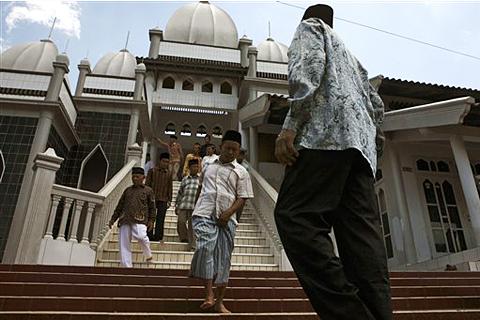
Ahmadiyah members leaving their mosque after Friday prayers in Manis Lor village in Kuningan, West Java. The mosque has been at the center of protests by hard-line Muslims groups from the area. (AFP Photo/Yonda)
Jakarta. Weddings in Indonesia often are elaborate feasts with at least 500 guests and the best food and drinks money can buy. But this wasn’t the case for 21-year-old Nur (not her real name).

Nur is a member of the controversial sect of Ahmadiyah, considered by many to be outside of mainstream Islam. Her wedding took place in secrecy and was attended by only six people — three members of her family, and three from her husband’s.

Although there is no formal instruction from the Ministry of Religious Affairs, there seems to be an unspoken rule prohibiting Indonesia’s Religious Affairs Office (KUA) from marrying a couple from the Ahmadiyah sect.

When she was applying for a marriage license, Nur was sent all over West Java, from one KUA office to another. “Like all brides and grooms from my village, I had to go to different districts [before I could] get my marriage license. We were asked to change our residency to the district [where we could get married], but we needed to have a sponsor living there before we could change our ID card,” Nur told the Jakarta Globe.

“I begged and I begged. Thankfully, because of the goodness of one KUA official, we were eventually able to get married. But everything had to be done in secrecy.”

After six months, the KUA official called Nur’s family to say it was safe to choose a venue and perform the wedding ceremony. A small mosque far away from the issuing KUA office was chosen to avoid detection.

But Nur was told not to hold a wedding reception. “But if we insisted, it had to be held months after the actual marriage, again to avoid detection,” she said.

“The official that oversaw our wedding could get into trouble if we did [get detected] and that would mean every Ahmadiyah couple after us could forget about getting married.”

Marriage is only one of the things made more difficult for members of Ahmadiyah, decreed a deviant sect in 2008 after mounting pressure on the government from mainstream Muslim organizations. Though the decree stopped short of banning the sect completely, it banned its members from publicly practicing their faith and spreading their beliefs, or proselytizing.

Not Always an Issue

Members of Ahmadiyah, founded in India in 1889, hold that the group’s founder, Mirza Ghulam Ahmad, was the last prophet, a belief that contradicts a tenet of Islam that reserves that position for the Prophet Muhammad.

But the sect wasn’t always a religious pariah.Ahmadiyah once lived in harmony with other Muslim groups. It traces its roots in Indonesia to 1925, when two Muslim scholars in Sumatra began spreading their beliefs upon their return from their studies in India.

Separately in Yogyakarta in 1929, several former members of the mainstream Muhammadiyah organization established their own Ahmadiyah group. This group, however, adopted a less controversial view already popular in Lahore, Pakistan, which maintains that Mirza Ghulam Ahmad was not a prophet but a reformer of Islam.

In 1953, the Indonesian government acknowledged Ahmadiyah as an Islamic organization, and it ranks of followers grew.

For the most part, the government managed to suppress calls for the Ahmadiyah to disband, though in 1980 several mainstream Muslim groups decided to consider the sect both deviant and blasphemous.

It was not until the end of former President Suharto’s regime, in 1998, that mainstream Muslim groups began to actively call for a prohibition of the sect.

After former President Abdurrahman Wahid — seen by many as a champion of religious tolerance — stepped down in 2001, the call intensified and the sect became the target of violent actions.

In 2005, the nation’s leading Islamic authority, the Indonesian Council of Ulema (MUI), issued a fatwa, or religious edict, against Ahmadiyah, calling its teachings blasphemous and deviant.

The increasing tension eventually led to the joint issuance of the 2008 decree by the Religious Affairs Ministry, the Home Affairs Ministry and the Attorney General’s Office.

Endless Intimidation

Zafrullah Pontoh, the president of the Indonesian Ahmadiyah Congregation (JAI), said that while the decree was a form of oppression directed against the estimated 600,000 members of the sect, it still left room for multiple interpretations.

“Members of Ahmadiyah face constant harassment both from the government and members of the public,” he said.

“The longer the government stays quiet about this, the harsher the intimidation against Ahmadiyah members.”

In February 2006, thousands of mainstream Muslims in West Nusa Tenggara province burned homes belonging to Ahmadiyah members in West Lombok district. The incidents left as many as 137 people homeless, all of whom had to be escorted by police officers to a temporary shelter in the provincial capital, Mataram.

Four years after the incident, more than 40 Ahmadiyah families still live in the shelter without electricity or any certainty about whether they will be able to return home. Most are traumatized and fear a repeat of the incident.

“Some families insisted on returning home to their village, although they know that police and the government have refused to vouch for their safety if they do,” Saeful Uyun, secretary of the provincial chapter of the JAI, told the Globe. “The conditions in the shelter are unbearable to some, so many have reluctantly ventured to other cities and provinces.”

Saeful added that one of the countless forms of discrimination that members of Ahmadiyah in Mataram had to endure was the fact that the local government had been refusing to grant members of the sect ID cards that are obligatory for all Indonesian citizens.

Without an ID card it is almost impossible for the Ahmadiyah members — having already lost virtually all their belongings in the attack — to apply for jobs, obtain a driver’s license or a passport for the Hajj pilgrimage.

“The city of Mataram refuses to give the refugees ID cards because officially they are listed as residents of West Lombok district, while the district argues that they should apply for Mataram residency because they have been living in Mataram for years,” he said. “They are left in limbo over their status and fate.”

For Ahmadiyah members in Manis Lor village, in Kuningan, West Java, the threat of violence returns almost every year. It comes from the local government and hard-line Muslim groups, both seeking the closure of an Ahmadiyah mosque and seven prayer facilities, or musholla, in the village.

“It seems like there is an agenda every year just before Ramadan to scare us off,” said Nurahim, the secretary of the An Nur Mosque in Manis Lor. “This is our home. The Ahmadiyah have existed in Manis Lor since 1953. We will fight for our rights until the end.”

Violent scenes erupted between July 26 and 29 in Kuningan when hundreds of police and public order officers tried to seal off the mosque and musholla.

The closures were met with resistance from members of the sect, with protesters blocking attempts to shut down the facilities. But a number of hard-line Muslim groups soon flocked to the village carrying wooden planks, knives and slingshots, and scuffles quickly broke out.

Nurahim said that the July confrontation was fairly minor compared to a 2006 incident in the village, when dozens of Ahmadiyah members were left heavily injured after being pelted with rocks and beaten.

Muslim Sect or Other Religion?

Witnesses have singled out the hard-line Islamic Defenders Front (FPI) as the force behind the string of attacks in Kuningan.

The FPI was also believed to be behind another attack on an Ahmadiyah mosque in Surabaya, East Java, on Aug. 9.

Around 200 people rallied in front of the mosque at that time, demanding the government shut it down. They ended up vandalizing the mosque by dismantling the signage at its gate.

Muhammad Shobri Lubis, an FPI leader, did not deny that members of his organization had participated in the attacks. “Even if they did attack an Ahmadiyah member it was because the FPI was provoked,” he said.

“The Ahmadiyah are a menace. Their members are hard-headed. They refuse to follow the MUI fatwa. They have also ignored calls from the government to cease their activities. We are merely urging them to respect the government, to respect Islam, the Koran and the Hadith [the narrated teachings of the Prophet Muhammad].”

Malik Madani, one of the leaders of Nahdlatul Ulama, the largest Islamic organization in the country, said that although the NU believed in peaceful dialogue to resolve differences with the sect, the organization’s standpoint was that Ahmadiyah should not be seen as an Islamic sect, but as a religion distinct from Islam, as is the case in places like Pakistan.

“People are anxious because most within the Muslim community feel that Ahmadiyah has disgraced Islam and the Prophet Muhammad. Muhammad is the final prophet and there is no negotiating that,” Malik said.

“The longer Ahmadiyah is allowed to practice its faith, the more the Islamic ideals and fundamentals will suffer.”

‘Muslims Just Like Us’

But Nuniek Susilowati disagrees. Although not an Ahmadiyah member herself, she lives in close proximity to the Ahmadiyah community in the Kebayoran Lama area of South Jakarta. She said that as a mainstream Muslim, she never felt that Ahmadiyah’s religious activities were disgracing her faith.

“They’re quite friendly and open about their beliefs. In fact, they are quite generous. They participate in a lot of community activities and social occasions. You can ask anyone here, they’re not troublemakers,” she said.

Ahmadiyah members in Kebayoran are a clear minority. The Ahmadiyah mosque there is completely surrounded by residents adhering to mainstream Islam. Just a few meters from the mosque is a secretariat of the Betawi Community Forum (FBR), which is considered by many to be an organization of very conservative and devout Muslims.

Nuniek also dismissed claims from hard-line Muslim groups that Ahmadiyah members performed different prayer rituals.

“Growing up, I was told that Ahmadiyah had a different version of the Koran, that their prayers were different, that their adhan [call to prayer] was different and that they didn’t believe Muhammad was a prophet. None of it is true,” she said.

“When I first moved here, I prayed at their mosque by mistake. My husband scolded me and told me that I had just prayed at a mosque of infidels. But after a while, I noticed that there were no differences. They’re Muslims just like us. Since then, I’ve often prayed at their mosque even though I’m not a member.”

Bonar Tigor Naipospos, deputy chairman of the Setara Institute for Peace and Democracy, said that Ahmadiyah members in major cities faced less intimidation than those in remote villages across the country.

“Mainstream Muslim groups in the rural areas have a more conservative and narrower view of Ahmadiyah. They hold greater prejudices toward Ahmadiyah because of their lack of understanding of the sect,” Bonar said.

Witnesses alleged that those attacking the Ahmadiyah mosque in Kuningan were not locals, but came from Cirebon in West Java, and places as far as Ponorogo in East Java. Those who burned down houses of the Ahmadiyah community in West Lombok are said to have come from the adjacent district of Central Lombok.

“Those who live in close proximity to Ahmadiyah members and those who often interact with them know that they’re just like other Muslims,” Bonar said.

Government (In)action

Nasarudin Umar, the Religious Affairs Ministry’s director general of Islamic affairs, claims that although the government no longer recognizes Ahmadiyah as part of Islam, Indonesia protects the human rights of the sect’s members and their privileges as Indonesian citizens.

“The government certainly never bars Ahmadiyah members from marrying at the KUA nor does it deny their rights as citizens, such as the right to obtain an ID card, to receive education and health care and to hold public office. The Religious Affairs Ministry even helps them if they want to perform the Hajj pilgrimage,” Nasarudin told the Globe.

“As far as intimidation goes, the government always tries to protect Ahmadiyah members’ civil rights. The government always prevents violence from escalating and facilitates peaceful talks between members of the sect and the wider Muslim population.”

These statements, though, do not seem to reflect the situation on the ground, as Ahmadiyah members in Lombok and Kuningan said that police were at the scene when the violence broke out but did very little to bring the situation under control.

Andreas Harsono, a representative of Human Rights Watch in Indonesia, said that there had never been any police investigation into the alleged human rights abuses against Ahmadiyah members or any record of the perpetrators being arrested.

“Ahmadiyah members in Lombok lost their homes and some were beaten until they were seriously injured. I know of one man in Lombok who was left permanently crippled from the injuries he sustained,” Andreas said.

“There are witnesses to the attack, the evidence is there, but the police have never arrested anyone. The same goes for the attacks against Ahmadiyah members in Garut, Bogor and Kuningan.”

Setara’s Bonar said the government itself was discriminating against Ahmadiyah members. He said his institute had discovered instances where Ahmadiyah members were dismissed from public office or discriminated against at public schools.

Siti Hafizah, a member of Ahmadiyah in Kuningan, said that because of her beliefs she was discriminated against during her high school years, particularly during classes on Islamic studies.

One of her teachers, Siti said, discovered that she was from Manis Lor, where 90 percent of the 4,500 residents are members of Ahmadiyah.

“I wasn’t allowed to participate in classes unless I denounced my beliefs and embraced mainstream Islam,” she said.

“All I could do was cry at the library each time we had a class on Islamic studies. Thank God my parents intervened so that I could at least take the tests. But still, although I knew I did well during the tests, the teacher kept giving me bad grades.”

Other Ahmadiyah students said that they were not allowed to take their final examination (part of the National Final Examination, or UAN) in the subject.

Legitimized Hostility?

Bonar said attackers have always been able to use the 1965 Blasphemy Law to legitimize hostilities against Ahmadiyah.

“Clearly the law, which is out of date and no longer relevant in today’s world, is being utilized as a weapon. The law creates an opportunity for the attackers to intimidate Ahmadiyah members and take the law into their own hands,” Bonar said.

The law forbids blasphemy and desecration of religions. Violators face lengthy jail terms.

Several groups have challenged the law and filed for a judicial review with the Constitutional Court, arguing the law is contradictory to the Constitution, as the latter guarantees freedom of worship. However, the court in April rejected the motion to annul the law.

Human Rights Watch said the government should annul both the Blasphemy Law and the 2008 joint decree against Ahmadiyah.

“Indonesia is a secular state and the government should not make laws and regulations that inhibit religious freedom. The Indonesian Constitution makes it clear that it is the government’s job to ensure that all citizens can exercise their religion freely,” Andreas said.

Bonar added that the only way to end the ongoing discriminatory acts against Ahmadiyah was for the government to enforce the rule of law. “The government must ensure impartial legal treatment and human rights protection for all citizens,” he said.

Copyright 2010 The Jakarta Globe

Saturday, August 7, 2010

‘No place of worship’ should be barred

NATIONAL
Sat, 08/07/2010
11:42 AM

‘No place of worship’ should be barred
The Jakarta Post, Jakarta

Human rights activists are urging the government to revoke existing local administration rulings that have resulted in the sealing of churches and mosques, mainly in Java.

“Neither the police nor the government have taken any concrete actions in response to forced closures, meaning that they have failed to uphold the democratic values that activists and students strove for during the inception of 1998 reform movement,” Syafiq Alielha of the ‘98 Activists Communication Forum said Thursday at the Wahid Institute in Jakarta.

The country is seeing more and more cases in which local administrations, such as in Bekasi and Bogor, unilaterally close down places of worship due to political pressure from Muslim hard-liners, Syafiq said.

A recent report from the Indonesian Communion of Churches shows that more than 10 churches have suspended services due to mob threats and forcible closures this year. Affected church congregation members believe that mobs exploit the absence of building permits to seal off their churches.

Syafiq added that besides the closures of places of worship, the trend of employing violence to suppress the religious freedom of minority groups was escalating in the country.

On July 29, hundreds of protesters from several hard-line Islamic groups, such as the Islam Defenders Front, the Indonesia Mujahidin Council and the Islamic Community Forum, pushed their way into a mosque belonging to Islamic minority sect Ahmadiyah in Kuningan regency, West Java. The encroachment on Ahmadiyah’s territory led to rioting that damaged houses and reportedly injured three people.

Recent research from the Setara Institute for Democracy and Peace reveals that there were 28 attacks on Christian churches between January and July this year. The number is higher than 2009’s year-end total of 18 cases and 2008’s 17 attacks.

Syafiq lamented the fact that the country had fallen back on primordial biases, which were exploited during the Soeharto era to pit religions against one another.

“What we dreamed of in 1998-an egalitarian, civilized, and multicultural society-is now sinking into the mire of vigilantism and ‘toothless’ law,” he said.

Another ‘98 activist, Bona Sigalingging, told The Jakarta Post that President Susilo Bambang Yudhoyono had to take stern action against vigilante groups, which so far enjoyed immunity from law.

“I don’t understand why the Jakarta administration bows to such fundamentalist groups. For instance, the administration’s plan to cooperate with the Islam Defenders Front ‘FPI’ to secure the city during the Islamic fasting month, Ramadan, is just unacceptable,” he said.

Bona added the plan was a strong indication that the city’s law enforcement agencies were incapable of providing security for its citizens.

Edwin Partogi, another 98 activist, who works for the Commission for Missing Persons and Victims of Violence (Kontras), said the police had their own interests in dealing with hard-line Muslim groups.

“Vigilantism will mushroom if law enforcement is weak,” Edwin said.

“In the case of our country, it seems that the police use mass organizations, especially those who politicize religious or ethnic symbols, as a buffer against minority groups, such as Ahmadiyah members or so-called communists,” he said.

He added that the police sometimes told the public that they had mediated when a conflict between church members and Muslim extremists occurred.

“They just use the term ‘peaceful and neutral’ mediation as a pretext to escape blame if violence ignites. But they seem unaware that they are law enforcement officers who have the capacity to bring human rights violators to justice,” Edwin added. (tsy)

Friday, August 6, 2010

Intimidation Picks Up Ahead of Holy Month

Jakarta Globe, Indonesia
Indonesia
Intimidation Picks Up Ahead of Holy Month
Nivell Rayda,Ulma Haryanto & Armando Siahaan | August 06, 2010

Indonesia. As Muslims nationwide count down the days until the start of the holy month of Ramadan, so are followers of Ahmadiyah, but for a very different reason.

Members of the controversial sect are currently living in fear of a repeat attack by hard-liners in the lead-up to Ramadan, one member told the Jakarta Globe on Thursday.

“We have received numerous text messages and there are also public statements released by the FPI demanding that we shut down our activities at least two days before Ramadan, or face the consequences,” Firdaus Mubarik said, referring to the Islamic Defenders Front.

“We’re afraid that they’ll launch an attack against Ahmadiyah mosques and members.

“This has occurred before. This happens in every major city across the country. They conduct raids against us and our mosques right before Ramadan each year.”

Ramadan is expected to begin on Wednesday.

Violent scenes erupted last week at Manis Lor village in Kuningan, West Java, when police and public order officers sealed off Ahmadiyah mosques in the area.

The closures, however, were met with resistance from members of the sect, with protesters blocking attempts to shut down the mosques. But a number of hard-line Muslim groups soon flocked to the village and scuffles quickly broke out.

Dedeh, a resident of Manis Lor, said villagers had boarded up their windows to protect them from stones being thrown by protesters.

But according to Dedeh, last week’s clashes were relatively minor compared to the violence experienced there last year and in 2007 because of the issue.

The National Commission for Missing Persons and Victims of Violence (Kontras) alleged that the forcible closure of the Ahmadiyah mosques was the result of political intervention, as it had been ordered by Kuningan district head Aang Hamid Suganda.

According to the official letter ordering the closures, a copy of which was obtained by the Globe, several clerics and Muslim groups had requested the action be taken.

Officials from the Kuningan district administration had met with the clerics on June 1 at Syiarul Islam Mosque in Kuningan, and again on June 14 at the Kuningan branch of Bank Jabar-Banten, the document suggested.

According to Alimah, a researcher from the Fahmina Institute, a religious study group that witnessed last week’s attacks, most of the instigators of the violence were not even locals.

“The residents of Manis Lor themselves were never bothered with the presence of Ahmadiyah in their village,” Alimah told the Globe.

“I saw from the clothes that they were wearing that the attackers were from Gamas [Anti-Sinners Movement] and the FPI. Most came from Cirebon and even Wonosobo in Central Java.”

The hard-liners, Alimah said, carried planks of wood, knives and slingshots.

“They were throwing rocks, targeting not just the mosque but also homes of Ahmadiyah members near the mosque,” she said.

The government in 2008 put limits on Ahmadiyah followers practicing their faith in public, but stopped short of banning the sect that hard-liners deem deviant.

Ahmadiyah recognizes the sect’s founder, Mirza Ghulam Ahmad, as a prophet, contradicting orthodox Islamic belief that Muhammad was the last prophet.

Separately, Franz Magnis Suseno, a prominent sociologist and political analyst, said religious institutions might have the right to declare the Ahmadiyah sect as deviant, but its members still deserved to live in peace.

“It’s the government’s utmost responsibility to provide protection to the attacked group,” the Jesuit priest said. “The president and his ministers related to this predicament have so far failed to do their job. The president has been very unclear about this situation. He has no bravery.”

Meanwhile, Said Aqil Siradj, chairman of Nahdlatul Ulama, the country’s largest Islamic organization, said extremist groups had misinterpreted the religion.

“People think that these acts are Islamic. They’re not,” he said. “Although their understanding of the matter is wrong, these groups strongly believe that they are right and their religion is the most important one. So they’re willing to die [for their beliefs].”

Said Aqil said NU and 11 other Islamic organizations were determined to fight against grassroots radicalism.

Pressure from hard-line Islamic groups has also been felt in Bekasi, where Mayor Mochtar Mohammad on June 13 signed an agreement with FPI Bekasi frontman Murhali Barda to address four points, including the removal of the “Tiga Mojang” statue, which they deemed offensive, and the closure of the HKBP Pondok Timur Indah Church.

Bekasi administration spokesman Endang Suharyadi confirmed the church closure was part of the June 13 demands.

Copyright 2010 The Jakarta Globe

Thursday, August 5, 2010

My Jakarta: Zafrullah Ahmad Pontoh, Ahmadiyah Indonesia Spokesman

Jakarta Globe, Indonesia
Indonesia
My Jakarta: Zafrullah Ahmad Pontoh, Ahmadiyah Indonesia Spokesman
Zack Petersen | August 05, 2010
Zafrullah Ahmad Pontoh says that as a member of Ahmadiyah, he fears for his life, but that ultimately he is under God's protection. (JG Photo)
Zafrullah Ahmad Pontoh says that as a member of Ahmadiyah, he fears for his life, but that ultimately he is under God’s protection. (JG Photo)
.
While most of the violence that has affected Ahmadiyah — a controversial sect that believes its founder was a prophet of Islam, a claim that contradicts the beliefs of mainstream Muslims — remains outside the capital, that doesn’t mean the nearly 10,000 members of Ahmadiyah here in Jakarta don’t feel intimidated.
Today, Zafrullah Ahmad Pontoh, the spokesman for Ahmadiyah Indonesia, talks to us from his mosque in Cideng, Central Jakarta, about the controversial attempts to close an Ahmadiyah mosque in West Java and his views on religious freedom.


What is the difference between Ahmadiyah and mainstream Islam here in Indonesia?

According to us, we are Sunnis because we understand that we follow the traditions of the holy prophet.

What differs between us and other Muslims is the interpretation of some of the verses of the holy Koran.

So in the Koran, as we understand it, there is the possibility of the coming of a prophet after the holy prophet of Islam.

What do you say to people who think members of Ahmadiyah are nonbelievers?

They are free to say that. But we believe that God accepts us as Muslims. Anyone can say anything they like.

We won’t say that they are nonbelievers because the holy prophet said that if you call a believer a nonbeliever, then you yourself are the nonbeliever.

Do you introduce yourself to people as a member of Ahmadiyah?

Yes. I just came from Sulawesi and most of my friends are not Ahmadiyah [members], but they saw the attacks in Kuningan and they said: “What kind of people would do this?”

You see, they don’t like this violence either.

Why were the people in Kuningan attacked?

What I understand is that the bupati [district chief] of Kuningan wished to close the mosque.

I understand that some people from outside Kuningan wanted the mosque closed. We had about 4,000 Ahmadiyah members there to protect the mosque in Manis Lor village.

And how do you feel about the church controversy in Bekasi?

Yesterday, I was at the House of Representatives. We are trying to gain religious freedom through dialogue not only for Ahmadiyah, but for all Indonesians.

Because Islam teaches us to live in harmony with others, and never to resort to violence.

The holy prophet never attacked nonbelievers first, he only defended and protected himself and Muslims. Islam is never spread by the sword.

How many Ahmadiyah members are there in Jakarta?

There are seven Ahmadiyah mosques here in Jakarta and around 10,000 Ahmadiyah members. Throughout Indonesia there are 500,000 Ahmadiyah members.

Do you ever fear for your safety?

As a human being, yes, but I still believe in the protection of God. I have no problem walking around the neighborhood here. I was out walking around before you came here.

Has there ever been an attack on this mosque?

The mosque has been here more than 70 years, and in 2006 some Muslims came and asked us to take down the name of the mosque, but I didn’t.

We have been trying to learn patience and love, but as human beings we have limitations, so to be patient is very hard.

I said: “Nobody can stop us from worshiping, God wants us to worship.” Nobody can tell us to stop doing what God wants us to do.

When there are clashes between Ahmadiyah and other Muslim groups, do you feel like the government gives you equal protection?

First, I should clarify that they are not clashes, but attacks. A clash means that there are two sides [fighting], but an attack is where we have to defend ourselves.

The Constitution gives freedom to every person to be a follower of any religion.

But it has to be one of the six official religions?

Yes, but we are Muslims.

Do you think that Ahmadiyah will ever be fully accepted and recognized in Indonesia?

Inshallah [God willing]. We always intermingle with people through love and I feel like love will overcome. Last year, nearly 1,000 people joined Ahmadiyah. You would be surprised how many people click on our Web site, www.alislam.org.

Didn’t the state come up with a law that said Ahmadiyah members are not allowed to worship in public?

Not a law made by the state, but there is a decree. I heard from some people that the current religious affairs minister said Ahmadiyah is straying from Islam.

He should not say that; he should understand how to protect our faith. But I believe he misunderstands the 2008 decree.

That decree only prohibits us from explaining publicly that there is a prophet after the Prophet Muhammad.

Isn’t that a violation of your religious freedoms?

Yes, but our leader said for the time being we should be quiet.

What would you say to the people who passed the decree?

I would tell them they are doing something different from the laws of the country. The decree says that we believe in the prophet, but it also hinders us.

Copyright 2010 The Jakarta Globe
URL: www.thejakartaglobe.com/myjakarta/my-jakarta-zafrullah-ahmad-pontoh-ahmadiyah-indonesia-spokesman/389673

Indonesian Government Needs Tough Action on Hard-Liners: Analysts

Jakarta Globe, Indonesia
Indonesia
Indonesian Government Needs Tough Action on Hard-Liners: Analysts
Nurfika Osman & Ulma Haryanto | August 05, 2010

Indonesia. Without strong sanctions by the state, hardline groups will continue to launch attacks against other religions, political analysts warned on Thursday.

Islamic scholar Azyumardi Azra said groups like the Islamic Defenders Front (FPI) and Betawi Brotherhood Forum (FBR) have become more powerful because they are not punished by the government.

“Until today, police have failed to take firm action against these groups,” he said.

Azyumardi’s statement came days after violent protesters attacked the mosques of Ahmadiyah (a minority Muslim sect) in Kuningan, West Java.

Weeks prior, several churches in West Java were shut down by local authorities, following protests by hardline groups.

“The law on community organizations does not specifically bar organizations from conducting violent acts. We need to amend the existing law,” Azyumardi said.

“The emergence of these kinds of groups are unintended consequences of democracy,” he added. “We are absolutely failing to enforce our laws.”

Similarly, Syamsuddin Haris, head of the Political Research Center at the Indonesian Institute of Sciences (LIPI), said that the government was being negligent when it failed to keep hardline groups in check.

“This government is trapped by its own negligence. It is failing to allow its own citizens to live in peace,” Syamsuddin said, acknowledging that dissolving hardline groups is not easy since they have the right to organize.

Edwin Partogi, head of the sociopolitics bureau at the Commission for Missing Persons and Victims of Violence (Kontras), said that if the state continues to turn a blind eye to simmering religious tensions, “this will prompt the birth of other such organizations that use threats and intimidations, in return for political favors.”

Such organizations, however, would never have thrived, much less existed, during the autocratic rule of the late former president Suharto, according to former left-leaning activist Syafiq Alielha. Suharto’s administration had the muscle to edge out any radical groups, he said.

“In Suharto’s time, people like [FPI leader] Habib Rizieq were not allowed in Indonesia. People like Habib were scared of the government,” Syafiq said. “The president would not have thought twice of jailing those kinds of people.”

Earlier, Syafi’i Anwar, executive director for the International Center for Islam and Pluralism, had said that the government’s inaction would only worsen the situation.

“The government has not done anything, even the House of Representatives, which is only concerned about its payroll. They leave people, like the Kuningan district head, to manipulate religious issues for the sake of politics,” Syafi’i said.

Kuningan district head Aang Hamid Suganda has been accused of ordering the closure of Ahmadiyah mosques to fulfill campaign promises made during the 2008 election.

He also said the Council of Ulema (MUI) are also accountable for the spread of Muslim radicalism.

“Their fatwas also make people intolerant. They never label violence as haram (forbidden),” he said.

Copyright 2010 The Jakarta Globe

Govt ‘robs people of sovereignty’

NATIONAL
Thu, 08/05/2010
9:29 AM

Govt ‘robs people of sovereignty’

Recent attacks on minority groups instigated by groups such as the Betawi Brotherhood Forum (FBR) and the Islam Defenders Front (FPI) reveal the government’s failure to accommodate popular expectations of sovereignty and democracy, says a researcher.

The highly-touted notion of popular sovereignty ushered in by the 1998 reformation movement is artificial, Indonesian Institute of Sciences (LIPI) senior political researcher Syamsuddin Haris said.

“Our people are not yet sovereign economically and politically,” he said, adding that popular needs were not well represented by existing government institutions, which are plagued by corruption and relfect the self-interest of entrenched elites.

The formation of mass organizations, such as the often violent FBR and FPI, are signs of the government’s inability to meet the needs of the people and reflect the popular distrust of government institutions, such as the police and judicial bodies, he said.

FBR members clashed with residents of Jl. Garuda in Rempoa, Tangerang, last weekend after people removed FBR flags in the area. More than 500 police officers could not quell the confrontation that disrupted traffic and created disturbances throughout the area.

“Distrust of law enforcement agencies and representative bodies contribute to the anarchic behavior of societal groups during local elections,” he added.

He said that politicians still viewed the public as a “floating mass” which could be manipulated during elections and ignored after the ballots were counted.

Radical organizations capitalize on mobilizing the masses on behalf of religion or ethnic groups “to destroy the country’s plurality which has become Indonesia’s identity”, he added.

Late last month, FPI members attacked the complex of the Islamic sect Jamaah Ahmadiyah in Manis Lor village, Kuningan regency, West Java. Public order officers and the police were rebuked by human rights observers for apparent complacency about the attack.

“Crowds are easily provoked, manipulated and mobilized by money or simply by a packet of rice, unlike citizens, who are aware of their rights and responsibilities,” he said. Democracy can’t be achieved without civil society, he added.

Civil society must be part of the process of creating awareness of what defines a citizen, he said. “The future of Indonesia’s democracy is not just in the hands of politicians, the military or bureaucrats,” he added.

Adriana Elisabeth, an expert in international relations, said that popular aspirations should inform government decision makers, especially on issues of daily life, such as the cost of staple foods, education and health.

“Besides having a political education aspect, this is also a way to develop a sense of ownership of the ongoing political process,” she said. (gzl)

Wednesday, August 4, 2010

Muslims ‘Prone’ to Radicalization

Jakarta Globe, Indonesia
Indonesia
August 04, 2010
Ulma Haryanto
Muslims ‘Prone’ to Radicalization
Indonesian Muslims are still vulnerable to being radicalized, according to a national survey by the Indonesian Survey Institute and Lazuardi Birru, an independent organization focused on combating extremism.

“We made an index of how Indonesian Muslims are vulnerable to being radicalized, and the highest factor contributing to their vulnerability is intolerance,” Dhyah Madya Ruth, who chairs Lazuardi Birru, told the Jakarta Globe on Tuesday.

The index puts susceptibility to radicalization at 54.95, with anything below 67 regarded as vulnerable, according to Lazuardi Birru. The information used to compile the index was taken from a focus group discussion involving 30 participants including government officials, civil society groups, terrorism experts and even former terrorists.

The survey, conducted from March 26 to April 6 across all 33 provinces, involved 1,320 randomly-selected respondents, the majority of whom were Muslims.

The radicalization vulnerability index, made available exclusively to the Jakarta Globe, is just one part of the wide-ranging survey. The rest of the data is still in the process of being analyzed.

Burhanuddin Muhtadi, a political analyst with the Indonesian Survey Institute (LSI) who managed the project, explained that the qualitative survey was meant to contribute to demographic profiling on what made people turn to extremism.

“From the survey, we found that intolerance on the part of respondents was the main factor used by radical groups to gain support,” he said.

The survey asked respondents about their religious and ideological views, particularly about groups they did not like.

“The highest was communism, followed by Jews and the third place went to Christians,” Burhanuddin said. “This shows how the New Order campaign to stigmatize communism worked so well in Indonesia.”

He added it could be concluded from the survey that most Muslims fell into a gray area: “Not resistant to radicalism or people who supported radical actions.”

The results have been released amid a recent spate of incidents in which hard-line Muslim groups have taken the law into their own hands, including the sealing of churches in West Java and the closure of mosques belonging to the Ahmadiyah sect.

Syafi’i Anwar, executive director for the International Center for Islam and Pluralism and who was consulted prior to the survey, told the Globe on Tuesday that the incidents of the past few months confirmed the survey’s results. “This is not the Indonesia I once knew,” he said.

“The government’s inaction only worsens this. They have not done anything — including the House, which is only concerned about its payroll — which leaves people like the Kuningan district head to manipulate religious issues for the sake of politics.”

Kuningan head Aang Hamid Suganda has been accused of ordering the closure of Ahmadiyah mosques to fulfill campaign promises made during the 2008 election.

Syafi’i also laid some blame with the Indonesian Council of Ulema (MUI) for turning a blind eye to radical Muslims. “Their fatwas also make people intolerant. Pluralism is haram. Ahmadiyah is haram. But they never label violence as haram,” he said.

At least 80 percent of the respondents also said they objected when the group they disliked spoke out in public, held parades or when a member of the group worked for the government. About 75 percent said members of such groups should be placed under special police surveillance and should be banned from teaching in public schools.

Noor Huda Ismail, an expert in extremism from the Institute for International Peace Building, agreed with the analysis of the survey, adding that intolerance was fueled by a fear of being victimized. “This includes by Christians, loosely connected to the Chinese minority,” he said. “This makes the majority insecure; the result being they restrict groups that are different to them from growing and moving forward.”

Lazuardi Birru’s Dhyah said economic disparity was another widely held excuse for intolerance. “People still think that Muslims are poor and non-Muslims are rich,” she said.

“The education and income level of people also determines how vulnerable they are to being radicalized, although, poor and low-educated people do not automatically become radicals. There needs to be a trigger. This is where jihad comes in.”

Ansyaad Mbai, head of the antiterror desk at the Coordinating Ministry for Political, Legal and Security Affairs, said a multifaceted approach to addressing terrorism was needed. “Terrorism is not only the government’s problem, society needs to be involved too,” he said.

Regarding the results of the radicalization survey, Ansyaad said more discussion was needed on the matter.

Copyright 2010 The Jakarta Globe

Monday, August 2, 2010

West Java Ahmadiyah Mosque Attacks Expose Deep Institutional Shortcomings

Jakarta Globe, Indonesia
Opinion
August 2, 2010
West Java Ahmadiyah Mosque Attacks Expose Deep Institutional Shortcomings
.
Last week’s attacks on Ahmadiyah Muslims in West Java reveal once again the terrible consequences citizens suffer when the state interferes in religious disputes.

The Kuningan district head’s order to close down Ahmadiyah mosques was, of course, against our Constitution.

However, it was arguably in line with a 2008 government decision that effectively banned Ahmadiyah from worshiping in public or proselytizing, while stopping short of outlawing the sect completely.

Yet like any other Muslim, an Ahmadiyah follower is obliged to spread the light of Islam through speech and actions — and that means proselytizing.

Therefore, the government’s decision, made under pressure from religious groups, is an oxymoron: it directly interferes with the right of a follower of Ahmadiyah to practice his or her faith.

As a blatant affront both to the Constitution and Pancasila, the national doctrine of unity, it should never have been passed and should be scrapped immediately.

Moreover, the parties responsible for curbing Ahmadiyah’s religious freedom should face serious charges in court.

Leaders like Aang Hamid Suganda, the Kuningan district head, should be seriously reprimanded for inciting violence by meddling in religious affairs.

If only we could only trust our courts to fairly dispense justice, we could drag such leaders before a panel of judges to face charges of treason against Pancasila and the Constitution.

Charging an official with treason and bringing a district head to court might sound rather harsh. It is not unreasonable, however.

Stern measures are required because the government needs to send a clear message about its position regarding religious tolerance in our pluralistic society.

At the time of independence in August 1945, our founding fathers wisely rejected calls from Islamists for every Indonesian Muslim to be obliged to follow Shariah law, as stated in the Jakarta Charter.

Instead, our leaders settled on the state ideology of Pancasila, which respects many religions and formally elevates none above others.

Unfortunately, however, a compromise was made with established Islamists in the Ministry of Religious Affairs, and ever since we have been paying dearly for that folly.

Although there has never been a transparent audit to reveal which institution is the nation’s most corrupt, the Ministry of Religious Affairs is certainly high on the list.

Because it organizes the hajj pilgrimage and people can compare ticket and accommodation prices, everyone can see how the ministry has cruelly hiked up hajj costs to squeeze money from pilgrims who have saved their pennies for a lifetime just to make the trip to Mecca.

What worse representation of Islam could our state support?

This means it is futile to suggest that the government uphold the Constitution on this issue, let alone scrap the Ministry of Religious Affairs anytime soon.

However, we can still hope that in the future we may have people in government who are confident enough in their own commitment to the Islamic faith to dismantle this useless ministry and deal evenhandedly with all religious groups in Indonesia.

Our founding president, Sukarno, was an eloquent and progressive Islamic polemicist in his youth.

But during his time in office he never hesitated to uphold Pancasila when facing armed attempts to create an Islamic Indonesian state under the banner of Darul Islam, the descendants of which remain active to this day.

Sukarno’s successor, Suharto, who had a background in Muhammadiyah, manipulated Islamists to purge the communists and sailed into power on the sea of blood they created, only to later cruelly suppress political Islam until his own interests obliged him to court it again.

Significantly, the late President Abdurrahman “Gus Dur” Wahid, who was himself a respected Islamic scholar as head of Nahdlatul Ulama, has been our best champion of peaceful Islam and our sanest bastion against violent Islamism to date.

Apparently, leaders who feel insecure in their own Islamic faith fear being perceived as not sufficiently devout. Thus, they overcompensate in their efforts to appear “more Muslim than thou.”

On the other hand, Gus Dur never hesitated to stand up against those who would do away with Pancasila and implement a harsh version of Shariah law here, even when he was accused of being a pawn in a “Jewish conspiracy” to destroy Islam.

We should be grateful that Gus Dur’s brave pluralist spirit is still present today.

As extremists attack Ahmadiyah in West Java, Nuruzzaman, the head of the Cirebon chapter of the Ansor Youth Movement, NU’s militia organization that is known to be loyal to the ideals of Gus Dur, has vowed to mobilize thousands of its men to protect Ahmadiyah from attack.

Nuruzzaman’s willingness to defend the Constitution against violent mobs who falsely claim to represent mainstream Islam is certainly noble, but it exposes a darker problem.

The state itself has been too slow in reacting to these and other blatant attacks.

When civilians feel obliged to come forward to uphold Pancasila with force, this opens further divisions that can easily disintegrate into still more sectarian conflict.

Radical Islamists who use violence to enforce their will are enemies of all sane Indonesians, whether they attack Christian churches, Ahmadiyah mosques or gay and lesbian activists.

But it should be the police who stand up to them, not the Ansor Youth Movement or other civilian bodies.

However, the police are preoccupied with attempts to mask their own corruption and incompetence.

Thus, much ado is made about frivolities like homemade celebrity porn. The dismal reality is that citizens cannot depend on law enforcers for security.

Lasting peace among religious groups here demands clean and honest institutions and not just courageous individuals.

Bramantyo Prijosusilo is an artist, poet and organic farmer in Ngawi , East Java.

Copyright 2010 The Jakarta Globe
 
^ Top of Page