Showing posts with label An Nur mosque. Show all posts

Tuesday, August 10, 2010

Indonesia: Orders to close Ahmadiyya Mosque in Manis Lor and attacks by extremists

Manis Lor is a small village, located 45KM south of Cirebon city in Kuningan Regency, with a population of approximately 4,350 out of which 3,000 (70%) are Ahmadis. They have one big and seven small Mosques in Village.

H. Aang Hamid Suganda, Head of Kuningan Regent, vide Warrant Number: 451.2/2065/SAT.POL.PP dated July 22, 2010, ordered Civil Order Police Chief Indra Purwantoro to close and seal all eight Mosques belonging to Ahmadiyah Muslim sect in Manis Lor. This order is in clear violation of constitution, which guarantees freedom of worship to all its citizens.
In the spotlight: People exit An-Nur Mosque, which belongs to the Ahmadiyah sect, after Friday prayer in Manis Lor village in Kuningan, West Java, on Friday.JP/R. Berto Wedhatama
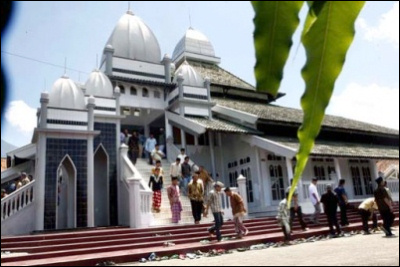
In the spotlight: People exit An-Nur Mosque, which belongs to the Ahmadiyah sect, after Friday prayer in Manis Lor village in Kuningan, West Java, on Friday.JP/R. Berto Wedhatama
An-Nur Mosque -JP/R. Berto Wedhatama
Reports are that Aang Hamid’s orders are in line with his promise made during his 2008 election campaign to hardliner extremists group. Some analysts also pointed out that religious extremist organization had pressurized him recently to take strict action and stop all Ahmadiyya activities in region.

Acting on orders Civil Order Police Chief tried to seal the Mosques on July 26, 2010, and met with some resistance from Ahmadiyya Muslims, who demanded a valid reason for closure of Mosques and dialogue to settle the issue. An NGO, Fahmina Institute, recorded the whole event. The Warrant and chronicle is reproduced below :-

Image of Warrant issued by Head of Kuningan Regent
Warrant by Regent of Kuningan
REGENT OF KUNINGAN
W  A   R   R  A  N  T
Number: 451.2/2065/SAT.POL.PP
Legal ground : 
1.
Law number 32 year 2004 article 27 clause 1 letter (c). That a head of district is responsible to keep the people safe and in order.
2.
Recommendation of Indonesian Cleric Council (MUI) of Kuningan Regency number 38/MUI-Kab/VI/2010 on June 24, 2010.
3.
Aspirations from Cleric and Islamic Organizations of Kuningan on June 1, 2010 at Syiarul Islam Mosque and on June 14, 2010 at Meeting Room of Jabar Banten Bank in Kuningan.
Name : 
H. AANG HAMID SUGANDA
Title : 
Regent of Kuningan
.
I N S T R U C T S :
Name : 
INDRA PURWANTORO, SAP
Civil Service ID : 
19670519 198603 1 002
Position/rank : 
Supervisor (IVa)
Title : 
Chief of Civil Order Police Unit of Kuningan
To : 
1.
Undertake the closure/sealing of eight Ahmadiyya function buildings in Manislor village, Jalaksana Sub district with provisions below:
Day/Date :
Monday/ July 26, 2010
Time :
09.00 am till it is finished
Place :
Manislor village, Jalaksana Sub district, Kuningan
2.
Have coordination with related security officers.
3.
Keep the tranquility and public order.
To be executed with a deep sense of responsibility.
Decided at :
KUNINGAN
Dated On :
July 23, 2010
REGENT OF KUNINGAN
H. AANG HAMID SUGANDA
Fahmina Institute - Cirebon

The Seal and Attack on Ahmadiyya Manis in Lor — Eyewitness Account
Editors :
Alimah and Maman Rohman on July 30, 2010
Location :
Manis Lor Village, Jalaksana, Kuningan
Date/Time :
Monday - Thursday (July 26-29, 2010)
Monday, July 26, 2010
Local government planned to seal the Ahmadiyya mosques at Manis Lor Village, Jalaksana District, Kuningan Regency. The process was backed by Satpol PP, Kuningan Regency Police Resort.
The operation failed after the Ahmadiyya Security Commission, Deden Sujana engaged in dialogue with the local government and Kuningan Police Resort officials. Deden indicated that this order to seal the Mosques was not to be executed immediately but there has to be a dialogue first between the local government and Ahmadiyya.
The order to seal Mosques relies on a Letter (SK) from Kuningan Regent Number 451.2/2065/Satpol PP which mentions that “Eight Mosques belongs to Ahmadiyya Jamaat are to be closed and sealed in Manis Lor Village”. This also relies on Majelis Ulama Indonesia’s recommendation Number 38/MUI-Kab/VI/2010 dated June 24, 2010.
A riot took place once but it was soon dispersed by Kuningan Police Resort.
Tuesday, July 27, 2010
Sector Police alongwith Police Resort of Kuningan Regency strictly guarded houses and Mosques belonging to Ahmadiyya Community in Manis Lor against anticipated attacks which failed earlier on Monday (7/26/2010).
Wednesday, July 28, 2010
Local authorities backed by Satpol PP made another attempt to seal the Ahmadiyya Mosque in Manis Lor.
According to one representative of Ahmadiyya Community, the seal was placed around 06.30am (GMT +07:00) but a Police representative from Kuningan Police Resort on patrol duty in Manis Lor denied and informed tha the seal could not be placed due to resistance from Ahmadiyya Jamaat who prevent and protect their Mosques.
Thursday, July 29, 2010
Massive attack on Ahmadiyya in Manis Lor.
Eyewitness Account of attack:
  • In the morning around 08.00 AM, the Muslims belonging to various factions of West Java (some of them were from outside of west java such as Wonosobo and other areas) conducted Istighosah (massive prayer) at Al-Huda Mosque, located about 500 meters from Ahmadiyya Mosque in Manis Lor.
  • About one hundred persons belonging to varioud factions, mostly radical Muslims, gathered in front of the Al-Huda Mosque. From their appearance and dresses they could be recognized and appeared to be affiliated with Majlis Mujahidin (mainly from Cirebon), GAMAS, GRANAT, FPI, some of male Santri from Islamic boarding schools (Pesantren) Kuningan, leader of Muslim (kyai), communities outside west java, and civilian around Kuningan.
  • Most of the Jamaa members alongwith Chairman of Police Resort and Regent were standing in front of the Al-Huda Mosque while hearing orations from Muslim cleric. Under the burning sun, with the fire spirit, they looked ready for one aim only i.e. to attack the Ahmadiyya’s. They called themselves as a ‘Jihad Team’. It was clear and evident, from the beginning, that GAMAS had organized and provoked the attack whose members, wearing black uniforms, were ready with their hitting weapon (stringer made from wood).
  • Istighosah started with a speech from clerics of Kuningan Regency. They belonged to Nahdlatul Ulama, Muhammadiyah, Indonesian Cleric Council (MUI) Kuningan Regency, Chairman of Police Resort and Kuningan Regent. Most of the speech was about denouncing the Ahmadiyya sectand wows to eliminate Ahmadiyya from the region. (According to Fahmina watch, the Istighosah appeared to be only for preparatins to attack Ahmadiyya as it was full with orations denouncing Ahmadiyya.)
  • Around 10.30am, Istighosah ended with prayers. Right after that the attack started by the Istighosah jamaa, who form the very beginning, has named themselves as Jihad Force on Ahmadiyya Jamaat.
  • The attack, conducted by Jihad Army, continued by pelting big stones, bricks and Acid Gas. The Police struggled to prevent the Jihad Army from crossing the border line that had been made earlier by Police but failed. Jihad Army succeeded in crossing the border line at 11.20am.
  • The Jihad Army suffered somr injuries due to stones coming from their members who were behind them as well as the stones thrown by the Ahmadiyya’s counter-attack defending themselves. Also there were some injuries from the Police Department.
  • By 12.00 O’clock, the Jihad Force was still pushing itsway to upside area where the Ahmadiyya gathered).
  • From 12.30 to 13.00 hrs half of the Jihad Force, calmed down by Police, was present upside while othef half got some rest and prayed at the Mosque. Some of them were standing in the middle of the road. After Police successfully ordered them to go downside, they still gathered at the downside re-grouping themselves to prepare for another attack.
  • At 13.11 hrs, the Jihad Force, which consisted of Majlis Mujahidin (MM) Cirebon, GAMAS and others, renewed their attacks twice. Although they almost broke the border-line defense of the Police but failed because the Police, by then, got reinforcements and a Mobile Brigade (Brimob) was moved behind the them.
  • Even though Police foiled the repeated attempts of Jihad Force, they did not disperse. They were still trying to empower themselves standing in front of the Mosque and listening orations from their coordinator. That continued till 17.30 hrs.
  • At 17.30 hrs they tryied to attack Ahmadiyya again and were now face to face with The Mobile Brigade Police which once again foiled their attempt.
According to Fahmina ‘what we heared during the watch, the conversation between some of the honorable person and Heads of Radical Muslims such as Majlis Mujahidin and FPI, that they will carry out another attack again on Friday (July 30, 2010). The attack will be carried out after Friday Prayers with more militants of Jihad Army.’ They said that the plan is a result of direct instructiond from Habib Riziq.


Thursday, August 5, 2010

Indonesian Government Needs Tough Action on Hard-Liners: Analysts

Jakarta Globe, Indonesia
Indonesia
Indonesian Government Needs Tough Action on Hard-Liners: Analysts
Nurfika Osman & Ulma Haryanto | August 05, 2010

Indonesia. Without strong sanctions by the state, hardline groups will continue to launch attacks against other religions, political analysts warned on Thursday.

Islamic scholar Azyumardi Azra said groups like the Islamic Defenders Front (FPI) and Betawi Brotherhood Forum (FBR) have become more powerful because they are not punished by the government.

“Until today, police have failed to take firm action against these groups,” he said.

Azyumardi’s statement came days after violent protesters attacked the mosques of Ahmadiyah (a minority Muslim sect) in Kuningan, West Java.

Weeks prior, several churches in West Java were shut down by local authorities, following protests by hardline groups.

“The law on community organizations does not specifically bar organizations from conducting violent acts. We need to amend the existing law,” Azyumardi said.

“The emergence of these kinds of groups are unintended consequences of democracy,” he added. “We are absolutely failing to enforce our laws.”

Similarly, Syamsuddin Haris, head of the Political Research Center at the Indonesian Institute of Sciences (LIPI), said that the government was being negligent when it failed to keep hardline groups in check.

“This government is trapped by its own negligence. It is failing to allow its own citizens to live in peace,” Syamsuddin said, acknowledging that dissolving hardline groups is not easy since they have the right to organize.

Edwin Partogi, head of the sociopolitics bureau at the Commission for Missing Persons and Victims of Violence (Kontras), said that if the state continues to turn a blind eye to simmering religious tensions, “this will prompt the birth of other such organizations that use threats and intimidations, in return for political favors.”

Such organizations, however, would never have thrived, much less existed, during the autocratic rule of the late former president Suharto, according to former left-leaning activist Syafiq Alielha. Suharto’s administration had the muscle to edge out any radical groups, he said.

“In Suharto’s time, people like [FPI leader] Habib Rizieq were not allowed in Indonesia. People like Habib were scared of the government,” Syafiq said. “The president would not have thought twice of jailing those kinds of people.”

Earlier, Syafi’i Anwar, executive director for the International Center for Islam and Pluralism, had said that the government’s inaction would only worsen the situation.

“The government has not done anything, even the House of Representatives, which is only concerned about its payroll. They leave people, like the Kuningan district head, to manipulate religious issues for the sake of politics,” Syafi’i said.

Kuningan district head Aang Hamid Suganda has been accused of ordering the closure of Ahmadiyah mosques to fulfill campaign promises made during the 2008 election.

He also said the Council of Ulema (MUI) are also accountable for the spread of Muslim radicalism.

“Their fatwas also make people intolerant. They never label violence as haram (forbidden),” he said.

Copyright 2010 The Jakarta Globe

Wednesday, August 4, 2010

Muslims ‘Prone’ to Radicalization

Jakarta Globe, Indonesia
Indonesia
August 04, 2010
Ulma Haryanto
Muslims ‘Prone’ to Radicalization
Indonesian Muslims are still vulnerable to being radicalized, according to a national survey by the Indonesian Survey Institute and Lazuardi Birru, an independent organization focused on combating extremism.

“We made an index of how Indonesian Muslims are vulnerable to being radicalized, and the highest factor contributing to their vulnerability is intolerance,” Dhyah Madya Ruth, who chairs Lazuardi Birru, told the Jakarta Globe on Tuesday.

The index puts susceptibility to radicalization at 54.95, with anything below 67 regarded as vulnerable, according to Lazuardi Birru. The information used to compile the index was taken from a focus group discussion involving 30 participants including government officials, civil society groups, terrorism experts and even former terrorists.

The survey, conducted from March 26 to April 6 across all 33 provinces, involved 1,320 randomly-selected respondents, the majority of whom were Muslims.

The radicalization vulnerability index, made available exclusively to the Jakarta Globe, is just one part of the wide-ranging survey. The rest of the data is still in the process of being analyzed.

Burhanuddin Muhtadi, a political analyst with the Indonesian Survey Institute (LSI) who managed the project, explained that the qualitative survey was meant to contribute to demographic profiling on what made people turn to extremism.

“From the survey, we found that intolerance on the part of respondents was the main factor used by radical groups to gain support,” he said.

The survey asked respondents about their religious and ideological views, particularly about groups they did not like.

“The highest was communism, followed by Jews and the third place went to Christians,” Burhanuddin said. “This shows how the New Order campaign to stigmatize communism worked so well in Indonesia.”

He added it could be concluded from the survey that most Muslims fell into a gray area: “Not resistant to radicalism or people who supported radical actions.”

The results have been released amid a recent spate of incidents in which hard-line Muslim groups have taken the law into their own hands, including the sealing of churches in West Java and the closure of mosques belonging to the Ahmadiyah sect.

Syafi’i Anwar, executive director for the International Center for Islam and Pluralism and who was consulted prior to the survey, told the Globe on Tuesday that the incidents of the past few months confirmed the survey’s results. “This is not the Indonesia I once knew,” he said.

“The government’s inaction only worsens this. They have not done anything — including the House, which is only concerned about its payroll — which leaves people like the Kuningan district head to manipulate religious issues for the sake of politics.”

Kuningan head Aang Hamid Suganda has been accused of ordering the closure of Ahmadiyah mosques to fulfill campaign promises made during the 2008 election.

Syafi’i also laid some blame with the Indonesian Council of Ulema (MUI) for turning a blind eye to radical Muslims. “Their fatwas also make people intolerant. Pluralism is haram. Ahmadiyah is haram. But they never label violence as haram,” he said.

At least 80 percent of the respondents also said they objected when the group they disliked spoke out in public, held parades or when a member of the group worked for the government. About 75 percent said members of such groups should be placed under special police surveillance and should be banned from teaching in public schools.

Noor Huda Ismail, an expert in extremism from the Institute for International Peace Building, agreed with the analysis of the survey, adding that intolerance was fueled by a fear of being victimized. “This includes by Christians, loosely connected to the Chinese minority,” he said. “This makes the majority insecure; the result being they restrict groups that are different to them from growing and moving forward.”

Lazuardi Birru’s Dhyah said economic disparity was another widely held excuse for intolerance. “People still think that Muslims are poor and non-Muslims are rich,” she said.

“The education and income level of people also determines how vulnerable they are to being radicalized, although, poor and low-educated people do not automatically become radicals. There needs to be a trigger. This is where jihad comes in.”

Ansyaad Mbai, head of the antiterror desk at the Coordinating Ministry for Political, Legal and Security Affairs, said a multifaceted approach to addressing terrorism was needed. “Terrorism is not only the government’s problem, society needs to be involved too,” he said.

Regarding the results of the radicalization survey, Ansyaad said more discussion was needed on the matter.

Copyright 2010 The Jakarta Globe

Tuesday, August 3, 2010

Indonesia Must End Oppression of Minority Sect: Human Rights Watch

Jakarta Globe, Indonesia
Indonesia
August 3, 2010
Ahmadiyah Muslims leave An-Nur Mosque after Friday prayers at Manis Lor village in Kuningan, West Java, Indonesia. Human Rights Watch say the government is failing to protect the sect from radical Islamists. (AP Photo/Achmad Ibrahim)
Indonesia Must End Oppression of Minority Sect: Human Rights Watch
Jakarta. Indonesia is letting radical Islamists trample the constitutional rights of minorities, leading to inter-communal violence, Human Rights Watch said on Tuesday.

The New York-based watchdog called on President Susilo Bambang Yudhoyono to repeal laws that it says have given extremists from the dominant religious group the legal space to launch violent attacks on people of other faiths and sects.

“When the Indonesian authorities sacrifice the rights of religious minorities to appease hard-line Islamist groups this simply causes more violence,” the group’s Asia director, Elaine Pearson, said in a statement.

Hundreds of Muslim extremists tried to attack a mosque belonging to the minority Ahmadiyah Islamic sect in Kuningan district of West Java province last week, resulting in clashes with police and the sect’s followers.

A government decree adopted in 2008 under pressure from Islamic conservatives bans the sect from spreading its faith, which includes the belief that its founder, Mirza Ghulam Ahmad, was the final Muslim prophet.

Orthodox Islam holds that Mohammed was the final prophet, leaving the Ahmadis open to charges of heresy and blasphemy which is punishable by up to five years in jail under a controversial 1965 law.

HRW called on the government to rescind such laws and said the failure of the police to arrest a single extremist over repeated attacks on the Ahmadis would only encourage more violence.

“While the police rightly stopped mobs from entering the mosque, their failure to arrest a single person will only embolden these groups to use violence again,” Pearson said.

Indonesia’s constitution explicitly guarantees freedom of religion and the country of some 240 million people, 80 percent of whom are Muslim, has ratified the International Covenant on Civil and Political Rights.

There have been growing calls for Yudhoyono to act against Islamic extremists who regularly attack civil society groups as well as minorities including Christians, “communists” and transvestites.

Agence France-Presse

Copyright 2010 The Jakarta Globe

Monday, August 2, 2010

Indonesia: End Policies Fueling Violence Against Religious Minority

Human Rights Watch

Indonesia: End Policies Fueling Violence Against Religious Minority
Rescind Laws That Oppress the Ahmadiyah Community
August 2, 2010
Indonesian officials have again reacted to official discrimination and vigilante violence against the Ahmadiyah by restricting their right to practice their religion. The government should show that it is serious about ending religious violence by holding those responsible to account.
Elaine Pearson, acting Asia director

(New York) - Indonesian authorities should end discriminatory policies against the Ahmadiyah religious community and investigate and prosecute anti-Ahmadiyah violence, Human Rights Watch said today. Human Rights Watch urged President Susilo Bambang Yudhoyono to revoke a local government order to close Ahmadiyah mosques and a repressive national decree against the Ahmadiyah community.

Since July 26, 2010, municipal police and hundreds of people organized by militant Islamist groups have made several attempts to force an Ahmadiyah mosque in Manis Lor village, Kuningan regency, West Java, to close, resulting in violence. The municipal police were acting on the orders of the regent of Kuningan to close the mosque. On July 29, the religious affairs minister, Suryadharma Ali, publicly stated that the Indonesian government would not tolerate violence in religious disputes, but he also warned that the Ahmadiyah followers “had better stop their activities” and said the police would enforce a 2008 decree barring them from spreading their faith.

“Indonesian officials have again reacted to official discrimination and vigilante violence against the Ahmadiyah by restricting their right to practice their religion,” said Elaine Pearson, acting Asia director at Human Rights Watch. “The government should show that it is serious about ending religious violence by holding those responsible to account.”

About two-thirds of Manis Lor’s approximately 4,500 residents are Ahmadiyah, making it the largest Ahmadiyah community in Indonesia. Ahmadiyah identify themselves as Muslims but differ with other Muslims about whether Muhammad was the “final” monotheist prophet; consequently, some Muslims perceive the Ahmadiyah as “heretics.”

A June 2008 national decree requires the Ahmadiyah community to “stop spreading interpretations and activities that deviate from the principal teachings of Islam,” including “spreading the belief that there is another prophet with his own teachings after Prophet Mohammed.” Violations of the decree can result in prison sentences of up to five years. Human Rights Watch has long called for the government to rescind this decree as it violates freedom of religion, recognized in various human rights treaties that Indonesia has ratified.

Aang Hamid Suganda, the regent of Kuningan, reportedly ordered the closure of eight Ahmadiyah mosques following a recommendation in June by the Indonesian Ulama Council, the country’s top Muslim clerical body. Suganda claimed that the Ahmadiyah’s religious activities had provoked conflict and that the closures were necessary to prevent the conflict from escalating.

On July 26, the municipal police - Satuan Polisi Pamong Praja, or Satpol-PP - acting on an executive order issued by Suganda, tried to close the An Nur mosque, where some of Manis Lor’s Ahmadiyah conduct religious services. The police withdrew after hundreds of Manis Lor residents blocked the street leading to the mosque.

On July 28, police and local government security officers again tried to seal the mosque. Ahmadiyah residents resisted by throwing rocks and sticks. Later, hundreds of protesters organized by militant Islamist organizations, including the Movement against Illegal Sects and Non-Believers (GAPAS), the Islam Defenders Front (FPI), the Indonesia Mujahidin Council (MMI), and the Islamic Community Forum (FUI) attempted to forcibly close the mosque. Police blocked the mob from reaching the mosque.

The next day, at least 300 protesters again tried to close down the mosque. About 600 officers, including Mobile Brigade police (Brimob) and public order officials, tried to block their advance, using tear gas, but were unsuccessful. Protesters briefly clashed with approximately 200 Ahmadiyah members. Minor injuries and some property damage were reported. Suganda then issued an ultimatum to the Ahmadiyah community, saying that he would order the municipal police to close the mosque if religious activities there did not cease two days before the beginning of the Islamic holy month of Ramadan, which starts on August 11.

West Java police reportedly deployed around 500 reinforcement officers from the anti-riot and Brimob units to the area in response to the violence. On July 30, the coordinating minister for political, legal and security affairs, Djoko Suyanto, called on the police to be “stern” in dealing with “anarchic action,” and reported that President Yudhoyono had asked him to make sure that the police are “strict” in doing so. To date however, the police have not arrested anyone in connection with the violence and intimidation.

“When the Indonesian authorities sacrifice the rights of religious minorities to appease hard-line Islamist groups this simply causes more violence, as in Manis Lor,” Pearson said. “While the police rightly stopped mobs from entering the mosque, their failure to arrest a single person will only embolden these groups to use violence again.”

Suganda, the Kuningan regent, has said that he and other community religious leaders will travel to Jakarta in August to press senior government officials to do more to carry out the June 2008 national decree.

Indonesia’s 1945 constitution explicitly guarantees freedom of religion in article 28(E). Under the International Covenant on Civil and Political Rights, which Indonesia ratified in 2006, states are to respect the right to freedom of religion. This includes freedom to have or to adopt a religion or belief of his choice, and freedom, either individually or in community with others and in public or private, to manifest his religion or belief in worship, observance, practice and teaching.” Members of religious minorities “shall not be denied the right, in community with other members of their group … to profess and practice their own religion.” Restrictions on the right to freedom of religion to protect public safety or order must be strictly necessary and proportional to the purpose being sought.

“Indonesia is obliged to prosecute those responsible for anti-Ahmadiyah violence and to repeal discriminatory laws and decrees, which militants rely on to justify their actions,” Pearson said. “These laws actively undermine religious freedom in Indonesia and jeopardize the safety of members of religious minorities.”

 
^ Top of Page