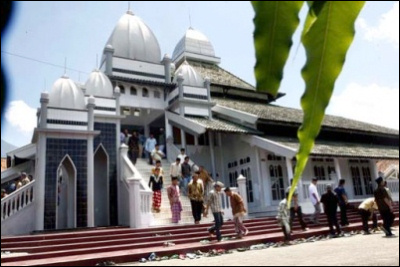
Showing posts with label anti-Ahmadiyah violence. Show all posts

Tuesday, April 19, 2011

Indonesia: Ensure Security in Religious Killings Trial

Human Rights Watch
Indonesia: Ensure Security in Religious Killings Trial
Fair Proceedings and Witness Protection Critical for Improving Minority Rights
April 19, 2011
A still shot from a video showing the assault of Ahmadiyah muslims by a group of assailants in Banten province in Western Java on Sunday, January 6. Source: Private
For the Cikeusik trial to be a step toward ending religious violence in Indonesia, the police need to ensure the security of everyone in the courtroom. Witnesses brave enough to testify, as well as judges and prosecutors, should not have to face intimidation.
Elaine Pearson, deputy Asia director at Human Rights Watch

UPDATE: The opening of the trial has now been postponed to April 26.

(New York) - Indonesian authorities should ensure the safety of all those attending the trial of 11 men charged in the deadly February 2011 attacks on the Ahmadiyah community in the village of Cikeusik in western Java, Human Rights Watch said today. Human Rights Watch said that the trial, which begins April 21, in Serang district, Banten province, can help reduce anti-Ahmadiyah violence in the country if it meets international fair trial standards and provides full protection for victims, witnesses, and court officials.

Longstanding impunity for religious violence in Indonesia has fostered larger and more brutal attacks by Islamist militants against religious minorities, and may have contributed to an April 15 suicide bombing of a police mosque in Cirebon, West Java province, Human Rights Watch said.

“For the Cikeusik trial to be a step toward ending religious violence in Indonesia, the police need to ensure the security of everyone in the courtroom,” said Elaine Pearson, deputy Asia director at Human Rights Watch. “Witnesses brave enough to testify, as well as judges and prosecutors, should not have to face intimidation.”

On February 6, a mob of about 1,500 people attacked 21 members of the Ahmadiyah religious community in Cikeusik, in Banten province, killing three people and seriously wounding five others. About 30 police officers were present but did little to stop the attack. A videographer recorded the violence, and the video was later posted by various individuals and organizations on YouTube. Since the attack, Ahmadiyah members in the village have found it difficult to return home due to tension and continued harassment from government officials and other villagers. Only an Ahmadiyah widow and her daughter remain in the village; others have moved to larger cities.

Few cases of violence against religious minorities reach trial in Indonesia, and such trials on Java, Indonesia’s majority-Muslim main island, have often been disrupted by Islamist militant threats and violence.

In a trial that began in January in Bogor district court regarding an October 2010 attack on an Ahmadiyah mosque in Cisalada village, more than 1,000 Islamist militants attended the hearings at times. Over the course of the trial, they threatened and harassed witnesses, judges, and prosecutors both in and outside the courtroom. On April 14, three defendants were found guilty of attacking the Ahmadiyah mosque and sentenced to prison terms of between four and six months; prosecutors had sought nine-month sentences.

In 2008, numerous activists from the Islamic Defender Front (FPI) attended the trial of an FPI member charged with violence at a June 2008 interfaith rally supporting the Ahmadiyah at the National Monument (Monas) in Jakarta. A witness said FPI members assaulted her outside the courtroom.

Human Rights Watch called on President Susilo Bambang Yudhoyono to review the increasing violence against religious and other minorities in Indonesia, and to revoke national and provincial decrees that ban Ahmadiyah practices. Over the past three years, there have been more than 180 anti-Ahmadiyah attacks, according to the Setara Institute, a nongovernmental group that monitors religious freedom.

A June 2008 national decree requires the Ahmadiyah to “stop spreading interpretations and activities that deviate from the principal teachings of Islam,” including “spreading the belief that there is another prophet with his own teachings after Prophet Muhammad.” Violations of the decree can result in prison sentences of up to five years.

The Ahmadiyah identify themselves as Muslims but differ with other Muslims as to whether Muhammad was the “final” monotheist prophet. Consequently, some Muslims perceive the Ahmadiyah as heretics.

On April 15, 2011, a suicide bomber, Mochamad Syarif, detonated a bomb at the mosque in the Cirebon police precinct, West Java, leaving 26 wounded. Syarif had been previously implicated in anti-Ahmadiyah attacks in Manis Lor, West Java, in July 2010, and harassing witnesses in a religious trial on blasphemy in Cirebon in 2010. Footage from Metro TV shows Syarif participating in demonstrations against the Ahmadiyah, banging on a vehicle holding the prosecutor and the blasphemy suspect, and attacking a police barricade at Manis Lor village.

“President Yudhoyono should rein in Islamist militants before they claim more lives, and that starts with revoking policies that promote religious intolerance,” Pearson said. “The government should be aggressively prosecuting all those responsible for scores of attacks against religious minorities in recent years.”

In a positive development, on February 16, the Nahdlatul Ulama, an independent Islamic organization, released a statement calling on all Muslims to respect the law and avoid religious violence.

Established in Indonesia in the 1920s, the Nahdlatul Ulama is one of the largest Islamic organizations worldwide. The statement says that “differences of religion and belief cannot be a justification to commit violent or arbitrary acts,” and urges the government “seriously fulfill its constitutional obligation to enforce the law and provide protection to all citizens regardless of religion or belief.”

“A major Muslim organization is telling the government to get serious about ending religious violence and protecting Indonesians of all beliefs,” Pearson said. “The government needs to start listening and taking action to prevent future crimes against minorities like the Cikeusik killings and Cirebon bombing.”

Wednesday, February 2, 2011

Indonesia: Protect Ahmadiyah Community From Violence

Human Rights Watch
Indonesia: Protect Ahmadiyah Community From Violence
Hate Crimes Against Religious Minorities a Troubling Trend
February 02, 2011

Indonesian police may have thought they were taking the Ahmadiyah out of harm's way, but they let the mob go on a rampage. The authorities need to send a message that hate crimes won't be tolerated by prosecuting those responsible.Elaine Pearson, deputy Asia director at Human Rights Watch
(New York) - Indonesian police should arrest those responsible for attacking an Ahmadiyah congregation in South Sulawesi province and protect vulnerable religious minorities throughout the country, Human Rights Watch said today.On January 28, 2011, police “evacuated” members of an Ahmadiyah congregation from their mosque in Makassar, the capital of South Sulawesi, amid increasingly threatening protests by members of a militant Islamist group, the Islamic Defenders Front (FPI). FPI militants then attacked the mosque, destroying property and breaking windows.

“Indonesian police may have thought they were taking the Ahmadiyah out of harm’s way, but they let the mob go on a rampage,” said Elaine Pearson, deputy Asia director at Human Rights Watch. “The authorities need to send a message that hate crimes won’t be tolerated by prosecuting those responsible.”

The attack on the Ahmadiyah community in South Sulawesi underscored a troubling trend in Indonesia, Human Rights Watch said. Religious extremists are harassing religious minorities, particularly members of the Ahmadiyah community, and law enforcement officials are failing to hold those responsible to account. The Setara Institute for Peace and Democracy, a Jakarta-based group working on religious freedom, recorded 50 cases of attacks in 2010 against the Ahmadiyah community.

In the Makassar attack, hundreds of FPI protesters first gathered on January 27 outside the mosque, where hundreds of Ahmadiyah were holding an annual prayer ceremony, the Jalzah Salanah. The mob demanded that they end the ceremony. Jamaluddin Feli, the Ahmadiyah imam in Makassar, told Human Rights Watch that the community tried to speed up the ceremony and that some members left the following morning.

When the mob returned at around 4 p.m. on January 28, members of the Ahmadiyah congregation barricaded themselves inside. At about 8 p.m., the South Sulawesi chief of police, Inspector General Johny Waenal Usman, arrived and asked the congregation members to evacuate the building for their safety. They initially refused, saying that it was their property, and held hands to prevent being removed. Police entered the mosque and pressured the Ahmadiyah to leave with them in trucks to the police station.

Feli said most of the congregation members agreed to leave and asked the police to guard the mosque from the protesters. As the main group of Ahmadiyah left, the protesters broke into the mosque and yelled at the remaining Ahmadi members to leave - some congregation members had remained in the center, hidden upstairs. By 10 p.m. all of the remaining Ahmadiyah members had left. The police provided no protection to the mosque and did not intervene when the mob smashed the windows, committed vandalism, seized financial records, and tore down religious placards.

The Indonesian authorities’ pattern of ineffectiveness reflects a political, legal, and social framework that propagates a culture of religious discrimination, Human Rights Watch said. Since August, Religious Affairs Minister Ali Suryadharma has repeatedly called for the Ahmadiyah faith to be banned in Indonesia. President Susilo BambangYudhoyono has failed to repudiate those statements, leading many to believe that he supports such an action.

In recent years Islamist militants have repeatedly attacked and burned Ahmadiyah homes and mosques. Anti-Ahmadiyah violence has increased since Yudhoyono announced a prohibition on teachings or public displays of the Ahmadiyah religion in June 2008.

In July 2010, municipal police and hundreds of people organized by militant Islamist groups forcibly tried to close an Ahmadiyah mosque in Manis Lor village. On October 1, mobs attacked the Ahmadiyah community in Cisalada, south of Jakarta, burning their mosque and several houses.

The Ahmadiyah faith was founded in what is now Pakistan in 1889 by Mirza Ghulam Ahmad. The Ahmadiyah community is banned in Pakistan and Saudi Arabia, and has come under attack in Bangladesh. There are approximately 200,000 Ahmadis in Indonesia.

The Ahmadiyah identify themselves as Muslims but differ with other Muslims as to whether Muhammad was the “final” monotheist prophet. Consequently, some Muslims perceive the Ahmadiyah as heretics.

Indonesian law facilitates discrimination against the Ahmadiyah. The June 2008 decree requires the Ahmadiyah to “stop spreading interpretations and activities that deviate from the principal teachings of Islam,” including “spreading the belief that there is another prophet with his own teachings after Prophet Muhammad.” Violations of the decree can result in prison sentences of up to five years. Human Rights Watch has consistently called for the government to rescind this decree, as it violates the right to freedom of religion. At the time of signing the decree, officials said it was necessary to help stop further violence.

“The 2008 decree has not stopped violence against the Ahmadiyah community, as officials said it would, but fueled further hatred and intolerance,” Pearson said.

Prohibiting the Ahmadiyah from practicing their religion also violates the International Covenant on Civil and Political Rights, ratified by Indonesia in 2006, which protects the right to freedom of religion and to engage in religious practice “either individually or in community with others and in public or private.” The treaty also protects the rights of minorities “to profess and practice their own religion.”

“The Makassar violence is not an isolated incident - time and again the police are ineffective in protecting religious minorities,” Pearson said. “Indonesia’s reputation as a rights-respecting country will suffer unless President Yudhoyono acts to end the violence against the Ahmadiyah and lifts the ban on their religious practices.”

Sunday, November 7, 2010

Indonesia: Obama Should Make a Stand for Human Rights

Human Rights Watch
Indonesia: Obama Should Make a Stand for Human Rights
Closer Ties Should Require Strengthening Accountability and Respect for Rights
November 7, 2010
Indonesia has made some good progress over the last decade, but that doesn’t mean President Obama should ignore other serious human rights problems. Obama should encourage Indonesia to take concrete measures to protect free expression and religious freedom, and to require accountability by the armed forces.
Sophie Richardson, acting Asia director at Human Rights Watch
(Jakarta) — US President Barack Obama’s visit to Indonesia on November 9 through 11, 2010, is an important opportunity to make a stand for free expression, religious freedom, and a rights-respecting, accountable military in Indonesia, Human Rights Watch said today.

During the visit, Obama and Indonesian President Susilo Bambang Yudhoyono are expected to discuss the US-Indonesia Comprehensive Partnership. The partnership addresses bilateral concerns including trade and investment, security and defense, education, health care, and energy, as well as transnational issues such as climate change and humanitarian relief. While Indonesia has made great strides on a number of human rights issues since it emerged from authoritarian rule nearly 12 years ago, serious challenges remain that could undermine Indonesia’s stability and democracy in the absence of real institutional reform, Human Rights Watch said.

“Indonesia has made some good progress over the last decade, but that doesn’t mean President Obama should ignore other serious human rights problems,” said Sophie Richardson, acting Asia director at Human Rights Watch. “Obama should encourage Indonesia to take concrete measures to protect free expression and religious freedom, and to require accountability by the armed forces.”

Indonesia has failed to show adequate respect for critical human rights such as freedom of expression and religion, Human Rights Watch said. In other areas where Indonesia has expressed a commitment to change, such as military reform, efforts have stalled. And although Indonesia has made some progress in combating corruption, graft remains a serious problem that impedes progress in fulfilling its human rights obligations.

A February 25 letter from Human Rights Watch to Obama highlighted a number of areas in which he should seek concrete human rights commitments from Yudhoyono. Human Rights Watch urged Obama to call for the release of the dozens of political prisoners, primarily from politically tense areas such as Papua and the Mollucas, imprisoned for engaging in nonviolent demonstrations, raising flags, and displaying pro-independence symbols.

Obama should also call for the repeal of laws that criminalize “insulting” public officials and defamation, which Indonesian authorities have used to silence anti-corruption activists, human rights defenders, and citizens who publicly aired consumer complaints or allegations of misconduct.

He should also call on the Indonesian government to take stronger efforts to protect members of religious minorities from discrimination and violence and to repeal dozens of laws that unfairly restrict the rights of women, discriminate against non-Muslims, and give the government the authority to prosecute people for holding religious beliefs it considers “blasphemous.” The religious affairs minister has repeatedly called for an outright ban of the Ahmadiyah, a minority who consider themselves Muslim but whom some other Muslims perceive to be heretics, and violence by Islamist militants against Ahmadi communities has increased.

“Media freedom has improved in Indonesia, but rights-respecting governments do not imprison people for peacefully airing critical views,” Richardson said. “Obama should also raise the plight of religious minorities and denounce laws that discriminate against women.”

Human Rights Watch urged Obama to call for Indonesia to restore free unhindered access for diplomats, foreign journalists, and human rights groups to the province of Papua, where the Indonesian military and police have frequently committed human rights abuses against civilians with impunity. In May 2009, the government closed the office of the International Committee of the Red Cross in Papua.

The release in October of a video showing the brutal torture of two Papuan men by Indonesian soldiers once again demonstrates the importance of ensuring effective prosecution of human rights violators, Human Rights Watch said. The government has promised to investigate, but Human Rights Watch emphasized that the trial should be open and transparent, charges should reflect the grievous level of torture inflicted, and those bearing command responsibility for these violations should also be prosecuted.

Human Rights Watch also reiterated its call for the government to revive a bill in the Indonesian parliament that would enable the government to prosecute members of the military who commit crimes against civilians before civilian courts, which offer better guarantees of an independent and effective remedy for the victims. Under the present system, such cases are usually handled by the military, with few cases ever making it to a tribunal. In the few cases that do, soldiers frequently face charges that do not reflect the scale of the abuse, and the trials lack transparency.

Human Rights Watch said that the US-Indonesia Comprehensive Partnership should address widespread corruption in the Indonesian bureaucracy and law enforcement system, which drains resources the government could be using to improve public services, including safeguarding the right to health. If, as US and Indonesian officials have suggested, the US intends to provide incentives for Indonesia to preserve its forests as a component of bilateral cooperation on climate change, Obama should press for those incentives to be linked to governance benchmarks, such as improving transparency and accountability in forestry data collection, Human Rights Watch said.

The decision of the Obama administration in July to lift a more than decade-long ban on US training and military assistance to Indonesia’s abusive Special Forces (Komando Pasukan Khusus, or Kopassus) has seriously compromised US commitment to promoting respect for human rights in Indonesia, Human Rights Watch said. Kopassus members also remain essentially unaccountable for past violations. At least 11 of 18 Kopassus soldiers that have been convicted by military tribunals for involvement in human rights abuses since 1998 are still serving in the military.

“The Obama administration has yet to realize that rewarding a military that has repeatedly thumbed its nose at accountability for serious human rights abuses is no way to encourage reform,” Richardson said. “This US government is essentially rewarding Kopassus for its intransigence and betraying Indonesians who have fought bravely for decades for accountability and justice.”

Kopassus was restricted from receiving US military training for over a decade as a result of its involvement in serious human rights abuses in East Timor, Aceh, and other areas. The US should require the following steps by Indonesia before engaging in any training or assistance activity:

  • Kopassus should permanently discharge personnel convicted of abuse.
  • Kopassus should commit to undertaking credible and impartial investigations of all future allegations of human rights abuse.
  • Yudhoyono should establish, and Kopassus should pledge to cooperate with, an ad hoc tribunal to investigate the enforced disappearance of student activists in the late 1990s, as recommended by Indonesia’s House of Representatives in October 2009.
Indonesia should also move forward on its commitments to become a party to the Convention on the Protection of All Persons from Enforced Disappearance to help prevent such abuses in the future.

On March 18, four prominent civil society organizations in Jakarta issued a statement calling on Obama to refrain from engaging further with Kopassus until the Indonesian military and government have acted on these three recommendations. Suciwati, the widow of slain human rights defender Munir Thalib, later said: “Indonesia has made much progress on the road to democracy and stability, but enhancing the reach of a powerful military force that lacks respect for the rule of law jeopardizes those hard-fought gains. Obama is rewarding Kopassus without requiring accountability. I fear that the Indonesian security services will again get away with murder.”

Thursday, November 4, 2010

Indonesia: Uphold Religious Freedom

Human Rights Watch
Indonesia: Uphold Religious Freedom
Cease Threats Against Ahmadiyah Community to Ban Their Religion
November 4, 2010
Soldiers walk past a burnt mosque owned by followers of the Ahmadiyah in Ciampea, a village in Indonesia's West Java province, on October 2, 2010. (c) 2010 Reuters
Soldiers walk past a burnt mosque owned by followers of the Ahmadiyah in Ciampea, a village in Indonesia's West Java province, on October 2, 2010.
© 2010 Reuters

(New York) - President Susilo Bambang Yudhoyono should uphold freedom of religion in Indonesia and repudiate statements by his religious affairs minister calling for the banning of the Ahmadiyah religion, Human Rights Watch said today in a letter to the Indonesian president.

Since August 2010, Religious Affairs Minister Ali Suryadharma has repeatedly called for the Ahmadiyah faith to be banned in Indonesia. President Yudhoyono has failed to repudiate those statements, leading many to believe that he supports such an action. In recent years Islamist militants have repeatedly attacked and burned Ahmadiyah homes and mosques. Anti-Ahmadiyah violence has increased since Yudhoyono announced a prohibition on teachings or public displays of the Ahmadiyah religion in June 2008.

“President Yudhoyono gave a nationwide speech about religious tolerance in the United States, but what will he tell visiting US President Barack Obama about the burned Ahmadiyah mosques in Indonesia?“ said Phil Robertson, deputy Asia director at Human Rights Watch. “Yudhoyono should take clear steps to protect religious freedom, starting with loudly rejecting any ban on the Ahmadis, and ensuring that those responsible for attacks on Ahmadiyah homes and mosques are prosecuted.”

The Setara Institute for Peace and Democracy, a human rights group in Jakarta, recorded 33 cases of attacks in 2009 against the Ahmadiyah community. In late July, municipal police and hundreds of people organized by militant Islamist groups forcibly tried to close an Ahmadiyah mosque in Manis Lor village. On October 1, mobs attacked the Ahmadiyah community in Cisalada, south of Jakarta, burning their mosque and several houses; a Quran inside the mosque was accidently burned.

The Ahmadiyah identify themselves as Muslims but differ with other Muslims as to whether Muhammad was the “final” monotheist prophet. Consequently, some Muslims perceive the Ahmadiyah as heretics. Current Indonesian law facilitates discrimination against the Ahmadiyah. The June 2008 decree requires the Ahmadiyah to “stop spreading interpretations and activities that deviate from the principal teachings of Islam,” including “spreading the belief that there is another prophet with his own teachings after Prophet Muhammad.” Violations of the decree can result in prison sentences of up to five years. Human Rights Watch has consistently called for the government to rescind this decree, as it violates the right to freedom of religion.

A ban against the Ahmadiyah would violate guarantees of freedom of religion in articles 28 and 29 of the Indonesian constitution. Prohibiting the Ahmadiyah from practicing their religion also violates the International Covenant on Civil and Political Rights, ratified by Indonesia in February 2006, which protects the right to freedom of religion and to engage in religious practice “either individually or in community with others and in public or private.” The treaty also protects the rights of minorities “to profess and practice their own religion.”

“President Yudhoyono should order Minister Suryadharma to stop playing with fire with his demands to ban the Ahmadiyah,” Robertson said. “Formalizing religious discrimination increases the vulnerability of Ahmadiyah and opens the door for further attacks and wider communal violence. This is hardly the recipe for promoting Indonesia as a modern, rights-respecting state.”

Background

The Ahmadiyah faith was founded in what is now Pakistan in 1889 by Mirza Ghulam Ahmad. The Ahmadiyah community is banned in Pakistan and Saudi Arabia, and has come under attack in Bangladesh. There are approximately 200,000 Ahmadis in Indonesia.

The Ahmadiyah have come under increasing attack since a July 2005 edict from Indonesia’s Council of Ulemas, a senior body of Islamic clerics, saying the Ahmadiyahs were deviating from Quranic teaching regarding the final prophet. Following the edict, Islamist groups attacked the Ahmadiyah headquarters near Bogor, and assaults on Ahmadiyah members were also reported in Lombok Timur, Manis Lor, Tasikmalaya, Parung, Garut, Ciaruteun, and Sadasari. Attacks on the Ahmadiyah community continued in 2006, forcing hundreds of Ahmadis to flee to a refugee camp in Lombok after mobs destroyed their homes and mosques. Some Ahmadis asked for political asylum at consulates in Bali.

In December 2007, mobs attacked Ahmadis, their mosques, and their homes in Kuningan, West Java. On April 16, 2008, Indonesia’s Coordinating Board for Monitoring Mystical Beliefs in Society (Bakor Pakem) recommended banning the Ahmadiyah faith. Moderate Muslim leaders, including former president Abdurrahman Wahid and civil rights activists, responded by rallying support for the Ahmadiyah and the principle of religious freedom.

More than 200 people signed a petition on May 10, 2008, saying the government should be protecting the Ahmadiyah from attack. The signatories included many Muslim scholars, Catholic priests, Protestant preachers, Confucianists, Buddhists, Hindus, poets, writers, and human rights campaigners. Yet the following month, the Religious Affairs and Home Affairs ministries, and the Attorney General’s Office, issued the discriminatory decree restricting the right of Ahmadis to publicly practice their faith.

The violence in Manis Lor, Kuningan regency, West Java, the largest Ahmadiyah community in Indonesia, followed an order by a local government official to close an Ahmadiyah mosque. On July 28 and 29, 2010, hundreds of protesters organized by militant Islamist groups forcibly tried to close the mosque. Minister Suryadharma responded by announcing that while the Indonesian government would not tolerate violence in religious disputes, the police would enforce the 2008 decree and warned that the Ahmadiyah “had better stop their activities.”

On August 31, Suryadharma again blamed the Ahmadiyah instead of their attackers for the recent instances of anti-Ahmadiyah violence, saying that he believed that the incidents were consequences of the failure of the Ahmadiyah to adhere to the decree. He later added in news reports that, “To ban [the Ahmadiyah] is far better than to let them be. … To outlaw them would mean that we are working hard to stop deviant acts from continuing.”

Wednesday, November 3, 2010

Indonesia: Guarantee Freedom of Religion and Stop Attacks on Ahmadiyah

Human Rights Watch
Indonesia: Guarantee Freedom of Religion and Stop Attacks on Ahmadiyah
Letter to President Susilo Bambang Yudhoyono
November 3, 2010

President Susilo Bambang Yudhoyono
Merdeka Palace
Jl. Medan Merdeka Utara
Jakarta 10010
Indonesia

Re: Persecution of the Ahmadiyah Community

Dear Mr. President,

We write to raise serious concerns about the continued persecution of members of the Ahmadiyah community in Indonesia. Recent public statements by Minister of Religious Affairs Suryadharma Ali, stating that he plans to officially ban the Ahmadiyah religion, would increase the likelihood of renewed communal violence towards religious minorities. We call on you to publicly repudiate those statements and intervene to ensure the Ahmadis enjoy the right to practice their religion without fear of government interference. We also urge you to rescind the discriminatory decree issued in 2008 by the Religious Affairs and Home Affairs Ministries, and the Attorney General’s Office, restricting the right of Ahmadis to publicly practice their faith.

A ban against the Ahmadiyah would violate guarantees of freedom of religion in Articles 28 and 29 of the constitution of Indonesia. Prohibiting the Ahmadiyah from practicing their religion also violates the International Covenant on Civil and Political Rights, ratified by Indonesia in February 2006. By ratifying that convention, Indonesia agreed to comply with all the provisions of that treaty, including that, “Everyone shall have the right to freedom of thought, conscience and religion. This right shall include freedom to have or to adopt a religion or belief of his choice, and freedom, either individually or in community with others and in public or private, to manifest his religion or belief in worship, observance, practice and teaching” (Article 18(1)), and “persons belonging to … minorities shall not be denied the right, in community with the other members of their group, to enjoy their own culture, to profess and practice their own religion” (Article 27).

Minister Suryadharma’s claim that banning the Ahmadiyah religion would somehow protect its members from attack is wrong. If anything, actions to restrict the rights of the Ahmadiyah have made them more vulnerable to attacks and given encouragement to Islamist militant groups who target them. The Setara Institute for Peace and Democracy, a human rights group in Jakarta, recorded 33 cases of attacks against Ahmadiyah taking places in 2009. Separately, Setara recorded 28 attacks against Christian churches this year. It is increasing significantly compared with 18 church incidents in 2009 and 17 in 2008.

The attacks against the Ahmadiyah have intensified ever since a July 2005 edict issued by the Indonesian Council of Ulemas declaring the Ahmadis were deviating from Koranic teaching. In 2006, Islamist militant groups attacked the Ahmadiyah headquarters near Bogor, and assaults on Ahmadiyah members were also reported on Lombok Island as well as in western Java, including in Manis Lor, Tasikmalaya, Parung, Garut, Ciaruteun, and Sadasari. In December 2007, mobs attacked Ahmadiyah mosques and their homes in Kuningan.

On April 16, 2008, Indonesia’s Coordinating Board for Monitoring Mystical Beliefs in Society (Bakor Pakem) recommended banning the Ahmadiyah faith. Two months later, on June 9, 2008, your government finally outlawed public teaching of Ahmadiyah beliefs by ordering the Ahmadiyah community to “stop spreading interpretations and activities which deviate from the principal teachings of Islam,” including “the spreading of the belief that there is another prophet with his own teachings after Prophet Mohammed.” Violations of the decree are subject to up to five years of imprisonment.

Human Rights Watch immediately called on the Indonesian government to reverse that decree, arguing that it will open up more attacks against the more than 200,000 Ahmadis in Indonesia and endanger their livelihoods. Our concerns unfortunately were realized when this prediction turned out to be correct. Unfortunately, your government and security forces have done little to either prevent these attacks or apprehend those committing these violent crimes.

In late July 2010, municipal police and hundreds of people organized by militant Islamist groups have made several attempts to close an Ahmadiyah mosque in Manis Lor village, resulting in violence. On October 1, 2010, mobs attacked the Ahmadiyah community in Cisalada, south of Jakarta, burning their mosque and several houses; the attackers also burned the Quran found inside the mosque.

We write to inquire why your government failed to act to investigate and prosecute those who burned the Ahmadiyah mosque in Cisalada, and what it is doing to prevent similar attacks against the Ahmadiyah in the future. We are deeply concerned that your government is pursuing a policy to ban Ahmadiyah that increases the likelihood that militants-taking encouragement from your government’s failure to offer protection to the Ahmadis-will further target their mosques.

The Indonesian government should stand up for religious tolerance instead of persecuting the Ahmadiyah for their religious views, and should make it clear that as a matter of policy, all Indonesians will be protected in their religious beliefs. We make the following recommendations to your government:
  • Publicly repudiate Minister of Religious Affairs Suryadharma Ali’s call to ban the Ahmadiyah religion;
  • Revoke the June 2008 decree on the Ahmadiyah, which has increased the vulnerability of Ahmadiyah communities to attacks against their mosques and villages;
  • Conduct prompt and impartial investigations into all threats and attacks against the Ahmadiyah and prosecute all those responsible for attacking Ahmadiyah mosques and houses; investigate Chep Hernawan, the leader of the Gerakan Reformis Islam, who openly admitted that he was responsible for the attacks in September 2005 in Sukadana, as well as Muhammad Izzi, who openly called on Muslims on Lombok Island to attack the Ahmadiyah village in Ketapang in February 2006;
  • Direct the Ministry of Home Affairs to review and strike down all government bylaws used to persecute the Ahmadiyah faith, including a local decree issued by the Kuningan regent, who had twice sealed an Ahmadiyah mosque and threatened to close it down in Manis Lor;
  • Direct provincial officials and the police to provide effective protection to all Ahmadiyah mosques and villages throughout Indonesia, particularly in West Java, which hosts Indonesia’s largest Ahmadiyah community;
  • Direct the governor of West Nusa Tenggara to allow Ahmadis who are now stranded in a refugee camp in Mataram, Lombok Island, to return to their houses in the Ketapang area; repudiate the governor’s plan to move the Ahmadis into an empty island near Lombok Island;
  • Raise protection of the Ahmadiyah as an important issue with President Barack Obama during his visit to Jakarta on November 9-10;
  • Request Komnas HAM, the national human rights commission of Indonesia, to conduct a thorough investigation of all attacks against the Ahmadiyah since the implementation of the June 2008 decree and provide additional recommendations.
Thank you for your consideration. I look forward to discussing these issues with you or appropriate members of your staff at your earliest convenience.

Sincerely,

Phil Robertson
Deputy Director, Asia Division

Tuesday, August 10, 2010

Indonesia: Orders to close Ahmadiyya Mosque in Manis Lor and attacks by extremists

Manis Lor is a small village, located 45KM south of Cirebon city in Kuningan Regency, with a population of approximately 4,350 out of which 3,000 (70%) are Ahmadis. They have one big and seven small Mosques in Village.

H. Aang Hamid Suganda, Head of Kuningan Regent, vide Warrant Number: 451.2/2065/SAT.POL.PP dated July 22, 2010, ordered Civil Order Police Chief Indra Purwantoro to close and seal all eight Mosques belonging to Ahmadiyah Muslim sect in Manis Lor. This order is in clear violation of constitution, which guarantees freedom of worship to all its citizens.
In the spotlight: People exit An-Nur Mosque, which belongs to the Ahmadiyah sect, after Friday prayer in Manis Lor village in Kuningan, West Java, on Friday.JP/R. Berto Wedhatama

In the spotlight: People exit An-Nur Mosque, which belongs to the Ahmadiyah sect, after Friday prayer in Manis Lor village in Kuningan, West Java, on Friday.JP/R. Berto Wedhatama
An-Nur Mosque -JP/R. Berto Wedhatama
Reports are that Aang Hamid’s orders are in line with his promise made during his 2008 election campaign to hardliner extremists group. Some analysts also pointed out that religious extremist organization had pressurized him recently to take strict action and stop all Ahmadiyya activities in region.

Acting on orders Civil Order Police Chief tried to seal the Mosques on July 26, 2010, and met with some resistance from Ahmadiyya Muslims, who demanded a valid reason for closure of Mosques and dialogue to settle the issue. An NGO, Fahmina Institute, recorded the whole event. The Warrant and chronicle is reproduced below :-

Image of Warrant issued by Head of Kuningan Regent
Warrant by Regent of Kuningan
REGENT OF KUNINGAN
W  A   R   R  A  N  T
Number: 451.2/2065/SAT.POL.PP
Legal ground : 
1.
Law number 32 year 2004 article 27 clause 1 letter (c). That a head of district is responsible to keep the people safe and in order.
2.
Recommendation of Indonesian Cleric Council (MUI) of Kuningan Regency number 38/MUI-Kab/VI/2010 on June 24, 2010.
3.
Aspirations from Cleric and Islamic Organizations of Kuningan on June 1, 2010 at Syiarul Islam Mosque and on June 14, 2010 at Meeting Room of Jabar Banten Bank in Kuningan.
Name : 
H. AANG HAMID SUGANDA
Title : 
Regent of Kuningan
.
I N S T R U C T S :
Name : 
INDRA PURWANTORO, SAP
Civil Service ID : 
19670519 198603 1 002
Position/rank : 
Supervisor (IVa)
Title : 
Chief of Civil Order Police Unit of Kuningan
To : 
1.
Undertake the closure/sealing of eight Ahmadiyya function buildings in Manislor village, Jalaksana Sub district with provisions below:
Day/Date :
Monday/ July 26, 2010
Time :
09.00 am till it is finished
Place :
Manislor village, Jalaksana Sub district, Kuningan
2.
Have coordination with related security officers.
3.
Keep the tranquility and public order.
To be executed with a deep sense of responsibility.
Decided at :
KUNINGAN
Dated On :
July 23, 2010
REGENT OF KUNINGAN
H. AANG HAMID SUGANDA
Fahmina Institute - Cirebon

The Seal and Attack on Ahmadiyya Manis in Lor — Eyewitness Account
Editors :
Alimah and Maman Rohman on July 30, 2010
Location :
Manis Lor Village, Jalaksana, Kuningan
Date/Time :
Monday - Thursday (July 26-29, 2010)
Monday, July 26, 2010
Local government planned to seal the Ahmadiyya mosques at Manis Lor Village, Jalaksana District, Kuningan Regency. The process was backed by Satpol PP, Kuningan Regency Police Resort.
The operation failed after the Ahmadiyya Security Commission, Deden Sujana engaged in dialogue with the local government and Kuningan Police Resort officials. Deden indicated that this order to seal the Mosques was not to be executed immediately but there has to be a dialogue first between the local government and Ahmadiyya.
The order to seal Mosques relies on a Letter (SK) from Kuningan Regent Number 451.2/2065/Satpol PP which mentions that “Eight Mosques belongs to Ahmadiyya Jamaat are to be closed and sealed in Manis Lor Village”. This also relies on Majelis Ulama Indonesia’s recommendation Number 38/MUI-Kab/VI/2010 dated June 24, 2010.
A riot took place once but it was soon dispersed by Kuningan Police Resort.
Tuesday, July 27, 2010
Sector Police alongwith Police Resort of Kuningan Regency strictly guarded houses and Mosques belonging to Ahmadiyya Community in Manis Lor against anticipated attacks which failed earlier on Monday (7/26/2010).
Wednesday, July 28, 2010
Local authorities backed by Satpol PP made another attempt to seal the Ahmadiyya Mosque in Manis Lor.
According to one representative of Ahmadiyya Community, the seal was placed around 06.30am (GMT +07:00) but a Police representative from Kuningan Police Resort on patrol duty in Manis Lor denied and informed tha the seal could not be placed due to resistance from Ahmadiyya Jamaat who prevent and protect their Mosques.
Thursday, July 29, 2010
Massive attack on Ahmadiyya in Manis Lor.
Eyewitness Account of attack:
  • In the morning around 08.00 AM, the Muslims belonging to various factions of West Java (some of them were from outside of west java such as Wonosobo and other areas) conducted Istighosah (massive prayer) at Al-Huda Mosque, located about 500 meters from Ahmadiyya Mosque in Manis Lor.
  • About one hundred persons belonging to varioud factions, mostly radical Muslims, gathered in front of the Al-Huda Mosque. From their appearance and dresses they could be recognized and appeared to be affiliated with Majlis Mujahidin (mainly from Cirebon), GAMAS, GRANAT, FPI, some of male Santri from Islamic boarding schools (Pesantren) Kuningan, leader of Muslim (kyai), communities outside west java, and civilian around Kuningan.
  • Most of the Jamaa members alongwith Chairman of Police Resort and Regent were standing in front of the Al-Huda Mosque while hearing orations from Muslim cleric. Under the burning sun, with the fire spirit, they looked ready for one aim only i.e. to attack the Ahmadiyya’s. They called themselves as a ‘Jihad Team’. It was clear and evident, from the beginning, that GAMAS had organized and provoked the attack whose members, wearing black uniforms, were ready with their hitting weapon (stringer made from wood).
  • Istighosah started with a speech from clerics of Kuningan Regency. They belonged to Nahdlatul Ulama, Muhammadiyah, Indonesian Cleric Council (MUI) Kuningan Regency, Chairman of Police Resort and Kuningan Regent. Most of the speech was about denouncing the Ahmadiyya sectand wows to eliminate Ahmadiyya from the region. (According to Fahmina watch, the Istighosah appeared to be only for preparatins to attack Ahmadiyya as it was full with orations denouncing Ahmadiyya.)
  • Around 10.30am, Istighosah ended with prayers. Right after that the attack started by the Istighosah jamaa, who form the very beginning, has named themselves as Jihad Force on Ahmadiyya Jamaat.
  • The attack, conducted by Jihad Army, continued by pelting big stones, bricks and Acid Gas. The Police struggled to prevent the Jihad Army from crossing the border line that had been made earlier by Police but failed. Jihad Army succeeded in crossing the border line at 11.20am.
  • The Jihad Army suffered somr injuries due to stones coming from their members who were behind them as well as the stones thrown by the Ahmadiyya’s counter-attack defending themselves. Also there were some injuries from the Police Department.
  • By 12.00 O’clock, the Jihad Force was still pushing itsway to upside area where the Ahmadiyya gathered).
  • From 12.30 to 13.00 hrs half of the Jihad Force, calmed down by Police, was present upside while othef half got some rest and prayed at the Mosque. Some of them were standing in the middle of the road. After Police successfully ordered them to go downside, they still gathered at the downside re-grouping themselves to prepare for another attack.
  • At 13.11 hrs, the Jihad Force, which consisted of Majlis Mujahidin (MM) Cirebon, GAMAS and others, renewed their attacks twice. Although they almost broke the border-line defense of the Police but failed because the Police, by then, got reinforcements and a Mobile Brigade (Brimob) was moved behind the them.
  • Even though Police foiled the repeated attempts of Jihad Force, they did not disperse. They were still trying to empower themselves standing in front of the Mosque and listening orations from their coordinator. That continued till 17.30 hrs.
  • At 17.30 hrs they tryied to attack Ahmadiyya again and were now face to face with The Mobile Brigade Police which once again foiled their attempt.
According to Fahmina ‘what we heared during the watch, the conversation between some of the honorable person and Heads of Radical Muslims such as Majlis Mujahidin and FPI, that they will carry out another attack again on Friday (July 30, 2010). The attack will be carried out after Friday Prayers with more militants of Jihad Army.’ They said that the plan is a result of direct instructiond from Habib Riziq.

Friday, August 6, 2010

Intimidation Picks Up Ahead of Holy Month

Jakarta Globe, Indonesia
Indonesia
Intimidation Picks Up Ahead of Holy Month
Nivell Rayda,Ulma Haryanto & Armando Siahaan | August 06, 2010

Indonesia. As Muslims nationwide count down the days until the start of the holy month of Ramadan, so are followers of Ahmadiyah, but for a very different reason.

Members of the controversial sect are currently living in fear of a repeat attack by hard-liners in the lead-up to Ramadan, one member told the Jakarta Globe on Thursday.

“We have received numerous text messages and there are also public statements released by the FPI demanding that we shut down our activities at least two days before Ramadan, or face the consequences,” Firdaus Mubarik said, referring to the Islamic Defenders Front.

“We’re afraid that they’ll launch an attack against Ahmadiyah mosques and members.

“This has occurred before. This happens in every major city across the country. They conduct raids against us and our mosques right before Ramadan each year.”

Ramadan is expected to begin on Wednesday.

Violent scenes erupted last week at Manis Lor village in Kuningan, West Java, when police and public order officers sealed off Ahmadiyah mosques in the area.

The closures, however, were met with resistance from members of the sect, with protesters blocking attempts to shut down the mosques. But a number of hard-line Muslim groups soon flocked to the village and scuffles quickly broke out.

Dedeh, a resident of Manis Lor, said villagers had boarded up their windows to protect them from stones being thrown by protesters.

But according to Dedeh, last week’s clashes were relatively minor compared to the violence experienced there last year and in 2007 because of the issue.

The National Commission for Missing Persons and Victims of Violence (Kontras) alleged that the forcible closure of the Ahmadiyah mosques was the result of political intervention, as it had been ordered by Kuningan district head Aang Hamid Suganda.

According to the official letter ordering the closures, a copy of which was obtained by the Globe, several clerics and Muslim groups had requested the action be taken.

Officials from the Kuningan district administration had met with the clerics on June 1 at Syiarul Islam Mosque in Kuningan, and again on June 14 at the Kuningan branch of Bank Jabar-Banten, the document suggested.

According to Alimah, a researcher from the Fahmina Institute, a religious study group that witnessed last week’s attacks, most of the instigators of the violence were not even locals.

“The residents of Manis Lor themselves were never bothered with the presence of Ahmadiyah in their village,” Alimah told the Globe.

“I saw from the clothes that they were wearing that the attackers were from Gamas [Anti-Sinners Movement] and the FPI. Most came from Cirebon and even Wonosobo in Central Java.”

The hard-liners, Alimah said, carried planks of wood, knives and slingshots.

“They were throwing rocks, targeting not just the mosque but also homes of Ahmadiyah members near the mosque,” she said.

The government in 2008 put limits on Ahmadiyah followers practicing their faith in public, but stopped short of banning the sect that hard-liners deem deviant.

Ahmadiyah recognizes the sect’s founder, Mirza Ghulam Ahmad, as a prophet, contradicting orthodox Islamic belief that Muhammad was the last prophet.

Separately, Franz Magnis Suseno, a prominent sociologist and political analyst, said religious institutions might have the right to declare the Ahmadiyah sect as deviant, but its members still deserved to live in peace.

“It’s the government’s utmost responsibility to provide protection to the attacked group,” the Jesuit priest said. “The president and his ministers related to this predicament have so far failed to do their job. The president has been very unclear about this situation. He has no bravery.”

Meanwhile, Said Aqil Siradj, chairman of Nahdlatul Ulama, the country’s largest Islamic organization, said extremist groups had misinterpreted the religion.

“People think that these acts are Islamic. They’re not,” he said. “Although their understanding of the matter is wrong, these groups strongly believe that they are right and their religion is the most important one. So they’re willing to die [for their beliefs].”

Said Aqil said NU and 11 other Islamic organizations were determined to fight against grassroots radicalism.

Pressure from hard-line Islamic groups has also been felt in Bekasi, where Mayor Mochtar Mohammad on June 13 signed an agreement with FPI Bekasi frontman Murhali Barda to address four points, including the removal of the “Tiga Mojang” statue, which they deemed offensive, and the closure of the HKBP Pondok Timur Indah Church.

Bekasi administration spokesman Endang Suharyadi confirmed the church closure was part of the June 13 demands.

Copyright 2010 The Jakarta Globe

Thursday, August 5, 2010

My Jakarta: Zafrullah Ahmad Pontoh, Ahmadiyah Indonesia Spokesman

Jakarta Globe, Indonesia
Indonesia
My Jakarta: Zafrullah Ahmad Pontoh, Ahmadiyah Indonesia Spokesman
Zack Petersen | August 05, 2010
Zafrullah Ahmad Pontoh says that as a member of Ahmadiyah, he fears for his life, but that ultimately he is under God's protection. (JG Photo)
Zafrullah Ahmad Pontoh says that as a member of Ahmadiyah, he fears for his life, but that ultimately he is under God’s protection. (JG Photo)
.
While most of the violence that has affected Ahmadiyah — a controversial sect that believes its founder was a prophet of Islam, a claim that contradicts the beliefs of mainstream Muslims — remains outside the capital, that doesn’t mean the nearly 10,000 members of Ahmadiyah here in Jakarta don’t feel intimidated.
Today, Zafrullah Ahmad Pontoh, the spokesman for Ahmadiyah Indonesia, talks to us from his mosque in Cideng, Central Jakarta, about the controversial attempts to close an Ahmadiyah mosque in West Java and his views on religious freedom.


What is the difference between Ahmadiyah and mainstream Islam here in Indonesia?

According to us, we are Sunnis because we understand that we follow the traditions of the holy prophet.

What differs between us and other Muslims is the interpretation of some of the verses of the holy Koran.

So in the Koran, as we understand it, there is the possibility of the coming of a prophet after the holy prophet of Islam.

What do you say to people who think members of Ahmadiyah are nonbelievers?

They are free to say that. But we believe that God accepts us as Muslims. Anyone can say anything they like.

We won’t say that they are nonbelievers because the holy prophet said that if you call a believer a nonbeliever, then you yourself are the nonbeliever.

Do you introduce yourself to people as a member of Ahmadiyah?

Yes. I just came from Sulawesi and most of my friends are not Ahmadiyah [members], but they saw the attacks in Kuningan and they said: “What kind of people would do this?”

You see, they don’t like this violence either.

Why were the people in Kuningan attacked?

What I understand is that the bupati [district chief] of Kuningan wished to close the mosque.

I understand that some people from outside Kuningan wanted the mosque closed. We had about 4,000 Ahmadiyah members there to protect the mosque in Manis Lor village.

And how do you feel about the church controversy in Bekasi?

Yesterday, I was at the House of Representatives. We are trying to gain religious freedom through dialogue not only for Ahmadiyah, but for all Indonesians.

Because Islam teaches us to live in harmony with others, and never to resort to violence.

The holy prophet never attacked nonbelievers first, he only defended and protected himself and Muslims. Islam is never spread by the sword.

How many Ahmadiyah members are there in Jakarta?

There are seven Ahmadiyah mosques here in Jakarta and around 10,000 Ahmadiyah members. Throughout Indonesia there are 500,000 Ahmadiyah members.

Do you ever fear for your safety?

As a human being, yes, but I still believe in the protection of God. I have no problem walking around the neighborhood here. I was out walking around before you came here.

Has there ever been an attack on this mosque?

The mosque has been here more than 70 years, and in 2006 some Muslims came and asked us to take down the name of the mosque, but I didn’t.

We have been trying to learn patience and love, but as human beings we have limitations, so to be patient is very hard.

I said: “Nobody can stop us from worshiping, God wants us to worship.” Nobody can tell us to stop doing what God wants us to do.

When there are clashes between Ahmadiyah and other Muslim groups, do you feel like the government gives you equal protection?

First, I should clarify that they are not clashes, but attacks. A clash means that there are two sides [fighting], but an attack is where we have to defend ourselves.

The Constitution gives freedom to every person to be a follower of any religion.

But it has to be one of the six official religions?

Yes, but we are Muslims.

Do you think that Ahmadiyah will ever be fully accepted and recognized in Indonesia?

Inshallah [God willing]. We always intermingle with people through love and I feel like love will overcome. Last year, nearly 1,000 people joined Ahmadiyah. You would be surprised how many people click on our Web site, www.alislam.org.

Didn’t the state come up with a law that said Ahmadiyah members are not allowed to worship in public?

Not a law made by the state, but there is a decree. I heard from some people that the current religious affairs minister said Ahmadiyah is straying from Islam.

He should not say that; he should understand how to protect our faith. But I believe he misunderstands the 2008 decree.

That decree only prohibits us from explaining publicly that there is a prophet after the Prophet Muhammad.

Isn’t that a violation of your religious freedoms?

Yes, but our leader said for the time being we should be quiet.

What would you say to the people who passed the decree?

I would tell them they are doing something different from the laws of the country. The decree says that we believe in the prophet, but it also hinders us.

Copyright 2010 The Jakarta Globe
URL: www.thejakartaglobe.com/myjakarta/my-jakarta-zafrullah-ahmad-pontoh-ahmadiyah-indonesia-spokesman/389673

Indonesian Government Needs Tough Action on Hard-Liners: Analysts

Jakarta Globe, Indonesia
Indonesia
Indonesian Government Needs Tough Action on Hard-Liners: Analysts
Nurfika Osman & Ulma Haryanto | August 05, 2010

Indonesia. Without strong sanctions by the state, hardline groups will continue to launch attacks against other religions, political analysts warned on Thursday.

Islamic scholar Azyumardi Azra said groups like the Islamic Defenders Front (FPI) and Betawi Brotherhood Forum (FBR) have become more powerful because they are not punished by the government.

“Until today, police have failed to take firm action against these groups,” he said.

Azyumardi’s statement came days after violent protesters attacked the mosques of Ahmadiyah (a minority Muslim sect) in Kuningan, West Java.

Weeks prior, several churches in West Java were shut down by local authorities, following protests by hardline groups.

“The law on community organizations does not specifically bar organizations from conducting violent acts. We need to amend the existing law,” Azyumardi said.

“The emergence of these kinds of groups are unintended consequences of democracy,” he added. “We are absolutely failing to enforce our laws.”

Similarly, Syamsuddin Haris, head of the Political Research Center at the Indonesian Institute of Sciences (LIPI), said that the government was being negligent when it failed to keep hardline groups in check.

“This government is trapped by its own negligence. It is failing to allow its own citizens to live in peace,” Syamsuddin said, acknowledging that dissolving hardline groups is not easy since they have the right to organize.

Edwin Partogi, head of the sociopolitics bureau at the Commission for Missing Persons and Victims of Violence (Kontras), said that if the state continues to turn a blind eye to simmering religious tensions, “this will prompt the birth of other such organizations that use threats and intimidations, in return for political favors.”

Such organizations, however, would never have thrived, much less existed, during the autocratic rule of the late former president Suharto, according to former left-leaning activist Syafiq Alielha. Suharto’s administration had the muscle to edge out any radical groups, he said.

“In Suharto’s time, people like [FPI leader] Habib Rizieq were not allowed in Indonesia. People like Habib were scared of the government,” Syafiq said. “The president would not have thought twice of jailing those kinds of people.”

Earlier, Syafi’i Anwar, executive director for the International Center for Islam and Pluralism, had said that the government’s inaction would only worsen the situation.

“The government has not done anything, even the House of Representatives, which is only concerned about its payroll. They leave people, like the Kuningan district head, to manipulate religious issues for the sake of politics,” Syafi’i said.

Kuningan district head Aang Hamid Suganda has been accused of ordering the closure of Ahmadiyah mosques to fulfill campaign promises made during the 2008 election.

He also said the Council of Ulema (MUI) are also accountable for the spread of Muslim radicalism.

“Their fatwas also make people intolerant. They never label violence as haram (forbidden),” he said.

Copyright 2010 The Jakarta Globe

Wednesday, August 4, 2010

Muslims ‘Prone’ to Radicalization

Jakarta Globe, Indonesia
Indonesia
August 04, 2010
Ulma Haryanto
Muslims ‘Prone’ to Radicalization
Indonesian Muslims are still vulnerable to being radicalized, according to a national survey by the Indonesian Survey Institute and Lazuardi Birru, an independent organization focused on combating extremism.

“We made an index of how Indonesian Muslims are vulnerable to being radicalized, and the highest factor contributing to their vulnerability is intolerance,” Dhyah Madya Ruth, who chairs Lazuardi Birru, told the Jakarta Globe on Tuesday.

The index puts susceptibility to radicalization at 54.95, with anything below 67 regarded as vulnerable, according to Lazuardi Birru. The information used to compile the index was taken from a focus group discussion involving 30 participants including government officials, civil society groups, terrorism experts and even former terrorists.

The survey, conducted from March 26 to April 6 across all 33 provinces, involved 1,320 randomly-selected respondents, the majority of whom were Muslims.

The radicalization vulnerability index, made available exclusively to the Jakarta Globe, is just one part of the wide-ranging survey. The rest of the data is still in the process of being analyzed.

Burhanuddin Muhtadi, a political analyst with the Indonesian Survey Institute (LSI) who managed the project, explained that the qualitative survey was meant to contribute to demographic profiling on what made people turn to extremism.

“From the survey, we found that intolerance on the part of respondents was the main factor used by radical groups to gain support,” he said.

The survey asked respondents about their religious and ideological views, particularly about groups they did not like.

“The highest was communism, followed by Jews and the third place went to Christians,” Burhanuddin said. “This shows how the New Order campaign to stigmatize communism worked so well in Indonesia.”

He added it could be concluded from the survey that most Muslims fell into a gray area: “Not resistant to radicalism or people who supported radical actions.”

The results have been released amid a recent spate of incidents in which hard-line Muslim groups have taken the law into their own hands, including the sealing of churches in West Java and the closure of mosques belonging to the Ahmadiyah sect.

Syafi’i Anwar, executive director for the International Center for Islam and Pluralism and who was consulted prior to the survey, told the Globe on Tuesday that the incidents of the past few months confirmed the survey’s results. “This is not the Indonesia I once knew,” he said.

“The government’s inaction only worsens this. They have not done anything — including the House, which is only concerned about its payroll — which leaves people like the Kuningan district head to manipulate religious issues for the sake of politics.”

Kuningan head Aang Hamid Suganda has been accused of ordering the closure of Ahmadiyah mosques to fulfill campaign promises made during the 2008 election.

Syafi’i also laid some blame with the Indonesian Council of Ulema (MUI) for turning a blind eye to radical Muslims. “Their fatwas also make people intolerant. Pluralism is haram. Ahmadiyah is haram. But they never label violence as haram,” he said.

At least 80 percent of the respondents also said they objected when the group they disliked spoke out in public, held parades or when a member of the group worked for the government. About 75 percent said members of such groups should be placed under special police surveillance and should be banned from teaching in public schools.

Noor Huda Ismail, an expert in extremism from the Institute for International Peace Building, agreed with the analysis of the survey, adding that intolerance was fueled by a fear of being victimized. “This includes by Christians, loosely connected to the Chinese minority,” he said. “This makes the majority insecure; the result being they restrict groups that are different to them from growing and moving forward.”

Lazuardi Birru’s Dhyah said economic disparity was another widely held excuse for intolerance. “People still think that Muslims are poor and non-Muslims are rich,” she said.

“The education and income level of people also determines how vulnerable they are to being radicalized, although, poor and low-educated people do not automatically become radicals. There needs to be a trigger. This is where jihad comes in.”

Ansyaad Mbai, head of the antiterror desk at the Coordinating Ministry for Political, Legal and Security Affairs, said a multifaceted approach to addressing terrorism was needed. “Terrorism is not only the government’s problem, society needs to be involved too,” he said.

Regarding the results of the radicalization survey, Ansyaad said more discussion was needed on the matter.

Copyright 2010 The Jakarta Globe

Tuesday, August 3, 2010

Indonesia Must End Oppression of Minority Sect: Human Rights Watch

Jakarta Globe, Indonesia
Indonesia
August 3, 2010
Ahmadiyah Muslims leave An-Nur Mosque after Friday prayers at Manis Lor village in Kuningan, West Java, Indonesia. Human Rights Watch say the government is failing to protect the sect from radical Islamists. (AP Photo/Achmad Ibrahim)
Indonesia Must End Oppression of Minority Sect: Human Rights Watch
Jakarta. Indonesia is letting radical Islamists trample the constitutional rights of minorities, leading to inter-communal violence, Human Rights Watch said on Tuesday.

The New York-based watchdog called on President Susilo Bambang Yudhoyono to repeal laws that it says have given extremists from the dominant religious group the legal space to launch violent attacks on people of other faiths and sects.

“When the Indonesian authorities sacrifice the rights of religious minorities to appease hard-line Islamist groups this simply causes more violence,” the group’s Asia director, Elaine Pearson, said in a statement.

Hundreds of Muslim extremists tried to attack a mosque belonging to the minority Ahmadiyah Islamic sect in Kuningan district of West Java province last week, resulting in clashes with police and the sect’s followers.

A government decree adopted in 2008 under pressure from Islamic conservatives bans the sect from spreading its faith, which includes the belief that its founder, Mirza Ghulam Ahmad, was the final Muslim prophet.

Orthodox Islam holds that Mohammed was the final prophet, leaving the Ahmadis open to charges of heresy and blasphemy which is punishable by up to five years in jail under a controversial 1965 law.

HRW called on the government to rescind such laws and said the failure of the police to arrest a single extremist over repeated attacks on the Ahmadis would only encourage more violence.

“While the police rightly stopped mobs from entering the mosque, their failure to arrest a single person will only embolden these groups to use violence again,” Pearson said.

Indonesia’s constitution explicitly guarantees freedom of religion and the country of some 240 million people, 80 percent of whom are Muslim, has ratified the International Covenant on Civil and Political Rights.

There have been growing calls for Yudhoyono to act against Islamic extremists who regularly attack civil society groups as well as minorities including Christians, “communists” and transvestites.

Agence France-Presse

Copyright 2010 The Jakarta Globe
 
^ Top of Page