Showing posts with label killing trial. Show all posts

Friday, July 29, 2011

Indonesia rejects outrage over anti-Ahmadi mob sentences

Express Tribune, Pakistan
World
Indonesia rejects outrage over anti-Ahmadi mob sentences
By AFP
Published: July 29, 2011
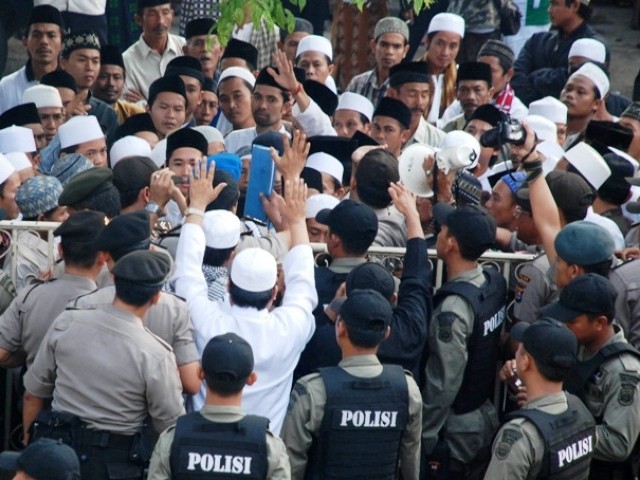
Indonesia policemen block Muslim supporters who are rallying in support for their friend, who was accused of assault on a Ahmadiyah follower, in Serang, Indonesia's Banten province July 28, 2011. PHOTO: REUTERS/FILE
Indonesia policemen block Muslim supporters who are rallying in support for their friend, who was accused of assault on a Ahmadiyah follower, in Serang, Indonesia’s Banten province July 28, 2011. PHOTO: REUTERS/FILE
JAKARTA: Indonesia on Friday dismissed expressions of outrage and disbelief over the perceived light sentences handed down to extremists who killed three minority sect members in a mob frenzy.

The United States and the European Union expressed strong misgivings while local rights groups and international watchdogs issued strong condemnations and calls for action to address rising intolerance in the mainly Muslim country.

But religious affairs ministry spokesman Zubaidi said the sentences of three to six months for the men accused of leading the murderous assault on the Ahmadiyah sect members in February were the result of a fair trial.

“As an executive body, we cannot interfere in the legal system. We believe in the law enforcers. They have the right to come up with the sentences,” he told AFP.

“Whether the sentences are light or harsh, how it’s perceived is relative.”

Indonesian President Susilo Bambang Yudhoyono, often held up by the United States and others as a champion of pluralism and democracy, made no comment on the sentences. Foreign ministry officials were unavailable to comment.

Human rights activists said prosecutors and the court in Serang, which handed down the verdicts, had been influenced by local Islamic leaders to play down the gravity of the crime.

They say religious violence against minorities is going unchecked in Indonesia, the world’s most populous Muslim-majority country, and criticise Yudhoyono for failing to defend the nation’s pluralist, moderate traditions.

But Zubaidi said the court was independent and its decisions could not be questioned.

“I don’t see that there has been any pressures from anyone. On the matter of intervention, I believe there was none,” he said.

The violence against the Ahmadiyah sect members in Cikeusik, western Java, was one of the most horrific in a long line of attacks on the minority group in Indonesia in recent years.

A secretly filmed video of the Cikeusik rampage sparked international concern when it appeared online within days of the attack.

Copyrighted © 2011 The Express Tribune News Network
URL: http://tribune.com.pk/story/219867/indonesia-rejects.../

No justice for victims of Islamic sect attack

CBS News, USA
World
July 29, 2011 7:25 AM
No justice for victims of Islamic sect attack

Indonesian Muslims who are on trial for their involvement in a fatal attack against followers of a minority Islamic sect earlier this year wait for the start of the hearing at a holding cell at a district court in Serang, Banten province, Indonesia, Thursday, July 28, 2011. The court has sentenced the men to up to six months in jail for their roles in the attack. (AP Photo)
(AP) JAKARTA, Indonesia — Foreign governments and human rights groups say the relatively light sentences given to 12 men who participated in the brutal killings of three minority Muslim sect members sends a chilling message about growing religious intolerance in Indonesia.

The attack — captured on video and widely circulated on the Internet — showed a frenzied crowd of around 1,500 descending on members of Ahmadiyah with machetes, wooden clubs and rocks to try to prevent them from worshipping.

Police looked on as the crowd pummeled the lifeless bodies of the victims, while others chanted “Allahu Akbar!“ or “God is Great!“

The sentences handed down by the Serang District Court on Thursday ranged between three to six months — less than what an ordinary citizen would get for begging in the street or gambling.

U.S. State Department spokesman Mark Toner said in a statement that Washington was disappointed by the “disproportionately light sentences.”

“The United States encourages Indonesia to defend its tradition of tolerance for all religions, a tradition praised by President Obama in his November 2010 visit to Jakarta.”

Indonesia, a predominantly Muslim and secular nation of 240 million, has a long history of religious tolerance.

But experts say a small, extremist fringe has grown more vocal in recent years and is seeking — with some success — to impose its will on police, the judicial system and the government.

They are emboldened by the inaction of President Susilo Bambang Yudhoyono, who relies on the support of Islamic parties in Parliament, and does not want to offend conservative Muslims by taking sides.

The February attack on members of Ahmadiyah — considered deviant by many Muslims here and abroad because they do not believe Muhammad was the final prophet — followed a long string of attacks on religious minorities.

They included the stabbing of a Christian preacher in September 2010 as she tried to lead followers to her boarded-up church outside the capital, Jakarta. There also have been beatings and the burning of houses of worship.

But the attack in the town of Cikeusik was the most brutal — and it was caught on camera.

Dani bin Misra, seen smashing the skull of one of the lifeless victims with a rock, got three months in jail for public incitement, destruction of property and an attack that led to death.

Idris bin Mahdani, who led the mob to the house where followers of the Ahmadiyah sect were gathering, got 5 1/2 months for illegal possession of a sharp weapons and involvement in the attack.

New York-based Human Rights Watch slammed the decision.

It said police failed to conduct thorough investigations and prosecutors — who sought reduced sentences contending the Ahmadiyah provoked the attack — did not call key witnesses.

“Indonesian authorities should be making all-out efforts to bring to justice those who kill people because of their religious beliefs,” said Elaine Pearson, the group’s deputy Asia director.

“The Cikeusik trial sends the chilling message that attacks on minorities like the Ahmadiyah will be treated lightly by the legal system.”
Copyright ©2011 CBS Interactive Inc. All rights reserved
URL: www.cbsnews.com/stories/2011/07/29/ap/asia/main20085232.shtml

Thursday, July 28, 2011

Indonesia: Verdicts a Setback for Religious Freedom

Human Rights Watch
Indonesia: Verdicts a Setback for Religious Freedom
Investigate All Involved in Deadly Attack on Ahmadiyah Community
July 28, 2011
A still shot from a video showing the assault of Ahmadiyah muslims by a group of assailants in Banten province in Western Java on Sunday, January 6. Source: Private
A still shot from a video showing the assault of Ahmadiyah muslims by a group of assailants in Banten province in Western Java on Sunday, January 6.
Source: Private
Indonesian authorities should be making all-out efforts to bring to justice those who kill people because of their religious beliefs. The Cikeusik trial sends the chilling message that attacks on minorities like the Ahmadiyah will be treated lightly by the legal system.
Elaine Pearson, deputy Asia director at Human Rights Watch
(Jakarta) — The light sentences imposed on Islamist militants for a deadly attack on a religious minority in Indonesia reflect the authorities’ weak efforts to prosecute the case, Human Rights Watch said today. The verdicts, announced on July 28, 2011, are a setback for religious freedom in Indonesia, Human Rights Watch said.

Human Rights Watch said both police and prosecutors failed to present a fully compelling case against the 12 defendants for their role in an organized attack on the Ahmadiyah community in Cikeusik village, Banten province in western Java on February 6 that left three people dead and five seriously injured. Police did not conduct thorough investigations, and prosecutors did not call key eyewitnesses to the attack. The prosecutors also sought reduced sentences, contending that the Ahmadiyah provoked the attack.

“Indonesian authorities should be making all-out efforts to bring to justice those who kill people because of their religious beliefs,” said Elaine Pearson, deputy Asia director at Human Rights Watch. “The Cikeusik trial sends the chilling message that attacks on minorities like the Ahmadiyah will be treated lightly by the legal system.”

The Serang district court in Java found 12 persons guilty on a mixture of charges, including public incitement, illegal possession of sharp weapons, destruction of property, maltreatment of others, individual assault, participating in an assault, involvement in an attack, and attacking others causing serious injuries or death. The court sentenced the accused to between 3 to 6 months in prison. Assault resulting in death can bring a maximum penalty of 12 years in prison.

None of the defendants were charged with murder or manslaughter.

Much of the attack on the Ahamadiyah home, which involved some 1,500 Islamist militants against about 20 Ahmadiyah members, was captured on video and posted on the Internet.

At the trial, which began on April 26, prosecutors only recommended sentences of up to seven months, saying that the sentences should be reduced since the Ahmadiyah members partly provoked the attack and filmed and distributed videos of the attack. By contrast, in a separate trial against an Ahmadiyah member, Deden Sujana, for his alleged role in provoking the attack, the prosecutors have charged him with incitement, disobeying police orders, and maltreatment. One of those charges, disobeying police orders, provides a maximum sentence of four years.

“It’s outrageous that the prosecutors asked for a reduction in sentences on the basis that the Ahmadiyah filmed and distributed a video of the attack on their community,” Pearson said. “It is telling victims of serious crime that they should keep quiet rather than come forward.”

Arif, an Ahmadiyah present during the attack, made the recording of the violence, which was later posted on YouTube. The police and prosecutors used the 28-minute video in their investigation. The 12 defendants were identified from the video footage and can be seen beating Ahmadiyah members.

The three Ahmadiyah members killed – Warsono Kastolib, Roni Pasaroni, and Tubagus Chandra – died of multiple injuries sustained during the attack, forensic reports said. In the footage, a 17-year-old defendant, “D.,” whose name was withheld because he is a child, hits Kastolib, who is sitting next to a hedge, on the head with a large stone. According to the prosecution, D. then struck the fallen Kastolib six times in the head with a wooden stick. The prosecutors also said that D. later struck Pasaroni, who was lying motionless, with a wooden stick. The prosecutors said that Chandra was killed when the crowd caught him next to the Ahmadiyah house.

Police investigations of the attack were woefully inadequate, Human Rights Watch said. Police interviewed Arif and two of the five Ahmadiyah who were seriously injured, but failed to question other Ahmadiyah who were injured or present during the attack or to ask them to testify.

“An extremely well-organized group of attackers targeted a religious minority group, yet the authorities have made no apparent effort to uncover the people behind the attack,” Pearson said. “The police shouldn’t rest until those who orchestrated the violence are arrested.”

One of those seriously injured, Muhamad Ahmad, told Human Rights Watch that he was not given an opportunity to testify at the trial.

“I might not recognize them, one by one, but I could describe the situation,” he said. “We were just trying to defend our properties. Hundreds of Ahmadiyah properties were destroyed and the government did almost nothing.”

Sujana, the Ahmadiyah being tried on charges of provoking the attack, was the only Ahmadiyah member asked to testify. He was berated by a judge about his faith and his motivations in going to Cikeusik that day, a scene videoed and available on YouTube. Responding to a question from the judges, prosecutors claimed they could not find the addresses of other witnesses, although two of them later testified at Sujana’s trial.

“The Cikeusik trial should have been a way to show vulnerable groups in Indonesia that when they are targets of violence, the state will protect them,” Pearson said. “Instead, these sentences will embolden militants who will see that using deadly violence brings few consequences.”

Background
The Ahmadiyah, a religious community founded in 1889 by Mirza Ghulam Ahmad, identify themselves as Muslims but differ with other Muslims about whether Muhammad was the “final” monotheist prophet. Consequently, some Muslims perceive the Ahmadiyah as “heretics.” Approximately 200,000 Indonesians follow the faith.

Indonesian law facilitates discrimination against the Ahmadiyah. A June 2008 decree requires the Ahmadiyah to “stop spreading interpretations and activities that deviate from the principal teachings of Islam,” including “spreading the belief that there is another prophet with his own teachings after Prophet Muhammad.” Violations of the decree can result in prison sentences of up to five years.

At the time the 2008 decree was signed, officials said it was necessary to help stop further violence. Yet since the decree, violence against the Ahmadiyah has increased dramatically, from three incidents in 2006 to 50 in 2010, according to the Setara Institute, a nongovernmental group that monitors religious freedom.

Few cases of violence against religious communities make it to court in Indonesia. When cases are brought to trial, the sentences for those convicted rarely match the seriousness of their crimes. In a trial that began in January in Bogor district court, three defendants were tried for setting fire to an Ahmadiyah mosque, a school, and more than a dozen houses in an October 2010 attack in Cisalada village, western Java. Three Ahmadiyah were injured in the attack. On April 14, the defendants were found guilty and sentenced to prison terms of between four and six months, while an Ahmadiyah man who tried to defend himself from attack was sentenced to nine months in prison.

Earlier in 2011, more than a dozen provincial governors and regents issued anti-Ahmadiyah regulations, contradicting Indonesia’s Autonomy Law, which prohibits regional governments from regulating religious matters. Human Rights Watch has repeatedly called for the government of President Susilo Bambang Yudhoyono to rescind the 2008 decree, as it violates the fundamental right to freedom of religion. The Home Affairs Ministry should also annul all regional regulations on religions.

Prohibiting the Ahmadiyah from practicing their religion violates the International Covenant on Civil and Political Rights, ratified by Indonesia in 2005, which protects the right to freedom of religion and the right to engage in religious practice “either individually or in community with others and in public or private.” The treaty also protects the rights of minorities “to profess and practice their own religion.”

Tuesday, July 19, 2011

Indonesia: Clinton Should Raise Human Rights Concerns

Human Rights Watch
Indonesia: Clinton Should Raise Human Rights Concerns
Address Military Impunity, Freedom of Religion and Expression
July 19, 2011
US Secretary of State Hillary Clinton © 2011 Reuters
US Secretary of State Hillary Clinton
© 2011 Reuters
This is an important opportunity for Clinton to speak publicly about the need for genuine military reform.
Elaine Pearson, deputy Asia director at Human Rights Watch
(New York) — US Secretary of State Hillary Clinton should raise military accountability for abuses, freedom of expression, and the rights of religious minorities during her visit to Indonesia on July 21 to 24, 2011, Human Rights Watch said in a letter to Secretary Clinton released today.

Clinton is to arrive in Bali a year after Robert Gates, the US defense secretary at that time, formally announced the resumption of US military relations with Indonesia’s special forces, Kopassus, which removed the last significant barrier to full-fledged US-Indonesian military ties.

“Closer US military ties with Indonesia were a reward for better behavior by Indonesian soldiers, yet one year later atrocities by the military still go unpunished,” said Elaine Pearson, deputy Asia director at Human Rights Watch. “This is an important opportunity for Clinton to speak publicly about the need for genuine military reform.”

On July 22, 2010, Secretary Gates announced that the Indonesian Defense Ministry “publicly pledged to protect human rights and advance human rights accountability and committed to suspend from active duty military officials credibly accused of human rights abuses, remove from military service any member convicted of such abuses, and cooperate with the prosecution of any members of the military who have violated human rights.”

However, the Indonesian military has failed to live up to its pledges to the US government to improve accountability, Human Rights Watch said. In one example, in January, three soldiers received light 8-to-10 month sentences for “disobeying orders” in the May 2010 torture of two farmers in Papua. None were charged with torture despite video evidence showing the soldiers kicking the victims, threatening one with a knife to his face, and repeatedly jabbing the second in the genitals with burning wood. Yet, a US Defense Department official characterized the prosecution of this case as “a success.”

Human Rights Watch also urged Clinton to raise concerns about several laws that criminalize the peaceful expression of political, religious, and other views. Clinton should call on President Susilo Bambang Yudhoyono to release immediately the more than 100 activists currently behind bars in Indonesia for peaceful acts of free expression, Human Rights Watch said.

Longstanding impunity for violence against religious minorities in Indonesia has fostered larger and more brutal attacks by Islamist militants. Since President Yudhoyono issued a decree restricting activity by the Ahmadiyah religious community in 2008, more than 180 attacks against Ahmadiyah mosques and other properties have been recorded. The Ahmadiyah, who consider themselves Muslims, have long been the targets of violence and persecution in Indonesia because some Muslims view them as heretics. Clinton should urge Yudhoyono to withdraw the 2008 anti-Ahmadiyah decree and take other actions to protect religious freedom in the country, Human Rights Watch said.

“Laws stifling dissent are used against peaceful critics, and violent attacks on religious minorities are getting worse,” Pearson said. “If the US really wants to support Indonesia as a rights-respecting democracy, then Clinton should not shy away from stressing the importance of rolling back practices that undermine freedom of religion and speech.”

Thursday, June 16, 2011

Indonesia: Monitor Trials of Deadly Attack on Religious Minority

Human Rights Watch
Indonesia: Monitor Trials of Deadly Attack on Religious Minority
Investigate Mob Attack Further to Find Instigators
June 16, 2011
Ujang M. Arif, a Muslim cleric, stands trial for his role in the February attack of an Ahmadiyah house in Cikeusik, western Java. © 2011 Private
Ujang M. Arif, a Muslim cleric, stands trial for his role in the February attack of an Ahmadiyah house in Cikeusik, western Java.
© 2011 Private
Indonesia has often failed to successfully prosecute crimes targeting religious minorities, exacerbating a culture of violent persecution. The Judiciary Commission should monitor these trials to strengthen justice in response to anti-Ahmadiyah attacks.
Elaine Pearson, deputy Asia director at Human Rights Watch
(New York) — Indonesia’s Judiciary Commission should monitor the trials of those charged in the deadly February 2011 attacks on the Ahmadiyah community in western Java, Human Rights Watch said in a letter to the Judiciary Commission released today. Having Commission representatives monitor the trials would acknowledge the importance of the case for the rights of religious minorities in Indonesia as well as concerns about the conduct of the proceedings, Human Rights Watch said.

“Indonesia has often failed to successfully prosecute crimes targeting religious minorities, exacerbating a culture of violent persecution,” said Elaine Pearson, deputy Asia director at Human Rights Watch. “The Judiciary Commission should monitor these trials to strengthen justice in response to anti-Ahmadiyah attacks.”

On February 6, a mob of 1,500 people attacked 20 members of the Ahmadiyah community in Cikeusik district, Banten province. Three Ahmadis were killed and five were seriously wounded in the attack, captured on film by an amateur videographer.

Trials for 12 defendants accused of the attack began on April 26. Police have so far acted professionally to maintain security in the courtroom, given the large numbers of protesters gathering at times outside the court. The defendants are charged with various crimes, including assault causing death, incitement, maltreatment of others (less serious assault), participating in assault, and illegal possession of sharp weapons. Assault resulting in death brings a maximum penalty of 12 years in prison. None were charged with murder or manslaughter.

Human Rights Watch also called on the police to conduct full investigations into all those involved in the attack. Courtroom testimony from witnesses on June 9 suggest that the Umbulan village head Johar (who uses only one name) and the secretary of the local Islamic Ulema Council, Ahmad Baghawi, played a role in determining February 6 as the date to forcibly remove the Ahmadiyah from Cikeusik.

“It is deeply troubling that police investigations into the brutal beating deaths of three people for their religious beliefs did not uncover who was behind the attacks,” Pearson said. “For justice to be complete, investigations should not stop at the 12 defendants, but include all those playing a role in this horrific attack.”

Violence against the Ahmadiyah community and other religious minorities is common in Indonesia, yet the Indonesian government has failed to seriously address the problem, Human Rights Watch said. Despite the high-profile nature of the case, the conduct of the trial so far has raised concerns that the religious beliefs of the victims might affect the outcome of the trials.

An eight-minute video clip of the trial uploaded to YouTube raises concerns about judicial impartiality as a judge berates an Ahmadiyah witness, Deden Sujana, about his religious faith and the motivations of the religious community. Defense lawyers have asked inappropriate questions of some witnesses - such as probing Sujana’s religious faith – in an apparent effort to intimidate them, with no interference from the judges. Outside the courtroom, a defense lawyer told reporters that Sujana must be “bullied till he shits” (“digencet hingga mencret”), but has suffered no rebuke from the court.

The Serang district court is separately hearing a case against Sujana on allegations that he had a role in provoking the attack. Prosecutors have called for a six-year prison sentence on charges of incitement, disobeying police orders, and maltreatment (less serious assault). Human Rights Watch urged the Judiciary Commission to monitor Sujana’s trial along with the others.

The Ahmadiyah, who consider themselves Muslims, have long been the targets of violence and persecution in Indonesia because some Muslims view them as heretics to Islam. Following a 2008 national decree that requires the Ahmadiyah to stop proselytizing their faith, attacks have increased dramatically - from 3 incidents in 2006 to 50 in 2010, according to the Setara Institute, a nongovernmental group that monitors religious freedom.

“If Indonesia’s courts deal properly with these cases, it could go a long way toward protecting religious minorities in the country,” Pearson said. “The Judicary Commission should send representatives to monitor the trials to ensure justice is done for all parties involved.”

Wednesday, June 8, 2011

Indonesia: Act on Human Rights Commitments

Human Rights Watch
Indonesia: Act on Human Rights Commitments
Strengthen Freedom of Religion, Expression, Assembly
June 8, 2011

Indonesia’s election to the Human Rights Council should be an impetus for rights reform at home. If Indonesia wants to be a global leader on human rights, it should start by protecting religious minorities and allowing peaceful protests by political dissidents.
Elaine Pearson, deputy Asia director at Human Rights Watch
(New York) - Indonesia should use its election to the United Nations Human Rights Council to implement reforms on the rights to freedom of expression, assembly, and religion, Human Rights Watch said today in a letter to President Susilo Bambang Yudhoyono. While Indonesia has in recent years moved toward being a rights-respecting democracy, unaddressed human rights concerns could seriously undermine its stability and democratic reforms, Human Rights Watch said.

“Indonesia’s election to the Human Rights Council should be an impetus for rights reform at home,” said Elaine Pearson, deputy Asia director at Human Rights Watch. “If Indonesia wants to be a global leader on human rights, it should start by protecting religious minorities and allowing peaceful protests by political dissidents.”

Indonesian laws and policies that obstruct the right to free expression have been used repeatedly against peaceful political activists from the Moluccas, Papua, and other regions. Other laws contribute to religious violence by criminalizing religious practices that deviate from the central tenets of the country’s six officially recognized religions. Longstanding impunity for religious violence has fostered larger and more brutal attacks by Islamist militants against religious minorities, particularly the Ahmadiyah, who consider themselves Muslims but are seen by some other Muslims as heretics. Human Rights Watch also urged Indonesia to address impunity for abuses by the security forces.

To demonstrate its commitment to human rights, the Indonesian government should follow through on the pledges it submitted ahead of its election to the UN Human Rights Council on May 20, 2011, Human Rights Watch said. These include responding without delay to outstanding requests to visit by UN human rights experts such as the special rapporteur on religious freedom, and ratifying core human rights treaties, including the International Convention for the Protection of All Persons from Enforced Disappearance.

“Indonesia has proudly expressed its commitment to human rights as a member of the Human Rights Council,” Pearson said. “Indonesia should now back those commitments with real reform at home.”

Tuesday, April 19, 2011

Indonesia: Ensure Security in Religious Killings Trial

Human Rights Watch
Indonesia: Ensure Security in Religious Killings Trial
Fair Proceedings and Witness Protection Critical for Improving Minority Rights
April 19, 2011
A still shot from a video showing the assault of Ahmadiyah muslims by a group of assailants in Banten province in Western Java on Sunday, January 6. Source: Private
For the Cikeusik trial to be a step toward ending religious violence in Indonesia, the police need to ensure the security of everyone in the courtroom. Witnesses brave enough to testify, as well as judges and prosecutors, should not have to face intimidation.
Elaine Pearson, deputy Asia director at Human Rights Watch

UPDATE: The opening of the trial has now been postponed to April 26.

(New York) - Indonesian authorities should ensure the safety of all those attending the trial of 11 men charged in the deadly February 2011 attacks on the Ahmadiyah community in the village of Cikeusik in western Java, Human Rights Watch said today. Human Rights Watch said that the trial, which begins April 21, in Serang district, Banten province, can help reduce anti-Ahmadiyah violence in the country if it meets international fair trial standards and provides full protection for victims, witnesses, and court officials.

Longstanding impunity for religious violence in Indonesia has fostered larger and more brutal attacks by Islamist militants against religious minorities, and may have contributed to an April 15 suicide bombing of a police mosque in Cirebon, West Java province, Human Rights Watch said.

“For the Cikeusik trial to be a step toward ending religious violence in Indonesia, the police need to ensure the security of everyone in the courtroom,” said Elaine Pearson, deputy Asia director at Human Rights Watch. “Witnesses brave enough to testify, as well as judges and prosecutors, should not have to face intimidation.”

On February 6, a mob of about 1,500 people attacked 21 members of the Ahmadiyah religious community in Cikeusik, in Banten province, killing three people and seriously wounding five others. About 30 police officers were present but did little to stop the attack. A videographer recorded the violence, and the video was later posted by various individuals and organizations on YouTube. Since the attack, Ahmadiyah members in the village have found it difficult to return home due to tension and continued harassment from government officials and other villagers. Only an Ahmadiyah widow and her daughter remain in the village; others have moved to larger cities.

Few cases of violence against religious minorities reach trial in Indonesia, and such trials on Java, Indonesia’s majority-Muslim main island, have often been disrupted by Islamist militant threats and violence.

In a trial that began in January in Bogor district court regarding an October 2010 attack on an Ahmadiyah mosque in Cisalada village, more than 1,000 Islamist militants attended the hearings at times. Over the course of the trial, they threatened and harassed witnesses, judges, and prosecutors both in and outside the courtroom. On April 14, three defendants were found guilty of attacking the Ahmadiyah mosque and sentenced to prison terms of between four and six months; prosecutors had sought nine-month sentences.

In 2008, numerous activists from the Islamic Defender Front (FPI) attended the trial of an FPI member charged with violence at a June 2008 interfaith rally supporting the Ahmadiyah at the National Monument (Monas) in Jakarta. A witness said FPI members assaulted her outside the courtroom.

Human Rights Watch called on President Susilo Bambang Yudhoyono to review the increasing violence against religious and other minorities in Indonesia, and to revoke national and provincial decrees that ban Ahmadiyah practices. Over the past three years, there have been more than 180 anti-Ahmadiyah attacks, according to the Setara Institute, a nongovernmental group that monitors religious freedom.

A June 2008 national decree requires the Ahmadiyah to “stop spreading interpretations and activities that deviate from the principal teachings of Islam,” including “spreading the belief that there is another prophet with his own teachings after Prophet Muhammad.” Violations of the decree can result in prison sentences of up to five years.

The Ahmadiyah identify themselves as Muslims but differ with other Muslims as to whether Muhammad was the “final” monotheist prophet. Consequently, some Muslims perceive the Ahmadiyah as heretics.

On April 15, 2011, a suicide bomber, Mochamad Syarif, detonated a bomb at the mosque in the Cirebon police precinct, West Java, leaving 26 wounded. Syarif had been previously implicated in anti-Ahmadiyah attacks in Manis Lor, West Java, in July 2010, and harassing witnesses in a religious trial on blasphemy in Cirebon in 2010. Footage from Metro TV shows Syarif participating in demonstrations against the Ahmadiyah, banging on a vehicle holding the prosecutor and the blasphemy suspect, and attacking a police barricade at Manis Lor village.

“President Yudhoyono should rein in Islamist militants before they claim more lives, and that starts with revoking policies that promote religious intolerance,” Pearson said. “The government should be aggressively prosecuting all those responsible for scores of attacks against religious minorities in recent years.”

In a positive development, on February 16, the Nahdlatul Ulama, an independent Islamic organization, released a statement calling on all Muslims to respect the law and avoid religious violence.

Established in Indonesia in the 1920s, the Nahdlatul Ulama is one of the largest Islamic organizations worldwide. The statement says that “differences of religion and belief cannot be a justification to commit violent or arbitrary acts,” and urges the government “seriously fulfill its constitutional obligation to enforce the law and provide protection to all citizens regardless of religion or belief.”

“A major Muslim organization is telling the government to get serious about ending religious violence and protecting Indonesians of all beliefs,” Pearson said. “The government needs to start listening and taking action to prevent future crimes against minorities like the Cikeusik killings and Cirebon bombing.”

 
^ Top of Page