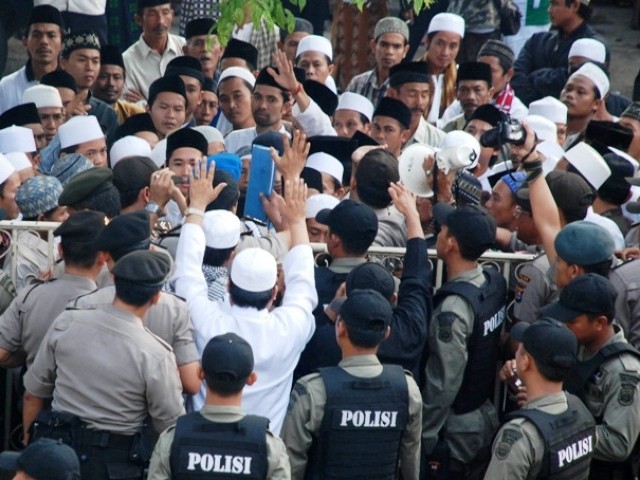
Showing posts with label Islamist militants. Show all posts

Tuesday, November 15, 2011

Indonesia: Obama Should Press Rights Concerns

Human Rights Watch
Indonesia: Obama Should Press Rights Concerns
November 15, 2011

The Obama administration’s deepening relationship with Indonesia means being frank about Indonesia’s serious human rights challenges. Indonesian government indifference to mob violence against religious groups and brutality by soldiers against peaceful protesters are good places to start.
Elaine Pearson, deputy Asia director at Human Rights Watch
(Washington, DC) – US President Barack Obama has an important and timely opportunity to raise human rights issues with the Indonesian government when meeting President Susilo Bambang Yudhoyono this week in Indonesia, Human Rights Watch said today in a letter to Obama. He will travel to Bali for the Association of Southeast Asian Nations (ASEAN) Summit on November 19, 2011.

Obama should address key human rights challenges in Indonesia, including attacks on religious minorities, restrictions on freedom of expression, and the lack of accountability of Indonesian security forces for human rights abuses, especially in the easternmost province of Papua, Human Rights Watch said.

“The Obama administration’s deepening relationship with Indonesia means being frank about Indonesia’s serious human rights challenges,” said Elaine Pearson, deputy Asia director at Human Rights Watch. “Indonesian government indifference to mob violence against religious groups and brutality by soldiers against peaceful protesters are good places to start.”

On his last visit to Indonesia in November 2010, Obama made a point of praising Indonesia’s religious tolerance. However, in the last year, religious violence has become more frequent and deadly as Islamist militants have repeatedly mobilized mobs to attack religious minorities in their homes, places of worship, and community centers.

“Obama needs to temper his past praise of religious tolerance in Indonesia with some tough talk on religious freedom,” Pearson said. “He should press President Yudhoyono to end discriminatory laws and actively protect the country’s religious minorities.”

Human Rights Watch urged Obama to criticize the lack of accountability of security forces for continuing abuses, including extrajudicial killings and torture, in Papua and other areas. He should also raise concerns about Indonesian officials using vague and overbroad laws to prosecute the peaceful expression of political, religious, and other viewsin Papua and the Moluccas Islands. More than 100 activists are behind bars in Indonesia for peaceful acts of free expression. They include the former Papuan civil servant Filep Karma, who was sentenced to 15 years in prison after publicly calling for Papuan independence in December 2004.

“Obama should point out that as long as soldiers who commit torture get a few months in jail while peaceful activists get sentenced for years, Papuans are unlikely to have faith in Indonesian rule,” Pearson said. “He should urge Yudhoyono that to begin to win Papuans’ trust he should unconditionally release all political prisoners.”

Letter to President Barack Obama Regarding his Visit to Indonesia and Human Rights Issues

Human Rights Watch
Letter to President Barack Obama Regarding his Visit to Indonesia and Human Rights Issues
November 15, 2011

Barack Obama
President of the United States of America
The White House
1600 Pennsylvania Avenue NW
Washington, DC 20500

Via facsimile: +1-202-456-2461

Re: Visit to Indonesia and Human Rights Issues

Dear President Obama,

Your administration has placed great emphasis on its deepening relationship with Indonesia. We believe your trip to Bali for the East Asian Summit on November 19, 2011, is an important opportunity for you to raise human rights issues with the Indonesian government, both publicly and privately, including matters concerning freedom of religion, freedom of expression, and accountability of the military for human rights abuses.

Freedom of Religion

Last November, when visiting Jakarta, you visited the Istiqlal Grand Mosque and later made a speech at Universitas Indonesia in which you praised Indonesia’s “religious tolerance,” noting that the Istiqlal Mosque was built by a Christian architect.

In the last year, however, increasingly violent attacks on religious minorities by Islamist militants, combined with bans issued by provincial authorities, have severely undermined Indonesia’s record on this front.

Incidents of religious violence have become more deadly and more frequent in 2011, as Islamist militants have repeatedly mobilized mobs to attack religious minorities in their homes, places of worship, and community centers. According to the Setara Institute, which monitors religious freedom, religious attacks have increased from 135 incidents in 2007, 216 incidents in 2010 to 184 cases in the first nine months in 2011. Most attacks were committed with complete impunity. Police and prosecutors have failed to adequately investigate and prosecute cases, sending a chilling message that members of minority religious groups are not provided the same protections as other Indonesian citizens. Even the most deadly cases have resulted only in short prison terms for a handful of offenders.

Some Indonesian ministers, including the minister of religious affairs, Suryadharma Ali, have made multiple public statements that appear to legitimize religious discrimination and violence. President Yudhoyono has not demanded that officials retract or clarify such remarks.

Recently, the Ministry of Religions submitted a draft law on “religious harmony.” There are concerns, however, that rather than promoting tolerance, the law will simply compile existing discriminatory decrees into a single law and strengthen discrimination against religious minorities.

The government has failed to overturn several decrees that discriminate against minority religions and foster intolerance. A 2008 national government decree prohibits the Ahmadiyah, a group who consider themselves Muslim but who some Muslims consider to be heretics, from practicing their faith. At least 17 provinces and regencies in Indonesia have issued local decrees banning the Ahmadiyah faith in Indonesia. As recently as October 13, 2011, the mayor of Bekasi, near Jakarta, issued a decree banning all “Ahmadiyah activities” in the city, effectively closing down its six Ahmadiyah mosques.

Ahmadiyah have suffered some of the worst of the recent violence. In one of the worst religiously-motivated attacks in 2011, more than 1,500 Islamist militants attacked a house in Cikeusik, in western Java, in February, killing three and seriously wounding five Ahmadiyah men. The incident was recorded on video. Public outrage prompted the authorities to promise to investigate the attack. But in July the Serang district court sentenced 12 men to between just three and six months’ imprisonment for the crimes of disturbing public order, incitement, and assault. Police did not conduct thorough investigations, and prosecutors did not call key eyewitnesses to the attack. The prosecutors sought reduced sentences, contending that the Ahmadiyah provoked the attack. In August, the Serang district court convicted one of the Ahmadiyah members seriously injured in the attack, Deden Sudjana, for assault and disobeying police orders, sentencing him to six months’ imprisonment.

Other religious minorities have increasingly expressed fears about the rise in attacks since President Susilo Bambang Yudhoyono took office in 2004. In February of this year, militants attacked three churches in Temanggung, Central Java. The Semarang district court later convicted eight of the perpetrators, sentencing them to short sentences of between five months and one year in prison. In April, an Islamist suicide bomber attacked a police mosque in Cirebon, West Java, killing himself and injuring at least 28 people; the bomber had previously been involved in violent protests over a blasphemy trial and an anti-Ahmadiyah attack in Cirebon in 2010. In September, another Islamist suicide bomber attacked a Christian church in Solo, Central Java, killing himself and wounding 14 churchgoers.

Minority congregations have also reported that local government officials arbitrarily refuse to issue permits required under a 2006 decree on building houses of worship. Those who attempt to worship without a permit often face harassment and violence from local populations or police.

Given your past statements on religious tolerance, we believe you are uniquely placed to register these issues with President Yudhoyono and call on him to take urgent steps to address growing religious tensions. In particular, you should call on President Yudhoyono to use the influence and stature of his presidency to speak out against religious violence. He should also revoke the 2008 decree on the Ahmadiyah, order provincial authorities to repeal similar local decrees, review or revoke the 2006 decree on building houses of worship, and consider amending or repealing the 1965 blasphemy law, which designates six official religions in Indonesia. You should also urge him to ensure that Indonesian prosecutors and police are tasked to fully and fairly investigate and prosecute individuals and groups implicated in attacks, threats, and harassment of religious minorities, anywhere in the country.

Impunity for Abuses by the Military

Impunity for members of Indonesia’s security forces remains a serious problem, undermining the development of the rule of law in Indonesia. The military insists on policing itself, but military tribunals rarely charge soldiers even for serious abuses. When they do file charges, the proceedings lack transparency and the charges frequently fail to reflect the seriousness of the abuses committed. We have long recommended that civilian courts be given jurisdiction over soldiers who commit serious human rights abuses, but the military and the Indonesian government have refused. This greatly exacerbates the difficulty in bringing soldiers to justice.

On July 22, 2010, then-US Secretary of Defense Robert Gates formally announced the resumption of US military relations with Indonesia’s special forces, Kopassus, the last significant barrier to full-fledged US-Indonesian military ties. Secretary Gates articulated the standards agreed to by the US and Indonesian governments and militaries:

The Ministry of Defense has publicly pledged to protect human rights and advance human rights accountability and committed to suspend from active duty military officials credibly accused of human rights abuses, remove from military service any member convicted of such abuses, and cooperate with the prosecution of any members of the military who have violated human rights.

However, 18 months later, the Indonesia military has failed to live up to the pledges made by the Defense Ministry. Past problems persist: the Indonesian military still shows no inclination to adequately and transparently investigate soldiers and especially officers responsible for abuses, involve civilian authorities in their investigations, or ensure the safety of witnesses.

While a handful of military tribunals have been held in Papua, the charges have been inadequate and soldiers that committed abuses continue to serve in the Indonesian military.

For instance, in January, a military tribunal in Jayapura, Papua, convicted three soldiers from Battalion 753 and sentenced them to between eight to twelve months’ imprisonment for the extremely brutal torture of two Papuan farmers. Despite video showing the involvement of six soldiers, the tribunal tried only three of the six soldiers, and on lesser military discipline charges instead of torture. The soldiers have not been discharged.

In August, the Jayapura military tribunal convicted three soldiers from the same battalion after soldiers shot and killed Reverend Kinderman Gire on the suspicion he was a Papuan separatist. At the trial, the defendants claimed Gire led them to believe he was a member of the rebel Free Papua Movement (Organisasi Papua Merdeka, OPM) and tried to grab a rifle from one of them, who then shot him in the chest. They dumped the body in a river, after trying to cut off his head. Again, the tribunal convicted them of a lesser offense of “disobeying orders” and sentenced them respectively to just six, seven, and fifteen months in prison.

In August, internal military documents, mainly from Kopassus, were made public, exposing how the Indonesian military monitors peaceful activists, politicians, and religious clergy in Papua. The documents show the deep military paranoia in Papua that conflates peaceful political expression with criminal activity. Several of those named in the documents as targets have faced arbitrary arrest, imprisonment, harassment, or violence.

Recently, on October 17, the Indonesian police, backed by a detachment of military forces in armored personnel carriers, attacked a peaceful demonstration of the Papuan People’s Congress in Jayapura, killing at least three of the protesters and arresting approximately 300, including several of the event’s leaders (some of whom have traveled to the United States in the past and attended events with State Department officials and members of Congress). According to witnesses, police and army forces fired military assault weapons over the crowd and later pistol-whipped or beat the participants with rattan canes and batons, resulting in 96 injuries according to Indonesia’s Human Rights Commission. Hundreds of the protesters fled into a nearby forest, where at least three were killed under unclear circumstances –two died of gunshot wounds. We urge you to ask the Indonesian government what efforts are being made to investigate the deaths and injuries, and alleged excessive use of force by security forces at the demonstration.

We ask that you use the US’s deepening ties with the Indonesian government to press the military on its failure to hold its personnel to account for serious abuses. If the current situation prevails, the United States will increasingly be called to task for its uncritical support for the Indonesian military.

It would be very helpful if publicly and in your meeting with President Yudhoyono you were to raise concerns about recent military tribunals in Papua and the failure to bring those implicated in serious abuses to justice. The US should ask the Indonesian government for full disclosure of all military tribunal cases involving alleged abuses against civilians. Until the Indonesian government takes steps to hold perpetrators accountable, in line with the Leahy law, which prevents the US from cooperating with abusive military units, the US government should not participate in joint endeavors with military personnel or units implicated in abuses against civilians.

Intelligence Law

A new law on intelligence-gathering approved by Indonesian parliament on October 12 contains vague and overbroad language that the government could use to repress dissent and peaceful acts of free expression. The law also lacks a strong and transparent accountability mechanism. We urge you to raise concerns about the law with President Yudhoyono, and urge that it be revised to meet rule-of-law requirements and international due process standards. The president should immediately order an interim measure to limit any opportunity for the law’s misuse by setting up an independent oversight mechanism for the State Intelligence Agency (Badan Intelejen Negara, BIN).

Threats to Free Expression

In the years immediately after President Suharto was forced from power, Indonesia made huge strides in opening space for free expression and the media. But recent years have seen some troubling developments. Indonesian officials continue to enforce a number of laws that criminalize the peaceful expression of political, religious, and other views. These laws include offenses in Indonesia’s criminal code such as treason (makar) and “inciting hatred” (haatzai artikelen), which have been used repeatedly against peaceful political activists, particularly those from the Moluccas and Papua.

More than a hundred such activists are currently behind bars in Indonesia for peaceful acts of free expression. For instance, Filep Karma, a civil servant, made a speech in December 2004 in Jayapura that was critical of the government’s policies in Papua. He is currently serving a 15-year sentence in Abepura on charges of treason. Ruben Saiya, a farmer from the Moluccas, joined a protest dance in front of President Yudhoyono in an Ambon stadium in June 2007. He was sentenced to 20 years’ imprisonment for treason. And as noted above, several Papua leaders were recently arrested after holding an event in Jayapura.

Human Rights Watch takes no position on claims to self-determination in the Moluccas Islands and Papua. Consistent with international law, however, Human Rights Watch supports the right of all individuals, including independence supporters, to express their political views peacefully without fear of arrest or other forms of reprisal. Indonesian laws, however, consider these non-violent acts as “treason” with the maximum penalty of life imprisonment.

We urge that you raise your concerns on the right to free expression in Indonesia with President Yudhoyono, and particularly urge that you ask Indonesian authorities to unconditionally release Filep Karma, Ruben Saiya, and all prisoners held for the peaceful expression of their views. The Indonesian government should also amend or repeal laws that criminalize peaceful political expression and repeal laws that criminalize defamation and “insulting” public officials, which are subject to misuse by authorities and individuals seeking to silence criticism.

Thank you for your consideration. We look forward to working with the White House, the State Department, the Defense Department, and the US Embassy in Jakarta to address these concerns.

Sincerely,

Brad Adams
Executive Director
Asia Division

Friday, July 29, 2011

Indonesia rejects outrage over anti-Ahmadi mob sentences

Express Tribune, Pakistan
World
Indonesia rejects outrage over anti-Ahmadi mob sentences
By AFP
Published: July 29, 2011
Indonesia policemen block Muslim supporters who are rallying in support for their friend, who was accused of assault on a Ahmadiyah follower, in Serang, Indonesia's Banten province July 28, 2011. PHOTO: REUTERS/FILE
Indonesia policemen block Muslim supporters who are rallying in support for their friend, who was accused of assault on a Ahmadiyah follower, in Serang, Indonesia’s Banten province July 28, 2011. PHOTO: REUTERS/FILE
JAKARTA: Indonesia on Friday dismissed expressions of outrage and disbelief over the perceived light sentences handed down to extremists who killed three minority sect members in a mob frenzy.

The United States and the European Union expressed strong misgivings while local rights groups and international watchdogs issued strong condemnations and calls for action to address rising intolerance in the mainly Muslim country.

But religious affairs ministry spokesman Zubaidi said the sentences of three to six months for the men accused of leading the murderous assault on the Ahmadiyah sect members in February were the result of a fair trial.

“As an executive body, we cannot interfere in the legal system. We believe in the law enforcers. They have the right to come up with the sentences,” he told AFP.

“Whether the sentences are light or harsh, how it’s perceived is relative.”

Indonesian President Susilo Bambang Yudhoyono, often held up by the United States and others as a champion of pluralism and democracy, made no comment on the sentences. Foreign ministry officials were unavailable to comment.

Human rights activists said prosecutors and the court in Serang, which handed down the verdicts, had been influenced by local Islamic leaders to play down the gravity of the crime.

They say religious violence against minorities is going unchecked in Indonesia, the world’s most populous Muslim-majority country, and criticise Yudhoyono for failing to defend the nation’s pluralist, moderate traditions.

But Zubaidi said the court was independent and its decisions could not be questioned.

“I don’t see that there has been any pressures from anyone. On the matter of intervention, I believe there was none,” he said.

The violence against the Ahmadiyah sect members in Cikeusik, western Java, was one of the most horrific in a long line of attacks on the minority group in Indonesia in recent years.

A secretly filmed video of the Cikeusik rampage sparked international concern when it appeared online within days of the attack.

Copyrighted © 2011 The Express Tribune News Network
URL: http://tribune.com.pk/story/219867/indonesia-rejects.../

No justice for victims of Islamic sect attack

CBS News, USA
World
July 29, 2011 7:25 AM
No justice for victims of Islamic sect attack

Indonesian Muslims who are on trial for their involvement in a fatal attack against followers of a minority Islamic sect earlier this year wait for the start of the hearing at a holding cell at a district court in Serang, Banten province, Indonesia, Thursday, July 28, 2011. The court has sentenced the men to up to six months in jail for their roles in the attack. (AP Photo)
(AP) JAKARTA, Indonesia — Foreign governments and human rights groups say the relatively light sentences given to 12 men who participated in the brutal killings of three minority Muslim sect members sends a chilling message about growing religious intolerance in Indonesia.

The attack — captured on video and widely circulated on the Internet — showed a frenzied crowd of around 1,500 descending on members of Ahmadiyah with machetes, wooden clubs and rocks to try to prevent them from worshipping.

Police looked on as the crowd pummeled the lifeless bodies of the victims, while others chanted “Allahu Akbar!“ or “God is Great!“

The sentences handed down by the Serang District Court on Thursday ranged between three to six months — less than what an ordinary citizen would get for begging in the street or gambling.

U.S. State Department spokesman Mark Toner said in a statement that Washington was disappointed by the “disproportionately light sentences.”

“The United States encourages Indonesia to defend its tradition of tolerance for all religions, a tradition praised by President Obama in his November 2010 visit to Jakarta.”

Indonesia, a predominantly Muslim and secular nation of 240 million, has a long history of religious tolerance.

But experts say a small, extremist fringe has grown more vocal in recent years and is seeking — with some success — to impose its will on police, the judicial system and the government.

They are emboldened by the inaction of President Susilo Bambang Yudhoyono, who relies on the support of Islamic parties in Parliament, and does not want to offend conservative Muslims by taking sides.

The February attack on members of Ahmadiyah — considered deviant by many Muslims here and abroad because they do not believe Muhammad was the final prophet — followed a long string of attacks on religious minorities.

They included the stabbing of a Christian preacher in September 2010 as she tried to lead followers to her boarded-up church outside the capital, Jakarta. There also have been beatings and the burning of houses of worship.

But the attack in the town of Cikeusik was the most brutal — and it was caught on camera.

Dani bin Misra, seen smashing the skull of one of the lifeless victims with a rock, got three months in jail for public incitement, destruction of property and an attack that led to death.

Idris bin Mahdani, who led the mob to the house where followers of the Ahmadiyah sect were gathering, got 5 1/2 months for illegal possession of a sharp weapons and involvement in the attack.

New York-based Human Rights Watch slammed the decision.

It said police failed to conduct thorough investigations and prosecutors — who sought reduced sentences contending the Ahmadiyah provoked the attack — did not call key witnesses.

“Indonesian authorities should be making all-out efforts to bring to justice those who kill people because of their religious beliefs,” said Elaine Pearson, the group’s deputy Asia director.

“The Cikeusik trial sends the chilling message that attacks on minorities like the Ahmadiyah will be treated lightly by the legal system.”
Copyright ©2011 CBS Interactive Inc. All rights reserved
URL: www.cbsnews.com/stories/2011/07/29/ap/asia/main20085232.shtml

Thursday, July 28, 2011

Indonesia: Verdicts a Setback for Religious Freedom

Human Rights Watch
Indonesia: Verdicts a Setback for Religious Freedom
Investigate All Involved in Deadly Attack on Ahmadiyah Community
July 28, 2011
A still shot from a video showing the assault of Ahmadiyah muslims by a group of assailants in Banten province in Western Java on Sunday, January 6. Source: Private
A still shot from a video showing the assault of Ahmadiyah muslims by a group of assailants in Banten province in Western Java on Sunday, January 6.
Source: Private
Indonesian authorities should be making all-out efforts to bring to justice those who kill people because of their religious beliefs. The Cikeusik trial sends the chilling message that attacks on minorities like the Ahmadiyah will be treated lightly by the legal system.
Elaine Pearson, deputy Asia director at Human Rights Watch
(Jakarta) — The light sentences imposed on Islamist militants for a deadly attack on a religious minority in Indonesia reflect the authorities’ weak efforts to prosecute the case, Human Rights Watch said today. The verdicts, announced on July 28, 2011, are a setback for religious freedom in Indonesia, Human Rights Watch said.

Human Rights Watch said both police and prosecutors failed to present a fully compelling case against the 12 defendants for their role in an organized attack on the Ahmadiyah community in Cikeusik village, Banten province in western Java on February 6 that left three people dead and five seriously injured. Police did not conduct thorough investigations, and prosecutors did not call key eyewitnesses to the attack. The prosecutors also sought reduced sentences, contending that the Ahmadiyah provoked the attack.

“Indonesian authorities should be making all-out efforts to bring to justice those who kill people because of their religious beliefs,” said Elaine Pearson, deputy Asia director at Human Rights Watch. “The Cikeusik trial sends the chilling message that attacks on minorities like the Ahmadiyah will be treated lightly by the legal system.”

The Serang district court in Java found 12 persons guilty on a mixture of charges, including public incitement, illegal possession of sharp weapons, destruction of property, maltreatment of others, individual assault, participating in an assault, involvement in an attack, and attacking others causing serious injuries or death. The court sentenced the accused to between 3 to 6 months in prison. Assault resulting in death can bring a maximum penalty of 12 years in prison.

None of the defendants were charged with murder or manslaughter.

Much of the attack on the Ahamadiyah home, which involved some 1,500 Islamist militants against about 20 Ahmadiyah members, was captured on video and posted on the Internet.

At the trial, which began on April 26, prosecutors only recommended sentences of up to seven months, saying that the sentences should be reduced since the Ahmadiyah members partly provoked the attack and filmed and distributed videos of the attack. By contrast, in a separate trial against an Ahmadiyah member, Deden Sujana, for his alleged role in provoking the attack, the prosecutors have charged him with incitement, disobeying police orders, and maltreatment. One of those charges, disobeying police orders, provides a maximum sentence of four years.

“It’s outrageous that the prosecutors asked for a reduction in sentences on the basis that the Ahmadiyah filmed and distributed a video of the attack on their community,” Pearson said. “It is telling victims of serious crime that they should keep quiet rather than come forward.”

Arif, an Ahmadiyah present during the attack, made the recording of the violence, which was later posted on YouTube. The police and prosecutors used the 28-minute video in their investigation. The 12 defendants were identified from the video footage and can be seen beating Ahmadiyah members.

The three Ahmadiyah members killed – Warsono Kastolib, Roni Pasaroni, and Tubagus Chandra – died of multiple injuries sustained during the attack, forensic reports said. In the footage, a 17-year-old defendant, “D.,” whose name was withheld because he is a child, hits Kastolib, who is sitting next to a hedge, on the head with a large stone. According to the prosecution, D. then struck the fallen Kastolib six times in the head with a wooden stick. The prosecutors also said that D. later struck Pasaroni, who was lying motionless, with a wooden stick. The prosecutors said that Chandra was killed when the crowd caught him next to the Ahmadiyah house.

Police investigations of the attack were woefully inadequate, Human Rights Watch said. Police interviewed Arif and two of the five Ahmadiyah who were seriously injured, but failed to question other Ahmadiyah who were injured or present during the attack or to ask them to testify.

“An extremely well-organized group of attackers targeted a religious minority group, yet the authorities have made no apparent effort to uncover the people behind the attack,” Pearson said. “The police shouldn’t rest until those who orchestrated the violence are arrested.”

One of those seriously injured, Muhamad Ahmad, told Human Rights Watch that he was not given an opportunity to testify at the trial.

“I might not recognize them, one by one, but I could describe the situation,” he said. “We were just trying to defend our properties. Hundreds of Ahmadiyah properties were destroyed and the government did almost nothing.”

Sujana, the Ahmadiyah being tried on charges of provoking the attack, was the only Ahmadiyah member asked to testify. He was berated by a judge about his faith and his motivations in going to Cikeusik that day, a scene videoed and available on YouTube. Responding to a question from the judges, prosecutors claimed they could not find the addresses of other witnesses, although two of them later testified at Sujana’s trial.

“The Cikeusik trial should have been a way to show vulnerable groups in Indonesia that when they are targets of violence, the state will protect them,” Pearson said. “Instead, these sentences will embolden militants who will see that using deadly violence brings few consequences.”

Background
The Ahmadiyah, a religious community founded in 1889 by Mirza Ghulam Ahmad, identify themselves as Muslims but differ with other Muslims about whether Muhammad was the “final” monotheist prophet. Consequently, some Muslims perceive the Ahmadiyah as “heretics.” Approximately 200,000 Indonesians follow the faith.

Indonesian law facilitates discrimination against the Ahmadiyah. A June 2008 decree requires the Ahmadiyah to “stop spreading interpretations and activities that deviate from the principal teachings of Islam,” including “spreading the belief that there is another prophet with his own teachings after Prophet Muhammad.” Violations of the decree can result in prison sentences of up to five years.

At the time the 2008 decree was signed, officials said it was necessary to help stop further violence. Yet since the decree, violence against the Ahmadiyah has increased dramatically, from three incidents in 2006 to 50 in 2010, according to the Setara Institute, a nongovernmental group that monitors religious freedom.

Few cases of violence against religious communities make it to court in Indonesia. When cases are brought to trial, the sentences for those convicted rarely match the seriousness of their crimes. In a trial that began in January in Bogor district court, three defendants were tried for setting fire to an Ahmadiyah mosque, a school, and more than a dozen houses in an October 2010 attack in Cisalada village, western Java. Three Ahmadiyah were injured in the attack. On April 14, the defendants were found guilty and sentenced to prison terms of between four and six months, while an Ahmadiyah man who tried to defend himself from attack was sentenced to nine months in prison.

Earlier in 2011, more than a dozen provincial governors and regents issued anti-Ahmadiyah regulations, contradicting Indonesia’s Autonomy Law, which prohibits regional governments from regulating religious matters. Human Rights Watch has repeatedly called for the government of President Susilo Bambang Yudhoyono to rescind the 2008 decree, as it violates the fundamental right to freedom of religion. The Home Affairs Ministry should also annul all regional regulations on religions.

Prohibiting the Ahmadiyah from practicing their religion violates the International Covenant on Civil and Political Rights, ratified by Indonesia in 2005, which protects the right to freedom of religion and the right to engage in religious practice “either individually or in community with others and in public or private.” The treaty also protects the rights of minorities “to profess and practice their own religion.”

Tuesday, July 19, 2011

Indonesia: Clinton Should Raise Human Rights Concerns

Human Rights Watch
Indonesia: Clinton Should Raise Human Rights Concerns
Address Military Impunity, Freedom of Religion and Expression
July 19, 2011
US Secretary of State Hillary Clinton © 2011 Reuters
US Secretary of State Hillary Clinton
© 2011 Reuters
This is an important opportunity for Clinton to speak publicly about the need for genuine military reform.
Elaine Pearson, deputy Asia director at Human Rights Watch
(New York) — US Secretary of State Hillary Clinton should raise military accountability for abuses, freedom of expression, and the rights of religious minorities during her visit to Indonesia on July 21 to 24, 2011, Human Rights Watch said in a letter to Secretary Clinton released today.

Clinton is to arrive in Bali a year after Robert Gates, the US defense secretary at that time, formally announced the resumption of US military relations with Indonesia’s special forces, Kopassus, which removed the last significant barrier to full-fledged US-Indonesian military ties.

“Closer US military ties with Indonesia were a reward for better behavior by Indonesian soldiers, yet one year later atrocities by the military still go unpunished,” said Elaine Pearson, deputy Asia director at Human Rights Watch. “This is an important opportunity for Clinton to speak publicly about the need for genuine military reform.”

On July 22, 2010, Secretary Gates announced that the Indonesian Defense Ministry “publicly pledged to protect human rights and advance human rights accountability and committed to suspend from active duty military officials credibly accused of human rights abuses, remove from military service any member convicted of such abuses, and cooperate with the prosecution of any members of the military who have violated human rights.”

However, the Indonesian military has failed to live up to its pledges to the US government to improve accountability, Human Rights Watch said. In one example, in January, three soldiers received light 8-to-10 month sentences for “disobeying orders” in the May 2010 torture of two farmers in Papua. None were charged with torture despite video evidence showing the soldiers kicking the victims, threatening one with a knife to his face, and repeatedly jabbing the second in the genitals with burning wood. Yet, a US Defense Department official characterized the prosecution of this case as “a success.”

Human Rights Watch also urged Clinton to raise concerns about several laws that criminalize the peaceful expression of political, religious, and other views. Clinton should call on President Susilo Bambang Yudhoyono to release immediately the more than 100 activists currently behind bars in Indonesia for peaceful acts of free expression, Human Rights Watch said.

Longstanding impunity for violence against religious minorities in Indonesia has fostered larger and more brutal attacks by Islamist militants. Since President Yudhoyono issued a decree restricting activity by the Ahmadiyah religious community in 2008, more than 180 attacks against Ahmadiyah mosques and other properties have been recorded. The Ahmadiyah, who consider themselves Muslims, have long been the targets of violence and persecution in Indonesia because some Muslims view them as heretics. Clinton should urge Yudhoyono to withdraw the 2008 anti-Ahmadiyah decree and take other actions to protect religious freedom in the country, Human Rights Watch said.

“Laws stifling dissent are used against peaceful critics, and violent attacks on religious minorities are getting worse,” Pearson said. “If the US really wants to support Indonesia as a rights-respecting democracy, then Clinton should not shy away from stressing the importance of rolling back practices that undermine freedom of religion and speech.”

Thursday, June 16, 2011

Indonesia: Monitor Trials of Deadly Attack on Religious Minority

Human Rights Watch
Indonesia: Monitor Trials of Deadly Attack on Religious Minority
Investigate Mob Attack Further to Find Instigators
June 16, 2011
Ujang M. Arif, a Muslim cleric, stands trial for his role in the February attack of an Ahmadiyah house in Cikeusik, western Java. © 2011 Private
Ujang M. Arif, a Muslim cleric, stands trial for his role in the February attack of an Ahmadiyah house in Cikeusik, western Java.
© 2011 Private
Indonesia has often failed to successfully prosecute crimes targeting religious minorities, exacerbating a culture of violent persecution. The Judiciary Commission should monitor these trials to strengthen justice in response to anti-Ahmadiyah attacks.
Elaine Pearson, deputy Asia director at Human Rights Watch
(New York) — Indonesia’s Judiciary Commission should monitor the trials of those charged in the deadly February 2011 attacks on the Ahmadiyah community in western Java, Human Rights Watch said in a letter to the Judiciary Commission released today. Having Commission representatives monitor the trials would acknowledge the importance of the case for the rights of religious minorities in Indonesia as well as concerns about the conduct of the proceedings, Human Rights Watch said.

“Indonesia has often failed to successfully prosecute crimes targeting religious minorities, exacerbating a culture of violent persecution,” said Elaine Pearson, deputy Asia director at Human Rights Watch. “The Judiciary Commission should monitor these trials to strengthen justice in response to anti-Ahmadiyah attacks.”

On February 6, a mob of 1,500 people attacked 20 members of the Ahmadiyah community in Cikeusik district, Banten province. Three Ahmadis were killed and five were seriously wounded in the attack, captured on film by an amateur videographer.

Trials for 12 defendants accused of the attack began on April 26. Police have so far acted professionally to maintain security in the courtroom, given the large numbers of protesters gathering at times outside the court. The defendants are charged with various crimes, including assault causing death, incitement, maltreatment of others (less serious assault), participating in assault, and illegal possession of sharp weapons. Assault resulting in death brings a maximum penalty of 12 years in prison. None were charged with murder or manslaughter.

Human Rights Watch also called on the police to conduct full investigations into all those involved in the attack. Courtroom testimony from witnesses on June 9 suggest that the Umbulan village head Johar (who uses only one name) and the secretary of the local Islamic Ulema Council, Ahmad Baghawi, played a role in determining February 6 as the date to forcibly remove the Ahmadiyah from Cikeusik.

“It is deeply troubling that police investigations into the brutal beating deaths of three people for their religious beliefs did not uncover who was behind the attacks,” Pearson said. “For justice to be complete, investigations should not stop at the 12 defendants, but include all those playing a role in this horrific attack.”

Violence against the Ahmadiyah community and other religious minorities is common in Indonesia, yet the Indonesian government has failed to seriously address the problem, Human Rights Watch said. Despite the high-profile nature of the case, the conduct of the trial so far has raised concerns that the religious beliefs of the victims might affect the outcome of the trials.

An eight-minute video clip of the trial uploaded to YouTube raises concerns about judicial impartiality as a judge berates an Ahmadiyah witness, Deden Sujana, about his religious faith and the motivations of the religious community. Defense lawyers have asked inappropriate questions of some witnesses - such as probing Sujana’s religious faith – in an apparent effort to intimidate them, with no interference from the judges. Outside the courtroom, a defense lawyer told reporters that Sujana must be “bullied till he shits” (“digencet hingga mencret”), but has suffered no rebuke from the court.

The Serang district court is separately hearing a case against Sujana on allegations that he had a role in provoking the attack. Prosecutors have called for a six-year prison sentence on charges of incitement, disobeying police orders, and maltreatment (less serious assault). Human Rights Watch urged the Judiciary Commission to monitor Sujana’s trial along with the others.

The Ahmadiyah, who consider themselves Muslims, have long been the targets of violence and persecution in Indonesia because some Muslims view them as heretics to Islam. Following a 2008 national decree that requires the Ahmadiyah to stop proselytizing their faith, attacks have increased dramatically - from 3 incidents in 2006 to 50 in 2010, according to the Setara Institute, a nongovernmental group that monitors religious freedom.

“If Indonesia’s courts deal properly with these cases, it could go a long way toward protecting religious minorities in the country,” Pearson said. “The Judicary Commission should send representatives to monitor the trials to ensure justice is done for all parties involved.”

Wednesday, June 8, 2011

Indonesia: Act on Human Rights Commitments

Human Rights Watch
Indonesia: Act on Human Rights Commitments
Strengthen Freedom of Religion, Expression, Assembly
June 8, 2011

Indonesia’s election to the Human Rights Council should be an impetus for rights reform at home. If Indonesia wants to be a global leader on human rights, it should start by protecting religious minorities and allowing peaceful protests by political dissidents.
Elaine Pearson, deputy Asia director at Human Rights Watch
(New York) - Indonesia should use its election to the United Nations Human Rights Council to implement reforms on the rights to freedom of expression, assembly, and religion, Human Rights Watch said today in a letter to President Susilo Bambang Yudhoyono. While Indonesia has in recent years moved toward being a rights-respecting democracy, unaddressed human rights concerns could seriously undermine its stability and democratic reforms, Human Rights Watch said.

“Indonesia’s election to the Human Rights Council should be an impetus for rights reform at home,” said Elaine Pearson, deputy Asia director at Human Rights Watch. “If Indonesia wants to be a global leader on human rights, it should start by protecting religious minorities and allowing peaceful protests by political dissidents.”

Indonesian laws and policies that obstruct the right to free expression have been used repeatedly against peaceful political activists from the Moluccas, Papua, and other regions. Other laws contribute to religious violence by criminalizing religious practices that deviate from the central tenets of the country’s six officially recognized religions. Longstanding impunity for religious violence has fostered larger and more brutal attacks by Islamist militants against religious minorities, particularly the Ahmadiyah, who consider themselves Muslims but are seen by some other Muslims as heretics. Human Rights Watch also urged Indonesia to address impunity for abuses by the security forces.

To demonstrate its commitment to human rights, the Indonesian government should follow through on the pledges it submitted ahead of its election to the UN Human Rights Council on May 20, 2011, Human Rights Watch said. These include responding without delay to outstanding requests to visit by UN human rights experts such as the special rapporteur on religious freedom, and ratifying core human rights treaties, including the International Convention for the Protection of All Persons from Enforced Disappearance.

“Indonesia has proudly expressed its commitment to human rights as a member of the Human Rights Council,” Pearson said. “Indonesia should now back those commitments with real reform at home.”

Saturday, November 20, 2010

Ahmadiyah followers evicted again

HEADLINES
Sat, 11/20/2010
12:07 PM

Ahmadiyah followers evicted again
Panca Nugraha, The Jakarta Post, West Lombok
.
Against Ahmadiyah members: Several people meet village officials in Gegerung village, Gerung regency in West Nusa Tenggara on Friday. The villagers objected the presence of Ahmadiyah followers, who just returned to Gegerung village after staying for a long time in shelters at Wisma Transito. They asked the officials to evict all Ahmadiyah members from the village.Antara/Ahmad Subaidi

.
Members of the Ahmadiyah sect, who returned to their homes in West Lombok, West Nusa Tenggara, a few months ago after being evicted, were evicted once again on Friday following pressure from local villagers.

Dozens of Gegerung villagers converged at the village office on Friday and urged the village chief to immediately evict the Ahmadiyah members from Ketapang hamlet.

They voiced objection to the presence of the Ahmadiyah members to the Gegerung village chief, the Lingsar district head and police chief.

During the meeting held at the Gegerung village office, located around 3 kilometers from Ketapang hamlet, a number of Ahmadiyah followers began leaving their homes, especially women and children.

Most of the men stayed until noon on the grounds that they were protecting their belongings.

The Ahmadiyah members, made up of 12 families, or 45 people, eventually agreed to leave their homes before Friday prayers after officials from the village administrative office and police assured the safety of their belongings.

They took with them household utensils that they could carry on motorcycles and returned to the displaced persons shelter at Wisma Transito in Mataram.

Gegerung village chief Sahudin told reporters the Ahmadiyah members returned to Ketapang six months ago, but they did not report their presence to the village administrative office.

The local villagers deemed the returning Ahmadiyah members a disturbance.

“The residents are resolute and rejected their return. We have coordinated on the issue with the regent.

For the time being, we ask the Ahmadiyah members to return to their shelter at Wisma Transito and vacate their homes in Ketapang so as to avoid undesirable incidents,” said Sahudin.

He added that after the meeting with residents, he and the Lingsar Police chief immediately reported the residents’ demand to West Lombok Regent Zaini Arony.

“We have reported the matter to the regent, and next Friday he will conduct Friday prayers in Ketapang and provide guidance to residents. There’s no decision whatsoever now, but we have asked the Ahmadiyah members to leave Ketapang to prevent untoward matters from happening,” he said.

The 45 Ahmadiyah members in Ketapang are part of the 36 families, or 127 Ahmadiyah members, staying at Wisma Transito.

The Ahmadiyah members, who were initially evicted from their village in February 2006, were forced to return to their homes in Ketapang because they had been staying at the Wisma Transito shelter without any certainty about their fate.

“We are willing to leave if asked, but please pay attention to our problem. We also want to lead a normal life like other people,” said Ahmadiyah member in Ketapang, Sarim Ahmad, 45.

Sarim and the other families returned to Ketapang three months ago. They returned to till their land and rear chickens because they have not received social assistance at the Wisma Transito shelter for the past two years.

He urged authorities to assure the safety of their belongings they left behind in Ketapang, because they had often lost chickens.

Friday, November 19, 2010

Indonesian Ahmadiyah Again Driven From Lombok Homes

Jakarta Globe, Indonesia
NEWS
Indonesian Ahmadiyah Again Driven From Lombok Homes
Fitri R. | November 19, 2010

Mataram. Twelve Ahmadiyah families who returned to their homes in Gegerung village in West Lombok shortly after being chased out in 2006 have once again been ordered to leave.

The 50 Ahmadiyah members, who had been back home for the past three years, were from a larger group forced to stay at the Transito temporary shelter in Mataram, the provincial capital, after they were driven from their homes by other residents of Gegerung.

However, in response to a protest against their presence by villagers at a town hall meeting on Friday, local authorities conducted a raid on the homes of the Ahmadiyah families shortly before noon prayers, forcing men, women and children to flee with their belongings.

The families were forced to return to the Transito shelter, although two individuals, a man and his aging father, have chosen to remain behind.

At the meeting that prompted the raid, presided over by Gegerung village chief Syahudin, Lingsar subdistrict chief Agus Sukma Aryana and Lingsar Police Chief Syamnurdin, the villagers said they could not accept the return of the Ahmadiyah members.

“We remain opposed to their presence in this village,” said one of the residents.

“They are a stain on this village and must be cleaned out.”

Another resident said that if the authorities did not order the families to relocate, “then the people will have to do it.”

“Don’t force the people to take matters into our own hands,” one resident said.

During the raids, overseen by Syahudin and Syamnurdin, the village chief asked the stricken families to return to the shelter.

“We ask with all respect that all Ahmadiyah members prepare to leave this village and return to Transito,” he said.

The subdistrict chief said he would oppose any move by the Ahmadiyah families to return to their homes, and asked other villagers not to resort to violence.

“This case will be resolved by the administration,” he said.

Syamnurdin ordered several of his officers to stand guard outside the deserted Ahmadiyah homes to ensure that residents did not vandalize or destroy them, following threats.

He also warned the two Ahmadiyah men who chose to stay on to “leave before something bad happens to you.” However, villagers had already burned down the home of the older man by then.

Zulhair, the younger Ahmadiyah member who chose to stay, blamed the latest surge in animosity toward the minority group on comments made by West Lombok district head Zaini Arony that the Ahmadiyah would have their civic rights respected.

He said the comments were printed in local news reports, which he cut out and took to the Gegerung village hall for confirmation on Nov. 10.

He added an official at the village hall had insisted that Zaini’s decision would never be accepted by Gegerung residents, who were opposed to the presence of the Ahmadiyah in their village.

“Why must we always be chased out, over and over again?” asked Gegerung Ahmadiyah member Sarim Ahmad.

“What did we do wrong?”

Sarim returned home three years earlier to resume farming his land that had been neglected for a whole year after the events of 2006.

“If I farm, at least I’m making a living, whereas at Transito I have no hope for a meaningful life,” he said.

Copyright 2010 The Jakarta Globe

Wednesday, November 17, 2010

Solemn Celebrations for Displaced Lombok Ahmadis

Jakarta Globe, Indonesia
NEWS
Solemn Celebrations for Displaced Lombok Ahmadis
Fitri | November 17, 2010

Mataram. Some 250 members of the Ahmadiyah sect on Wednesday performed their Idul Adha prayers in the transit shelter they have been living in for almost five years after their homes in Lombok were razed by hard-liners.

“We should not blame God or feel that there has been no greater suffering than what we are going through now,” Nasrudin, an Ahmadiyah scholar who was leading the prayers, said during his sermon.

In February 2006, thousands of hard-line Muslims burned down homes and mosques belonging to followers of the minority Islamic sect in Lingsar, West Lombok district, leaving more than 40 families homeless.

About half of the families continue to live in the temporary shelter, a former transit dormitory for hajj pilgrims in West Nusa Tenggara’s provincial capital, while the others have gone to stay with relatives.

Despite the small community’s ongoing tribulations, no tears were shed this year. “We are tired of crying; what we can do now is strengthen ourselves to accept whatever we have to face,” said one Ahmadiyah member who declined to be named.

Nasrudin said some people at the shelter had become resigned to their fate. “One of the members of the congregation even asked not to be moved from the shelter because he found this place beautiful and pleasing, as a way to heaven,” he said.

Nasrudin called on the community to remain unified in the face of hardship. “We are in the spotlight and we should not be torn apart just because of trivial matters,” he said.

Two cows and four goats had been donated to help the displaced community celebrate the qurban ritual, or traditional animal sacrifice. “These are from our brothers and sisters in Jakarta,” one of the organizers said of the animals.

Ahmadiyah communities have been the target of attacks by hard-line Muslims in several regions, mostly in Lombok and West Java, in recent years. They claim to also face continued official discrimination, having difficulties obtaining jobs and processing official paperwork.

Followers of Ahmadiyah, a sect founded in India in 1889, profess that the group’s founder, Mirza Ghulam Ahmad, was the Messiah, a belief that is contested by mainstream Muslims.

Ahmadiyah representatives have had to dismiss claims the group does not believe Muhammad was the last prophet and does not consider the Koran its holy book.

Copyright 2010 The Jakarta Globe

Sunday, November 14, 2010

Sect Families Facing Island Exile Ungrateful for Rejecting Aid Offer, Indonesian Official Says

Jakarta Globe, Indonesia
NEWS
Sect Families Facing Island Exile Ungrateful for Rejecting Aid Offer, Indonesian Official Says
Fitri | November 14, 2010

Mataram, West Nusa Tenggara. Ahmadiyah families in danger of being evicted to a remote island have been criticized for opposing the move and an offer to buy assets they were forced to abandon in a previous eviction.

The West Lombok administration plans to buy the assets left behind by the families when they were forced to move out of Gegerung village in 2006, after other villagers attacked them.

District spokesman Ispan Junaidi said on Saturday that Rp 710 million ($80,000) had been set aside to buy the houses and furniture of the families.

“We are trying to help them,” he said. “They have not responded positively to our offer. We feel they are trying to make it difficult for us to find a solution that will resolve this matter once and for all.”

Twenty-two families from the minority Muslim sect have been living in the Transito evacuee shelter in Mataram, the capital of West Nusa Tenggara, since the 2006 eviction. They have made frequent requests to village and district leaders to be allowed to return to Gegerung.

But last month, the head of West Lombok said they were moving the Ahmadiyah families to a remote island, a decision many have called discriminatory and inhumane.

“We are trying to protect Ahmadiyah members,” district head Zaini Arony said.

He said he had discussed the situation with religious figures and it had been agreed the families would be sent to Teluk Sepi Island. He defended the decision by saying the local administration feared a repeat of the violence in February 2006, when thousands of Muslims burned down the families’ homes.

Ispan said there was no possibility of the families returning to Gegerung because the villagers were adamant they would not let them live among them.

“We have offered to pay Rp 710 million for their assets,” he said. “Instead, the families are now asking for Rp 1.5 billion. They do not seem to want to sell us their assets.” He added that only two of the homes had proper documentation so that their value could be assessed.

“So it is difficult for us to increase our offer above Rp 710 million,” Ispan said. “We believe some of the leaders of the Ahmadiyah in West Nusa Tenggara don’t want to help themselves or their followers. They reject whatever solutions we offer. Our offer is to buy their assets and relocate them to Sepi Island.”

Jauzi Djafar, a spokesman for the provincial chapter of Jemaah Ahmadiyah Indonesia, said the West Lombok administration had never sat down with them to discuss the offer.

“How are we supposed to evaluate the offer when they have never called us to sit down and discuss this offer with them?” he said. “What assets are they specifically referring to is not clear to us.”

He said the most important concern of the families was their safety and security.

“We want our people to return home to their own backyards,” he said.

“People should be made aware of the law, so that differences are not used as a reason to attack Ahmadis. No one has talked to us, whether about buying our assets or moving us to Sepi Island.”

Ispan has said at least 20 families will be moved to the island next year. “There’s enough land on Teluk Sepi for them to farm,” he said. “It’s better than letting them get attacked or killed. It’s the humane thing to do.”

He had previously acknowledged that the families had not been consulted about the plan.

Copyright 2010 The Jakarta Globe

Wednesday, November 10, 2010

Ahmadiyah Leader Tries To Clear the Air About Persecuted Sect's Beliefs

Jakarta Globe, Indonesia
NEWS
Ahmadiyah Leader Tries To Clear the Air About Persecuted Sect’s Beliefs
Ulma Haryanto & Fitri | November 10, 2010

Jakarta. The beleaguered Ahmadiyah sect has tried to clarify its beliefs, with the national secretary of Ahmadiyah Indonesia, Zafrullah Pontoh, saying it had never claimed Mirza Ghulam Ahmad as their prophet.

Rather, he was the “Promised Messiah, a savior for Muslims, Christians and Jews.”

“We believe in the Holy Prophet Muhammad as the messenger of the last religion, which is Islam. We follow Islam as the final religion,” Zafrullah told the Jakarta Globe on Tuesday.

He denied they were too afraid to say they believed Mirza Ghulam Ahmad was the Prophet and were hiding their true beliefs to avoid further persecution.

Religious Affairs Minister Suryadharma Ali has repeatedly called for the sect to be banned, claiming members cannot consider themselves followers of Islam because they did not believe Muhammad was the final monotheist prophet. Nor did they consider the Koran as their holy book.

Anti-Ahmadiyah violence has increased since 2008, when Indonesia banned the sect from any public displays or teaching. Earlier that year the sect had to give the government a statement explaining the core contents of the religion. Zafrullah said this was to “avoid unrest and disruption to peace and order.”

“This limits us from explaining our beliefs to the public,” he said. “As a result, people receive second-hand information and stick with it.”

Mirza Ghulam Ahmad established the Ahmadiyah movement in Qadian in India in 1889.

Zafrullah said the 12-point statement submitted to the government had explained that they believed Muhammad was the final messenger, and that Mirza Ghulam Ahmad was “a teacher and a messiah who will strengthen the understanding of Islam, as taught by Prophet Muhammad.”

“They often claim that we consider Tazkirah as the holy book, which is not true,” he said. “Tazkirah is a compilation of Mirza’s writings and notes on his behavior, just like the Hadith [the words and deeds of Prophet Muhammad].” God was Allah to them, just like any other Muslim.

According to Jauzi, who chairs the Ahmadiyah regional leadership council in West Nusa Tenggara, the main difference between the two was that Ahmadiyah believed Mirza Ghulam Ahmad was the Promised Messiah.

“In other religions, the Messiah has not arrived yet. For us he did. It was Mirza Ghulam Ahmad. That is the core difference,” Jauzi told the Globe.

Zafrullah said there were two Ahmadiyah groups in Indonesia – the Jemaah Ahmadiyah Indonesia, or JAI, and the Gerakan Ahmadiyah Indonesia, or GAI.

“Both are Ahmadiyah, [JAI] is Ahmadiyah from Qadian, a small town in India, while [GAI] derives its teachings from Lahore [Pakistan],” he said.

“Although both follow Islam according to the teachings of Mirza Ghulam Ahmad, Lahore Ahmadis place Mirza Ghulam Ahmad merely as a “reformer”, and not the messiah, as opposed to the main belief of Ahmadiyah.

“JAI has more members than GAI. But the leaders of the two organizations know each other, and we acknowledged each other without getting too deep into each other’s business.”

Zafrullah said the split came after a feud among pupils of Mirza Ghulam Ahmad after his death. Those who did not see him as a messiah moved to Lahore.

Ulil Abshar Abdalla, a Democratic Party chairman and founder of the Liberal Islam Network, has been critical of Suryadharma for his failure to stand up to those who preach hatred and instigate violence against the sect.

On Tuesday he said the minister had adopted an approach that fostered radicalism.

“It’s like putting oil on a flame,” Ulil said.

Copyright 2010 The Jakarta Globe

Friday, November 5, 2010

Indonesian President Urged to Take Minister to Task Over Ahmadiyah

Jakarta Globe, Indonesia
NEWS
Indonesian President Urged to Take Minister to Task Over Ahmadiyah
Armando Siahaan | November 05, 2010

Jakarta. The religious affairs minister has once again come under fire after an international human rights group called on President Susilo Bambang Yudhoyono to repudiate the minister’s stance against the Ahmadiyah.

In an open letter to the president, New York-based Human Rights Watch accused Suryadharma Ali of actively promoting discrimination against the minority Islamic sect.

“President Yudhoyono should order Minister Suryadharma to stop playing with fire with his demands to ban the Ahmadiyah,” said Phil Robertson, HRW’s deputy director for Asia.

“Formalizing religious discrimination increases the vulnerability of Ahmadiyah and opens the door for further attacks and wider communal violence. This is hardly the recipe for promoting Indonesia as a modern, rights-respecting state.”

Suryadharma has been heavily criticized for his repeated calls for the sect to be banned and his unwillingness to revoke a 2006 joint ministerial decree that makes it difficult for minority religions to build houses of worship.?

In September, the deputy speaker of the House of Representatives, Pramono Anung, from the Indonesian Democratic Party of Struggle (PDI-P), lambasted Suryadharma for his inability to separate his roles as a minister and as the chairman of the United Development Party (PPP), the second-largest Islamic party in the country.

Pramono said some of Suryadharma’s decisions on religious issues had been heavily influenced by his political background.

“A religious affairs minister should protect all religious groups. Not just his group or his religion,” he said.?

Bonar Tigor Naipospos, deputy chairman of the Setara Institute for Democracy and Peace, said it was “obvious” Suryadharma was abusing his position to push his own political agenda.??

Ulil Abshar Abdalla, a Democratic Party politician and founder of the Liberal Islam Network, has also chastised Suryadharma for his failure to stand up to those who preached hatred, going as far as saying the minister had adopted an approach that fostered radicalism.

In its letter, HRW questioned why Yudhoyono had not taken action against his minister, which had lead many to believe that he supported such intolerance.

“President Yudhoyono gave a nationwide speech about religious tolerance in the United States, but what will he tell visiting US President Barack Obama about the burned Ahmadiyah mosques in Indonesia?” Robertson said.?

“Yudhoyono should take clear steps to protect religious freedom, starting with loudly rejecting any ban on the Ahmadis, and ensuring that those responsible for attacks on Ahmadiyah homes and mosques are prosecuted.”

Nasaruddin Umar, a director for Islamic affairs at the Religious Affairs Ministry, said that it could not comment on the issue before studying HRW’s letter comprehensively.

Copyright 2010 The Jakarta Globe

Thursday, November 4, 2010

Indonesia President Urged to Renounce Comments From Religious Affairs Minister

Jakarta Globe, Indonesia
NEWS
Indonesia President Urged to Renounce Comments From Religious Affairs Minister
November 04, 2010

President Susilo Bambang Yudhoyono has failed to repudiate religiously inflammatory comments from Religious Affairs Minister Suryadharma Ali, pictured, leading many to believe that he supports such an action, Human Rights Watch said on Thursday. Suryadharma has repeatedly called for Ahmadiyah to be banned. (Antara Photo)
Jakarta. Indonesia President Susilo Bambang Yudhoyono should uphold freedom of religion in Indonesia and repudiate statements by his religious affairs minister calling for the banning of the Ahmadiyah religion, Human Rights Watch said on Thursday in a letter to the Indonesian president.

Since August 2010, Religious Affairs Minister Suryadharma Ali has repeatedly called for the Ahmadiyah faith to be banned in Indonesia. Yudhoyono has failed to repudiate those statements, leading many to believe that he supports such an action, the international nongovernmental organization said in a statement.

In recent years Islamist militants have repeatedly attacked and burned Ahmadiyah homes and mosques. Anti-Ahmadiyah violence has increased since Yudhoyono announced a prohibition on teachings or public displays of the Ahmadiyah religion in June 2008, the statement read.

“President Yudhoyono gave a nationwide speech about religious tolerance in the United States, but what will he tell visiting US President Barack Obama about the burned Ahmadiyah mosques in Indonesia?” said Phil Robertson, deputy Asia director at Human Rights Watch. “Yudhoyono should take clear steps to protect religious freedom, starting with loudly rejecting any ban on the Ahmadis, and ensuring that those responsible for attacks on Ahmadiyah homes and mosques are prosecuted.”

The Setara Institute for Peace and Democracy, a human rights group in Jakarta, recorded 33 cases of attacks in 2009 against the Ahmadiyah community. In late July, municipal police and hundreds of people organized by militant Islamist groups forcibly tried to close an Ahmadiyah mosque in Manis Lor village. On Oct. 1, mobs attacked the Ahmadiyah community in Cisalada, south of Jakarta, burning their mosque and several houses; a Quran inside the mosque was accidently burned.

The statement said that Indonesian law facilitated discrimination against the Ahmadiyah, who identify themselves as Muslims but differ with other Muslims as to whether Muhammad was the “final” monotheist prophet.

The June 2008 decree requires the Ahmadiyah to “stop spreading interpretations and activities that deviate from the principal teachings of Islam,” including “spreading the belief that there is another prophet with his own teachings after Prophet Muhammad.” Violations of the decree can result in prison sentences of up to five years.

Human Rights Watch has called for the government to rescind this decree, saying it violates the right to freedom of religion.

A ban against the Ahmadiyah would violate guarantees of freedom of religion in articles 28 and 29 of the Indonesian Constitution, as well as the International Covenant on Civil and Political Rights, ratified by Indonesia in February 2006, which protects the right to freedom of religion and to engage in religious practice.

“President Yudhoyono should order Minister Suryadharma to stop playing with fire with his demands to ban the Ahmadiyah,” Robertson said. “Formalizing religious discrimination increases the vulnerability of Ahmadiyah and opens the door for further attacks and wider communal violence. This is hardly the recipe for promoting Indonesia as a modern, rights-respecting state.”

Suryadharma has previously stated that the Indonesian government would not tolerate violence in religious disputes, the police would enforce the 2008 decree and warned that the Ahmadiyah “had better stop their activities.”

On Aug. 31 he said: “To ban [the Ahmadiyah] is far better than to let them be … To outlaw them would mean that we are working hard to stop deviant acts from continuing.”

Copyright 2010 The Jakarta Globe
 
^ Top of Page