Showing posts with label Sukabumi. Show all posts

Tuesday, March 8, 2011

Fauzi Bowo U-Turn: No Ahmadiyah Ban

Jakarta Globe, Indonesia
HOME
Fauzi Bowo U-Turn: No Ahmadiyah Ban
Dofa Fasila | March 08, 2011

Jakarta Governor Fauzi Bowo says a city ban on Ahmadiyah is now unlikely. (JG Photo)
Jakarta Governor Fauzi Bowo on Monday backed away from comments in which he suggested his administration was considering following the lead of West and East Java in imposing restrictions on the minority Ahmadiyah sect.

Fauzi, who drew widespread criticism from Jakarta Globe Web site and Facebook followers for suggesting the capital could implement similar regulations, said the administration would not place bans on Ahmadiyah.

He said he would follow the instructions issued by Djoko Suyanto, the coordinating minister for political, legal and security affairs.

“His instructions were clear,” Fauzi said. “There should not be a gubernatorial decree or any kind of regulation issued in this country that is in violation of the Constitution.”

Initially, Fauzi said the administration would first analyze and review the controversial regulations issued in the Indonesian provinces.

“In any case, everything that is needed in order to ensure security, order and harmony in the lives of Jakartans is already listed in the [2008] joint ministerial decree,” Fauzi said.

The 2008 joint ministerial decree prohibits Ahmadiyah from proselytizing, though critics say the legislation encourages attacks on the sect.

There are widespread concerns Indonesia is becoming less tolerant toward minority faiths.

Copyright 2010 The Jakarta Globe
URL: www.thejakartaglobe.com/home/fauzi...ban/427263

Thursday, February 24, 2011

Ahmadi in Court Over Stabbing as Banten District Bans Sect Entirely

Jakarta Globe, Indonesia
NEWS
Ahmadi in Court Over Stabbing as Banten District Bans Sect Entirely
Vento Saudale & Ulma Haryanto | February 24, 2011

Ahmad Nuryamin, an Ahmadi accused of wounding a 15-year-old boy, told the Cibinong District Court on Thursday that he had panicked and “accidentally” stabbed one of about 200 men who attacked and looted his village last year.

“I saw Rendy [the victim] coming from the opposite direction carrying a samurai sword. I pulled my knife and accidentally stabbed him,” Ahmad told the panel of judges.

Ahmad, a 35-year-old farmer and trader, said he had just returned home from fishing and had the knife on him when he heard a commotion outside.

Earlier, Ahmad had claimed his knife had been in its sheath during the entire attack.

Rendy was believed to have been part of a mob of some 200 people who on Oct. 1 burned and looted homes, schools and a mosque in Cisalada village in Bogor, West Java, home to about 600 followers of the Ahmadiyah.

Two witnesses gave accounts of the attack to the court, but neither saw the stabbing. “I remember people brandishing machetes, samurai swords and bamboo spears,” one witness told the judges.

The court adjourned the case until March 3.

Meanwhile, in the neighboring province of Banten, the Ahmadiyah is being curtailed even beyond the 2008 joint ministerial decree that bans the sect from practicing its religion openly and proselytizing, media reports indicate.

Lebak district would soon issue a bylaw banning the sect entirely, and the administration of Pandeglang district already issued such a decree on Monday, Antara news agency reported.

“The [deadly] clash in Cikeusik [on Feb. 6] is strong evidence that people reject the existence of the Ahmadiyah. Therefore there will be a bylaw banning it soon,” Lebak District Chief Mulyadi Jayabaya was quoted as saying by the Coordinating Ministry for People’s Welfare on Thursday.

On Feb. 6 a mob of about 1,500 people attacked about 20 Ahmadiyah members in Cikeusik village, which also falls under Banten’s jurisdiction, resulting in the death of three Ahmadiyah members.

Coordinating Minister for People’s Welfare Agung Laksono said in a statement that he appreciated all plans by local administrations to issue bylaws that are created “to better people’s lives.”

“It is the right of every district and provincial administration, together with councilors, to draft and issue bylaws,” he added.

However, Indonesian commissioner to the Asean Intergovernmental Commission on Human Rights, Rafendi Djamin, said such statements harmed Indonesia’s international image as a democracy.

“Within Asean, Indonesia was perceived as one of the states with a strong democracy, with freedom of the press and speech, and a critical civil society. But this image will fade if our law enforcement cannot prevent intolerant acts happening everywhere,” he told the Jakarta Globe.

Monday, February 21, 2011

Ahmadis Receive Promise of Protection From Central Sulawesi Police

Jakarta Globe, Indonesia
NEWS
Ahmadis Receive Promise of Protection From Central Sulawesi Police
February 21, 2011

Palu. Central Sulawesi Police on Monday pledged to monitor the conditions of Ahmadiyah followers in the province and protect them from violence.

“We’re keeping a close eye on the Ahmadis and we are asking the people [of Central Sulawesi] not to resort to anarchy,” Central Sulawesi Police Chief Brig. Gen. Dewa Parsana said after a meeting with the local Ahmadiyah officials, representatives of Islamic organizations and government officials in Palu.

Dewa promised to protect Ahmadi followers from the threats of violence.

“All citizens have the right to be protected,” he said.

There are around 100 Ahmadi followers in Central Sulawesi, according to Ahmad Nadjamuddin, a representative of Palu’s Ahmadiyah community.

“We can only pray for the safety of our brothers,” Nadjamuddin said.

Over in Cianjur, West Java, however, the local chapter of the Indonesian Council of Ulema (MUI) reiterated that the only way for attacks against the minority sect’s followers to stop was for them to leave Islam and declare a new religion.

“Ahmadiyah is deviant and deviating,” said the head of Cianjur’s MUI office, Abdul Halim. “If they keep insisting to be a part of Islam, conflicts will keep on happening. Why aren’t they brave enough to stand up for what they believe in and declare themselves a religion outside of Islam?” he said.

MUI has a 2005 fatwa labeling Ahmadiyah a deviant Muslim sect and its followers as apostates.

On Sunday, MUI defended itself against critics who say the fatwa has contributed to the violence against the minority sect.

“There’s not one religion in this world that teaches violence,” Amidhan, chairman of the MUI, said on Sunday.

Antara, JG

Copyright 2010 The Jakarta Globe
URL: www.thejakartaglobe.com/news/mui...its-fatwa/423827

MUI Denies Ahmadiyah Attacks a Result of Its Fatwa

Jakarta Globe, Indonesia
NEWS
MUI Denies Ahmadiyah Attacks a Result of Its Fatwa
Dessy Sagita & Camelia Pasandaran | February 21, 2011

Police officers inspecting the damaged house of an Ahmadi after it was attacked by a Muslim mob in Pandeglang, Banten, earlier this month. (AP Photo)
Two weeks after a deadly attack on Ahmadiyah followers in Banten, the Indonesian Council of Ulema has called on the government to investigate cases of religious violence.

The group, known as the MUI, also defended itself against critics who say its edict denouncing Ahmadiyah has contributed to the violence against the minority sect.

“There’s not one religion in this world that teaches violence,” Amidhan, chairman of the MUI, said on Sunday.

He said many people had misunderstood the council’s 2005 fatwa labeling Ahmadiyah a deviant Muslim sect and its followers as apostates.

“Indeed, point No. 1 of that edict calls for a ban on Ahmadiyah,” he said, “but point No. 3 clearly states that any violence against Ahmadiyah followers is strictly prohibited.”

He said the misinterpretation had damaged the MUI’s reputation, making it a target for critics who claim the organization has incited hatred and encouraged attacks on the sect.

“No belief, whether it is heretical or not, deserves to be treated violently, and we are fully aware of that fact,” he said. “Therefore, I don’t understand why the MUI is linked to these violent acts.”

On Friday, hard-line Muslim groups rallied in Jakarta to demand the government disband Ahmadiyah. The chairman of the Islamic Defenders Front (FPI), Habib Riziq, said that “Ahmadiyah must not exist in Indonesia” and should be dismantled at all costs.

He warned of a revolution if the president failed to disband the sect, going as far as to call for the government to be toppled.

Amidhan dismissed such threats and said the Feb. 6 attack in Banten, which left three Ahmadis dead, and the government’s response, had led some groups to believe they were above the law. He urged the government to punish those responsible.

“The government and the police need to act fast to find the real culprits and provocateurs behind the incident . They must investigate both the attackers and the Ahmadiyah members who were at the scene,” he said, adding that the only way to properly resolve the issue was through the courts.

Meanwhile, in response to an outpouring of criticism over its slow response to a spate of attacks on minority groups, the government plans to revise the Law on Mass Organizations to make it easier to disband groups that advocate violence.

Home Affairs Minister Gamawan Fauzi said the revision would be part of this year’s national legislative program.

“The new law is expected to be more strict and shorten the time it takes to disband an organization,” he told the Jakarta Globe in Mamuju, West Sulawesi, on Saturday.

The law currently requires a lengthy process of collecting evidence of illegal behavior, followed by a freezing of the organization, before it can be disbanded.

Gamawan said the law made it difficult to disband organizations, even ones like the FPI that have openly called for revolution.

“We need evidence, because if we did it without evidence, the government would be accused of breaking the law,” he said.

President Susilo Bambang Yudhoyono on Feb. 9, three days after the Banten attack, called for organizations that advocate violence to be shut down.

Copyright 2010 The Jakarta Globe
URL: www.thejakartaglobe.com/news/mui...its-fatwa/423827

Sunday, February 13, 2011

Editorial: Shameful days

EDITORIAL
Sun, 02/13/2011
10:15 AM
Editorial: Shameful days
It was no exaggeration that many Indonesians this past week felt ashamed of their country. Once proud of declarations hailing the nation for its moderate Muslim majority and pluralistic ethos, the public was jolted by reports of a series of attacks on religious minorities.

The disgust was not so much for the attacks, although the violence in and of itself was despicable. What shocked people was the brutality of the assaults and the government’s aloof response to previous calls to protect minority religious rights and communities.

Did the nation need to see so much death and destruction before authorities took action and realized that their proclamations of interracial harmony were nothing more than empty rhetoric?

“Barbaric” and “sadistic” were the two words most commonly used to describe the onslaught on Feb. 6 that took the lives of three Ahmadis in Umbulan village, Banten.

It was not the first public incidence of prejudice and assault. Just look at the forced expulsion of hundreds of Ahmadis from Lombok Island in 2001, 2002 and 2006 which lead to the death of one in 2001.

The root causes of violence may also lie beyond theological differences. Resentment of the Ahmadis appears to be fueled by allegations of their exclusivity.

Regardless, prejudice and violence directed at minority faiths is not limited to any one group.

Just two days after the attack in Banten, mobs destroyed three churches in Temanggung, Central Java. Violence erupted following a hearing in the blasphemy trial of Antonius Richmond Bawengan.

The aggression was reportedly sparked after the mob was dissatisfied with prosecutors’ demand that Antonius be sentenced to five years’ imprisonment for alleged blasphemy against Islam via books and articles in October.

These violent acts not only tarnished Indonesia’s reputation as a peaceful pluralistic nation but sullied the start of a conference which should have celebrated the country’s diversity.

A meeting of the World Interfaith Harmony Week which began in Indonesia on Feb. 6, the day of the Ahmadi massacre, highlighted the fragility of interfaith harmony and reminded everyone of the gap between pronounced declarations and the practical realities at hand.

Roundly criticized for the government’s failure, President Susilo Bambang Yudhoyono responded to the attack that authorities should “seek legal ways, if necessary, to disband” groups or organizations that acted violently.

In a speech at the commemoration of the 2011 National Press Day in Kupang, East Nusa Tenggara, on Wednesday, Yudhoyono said, “We will not tolerate hate-speech or calls on certain communities to commit violence, including murder”.

He stopped short of naming any groups, though many believed he was referring to the Islam Defenders Front (FPI), a local hard-line group known for its violent raids on nightclubs and animosity toward anything blaspheming Islam.

The response from his ministers was more vague. Home Minister Gamawan Fauzi said there were no mass organizations that have disturbed public order that need to be disbanded. He added that an organization could be disbanded if they were thought to have disturbed public order or received foreign aid that induced them to provoke unrest.

……

— Meidyatama Suryodiningrat

Tuesday, January 25, 2011

Violations of Religious Freedom in Indonesia Rise in 2010

Jakarta Globe, Indonesia
NEWS
Violations of Religious Freedom in Indonesia Rise in 2010
Ulma Haryanto | January 25, 2011

Youths chanting in front of a burning house belonging to an Ahmadiyah follower in Ciampea, West Java, late last year. A total of 216 cases of violations of religious freedom across Indonesia were recorded in 2010, up just a little from the 200 cases recorded in 2009, a human rights watchdog says. (Reuters Photo)
Jakarta. A total of 216 cases of violations of religious freedom across Indonesia were recorded last year, up just a little from the 200 cases recorded in 2009, according to a human rights watchdog.

In a media briefing on Monday, the Setara Institute for Peace and Democracy pointed out that West Java, with 91 cases registered last year alone, continued to top the list as the region where the highest number of violations occurred.

East Java stands at second place with 28 violations last year, followed by Jakarta with 16 cases.

Setara’s Ismail Hasani said the highest number of violations in all of last year — 75 — were targeted at Christian congregations, followed by 50 violations aimed at the Ahmadiyah, a minority Muslim sect.

“A total of 59 houses of worship were attacked or suffered security disturbances last year. Of those 59, 43 were Christian houses of worship and 9 were Ahmadiyah mosques,” Ismail told reporters.

The number of incidents, he said, peaked in August 2010.

“Even though we did not detect any significant trigger for August last year, we believe the number of incidents coincides with statements and speeches that condone attacks — a violation in itself — by state figures and leaders,” Ismail continued.

Those behind the violations were divided by Setara into two categories: government and non-government. The police, the institute said, with 56 cases topped the list of those responsible for or condoning violations, followed by district heads in 19 and subdistrict chiefs in 17 cases.

“The Indonesian Council of Ulema [MUI] took second place among the non-state actors with 22 violations, followed by the Islamic Defenders Front [FPI] with 17,” Ismail added.

Setara chairman and founder Hendardi called on the state to guarantee the rights of the people and to eradicate violence and religious intolerance.

“This has been the fourth year we published a report like this. We see it as a tool to demand from the state, over and over again, to protect religious freedom, which is the people’s constitutional right,” he said.

Setara deputy chairman Bonar Tigor Naipospos added that the central government had only responded to two incidents after they escalated into physical conflict: the Ahmadiyah attack in Kuningan, West Java, in July and the attack of leaders of the Batak Christian Protestant Church (HKBP) in Bekasi in September.

“The central government only reacted to situations that had already gotten out of hand — smaller incidents were left for regional governments to deal with, which do not have the capacity to solve such problems,” Bonar said. He added that 40 percent of the cases in 2010 were conflicts that had been going on for years.

Contrary to recent statements made by Religious Affairs Minister Suryadharma Ali, Nasaruddin Umar, director general for Islamic Affairs at the ministry, said there had been religious conflicts in 2010, although he said these were part of local political struggles.

“Causes or issues presented in religious terms always attract many followers,” he said.

Copyright 2010 The Jakarta Globe
URL: www.thejakartaglobe.com/home/violations...2010/418819

Indonesia Clerics Alleging Ahmadiyah Ties Protest Candidates

Jakarta Globe, Indonesia
NEWS
Indonesia Clerics Alleging Ahmadiyah Ties Protest Candidates
Yuli Krisna | January 25, 2011

Bandung. In yet another blow to the beleaguered Ahmadiyah community, a group of Islamic clerics in Garut, West Java, have formally objected to the three candidates for district secretary on the grounds that they may be from the sect.

In a hearing at the district legislature on Monday, dozens of clerics and community elders said the three men nominated for the post by the district head — Iman Ali Rahman, Hermanto and Indriana Soemarto — were “suspected of following Ahmadiyah teachings.”

Ahmad Hidayat, one of the clerics, said this was grounds for the district head to “repeal all the nominations made earlier.”

Legislative speaker Irfan Suryanagara pointed out that there were no provisions forbidding members of the minority Islamic sect from seeking office.

“All citizens are guaranteed equal legal standing. That’s the law,” he said.

However, he conceded to demands that candidates be questioned about their backgrounds.

“If they’re believed to be from a certain element of society, we have to look into whether the allegations are true,” he said.

District head Aceng Fikri labeled the allegations by the clerics questionable, but he declined to comment on whether he would nominate an Ahmadiyah follower to his administration.

“I’m not going to comment on it because I’m bound to be accused of discrimination,” he told the Jakarta Globe.

He stressed none of the candidates were Ahmadis.

“They’ve been accused of being Ahmadiyah, but there’s nothing to indicate this, so we could be dealing with a baseless accusation here,” he said.

He added that one of the candidates, Iman, had even gone so far as to sign a sworn statement before a group of clerics to deny he was an Ahmadi.

He said all three candidates had met the requirements to become district secretary, a post second in command to the district head and his deputy.

“For that reason, I refuse to withdraw their candidacies and will stick with my decision,” Aceng said.

Members of the Ahmadiyah continue to face acts of discrimination and outright oppression by mainstream and hard-line Muslims across much of the country, including West Java.

In October, a mob of 200 looted homes and burned down a mosque and school belonging to an Ahmadiyah community in Bogor.

Similar attacks have also occurred recently in Cianjur, Sukabumi, Garut, Tasikmalaya, Ciamis and Kuningan, while in West Nusa Tenggara, an Ahmadiyah community purged from its village in 2006 has been forced to live in a “temporary” shelter and denied permission to return home.

Governor Wants Lombok Tolerant, but Ahmadiyah-Free

Jakarta Globe, Indonesia
NEWS
Governor Wants Lombok Tolerant, but Ahmadiyah-Free
Nivell Rayda | January 25, 2011

Senggigi beach on Indonesia's Lombok. The island's governor wants to turn Lombok into a top holiday destination, but only if the minority Ahmadiyah leave the island. (Reuters Photo)
Lombok, Indonesia. West Nusa Tenggara’s governor dreams of turning Lombok into a top holiday destination, rich in culture and known for interreligious harmony — but only if a minority Muslim sect is out of the picture.

Zainul Majdi says that he did not see why the Ahmadiyah should be part of the island’s plans to follow in the footsteps of neighboring Bali, a noted tourist hotspot.

Ahmadis, Zainul said, would be better off moving out of the province entirely or agreeing to a proposal to relocate to a remote island in West Nusa Tenggara.

The governor said the sect — maligned by mainstream Muslims for believing that Ahmadiyah founder Mirza Ghulam Ahmad was a prophet, in opposition to Islamic tenets — did not fit into his drive to ramp up Lombok’s tourist appeal.

Zainul, a politician from the conservative Prosperous Justice Party (PKS), said he planned to promote dozens of traditional festivals to draw in more visitors.

The main highlight, he says, is Perang Topat, or rice cake war, a festival observed by both Hindus and Muslims in Lombok.

It is celebrated after Ramadan, the Islamic month of fasting, at the Lingsar Temple, a Hindu shrine in West Lombok.

The governor said he was eager to promote the rice cake festival as an example of the province’s cultural diversity and religious tolerance.

However, such tolerance was called into question by some residents in Mataram, who said the Ahmadiyah members had suffered through mob attacks, the closure of their mosques or eviction from their homes.

“The relationship between Muslims and Hindus is harmonious. Conservative Muslims also live side by side with other Islamic communities which still conform to animistic beliefs. How can Muslims be so violent toward the Ahmadiyah?” said Gusti, a Hindu driver in Mataram.

But Zainul, who referred to the sect as “my Ahmadiyah brothers,” said the only solution to tensions was to “get them out of the province” or move them to the remote village of Teluk Sepi in southern Lombok.

“Ahmadiyah had never been a problem. It was only after they formed their own community, maintaining their exclusivity and proselytizing their faith did friction with surrounding areas occur,” he said.

Copyright 2010 The Jakarta Globe
URL: www.thejakartaglobe.com/news/governor...free/418631

Monday, January 24, 2011

Hounded Indonesia Muslim Group Still in Dire Straits

Jakarta Globe, Indonesia
NEWS
Hounded Indonesia Muslim Group Still in Dire Straits
Nicholaus Prasetya | January 24, 2011

Mataram, West Nusa Tenggara. Last year, Faizah used the money she had painstakingly saved over the course of four years to rebuild the home that had been destroyed in a 2006 mob attack.

Last year, though, the village of this mother of four came under attack again, with Faizah and her neighbors being forced to flee.

A former resident of Gegerung village in West Lombok, Faizah is a member of Ahmadiyah, a minority Muslim sect deemed deviant and constantly harassed by mainstream Muslim groups.

On Nov. 26, more than a hundred people ransacked the village, with police standing by idly.

Speaking to the Jakarta Globe at a temporary shelter that houses around 500 displaced Ahmadiyah members in Mataram, the provincial capital, Faizah said that although her home was spared in the November incident, people did loot her possessions — and continue to do so.

“I am too afraid to return home,” she said. “I have been told there are still people taking away tiles from the roof of my home, stealing the wooden beams, taking everything I have. I believe all that’s left is just the skeleton of my former home.”

November’s violence was the third attack against the Ahmadiyah group in West Nusa Tenggara in recent years. Like most residents of Gegerung, Faizah and her family moved there from Selong village in neighboring East Lombok, where hard-line groups reduced their houses to rubble. Nobody was prosecuted for the attack, and the local administration did not compensate for losses.

In fact, amid intensifying calls to ban the sect, the central government issued a decree in 2008 that prohibited its members from practicing their faith in public and from spreading its beliefs.

“Before the [2006] incident, we lived harmoniously with [non-Ahmadiyah] residents,” Faizah said. “We prayed at the same mosques. They visited us like neighbors do. Some of them borrowed soap and kitchen utensils. There was never any tension.”

She accused firebrand clerics for fueling hatred toward the Ahmadiyah and intolerance in the district.

“There was this one man, Syafii. He used to borrow money from us. We were very nice to him and treated him like a family member. But when the attackers came, he joined them in destroying our homes,” Faizah said. “I guess the provocateurs brought out the worst in him.”

The only protection the government offered the displaced Ahmadiyah members was to relocate them to the Transito building complex in Mataram — an abandoned facility once used to temporarily house migrant workers.

More than 500 homeless Ahmadiyah members were cramped into the 600-square-meter facility. Four years on, the government seems to have forgotten about the displaced as they now live with hardly any running water, proper sanitation, electricity or financial assistance.

What was supposed to be a temporary solution seems to have become permanent. There have been no signs from the local administration that the Ahmadiyah members will be allowed to return to Gegerung.

Zubaidah, 52, another displaced Ahmadiyah member, agreed to show the 3-meter by 4-meter booth she shares with her two daughters, their husbands and her six grandchildren. The structure is in the corner of one of the 150-square-meter rooms in the run-down facility.

Up to 10 families occupy a single room, each with its own booth, partitioned off with bamboo poles, cardboard and pieces of fabric.

With such limited space, children are forced to play in the small hallways and toddlers are left to lie on the dirty tile floor as their mothers prepare meals in a small, makeshift kitchen outside.

Each family has its own kitchenette constructed of bamboo and a corrugated iron roof. The kitchenettes are dark, blackened by the fumes of kerosene stoves. Some poorer families cook with wood.

“Five years we have been neglected. In five years, government officials have never set foot in this place to check our condition or to listen to our problems,” Zubaidah said.

“Just once, in 2009, did they come — to erect a booth for the legislative and presidential elections, so that those of us who still had valid ID cards could vote.”

Those whose ID cards have expired have great difficulties in getting them extended because of their disputed residency status.

The grim conditions at the shelter have left some families willing to return to their village, despite knowing that police and the government have refused to vouch for their safety.

“The conditions at the shelter are unbearable to some, so many have reluctantly ventured to other cities and provinces,” said Jauzi Djafar, spokesman of the West Nusa Tenggara chapter of the Indonesian Ahmadiyah Congregation (JAI).

Jauzi added that the local government has refused to grant the displaced Ahmadiyah members ID cards, even though such cards are compulsory in Indonesia.

Without an ID card it is almost impossible for the Ahmadiyah members — having lost virtually all their belongings in the attacks — to apply for jobs, obtain a driver’s license or a passport for the hajj pilgrimage.

“Mataram refuses to give the displaced ID cards because officially they are residents of West Lombok district,” Jauzi said. “But the district argues they should apply for Mataram residency because they have been living here for years.”

All the displaced can do is work at local plantations or — like Faizah — make a living as a small-scale vendor.

Copyright 2010 The Jakarta Globe
URL: www.thejakartaglobe.com/news/hounded...straits/418628

Thursday, January 20, 2011

Indonesian Prosecutors ‘Dead’ Wrong in Sect Stabbing Claim in Bogor

Jakarta Globe, Indonesia
NEWS
Indonesian Prosecutors ‘Dead’ Wrong in Sect Stabbing Claim in Bogor
Ulma Haryanto | January 20, 2010

Ahmad Nuryamin, 35, was arrested and accused of a stabbing he says he was forced to confess to during torture. (JG Photo/ Nivell Rayda)
Indonesia. Prosecutors in Bogor on Wednesday admitted making a big mistake in their indictment of an Ahmadiyah sect member who was accused of stabbing a teenager during a mob attack on an Ahmadi settlement in October.

The indictment against Ahmad Nuryamin, 35, said a forensic test done on the victim’s “dead body” had shown stab wounds. But the defense counsel had argued that the victim, 15-year-old Rendi Apriansyah from neighboring Pasar Salasa village, was alive and only wounded — not dead.

In their response to last week’s defense statement at the court in Cibinong, Bogor, the team of prosecutors on Wednesday admitted to the mistake. “We admit that we were careless,” Prosecutor Nuraeni Aco told the court.

However, Nuraeni said the defendant was carrying a knife at the time of the incident and that the prosecutors would leave it to the court to decide whether he stabbed the victim or not.

“We believe it was suspicious for Nuryamin to have a knife with him at nighttime, because farmers don’t work at night,” she said.

Nuryamin has argued that, as a farmer, he carried the knife every day and that the victim had bumped into him in the confusion and darkness during the Oct. 1 attack by a mob of mainstream Muslims on Cisalada, a village that is home to some 600 members of the Ahmadiyah community. He said his knife had still been in its sheath at the time of the alleged attack.

“Rendi himself could not rightly identify the suspect,” Muhammad Isnur, a member of the Jakarta Legal Aid Foundation (LBH) and Nuryamin’s legal counsel, told reporters after the hearing. “First he said it was a long-bearded old man with a white shirt. The police arrested two elderly men, neither of whom carried a sharp weapon,” he said.

Police attention fell upon Nuryamin after a boy’s report that he had overheard him saying that he might have stabbed someone.

Nuryamin was arrested for questioning three days later.

He signed a confession that he had stabbed Rendi during the night of the attack when hundreds of assailants burned and looted homes, schools and a mosque in Cisalada.

But the defendant, who faces up to 10 years in jail for assault on a minor, claims he only signed the confession after being tortured by two police officers.

Nuryamin’s mother, Rohmatika, said that after he had been interrogated by the police, “I saw his face was full of bruises, his lips were bleeding and he had difficulty hearing.”

Judge Eddy Wibisono adjourned the trial to Jan. 27 to hear the prosecutors’ reply.

A different panel of judges at the same court on Wednesday heard the case of three teenagers who allegedly destroyed property during the same attack on Cisalada. Judge Atriwati adjourned their trial until Jan 26.

Authorities have declared the Ahmadiyah religion to be a deviant sect, and its followers have been the repeated target of attacks, especially in West Java and West Nusa Tenggara, by mainstream Muslim neighbors.

Copyright 2010 The Jakarta Globe
URL: www.thejakartaglobe.com/home/indonesian...in-bogor/417964

Monday, January 17, 2011

The Thinker: Faith Talks Silenced

Jakarta Globe, Indonesia
OPINION
The Thinker: Faith Talks Silenced
Nicholaus Prasetya | January 17, 2011
Last week, Religious Affairs Minister Suryadharma Ali sparked debate when he said “there were no religious conflicts during 2010” in Indonesia.

But it doesn’t take much to see that the minister’s comment was far from the truth.

Last week, for instance, members of a hard-line Muslim group forced 15 people in Surabaya to halt a discussion on religious tolerance.

The Surabaya incident was a continuation of religious tussles from last year, including disputes over permits to worship and the forced closure of churches.

It had the look of numerous conflicts before it, having been perpetrated by intolerant groups whose moves were, in the end, supported by local authorities. In this case, police in Surabaya ultimately forced the meeting to end.

The forum was disbanded for two main reasons.

First, members of the Ahmadiyah community, a minority Muslim sect, were at the talks, according to news portal Detik.com. Their mere presence anywhere is enough for critics to launch protests or other forms of intimidation.

The other reason is an old excuse: The 15 participants apparently lacked a permit to hold such a forum.

The country is supposed to celebrate diversity, even when it comes to religion. Ahmadiyah members have rights that should be protected by the government.

However, many of the sect’s members live in fear — and they’re not the only ones.

The Setara Institute for Democracy and Peace recorded 28 attacks and rights violations against Christian communities across the archipelago in the first seven months of last year, up from 18 cases in 2009 and 17 in 2008.

The Wahid Institute cited 196 cases last year of violence based on intolerance and religious discrimination, an increase of almost 50 percent from a year earlier.

The Moderate Muslim Society, moreover, said at least 81 cases of religious conflict occurred last year — an increase of more than 30 percent from 2009.

In such a country where the government fails to ensure the rights of all its citizens, communication becomes integral to avoiding clashes such as the ones we have seen or heard about in the news.

But is there still room for religious tolerance if criticism is often silenced?

The German sociologist and philosopher Jurgen Habermas theorized that a rational society would evolve through the development of economy, technology or capital.

But he also said communication and information exchange — not the economy, as others such as Marx posited — was the true driving force of society.

Seen in this context, the Surabaya forum’s dispersal is particularly regrettable because participants were trying to engage in discourse on the very subject of engaging in discourse.

Ideally, peaceful communication means no group dominates the dialogue, giving all participants — with the goal of reaching a consensus — the chance to speak their minds, regardless of their status in the community.

Before the breakup of the talks, the Ahmadiyah members at the Surabaya forum were given a fair chance to share their thoughts. For once, they were not silenced by rowdy protests or government sanctions. They were not forced to follow what other groups wanted them to do.

The Ahmadis were there to talk about how to foster a better environment for interfaith harmony in the country.

Surely the meeting in Surabaya was a welcome break from the world where stigmatization, threats and repression are part of their daily lives. They are Indonesians, but strangers in their own land.

This begs the question: Why is it that groups of hard-liners do not participate in such forums instead of cracking down on such peaceful initiatives?

It is clear that, as a country with a Muslim majority, mainstream Islamic groups should be involved in the dialogue.

But resisting the urge to advance their own interests should be a prerequisite before they can take part. Ideal communication eschews the supremacy of one group over another and focuses on finding long-term solutions to conflicts through building consensus.

Interreligious conflicts should be bridged by communication.

They cannot be solved by force.

Thus, it is everyone’s duty to protect open lines of communication wherever they have been established.

Last year, it was clear to all — save perhaps for our religious affairs minister — just how common acts of intolerance were.

Should we expect the same this year?

We will if the rights to free speech and religious freedom are at the mercy of those who shut out ideas and beliefs contrary to their own.

Nicholaus Prasetya is currently a student at the Bandung Institute of Technology (ITB)

Copyright 2010 The Jakarta Globe
URL: www.thejakartaglobe.com/news/hard...activists/416885

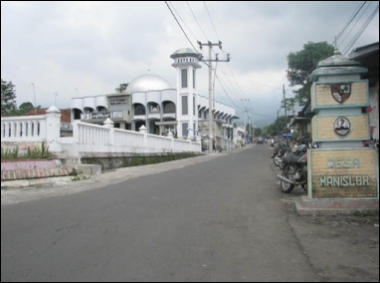
Manislor, the largest Ahmadiyah ghetto

SPECIAL REPORT
Mon, 01/17/2011
9:23 AM
Manislor, the largest Ahmadiyah ghetto
The Jakarta Post
Into the war zone: The Al-Huda mosque in Manislor village in Kuningan regency, West Java, stands at the entry into the village in this photo taken early this month. The village, where 2,000 Ahmadis live side by side with more than 1,000 other villagers, is the epicenter of the unfolding tragedy of discrimination against the minority. JP/Arghea Desafti Hapsari
Followers of the minority Ahmadiyah sect in West Java have seen the worst. They face persecutions by hard-line Islamic groups that have become more frequent and violent than in any other area in Indonesia.

The province is home to the largest population of Ahmadiyah followers in the country, and the epicenter of this unfolding tragedy is Manislor village in Kuningan regency, where 2,000 Ahmadis live side by side with more than 1,000 other villagers.

The Ahmadis have witnessed angry mobs forcing their way into the village to attack and seal off their mosque and houses, but to no avail. This has not happened only once, but four times.

“This village has the largest number of Ahmadis in one location. So it makes us a big glowing target for hardliners,” Nurahim, the secretary-general of Manislor’s Ahmadiyah community, said.

“The hardliners think that if they can take down the biggest group, it would be easier to quash smaller ones.”

Ahmadiyah first spread to the four hamlets of Manislor in the 1950s when village elders attended a discussion on Ahmadiyah in Cirebon, located an hour’s drive from Kuningan.

“They wanted to learn more about Islam so they invited a cleric to the village to teach locals,” Nurahim said.

The arrival of the cleric changed the face of Manislor.

“Manislor in the 1950s was very underdeveloped. It was poor and the villagers practiced animism. They worshipped trees and performed shamanist rituals,” Nurahim said.

“But this all ended when Ahmadiyah spread to this village. Villagers were taught to think more about religion, traditions and social issues,” he said.

The villagers began to abandon their animist ways, paving the path for Ahmadiyah to develop rapidly since 1954, with more and more locals taking up the faith.

Today, villagers who identify as Ahmadis outnumber other residents.

Despite decades of living peacefully despite theocratic differences, no physical confrontations had ever erupted until August 2002 when Islamic hard-line groups from outside the village launched a concerted attack on the Ahmadis.

The incident began when a Muslim youth group in Kuningan attended a seminar on Ahmadiyah at Istiqlal Mosque in Jakarta and returned to the city to stage a protest in Manislor, claiming the Ahmadis were heretical.

Two months later, the group attacked several houses and two small Ahmadiyah places of worship in the village.

Since then, the Kuningan administration has been bombarded by almost constant pressure from various groups to ban Ahmadiyah and evicted the Ahmadis from the village.

The hard-line groups and the Ahmadis frequently lobbied local authorities, each looking to get their demands met, but to no avail.

Manislor villagers have become accustomed to the ever-present tension and carried on with life as usual.

“We’ve experienced so many attacks I lost count. I think we’ve probably been attacked every year since the [2002] attack,” Siti Mudiati, an Ahmadi villager in Manislor, said.

She said the first attack left her traumatized, but as the attacks gained in frequency, she became more inured to them.

But other villagers are not as enduring as Siti. Ayu, who is not an Ahmadi, remains gripped by fear when hardliners appear at her village.

Her house is located between an Ahmadiyah mosque, An-Nur, and the village mosque, Al-Huda, which is used by non-Ahmadi villagers.

“What can I do? It’s not like I can stop the mobs or move my house somewhere else,” she said.

Manislor, a village located at the foot of the Ciremai hills, still bears traces of the latest attack that occurred in July last year.

Several houses along the main street are still plastered with signs reading “members of the Al-Huda mosque, followers of Prophet Muhammad” on their front walls to let attackers know that they are not the targeted Ahmadis. Ayu displays the sign in her window.

Al-Huda sits 150 meters from the An-Nur mosque, which is the center of the Ahmadis’ religious life in Manislor.

Not far from An-Nur is a cooperative run by the Ahmadiyah office in Manislor. Nurahim said the cooperative provided services ranging from granting loans, and electricity and phone bill payment facilities to courier services.

The Ahmadiyah organization in the village also runs a junior high school with around 230 students.

In another hamlet, Siti and 20 other housewives gather to make snacks and handicrafts to be sold at local food stalls and shops.

Ahmadis gather at the An-Nur mosque every Friday for noon prayer and every Wednesday and Sunday when they hold regular religious studies.

As an important part of Ahmadi life, the mosque has been a target of repeated attacks.

In October 2004, a public gathering was held at the Al-Huda mosque, which was attended by members of an Islamic hard-line group.

After the event, a large crowd was mobilized in Manislor and attacked the An-Nur mosque. The attackers demanded that the sect be broken up and its activities terminated.

In July 2005, the Indonesian Ulema Council (MUI) issued a fatwa declaring Ahmadiyah a deviant faith and called on the government to ban it. The fatwa was a reiteration of a previous fatwa issued in the 1980s.

On July 29, a day after the fatwa, the Kuningan administration shut down the An-Nur mosque and seven smaller Ahmadi places of worship in Manislor. Other facilities run by Ahmadis were also closed off, including the school.

Pressure on the Ahmadis in Manislor intensified on Dec. 18, 2007, when a large crowd damaged a small Ahmadiyah mosque and dozens of houses.

The Ahmadis, however, stood their ground, defending their house of worship. Both sides threw rocks and four people were injured in the incident.

But the worst insult to the villagers occurred on July 26, 2010. Local officials and dozens of public order officers came to Manislor to shut down the iconic An-Nur mosque.

After heated debate between the Ahmadis and officials, the latter decided to leave the village without sealing off the mosque.

However, two days later, the Ahmadis woke up to find their mosque sealed off with planks of wood and chains.

On July 29, the Al-Huda mosque held a mass prayer, after which hundreds of outsiders tried to force their way into Manislor to support the officials’ closure of the Ahmadi mosque.

Police halfheartedly attempted to stop them, resulting in clashes and rock throwing, with houses damaged and several people injured in the incident.

- JP/Arghea Desafti Hapsari

Thursday, January 13, 2011

Hard-Liners, Police Shut Down Tolerance Talk in Surabaya: Activists

Jakarta Globe, Indonesia
NEWS
Hard-Liners, Police Shut Down Tolerance Talk in Surabaya: Activists
Amir TejoAmir Tejo | December 15, 2010

Members of the Islamic Defenders Front (FPI) protesting against the Q! Film Festival in Jakarta last year. Pluralism advocates said hard-liners also disrupted a talk on religious tolerance in Surabaya on Thursday. (AP Photo/Irwin Fedriansyah)
Surabaya. Police and Islamic hard-liners on Thursday disbanded a discussion on religious tolerance in Surabaya, said members of a humanitarian watchdog who were in attendance.

Members of the Setara Institute for Peace and Democracy, a group that advocates for pluralism and freedom of worship, said they were participating in the discussion at a coffee shop in the Inna Simpang Hotel with groups including Surabaya Legal Aid and members of the minority Ahmadiyah sect.

They said the meeting was disrupted by dozens of members of a group calling itself the Warring Defenders of Islam (LPI).

Setara activists said Sasmito, a man identifying himself as the head of the LPI, told the attendees the discussion was illegal and would have to be disbanded.

Shortly afterward, the activists said, Surabaya Police arrived and conferred with the LPI, after which the hard-liners left.

The tolerance discussion resumed, but police returned and ordered an end to the gathering, Setara members said.

“We request that you stop with this discussion, because you have not informed us that you were going to hold it,” a police officer said, according to Setara official Bonar Tigor Naipospos.

Bonar said he demanded police tell them what law required police permission to hold a meeting.

“This was no demonstration which requires a permit. This was a meeting involving 15 people at a hotel. Why were we stopped from meeting?” Bonar told the Jakarta Globe.

He said police told him the meeting could pose a security risk because it was held not far from a building where President Susilo Bambang Yudhoyono would be staying during a working visit.

“This was a fabricated reason,” Bonar said.

“Yudhoyono’s visit anywhere would have extraordinary security. This was just a discussion.” He added that organizers had sent a text message to East Java Police Chief Insp. Gen. Badrodin Haiti informing him of the meeting, but that he hadn’t responded.

“We did not meet to conduct anarchic activities or to attack the country,” Bonar said.

“We met here to find a resolution for an ongoing problem. To find a resolution we must listen to all parties involved. This was meant to be positive.”

Members of the gathering said they believed that the hard-liners were connected to the Islamic Defenders Front (FPI), a fundamentalist group known for forcibly imposing their religious views on others.

Setara Institute founder Hendardi on Thursday said he condemned the police’s failure in stopping hard-liners from disrupting human rights discussions.

“This is a clear threat to our constitutional rights to freely express our opinion,” he said.

“Police in the regions can no longer be separated from radical Islamic organizations, who continue to persecute and intimidate minority communities, including those organizations that fight for the rights of these communities.”

Wednesday, January 5, 2011

Religious Affairs Ministry Courts Controversy With Islamic Awards

Jakarta Globe, Indonesia
NEWS
Religious Affairs Ministry Courts Controversy With Islamic Awards
Elisabeth Oktofani, Ulma Haryanto & Fitri R. | January 5, 2011

A gang of youths in West Lombok district destroying an empty home belonging to the Ahmadiyah community in November. Questions are being raised over the Religious Affairs Ministry's decision to honor West Nusa Tenggara Governor Zainul Majdi, who has pushed for a ban on Ahmadiyah (JG Photo/Fitri)
A gang of youths in West Lombok district destroying an empty home belonging to the Ahmadiyah community in November. Questions are being raised over the Religious Affairs Ministry’s decision to honor West Nusa Tenggara Governor Zainul Majdi, who has pushed for a ban on Ahmadiyah (JG Photo/Fitri)
Critics have lashed out at the Ministry of Religious Affairs for recently handing out awards to Muslim leaders, saying it unduly favored Islam over other faiths.

The ministry on Monday presented awards to six governors and 10 district heads and mayors for “explicitly including Islamic education in regional bylaws.”

Recipients included the governors of Bangka-Belitung, Jakarta, Yogyakarta, East Java, West Nusa Tenggara and South Sulawesi.

The winning district heads and mayors were from Lhokseumawe and Sabang in Aceh, East Ogan Komering Ulu and Palembang in South Sumatra, Lebak and Tangerang in Banten, Sukabumi in West Java, Jepara in Central Java, West Sumbawa in West Nusa Tenggara and Kendari in Southeast Sulawesi.

Ismail Hasani, a senior researcher at the Setara Institute for Democracy and Peace, said the ministry “showed favoritism” by handing out the awards.

“It’s supposed to be the Religious Affairs Ministry, not the Islamic Affairs Ministry,” Ismail said on Tuesday.

“I fear that the objectivity of the country’s public officials has been compromised,” he added. “They no longer work for all groups in society, but rather they see things based on the dichotomy of majority and minority.”

In particular, Ismail questioned the ministry’s decision to honor West Nusa Tenggara Governor Zainul Majdi, who pushed for a ban on Ahmadiyah, a minority Islamic sect considered deviant by most mainstream Muslims, in his province.

“Zainul is an Islamic cleric whose grandfather founded Nahdlatul Wathan, the biggest Islamic organization in the province,” Ismail said. “Now he has ambitions to build the country’s biggest Islamic center there, for which he’s already had two schools bulldozed. Not to mention he’s already quarantined the Ahmadiyah.”

Members of the sect have been forced to live in temporary shelters in Mataram after being barred from returning to their homes. Several provincial officials have proposed relocating sect members to a deserted island.

Taqiuddin Mansur, director of the Al Mansuryah Islamic boarding school in Central Lombok, said Zainul’s administration treated Nahdatul Wathan institutions more favorably than those run by Muhammadiyah or Nahdlatul Ulama, the country’s two biggest Islamic organizations.

“A governor shouldn’t be so primordial or sectarian like that,” he said.

Tantowi, a coordinator for the Institute of Humanitarian Studies (LenSA) in West Nusa Tenggara, said funding was skewed toward Zainul’s pet organization and projects.

“The provincial Islamic center gets an annual budget of Rp 500 billion [$56 million],” he said. “Meanwhile, anyone wanting to build a church or house of worship for any other religion gets a hard time from the authorities.”

Noorhaidi Hasan, from Jakarta’s Syarif Hidayatullah State Islamic University, said the awards might have been politically motivated.

“Research shows that religious bylaws are often used only to accumulate power or influence, and they’re not always implemented,” he said. “That the administrations getting the awards are those that pushed for Islamic interests — there might be something there.”

Ismail said the awards were introduced after Suryadharma Ali became the religious affairs minister in October 2009. “During his rule, he has often made decisions that reflect his Islamic political background and not his role as a public official,” he said.

Afrizal Zein, a spokesman of the Religious Affairs Ministry, said the awards were initiated by the head of the Directorate of Islamic Education, which naturally recognized efforts to help Muslim schools.

“If other directorate heads want to do the same thing, they are allowed to do so,” he said. “It just depends on whether they have the budget for it.”

Bonar Tigor Naipospos, Setara’s deputy chairman, said the state should “maintain its distance” from all faiths.

“Unfortunately, the government does things that it thinks are right, but that only turn out to be discriminative,” he said.

Friday, December 31, 2010

2010 Review: Wave of Religious Intolerance Intensifies

Jakarta Globe, Indonesia
NEWS
2010 Review: Wave of Religious Intolerance Intensifies
Dewi Kurniawati | December 30, 2010

Young people chant as an Ahmadiyah member's house is razed. (JG Photo)
Young people chant as an Ahmadiyah member’s house is razed. (JG Photo)
If one trend that emerged in the past year was considered more disturbing than others, it would be the apparent increase in fundamentalism and religious intolerance in a country that prides itself on being a bastion of pluralism.

It is hard to ignore. The increasing trend is evidenced by a constant stream of news reports of attacks against minority religious groups, as well as reports and surveys from various organizations.

The Setara Institute for Peace and Democracy recorded 28 attacks and violations of Christians’ right to worship in the first seven months of the year alone, up from 18 in all of 2009 and 17 in 2008.

In a separate report, the Wahid Institute said it had recorded 196 cases of violence based on intolerance and religious discrimination in 2010, an increase of almost 50 percent from a year earlier. The Moderate Muslim Society, on the other hand, says Indonesia saw at least 81 cases of interreligious conflict in 2010 — an increase of more than 30 percent from 2009.

“What we see today is an excess stemming from the repressive approach to religion during the Suharto era,” said Siti Musdah Mulia, a progressive Islamic scholar from the Indonesian Conference on Religion and Peace.

“Back then, when there was no freedom of speech, religious councils were established to coordinate all religious affairs.”

“Now that we have democracy, everyone wants to express his or her opinion. Unfortunately, many violated Pancasila and our constitution, and the government just turned a blind eye on it,” she added. “The government should forcefully implement the law against those groups. What we see lately is a process of human rights violations by omission.”

Blatant Attacks

It is not just the number of attacks and conflicts that are worrisome. It is also how emboldened the attackers seem to have become.

Members of the Ahmadiyah sect, for example, have been persecuted in the country for many years. Beginning in June, though, attacks against the group began occurring one after the other, the next one seemingly worse than the last.

In the capital, an Ahmadiyah mosque was firebombed. Then, in Bogor, a mob destroyed a mosque and several homes belonging to sect members.

An Ahmadiyah community in West Nusa Tenggara was also attacked in November and forced to leave its village.

The same trend was seen in conflicts involving Christians in the Greater Jakarta area. The shutdown of churches due to lack of necessary permits preceded violent attacks.

In September, Asia Sihombing and Rev. Luspida Simandjuntak, leaders of the Batak Christian Congregation (HKBP) in Bekasi, were stabbed and assaulted. Asia was stabbed and Luspida was be aten with a stick.

Thirteen defendants — including Murhali Barda, the suspended leader of the Islamic Defenders Front’s (FPI) Bekasi chapter — were indicted in court on Wednesday for a variety of charges, but the root of the problem remains.

Setara researcher Ismail Hasani had said earlier that the suburban regions of Jakarta — primarily Bekasi and Bogor, and even Depok and Tangerang — were seeing a radicalization phenomenon.

In June, a new group calling itself the Bekasi Islamic Presidium even announced plans for a road show aimed at persuading every mosque in the city to prepare for the possibility of “war” against “Christianization.”

Government Role

Equally — if not more — frustratingly for pluramism and rights advocates is the government’s response to the problem.

While President Susilo Bambang Yudhoyono has made a number of calls for pluralism to be upheld, those demands have failed to translate into action on the part of the government.

Religious Affairs Minister Suryadharma Ali, for instance, has re peatedly called for Ahmadiyah to disband, and he has shown support for the 1965 Law on Blasphemy that observers say has legitimized acts of violence against minority sects and groups.

The lack of change is also seen among law enforcement officers.

“A police officer once asked why I defended Ahmadiyah because he thinks Ahmadiyah is deviant. I told him that the police should protect them despite what they believe,” Siti said, pointing out that law enforcers should be neutral.

“It shows the lack of civic education in the recruitment process,” she added.

Suryadharma also supports the 2006 Joint Ministerial Decree on Houses of Worship, which requires the consent of the surrounding community for building churches, temples and mosques.

This has often been cited as the cause of the ongoing problem. In a majority Muslim country, a number of Christian congregations have encountered difficulty in getting consent from locals to build churches, forcing them to use houses or even vacant lots as venues for worship, which local governments say is illegal.

“Indonesians have witnessed an enormous process of mismanagement carried out by the government,” said Siti Zuhro, a political analyst from the Indonesian Institute of Sciences (LIPI).

During the iron-fisted rule of former President Suharto, he said, there was no tolerance shown for religious frictions, and any statements that had the potential to stir up social, religious and racial tensions were limited.

“Our democracy failed to create leaders that manage to protect all citizens. We only have rulers,” he said.

Rising Extremism

“I remember when President Yudhoyono held a state dinner during Obama’s visit. He repeatedly mentioned the country’s unity in diversity and pluralism,” said Siti Musdah, the chairwoman of the Indonesian Conference on Religion and Peace.

“Yudhoyono should be ashamed of himself with all these problems in the country.”

Adding insult to injury, the Indonesian Council of Ulema (MUI) said earlier this month that the proliferation of Santas, reindeer and twinkly lights in malls and public places had gone too far for the nation’s Muslim majority, claiming the decor had sparked complaints about Christmas overload.

“We have a serious problem with the powerless leadership that has no vision on how to keep this country united,” said Father Benny Susetyo of the Indonesian Bishops Conference.

“The state is absent in all of this chaos.”

Benny is worried that if the ongoing religious intolerance continues, Indonesia will become like Pakistan, where violence becomes part of daily life. “We may be shattered like the Soviet Union,” he said.

Another problem Benny highlighted was the moderate voices who have become a silent majority in the whole process.

“Moderate Indonesians should raise their voice and demand serious law enforcement by the state apparatus to crack down on these small, hard-line groups,” he said.

A survey released in September by the Center for the Study of Islam and Society found that among 1,200 adult Muslim men and women surveyed nationwide, 57.8 percent said they were against the construction of churches and other non-Muslim places of worship — the highest rate the study center has recorded since 2001. More than a quarter, 27.6 percent, said they minded if non-Muslims taught their children, up from 21.4 percent in 2008.

“Our education system has failed to instill the mentality to respect others whose views are different from ours. Even some elementary schools teach that people who think or live differently are enemies,” Siti said, demanding the government begin serious intervention on the issue. “Education is our only chance for the future.”

Copyright 2010 The Jakarta Globe

Tuesday, December 28, 2010

Tasikmalaya Mayor Claims Ahmadiyah Orphanage Locked at Public’s Request

Jakarta Globe, Indonesia
Jakarta
Tasikmalaya Mayor Claims Ahmadiyah Orphanage Locked at Public’s Request
JG & Antara | December 28, 2010

The Khasanah Kautsar orphanage in Tasikmalaya, West Java, was sealed off by the government on Dec. 18. Tasikmalaya Mayor Syarif Hidayat said the lock-up was at the public's request. (JG Photo/Nivell Rayda)
Jakarta. The municipal government of Tasikmalaya, West Java, is reluctant to reopen an Ahmadiyah orphanage that has been kept shut for weeks by law enforcement.

“We will keep it under lock and key because it is the public’s request,” Syarif Hidayat, the mayor of Tasikmalaya, told state news agency Antara.

The Khasanah Kautsar Orphanage, which is operated by the minority Ahmadiyah community in Kawalu subdistrict in Tasikmalaya, West Java, was locked up, with the children and staff still inside, by the subdistrict police chief and prosecutor on Dec. 18.

Officials argued that the hard-line Islamic Defenders Front (FPI) would otherwise have come to close it down.

Mayor Syarif said the decision attempted to maintain peace and order because the Tasikmalaya public resented the activities of the Ahmadiyah congregation.

“It depends on them [the congregation] whether they acknowledge Ahmadiyah as an organization or as a religion. If they say it’s a religion, of course the public will disagree,” he said.

Meanwhile, Tasikmalaya’s Ahmadiyah leader, Ion Sofyan, said the lock-up had made it difficult for them to do daily activities because they had to climb a three-meter wall every day for school or supplies.

On Monday, 12 rights groups called on the government to reopen the orphanage as it was a violation of the children’s rights.

Seto Mulyadi, chairman of the National Commission for Child Protection (Komnas Anak), said children should not be dragged into adult conflicts.

“The locking up of the children inside the orphanage has taken away the right of the children to have a comfortable place to live, to get an education and also to have the freedom of religion or belief,” he said.

Seto said he would meet with the head of the FPI, Rizieq Shihab, and the leader of the FPI’s Tasikmalaya chapter to find a solution that will spare the children.

Groups urge govt to stop intolerance, enforce law

HEADLINES
Tue, 12/28/2010
10:34 AM

Groups urge govt to stop intolerance, enforce law
The Jakarta Post

Human rights activists called on the government Monday to cease the blockade of an Ahmadi orphanage in Tasikmalaya and protect people’s constitutional right to worship, while another group condemned an attack on a church in Bogor.

On Dec. 7, Tasikmalaya district prosecutors summoned the leader of Ahmadiyah’s Tasikmalaya branch and banned all religious activity inside the Ahmadiyah orphanage in Kawalu district of Tasikmalaya, West Java, citing public protests.

A day later, prosecutors and police sealed off the orphanage, locking 10 children inside.

“The police, prosecutors and local administration must reopen [the orphanage] immediately. It’s their home and they are only children who want to go to school and play,” Muhammad Isnur from the Jakarta Legal Aid Institute (LBH) said.

“The children, aged between 12 to 18 years old, have to climb the fence to get to the school located 2 kilometers from the home,” Budi Badrussalam, who lives close to the orphanage, said at the press conference held by the Coalition for Indonesian Children Advocacy on Monday.

Budi said the children stayed inside the orphanage and were looked after by a caretaker. “They have no choice,” he told The Jakarta Post.

Budi, who is also an Ahmadi, said the orphanage received threats this year from people claiming to be from the hard-line Islam Defenders Front (FPI) and the Islam Defender Troops (LPI).

One of the children, Sofwatur Rohman, said officials tried to expel the children on the same day that the orphanage was sealed off. “We choose to stay inside and they put a padlock on the gate after telling us they did it because the place was used for worship,” he said.

Rohman said neighbors sometimes checked on them and brought food for the locked-up children.

Children rights advocate from the National Commission for Child Protection (Komnas Anak), Seto Mulyadi, criticized the government for not protecting the children. “Children are supposed to be protected and should not be involved in any conflict, especially religious ones,” he said.

Nia Sjarifuddin from the Unity and Diversity National Alliance (ANBTI) condemned the government, including the Women’s Empowerment and Child Protection Ministry, the National Education Ministry, Home Ministry and the Indonesian Child Protection Commission (KPAI) for allowing the children to become victims of religious intolerance.

In another criticism of religious intolerance, the Wahid Institute slammed the government for condoning discrimination against the Indonesian Christian Church (GKI) in Taman Yasmin, Bogor. The government sealed off the under-construction church and stopped the congregation from worshipping and conducting Christmas service.

“The Bogor administration once again violated our rights by ordering us not to observe Christmas this year,” Bona Sigalingging from the church told the Post.

The congregation has been on the receiving end of discriminatory treatment by the local government since March when officials forced them to stop the church construction and later sealed off the site.

Bona said the church had all requisite permits.

“Stop the discrimination. They have the right to worship in peace,” M. Subhi Azhari from the Wahid Institute said. “The central government must act immediately to protect their rights to worship.” (ipa)

Thursday, December 9, 2010

Where’s the Public Justification in Ostracizing Ahmadiyah?

Jakarta Globe, Indonesia
OPINION
Where’s the Public Justification in Ostracizing Ahmadiyah?
Aristo Pangaribua | December 09, 2010

In the most recent example of religious intolerance targeting a minority group in Indonesia, an armed mob attacked an Ahmadiyah mosque in South Jakarta last Friday. This was yet another wound for the Ahmadis, who have experienced hundreds of attacks in various places.

Our government seems reluctant to act on behalf of these minorities.

No one is ever convicted for ransacking and destroying Ahmadi mosques or homes.

It is not surprising to me because in 2008 the minister of religious affairs, the home minister and the attorney general essentially “endorsed” such actions by placing the blame on Ahmadis for failing to halt their religious activities.

Cabinet ministers even provided a “solution” to end the controversy by enacting a 2008 joint ministerial decree that prohibits Ahmadis from performing their religious services in public, because Ahmadiyah is considered a deviant sect of Islam.

Furthermore, the government is now discussing strengthening the legal status of the decree by turning it into state legislation (Undang-undang ).

Rights activists claim that such actions violate freedom of religion.

This has become a hot topic. Does the government have the right to interfere with a citizen’s private beliefs?

This kind of dispute does not just happen in Indonesia.

In the United States, the proselytizing of the Jehovah’s Witnesses sect has been restricted, partly because the group bans blood transfusions for its members, which has led to an outcry over children’s health.

The legalization of gay marriage in the United States is another case, as is the ban on wearing the full Islamic veil in public in France.

Nevertheless, I believe that in some cases the state does have the discretion to interfere with private beliefs to promote a broader “good” and to maintain order as a nation in general.

But what our government has forgotten is the role of explaining and justifying a given action that might be for the good of society.

The government, in deciding to restrict Ahmadiya’s actions, is acting on the basis of “good” religious doctrine.

The action was taken merely because Ahmadiyah tenets contradict the majority view of Islam.

The United States and France both use this discretion largely on the basis of health, security, community standards or nationalism rather than religious values.

Is this a sounder public justification?

Professor Gerald F. Gaus, from the University of Pittsburgh (Value and Justification: 1990), argues that in order to create public justification, a state action must be neutral toward different conceptions of the good.

A ban on the Jehovah’s Witnesses in the US state of Ohio was overturned in court because there was no sufficient public justification and it was deemed unconstitutional.

Public justification plays an indispensable role in the practice of democratic citizenship.

For Indonesia, which often goes on about its being the world’s third-biggest democracy, this requirement is extremely important.

If the term “public justification” seems too abstract, just ask the three ministers who enacted the joint decree how they would feel if the state used its power to prevent them from doing something they believed to be essential to their quality of life, without providing an adequate reason.

The use of coercive power itself is suspect in this case.

The “joint ministerial decree” is unknown in our legal hierarchy.

But the government is adamant this action is necessary to maintain “public order.”

Under the doctrine of separation of powers, it is the task of the courts to balance the state’s interest in restricting Ahmadiyah’s actions against the group’s inherent right to practice its beliefs.

It is imperative for the judges to make sure that the state is not acting for the wrong reasons and has provided a public justification for its action.

However, it is also true that in April 2010, the Constitutional Court declined to void the 1965 Blasphemy Law, which serves as the basis for the government entering the domain of religion.

The court rejected a motion for a judicial review, lodged by former President Abdurrahman Wahid and others, on the ground that the state needs to have this discretion to prevent turmoil and anarchy.

What makes it more confusing is that the joint ministerial decree cannot itself be tested in court.

Constitutional Court Chief Justice Mahfud MD was quoted as saying that the vague status of the decree makes it hard to challenge.

The bottom line is that our “third-largest democracy” has failed to produce a sufficient public justification for the use of its political power against a minority religion.

From what I understand, in a democracy, the citizen is entitled to an explanation when the state uses its power of coercion.

Where in the world is our principle of due process of law?

Aristo Pangaribua is a Jakarta-based lawyer and chairman of Pemuda Indonesia Progresif. He can be reached at www.progresif.net.

Copyright 2010 The Jakarta Globe
 
^ Top of Page