Showing posts with label discrimination. Show all posts

Saturday, December 10, 2011

Ahmadiyah bans: Legal justification for intolerance?

Jakarta Post, Indonesia
OPINIONSat, 12/10/2011 9:27 AM
Ahmadiyah bans: Legal justification for intolerance?
Ati Nurbaiti, Canberra
As of September this year, at least 26 regencies and municipalities have passed bylaws restricting or banning the Ahmadiyah sect, 11 of them in West Java alone, according to a list from the National Commission on Violence Against Women.

Some were issued after the murderous assault on the sect in Pandeglang regency, Banten, in February 2011; including the Banten bylaw itself. The Commission has said women and children of the sect were the most vulnerable in the attacks, which according to the Setara Institute have included 342 cases of assault from 2007 to 2011. This also includes the resettlement of an entire Ahmadiyah community to an island off Lombok.

The local regulations justify other citizens and authorities into closing down Ahmadi mosques, forcing them out of their homes, or ordering them to denounce Islam if they insist on their beliefs. Unlike mainstream Muslims, the Ahmadiyah do not believe that Muhammad is the last prophet, saying they differentiate between prophets and messengers.

However, Muslims have said this is their excuse to hide their real beliefs; that the Ahmadiyah have frequently violated the joint ministerial decree on their sect by proselytizing; and that the attacks on them would stop — if only they would drop their teachings, or declare that they are no longer Muslims.

The bylaws and the joint ministerial decree, revived in 2008, refer to the 2005 non-binding fatwa of the Indonesian Council of Ulema (MUI) which states the Ahmadiyah is deviant; and also the 1965 Law on Blasphemy, which was upheld in 2005 by the Constitutional Court in its ruling against a group of human rights advocates who wanted it annulled. The plaintiffs had said the blasphemy law was no longer relevant for a democracy since it was issued under martial law in 1965.

The movement to annul the 1965 law and those advocating an end to prosecuting minorities, pursue entirely different reasoning from groups who are sealing the Ahmadiyah mosques, often accompanied by local police.

The first argues that the state of a democratic country should not decide which Islam is “right”. The second wonders out loud why the state is leaving Muslims to take matters into their own hands, because, they say, it is evident that Ahmadiyah should be banned, based on the 1965 law, the joint ministerial decree and the MUI fatwa.

A glimpse at news reports in the wake of the Feb. 6 attacks shows that a number of these reports asserted or implied that the real victims were not the Ahmadiyah, whose three members were mobbed and killed, with helpless police officers looking on — all on display to the world thanks to YouTube.

According to the sources in the reports, such as in CyberSabili and hidayatullah.com, the real victims were the Muslims, because the Ahmadis, who insulted Islam, and blatantly defied all civilized requests to stop proselytizing, gained all the sympathy. The “victimization” of Muslims is traced to the marginalization and suppression of Islamic expression by Soeharto, apart from reports of intelligence operations against Muslim activists.

That the Ahmadiyah were not the real victims in the February assault would not necessarily be the majority view; a poll involving 3,000 respondents found most rejecting violence in the name of religion. The July poll by the Setara Institute was conducted in 47 regencies and municipalities in 10 provinces.

But if most Indonesians agreed with these respondents, it doesn’t explain all those bylaws restricting the Ahmadiyah, emerging right under the nose of President Susilo Bambang Yudhoyono. The passing of the bylaws had no difficulty, it seemed, even though the regional autonomy law states that religion should be regulated by the state. But similarly, Religious Affairs Minister Suryadharma Ali and Home Minister Gamawan Fauzi have voiced their opinions that the state should ban or dissolve the Ahmadiyah instead of only restricting their activities.

So are Indonesia’s Muslims becoming increasingly intolerant? Many say tolerance is not the issue, for the Ahmadiyah has insulted Islam.

Leading lawyer Adnan Buyung Nasution told a recent discussion in Canberra that he had a hard time convincing President Yudhoyono that the Ahmadiyah had constitutional rights as a minority — and thus the President may have been persuaded against an outright ban. The ministers overseeing the joint ministerial decree restricting the Ahmadiyah also have a constitutional reference; that religious freedom is limited in respect of followers of other faiths.

The International Crisis Group had recommended an independent body to work out a strategy for religious tolerance; such a body would have to deal with this legal confusion stemming from demands to “protect” the Muslim majority against “deviants”, through rulings such as a state ban on the Ahmadiyah.

Malaysia may seem tragic to many of us as its activists say ordinary citizens, including Muslims themselves, cannot speak out against increased state regulation of Islam, lest they would be considered un-Islamic.

But the incidences of Malaysians’ violence against minorities do not come anywhere close to our long list. Should we be proud of outdoing Malaysia?

The author is a staff writer at The Jakarta Post.

Copyright © 2008 The Jakarta Post - PT Bina Media Tenggara. All Rights Reserved
URL: www.thejakartapost.com/news/2011/12/10/ahmadiyah...intolerance.html

Friday, November 25, 2011

Pakistan: Ahmadi student ejected for resisting Islamists

Sepro News
World:  Asia
Pakistan: Ahmadi student ejected for resisting Islamists
Ahmadi Muslims live in constant fear of persecution in Pakistan. Earlier this year, hundreds were killed by Islamic radicals
Friday, November 25, 2011
By Rodrick Samson

Rabia Saleem, a female student of the Ahmadi religious sect in the final year of studies at the COMSATS Institute of Information Technology in Lahore, Pakistan, has been expelled on allegations of blasphemy. Rabia Saleem was accused of blasphemy by the student wing of the banned Islamist organization known as Tahaffuz-e-Khatam-e-Nabuwwat (TKN). She lived at a student hostel in Lahore, and allegedly removed a banner displayed by TKN condemning the Ahmadi community. A guard observed her removing the poster. He then accused her of committing blasphemy by dishonoring the verses of the Koran. The controversy has been extensively covered in the Pakistani media. Ahmadis are considered by many Muslims as heretics and are treated to the same persecution as are Christians and Hindus in Pakistan.

According to a fellow CIIT student, Nasreem Ghulam, the banner displayed at the hostel door condemned Ahmadis but did not include Koranic verses. Ahmadis claim that she has been falsely accused because of her faith. Rasheed Ahmed Khan, the CIIT Registrar, denied any connection between the removal of the offending banner with the student’s faith. According to the Al-Ufaq website, “Rabia Saleem has been expelled for violating the discipline of the Institution and not complying with the rules and regulation.” He refused to provide a copy of the notice that was served to the student.

Pakistani Ahmadis bury massacre victims, 2011.

A faculty member on the condition of anonymity said,” It was a petty matter that could have been resolved by the warden and the administration, but the warden along with the security guard and CIIT administration exploited the situation against the Ahmadi student, the administration has a very discriminating attitude towards the religious minorities and never leaves a chance to take action against them. In the past several similar incidents took place, but the administration allowed the Tahaffuz-e-Khatam-e-Nabuwwat to continue their propaganda against the Ahmadis, the administration allows the TKN to act, because of the support from the administration they have become strong. The religious organizations should be barred from all the educational institutes, they are harboring terrorists by allowing such organizations to act freely and do whatever they like.”

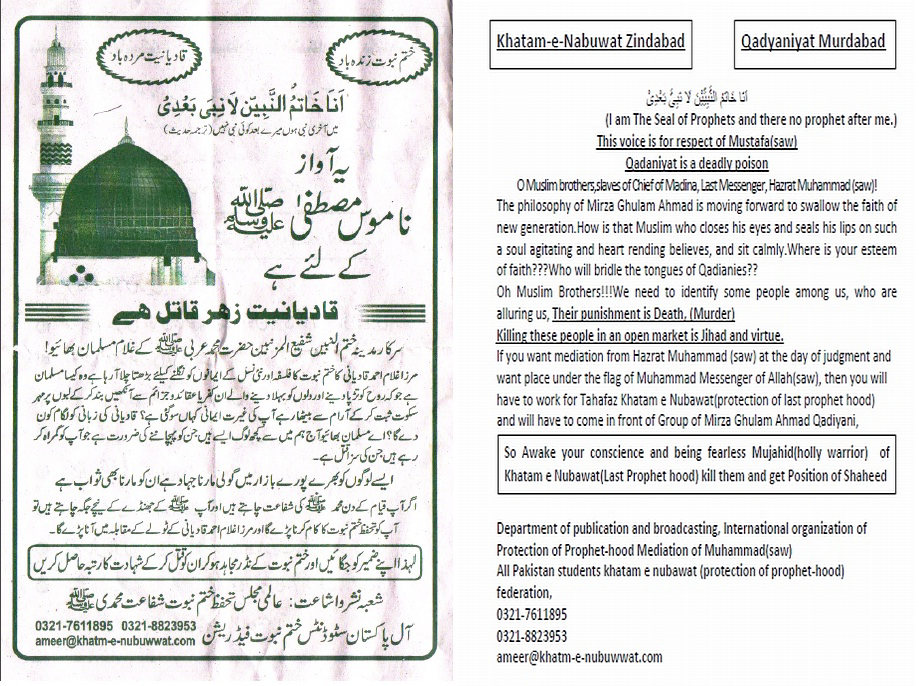
The TKN has been displaying banners denouncing Ahmadis, while the CIIT administration has expelled the student with TKN‘s support and allowed them to display banners inciting hatred against the religious minorities and protest against the Ahmadis. They announced that they will not allow any Ahmadi student to live on the campus and will even kill if any of them resists. TKN has also started campaigns against the Ahmadis on various social networks as well.

The CIIT administration has been accused of allowing such extremist activities to continue on campus, while authorities and the ministry of education silently observe the situation allowing the propaganda against the Ahmadi students.

The Ahmadis have been living in continuous fear, earlier this year an Ahmadi religious institute was attacked in Lahore, and hundreds of innocent people were killed. In past several years the persecution against the Ahmadis has been on the rise.

In September an 8th grader was expelled for a spelling mistake in the Urdu exam in Abbotabad. Her mother was also expelled from Abbotabad.

The Masihi Foundation and Life for All Pakistan, which campaign for human rights, have also condemned the incident and issued a joint statement,” We strongly condemn the incident, the administration of the institution must be condemned for supporting a religious organization and allowing them to act against the code of conduct. The Institution‘s spokesperson said that the Ahmadi student was expelled for violating discipline, displaying banners against the religious minorities is not a violation of the discipline?”

Furthermore, read the statement “ Openly announcing a religious minority liable to be killed is allowed in an educational institution, is this not violation of the regulations and humanity? Where are we headed? Why was a banner against a religious minority allowed to be displayed at the hostel door? Many students suffer discrimination in the educational institutions, but no one addresses the matter. I fail to understand the role of the education Ministry, if they dont do anything for the education, then what is the need of having such an department, it is merely a burden on the nation, simply abolish such ministries which are not performing their designated duties. The state is allowing the religious hatred to grow and is not taking notice of the growing persecution.”

“The extremist mind set is growing and taking over, if this continues Pakistan will lose all the sane people alive. Ensuring the safety of the minorities is the state‘s responsibility, Quaid-e-Azam the founder of Pakistan said every citizen has the right to practice his / her religion freely, anyone‘s religion is their personal mater and not the matter of the state. Is today‘s Pakistan Quaid-e-Azam‘s Pakistan? The Director COMSATS must have immediately resigned on such a shameful incident.”

“This is the reason religious and state affairs should be kept separate,” continued the statement from the humanitarian organizations.

“The concerned authorities must intervene and take the necessary action. The growing extremism in the educational institutions must be checked, no one should be allowed to speak or do anything against any religion. Tolerance and Harmony must be promoted, the religious leaders must play a positive role and condemn such incidents, so that in future students like Rabia Saleem don’t suffer. The only Pakistani who won the Nobel peace prize - Abdul Salam - was never given the place he deserved only because he was an Ahamdi. It is about time the government takes steps to end the religious extremism before it consumes the nation like a plague.”

Rodrick Samson is Spero correspondent in Pakistan.

© Copyright Spero, All rights reserved.
URL: www.speroforum.com/a/OKRZLTUIGV5/...resisting-Islamists

Lahore: Ahmadi student expelled on false blasphemy charges

Asia News
» 11/25/2011 17:11
PAKISTAN
Lahore: Ahmadi student expelled on false blasphemy charges
by Jibran Khan
Rabia Saleem ripped up an anti-Ahmadi poster. Students affiliated with Islamic fundamentalist groups accused her falsely in order to expel her from campus. The university usually covers up extremist abuses as silence reigns in the Education Ministry. Catholic priest slams the authorities’ inaction.

Lahore (AsiaNews) — An Ahmadi student from Lahore (Punjab) was expelled from her university in her senior after she was accused of blasphemy. Students affiliated with Tahaffuz-e-Khatam-e-Nabuwwat (TKN) accused Rabia Saleem of ripping up a poster with anti-Ahmadi content. Ahmadi Muslims are considered heretical by mainstream Islam because they do not view Muhammad as the last prophet. The poster was on the door of the hostel where the young woman lived, and, according to sources, it did not contain any verses from the Qur‘an. A student, who asked for anonymity, said that the university “discriminates against religious minorities” and allows fundamentalist groups to “do as they as they please.”

Rashid Ahmad Khan, additional registrar at the Comsats Institute of Information Technology in Lahore, had denied any link between the student’s expulsion and her religion. Instead, he said she was expelled for “breaking university rules” since she “did not provide a document” required in order to register. Student sources say instead that the expulsion of the Ahmadi student was racist in nature, the result of an attitude of discrimination towards religious minorities that permeates the university.

In the meantime, TKN-affiliated students announced that “Ahmadi students would not be allowed” on campus, and that anybody who tried to resist them would be killed. The university and the education ministry reacted to the threat with total silence.

By contrast, it has send shockwaves through the Ahmadi community, which now fears fresh attacks, like the dual attack of May 2010 against two mosques in Lahore that left hundreds dead.

Speaking to AsiaNews, Fr Amir John said that “many students are victims of discrimination in school and that no one has seriously tackled the problem.” In his view, the state “tolerates religious hatred” and “does nothing when episodes of persecution occur.”

For the Catholic priest, the extremist mindset continues to spread and because of it Pakistan could lose important and prominent people from religious minorities.

The Masihi Foundation and Life for All, two NGOs involved in helping victims of discrimination and violence, also condemned Rabia Saleem’ expulsion. In a joint statement, they called for “tolerance and harmony” and urged religious leaders to “play a positive role” in building a multi-confessional society.

They also noted that the only Pakistani to win a Nobel Prize (for Physics) is Abdus Salam, an Ahmadi, who was not appropriately honoured at home for his international award.

Saturday, November 19, 2011

City closes Ahmadi mosque, denies religious prejudice

Jakarta Post, Indonesia
CITYSat, 11/19/2011 11:40 AM
City closes Ahmadi mosque, denies religious prejudice
Andreas D. Arditya, The Jakarta Post, Jakarta
The Jakarta administration denies any religious predilection in sealing off an Ahmadiyah mosque in East Jakarta this week.

Jakarta Deputy Governor Prijanto said that mosque was shut down because it violated a building permit.

Prijanto did not consider that the Ahmadis had unsuccessfully proposed to the local administration to convert the building permit from a private residence to a public building.

The Ahmadis had held religious services there for 21 years.

“Our local official sealed the building off after sending warning letters,” Prijanto told reporters at City Hall on Friday.

On Thursday, officials from the East Jakarta Building Supervisory Agency (P2B) and the City Public Order closed down At-Taqwa mosque after claiming that the owners of the premises had misused the building permit issued for the premises.

Prijanto said that issues regarding the Islamic sect had been decided by the central government through a ministerial decree.

The head of the East Jakarta branch of the Ahmadiyah, Aryudi Muhammad Shadiq, said the management of the mosque was fully aware of the building violation.

Aryudi said that they had been proposing to the local administration to convert the building permit from that for a private residence to one for a public building, but to no avail.

He questioned the city administration’s decision to seal off the mosque after allowing it to remain open for the past 21 years.

Following the closing of the mosque, a local Islam Defenders Front (FPI) branch said that they would monitor the sect’s activity and report to the city administration should the sect continue performing their religious services there.

Separately on Friday, Jakarta Police chief Insp. Gen. Untung Suharsono Radjab held a meeting with a number of mass organizations, including those notorious for their violent behavior, in Central Jakarta.

Untung said that the meeting was to seek input from the organizations regarding security issues in the capital. The police chief warned that members of any organization who resorted to violence and violated the law would be penalized. “We will process them according to the law.”

Three years ago, the central government issued a joint ministerial decree banning members of the Ahmadiyah Indonesia Congregation (JAI) from propagating their religious beliefs, but allowed them to maintain their faith and perform their daily religious duties.

The decree was followed by a number of regional administrations issuing bans to prevent members of the Ahmadiyah sect from practicing their faith in public.

Jakarta Governor Fauzi Bowo also planned to issue a similar ban, but backtracked after realizing that such bylaws were illegal.

The Coordinating Political, Legal and Security Affairs Ministry said that the local administration could not issue ordinances that went against the Constitution, which guaranteed the freedom of faith and worship.

Copyright © 2008 The Jakarta Post - PT Bina Media Tenggara. All Rights Reserved
URL: www.thejakartapost.com/news/...religious-prejudice.html

Friday, November 18, 2011

City seals off Ahmadiyah mosque in East Jakarta

Jakarta Post, Indonesia
CITYFri, 11/18/2011 10:41 AM
City seals off Ahmadiyah mosque in East Jakarta
The Jakarta Post
East Jakarta officials sealed off a mosque belonging to a group of Ahmadiyah followers in Duren Sawit on Thursday, saying that the place of worship violated zoning regulations.

Officials from the East Jakarta Building Supervisory Agency (P2B), accompanied by public order officers, closed down At-Taqwa mosque after claiming that the owners of the premises had misused the building permit issued for the premises.

In the eviction notice, the P2B said that a building permit had been issued for a private residence, but owners had used the premises as a house of worship. The agency claimed that three warning letters had been issued before the eviction.

The head of the East Jakarta branch of the Ahmadiyah, Aryudi Muhammad Shadiq, said the management of the mosque was fully aware of the building violation.

“We have been trying to convert the building permit from that for a private residence to one for a public building, but to no avail,” he told The Jakarta Post on Thursday.

Aryudi said that bureaucratic red tape had hampered the congregation in obtaining a new building permit. “We spent six months on completing all the required documents. But we didn’t get it,” he said.

He suspected that officials of the B2P had intentionally thwarted their efforts to get a new permit.

“We feel like the city administration doesn’t support our efforts to get a new permit for the mosque,” he said.

Aryudi also questioned the city administration’s decision to seal off the mosque after allowing it to remain open for the past 21 years. “Why now and not years ago? We have never caused problems in the community,” Aryudi said.

Since the founding of the mosque in 1990, members of the Ahmadi congregation have performed their rituals in peace and locals had never lodged any complaints.

A local Ahmadi cleric living in Duren Sawit, Muhammad Diantono, said the Ahmadi community had been in the area since 1967. “They are all locals who have lived in the area for years. They have become part of the community,” he said.

Diantono said that Ahmadis in the area had voluntarily reduced the time they spent on rituals in the mosque even though the East Jakarta administration had made no move to restrict their freedom.

Lately, At-Taqwa had held daily prayers only. Previously, the management of the mosque held a weekly sermon and Koran recitation for its 300 members.

“Ahmadis in several areas may deal with tighter local regulations, but we have been fine here. Yet, we decided to reduce the time we spent at the mosque to prevent possible conflict,” he said.

An East Jakarta Islam Defenders Front (FPI) member, Subhan Amir, said that it was still possible that conflict in the area could result from Ahmadis conducting their rituals at the mosque.

“The mosque is a dangerous place for people living nearby because the Ahmadis can be a bad influence. And now locals have realized how dangerous their beliefs are,” he said.

Subhan said the FPI supported the B2P’s decision to shut down the mosque.

“We will keep an eye on the mosque and if we find that the Ahmadis are still conducting their rituals, we will file a report with the city administration,” said Subhan. (lfr)

Copyright © 2008 The Jakarta Post - PT Bina Media Tenggara. All Rights Reserved
URL: www.thejakartapost.com/news/...east-jakarta.html

Tuesday, November 15, 2011

House told to scrap ‘intolerant’ bill

Jakarta Post, Indonesia
HEADLINESTue, 11/15/2011 12:23 PM
House told to scrap ‘intolerant’ bill
Ina Parlina, The Jakarta Post, Jakarta
The House of Representatives has completed a draft of the so-called religious tolerance bill, which observers claim would threaten the very essence of pluralism and tolerance.

The draft bill, which would regulate religious sermons and segregate graves within public cemeteries according to religion, is seen by some as a potentially giant fan that would spread the growing flame of religious intolerance that has sparked violent conflicts across the nation over the past three years.

The bill does not propose an alternative regulation to the current problematic house of worship licensing system that majority groups have used to make it difficult for members of minority religions to congregate for religious prayers in several regions.

Setara Institute for Peace and Democracy head Hendardi said that if passed, the House-initiated bill would likely legitimize restrictions against minorities for the sake of harmony.

He questioned Article 1 Point 4, which defines blasphemy as any act or interpretation of a religion beyond the scope of that religion’s basic teachings.

“Religious harmony is impossible unless religious freedom for every citizen is guaranteed. Therefore, the state must punish all groups that attack this freedom,” he said.

“We need a bill to eliminate religious discrimination, rather than this sort of tolerance bill.”

“Thus, Setara urges the House of Representatives to bin the draft and arrange a new one based on plurality, equality and religious freedom.”

Indonesia, the world’s largest Muslim majority nation, and also a home to many religions and multi-ethnic groups, has been celebrated worldwide as a champion of cultural and religious pluralism.

However, teachings of the Islamic minority sect Ahmadiyah have been deemed heretical and blasphemous by the Indonesian Ulema Council (MUI). Followers of the faith have been increasingly targeted in recent years by violent groups who have persuaded several local governments through intimidation and rallies to ban the sect “to maintain security in their regions”.

In February, three Ahmadis were murdered in a mob assault on their community compound in Cikeusik, Banten. The attackers were believed to be members of Islamic hard-line groups. Despite video evidence showing the perpetrators commit the crimes, only a handful were brought to court, where they were handed light sentences of several months each.

Setara recorded 50 separate attacks against Ahmadis in 2010.

The much criticized government licensing process for houses of worship is at the heart of an ongoing legal conflict that has stopped a Christian congregation from holding Sunday services in their own church in Bogor, West Java.

The Bogor administration has persisted on banning the GKI Taman Yasmin congregation’s members from conducting religious services in their church despite that the congregation has received permission to do so from the Supreme Court.

Bogor Mayor Diani Budiarto recently filed a lawsuit against the church, alleging that the petition of local consent used by the congregation to gain approval to build the church contained forged signatures.

The Indonesian Ombudsman has issued a statement saying that Diani’s new evidence is not relevant because GKI Yasmin produced the signed petition in 2002, whereas the allegedly false petition was dated 2006.

“The bill is likely to nurture tyranny of the majority. We must know that there is no single majority group in Indonesia. The tyranny of the majority in a certain group might trigger vengeance toward it in the area where it is a minority,” said Catholic priest Benny Susetyo, who is also the chairman of the Indonesian Bishops Conference (KWI) inter-faith dialogue division.

Copyright © 2008 The Jakarta Post - PT Bina Media Tenggara. All Rights Reserved
URL: www.thejakartapost.com/news/...intolerant-bill.html

Friday, November 11, 2011

Blasphemy not a crime: UN official

Jakarta Post, Indonesia
NATIONALFri, 11/11/2011 11:30 AM
Blasphemy not a crime: UN official
Bagus BT Saragih, The Jakarta Post, Jakarta
Amid various acts of discrimination and the persecution of followers of the Ahmadiyah sect, a UN official says blasphemy should not be categorized as a crime.

Frank William La Rue, the UN Special Rapporteur on the promotion and protection of the right to freedom of opinion and expression, said blasphemy may indeed come from someone who disrespects a religion but that this should not be seen as a criminal action.

“I understand that religion, as well as philosophy, is in the world of context of spirituality and concept and idea, and therefore they are open to discussion and debate, which should never be charged with blasphemy law,” Frank told The Jakarta Post on the sidelines of the Asia Civil Society Consultation on National Security and Right to Information Principles, at a hotel in Jakarta on Thursday.

“I believe in respect, but I don’t believe respect can be achieved through censorship,” he added. “Europe also has a blasphemy law and I think that is a mistake.”

Frank cited article 20 of the International Covenant of Civil and Political Rights, which stipulates that all states should prohibit the incitement to hatred hostility and violence and to any form of discrimination on the basis of race, religion or nationality against anyone.

In Indonesia, the covenant was ratified in 2006.

Several Islam groups have been repeatedly urging for the disbandment of the Ahmadiyah sect in Indonesia, saying it is a deviant sect that is blasphemous against Islam.

Members of the groups insist that the government has the authority to ban Ahmadiyah under the old 1965 Law on Blasphemy.

The sentiment was seen earlier this year in a fatal incident in which an Ahmadiyah sect in Cikeusik, Banten, were brutally attacked by a mob in February, leaving three of its members dead and many others injured. Video recordings of the incident were later distributed online, resulting in a public outcry, however, those responsible for the violence received comparitively light sentences.

In 2008, the leader of the Salamullah (God’s Kingdom of Eden) sect, Lia Aminudin, was also detained by police and charged with blasphemy.

In 2010, a number of NGOs concerned with human rights filed for a judicial review at the Constitutional Court, challenging the law against the 1945 Constitution. The petitioners said article 28 of the Constitution guarantees every citizens’ religious rights.

The court, however, denied the request and upheld the law.

Copyright © 2008 The Jakarta Post - PT Bina Media Tenggara. All Rights Reserved
URL: www.thejakartapost.com/news/2011/...official.html

Monday, October 3, 2011

Ahmadi schoolteacher shot dead in Sheikhupura

Express Tribune, Pakistan
Pakistan
Ahmadi schoolteacher shot dead in Sheikhupura
By Rana Tanveer
Published: October 3, 2011
Dilawar Hussain was shot twice at the government school where he taught.
LAHORE: As his students watched, a recent convert to the Ahmadi faith, Dilawar Hussain, 42, was shot dead at a government primary school in a village in Sheikhupura on Saturday.

According to the FIR registered, the deceased was shot twice while he was taking a class at the primary school in Dere Golianwala.

Hussain, along with his wife, Ishrat Bibi, and four children, had recently converted to the Ahmadi faith. His family was the only one in the village belonging to the Ahmadiyya community, Sheikhupura’s Ameer Jamaat Ahmadiyya Chaudhry Abdul Hameed Bhatti told The Express Tribune.

He said the deceased’s siblings boycotted him after his conversion and other relatives went against him when local clerics declared him “liable to be killed”.

Bhatti said even his brothers, one of whom is a police officer, did not want to register an FIR and become a complainant. Instead, they made Ishrat Bibi the complainant and prepared the application themselves.

Hussain’s relatives refused to own his body. At the same time, they created obstacles for his widow to take the body away from the village to Rabwah, the headquarters of the Ahmaddiya community. However, under police security, she finally managed to take the body away.

Sheikhupura SHO Shahid Zafar Gujjar said that as the FIR was registered against two unidentified people, they had no information about the murderers.

The SHO said authorities will be able to trace out the assailants once the witness identifies them. He added that the police had completed the legal requirements by getting autopsy of the body and registering the FIR. He revealed FIR # 1146/11 under section 302 of the Pakistan Penal Code had been registered against the assailants.

Saleemuddin, a spokesperson for Jamat-e-Ahmadiyya Pakistan, condemned the murder and demanded the immediate arrest of the accused. He said fatwas declaring members of the Ahmadi sect “liable to be killed” were being issued in different parts of the country and these religious edicts were being published in vast numbers. This, according to Saleemuddin, has resulted in target killings of many Ahmadis.

Published in The Express Tribune, October 3rd, 2011.

Copyrighted © 2011 The Express Tribune News Network
URL: http://tribune.com.pk/story/265652/ahmadi-schoolteacher-shot...

Monday, September 19, 2011

Jinnah’s Pakistan, hijacked by clerics

The Express Tribune Blogs
Opinion
The Verdict
Kashif ChaudharyJinnah’s Pakistan, hijacked by clerics
Posted by Kashif Chaudhry
Published: September 19, 2011
Jinnah founded Pakistan with the dream of it being a secular state where people could live as free citizens. However, today, Pakistan finds it hard to uphold the very ideals it was founded upon
Jinnah founded Pakistan with the dream of it being a secular state where people could live as free citizens.However, today, Pakistan finds it hard to uphold the very ideals it was founded upon
With the partition of the Indian subcontinent, Pakistan came into existence on August 14, 1947. The valiant and astute Muhammad Ali Jinnah led the minority Muslim community of united India to a separate homeland to fulfill the demand for freedom of religion, profession, and speech.

Jinnah was an outstanding lawyer who had studied law in London. He had a modern outlook on the world and was strongly secular. Part of the oath under which he took office reads:

“No subject … in Pakistan shall, on grounds only of religion, place of birth, descent, color or any of them be ineligible for office.”

He was absolutely clear that the new state he was founding would accommodate people of all faiths and descent without any prejudice. To assert this point, he appointed a non-Muslim as his first law minister. The Muslims in his cabinet consisted of Sunni, Shia, and Ahmadis alike. He believed that Islam endorsed a secular democracy and the two were perfectly compatible.

“The great majority of us are Muslims. Consequently, we have a special and a very deep sense of unity. But make no mistake: Pakistan is not a theocracy or anything like it” he said in an address in 1948.

He believed in a Pakistan wherein the mosque would be separate from the state.

“You are free; you are free to go to your temples, you are free to go to your mosques or to any other place of worship in this State of Pakistan. You may belong to any religion or caste or creed that has nothing to do with the business of the State” he said.

In the struggle for Pakistan, Jinnah was not faced with the Indian Congress and the British alone. He also had to endure intense animosity from hard-line Muslim clerics and counter their vile propaganda. He was accused, by the ultra right-wing, of blasphemy, and they considered him a great heretic for his secular ideology.

Prominent clerics like Maulana Maududi urged common Muslims not to side with Jinnah. Maududi wrote:

“It is forbidden to vote for [Jinnah’s] Muslim League.”

Despite this, the resolute Jinnah was successful in garnering support from the masses in most Muslim-majority areas.

Today, the nation finds it hard to uphold the very ideals it was founded upon. As it passes through dangerously volatile times, it has forsaken its founding principles of freedom and secularism.

But how and why did Pakistan turn against itself?

Even though he tried his best to steer it toward a secular democracy, Jinnah did not live long enough to see it become one. Over the coming years, Pakistan took a very troubling turn. In a matter of nine years, it became an “Islamic Republic,” and in a little over two decades, it had essentially become a theocracy.

The same extremist clerics who had opposed Jinnah and his struggle for Pakistan gradually claimed ownership of the State. They formed political groups that used religion to amass public support. Their demonstrations of street power, frequently violent, meant that sectarian hatred and intolerance was the order of the day.

Even governments avoided a clash with the radical right and became increasingly wary of arousing any negative religious sentiment and consequently losing popular vote. This only furthered the extremist cause, and in time, the original path Pakistan started on was completely forsaken. Pakistan, it is now said, was formed for the Muslims and is meant to become an Islamic theocracy where the Shariah, as interpreted by the hard-liners, is to be the ultimate law.

One tragedy after another, Jinnah’s Pakistan was dealt with massive blows. His Pakistan was no more his; it had been hijacked by forces of extremism and intolerance.

Non-Muslims could not hold the highest office in any of the core institutions anymore.

In 1953, there were widespread riots against the Ahmadi Muslims, a sect that extremists considered heretics.

The harassment of Shia Muslims and other minority groups also increased and went largely unchecked.

In 1974, the government yielded to intense pressure and declared the Ahmadiyya sect non-Muslim.

Tout de suite, the State had taken authority to decide its people’s religion, and the two were no longer separate.

General Zia ul Haq took over the country and became its third military president in 1977. To legitimize his dictatorship, he sought to please the right-wing and set to Islamize Pakistan. Amongst other things, he introduced the controversial blasphemy laws that stated death as the punishment for any derogatory remark against the Quran, Prophet Muhammad (PBUH), and other Islamic holy personages.

For Ahmadis, Zia also promulgated an ordinance in 1984 that criminalized the practice of their faith. Zia’s rule was the toughest for citizens who did not adhere to what had now become the state-backed perversion of Islam. Jinnah’s secular Pakistan had drifted into the hands of his enemies.

Jinnah had warned of this in his August 11th, 1947 address to the Constituent Assembly of Pakistan. He said:

“As you know, history shows that in England, conditions, some time ago, were much worse than those prevailing in India today. The Roman Catholics and the Protestants persecuted each other. Even now there are some States in existence where there are discriminations made and bars imposed against a particular class. Thank God, we are not starting in those days.” He continued: “Today, you might say with justice that Roman Catholics and Protestants do not exist; what exists now is that every man is a citizen, an equal citizen of Great Britain and they are all members of the nation.”

In the same address, he said:

“My guiding principle will be justice and complete impartiality, and I am sure that with your support and cooperation, I can look forward to Pakistan becoming one of the greatest nations of the world.”

Jinnah knew that a secular form of government could bridge differences and bring together people of all faiths and backgrounds to build a strong Pakistan. Just as the Catholics had learned to live with the Protestants, he was optimistic that the Pakistan he was founding would be a successful nation, a beacon of tolerance and an example of unity in diversity. However, the men who opposed Jinnah’s ideals before partition stood in his way yet again.

Founded on freedom of religion and practice, Pakistan is one of the biggest violator of religious freedom today. For Pakistan to succeed, it will have to reverse the dangerous turn it took and get back on the path that Jinnah laid before it. The blasphemy laws must be amended, everyone must be equal citizen of the state, the anti-Ahmadi laws must be revisited and the state must remain separate from the mosque at every cost. Pakistan must educate itself and look for the unity that Jinnah so cherished in the diversity across the land.

In February 1948, Jinnah said in an address:

“You have to stand guard over the development and maintenance of democracy, social justice and the equality of manhood in your own native soil. With faith, discipline and selfless devotion to duty, there is nothing worthwhile that you cannot achieve.”

Unfortunately, recent events have shown that Pakistan is still far away from taking that vital turn. The government has shown little resolve to go after the perpetrators of religious hate and violence and definitely no will to even trigger a dialogue on the controversial laws of the land. With Pakistan headed toward a steep decline, the solution lies in bold courage and reform. Jinnah’s Pakistanis will have to wake up sooner than later and reclaim the land from his opponents. Pakistanis must bring about a rebirth of Pakistan – Jinnah’s Pakistan.

Copyrighted © 2011 The Express Tribune News Network
URL: http://blogs.tribune.com.pk/story/8046/jinnahs-pakistan-hijacked-by-clerics/

Thursday, September 15, 2011

Religious freedom report: Pakistan one of 10 countries ‘failing to protect minorities’ rights’

Express Tribune, Pakistan
Pakistan
Sindh
Religious freedom report: Pakistan one of 10 countries ‘failing to protect minorities’ rights’
By Atika Rehman
Published: September 15, 2011
US state department report states that the Pakistani govt failed to protect minorities against abuse, discrimination. PHOTOS: FILE
KARACHI: Pakistan was cited among 10 countries “failing to sufficiently protect religious rights”, in a report regarding religious freedom released by Washington on Wednesday.

The other countries, mentioned in the US State Department’s International Religious Freedom report for the second half of 2010, included Afghanistan, Egypt, Iraq, Nigeria, Russia, Tajikistan, Turkmenistan, Venezuela and Vietnam.

However, Pakistan was not included in the list of ‘countries of particular concern’ regarding religious freedom – much to the dismay of the US Commission on International Religious Freedom (USCIRF). The list named China, Saudi Arabia, Myanmar, North Korea, Eritrea, Iran, Sudan and Uzbekistan.

“… the current list continues with glaring omissions, such as Pakistan and Vietnam. We respectfully urge Secretary Clinton to consider the six additional countries we recommended for designation,” said USCIRF Chair Leonard Leo.

The report details actions such as active state repression, violence against religious groups, apostasy and blasphemy laws, anti-Semitism and restrictions on religious attire and expression.

The report bluntly states that the constitution and laws in Pakistan “restricted religious freedom and, in practice, the government enforced these restrictions.”

Citing acts of violence against religious minorities as well as societal and governmental discrimination, it states that “the government rarely investigated or prosecuted the perpetrators of increased extremist attacks on minorities and the majority promoting tolerance, which deepened the climate of impunity.”

The report includes a long list of case studies of violence and discrimination against Ahmadis, Christians, Sikhs, Hindus and other Muslim sects.

The controversial blasphemy law, Aasia Bibi’s case in particular, and discrimination against the Ahmadiyya community take centre stage in the 30 pages of the report dedicated solely to Pakistan. “The government did not undertake reform measures to prevent the abuse of the blasphemy laws.

Toward the end of the reporting period the public discourse regarding the blasphemy laws became increasingly heated, which contributed to the government’s reluctance to address the issue. For example, after initially signalling he was considering pardoning Aasia Bibi’s death penalty sentence for alleged blasphemy, President Zardari refrained from doing so,” the report states.

It adds that the government, in fact, distanced itself from a bill introduced by a member of the ruling party that would have amended the blasphemy laws to prevent abuse.

Terming the blasphemy laws “a legal weapon against religious minorities and other Muslims”, the report says that the government’s failure in addressing religious hostility fostered intolerance and acts of violence against minorities and Muslims alike.

However, the report gives credit to the slain minorities minister Shahbaz Bhatti for promoting religious tolerance and taking an active role in assisting victims of religiously motivated attacks on Christians and Ahmadis.

The report states that, according to the National Commission for Justice and Peace (NCJP), between 1987 and 2010, a total of 1,068 persons were charged under the blasphemy laws. In 2010, blasphemy complaints were registered with the police against 17 Christians, eight Muslims, five Ahmadis, and seven Hindus, according to the report.

(ADDITIONAL INPUT FROM AFP)

Published in The Express Tribune, September 15th, 2011.

Copyrighted © 2011 The Express Tribune News Network
URL: http://tribune.com.pk/story/252659/religious...rights/

Wednesday, September 14, 2011

Count Pakistan among countries violating religious freedom: US commission

Express Tribune, Pakistan
Pakistan
Thinking proactively: Ahmadis have found their own solutions in Rabwah
By Atika Rehman
Published: September 14, 2011
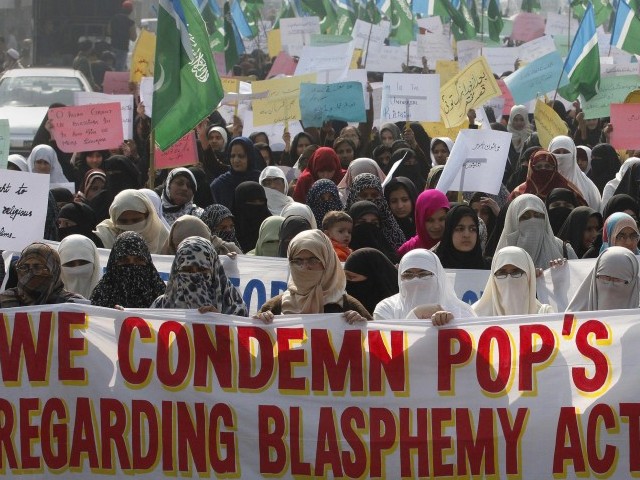
Female supporters of Jamaat-i-Islami (JI) hold placards and banner during a protest regarding the Pope's statements on Pakistan's blasphemy law. PHOTO: AFP/FILE
Female supporters of Jamaat-i-Islami (JI) hold placards and banner during a protest regarding the Pope’s statements on Pakistan’s blasphemy law. PHOTO: AFP/FILE
WASHINGTON: The United States Commission on International Religious Freedom (USCIRF) expressed concern over Pakistan’s omission from the list of eight countries termed “countries of particular concern” with regards to violation of religion freedom.

The list was published by the US State Department in a report which listed Burma, China, Eritrea, Iran, North Korea, Saudi Arabia, Sudan and Uzbekistan as countries where religious rights were severely infringed.

Although Pakistan was omitted from the list, the report stated that Pakistan’s laws restrict religious freedom and that the government enforced these restrictions. It also adds that investigation and prosecution of perpetrators in the case of extremist attacks on minorities are rare.

Citing the blasphemy law and Aasia Bibi’s case, the report suggests that the Pakistan government distanced itself from a bill proposed by an MNA to repeal the “discriminatory” law.

It also mentions that the Ahmadiyya community along with members of other Islamic sects, Christians, Sikhs, and Hindus face governmental and societal discrimination.

The report noted, however, that the government took some measures to improve religious freedom. It mentioned the late Federal Minister for Minorities, Shahbaz Bhatti’s attempts to assist victims of religiously motivated attacks.

The commission on Tuesday remarked that it is concerned that no new countries were added to the list.” said

‘Don’t forget Pakistan’

“Repeating the current list continues glaring omissions, such as Pakistan and Vietnam … we respectfully urge Secretary Clinton to consider the six additional countries we recommended for designation,” said Leonard Leo, USCIRF Chair.

The other four countries recommended by the commission are Egypt, Iraq, Nigeria and Turkmenistan.

Commenting on the report, US Secretary of State Hillary Clinton urged governments Tuesday to do more to defend religious freedom as Washington released a report citing eight countries with troubling records on the issue.

“We reaffirm the role that religious freedom and tolerance play in building stable and harmonious societies. Hatred and intolerance are destabilizing,” Clinton said.

Copyrighted © 2011 The Express Tribune News Network
URL: http://tribune.com.pk/story/252125/count...commission/

Wednesday, May 18, 2011

UN High Commissioner urges for Special Rapporteur visit

Jakarta Post, Indonesia
NATIONALWed, 05/18/2011 9:29 PM
UN High Commissioner urges for Special Rapporteur visit
The Jakarta Post, Jakarta
The United Nations’ High Commissioner for Human Rights, Navanethem Pillay, has urged the government to accept the request of the Special Rapporteur on freedom of religion or belief to visit the country this year.

The call came in a letter sent to Foreign Affairs Minister Marty Natalegawa, a copy of which was obtained by The Jakarta Post on Wednesday.

In the letter, dated April 26, Pillay expressed his concern over reports of violence against members of religious minorities in Indonesia.

He said he had received reports of widespread violence and discrimination against the Ahmadiyah community in Indonesia, including the issuance of several decrees banning their activities in certain regions.

He had also received reports concerning harassment and violence against members of other religious minorities, he said.

“In Bogor, West Java, I am informed that local authorities have closed off the Indonesian Christian Church of Taman Yasmin and prevented them from conducting religious services,” Pillay wrote in his letter.

There were also reports of Christian groups being attacked and Christian churches being burned in several regions. He further mentioned reports that a Buddhist community in North Sumatra was ordered to dismantle a Buddha statue at a temple that was considered by some to be a challenge to Islam in that area.

Pillay said he hoped that his office “might be able to contribute in some meaningful and constructive way to the discussion and law reform efforts taking place within Indonesia and would welcome the opportunity to discuss this further” with the Indonesian government.

“In this regard, I strongly encourage the Government of Indonesia to accept the request of the Special Rapporteur on freedom of religion or belief to undertake a visit to the country later this year,” he added.

Copyright © 2008 The Jakarta Post - PT Bina Media Tenggara. All Rights Reserved
URL: www.thejakartapost.com/news/2011/05/18/un-high...visit.html

UN tells RI to review laws restricting religious freedom

Jakarta Post, Indonesia
NATIONALWed, 05/18/2011 8:15 PM
UN tells RI to review laws restricting religious freedom
The Jakarta Post, Jakarta
The United Nations’ High Commissioner for Human Rights Navanethem Pillay has urged Indonesia to review its laws restricting religious expression and practice.

In a letter sent to Foreign Minister Marty Natalegawa, a copy of which was obtained by The Jakarta Post on Wednesday, Pillay expressed his concern over reports of violence against members of religious minorities in Indonesia.

“I have been particularly disturbed by the widespread violence and discrimination reported against the Ahmadiyya community which has included the state-sanctioned closing of Ahmadi mosques, the burning of homes and places of worship, and even physical violence and murder,” Pillay wrote in his letter dated April 26.

Three Ahmadis were killed when Islamic hard-liners attacked a small Ahmadiyah community in Cikeusik, West Java, on Feb. 6 this year. Several local and provincial administrations have since issued decrees banning Ahmadiyah activities in their respective regions.

Pillay said reports had said that since the new regulations were issued, “further acts of harassment and violence have taken place”.

He pointed out that Indonesia had ratified the International Covenant on Civil and Political Rights (ICCPR), which guarantees the right to freedom of religion.

“Government at both national and provincial levels should comply with the guarantees contained in the Indonesian Constitution and in the international treaties in which Indonesia is a party. All laws, particularly those restricting religious expression and practice, should be reviewed to ensure they comply with these standards,” he said.

He also urged the Indonesian government to ensure the legal accountability of all perpetrators, including the imposition of penalties.

Copyright © 2008 The Jakarta Post - PT Bina Media Tenggara. All Rights Reserved
URL: www.thejakartapost.com/news/2011/05/18/un-tells...freedom.html

Tuesday, May 17, 2011

UN ‘Disturbed’ by Indonesia’s Religious Violence

Jakarta Globe, Indonesia
HOME
UN ‘Disturbed’ by Indonesia’s Religious Violence
Camelia Pasandaran & Cameron Bates | May 17, 2011

The United Nations has written to the Indonesian government expressing “concern” about the increasing number of reports about violence committed against religious minorities.

The Ministry of Foreign Affairs, however, says it is yet to receive a copy of the letter, dated April 26, 2011, from UN High Commissioner for Human Rights Navanethem Pillay. The letter was also copied to the National Commission on Human Rights (Komnas HAM) and a number of other Indonesia institutions.

Pillay also reveals a proposed visit by the UN’s special rapporteur on freedom of religion or belief to visit Indonesia this year to investigate the allegations.

In the letter, a copy of which was obtained by the Jakarta Globe on Sunday, Pillay says she is writing to the Indonesian government to “express my concern over the large number of letters and reports I have received in recent months concerning violence against members of religious minorities in Indonesia.”

“I have been particularly disturbed by the widespread violence and discrimination reported against the [Ahmadiyah] community, which has included the state-sanctioned closing of Ahmadi mosques, the burning of homes and places of worship, and even physical violence and murder.”

Pillay said that since the violent attack that left three Ahmadi dead in Cikeusik, West Java, on Feb. 6, several government authorities had responded by issuing new regulations and decrees that allowed “further acts of harassment and violence” to occur.

Pillay also noted a number of other reported incidences of religious intolerance, including the ongoing stand-off between the Bogor government and the Indonesian Christian Church (GKI) Yasmin.

“Christian groups have reportedly been attacked and Christian churches have reportedly been burned in Gebyog, Klaten and Tegal in Central Java. In North Sumatra, a Buddhist community was ordered to dismantle a Buddha statue at a temple that was considered by some to be a challenge to Islam in that area.”

The commissioner said the incidents put at risk the human rights guaranteed in the Constitution and the International Covenant on Civil and Political Rights, to which Indonesia is a signatory.

“The General Assembly and Human Rights Council have repeatedly urges States to take all necessary and appropriate actions, in conformity with international human rights standards, to combat hatred, discrimination, intolerance and acts of violence, intimidation and coercion motivated by intolerance based on religion or belief, as well as incitement to hostility and violence, with particular regard to members of religious minorities.”

Pillay said she understood that discussions were ongoing between the government, Komnas HAM, civil society and religious groups concerning the issue.

“I encourage the government of Indonesia to take this opportunity to support reflection and action at various levels to address the broader issues behind religious intolerance and discrimination.”

She said that laws that restricted religious expression and practise “must be reviewed to ensure they comply with these standards” and well as ensuring that justice was upheld against those found to have committed wrongdoing.

Pillay also “strongly encouraged” the government to accept a proposed visit by the United Nation’s special rapporteur on freedom of religion or belief to visit Indonesia this year.

Rev. Ujang Tanusaputra of GKI Yasmin said the letter was “a bad assessment of Indonesia in the context of religious freedom.”

“As a nation that is based on [the state ideology] Pancasila with its motto Unity in Diversity, the government should uphold and implement the pillars of Indonesia.”

Copyright 2010 The Jakarta Globe
URL: www.thejakartaglobe.com/home/united-nations.../441540

Friday, December 31, 2010

2010 Review: Wave of Religious Intolerance Intensifies

Jakarta Globe, Indonesia
NEWS
2010 Review: Wave of Religious Intolerance Intensifies
Dewi Kurniawati | December 30, 2010

Young people chant as an Ahmadiyah member's house is razed. (JG Photo)
Young people chant as an Ahmadiyah member’s house is razed. (JG Photo)
If one trend that emerged in the past year was considered more disturbing than others, it would be the apparent increase in fundamentalism and religious intolerance in a country that prides itself on being a bastion of pluralism.

It is hard to ignore. The increasing trend is evidenced by a constant stream of news reports of attacks against minority religious groups, as well as reports and surveys from various organizations.

The Setara Institute for Peace and Democracy recorded 28 attacks and violations of Christians’ right to worship in the first seven months of the year alone, up from 18 in all of 2009 and 17 in 2008.

In a separate report, the Wahid Institute said it had recorded 196 cases of violence based on intolerance and religious discrimination in 2010, an increase of almost 50 percent from a year earlier. The Moderate Muslim Society, on the other hand, says Indonesia saw at least 81 cases of interreligious conflict in 2010 — an increase of more than 30 percent from 2009.

“What we see today is an excess stemming from the repressive approach to religion during the Suharto era,” said Siti Musdah Mulia, a progressive Islamic scholar from the Indonesian Conference on Religion and Peace.

“Back then, when there was no freedom of speech, religious councils were established to coordinate all religious affairs.”

“Now that we have democracy, everyone wants to express his or her opinion. Unfortunately, many violated Pancasila and our constitution, and the government just turned a blind eye on it,” she added. “The government should forcefully implement the law against those groups. What we see lately is a process of human rights violations by omission.”

Blatant Attacks

It is not just the number of attacks and conflicts that are worrisome. It is also how emboldened the attackers seem to have become.

Members of the Ahmadiyah sect, for example, have been persecuted in the country for many years. Beginning in June, though, attacks against the group began occurring one after the other, the next one seemingly worse than the last.

In the capital, an Ahmadiyah mosque was firebombed. Then, in Bogor, a mob destroyed a mosque and several homes belonging to sect members.

An Ahmadiyah community in West Nusa Tenggara was also attacked in November and forced to leave its village.

The same trend was seen in conflicts involving Christians in the Greater Jakarta area. The shutdown of churches due to lack of necessary permits preceded violent attacks.

In September, Asia Sihombing and Rev. Luspida Simandjuntak, leaders of the Batak Christian Congregation (HKBP) in Bekasi, were stabbed and assaulted. Asia was stabbed and Luspida was be aten with a stick.

Thirteen defendants — including Murhali Barda, the suspended leader of the Islamic Defenders Front’s (FPI) Bekasi chapter — were indicted in court on Wednesday for a variety of charges, but the root of the problem remains.

Setara researcher Ismail Hasani had said earlier that the suburban regions of Jakarta — primarily Bekasi and Bogor, and even Depok and Tangerang — were seeing a radicalization phenomenon.

In June, a new group calling itself the Bekasi Islamic Presidium even announced plans for a road show aimed at persuading every mosque in the city to prepare for the possibility of “war” against “Christianization.”

Government Role

Equally — if not more — frustratingly for pluramism and rights advocates is the government’s response to the problem.

While President Susilo Bambang Yudhoyono has made a number of calls for pluralism to be upheld, those demands have failed to translate into action on the part of the government.

Religious Affairs Minister Suryadharma Ali, for instance, has re peatedly called for Ahmadiyah to disband, and he has shown support for the 1965 Law on Blasphemy that observers say has legitimized acts of violence against minority sects and groups.

The lack of change is also seen among law enforcement officers.

“A police officer once asked why I defended Ahmadiyah because he thinks Ahmadiyah is deviant. I told him that the police should protect them despite what they believe,” Siti said, pointing out that law enforcers should be neutral.

“It shows the lack of civic education in the recruitment process,” she added.

Suryadharma also supports the 2006 Joint Ministerial Decree on Houses of Worship, which requires the consent of the surrounding community for building churches, temples and mosques.

This has often been cited as the cause of the ongoing problem. In a majority Muslim country, a number of Christian congregations have encountered difficulty in getting consent from locals to build churches, forcing them to use houses or even vacant lots as venues for worship, which local governments say is illegal.

“Indonesians have witnessed an enormous process of mismanagement carried out by the government,” said Siti Zuhro, a political analyst from the Indonesian Institute of Sciences (LIPI).

During the iron-fisted rule of former President Suharto, he said, there was no tolerance shown for religious frictions, and any statements that had the potential to stir up social, religious and racial tensions were limited.

“Our democracy failed to create leaders that manage to protect all citizens. We only have rulers,” he said.

Rising Extremism

“I remember when President Yudhoyono held a state dinner during Obama’s visit. He repeatedly mentioned the country’s unity in diversity and pluralism,” said Siti Musdah, the chairwoman of the Indonesian Conference on Religion and Peace.

“Yudhoyono should be ashamed of himself with all these problems in the country.”

Adding insult to injury, the Indonesian Council of Ulema (MUI) said earlier this month that the proliferation of Santas, reindeer and twinkly lights in malls and public places had gone too far for the nation’s Muslim majority, claiming the decor had sparked complaints about Christmas overload.

“We have a serious problem with the powerless leadership that has no vision on how to keep this country united,” said Father Benny Susetyo of the Indonesian Bishops Conference.

“The state is absent in all of this chaos.”

Benny is worried that if the ongoing religious intolerance continues, Indonesia will become like Pakistan, where violence becomes part of daily life. “We may be shattered like the Soviet Union,” he said.

Another problem Benny highlighted was the moderate voices who have become a silent majority in the whole process.

“Moderate Indonesians should raise their voice and demand serious law enforcement by the state apparatus to crack down on these small, hard-line groups,” he said.

A survey released in September by the Center for the Study of Islam and Society found that among 1,200 adult Muslim men and women surveyed nationwide, 57.8 percent said they were against the construction of churches and other non-Muslim places of worship — the highest rate the study center has recorded since 2001. More than a quarter, 27.6 percent, said they minded if non-Muslims taught their children, up from 21.4 percent in 2008.

“Our education system has failed to instill the mentality to respect others whose views are different from ours. Even some elementary schools teach that people who think or live differently are enemies,” Siti said, demanding the government begin serious intervention on the issue. “Education is our only chance for the future.”

Copyright 2010 The Jakarta Globe

Thursday, December 23, 2010

“Historic” meeting between Ahmadiyya Community and Tooting Islamic Centre ends in silence

Wimbledon Guardian, UK
News
“Historic” meeting between Ahmadiyya Community and Tooting Islamic Centre ends in silence
4:00pm Thursday 23rd December 2010
By Omar Oakes »

Sadiq Khan MP: Joint statement of TIC and Ahmadis will reflect 'goodwill and postivity' at meeting
Sadiq Khan MP: Joint statement of TIC and Ahmadis will reflect “goodwill and postivity” at meeting
Ten days after what was billed as a “historic” meeting to rebuild community relations damaged by a hate campaign against a minority Islamic sect the main participants seem unable to agree what, if anything, it has achieved.

In October, the Wimbledon Guardian and the Wandsworth Guardian revealed evidence of a hate campaign against the Morden-based Ahmadis, an Islamic minority sect considered non-Muslim by many mainstream Muslims.

Our investigation focused on Tooting and the Tooting Islamic Centre (TIC) in Upper Tooting Road, where an anti-Ahmadi conference was held in March in which worshippers were told to boycott Ahmadi-run shops.

After that conference, Ahmadi-run shops complained of a sharp loss of trade and anti-Ahmadi leaflets have been found on display in a Tooting cosmetics shops and on the main noticeboard of the Tooting Islamic Centre.

Following our investigation, a meeting, organised by Tooting MP Sadiq Khan, was held at Wandsworth Town Hall on Monday, December 13 to discuss the Ahmadis’ concerns.

It was attended by Mr Khan, Wandsworth police borough commander David Musker, Wandsworth Council Leader Edward Lister, four representatives from the TIC and nine representatives from the Ahmadiyya Muslim Association (AMA).

A joint statement was due to be issued last week on behalf of the TIC and the AMA, but so far no statement has been agreed and no further meetings have been planned.

This newspaper was denied access to the meeting and the participants are remaining tight lipped on the outcome - billed by Tooting MP Sadiq Khan as a “historic” chance for the TIC and AMA to clear the air.

In an interview last month Mr Khan said he did not know about the anti-Ahmadi campaign until told by this newspaper in October.

At the time he said he was pleased to “organise this historic first meeting”.

But yesterday his only comment was to issue a two line statement saying: “It was agreed the management of TIC and the Ahmadiyya community leaders would try and agree a joint statement, and I am hopeful this will reflect the goodwill and positivity that was evident from all sides during the meeting.”

Kingston police were investigating allegations of hate crimes after a leaflet was allegedly distributed in Kingston town centre.

A teenage Ahmadi girl, who did not want to be named, gave police a statement claiming the leaflet, which she said was written in Urdu, said: “Kill a Qadiyani [Ahmadiyya] and doors to heaven will be open to you”.

Kingston police later said it had never been handed the leaflet and has not received any other allegations.

Copyright 2001-2010 Wimbledon Guardian, UK. All rights reserved.
URL: www.wimbledonguardian.co.uk/news...c_Centre_ends_in_silence/

Thursday, December 9, 2010

Riot Threatens to Burn Down Orphanage

HeadlinesVIVA News
Riot Threatens to Burn Down Orphanage
“Why does it matter for them if the building is used for praying?”
Ismoko WidjayaKamis, 9 Desember 2010, 10:59 WIB

Ahmadiyah Spokesperson Zafrullah Ahmad Pontoh (Antara/ Maulana Surya Tri Utama)
VIVAnews - An orphanage belonging to a modern Islamic group Ahmadiyah which is situated in Cicariang, Kawalu, Tasikmalaya, West Java, is threatened to be burnt down by riot. Hasanah Kautsar orphanage has been in the area for around 10 years.

“It’s already inhuman to lock us up in the orphanage not to mention burning [the orphanage] down,” said spokesperson of Ahmadiyah, Zafrullah Ahmad Pontoh, today, Dec 8.

According to Zafrullah, the occurrence took place yesterday as a handful of state officials tried to seal the building. Children of 10-14 years of age were still inside the building when the officials locked the gate.

“A few minutes after, a group of people shouted outside of the complex saying that they wanted to set the orphanage on fire. It’s a social house. We don’t understand their logic,” he said.

The building was owned by a member of Ahmadiyah living in Tasikmalaya. “It’s home of some orphans as well. Why does it matter for them if the building is used for praying?“ he said.

In the meantime, Kawalu and Tasikmalaya police departments have yet to share any information.

Earlier, Minister of Religious Affairs, Suryadharma Ali, requested Ahmadiyah to disband the group. According to Suryadharma, Ahmadiyah has been against a Joint Decree of Three Ministers.

“Ahmadiyah should be disassembled as soon as possible. Otherwise, more problems will keep on appearing,” Suryadharma said on August 30, 2010.

Monday, November 8, 2010

Minority Religions Pray For End to Discrimination

IPS-Inter Press Service, Italy

Minority Religions Pray For End to Discrimination

By Kanis Dursin

BEKASI, Indonesia, Nov 8, 2010 (IPS) - Clutching bibles and song leaflets, members of a Protestant church flocked into a one-storey building here, situated next to a new shopping mall on one of the busiest streets in this municipality in Indonesia’s West Java province.

The mood among the congregation of the Huria Kristen Batak Protestan (HKBP) church was subdued, devoid of talk and laughter typical of the ethnic Batak people when they greet each other. Crammed in absolute silence in the small hall, hundreds of Christians faced a small brown cross that hung on the wall.

“You may cover the (Sunday) service, but please no interviews with congregation members as the situation is still dangerous,” a leader of the church told IPS, pleading not to be identified.

Outside, dozens of armed plainclothes and uniformed police officers kept watch on people coming close to the building. “At least 30 police personnel are deployed here every Sunday since HKBP started holding their service in the building,” said a police officer on duty.

HKBP moved to its current government-designated on Sept. 26 after a group of local Muslims beat up HKBP pastor Rev Luspida Simanjutak and stabbed her assistant, Hasian Lumbantoruan Sihombing, in the stomach while the two were on their way to Sunday service on Sep. 12.

The HKBP incident, which was widely reported in local media, is the latest in a series of religion-related animosity and violence in Indonesia, raising some concerns over the space for religious freedom in the world’s largest Muslim country.

But Indonesian President Susilo Bambang Yudhoyono has repeatedly called for greater tolerance among followers of different religious groups in this Muslim-majority South- east Asian country.

Said Aqil Siraj, chairman of Nahdlatul Ulama, Indonesia’s largest Muslim organisation with some 40 million members, said it is unlikely the attacks on minority groups were religiously motivated.

Instead, he said, they are more reflective of social and economic tensions in society. The attackers were “economically poor and marginalised in the ever-widening economic gap between the poor and the rich,” he explained.

“What happened (to HKBP) in Bekasi was pure unfairness,” Said explained. “The developer moved a mosque out of the housing complex and Muslims there accepted it as the new mosque was big and nice. But when they learned that a house inside the (old) complex had been converted into a church, they became so angry.”

Since then, Simanjutak said, local authorities have sealed off the residential house for violating a building regulation that prohibits its use for any other purpose other than its original function. HKBP can now only hold its Sunday service in the new, heavily guarded location, although other activities, including Sunday school, are still held at the sealed house.

“The number of churchgoers and Sunday school students has dropped significantly,” said Simanjutak, who claimed the church had around 1,500 followers, including 300 Sunday school students, in Bekasi Timur alone.

“Since its birth, Indonesia has always been a pluralistic country and those who wish to turn the country into an Islamic state are just being nostalgic (of past Islamic civilisation),“ Said said.

“Pancasila is a done deal, and Nahdlatul Ulama would continue to promote pluralistic values,” he said, referring to the Indonesian state ideology that promotes pluralism and secularism.

According to Setara Institute for Democracy and Peace, there were at least 28 cases of violence against Christians – who account for some 10 percent of Indonesia’s 240 million population – from January to July 2010 alone, compared to 18 throughout 2009, and 17 in 2008.

But other minority religions, too, have had their share of worries.

A group of Muslims in Parung, West Java, burned down a mosque owned by the Islamic sect Ahmadiyah in October 2010, along with five houses and several vehicles belonging to sect members. At least another 17 houses were destroyed and looted, forcing members of the minority sect to evacuate.

Local authorities have also ordered Buddhist leaders in Tanjung Balai of Indonesia’s northern Sumatra province to remove a six-metre high statue from Tri Ratna – the town’s only Buddhist temple, with some 2,000 followers – after receiving complaints that the statue did not reflect Islamic values and may hurt social harmony.

“Weak law enforcement by police officers against those involved in destroying places of worships has only encouraged more religious violence in the country,” lamented Hendardi, chairman of Setara Institute.

Experts say suspects are often let off the hook or get only light sentences. While police have named 10 suspects in the HKBP Bekasi case, no trial date has yet been set. Among these suspects are a leader of the radical Islamic Defenders Front, which has also been blamed for attacks on numerous entertainment centres in the capital Jakarta and surrounding towns.

According to Hendardi, radicals also exploit a joint decree issued in 2006 by the home affairs and religious affairs ministries, which stipulates that any religious group proposing a new place of worship must first secure written consent in the form of signatures from residents, before applying for a construction permit from the government.

Human rights activists want this regulation revoked, saying that it is discriminatory to minority religious communities. (END)

 
^ Top of Page