Showing posts with label Christians. Show all posts

Monday, October 3, 2011

Ahmadi schoolteacher shot dead in Sheikhupura

Express Tribune, Pakistan
Pakistan
Ahmadi schoolteacher shot dead in Sheikhupura
By Rana Tanveer
Published: October 3, 2011
Dilawar Hussain was shot twice at the government school where he taught.
LAHORE: As his students watched, a recent convert to the Ahmadi faith, Dilawar Hussain, 42, was shot dead at a government primary school in a village in Sheikhupura on Saturday.

According to the FIR registered, the deceased was shot twice while he was taking a class at the primary school in Dere Golianwala.

Hussain, along with his wife, Ishrat Bibi, and four children, had recently converted to the Ahmadi faith. His family was the only one in the village belonging to the Ahmadiyya community, Sheikhupura’s Ameer Jamaat Ahmadiyya Chaudhry Abdul Hameed Bhatti told The Express Tribune.

He said the deceased’s siblings boycotted him after his conversion and other relatives went against him when local clerics declared him “liable to be killed”.

Bhatti said even his brothers, one of whom is a police officer, did not want to register an FIR and become a complainant. Instead, they made Ishrat Bibi the complainant and prepared the application themselves.

Hussain’s relatives refused to own his body. At the same time, they created obstacles for his widow to take the body away from the village to Rabwah, the headquarters of the Ahmaddiya community. However, under police security, she finally managed to take the body away.

Sheikhupura SHO Shahid Zafar Gujjar said that as the FIR was registered against two unidentified people, they had no information about the murderers.

The SHO said authorities will be able to trace out the assailants once the witness identifies them. He added that the police had completed the legal requirements by getting autopsy of the body and registering the FIR. He revealed FIR # 1146/11 under section 302 of the Pakistan Penal Code had been registered against the assailants.

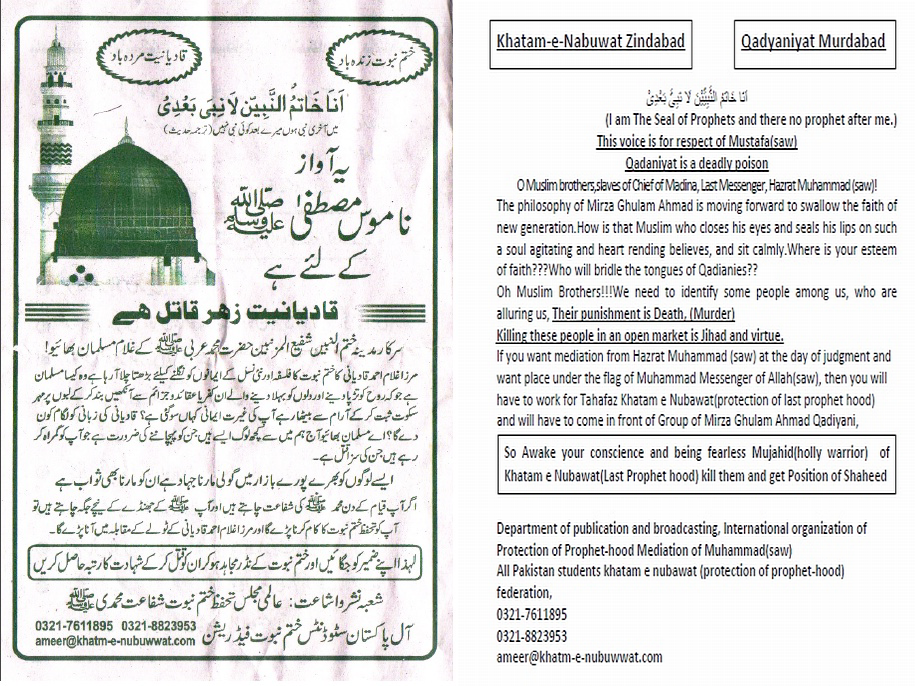
Saleemuddin, a spokesperson for Jamat-e-Ahmadiyya Pakistan, condemned the murder and demanded the immediate arrest of the accused. He said fatwas declaring members of the Ahmadi sect “liable to be killed” were being issued in different parts of the country and these religious edicts were being published in vast numbers. This, according to Saleemuddin, has resulted in target killings of many Ahmadis.

Published in The Express Tribune, October 3rd, 2011.

Copyrighted © 2011 The Express Tribune News Network
URL: http://tribune.com.pk/story/265652/ahmadi-schoolteacher-shot...

Monday, September 19, 2011

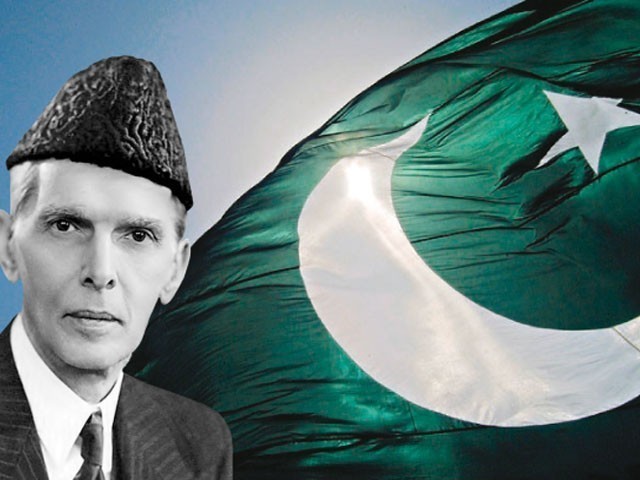
Jinnah’s Pakistan, hijacked by clerics

The Express Tribune Blogs
Opinion
The Verdict
Kashif ChaudharyJinnah’s Pakistan, hijacked by clerics
Posted by Kashif Chaudhry
Published: September 19, 2011
Jinnah founded Pakistan with the dream of it being a secular state where people could live as free citizens. However, today, Pakistan finds it hard to uphold the very ideals it was founded upon
Jinnah founded Pakistan with the dream of it being a secular state where people could live as free citizens.However, today, Pakistan finds it hard to uphold the very ideals it was founded upon
With the partition of the Indian subcontinent, Pakistan came into existence on August 14, 1947. The valiant and astute Muhammad Ali Jinnah led the minority Muslim community of united India to a separate homeland to fulfill the demand for freedom of religion, profession, and speech.

Jinnah was an outstanding lawyer who had studied law in London. He had a modern outlook on the world and was strongly secular. Part of the oath under which he took office reads:

“No subject … in Pakistan shall, on grounds only of religion, place of birth, descent, color or any of them be ineligible for office.”

He was absolutely clear that the new state he was founding would accommodate people of all faiths and descent without any prejudice. To assert this point, he appointed a non-Muslim as his first law minister. The Muslims in his cabinet consisted of Sunni, Shia, and Ahmadis alike. He believed that Islam endorsed a secular democracy and the two were perfectly compatible.

“The great majority of us are Muslims. Consequently, we have a special and a very deep sense of unity. But make no mistake: Pakistan is not a theocracy or anything like it” he said in an address in 1948.

He believed in a Pakistan wherein the mosque would be separate from the state.

“You are free; you are free to go to your temples, you are free to go to your mosques or to any other place of worship in this State of Pakistan. You may belong to any religion or caste or creed that has nothing to do with the business of the State” he said.

In the struggle for Pakistan, Jinnah was not faced with the Indian Congress and the British alone. He also had to endure intense animosity from hard-line Muslim clerics and counter their vile propaganda. He was accused, by the ultra right-wing, of blasphemy, and they considered him a great heretic for his secular ideology.

Prominent clerics like Maulana Maududi urged common Muslims not to side with Jinnah. Maududi wrote:

“It is forbidden to vote for [Jinnah’s] Muslim League.”

Despite this, the resolute Jinnah was successful in garnering support from the masses in most Muslim-majority areas.

Today, the nation finds it hard to uphold the very ideals it was founded upon. As it passes through dangerously volatile times, it has forsaken its founding principles of freedom and secularism.

But how and why did Pakistan turn against itself?

Even though he tried his best to steer it toward a secular democracy, Jinnah did not live long enough to see it become one. Over the coming years, Pakistan took a very troubling turn. In a matter of nine years, it became an “Islamic Republic,” and in a little over two decades, it had essentially become a theocracy.

The same extremist clerics who had opposed Jinnah and his struggle for Pakistan gradually claimed ownership of the State. They formed political groups that used religion to amass public support. Their demonstrations of street power, frequently violent, meant that sectarian hatred and intolerance was the order of the day.

Even governments avoided a clash with the radical right and became increasingly wary of arousing any negative religious sentiment and consequently losing popular vote. This only furthered the extremist cause, and in time, the original path Pakistan started on was completely forsaken. Pakistan, it is now said, was formed for the Muslims and is meant to become an Islamic theocracy where the Shariah, as interpreted by the hard-liners, is to be the ultimate law.

One tragedy after another, Jinnah’s Pakistan was dealt with massive blows. His Pakistan was no more his; it had been hijacked by forces of extremism and intolerance.

Non-Muslims could not hold the highest office in any of the core institutions anymore.

In 1953, there were widespread riots against the Ahmadi Muslims, a sect that extremists considered heretics.

The harassment of Shia Muslims and other minority groups also increased and went largely unchecked.

In 1974, the government yielded to intense pressure and declared the Ahmadiyya sect non-Muslim.

Tout de suite, the State had taken authority to decide its people’s religion, and the two were no longer separate.

General Zia ul Haq took over the country and became its third military president in 1977. To legitimize his dictatorship, he sought to please the right-wing and set to Islamize Pakistan. Amongst other things, he introduced the controversial blasphemy laws that stated death as the punishment for any derogatory remark against the Quran, Prophet Muhammad (PBUH), and other Islamic holy personages.

For Ahmadis, Zia also promulgated an ordinance in 1984 that criminalized the practice of their faith. Zia’s rule was the toughest for citizens who did not adhere to what had now become the state-backed perversion of Islam. Jinnah’s secular Pakistan had drifted into the hands of his enemies.

Jinnah had warned of this in his August 11th, 1947 address to the Constituent Assembly of Pakistan. He said:

“As you know, history shows that in England, conditions, some time ago, were much worse than those prevailing in India today. The Roman Catholics and the Protestants persecuted each other. Even now there are some States in existence where there are discriminations made and bars imposed against a particular class. Thank God, we are not starting in those days.” He continued: “Today, you might say with justice that Roman Catholics and Protestants do not exist; what exists now is that every man is a citizen, an equal citizen of Great Britain and they are all members of the nation.”

In the same address, he said:

“My guiding principle will be justice and complete impartiality, and I am sure that with your support and cooperation, I can look forward to Pakistan becoming one of the greatest nations of the world.”

Jinnah knew that a secular form of government could bridge differences and bring together people of all faiths and backgrounds to build a strong Pakistan. Just as the Catholics had learned to live with the Protestants, he was optimistic that the Pakistan he was founding would be a successful nation, a beacon of tolerance and an example of unity in diversity. However, the men who opposed Jinnah’s ideals before partition stood in his way yet again.

Founded on freedom of religion and practice, Pakistan is one of the biggest violator of religious freedom today. For Pakistan to succeed, it will have to reverse the dangerous turn it took and get back on the path that Jinnah laid before it. The blasphemy laws must be amended, everyone must be equal citizen of the state, the anti-Ahmadi laws must be revisited and the state must remain separate from the mosque at every cost. Pakistan must educate itself and look for the unity that Jinnah so cherished in the diversity across the land.

In February 1948, Jinnah said in an address:

“You have to stand guard over the development and maintenance of democracy, social justice and the equality of manhood in your own native soil. With faith, discipline and selfless devotion to duty, there is nothing worthwhile that you cannot achieve.”

Unfortunately, recent events have shown that Pakistan is still far away from taking that vital turn. The government has shown little resolve to go after the perpetrators of religious hate and violence and definitely no will to even trigger a dialogue on the controversial laws of the land. With Pakistan headed toward a steep decline, the solution lies in bold courage and reform. Jinnah’s Pakistanis will have to wake up sooner than later and reclaim the land from his opponents. Pakistanis must bring about a rebirth of Pakistan – Jinnah’s Pakistan.

Copyrighted © 2011 The Express Tribune News Network
URL: http://blogs.tribune.com.pk/story/8046/jinnahs-pakistan-hijacked-by-clerics/

Thursday, September 15, 2011

Religious freedom report: Pakistan one of 10 countries ‘failing to protect minorities’ rights’

Express Tribune, Pakistan
Pakistan
Sindh
Religious freedom report: Pakistan one of 10 countries ‘failing to protect minorities’ rights’
By Atika Rehman
Published: September 15, 2011
US state department report states that the Pakistani govt failed to protect minorities against abuse, discrimination. PHOTOS: FILE
KARACHI: Pakistan was cited among 10 countries “failing to sufficiently protect religious rights”, in a report regarding religious freedom released by Washington on Wednesday.

The other countries, mentioned in the US State Department’s International Religious Freedom report for the second half of 2010, included Afghanistan, Egypt, Iraq, Nigeria, Russia, Tajikistan, Turkmenistan, Venezuela and Vietnam.

However, Pakistan was not included in the list of ‘countries of particular concern’ regarding religious freedom – much to the dismay of the US Commission on International Religious Freedom (USCIRF). The list named China, Saudi Arabia, Myanmar, North Korea, Eritrea, Iran, Sudan and Uzbekistan.

“… the current list continues with glaring omissions, such as Pakistan and Vietnam. We respectfully urge Secretary Clinton to consider the six additional countries we recommended for designation,” said USCIRF Chair Leonard Leo.

The report details actions such as active state repression, violence against religious groups, apostasy and blasphemy laws, anti-Semitism and restrictions on religious attire and expression.

The report bluntly states that the constitution and laws in Pakistan “restricted religious freedom and, in practice, the government enforced these restrictions.”

Citing acts of violence against religious minorities as well as societal and governmental discrimination, it states that “the government rarely investigated or prosecuted the perpetrators of increased extremist attacks on minorities and the majority promoting tolerance, which deepened the climate of impunity.”

The report includes a long list of case studies of violence and discrimination against Ahmadis, Christians, Sikhs, Hindus and other Muslim sects.

The controversial blasphemy law, Aasia Bibi’s case in particular, and discrimination against the Ahmadiyya community take centre stage in the 30 pages of the report dedicated solely to Pakistan. “The government did not undertake reform measures to prevent the abuse of the blasphemy laws.

Toward the end of the reporting period the public discourse regarding the blasphemy laws became increasingly heated, which contributed to the government’s reluctance to address the issue. For example, after initially signalling he was considering pardoning Aasia Bibi’s death penalty sentence for alleged blasphemy, President Zardari refrained from doing so,” the report states.

It adds that the government, in fact, distanced itself from a bill introduced by a member of the ruling party that would have amended the blasphemy laws to prevent abuse.

Terming the blasphemy laws “a legal weapon against religious minorities and other Muslims”, the report says that the government’s failure in addressing religious hostility fostered intolerance and acts of violence against minorities and Muslims alike.

However, the report gives credit to the slain minorities minister Shahbaz Bhatti for promoting religious tolerance and taking an active role in assisting victims of religiously motivated attacks on Christians and Ahmadis.

The report states that, according to the National Commission for Justice and Peace (NCJP), between 1987 and 2010, a total of 1,068 persons were charged under the blasphemy laws. In 2010, blasphemy complaints were registered with the police against 17 Christians, eight Muslims, five Ahmadis, and seven Hindus, according to the report.

(ADDITIONAL INPUT FROM AFP)

Published in The Express Tribune, September 15th, 2011.

Copyrighted © 2011 The Express Tribune News Network
URL: http://tribune.com.pk/story/252659/religious...rights/

Wednesday, September 14, 2011

Count Pakistan among countries violating religious freedom: US commission

Express Tribune, Pakistan
Pakistan
Thinking proactively: Ahmadis have found their own solutions in Rabwah
By Atika Rehman
Published: September 14, 2011
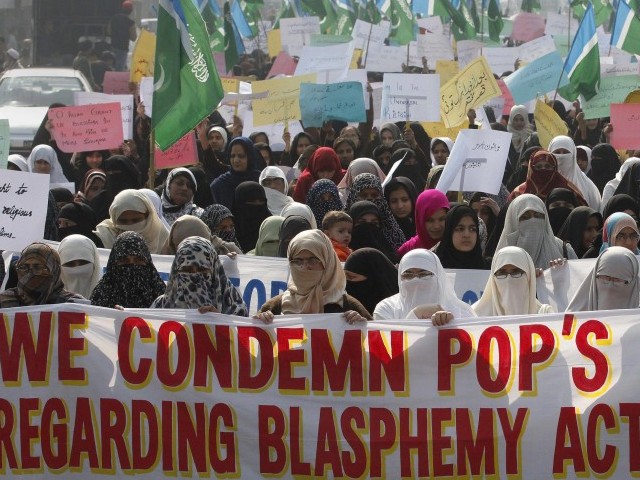
Female supporters of Jamaat-i-Islami (JI) hold placards and banner during a protest regarding the Pope's statements on Pakistan's blasphemy law. PHOTO: AFP/FILE
Female supporters of Jamaat-i-Islami (JI) hold placards and banner during a protest regarding the Pope’s statements on Pakistan’s blasphemy law. PHOTO: AFP/FILE
WASHINGTON: The United States Commission on International Religious Freedom (USCIRF) expressed concern over Pakistan’s omission from the list of eight countries termed “countries of particular concern” with regards to violation of religion freedom.

The list was published by the US State Department in a report which listed Burma, China, Eritrea, Iran, North Korea, Saudi Arabia, Sudan and Uzbekistan as countries where religious rights were severely infringed.

Although Pakistan was omitted from the list, the report stated that Pakistan’s laws restrict religious freedom and that the government enforced these restrictions. It also adds that investigation and prosecution of perpetrators in the case of extremist attacks on minorities are rare.

Citing the blasphemy law and Aasia Bibi’s case, the report suggests that the Pakistan government distanced itself from a bill proposed by an MNA to repeal the “discriminatory” law.

It also mentions that the Ahmadiyya community along with members of other Islamic sects, Christians, Sikhs, and Hindus face governmental and societal discrimination.

The report noted, however, that the government took some measures to improve religious freedom. It mentioned the late Federal Minister for Minorities, Shahbaz Bhatti’s attempts to assist victims of religiously motivated attacks.

The commission on Tuesday remarked that it is concerned that no new countries were added to the list.” said

‘Don’t forget Pakistan’

“Repeating the current list continues glaring omissions, such as Pakistan and Vietnam … we respectfully urge Secretary Clinton to consider the six additional countries we recommended for designation,” said Leonard Leo, USCIRF Chair.

The other four countries recommended by the commission are Egypt, Iraq, Nigeria and Turkmenistan.

Commenting on the report, US Secretary of State Hillary Clinton urged governments Tuesday to do more to defend religious freedom as Washington released a report citing eight countries with troubling records on the issue.

“We reaffirm the role that religious freedom and tolerance play in building stable and harmonious societies. Hatred and intolerance are destabilizing,” Clinton said.

Copyrighted © 2011 The Express Tribune News Network
URL: http://tribune.com.pk/story/252125/count...commission/

Friday, June 24, 2011

Critics Say Pakistan’s Blasphemy Law is Being Abused

VOA News
News
Critics Say Pakistan’s Blasphemy Law is Being Abused
Peter Fedynsky | New York June 24, 2011
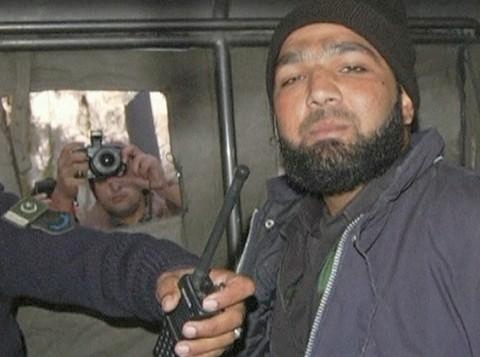
Alleged assassin of Punjab province governor, Mumtaz Qadri is taken into custody

In January, the governor of Pakistan’s Punjab province, Salman Taseer, was assassinated by his bodyguard, who claimed Taseer had violated the country’s blasphemy law. Taseer, a Muslim, was shot dead in broad daylight on January 4 in Islamabad. His alleged assassin, Mumtaz Qadri, has yet to be tried, though he does not deny pulling the trigger. The late governor’s daughter, Shehrbano Taseer, has become a critic of the blasphemy law, saying it is is often abused.

Asia Bibi, the Christian woman who Taseer sought to defend against charges of blasphemy, faces the death penalty - accused by women in her village of blaspheming the Prophet Mohammed.

Bibi protested her innocence in November.

“They [neighbors] filed fake charges against me,” she said. “In the past I have had conflicts with them due to a sewerage issue. They stole my goat.”


Shehrbano Taseer, the governor’s daughter, is on a speaking tour of the United States to discuss the issues surrounding the case. She says blasphemy laws are easily twisted to victimize Christians, Hindus and even Muslims, to serve the self-interest of the accusers.

“The ground reality is that they are mostly used as an instrument of oppression and terror. Anyone can level a blasphemy charge against anyone,” explained Taseer. “You know, it’s mostly due because of personal vendettas or land disputes.”

In the case of Asia Bibi, local clerics reportedly took the accusations against her at face value. One of them, Maqsood Ahmed Masoomi, insists that courts are not necessary to punish blasphemy.

“We are saying that anybody in this world who says anything blasphemous against the Holy Prophet has to be killed, and anyone who hears it [blasphemous words], should kill him on the spot. This is our belief,” the cleric said.

Taseer says Pakistani leaders fail to adequately pursue cases against those who abuse the blasphemy laws - partly because they fear being killed by extremists.

“This is not just this government, but previous governments have a tendency to appease these religious extremists, and there needs to be a no-holds-barred policy,” Taseer said. “They need precedents to be set to ensure that this kind of behavior will not be tolerated by the state.”

Taseer warns that in Pakistan, knives are being turned inward - by people who take the law into their own hands, hiding behind religion to pursue selfish ends. She says her father’s murder should serve as an occasion for the people of Pakistan to consider whether this is the kind of country they want.

Monday, December 13, 2010

Pak clerics warn of protests if blasphemy laws are amended

December 13, 2010
Pak clerics warn of protests if blasphemy laws are amended
Updated on Monday, December 13, 2010, 15:32

Rawalpindi: Religious parties in Pakistan have warned that they will launch a movement called the Tehreek Namoos-e-Risalat (TNR), if the government moves to amend the country’s blasphemy laws.

Talking to reporters after attending an all parties Namoos-e-Risalat conference here on Sunday, Markazi Jamaat Ahle Sunnat Ameer Pir Atiqur Rehman said that Jamiat Ulema-e-Pakistan (JUP) president Dr Abul Khair Muhammad Zubair had been nominated as the convener of the newly formed group.

The Daily Times quoted him, as saying further that a six-member action committee, comprising Liaqat Baloch, Maulana Abdul Ghafoor Haidri, Abdul Rauf Farooqi, Sikandar Abbas Gillani and Maulana Muhammad Abbas, had been formed to evolve the TNR’s future strategy.

“The purpose of the meeting was to convey a message to the government that the nation would not tolerate any type of amendment in the blasphemy law, especially in the article 295-C of the Constitution,” Dr Abul Khair Zubair, a religious leader, said.

“The future strategy will be evolved in a meeting to be held in Islamabad on December 15,” he added.

Dr Zubair further said that the heads of all the five Wafaqul Madaris (religious educational boards) had also ratified the outcome of the conference.

Syed Munawar Hassan, Qazi Hussain Ahmed, Maulana Fazlur Rehman, Professor Sajid Mir, Allama Sajid Naqvi, Mufti Muneebur Rehman, Dr Abul Khair Zubair, Pir Atiqur Rehman, Hamidul Haq Haqqani, Liaqat Baloch, Maulana Abdul Ghafoor Haidri, Abdul Rauf Farooqi, Sikandar Abbas Gillani and Maulana Muhammad Abbas attended the conference.

ANI

Thursday, November 18, 2010

Serious problems in Pak on religious freedom: US

November 18, 2010
Serious problems in Pak on religious freedom: US
Updated on Thursday, November 18, 2010, 10:04

Ahmadiyya Mosque, LahoreWashington: Noting that serious problems remain in Pakistan with regard to religious freedom, the Obama administration has expressed its concern over the existence of laws that are “discriminatory” against religious minorities.

“There have been attacks against Christians, against the Ahmadis. There’s still discriminatory laws on the books, blasphemy laws, anti-Ahmadi laws.”

“We’re raising these issues with the government of Pakistan,” Assistant Secretary of State for Democracy, Human Rights and Labour, Michael Posner, said.

Posner was responding to questions after the release of the annual State Department Report on Global Religious Freedom by Secretary of State Hillary Clinton.

“The (Pak) government is taking steps. It’s a very tense situation now, and there are tensions within the society. So it’s a mixed picture, honestly.”

“We give the government credit for steps it has taken, but also recognise that more needs to be done. And it’s part of our diplomacy with them,” Posner said in response to a question.

One of the things this report does is identify, in Pakistan and elsewhere, government actions that contribute to the problem, he said.

The annual State Department Report said despite the government’s steps to protect religious minorities, the number and severity of reported high-profile cases against minorities increased during the reporting period.

“Organised violence against minorities increased; for example, there was violence against Christians in Gojra, Punjab, and a terrorist attack on Ahmadis in Lahore, Punjab.”

“There were instances in which law enforcement personnel abused religious minorities in custody,” it said.

Security forces and other government agencies did not adequately prevent or address societal abuse against minorities.

Discriminatory legislation and the government’s failure or delay in addressing religious hostility by societal actors fostered religious intolerance, acts of violence, and intimidation against religious minorities, it said.

“Specific laws that discriminated against religious minorities included the anti-Ahmadi provisions of the penal code and the blasphemy laws which provided the death penalty for defiling Islam or its prophets,” said the report.

The Ahmadiyya community continued to face governmental and societal discrimination and legal bars to the practice of its religious beliefs. Members of other Islamic sects, Christians, Sikhs, and Hindus also reported governmental and societal discrimination, it said.

Noting that relations between religious communities remained tense, the State Department Report said societal discrimination against religious minorities was widespread, and societal violence against such groups occurred.

Non-governmental actors, including terrorist and extremist groups and individuals, targeted religious congregations, it said, adding that a domestic insurgency led by religious militants increased acts of violence and intimidation against religious minorities and exacerbated existing sectarian tensions.

“Extremists target violence against Muslims advocating for tolerance and pluralism, including followers of Sufism,” the report said.

During the reporting period, US embassy officials closely monitored the treatment of religious minorities, worked to eliminate the teaching of religious intolerance, and encouraged the amendment or repeal of the blasphemy laws, it added.

PTI

Sunday, August 8, 2010

Smokers’ Corner: Rewarding hate

Daily Dawn, Pakistan
Columnist
.
Smokers’ Corner: Rewarding hate
   Nadeem F. Paracha
   Sunday,08 Aug, 2010

The 'educated' today require an education based on facts and truth instead of what they were taught at school as 'history' and 'ethics': Nadeem Paracha.
The ‘educated’ today require an education based on facts and truth instead of what they were taught at school as ‘history’ and ‘ethics’: Nadeem Paracha.

When televangelist Aamir Liaquat Hussain travelled to Saudi Arabia to perform hajj last year, rational Pakistanis let out a sigh of relief.

The more mischievous among us even prayed to the Almighty to let the Saudis fall in love with this eminent ‘Islamic scholar’ and fund his outlandish theories, leaving television viewers ever so grateful for keeping him there.

But, alas, he is set to make a comeback. This time he would be seen on a different channel. Of course, just like his record as a religious talk-show host didn’t seem to bother his old employers, one shouldn’t expect any miracles in this respect from his new bosses either.

Apart from being accused of having a questionable degree, he was also accused by his old party, the MQM, and a number of columnists of instigating violence against the Ahmadi community through his show. Many also castigated him for holding some truly audacious views about Islam, society and politics.

Though he was summarily dismissed by the MQM, he gloatingly hung on to his celebrity status at the TV channel which saw nothing wrong in a host who discussed on air the merits of proclaiming members of a minority sect as wajibul qatal (punishable by death).

He passionately blamed the defeats faced by Pakistan’s cricket team on the green-coloured soles of their shoes! “Green is the colour of Islam”, said the wise man. “How can they have it underneath their shoes?’

As is apparent by the ways of some leading news channels — from their audacious pro-militants coverage of the Lal Masjid episode to the amoral and insensitive way they covered the recent Air Blue crash — people like Mr Hussain have proved to be great attractions not only for the channels but many multinationals as well, which advertise their brands during the most foolhardy of shows. Thus, one can understand the channels’ unflinching obsession with such characters.

Pakistani society is going through a gradual breakdown. A number of us are lashing out, hoping to find all kinds of enemies to attack for our misfortunes. India, Israel, the US, the UK, Ahamdis, Hindus, Christians, Barelvi, Shias… President Zardari, anyone or everyone but our own individual acts and morals.

It is an act of selective nihilism in which most Pakistanis refuse to trust or listen to state institutions and the government; but then let this hard mixture of cynicism and defiance melt away when engaged by clever, media-savvy chameleons.

The latter make a name and a game out of giving vent to all the repressed strains of religious bigotry, political hatred and delusions of grandeur now brewing in the collective psyche of middle-class Pakistan. It reminds one of the damaged and hurt Germany on the eve of Hitler’s take-over.

A country ravaged by economic downturns, violence and low self-esteem, and looking for ‘enemies’ (Jews, communists, gypsies, blacks) to pin the blame on. This attitude became fascist Germany’s rallying cry for regeneration, but ended up in its own destruction.

We already have the army fighting a battle with armed fanatics. But what about a lot of those working in offices and studying in schools and colleges? These are ‘educated’ folks who may not be armed or look like the Taliban, but many have views close to what the fanatics advocate.

These are the people who would exhibit more disgust at the sight of a politician than they would at the sight of blown up bodies of innocent men, women and children; people who would scream vengeance at the plight of Dr Afia Siddiqui but look the other way when a woman is gang raped in their own Islamic republic; people who would bribe a cop to avoid a traffic violation ticket and yet find themselves above corruption.

The ‘educated’ today require an education based on facts and truth instead of what they were taught at school as ‘history’ and ‘ethics.’

An education that highlights the importance of tolerance, plurality and democracy instead of the kind of education most of us continue to be given at schools and by the media, which is based on arrogance and paranoia against imagined enemies.

©2010 DAWN Media Group. All rights reserved

Tuesday, June 15, 2010

I never really cared for Ahmadis

Express Tribune, Pakistan
Pakistan
Opinion
I never really cared for Ahmadis
Fasi Zaka
By Fasi Zaka
June 15, 2010
The writer is a columnist and TV and radio anchor (fasi.zaka@tribune.com.pk)

I have never really been vocal about rights for Ahmadis, even privately, but my compassion trigger is easily pulled if there are atrocities against Pakistani Hindus and Christians. Part of this can be ascribed to my belief in the prejudice that the Ahmadis are a relatively well-off community, making the Christians and Hindus of Pakistan uniquely guilty of a double crime, first for not being Muslims and second for being poor. These two communities seem especially vulnerable.

I have changed my mind. And it’s not because of the attack in Lahore that killed so many Ahmadis. The whole country, Muslim and non-Muslim, is under attack by the Taliban.

What really helped me see the inhuman treatment of the Ahmadis in Pakistan is the absence of condemnation for it. Nawaz Sharif in his condolence message said Ahmadis were our brothers; it’s been enough to get the Pakistani religious world on his case. While sympathy is not outlawed for Ahmadis, it may as well be.

Those of us with a passport have declared that “I consider Mirza Ghulam Ahmad Qadiani to be an impostor prophet and an infidel and also consider his followers, whether belonging to the Lahori, Qadiani or Mirzai groups, to be non-Muslims.” Most of us do not believe that Mirza Ghulam Ahmad Qadiani was a prophet, but do we have to rub it in? Imagine if the UK put in that sort of column for a prophet of another faith.

We have declared not just that we don’t believe in Mirza Ghulam Ahmad, but added the connotation that he was an imposter. People who follow imposters must be crooks, right? Let’s stop the pretence that they are equal, or human.

But no, we are a peaceful people, right? Of course we are. I read a very poignant anecdote in columnist Mosharraf Zaidi’s article recently; he described how an old friend would never say salaam to him in return. His friend is an Ahmadi, he can go to jail for that. I cringe when I see Pakistanis stumbling over one another to felicitate a white westerner who chooses to say salaam when greeting us in our country. Why not put him in jail too? He could be an atheist, whereas at least the Ahmadis believe in the oneness of God.

But, you see it’s not about that. Ahmadis are a secretive people up to no good. They won’t even tell you they are Ahmadis. But who wouldn’t be secretive if they could go to jail for saying they are Muslim, or responding in kind to a salutation of salaam. Or for that matter having a Quran in their home, the same kind you and I have.

Sunnis don’t believe in the imam of the Shias. What about Barelvis and Bohris? Its time their special treatment ended. If anything we have been too moderate. We need to cut diplomatic relations with Indonesia because they refuse to declare Ahmadis non-Muslim as it may open a Pandora’s Box of declaring other groups the same. Why is the amir of the Jamaat-i-Islami, Munawar Hassan, silent on this? He could address this diplomatic issue, after all he did want to cut off diplomatic relations with many countries over the Facebook fiasco.

Pakistani Ahmadis aren’t allowed to go for Hajj, but Ahmadis from other countries are. Maybe we should cut off relations with Saudi Arabia too. Also, since we Muslims believe in equality, I would suggest all non-Muslim countries make it mandatory that we wear special collars to identify us as Muslim when we visit. Or is that going too far since we haven’t, obviously, in the case of the Ahmadis?

The truth is the bulk of this country doesn’t like Ahmadis. They are Pakistan’s Palestinians. Their humane treatment and acceptance will decide whether we are a people who can move forward in the future, or if we will become a fragmented warlord state divided on sectarian lines.

And yes, Ahmadis are worse off in Pakistan than Christians and Hindus. We want to forcibly convert Christians and Hindus. But Ahmadis shouldn’t exist. Period.

Published in the Express Tribune, June 15th, 2010

Sunday, June 13, 2010

Minorities form working group

Daily Times, Pakistan
Sunday, June 13, 2010

Minorities form working group

KARACHI: The representatives of Hindus, Christians, Sikhs, Bahai, Ahmedi and Zoroastrian communities of Sindh formed on Saturday a working group on ‘Right of Communities Vulnerable Because of Their Belief’ during a meeting at a local hotel. The Human Right Commission of Pakistan (HRCP) would support the group.

The group will highlight human rights violations through fact finding reports, researches, issuing public statements and arranging press briefings and also to analyse the laws, practices and policies, which are discriminatory and would provide recommendations. The meeting also decided that the group will conduct capacity building programmes of the members of vulnerable communities and a mechanism of early warning signs to determine the tension involving minorities and would recommend appropriate actions.

During the meeting, the participants discussed the agenda of the newly formed group including the status of commission of minorities, countering advocacy of hatred based religious beliefs, discrimination being faced by the communities in services, education, family and property laws, constant threats and fear, blasphemy laws and property related issues. During the meeting the participants decided that the newly formed group would meet once in six months.

Addressing the meeting HRCP Director I A Rehman said that the group would address all the issues being faced by the communities and deal with the rights of these communities.

“Since the last several years, the living conditions of minorities has worsened and the communities have become extremely vulnerable as extremists and militants are inciting hatred,” he said. amar guriro

Thursday, June 3, 2010

There is blood on our hands

The News - Internet Edition
Thursday, June 03, 2010,
Jamadi-us-Sani 19, 1431 A.H.
 There is blood on our hands

Thursday, June 03, 2010
Kamila Hyat

The writer is a freelance columnist and former newspaper editor

The different kinds of violence that run through our country have turned it into a zone where war, and the chaos it brings about, is a perpetual phenomenon.

Most recently Ahmedis have been its victims, with 90 killed in the bloodbath in Lahore. In past months Shias have suffered similar violence. Ethnic battles rage on in Karachi, the military fights extremists in the northwest and other kinds of killings take place in Balochistan where five teachers have been among the 128 shot dead in targeted killings over the past five months. Fourteen teachers have been among the 782 killed in targeted shootings in the province in the past three years. Attacks on Christians are reported every now and then as are different kinds of random violence that seem on the surface to be senseless. Mob action against those suspected of crime is becoming more and more frequent and, frighteningly, as the killing fields spread, the state’s law-enforcers seem to have been reduced to the role of spectators, who can, at best, only rush in after the spree of violence to pick bodies off the streets.

Certainly, this is what happened in Lahore. Threats to the Ahmedi community, coming in for almost a year in the Model Town area went largely unheeded. Security was stepped up but was obviously inadequate in the face of an attack as well-coordinated and planned as the siege that disrupted weekly prayers. It appears that intelligence agencies had failed to pick up on plans for the attack. Ahmedis report that after it took place the police response was delayed and the death toll could have been even higher had two young Ahmedi men not acted with immense courage and disarmed two of the suicide bombers, holding them captive for 30 minutes until the police made their way to the spot in Model Town. Even after the carnage, there is evidence the lessons have not been learned.

Arrangements for a mass funeral were altered by the Ahmedi community which saw the security as insufficient. Their fears are not out of place. Attacks at burials have been staged on more than one occasion by the militants to maximise the numbers they consign to death.

The events we saw on Friday go beyond the issue of a failure to offer security. They are rooted in the state’s discrimination against a particular community which in 1974 was declared ‘non-Muslim’ despite its own protestations to the contrary. Some ten years later specific laws against Ahmedis made it more likely they would be persecuted. According to the US State Department’s annual Human Rights Report issued in March 2010, 94 Ahmedis faced criminal charges in Pakistan for religious offences during the past year: 37 under the blasphemy laws and 57 under Ahmedi-specific laws.

Pakistan remains on the list of countries of ‘particular concern’ for the US Commission on International Religious Freedoms. Such state-backed discrimination has strengthened the hatred against Ahmedis propagated by extremist groups. This sentiment has found its way into mainstream society, mainly through the doings of sections of the media. While Friday’s killings shocked many, there was disturbingly muted comment from some quarters about the ‘controversial’ beliefs of the community – as if this justified murder. Some national leaders made it a point not to mention Ahmedis by name in statements condemning the act of terrorism against them.

Another game now appears to be afoot. There have been observations from police officers in Lahore that the militants who staged the attack had roots in North Waziristan. It is quite possible that these findings are not inaccurate. But there is suspicion that a part of the motive is to deflect criticism faced by the Punjab government for failing to act against groups in southern Punjab suspected of being linked to the attack. There is certainly evidence to back this. Those present at the Model Town place of worship say one of the young men pinned down by worshippers spoke in Seraiki, cursing those who had prevented him from completing his ‘mission’.

Initial claims of responsibility for the assault appeared to come from the Tehrik-e-Taliban, Punjab, and despite the denial of the Punjab government the fact is that this group has been linked to many of the recent spate of terrorist attacks. It of course is likely that it is working alongside forces based in the northwest, forming a new – and extremely dangerous – nexus.

Southern Punjab has for many years been the heartland of sectarian violence and also anti-Ahmedi sentiment. The groups guilty of repeatedly violating the law against the spread of religious hatred have never been charged. No attempt was ever made to prevent them from inciting violence against the Ahmedi community. In some cases the government, at various points in time, has connived in actions directed against Ahmedis. The refusal to go after extremist groups has almost certainly encouraged them.

For purposes of electoral gain, Punjab ministers have joined hands with leaders of the Sipah-e-Sahaba Pakistan, despite the fact that it is a banned organisation. Other banned groups continue to operate in the province. This dangerous situation of course increases the possibility of more violence in future with Punjab becoming a safe haven for militants.

The state of war we live in leaves no room for development or an improvement in the quality of human life. It presents fearful dangers to the state itself, with new fault lines zigzagging across it. The cracks have been widening rapidly. We must find ways to fill them in before the rifts grow deeper and the violence they generate assumes still more dangerous dimensions. The state needs to take the lead in this. Discrimination laid down in law must be ended and an even playing field created for all citizens.

Until his happens, we will remain a nation divided on the basis of religious belief, ethnicity and other factors which prevent us from discovering the tolerance we so badly need to create integrity and the willingness to live together within a territory shared by many diverse groups.

Email: kamilahyat@hotmail.com

Speak up!

The News - Internet Edition
Thursday, June 03, 2010,
Jamadi-us-Sani 19, 1431 A.H.
 Speak up!

Thursday, June 03, 2010
Sehar Tariq

Thousands took to the streets to protest against Facebook and blasphemous content being published on it. On May 28th, 80 innocent Pakistanis were murdered in cold blood as they were peacefully praying in a house of worship. I wonder how many will take to the streets to protest this atrocity? I have a feeling that there will be few or perhaps none. There will be the usual round of condolences and demands for inquiries, but we know these are merely hollow promises. In Pakistan little is accomplished without popular support, and popular support does not lend its self to causes such as protection of minorities.

When we wanted the judiciary restored, we took to the streets and had it done. When we wanted Facebook banned we took to the streets and had that done. But I have a feeling we’re going to let this one slide and stay inside. It’s ironic that we are willing to take to the streets for the sanctity of the name of the Prophet (PBUH) but not for any of his teachings. The Prophet preached that it was a sin to harm innocent people.

But somehow it doesn’t matter what happens to those that “we” don’t consider Muslims. While the phenomenon of terrorism is new, the problem of sectarian violence is not. We have harboured violent hatred and have not been afraid of expressing it. We are so caught up in some billowing self-righteous rage that we have become blind to the teachings of the religion that we profess to love and in whose name we commit all of these sins.

But these really aren’t Muslims some would say. And some would cite the teachings of popular television anchors who consider these people wajib-ul-qatl. The Prophet (PBUH) preached that even in times of war those who do not pick up arms should not be harmed; particularly women and children. But innocent children were slaughtered, the old and infirm suffered frightened and tortured deaths while they were busy in worship.

The people that were murdered were peaceful, taxpaying, law-abiding citizens of the Islamic Republic of Pakistan. It is the responsibility of the state, under the constitution and Islam, to provide security to those citizens who, despite adhering to different religions, pay taxes and abide by the laws of the land. But instead of providing protection to these people, we have television programs where anchors are allowed to rally support for murdering innocent citizens. And in the wake of such hatred, innocent people are murdered.

No word, whisper or whimper about this is heard. Because in our twisted worldview, it’s alright to say whatever we want about any other religions or their followers. But when someone attacks our religion in any way, shape or form, we are up in arms in a matter of minutes. We expect the world to show us nothing but respect while we show none of this to any other religion. We can laugh, joke, degrade and even attack and murder the followers of other religions without having our collective conscience flinch. How did we become so hypocritical and irrational? How did we become so cruel?

With the deaths of 80 innocent Pakistanis, the lives of hundreds of families have changed forever. There is sorrow and heartache and fear in hundreds of Ahmedi homes. But as the rest of Pakistan sleeps easy and TV anchors remain hypocritically silent, they forget that tomorrow this could be them. Through our collective silence, as we aid and abet a culture of intolerance and senseless killing that one day might consume us too. This violence, intolerance and injustice must stop. And it must stop with the largest majority speaking up against it.

For once, let’s stand up and show the world that we actually abide by the spirit of the religion that we profess to love and follow. Let us turn not far away, but towards the Holy Book and teachings of the Prophet (PBUH) to learn that this kind of violence and hate is not tolerated in Islam. This senseless killing, violence and hate will not stop unless we demand that this be done.

The writer is a student of Woodrow Wilson School at Princeton University, working for a master’s degree in public policy. Email: tell.sehar@gmail.com and www.sehartariq.wordpress.com

Monday, May 10, 2010

Blasphemy laws: the root of Pakistani extremism

---The Baltimore Sun, USA

Home  >  News  >  Maryland Voices

Blasphemy laws: the root of Pakistani extremism
By Faheem Younus
May 10, 2010

The failed Times Square bombing raises important questions.


As a U.S. Muslim of Pakistani descent, I have wondered why so many plots against America continue to be hatched in Pakistan. At least nine people with some connection to Pakistan have been charged with terror plots against the United States in the past two years. What is it that accounts for this disturbing trend?

One can’t simply blame Islam. Were that true, Indonesia, the most populous Muslim country, would be the epicenter of terrorist plots against America. But it’s not. One can’t simply blame fiery rhetoric. Were that true, Iran, the most vocally anti-American of Islamic nations, would be breeding terrorists. But it’s not. One can’t simply blame illiteracy. Were that true, Ethiopia, ranked 170th in literacy, would be at the forefront of terrorist activities. But it’s not. One can’t simply blame poverty, either. Were that true, Bangladesh, the poorest of Islamic nations, would be leading the charge against America. But it’s not.

So, what makes Pakistan so uniquely conducive to extremism?

The answer, I believe, is rather simple. Pakistan proudly prosecutes its own people for a crime that exists in few countries: blasphemy. Section 295-C of Pakistan’s penal code, the so-called blasphemy law, states, “Whoever by words, either spoken or written or by visible representation, or by any imputation, innuendo, or insinuation, directly or indirectly, defiles the sacred name of the Holy Prophet Mohammed (PBUH) shall be punished with death, or imprisonment for life, and shall also be liable to fine.”

This law was passed in 1984, and six years later the stakes were raised when a federal Sharia Court ruled that “the penalty for contempt of the Holy prophet is death and nothing else.” A component was later added to target, by name, the Ahmadiyya Muslim Community, a minority Muslim group that believes Mirza Ghulam Ahmad to be the messiah of the latter days.

Blasphemy laws are to Pakistan’s extremists what Miracle Gro is to one’s home garden.

The alleged Time Square suspect, Faisal Shahzad, was a 5-year-old Pakistani citizen when these draconian laws were enacted. His generation knows only one way to deal with a difference of opinion in matters of religion: Shoot the opponent.

Here is Pakistan’s record: 650 Christians have been accused under the blasphemy law and more than 20 killed between 1988 and 2005, according to the Pakistan Catholic Bishops’ Conference’s National Commission for Justice and Peace. Since the promulgation of anti-Ahmadi laws in 1984, 101 Ahmadis have been killed on religious grounds. In June 2008, the entire population of Rabwah (the headquarters town of Ahmadiyya Muslim Community in Pakistan) — 60,000 people — was charged with committing blasphemy.

And while few Pakistanis actually terrorize minorities and non-Muslims, many others have cheered or remained silent.

Some in Faisal Shahzad’s generation seek a new challenge in United States. If drone attacks and back-door diplomacy are not working, what should be our strategy to deal with this threat?

Immediate attention is needed to repeal the blasphemy and anti-Ahmadi laws in Pakistan. Wasting more time in “bilateral talks” will be a godsend for countries such as Indonesia, where a court only last month upheld the constitutionality of that nation’s blasphemy code, which, while less punitive and restrictive than Pakistan’s law, still discriminates against minority religions. The U.S. State Department should make all future aid packages conditioned on Pakistan repealing these harmful laws. While it may be difficult for President Asif Ali Zardari to find Osama bin Laden, it sure isn’t difficult for him to locate a copy of his country’s Second Amendment, which strips the right of millions of Ahmadis to call themselves Muslims.

Once this root cause is removed, a long-term solution of strengthening religious freedom through legislation and establishing a robust educational infrastructure will have a chance to work. After Nigeria, Pakistan has the world’s largest number of out-of-school children and youth. School-age children need to be taught, from an early age, how to express a difference of religious opinion — and more importantly, how to respect one. This can be achieved through curriculum reform in both public and religious (madrassa) education systems.

For more than 200,000 peace-loving U.S. Muslims of Pakistani descent, staying quiet or cheering secretly is not an option anymore. We have to make a choice. Let’s not bite the hand that feeds us. If we are too weak to maintain our loyalty to the United States, then take the Holy Quran’s advice, “… Was not Allah’s earth vast enough for you to emigrate therein?“ (4:98).

Or, to quote a bumper sticker I once saw: America. Love it or leave it.

Dr. Faheem Younus is medical director for healthcare epidemiology and infection prevention at Upper Chesapeake Health in Bel Air and a clinical assistant professor at the University of Maryland, School of Medicine. His e-mail is dryounus@comcast.net

Copyright © 2010, The Baltimore Sun

URL: www.baltimoresun.com/news/opinion/bs-ed-bomb...6374355.story

Saturday, May 8, 2010

Terrorists grow where freedom does not

---OregonLive.com, USA
Hot Topic, International affairs, Terrorism, oped »
Terrorists grow where freedom does not
May 08, 2010, 4:23PM

By HARRIS ZAFAR

The alleged culprit in last weekend’s attempted terrorist attack in Times Square is a 30-year-old U.S. citizen of Pakistani descent who recently traveled back to Pakistan for bomb training. This is not the first time we have heard of a Muslim American of Pakistani descent attempting to kill fellow Americans.

Why does this keep happening? Is there something wrong with Pakistani people? I find myself asking this question so much because on paper, the description of Faisal Shahzad – the suspect in the attempted Times Square bombing – sounds a lot like me. Early 30s … American citizen … Pakistani ethnicity … American education … working a normal 9-to-5 job … from an educated family. How can two people with these similarities turn out so different? Why did he lean toward terrorist tendencies while I maintained my Islamic identity as a person who stands for peace, loyalty and freedom?

To understand this, one must understand the environment that Shahzad grew up in and how it formed a subtle but lasting impression on his mind. Whereas I was born and raised in the United States, Shahzad grew up in Pakistan and only came here 11 years ago. And it is there in Pakistan where Shahzad learned that it is OK to get rid of anyone who you disagree with. The mentality subconsciously instilled in young minds growing up in that society is that people with different views are bad and must be taken out.

Pakistan is one of the only countries in the world that prosecutes and persecutes its own citizens for what it calls “blasphemy.” Under the Pakistani Penal Code, any person found guilty of blasphemy is subject to either the death penalty or life imprisonment. The actual law states, “Whoever by words, either spoken or written or by visible representation, or by any imputation, innuendo, or insinuation, directly or indirectly, defiles the sacred name of the Holy Prophet Mohammed shall be punished with death, or imprisonment for life, and shall also be liable to fine.”

So how did this manifest itself in a way that would have a direct impact on a Pakistani citizen’s psyche? Well, this law has been used to prosecute more than 650 Christians in Pakistan for blasphemy. Even moderate Muslims in Pakistan – namely, the Ahmadiyya Muslim Community – have been charged under this law for blaspheming. Pakistan took it a step further in 1984 when it passed “Ordinance XX,” which prevented members of the Ahmadiyya Muslim Community from even calling themselves Muslims. If they do call themselves Muslims, they are subject to imprisonment and death.

Why such a bold law? Because Pakistani clerics disagreed with the Ahmadiyya Muslim Community’s belief that the promised messiah and reformer – the one Muslims have been waiting for – had come in the person of Mirza Ghulam Ahmad of Qadian. Pakistan passed laws to censor their thoughts and expressions and has exerted authority over minority religious groups to keep them quiet.

How ironic it is, then, that the Ahmadiyya Muslim Community USA was the first and foremost Muslim community in this country to speak out and condemn Shahzad’s actions. Its vice president and missionary-in-charge, Naseem Mahdi, made a bold statement Tuesday not only condemning the attempted terrorist plot but saying that any Muslim living in America who is not loyal to this country should go live in the land where they feel their loyalties belong. This is based on the Prophet Muhammad’s saying, “Love of one’s homeland (one’s place of residence) is a part of the Muslim’s faith.”

How such a community can be declared non-Muslim and punished by threats of imprisonment and death in Pakistan is beyond my comprehension. In order to avoid more Shahzads in the future, we need to set a precedent that differences in opinion or interpretation do not justify legal action. The average Pakistani citizen may not try to murder Americans himself or herself, but these people are vastly silent toward those who do. Their anti-blasphemy laws have desensitized them to the point where they have not the courage to speak out against morally repugnant actions and laws.

To save future generations from falling into the same pitfalls of subtle acceptance of extremism, or even full participation in terrorism like Shahzad, Pakistan must repeal these anti-blasphemy laws immediately. Pakistanis need to get to the root of the problem. Instead of hoping that our law enforcement officials can continue to heroically prevent future attacks from being successful, let’s put our efforts in preventing the idea of such attacks.

Harris Zafar is the national director of community service and local coordinator of faith outreach for a Muslim youth organization, and a freelance writer based in Portland.
Reach him at hrzafar@gmail.com.

© 2010 Oregon Live LLC. All Rights Reserved
URL : www.oregonlive.com/opinion/index.ssf/2010/05/terro...om.html

Monday, April 19, 2010

An intolerant nation [Editorial]

---Daily Dawn, Pakistan
FROM THE PAPER > Editorial
An intolerant nation
   Dawn Editorial
   Monday, 19 Apr, 2010

We are reaping the harvest of the seeds of hatred sown in the seventies and eighties. Pakistan is becoming an increasingly intolerant nation where religious and sectarian minorities live in fear and are awarded little or no protection by the state. Difference is unacceptable to the obscurantists who want everyone to toe their line. And if that takes intimidation, torture or even murder, then so be it, for no option is unavailable to the self-righteous who believe that they alone have seen the light.

This mindset is not limited to the Taliban who kill in the name of religion. There is no shortage in Pakistan of sectarian and other militant outfits that feel justified in murdering Shias, Christians and Ahmadis — or indeed anyone who doesn’t share their views. Most of these organisations have their genesis in the Zia era, a dark chapter in the country’s history which is responsible for rending our social fabric and fanning the flames of intolerance.

Take the case of Friday’s bloody events in Quetta. First the son of a prominent Shia leader was shot dead outside a bank. And when his body was taken to hospital, a suicide bomber blew himself up outside the emergency ward. Responsibility for the deadly attack was taken by the banned Lashkar-i-Jhangvi, an offshoot of the Sipah-i-Sahaba Pakistan.

It is even more extreme in its views than the outlawed SSP (now called the Ahl-i-Sunnat Waljamaat) and has a history of killing Shias and destroying their property in various parts of Punjab. The Lashkar-i-Jhangvi is active elsewhere in the country as well, as evidenced by Friday’s killings in Quetta. Consider also the plight of Ahmadis living in Faisalabad. As this paper reported on Saturday, the government is looking the other way even as they are robbed, threatened and killed. This terror spree is attributed to the defunct SSP which became emboldened when some Ahmadi students were expelled from a medical college after being falsely accused of blasphemy.

Instead of taking the accusers to task, the authorities punished the victims. Meanwhile a shadowy cleric has apparently decreed that robbing and killing Ahmadis is permissible.

The Punjab government needs to act, and act now, to protect Faisalabad’s Ahmadi community and other minorities in the province. But that is perhaps asking too much of an administration whose law minister consorts openly with known extremists. Organisations such as the SSP and Lashkar-i-Jhangvi are proscribed only in name. Their strength remains undiminished and the leader of the Ahl-i-Sunnat Waljamaat is granted audiences with provincial chief ministers and at least one governor. This double-game must end if extremism is to be curbed.

©2010 DAWN Media Group. All rights reserved
URL : www.dawn.com/wps/wcm/connect/dawn-...an-intolerant-nation-940

Friday, August 28, 2009

NCJP’s signature drive against blasphemy laws

---daily Dawn, Pakistan
The Newspaper - National

NCJP’s signature drive against blasphemy laws

By Our Staff Correspondent
Friday, 28 Aug, 2009 | 02:13 AM PST

FAISALABAD, Aug 27: The National Commission for Justice and Peace (NCJP) has launched a signature campaign for the repeal of blasphemy laws, including sections 295-B, C, 298 A, B and C of the Pakistan Penal Code.

NCJP director Nisar Barkat said in 2000, the commission had launched a signature campaign for the restoration of joint electorate in Pakistan and collected around 200,000 signatures from people belonging to different segments of society.

He said the commission had started distribution of the forms designed for the campaign which would be collected till Sep 15 for their onward submission to the quarters concerned.

Quoting from the data collected by the commission, he said from 1986 to August 2009, 964 people were booked under these laws and of them 479 were Muslims, 119 Christians, 340 Ahmadis, 14 Hindus and 10 others. As many as 32 people, he said, had been killed by the mob or individuals after facing blasphemy allegations.

Deploring inaction of successive governments regarding misuse of theses laws, Mr Barkat said their repeal was the only solution to the issue.

He urged the parliament to repeal blasphemy laws since they were a source of promoting religious intolerance and disharmony in society.

Citing recent violent incidents in Gojra as an example, he said they were prompted by abuse of blasphemy laws which justified violence against the accused.

©2009 DAWN Media Group. All rights reserved

Sunday, June 14, 2009

Pakistan: International Religious Freedom Report – May, 2009

Excerpts from
United States Commission on International Religious Freedom
Report on International Religious Freedom – May, 2009

INTRODUCTION

“The Threat of Religious Extremism to Religious Freedom and Security” has been the Commission’s overarching theme during this reporting period, and unfolding events in Pakistan make clear the relevance of this theme to the 2009 Annual Report. At the time of writing, emboldened Taliban-associated extremists had advanced to within 60 miles of the Pakistani capital of Islamabad. In the areas they already control, these groups are imposing draconian restrictions on human rights and religious freedom and engaging in brutal acts against individuals, particularly women and local police, who refused to accede to their repressive policies.

The Commission predicted this result in February 2009, as the Pakistani government considered entering into a so-called “peace deal” with these elements in the Swat Valley. On February 25, the Commission publicly warned that the agreement “would represent a significant victory for Talibanassociated extremists fighting in the Swat Valley, and could embolden other violent extremists and Taliban militants who would seek to expand their influence and control elsewhere in Pakistan and Afghanistan”. The Commission’s concerns sadly were borne out when, soon after Pakistan’s Parliament and President approved the deal, the extremists moved to duplicate their success in neighboring regions.

While Pakistani leaders have acquiesced to the rule of Taliban-associated extremists in some regions, members of civil society have courageously objected. The front cover of this report features Pakistani women standing up against these violent extremist groups. Their signs, written in Urdu, protest violent religious fanaticism and the systematic destruction of girls’ schools, 150 of which reportedly have been demolished. These brave women are on the frontlines of the battle to preserve human rights, including religious freedom, in their country. Their voices must be amplified.

Since its inception, the Commission has strived to place religious freedom at the forefront of the U.S. foreign policy agenda, and the 10th Annual Report is a key component of those efforts. In this reporting period, the Commission engaged both the Bush and Obama Administrations on ways to promote religious freedom and highlighted a number of critical issues to U.S. foreign policy.

………
During this reporting period, the Commission met with human rights defenders from many nations where violent extremists or repressive regimes threaten fundamental rights and national security. The Commission held public hearings that examined the threat to religious freedom and security posed by violent religious extremists in Sudan, Bangladesh, and Pakistan, and reviewed possible U.S. government responses.………

………
The Commission also has raised concerns and highlighted a variety of problematic regional and global trends, such as the expansion of highly restrictive religion laws in many countries of the former Soviet Union, the promotion of the pernicious .defamation of religions. concept at the United Nations, and major limitations on religious freedom throughout Asia.

REPORT OVERVIEW

Countries of Particular Concern and the Watch List

Each year the Commission makes recommendations to the President, the Secretary of State, and the Congress, based on its ongoing review of the facts and circumstances of violations of religious freedom, as to which countries should be designated as “countries of particular concern,” or CPCs. In doing this, the Commission works alongside an array of diplomatic mechanisms also established by the International Religious Freedom Act (IRFA), such as the Office of International Religious Freedom at the Department of State, headed by the Ambassador-at-Large for International Religious Freedom. IRFA mandated that the State Department work through its embassies and consulates abroad to collect information on religious freedom conditions and by September 1 of each year review the status of freedom of religion or belief worldwide. That review comes in the form of the Annual Report on International Religious Freedom.

Based on that review, IRFA directs the Secretary of State, delegated by the President, to designate “countries of particular concern,” or CPCs, which are countries whose governments have engaged in or tolerated “particularly severe” violations of religious freedom. IRFA defines “particularly severe” violations as ones that are “systematic, ongoing, and egregious,” including acts such as torture, prolonged detention without charges, disappearances, or “other flagrant denial[s] of the right to life, liberty, or the security of persons”. After a country is designated as a CPC, the president is required by law to oppose the violations by taking actions specified in IRFA.

In this reporting period, the Commission recommends that the Secretary of State designate the following 13 countries as CPCs: Burma, the Democratic People’s Republic of Korea (North Korea), Eritrea, Iran, Iraq, Nigeria, Pakistan, the People’s Republic of China, Saudi Arabia, Sudan, Turkmenistan, Uzbekistan, and Vietnam.

Overview of CPC Recommendations and Watch List


Justification of Commission Recommendations for CPC Designation

Serious religious freedom concerns persist in Pakistan, due to continuing sectarian and religiously-motivated violence and the government’s inadequate response. The past year has seen the largely unchecked growth in the power and reach of extremist groups whose members are engaged in religiouslymotivated violence in Pakistan and abroad. A number of the country’s laws abridge freedom of religion or belief. Anti-Ahmadi legislation results in discrimination against individual Ahmadis and effectively criminalizes various practices of their faith. Anti-blasphemy laws have been used to silence members of religious minorities and dissenters, and frequently result in imprisonment on account of religion or belief and/or vigilante violence. The Hudood Ordinances—Islamic decrees predominantly affecting women that are enforced alongside Pakistan’s secular legal system—provide for harsh punishments for alleged violations of Islamic law. Extremists have imposed a harsh, Talibanstyle rule in the Swat Valley and neighboring districts, with the acquiescence of provincial and Federal government authorities. The government of Pakistan also continues to promote the flawed.defamation of religions. concept at the United Nations, which would violate the freedoms of religion and expression.

Keeping Congress Apprised of Religious Freedom Issues

The Commission held a series of hearings during the reporting period, many of which explored religious extremism and U.S. national security interests. Two hearings focused on the impact of religious extremism on religious freedom and security in Bangladesh and Pakistan, respectively, while the other discussed the peace process in Sudan and the implementation of the Comprehensive Peace Agreement.

………
In March 2009, the Commission convened a hearing to discuss Pakistan and the threat posed by religious extremism to religious freedom and related human rights, particularly for women, members of religious minorities, and other vulnerable communities. Entitled Pakistan: The Threat of Religious Extremism to Religious Freedom and Security, Commissioners heard testimony from five witnesses who discussed limitations on religious freedom and violence against women and religious minorities, including Shi’a Muslims, Ahmadis, Christians, and Hindus, as well as the extremist threat to democratic institutions and the rule of law and Pakistan’s relationship with Taliban-associated religious extremists. Witnesses included the former U.S. ambassador to Pakistan, William Milam, and Pulitzer Prize-winning journalist Steve Coll. Representative Sheila Jackson Lee (D-TX) participated and provided opening remarks.

OTHER COUNTRIES ON THE COMMISSION’S CPC LIST

Pakistan

Dramatic political events unfolded in Pakistan in the past year, some of them with a potentially significant impact on the rule of law and human rights protections generally, including freedom of religion or belief. This year also has seen the largely unchecked growth in the power and reach of religiously-motivated extremist groups whose members are engaged in violence in Pakistan and abroad, with Pakistani authorities ceding effective control to armed insurgents espousing a radical Islamist ideology. In addition, all of the serious religious freedom concerns on which the Commission has reported in the past persist. Sectarian and religiously-motivated violence continues, particularly against Shi’a Muslims, Ahmadis, Christians, and Hindus, and the government’s response continues to be insufficient, and in some cases, is outright complicit. A number of the country’s laws, including those restricting the rights of Ahmadis and criminalizing blasphemy, frequently result in imprisonment on account of religion or belief and/or vigilante violence against the accused.

Moreover, despite some minor improvements, Pakistan’s Hudood Ordinances, Islamic decrees introduced in 1979 and enforced alongside the country’s secular legal system, provide for harsh punishments, including amputation and death by stoning, for violations of Islamic law. Pakistan also has taken a leadership role in promoting in various international fora the concept of “defamation of religions,” an attempted globalization of its own blasphemy laws, which this Commission believes would limit seriously and criminalize the rights to freedom of religion and expression of individuals worldwide.… In light of these persistent, serious concerns, the Commission continues to recommend that Pakistan be designated a “country of particular concern,” or CPC. To date, the State Department has not designated Pakistan a CPC.

………
The Zardari government has taken some positive steps regarding religious freedom. In November 2008, the government appointed prominent minority-rights advocate Shahbaz Bhatti as Federal Minister for Minorities with cabinet rank. Mr. Bhatti has publicly promised that the Zardari government will review Pakistan's blasphemy laws and that the government is committed to protecting the rights of minority religious communities, including by implementing a five percent quota for religious minorities in federal government employment. In March 2009, the government appointed a Christian jurist as a judge in the Lahore High Court. It is not yet clear what impact these developments will have on religious freedom, which has been severely violated by successive Pakistani governments in the past. Discriminatory legislation, promulgated in previous decades and persistently enforced, has fostered an atmosphere of religious intolerance and eroded the social and legal status of members of religious minorities, including Shi’a Muslims, Ahmadis, Hindus, and Christians. Government officials do not provide adequate protections from societal violence to members of these religious minority communities, and perpetrators of attacks on minorities seldom are brought to justice. This is partly due to the fact that Pakistan’s democratic institutions, particularly the judiciary and the police, are weakened by endemic corruption, ineffectiveness, and a general lack of accountability.

Many religious schools, or madrassas, in Pakistan provide ongoing ideological training and motivation to those who take part in violence targeting religious minorities in Pakistan and abroad. In mid-2005, the government of Pakistan renewed its effort to require all madrassas to register with the government and ordered them to expel all foreign students. By that year’s end, despite an outcry from some violent extremist groups, most of the religious schools had registered. However, reports indicate that the registration process has had little if any effect on the content of the schools’ curricula, which remains extremist and includes exhortations to violence, and there are still no government controls on the madrassas’ sources of funding. It remains doubtful whether these belated official efforts to curb extremism through reform of the country’s Islamic religious schools will be accompanied by other measures to make them effective. Moreover, these efforts do not adequately address the much wider problem of religious extremism in Pakistan and the continued, unwarranted influence of militant groups on the rights and freedoms of others.
………

Ahmadis, Christians, and Hindus also have been targeted in attacks by Sunni extremists and in mob violence conducted with apparent impunity. In September 2008, the Pakistani television network Geo TV broadcast a religious affairs program about the Pakistani parliament’s 1974 decision to declare Ahmadis “non-Muslim.” The host of the program reportedly encouraged his guests, who were religious scholars, not only to endorse this decision but to affirm the duty of killing Ahmadis. A day later, a prominent Ahmadi doctor was assassinated, and a local Ahmadi leader was killed the following day. Perpetrators of such attacks on minorities are seldom brought to justice. Indeed, according to the State Department, the government stalled investigation of these two murders.
………

Among Pakistan’s religious minorities, Ahmadis are subject to the most severe legal restrictions and officially-sanctioned discrimination. Ahmadis, who number between 3 and 4 million in Pakistan, are prevented by law from engaging in the full practice of their faith and may face criminal charges for a range of religious practices, including the use of religious terminology. Pakistan’s constitution declares members of the Ahmadi religious community to be “non-Muslims,” despite their insistence to the contrary. Barred by law from “posing” as Muslims, Ahmadis may not call their places of worship “mosques,” worship in non-Ahmadi mosques or public prayer rooms which are otherwise open to all Muslims, perform the Muslim call to prayer, use the traditional Islamic greeting in public, publicly quote from the Koran, or display the basic affirmation of the Muslim faith. It is also illegal for Ahmadis to preach in public; to seek converts; or to produce, publish, or disseminate their religious materials. Over two days in late May 2008, the inhabitants of the majority-Ahmadi town of Rabwah, Punjab (called Chenab Nagar by Pakistani authorities) celebrated their faith through distinctive clothing, badges with religious slogans, lighting displays, and fireworks. Two weeks later, police lodged charges against the entire community under the anti-Ahmadi laws. In a separate incident in June 2008, 23 Ahmadis were expelled from medical school in Faisalabad, Punjab for allegedly preaching their faith to others. Moreover, because they are required to register to vote as non-Muslims, Ahmadis who refuse to disavow their claim to being Muslims are effectively disenfranchised. The one potentially positive development—the December 2004 abolition of the religious identification column in Pakistani passports, which, among other advances, enabled Ahmadis to participate in the hajj—was derailed in March 2005, when members of a government ministerial committee restored the column, reportedly in response to pressure from Islamist religious parties. As far as is known, there has never been an effort on the part of any Pakistani government to reform the anti-Ahmadi laws.

Prescribed criminal penalties for what is deemed to be blasphemy include life imprisonment and the death penalty. Blasphemy allegations, which are often false, result in the lengthy detention of, and sometimes violence against, Ahmadis, Christians, Hindus, and members of other religious minorities, as well as Muslims. Because the laws require no evidence to be presented after allegations are made and no proof of intent, and contain no penalty for leveling false allegations, they are commonly used by extremists to intimidate members of religious minorities and others with whom they disagree. They also are often used by the unscrupulous simply to carry out a vendetta or gain an advantage over another. Although the penalties were amended in October 2004 with the aim of reducing the more maliciously applied charges, the minor procedural changes have not had a significant effect on the way the blasphemy laws are exploited in Pakistan. The negative impact of the blasphemy laws is further compounded by the lack of due process involved in these proceedings. In addition, during blasphemy trials, Islamic militants often pack the courtroom and make public threats of violence as a consequence of an acquittal. Such threats have proven credible since they have sometimes been followed by violence. Although no one has yet been executed by the state under the blasphemy laws, individuals have been sentenced to death. Several of those accused under the blasphemy laws have been attacked, even killed, by violent extremists, including while in police custody. Those who escape official punishment or attacks by extremists are sometimes forced to flee the country.

Scores of arrests on blasphemy charges are reported each year and most of the accused are refused bail because of the danger of mob violence. In one case, five Ahmadi teenagers were arrested in January 2009 for allegedly writing the Prophet Mohammed's name on the walls of a toilet in a Sunni mosque. The arrest reportedly occurred when they voluntarily appeared before the police to deny the allegation. A fact-finding mission by the Human Rights Commission of Pakistan concluded that there was no witness to the deed and no evidence linking the accused with the alleged action. In January 2009, five Christians, held on blasphemy charges since April 2007, were acquitted and released from custody in Punjab following reconciliation meetings between Muslim clerics and Christian representatives. Another two Christians, both elderly men from Faisalabad, Punjab, were acquitted by the Lahore High Court in April 2009. In November 2006, the two had been sentenced to 10 years in prison for allegedly burning pages from the Koran, a charge reportedly fabricated due to a land dispute. Although there have been occasional acquittals on blasphemy charges, in virtually all cases those acquitted have been forced into hiding or even exile, out of fear of attacks by religiously-motivated extremists.
………

The government of Pakistan also has been active in the international arena in promoting limitations on freedom of religion or belief. As it has done in UN bodies since 1999, in March 2009 Pakistan once again presented a resolution to the UN Human Rights Council in Geneva supporting measures to halt the so-called “defamation of religions”. The backers of the resolution claim that their aim is to promote religious tolerance, but in practice such laws routinely criminalize and prosecute what is often deemed—capriciously by local officials in countries where such laws exist—to be “offensive” or “unacceptable” speech about a particular, favored religion or sect. Defamation of religion laws clearly violate principles outlined in international human rights instruments, which guarantee the right to freedom of expression, as well as freedom of thought, conscience, and religion. Moreover, they appear to grant rights to entire religions rather than to individuals. Regrettably, the resolution passed the Council with 23 votes. Eleven countries voted against the resolution and 13 countries abstained.

The Commission has long been concerned with the serious religious freedom abuses that are perpetuated in Pakistan, some of which are condoned by the government of Pakistan itself. Since 2002, the Commission has recommended each year that Pakistan be designated a country of particular concern. The Commission has highlighted religious freedom problems in Pakistan through public hearings, meetings with the Administration and the Congress, letters to senior U.S. government officials, and press statements. In February and April 2009, the Commission called attention to the willingness of Pakistan’s provincial and central governments to accept an agreement conceding local control of the Malakand division, of which the Swat Valley is a part, to Taliban-associated extremists who routinely use violence to enforce their political and theological agendas, resulting in systematic human rights abuses and severe limitations on religious freedom.

In March 2009, the Commission held a hearing on Capitol Hill entitled, “Pakistan: The Threat of Religious Extremism to Religious Freedom and Security”. Experts discussed legal restrictions on religious freedom in Pakistan; the threat, particularly to women and religious minorities, of religiously motivated violence and intolerance; strategies for promoting tolerance in Pakistan's educational system, including Islamic schools; and how U.S. policy toward Pakistan could better support the institutions that promote respect for human rights, including freedom of religion or belief.

Based on that hearing and the Commission’s earlier work on Pakistan, the Commission welcomes the Administration’s announcement on March 27, 2009 of “a comprehensive, new strategy” that “focuses more intensively on Pakistan than in the past, calling for more significant increases in U.S. and international support, both economic and military, linked to Pakistani performance against terror.” The Commission concludes strongly, however, that the contest with religious extremists now taking place in Pakistan, and neighboring Afghanistan, requires, in addition to economic and military assistance, that the United States bolster the position of those elements within Pakistani society that respect democratic values, the rule of law, and international standards of human rights, including freedom of religion or belief. To this end, the Commission has made a number of recommendations, the most recent of which appear below.

Recommendations for U.S. Policy

In addition to recommending that Pakistan be designated a CPC, the Commission has the following recommendations for the U.S. government regarding Pakistan.

I. Stopping Abuses of Religious Freedom and Other Human Rights

The U.S. government should urge the government of Pakistan to:
  • oppose agreements that would empower violent Taliban-associated groups to control local justice systems, whether sharia or secular, which would result in human rights abuses and religious freedom restrictions for the citizens of Pakistan, and rescind any agreements made to date, including the agreement affecting the Swat Valley approved by the central government in April 2009;
  • decriminalize blasphemy and, in the interim period until that action is taken, implement procedural changes to the blasphemy laws that will reduce and ultimately end their abuse; and ensure that those who are accused of blasphemy and their defenders are given adequate protection, including by investigating death threats and other actions carried out by militants, and that full due process is followed;
  • prioritize the prevention of religiously-motivated and sectarian violence and the punishment of its perpetrators, including by:
  • making greater efforts to disarm violent extremist groups and provide the necessary security to Shi’a, Sufis, Christians, Ahmadis, Hindus, Sikhs, and other minority religious communities in their places of worship and other minority religious sites of public congregation;
  • investigating acts of religiously-motivated and sectarian violence, and punishing perpetrators in a timely manner; and
  • constituting a government commission that is transparent, adequately funded, inclusive of women and minorities, and defined by a mandate to study and produce recommendations on ways that the Pakistani government can proactively diminish religiously-motivated and sectarian violence, particularly in areas with a heavy concentration of members of religious minority communities, such as Shi’a Muslims in Kurram Agency.
  • rescind the laws targeting Ahmadis, which effectively criminalize the public practice of their faith and violate their right to freedom of religion guaranteed in the Universal Declaration of Human Rights and the International Covenant on Civil and Political Rights; and
  • halt its practice at the UN Human Rights Council and other international fora of introducing the socalled.defamation of religions. resolution, which violates the internationally-guaranteed rights to freedom of religion and expression.

    The U.S. government should:

  • clearly articulate a concern for upholding religious freedom and related human rights as an essential element of the new U.S. strategy toward Pakistan, and support Pakistani civil society institutions that work to uphold and guarantee those rights; and
  • designate a member of Special Representative to Afghanistan and Pakistan Richard Holbrooke’s team to report to the Special Representative exclusively on human rights in Pakistan, specifically including religious freedom and sectarian violence.
II Strengthening Law Enforcement, the Judiciary, and Civil Society

The U.S. government should urge the government of Pakistan to:

  • reinforce the rule of law, including by strengthening protections for the freedoms of religion, speech, association, assembly, and the media, and by restoring and resolutely defending an independent judiciary.

    The U.S. government should:

  • use its civilian financial assistance to Pakistan to strengthen institutions crucial to Pakistan’s democratic development, particularly the judiciary and the police, which are reported to be especially corrupt, ineffective, and lacking accountability, thereby contributing to violations of human rights, including religious freedom;
  • ensure that non-military assistance emphasizes respect for human rights, civil society, constitutional processes, and democratic institutions, rather than the previous strategy of emphasizing the importance of certain political parties or particular political or military leaders to Pakistan’s stability;
  • expand U.S. government contacts beyond the Pakistani government to include substantially more open and public dialogue with a variety of civil society representatives, including groups and political parties that may be critical of the government or represent diverse viewpoints; andexpand U.S. government contacts beyond the Pakistani government to include substantially more open and public dialogue with a variety of civil society representatives, including groups and political parties that may be critical of the government or represent diverse viewpoints; and
  • recognizing that lasting stability in Pakistan will come from a vibrant civil society, expand programs leading to the sustained engagement of the United States with the Pakistani people, such as the Fulbright Program, the International Visitor Program, and other exchanges for professionals, students, and religious and civil society leaders from all of Pakistan’s diverse communities.
III Fighting Extremism and Government Alliances with Extremist Groups

The U.S. government should urge the government of Pakistan to:
  • cease toleration or support of the Taliban or other terrorist groups by any element of the Pakistani government, including the intelligence services; and
  • confront and work to address the consequences of the political alliances maintained by past military-dominated governments with Islamist political parties, which afforded an excessive amount of influence to these groups, and which, in turn, had a strong negative impact on religious freedom in Pakistan.

    The U.S. government should:

  • set detailed, transparent, and measurable benchmarks for the use of civilian and military assistance to ensure, inter alia, that U.S. aid does not bolster Taliban-associated or other violent extremist groups; serves as a confidence-building measure that can help restore the trust of the Pakistani people in the United States and its commitment to Pakistan’s security, stability and prosperity; and promotes consistency in how aid is disbursed and goals are pursued.
IV Focusing on Education and Tolerance in Schools

The U.S. government should urge the government of Pakistan to:

  • investigate and close any religious schools that provide weapons or illegal arms training in perpetrating acts of violence;
  • set national textbook and curricula standards that actively promote tolerance towards all religions, and establish appropriate review and enforcement mechanisms to guarantee that such standards are being met in government (public) schools; and
  • ensure that a madrassa oversight board is empowered to develop, implement, and train teachers in human rights standards, and to provide oversight of madrassa curricula and teaching standards.

    The U.S. government should:

  • in administering its education assistance to Pakistan, focus more specifically on promoting reform in the state schools and madrassas, where textbooks regularly present religious intolerance as acceptable and include derogatory statements about religious minorities, particularly Jews and Hindus; and
  • request an annual progress report from the U.S. State Department and/or the U.S. Agency for International Development to Congress and the U.S. Commission on International Religious Freedom regarding U.S. education assistance to diminish intolerance in Pakistan’s state schools and madrassas, and progress made toward detailed, transparent, and measurable benchmarks.
 
^ Top of Page