 |
Web | Aug 04, 2010
International / Opinion
Pakistan
Business As Usual
Business As Usual
‘It is strange that while the International community seizes upon the slightest violation of human rights in some countries to condemn them from all corners, it is quite reluctant to put pressure on Pakistan to change course’
Sultan Shahin
Sultan Shahin
Cultural and ethnic minorities in Pakistan are in great distress, with suicide bombers routinely killing sectarian minorities like the Shia and the Ahmadi during prayers inside mosques, cross border terrorism once again raising its head after a brief lull, terrorists trained in Pakistan seeking to perpetrate terror even in the West.
After a few threatening noises following the recent Times Square bombing attempt, the international community appears to be treating its dealings with Pakistan as business as usual. But if we are to get rid of the menace of massive violation of the human rights of sectarian, religious, ethnic minorities and women in Pakistan as well as cross border terrorism, it’s high time the world took the issue of neutralising the epicentre of terrorism in the world more seriously.
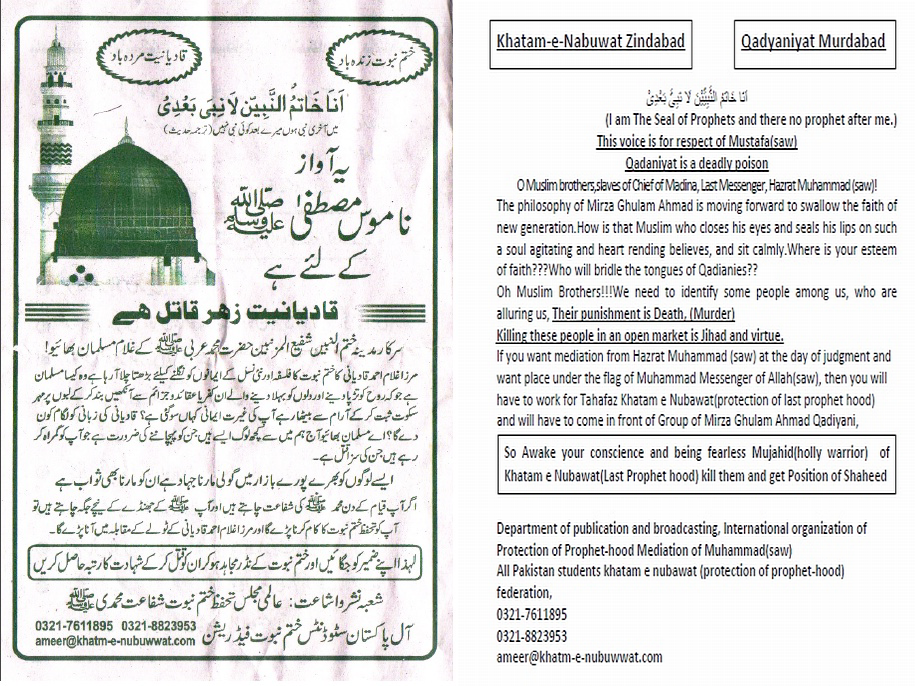
Recently, nearly a hundred Ahmadis were killed while praying in their mosques in Lahore. This kind of killing has become virtually routine for another sectarian minority, the Shia. Suicide bombers regularly invade their mosques on the pretext of praying with them and explode themselves, killing scores of their co-religionists. Ethnic minorities like the Baluchis, Mohajirs, Pashtuns and Sindhis are under constant pressure of varying intensity at different times on different pretexts.
Religious minorities
Religious minorities like Hindus and Christians face similar persecution. There have been several incidents of these religious minorities having had their prayer houses burnt down, killing scores. Forced conversions to Islam, particularly of Hindu girls, who are abducted first, have become another routine. Hindu minorities who constituted 23 per cent of the population at the time of Pakistan’s creation in 1947 have now been reduced to barely 2 per cent. These religious minorities, along with the Ahmadis, also suffer from Pakistan’s notorious blasphemy laws which prescribe death for alleged defamation of Islam. In the case of Ahmadis their mere claim to be Muslim constitutes blasphemy. This leads to some ridiculous but deadly situation for the minorities. Two Ahmadi teachers were put under detention and faced the threat of death penalty merely because their bikes had a sticker containing a verse of the Holy Quran, (Is God not sufficient for His servant?). Ten important functionaries of the Ahmadiyya Community were detained under PPC 295-A, 298-C and 295-C which carry long imprisonments and death penalty for writing the following in their correspondence:
(In the name of God, the Gracious, the Merciful)
(We praise Him, and invoke blessings on His Noble Prophet)
(May peace and Allah’s mercy be with you)
A case was registered under the Blasphemy law on 12 October 1994 against three Ahmadis for translating the Quran in Sindhi language. Subsequently, two more Ahmadis were added to the final charge sheet, alleging them to be the publishers.
In this age of the internet it will not be difficult for anyone to find hundreds of examples of such persecution of the ethnic, religious and sectarian minorities in Pakistan.
International dimension
Pakistan’s violation of human rights is not only causing distress to millions of its own citizens; it has an international dimension as well. For Human Rights defenders around the world, the most worrying aspect is the involvement of State laws and state machinery. It is no accident that the recent attacks on Ahmadis took place in the backdrop of the recent 18th Amendment to the Pakistan constitution which has sealed off the office of prime minister to non-Muslims by declaring that the post will be held by a Muslim. The presidency has, since 1956, already been reserved for Muslims alone. State’s growing intolerance of minorities inevitably encourages extremists to perpetrate more terror.
For Pakistan’s neighbours like India, the concern arises from the fact that Pakistan continues to ignore, if not actively support, the terrorist groups it had spawned earlier under some misplaced strategic imperatives to export terrorism to other countries.
For Muslims around the world, the concern is that Pakistan maintains such discriminatory laws and allows its misuse by the state machinery in the name o Islam, supposedly to promote Islam. After all, the terrorists who blow themselves up, killing scores of people in Ahmadi or Shia mosques, do not do so just because they have been offered some money, but because they have been brainwashed into believing that this act will take them instantly to heaven. There are ostensibly Islamic institutions preaching this evil, brainwashing their pupils and training them to do so. These institutions are well-known, their leaders strut around Pakistani cities, addressing large gatherings, preaching terror, openly collecting donations for their nefarious acts. Pakistani state cannot possibly be unaware of these events, particularly as it organises security for the leaders of these institutions like Hafiz Mohammad Saeed of Jamaat-ud Dawa and Lashkar-e-Tayyaba.
Pakisani civil society
It is heartening that Pakisani civil society is seized of the matter and many intrepid journalists are condemning such dastardly suicide bombings and other terrorist acts at great personal risk. But at the same time, and very unfortunately, one hears voices, even in the English media that used to be the one corner of sanity in Pakistan, justifying killings of Ahmadis and persecution of other minorities in the name of maintaining the purity of Islam. This is largely a result of the ongoing project of Wahhabisation around the world that has spawned many vested interests promoting a very dry, desiccated version of Islam in which the beauty and generosity of Islam, its compassion and mercy have no place. It is necessary for mainstream Muslims to sit up and take notice. Let us hope there is still time and Islam can still be retrieved from the hands of these marauders.
Pakistani state’s continued involvement in promoting acts of terror abroad, even if it is more an act of omission rather than commission, as it claims, has to be inevitably viewed with concern by all those who believe in the indivisibility of human rights. One cannot protect human rights in one country and allow their violation in another country. But this is a cause for even greater alarm for Muslims who see the goings on in Pakistan, as tarnishing the fair name of Islam, thus immensely fuelling Islamophobia around the world. It is no accident that Islamophobic political parties have begun to gain ground in several European countries in the aftermath of continuing massive human rights violations in some Muslim countries and by Muslim extremists even after 9/11.
UN, OIC must intervene
Humanity in general, but Muslims in particular, have got to become very careful about how Islam is being projected by Muslims in the eyes of the world. Thus not only world organisation like the UN, but also Muslim Organisations like OIC must intervene and seek to impress upon offending Muslim countries like Pakistan to stop following domestic and foreign policies that sully the name of Islam. Suicide bombers trained in Pakistan are not only creating havoc in their own country, but also crossing land and seas to terrorise the world. It is strange that while the International community seizes upon the slightest violation of human rights in some countries to condemn them from all corners, it is quite reluctant to put pressure on Pakistan to change course. This is presumably because it is perceived as an ally in the ongoing war on terror. But it has to be understood that by its acts of omission and commission Pakistan is actually fuelling this war. It is not in Pakistani interest or at least in the interest of all-powerful Pakistan Army for this war to end. So those of us who are working towards creating a more peaceful world should take the issue much more seriously than we have done up to now.
After a few threatening noises following the recent Times Square bombing attempt, the international community appears to be treating its dealings with Pakistan as business as usual. But if we are to get rid of the menace of massive violation of the human rights of sectarian, religious, ethnic minorities and women in Pakistan as well as cross border terrorism, it’s high time the world took the issue of neutralising the epicentre of terrorism in the world more seriously.
Recently, nearly a hundred Ahmadis were killed while praying in their mosques in Lahore. This kind of killing has become virtually routine for another sectarian minority, the Shia. Suicide bombers regularly invade their mosques on the pretext of praying with them and explode themselves, killing scores of their co-religionists. Ethnic minorities like the Baluchis, Mohajirs, Pashtuns and Sindhis are under constant pressure of varying intensity at different times on different pretexts.
Religious minorities
Religious minorities like Hindus and Christians face similar persecution. There have been several incidents of these religious minorities having had their prayer houses burnt down, killing scores. Forced conversions to Islam, particularly of Hindu girls, who are abducted first, have become another routine. Hindu minorities who constituted 23 per cent of the population at the time of Pakistan’s creation in 1947 have now been reduced to barely 2 per cent. These religious minorities, along with the Ahmadis, also suffer from Pakistan’s notorious blasphemy laws which prescribe death for alleged defamation of Islam. In the case of Ahmadis their mere claim to be Muslim constitutes blasphemy. This leads to some ridiculous but deadly situation for the minorities. Two Ahmadi teachers were put under detention and faced the threat of death penalty merely because their bikes had a sticker containing a verse of the Holy Quran, (Is God not sufficient for His servant?). Ten important functionaries of the Ahmadiyya Community were detained under PPC 295-A, 298-C and 295-C which carry long imprisonments and death penalty for writing the following in their correspondence:
(In the name of God, the Gracious, the Merciful)
(We praise Him, and invoke blessings on His Noble Prophet)
(May peace and Allah’s mercy be with you)
A case was registered under the Blasphemy law on 12 October 1994 against three Ahmadis for translating the Quran in Sindhi language. Subsequently, two more Ahmadis were added to the final charge sheet, alleging them to be the publishers.
In this age of the internet it will not be difficult for anyone to find hundreds of examples of such persecution of the ethnic, religious and sectarian minorities in Pakistan.
International dimension
Pakistan’s violation of human rights is not only causing distress to millions of its own citizens; it has an international dimension as well. For Human Rights defenders around the world, the most worrying aspect is the involvement of State laws and state machinery. It is no accident that the recent attacks on Ahmadis took place in the backdrop of the recent 18th Amendment to the Pakistan constitution which has sealed off the office of prime minister to non-Muslims by declaring that the post will be held by a Muslim. The presidency has, since 1956, already been reserved for Muslims alone. State’s growing intolerance of minorities inevitably encourages extremists to perpetrate more terror.
For Pakistan’s neighbours like India, the concern arises from the fact that Pakistan continues to ignore, if not actively support, the terrorist groups it had spawned earlier under some misplaced strategic imperatives to export terrorism to other countries.
For Muslims around the world, the concern is that Pakistan maintains such discriminatory laws and allows its misuse by the state machinery in the name o Islam, supposedly to promote Islam. After all, the terrorists who blow themselves up, killing scores of people in Ahmadi or Shia mosques, do not do so just because they have been offered some money, but because they have been brainwashed into believing that this act will take them instantly to heaven. There are ostensibly Islamic institutions preaching this evil, brainwashing their pupils and training them to do so. These institutions are well-known, their leaders strut around Pakistani cities, addressing large gatherings, preaching terror, openly collecting donations for their nefarious acts. Pakistani state cannot possibly be unaware of these events, particularly as it organises security for the leaders of these institutions like Hafiz Mohammad Saeed of Jamaat-ud Dawa and Lashkar-e-Tayyaba.
Pakisani civil society
It is heartening that Pakisani civil society is seized of the matter and many intrepid journalists are condemning such dastardly suicide bombings and other terrorist acts at great personal risk. But at the same time, and very unfortunately, one hears voices, even in the English media that used to be the one corner of sanity in Pakistan, justifying killings of Ahmadis and persecution of other minorities in the name of maintaining the purity of Islam. This is largely a result of the ongoing project of Wahhabisation around the world that has spawned many vested interests promoting a very dry, desiccated version of Islam in which the beauty and generosity of Islam, its compassion and mercy have no place. It is necessary for mainstream Muslims to sit up and take notice. Let us hope there is still time and Islam can still be retrieved from the hands of these marauders.
Pakistani state’s continued involvement in promoting acts of terror abroad, even if it is more an act of omission rather than commission, as it claims, has to be inevitably viewed with concern by all those who believe in the indivisibility of human rights. One cannot protect human rights in one country and allow their violation in another country. But this is a cause for even greater alarm for Muslims who see the goings on in Pakistan, as tarnishing the fair name of Islam, thus immensely fuelling Islamophobia around the world. It is no accident that Islamophobic political parties have begun to gain ground in several European countries in the aftermath of continuing massive human rights violations in some Muslim countries and by Muslim extremists even after 9/11.
UN, OIC must intervene
Humanity in general, but Muslims in particular, have got to become very careful about how Islam is being projected by Muslims in the eyes of the world. Thus not only world organisation like the UN, but also Muslim Organisations like OIC must intervene and seek to impress upon offending Muslim countries like Pakistan to stop following domestic and foreign policies that sully the name of Islam. Suicide bombers trained in Pakistan are not only creating havoc in their own country, but also crossing land and seas to terrorise the world. It is strange that while the International community seizes upon the slightest violation of human rights in some countries to condemn them from all corners, it is quite reluctant to put pressure on Pakistan to change course. This is presumably because it is perceived as an ally in the ongoing war on terror. But it has to be understood that by its acts of omission and commission Pakistan is actually fuelling this war. It is not in Pakistani interest or at least in the interest of all-powerful Pakistan Army for this war to end. So those of us who are working towards creating a more peaceful world should take the issue much more seriously than we have done up to now.
The above is from a speech titled Human Rights in Pakistan: Cultural and Ethinic Dimensions made by Sultan Shahin, editor, New Age Islam, on 11 June 2010, addressing a parallel seminar on Human Right Concerns in South Asia organised by Inter-Faith International during UN Human Rights Council’s June 2010 session at Geneva
Copyright: www.NewAgeIslam.com
Copyright: www.NewAgeIslam.com







 Posts
Posts


