Showing posts with label carnage. Show all posts

Tuesday, June 14, 2011

PML-N and Bigotry: The ‘Basanti’ Connection

Newsline, Pakistan
Home » Blog Row,
The Water Cooler
PML-N and Bigotry: The ‘Basanti’ Connection
14 JUNE 2011By Kashif N Chaudhry

Shahbaz Sharif
Shahbaz Sharif
While Jamaat-e-Islami might be the biggest party supporting the Talibani mindset in Pakistan, the PML-N seems to be certainly competing for the position. The legacy of Zia-ul-Haq lives among us today through these political parties. The vote bank of the PML-N is largely comprised of right-wing conservatives (unsurprising considering the demographic composition of the areas the party controls). Fearful of losing control, the PML-N has had a long record of appeasing the demands of rightists. In doing so, it has been guilty not just of uncountable accounts of serious violations of human rights but also of completely denying justice to the underprivileged segments of society.

More than a decade ago, certain members of the Punjab Provincial Assembly demanded that the name “Rabwah” (the name for the only Ahmadi-majority city in Pakistan) be changed. Anti-Ahmadi Khatme Nabuwwat claimed that the word “Rabwah” was derived from the Quran and therefore only state-defined Muslims could use the word. The Punjab Assembly, headed by Shahbaz Sharif, surrendered to this contemptuous demand without hearing the opinion of a single resident of Rabwah. With the stroke of a pen, the city’s name was changed to “Chenab Nagar” very much against the wishes of its residents.

Then in 2008, after fierce protests by the Islami Jamiat-e-Talaba’s caused the expulsion of all 23 Ahmadi students from Punjab Medical College due to their faith, the PML-N government turned a blind eye. Fearful of upsetting the radical right, the careers of 23 competent medics were left to rot. Thanks to late Governor Salmaan Taseer’s timely intervention, the students were relocated to other institutions.

Then in 2009, the shameful Gojra incident occurred where eight Christians were burnt alive. A mob of banned religious outfits was responsible for the carnage. Chief Minister Shahbaz Sharif refused to visit the victims. The threat of resignation from a Christian provincial minister, Mr Kamran Michael, as well as strong international protest forced Sharif to eventually rethink his decision four days after the brutal killings.

Kamran Michael
Kamran Michael
The list of incidents of PML-N bigotry and chauvinism is unending. The party has had an unshakeable relationship with the violation of minority rights. Last week, bigoted leaders of the PML-N expressed major concern over Michael presenting the annual budget speech in the Punjab Assembly. And no, this was not because Michael stuttered like the king in The King’s Speech or had any problems with his fluency with Urdu or English. It was because he was a Christian. This was apparently such a critical issue that a “high-level” meeting was called and Michael was stripped of his position in the finance ministry. Once again, Shahbaz Sharif was the man behind the decision.

The PML-N came under heavy criticism once again from local and international groups and was forced to reinstate Michael – and he eventually presented the budget on June 10. While this is the latest display of PML-N’s twisted mindset, it will not be the last.

Shahbaz Sharif, like his brother, has had a long history of accommodating Punjab’s intolerant clergy, and causing immense pain to minorities. For example, many members of minority groups rot in jails in Punjab on bogus charges, their trials interrupted, their attackers acquitted.

The reversal of the decision regarding Kamran Michael makes one thing clear: the PML-N is facing a serious problem. Now that the world watches Pakistan closely, the party leadership has an international audience to please. It is in a fix, struggling hard to decide between doing what is right and what is rightist.

But then a friend tells me Shahbaz Sharif is a good man and the PML-N’s proclivity for bigotry is due to the preponderance of rightist members in the party. If this is the case, my advice to the chief minister would be best conveyed in the words my friend Taimur Khan likes to recite: “Basanti, in kutton ke saamne mat nachna” (Basanti, stop dancing in front of these dogs).

But to be honest, I have very little hope that Sharif will stop dancing before his dogs.

Kashif N Chaudhry is a graduate of King Edward Medical College in Lahore and is presently completing his medical residency at Mt Sinai Hospital in New Jersey.

© 2009 Newsline Publications (Pvt) Ltd
URL: www.newslinemagazine.com/2011/06/pml...connection/

Thursday, July 8, 2010

Pakistan’s Religious Minorities Face Persecution by the State

Jakarta Globe, Indonesia

July 08, 2010
Pakistan’s Religious Minorities Face Persecution by the State

Just a month ago, at least 95 members of the Ahmadiyah Islamic sect were killed and nearly 100 injured in attacks on their places of worship in Lahore, in Pakistan’s Punjab province. The attacks were part of a campaign against Ahmadis by Islamist groups openly sympathetic to terrorist groups, including the Taliban.

Politicians have been strangely silent on the attacks. Punjab’s chief minister, Shahbaz Sharif, the leader of the Pakistan Muslim League, has not shown his face at either Ahmadi mosque targeted in the attacks, despite living down the road from them.

Mohammed Hanif, a journalist, wrote: “When the funerals of the massacred Ahmadis took place there were no officials, no politicians present.”

Several days after the attack, former Pakistani Prime Minister and Pakistan Muslim League leader Nawaz Sharif said the members of the Ahmadi sect were his brothers and sisters and that militants should be flushed out wherever they were active.

His comments drew sharp criticism from religious parties like the Khatm-e-Nabuwat Movement, Jamiat Ulema-e-Islam and Jamaat-e-Islami.

Maulana Ilyas Chinioti, the head of KNM, a member of the PML-N and the Punjab provincial assembly, also condemned Sharif’s statement.

Maulana seems to be openly preaching that non-Muslims are lesser humans, despite the fact that Ahmadis profess that they are Muslims.

Those who dare to defend the rights of religious minorities in Pakistan are usually labeled as being “anti-Islam.”

Ahmadis have been under widespread attack by increasingly violent Islamic fundamentalists across the planet.

The movement was founded in India by Mirza Ghulam Ahmad, who died in 1908 and who claimed to have succeeded the Prophet Muhammad as leader of the religion and who would bring about the final triumph of Islam as per Islamic prophecy.

According to a June 4 story in The News, a surviving attacker of the Lahore carnage, Abdullah, alias Muhammad, said he was misled into believing that Ahmadis were involved in drawing blasphemous caricatures of the Prophet Muhammad, so their bloodshed was a great service to Islam.

The campaign against the sect began a decade ago in Pakistan. Before the 1947 partition of Pakistan and India, anti-Ahmadiyah agitation was instigated by the Majlis-i-Ahrar, a lower-middle-class party.

In 1934, Ahrar set up an anti-Ahmadi movement after the Ahmadi community supported a demand for a Pakistan. In 1953, six Ahmadis lost their lives when an anti-Ahmadiyah wave swept the newly founded country.

According to Waqar Gilani, in 1973 the then president of Azad Jammu and Kashmir, Sardar Abdul Qayyum, declared Ahmadis to be non-Muslims. In the same year, a Saudi Arabian conference also agreed to oust Ahmadis from the circle of Islam.

In 1974 they were declared non-Muslims by the Pakistani Parliament. In 1984, Gen. Zia-ul-Haq promulgated a martial law ordinance containing blasphemy laws that undercut the activities of religious minorities generally, but struck at Ahmadis in particular.

Since then, they have been arrested frequently for greeting someone with the traditional Islamic Assalam-o-Alaikum, reciting Muslim prayers or reading the Holy Koran.

In the period 1984-2009, 105 Ahmadis were killed in Pakistan, according to two authors writing in Viewpoint, a Pakistani online magazine.

“During the same period, 22 Ahmadiyah mosques were demolished, 28 were sealed by authorities, 11 were set on fire and 14 were occupied, while construction of 41 was banned. In at least 47 cases, burials were denied in common graveyards while 28 bodies were exhumed,” the two wrote.

Since 2000, an estimated 400 Ahmadis have been formally charged in criminal cases, including blasphemy. Many remain imprisoned.

Both printed and electronic Pakistani media have played a scandalous role in spreading hatred against the community.

Recently, the Muslim Canadian Congress blamed major media outlets in Pakistan for inflaming rhetoric against Ahmadiyah, Ismaili and Shia Muslims.

In particular, the MCC pointed out that GEO Television had become the voice of Al Qaeda and the Taliban and had spread hatred against these communities as well as against non-Muslims.

Religious minorities in general and Ahmadis in particular are not treated by the Pakistani state as equal citizens. They are routinely intimidated and persecuted because of their faith.

Unless the state changes its mind-set about minorities, they will live under constant threat, which is against international human rights laws and the constitution of Pakistan.

Aftab Alexander Mughal is the editor for a Pakistan-based nongovernmental organization, Minorities Concern of Pakistan.

Copyright 2010 The Jakarta Globe

Tuesday, July 6, 2010

Religious fundamentalism main root of violence in Pakistan

Calgary Herald, Canada
Religious fundamentalism main root of violence in Pakistan
By Mahfooz Kanwar, For The Calgary Herald July 6, 2010

In a little more than a month there have been two major terrorist attacks perpetrated by Muslims against other Muslims at mosques in Lahore, Pakistan.

This past Thursday, two suicide bombers blew themselves up killing at least 42 people and injuring a minimum of 180 people at the Data Darbar shrine, where a famous Sufisaint is buried.

On May 28, fundamentalist Muslims massacred more than 90 Ahmadiyya Muslims at their two mosques in Lahore and injured hundreds more.

When these events occur – and their have been many more in this Punjab region of Pakistan – the world wonders: why do Muslims kill other Muslims?

Not only did some Muslim fundamentalists armed with suicide vests, guns and grenades kill and injure dozens of worshippers, but they also took a large number of Ahmadis hostage.

This appalling, murderous act is not unusual in the history of Pakistan. In 1953, Jamaat-e-Islami Pakistan, a fundamentalist religious and political party in Pakistan, created a murderous upheaval against Ahmadis in the same city of Lahore. Jamaat’s hooligans killed approximately 2,000 innocent Ahmadis. Now, the Taliban and al-Qaeda are suspected in this sectarian violence.

During my schooling, I minored in Islamic studies, and have published a book on Sociology of Islam. I have studied Islam further and have published my research in two other of my books as well as columns in newspapers and I have discussed those results in three of my 21 documentaries over the years.

Many Muslim fundamentalists are semi-literate, and some of them totally illiterate mullahs. The Holy Book of Qur’an makes it very clear that those Muslims who kill or commit suicide will be condemned to hell. Yet, some of these ill-informed Muslim extremists, such as suicide bombers, commit both murder and suicide. And they believe they are acclaimed to go to heaven in their life here after.

Pakistani Islamists always have had issues with the Muslim sect of Ahmadis. Along with the Islamic fundamentalists, some prominent secular politicians have also played the card of religion in Pakistan. The former prime minister of Pakistan, Zulfikar Ali Bhutto, declared Ahmadis as non-Muslims in the early 1970s.

Bhutto’s government introduced a column for religion on the national identity cards as well as passports in singling out the Muslim sect of Ahmadis along with the rest of non-Muslims in Pakistan. This was designed basically to create a system of religious apartheid in Pakistan. That act smacked the basic Islamic principle of tolerance.

In Pakistan, Ahmadis are often barred from praying in their mosques. To preach their faith is considered to be a crime under Article 295 of the Penal Code of Pakistan. The federal sharia Court of Pakistan has ruled that preventing Ahmadis from preaching their faith is no violation of the fundamental rights guaranteed in the Constitution of Pakistan. This is akin to the system of apartheid which was once practised in South Africa.

Although Bhutto was overwhelmingly supported politically by more than two million Ahmadis in Pakistan, he declared Ahmadis as non-Muslims. Bhutto, a secular political leader, betrayed Ahmadis big time. However, the vile fundamentalist and ruthless military dictator Muhammad Zia-ul-Haq expanded the system of apartheid for Ahmadis in Pakistan.

What makes Bhutto, Zia and many mullahs qualified to decide who are or aren’t Muslims? It is supposed to be God’s business to judge His creatures.

In my research for my forthcoming book, Addiction to Religion, I note, among other things, that Islam means peace and Muslims are supposed to adhere to peace, but that does not seem to be the case for decades now.

Islam is a religion but Islamism is an addiction to religion that leads to terrorism. Fundamentalism is a gateway to addiction to religion which blinds people to become suicide bombers who commit two sins in Islam that will take them to hell.

Unfortunately, Pakistan is ruled by five pillars of corrupt establishment. They are: unpatriotic feudal landlords turned politicians (they, along with the Jamaat-e-Islami, were opposed to the creation of Pakistan), cruel military dictators (who have ruled Pakistan ruthlessly for more than half of it’s history), corrupt politicians, depraved bureaucrats, and fundamentalist mullahs.

This last pillar is perhaps the most key. Until the idea of freedom of religion becomes accepted in Pakistan, Muslims will keep on killing each other. That’s because they believe that there is only one way to practice Islam – their way. They are taught no tolerance to other faiths or even to those who share their faith but practise it differently. That’s why Shiites kill Sunnis, Sunnis kill Shiites, both kill Ahmadis and these groups – with the backing of the government and Pakistani law – all persecute and attack Christians and Hindus.

Until and unless something revolutionary happens, Pakistan will continue facing drastic, murderous problems.

Mahfooz Kanwar is Professor Emeritus at Mount Royal University

Copyright © The Calgary Herald

Taliban oppresses Ahmadi Muslim sect in Pakistan

Sepro News
World:  Asia
Taliban oppresses Ahmadi Muslim sect in Pakistan
Tuesday, July 06, 2010
By Spero News

In June 2010, at least 95 members of the Ahmadi Muslim sect were killed and nearly 100 injured in attacks on their places of worship in Garhi in Lahore, Pakistan’s Punjab province. This attack is part of a campaign against Ahmadis by Islamist groups such as the Sunni Tehrik, Tehrik-e-Tahafaz-e-Naomoos-e-Risalat, Khatm-e-Nabuwat and many others who are openly sympathetic to terrorist groups, including Taliban. Ironically, most of the politicians were very careful to condemn the attacks on Ahmadis. Even Punjab’s chief minister, Shahbaz Sharif, leader of Pakistan Muslim League (PML-Nawaz Group), has not shown his face at either mosque, despite living down the road from them. Mohammed Hanif, a journalist, writes, “When the funerals of the massacred Ahmadis took place there were no officials, no politicians present.”

Later, former Pakistan Prime Minister and PML-N chief Nawaz Sharif said that the members of the minority Ahmedi sect are his brothers and sisters and that militants should be flushed out wherever they are active. His comments drew sharp criticism from religious parties like Khatm-e-Nabuwat Movement (KNM), Jamiat Ulema-e-Islam and Jamaat-e-Islami. Maulana Ilyas Chinioti, the head of KNM, a member of the PML-N and the Punjab provincial assembly, also condemned Sharif’s statement. There was no doubt that Maulana Chinioti seems to be openly preaching that non-Muslims are lesser humans. Daily Times says that those who dare to defend the rights of religious minorities are usually labeled as being ‘anti-Islam’.

According to The News of Pakistan, a surviving attacker of the Lahore carnage, Abdullah alias Muhammad, disclosed that he was misled into believing that Ahmadis were involved in drawing blasphemous cartoons of Mohammed, and believed that killing them was a great service to Islam. The attacker belongs to a militant group affiliated with al-Qaeda. He was trained in Miramshah in North Waziristan, lawless tribal area of Pakistan.

Right after the Lahore carnage, a mysterious SMS campaign has been launched against Ahmaddiya community which makes them more fearful, the Minorities Concern of Pakistan learnt. Moreover, the Islamists issued statements in which they asked Ahmadis to cease from hurting the feelings of the majority population. Jamaat-i-Islami chief Syed Munawwar Hasan, on June 18, warned of a fresh Khatm-i-Nubuwwat movement if the “Ahmadis did not accept their minority status” in Pakistan. At the same time, many blame a “foreign hand.” Some openly said that the Indian intelligence agency, Research and Analysis Wing (RAW), was involved in Lahore attacks. However, Interior Minister Rehman Malik declared on June 18 that the RAW was not involved in the killing of Ahmadis.

Ahmadiyya sect was formed in 1880s in Qadian, India. They view themselves as Muslims but hardliners consider them non-Muslims. They are a relatively small minority in Pakistan and they make up somewhere between 0.25 per cent (according to Pakistan’s census 1998). However, the Economist estimates that their population is 2.5 per cent. They have always been a soft target for persecution. The campaign against them is a decade ago. Before the partition, Anti-Ahmadiyya agitation instigated by Majlis-i-Ahrar, a lower middle class party.

In 1934, Ahrar arranged a big gathering against Ahmadis called Tahafuz-e-Khatm-e-Nabuwat Conference, held at Qadian. Ahrar was angry with Ahmadiyya community to support Quaid-e-Azam Muhammad Ali Jinnah for the demand of Pakistan. In 1953, six Ahmadis lost their lives when an anti-Ahmadiyya wave swept in newly founded Pakistan. The state constituted an inquiry commission; Justice Muhammad Munir as president and Justice Kayani as member. The commission’s report, also called Munir Report, carried an analysis of the Ulema’s concept of the Islamic State and of a Muslim. The report concluded that the concept of a Muslim differed for different sects and if the fatwas of the Ulema were relied upon to determine whether an individual is Muslim or Kafir then no sect could be called Muslim because of the lack of a single, coherent and unanimous definition of a Muslim and an Islamic State.

According to Waqar Gilani, in 1973, the then president of Azad Jammu and Kashmir, Sardar Abdul Qayyum declared Ahmadis to be non-Muslims. In the same year, Rabta-e-Alam-e-Islami Conference in Saudi Arabia also gave its stamp of approval to oust Ahmadis from the circle of Islam. The unfortunate beating of the students of Nishtar Medical College, Multan, on May 29, 1974, proved to be a major incident that infuriated this anti-Ahmadi movement. The students, going on train, started shouting against Ahmadis while reaching Rabwah, the headquarter city of Ahmadis in Pakistan, resulting in a strong reaction of Ahmadis to this gathering. The incident geared up the Khatm-e-Nabuwat movement that started a violent protest.

On Sept. 6, 1974, a minor incident sparked other anti-Ahmadiyya riots leaving 24 members of Ahmadiyya community dead. In the same year, they were declared non-Muslims by the parliament.

On April 26, 1984, General Zia-ul-Haq promulgated the Martial Law Ordinance XX. Through this ordinance he introduced some blasphemy laws which undercut the activities of religious minorities generally, but struck at Ahmadis in particular. Since then, frequently, they have been arrested for greeting someone with an Assalam-o-Alaikum, reciting the kalima or reading the Holy Quran. “In the period 1984-2009, 105 Ahmadis were target killed. During the same period, 22 Ahmadiyya mosques were demolished, 28 were sealed by authorities, 11 were set on fire, and 14 were occupied while construction of 41 was banned. In at least 47 cases, burials were denied in common grave yards while 28 bodies were exhumed,” Adnan Farooq and Riaz ul Hassan write in View Point.

Since 2000, an estimated 400 Ahmadis have been formally charged in criminal cases, including blasphemy. According to one report, in 2009, at least 37 Ahmadis were charged under the general provisions of the blasphemy laws and over 50 were charged under Ahmadi-specific provisions of the law. Many of these individuals remain imprisoned.

It is apparent that both the Pakistani state and society are both are very hostile against Ahmadis. Moreover, both printed and electronic Pakistani media have also played a role in spreading hatred against this community. Recently, the Muslim Canadian Congress (MCC) blamed the major media outlets in Pakistan for inflaming the rhetoric against Ahmadiyya, Ismaili and Shia Muslims. In particular, the MCC pointed out that GEO Television has become the voice of al-Qaeda and the Taliban, and spreads hate against these communities as well as against non-Muslims.

According to one report, “After the attacks some newspapers ran op-ed article creating an impression as if these attacks were a violent consequence of ongoing polemic between certain Muslim sects and the Ahmadiyyas.”

The Minorities Concern of Pakistan learnt that when Jamaat-i-Ahmadiyya’s arranged a press conference after Lahore incident most of the reporters refused to take tea there.

Adnan Farooq writes on June 18: It remained a routine with the Urdu papers to print anti-Ahmadiyya statements and hate-mongering stories with bold headlines. However, no paper published the occasional Ahmadiyya explanation. In year 2007, 974 such news items appeared in the press, but in 2008 the number went up to 1033 items. Almost all of these were prejudiced, hate-promoting and false propaganda. The daily Nawa-i-Waqt (with editor Majeed Nizami) led this bandwagon by printing 465 items. The daily Jang stood second, and the Daily Express was a close third. Provocative statements issued by various clerics’ are carried without any verification. A few of these headlines are translated below: Qadianis are not loyal to the country, nation and Islam: ‘Sajid Mir’ (The daily Jang, Lahore; May 27, 2008) - Qadianis are enemies of Islam and Pakistan: Shadabi Raza, Mufti M. Sadeeq (The Daily Express, Lahore; June 2, 2008).

Source: Minorities Concern of Pakistan

© Copyright Spero, All rights reserved.

Thursday, June 3, 2010

There is blood on our hands

The News - Internet Edition
Thursday, June 03, 2010,
Jamadi-us-Sani 19, 1431 A.H.
 There is blood on our hands

Thursday, June 03, 2010
Kamila Hyat

The writer is a freelance columnist and former newspaper editor

The different kinds of violence that run through our country have turned it into a zone where war, and the chaos it brings about, is a perpetual phenomenon.

Most recently Ahmedis have been its victims, with 90 killed in the bloodbath in Lahore. In past months Shias have suffered similar violence. Ethnic battles rage on in Karachi, the military fights extremists in the northwest and other kinds of killings take place in Balochistan where five teachers have been among the 128 shot dead in targeted killings over the past five months. Fourteen teachers have been among the 782 killed in targeted shootings in the province in the past three years. Attacks on Christians are reported every now and then as are different kinds of random violence that seem on the surface to be senseless. Mob action against those suspected of crime is becoming more and more frequent and, frighteningly, as the killing fields spread, the state’s law-enforcers seem to have been reduced to the role of spectators, who can, at best, only rush in after the spree of violence to pick bodies off the streets.

Certainly, this is what happened in Lahore. Threats to the Ahmedi community, coming in for almost a year in the Model Town area went largely unheeded. Security was stepped up but was obviously inadequate in the face of an attack as well-coordinated and planned as the siege that disrupted weekly prayers. It appears that intelligence agencies had failed to pick up on plans for the attack. Ahmedis report that after it took place the police response was delayed and the death toll could have been even higher had two young Ahmedi men not acted with immense courage and disarmed two of the suicide bombers, holding them captive for 30 minutes until the police made their way to the spot in Model Town. Even after the carnage, there is evidence the lessons have not been learned.

Arrangements for a mass funeral were altered by the Ahmedi community which saw the security as insufficient. Their fears are not out of place. Attacks at burials have been staged on more than one occasion by the militants to maximise the numbers they consign to death.

The events we saw on Friday go beyond the issue of a failure to offer security. They are rooted in the state’s discrimination against a particular community which in 1974 was declared ‘non-Muslim’ despite its own protestations to the contrary. Some ten years later specific laws against Ahmedis made it more likely they would be persecuted. According to the US State Department’s annual Human Rights Report issued in March 2010, 94 Ahmedis faced criminal charges in Pakistan for religious offences during the past year: 37 under the blasphemy laws and 57 under Ahmedi-specific laws.

Pakistan remains on the list of countries of ‘particular concern’ for the US Commission on International Religious Freedoms. Such state-backed discrimination has strengthened the hatred against Ahmedis propagated by extremist groups. This sentiment has found its way into mainstream society, mainly through the doings of sections of the media. While Friday’s killings shocked many, there was disturbingly muted comment from some quarters about the ‘controversial’ beliefs of the community – as if this justified murder. Some national leaders made it a point not to mention Ahmedis by name in statements condemning the act of terrorism against them.

Another game now appears to be afoot. There have been observations from police officers in Lahore that the militants who staged the attack had roots in North Waziristan. It is quite possible that these findings are not inaccurate. But there is suspicion that a part of the motive is to deflect criticism faced by the Punjab government for failing to act against groups in southern Punjab suspected of being linked to the attack. There is certainly evidence to back this. Those present at the Model Town place of worship say one of the young men pinned down by worshippers spoke in Seraiki, cursing those who had prevented him from completing his ‘mission’.

Initial claims of responsibility for the assault appeared to come from the Tehrik-e-Taliban, Punjab, and despite the denial of the Punjab government the fact is that this group has been linked to many of the recent spate of terrorist attacks. It of course is likely that it is working alongside forces based in the northwest, forming a new – and extremely dangerous – nexus.

Southern Punjab has for many years been the heartland of sectarian violence and also anti-Ahmedi sentiment. The groups guilty of repeatedly violating the law against the spread of religious hatred have never been charged. No attempt was ever made to prevent them from inciting violence against the Ahmedi community. In some cases the government, at various points in time, has connived in actions directed against Ahmedis. The refusal to go after extremist groups has almost certainly encouraged them.

For purposes of electoral gain, Punjab ministers have joined hands with leaders of the Sipah-e-Sahaba Pakistan, despite the fact that it is a banned organisation. Other banned groups continue to operate in the province. This dangerous situation of course increases the possibility of more violence in future with Punjab becoming a safe haven for militants.

The state of war we live in leaves no room for development or an improvement in the quality of human life. It presents fearful dangers to the state itself, with new fault lines zigzagging across it. The cracks have been widening rapidly. We must find ways to fill them in before the rifts grow deeper and the violence they generate assumes still more dangerous dimensions. The state needs to take the lead in this. Discrimination laid down in law must be ended and an even playing field created for all citizens.

Until his happens, we will remain a nation divided on the basis of religious belief, ethnicity and other factors which prevent us from discovering the tolerance we so badly need to create integrity and the willingness to live together within a territory shared by many diverse groups.

Email: kamilahyat@hotmail.com

Speak up!

The News - Internet Edition
Thursday, June 03, 2010,
Jamadi-us-Sani 19, 1431 A.H.
 Speak up!

Thursday, June 03, 2010
Sehar Tariq

Thousands took to the streets to protest against Facebook and blasphemous content being published on it. On May 28th, 80 innocent Pakistanis were murdered in cold blood as they were peacefully praying in a house of worship. I wonder how many will take to the streets to protest this atrocity? I have a feeling that there will be few or perhaps none. There will be the usual round of condolences and demands for inquiries, but we know these are merely hollow promises. In Pakistan little is accomplished without popular support, and popular support does not lend its self to causes such as protection of minorities.

When we wanted the judiciary restored, we took to the streets and had it done. When we wanted Facebook banned we took to the streets and had that done. But I have a feeling we’re going to let this one slide and stay inside. It’s ironic that we are willing to take to the streets for the sanctity of the name of the Prophet (PBUH) but not for any of his teachings. The Prophet preached that it was a sin to harm innocent people.

But somehow it doesn’t matter what happens to those that “we” don’t consider Muslims. While the phenomenon of terrorism is new, the problem of sectarian violence is not. We have harboured violent hatred and have not been afraid of expressing it. We are so caught up in some billowing self-righteous rage that we have become blind to the teachings of the religion that we profess to love and in whose name we commit all of these sins.

But these really aren’t Muslims some would say. And some would cite the teachings of popular television anchors who consider these people wajib-ul-qatl. The Prophet (PBUH) preached that even in times of war those who do not pick up arms should not be harmed; particularly women and children. But innocent children were slaughtered, the old and infirm suffered frightened and tortured deaths while they were busy in worship.

The people that were murdered were peaceful, taxpaying, law-abiding citizens of the Islamic Republic of Pakistan. It is the responsibility of the state, under the constitution and Islam, to provide security to those citizens who, despite adhering to different religions, pay taxes and abide by the laws of the land. But instead of providing protection to these people, we have television programs where anchors are allowed to rally support for murdering innocent citizens. And in the wake of such hatred, innocent people are murdered.

No word, whisper or whimper about this is heard. Because in our twisted worldview, it’s alright to say whatever we want about any other religions or their followers. But when someone attacks our religion in any way, shape or form, we are up in arms in a matter of minutes. We expect the world to show us nothing but respect while we show none of this to any other religion. We can laugh, joke, degrade and even attack and murder the followers of other religions without having our collective conscience flinch. How did we become so hypocritical and irrational? How did we become so cruel?

With the deaths of 80 innocent Pakistanis, the lives of hundreds of families have changed forever. There is sorrow and heartache and fear in hundreds of Ahmedi homes. But as the rest of Pakistan sleeps easy and TV anchors remain hypocritically silent, they forget that tomorrow this could be them. Through our collective silence, as we aid and abet a culture of intolerance and senseless killing that one day might consume us too. This violence, intolerance and injustice must stop. And it must stop with the largest majority speaking up against it.

For once, let’s stand up and show the world that we actually abide by the spirit of the religion that we profess to love and follow. Let us turn not far away, but towards the Holy Book and teachings of the Prophet (PBUH) to learn that this kind of violence and hate is not tolerated in Islam. This senseless killing, violence and hate will not stop unless we demand that this be done.

The writer is a student of Woodrow Wilson School at Princeton University, working for a master’s degree in public policy. Email: tell.sehar@gmail.com and www.sehartariq.wordpress.com

Wednesday, June 2, 2010

Religious leaders launch tirade against Ahmedis

Press Trust of India
Religious leaders launch tirade against Ahmedis
STAFF WRITER 16:36 HRS IST
M Zulqernain

Lahore, Jun 2 (PTI) Religious hardliners have launched a fresh tirade against Pakistan’s Ahmedi sect, just days after a terrorist attack on mosques of the religious minority left 95 people dead and over 100 injured.

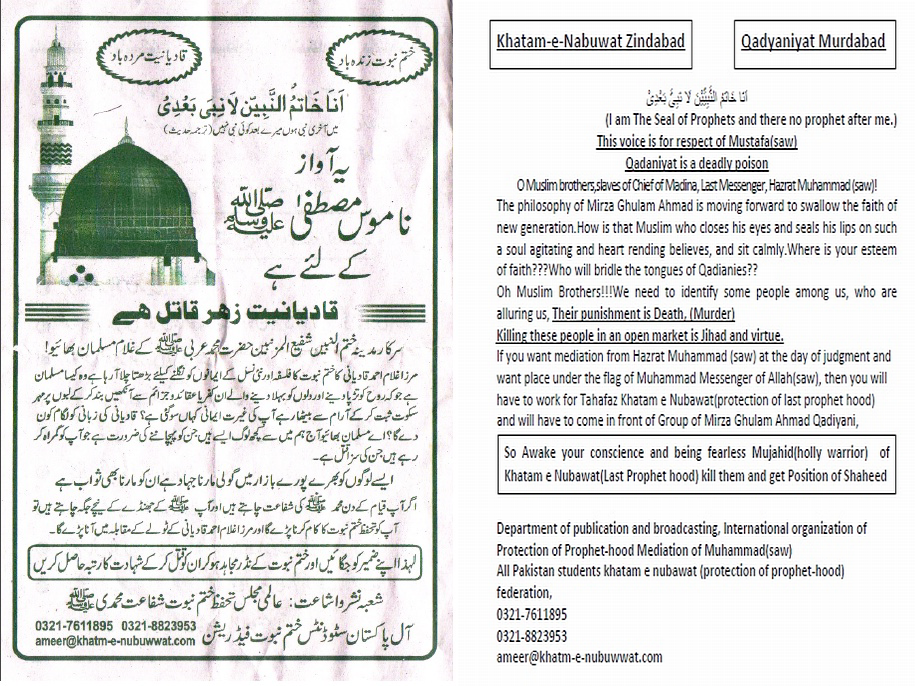
Leaders of the Tahfuz-e-Namoos Risalat Mahaz demanded that the government should take “strict action” against Ahmedi community director Mirza Ghulam Ahmad for committing “blasphemy” by saying that with a stroke of a pen the community had been declared non-Muslims.

Addressing a press conference yesterday, TNRM leaders Allama Razai Mustafa, Allama Abdus Star Saeedi, Qazi Muzafar Iqbal, Qari Zawar Buhadar, Allama Gul Muhammad Aqiqi, Allama Khadim Hussain and Ashraf Jilali did not condemn Friday’s attacks on the Ahmedi mosques.

Instead, they demanded that the Ahmedi leaders should be penalised for statements they had issued after the carnage.

Jilali claimed the feelings of Pakistani Muslims were hurt by such statements.

“Qaidianis (Ahmedis) are non-Muslims. Not only Pakistan, but a number of other countries have also declared them so,” he said.

“Qaaidians are a threat to our religion and they want to highjack our Quran and Prophet,” Jilali said.

He demanded that the government must “come down hard” on the Ahmedis.

Jilali said that 600 Ahmedis were in the Israeli army but did not offer any proof to back up his claim.

The TNRM leaders also spoke at length about the sins allegedly committed by Ahmedis against Islam and Muslims.

To the surprise of liberal segments of society, the comments made by the TNRM leaders were published in almost all Urdu dailies.

However, the electronic media and English newspaper did not cover the press conference.

Jamaat-e-Ahmadiyya Pakistan spokesman Saleemuddin said: “Such propaganda against Ahmedis is not new. Religious extremists have been injecting venom against us even in children studying in seminaries for a long time. They want us to leave Pakistan.”

While Ahmedis consider themselves Muslim, they were declared non-Muslims in Pakistan in 1974, and in 1984 they were legally barred from proselytising or identifying themselves as Muslims.

Some 1.5 million Ahmedis live across Pakistan.

News also carried by Zee News @ www.zeenews.com/news630997.html
 
^ Top of Page