Showing posts with label Khatm-e-Nabuwat. Show all posts

Sunday, September 18, 2011

Persistent persecution

News on Sunday, Pakistan
threat
Persistent persecution
Ahmadi community in Faisalabad keeps carrying the tag of ‘liable to be killed’ with no security
By Aoun Sahi
September 18, 2010

Naseem Ahmad Butt, 55, father of four daughters and a son and a follower of Ahmadi school of thought, was sleeping in the courtyard of his house in Muzaffar Colony in Faisalabad on the night of September 4, 2011 when four unidentified attackers broke into his house and attacked him. He received one bullet in his chest while the second one ruptured his kidney.

The firing woke up his wife whose cries forced the attackers to flee. “My brother was lying in a pool of blood when I saw him. He told me that the attackers were between 20 and 25 years old. One of them kicked him and when he woke up, they shot him. He died in a local hospital seven hours after the attack,” Khalid Pervez Butt, younger brother of Naseem Butt, tells TNS.

Naseem used to work as a technician in a local powerloom and had no enmity. “The attackers did not steal anything from his house. Being Ahmadi seems to be his only ‘sin’ that made him liable to be killed,” says Khalid Butt. His first cousin Naseer Butt was also killed in a similar fashion on September 8, 2010. “Police has made no effort to trace his killers. However, in a hope of assistance, I have got a case registered with police under section 302 of Pakistan Penal Code,” he tells TNS, adding that it is the fourth murder in his family.

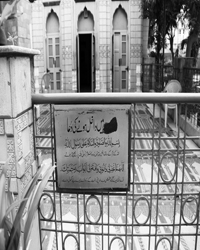
Baitul Hadi“In 1994, one of my younger brothers and one of my first cousins (younger brother of Naseer Butt) were killed by religious fanatics. Police had arrested the assailants. Local activists of religious parties held protest rallies against the arrests of culprits and one of the assailants had been released just a few months back,” he says.

Three days after this incident on September 7, 2011, another Ahmadi, Chaudhry Basheer Ahmad, was attacked in Rachna Town in Sheikhupura district. He received three bullets and is still in hospital in a critical condition.

September has always been a tough month for Ahmadis in Pakistan as on September 7, 1974, the Parliament of Pakistan declared them non-Muslims. Almost all religious parties hold rallies and gatherings in the first week of September every year against Ahmadis. Majlis-e Tahffuz-e Khatm-e Nubuwwat takes the lead and arranges an annual gathering to celebrate victory against Ahmadis every year in Rabwah — the Jama’at Ahmadiya’s headquarters in Pakistan.

“Faisalabad has become one of the toughest cities in Pakistan for Ahmadis to live in,” Syed Mahmood Ahmad, secretary of the Faisalabad chapter of Jama’at Ahmadiya, tells TNS. “Naseem Butt was neither an active member of our Jama’at nor was an influential person. He was killed only because of his religious beliefs. Within days after his killing, unidentified people have written slogans like ‘slaves of the companions of Prophet (PBUH) and ‘down with Qadyaniat’ on the walls of Muzaffar Colony.

In May this year, a pamphlet terming Ahmadis ‘liable to be killed’ was distributed in Faisalabad. “It also carried names and addresses of prominent Ahmadis in Faisalabad. We have time and again contacted the Faisalabad police that a group of fanatics is threatening Ahmadis in the area. But no action has ever been taken,” says Ahmad. “On June 2, 2011, I sent an email to the home secretary and the police chief of Punjab as well as Faisalabad’s regional police officer, but nothing has been done to help us.”

Over the past two years, as many as six Ahmadis have been killed in Faisalabad, but no killer has been brought to book. “Religious fanatics are being encouraged by a lack of action on the part of the government agencies. It has even become too tough for Ahmadi youth to get education in public sector universities. A few months back, four girls belonging to our community were expelled from National Textile University. The 2010 annual magazine of that university carried three articles against Ahmadis,” says Mahmood Ahmad.

An Ahmadi praying in MosquePolice officials in Faisalabad do not seem to have taken the issue seriously. “We have no resources to provide special security for Ahmadis,” Shakir Hussain Dawar, senior police official in Faisalabad, tells TNS. “As far as Naseem Butt’s murder is concerned, we are investigating it from all angles. We have not ruled out the possibility of religious factor,” he says.

Saleemuddin, the Jama’at spokesperson, says that Ahmadis are being threatened all across the country, adding that Faisalabad has become the most hostile city towards the Ahmadis. “Most hate material is being generated and funded there. Eleven Ahmadis have been killed in Faisalabad since 1984.” In May last year, more than 88 people were killed in Lahore when gunmen opened fire at two separate places of worship of Ahmadis. “One year has passed, but no progress has been made in the case.”

Human rights activists have termed the situation deplorable. They are worried about the situation and have been writing constantly to the government about the security of Ahmadis. “Faisalabad has become a test case for the government to check the persecution of Ahmadis. The opponents of Ahmadis have even published their addresses and phone numbers on the pamphlets distributed in Faisalabad around three months back. No action has been taken against the culprits. It seems that the persecution will continue,” says HRCP Director IA Rehman.


Friday, August 5, 2011

Morden man fears for brother named on Ahmadiyya Muslim murder list in Pakistan

Wimbledon Guardian, UK
News
Morden man fears for brother named on Ahmadiyya Muslim murder list in Pakistan
12:25pm Friday 5th August 2011
By Omar Oakes »

Fears: Chaudhary Nawaz shows a list of names of people, including his brother, who are 'liable to be murdered' in Pakistan
Fears: Chaudhary Nawaz shows a list of names of people, including his brother, who are “liable to be murdered” in Pakistan
The brother of a Pakistani man whose name was published on a religious murder list by Muslim fanatics has said he is distraught with worry.

Chaudhary Nawaz, from Hillcross Avenue in Morden, said his brother Dr Muhammad Nawaz, a technology college academic in Pakistan, had gone into hiding for fear of being murdered for being an Ahmadi Muslim.

Ahmadi Muslims are not considered Islamic in Pakistan under the Government’s strict blasphemy laws and this list of prominent Ahmadis is being widely distributed in Faisalabad, a textile hub in the Punjab province.

The list is published on a pamphlet given out widely in shopping areas and claims: “To shoot such people is an act of jihad [struggle of faith] and to kill such people is an act of sawab [reward].”

Mr Nawaz, 48, said: “I can’t tell you how worried I am. Sometimes I try not to think about it because I am so frightened about what could happen.

“My brother is a good man, an educator. He doesn’t deserve to be targeted like this.

“I feel helpless because he is thousands of miles away and I can’t help him.”

Mr Nawaz, a senior member of the Morden district of the Ahmadiyya Muslim Association, said his brother cannot leave Faisalabad because he has to care for their mother, an 82-year-old Alzheimer’s sufferer.

A similar list of Ahmadis was published two years ago in Faisalabad. Three people on that list were murdered by militants in a crowded market bazaar in April 2010.

Nearly two months later, 94 Ahmadis were murdered in mosques in Lahore.

Last October, the Wimbledon Guardian revealed how religious hatred by hardline Muslims towards Ahmadis was being demonstrated on a much smaller scale in south London, which is home to their UK headquarters, the massive Bait-ul-Futuh mosque in London Road, Morden.

Our investigation revealed Sheikh Suliman Gani, imam at the Tooting Islamic Centre (TIC), had told worshippers to boycott Ahmadi businesses, leading to financial hardship for shop owners and the sacking of a worker who would not renounce his religion.

The Khatme Nabuwwat Academy, an East London-based religious group affiliated to the Pakistan-based Khatme Nabuwwat, was invited to talk at the TIC last year.

The Khatme Nabuwwat’s Pakistani-based website describes Ahmadis as “nothing but a gang of traitors, apostates and infidels”.

Copyright 2001-2010 Wimbledon Guardian, UK. All rights reserved.
URL: www.wimbledonguardian.co.uk/news/9180679.Man_fears.../

Sunday, June 19, 2011

Writing on the pamphlet

News on Sunday, Pakistan
minorities
Writing on the pamphlet
Dreaded messages have reappeared in Faisalabad to haunt the threatened Ahmadi community
By Aoun Sahi
June 19, 2010
Two brothers, Sheikh Ashraf Parvez and Sheikh Masood Jawed, owners of Murad Cloth House and Murad Jewellers, in Faisalabad’s Rail Bazaar, refused to leave the country after a mob destroyed their shops back in 1974 during the anti-Ahmadi riots. Luckily, in only a few months, they were able to establish their businesses again and, in the coming years, Sheikh Ashraf Parvez became the senior vice-president of Rail Bazaar traders’ association.

Word Mosque removed from boardThings were going well until early 2010 when a pamphlet was distributed in Faisalabad condemning the Ahmadi community and exhorting the Muslims in the city to boycott the traders and businesses owned by the Ahmadis. Distributors of the pamphlet listed some shops and businesses owned by people belonging to the Ahmadi community. The names of Murad Cloth House and Murad Jewellers featured at number three on the list.
A couple of months later, on April 1, 2010, Sheikh Ashraf, Sheikh Masood and his son Sheikh Asif Masood were killed by ‘unknown people’ on the road at around 10 in the night when they were returning to their homes from their shops. A case was registered. However, no suspect has been arrested so far. “They were killed only because of their faith,” says Sheikh Ashraf’s son, requesting not to be named, who sits at the shop. His worries are not over yet.

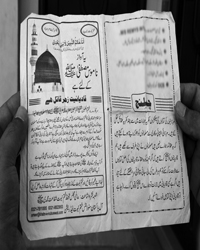
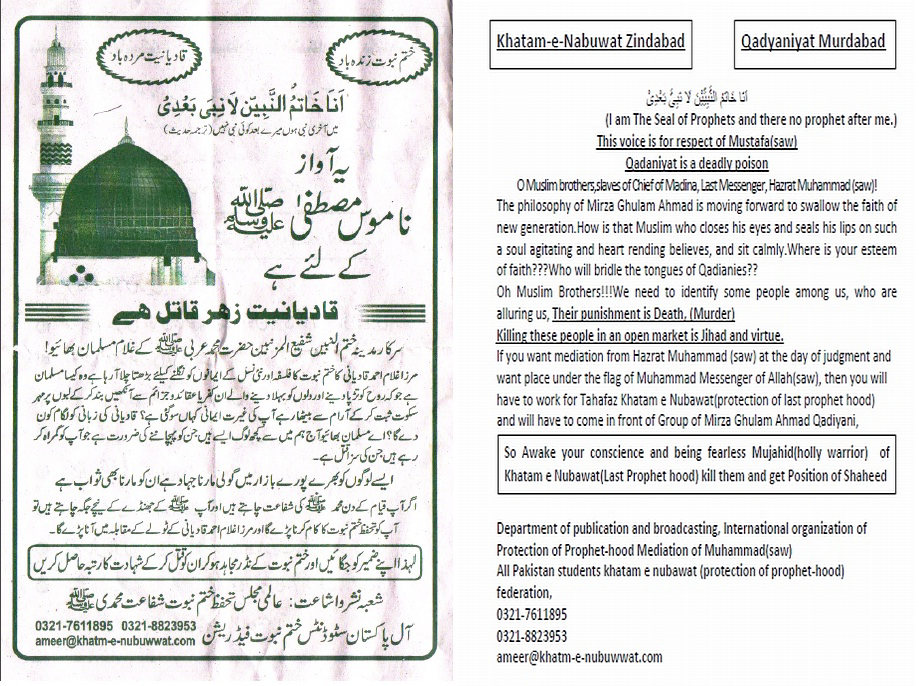
Two weeks back, another pamphlet was distributed in Faisalabad that labelled members of the Ahmadi community as “Wajibul Qatl” (liable to be persecuted), and inciting people to publicly attack followers of the faith. “Their punishment is death. Killing these people amounts to jihad,” read the leaflet. The pamphlet contained names and addresses of Ahmadi traders, industrialists and doctors. This time, Murad Cloth House was on top of the list.

“I don’t know how to react; our lives have been disturbed, our sanity badly affected,” says the 28-year-old son of the slain Sheikh Ashraf. “We are very vulnerable. I cannot concentrate on my business. I suspect every customer is a potential attacker!”

“I don’t expect justice,” he goes on.

Talking to TNS, another person on the ‘hit list’ relates how he was forced to move somewhere else after last year’s pamphlet was circulated. “It seems we are being watched all the time. They seem to know everything about us which is obvious from the way they’ve given the latest addresses of our homes and businesses,” he says. “We feel like petty outcasts.”

According to him, as a matter of routine, the situation becomes tense every year in April-May when the annual event of ‘Khatm-e-Nabuwat’ is held in the city. “Every speaker condemns and abuses the Ahmadis. We have put up our complaints before the administration, to no avail.”

Pamphlets distributed in Faisalabad urging Muslims to kill AhmadisHe laments the fact that things have gotten to a point where introducing oneself as Ahmadi means inviting trouble and public isolation.

So far, no security has been provided even to those who were mentioned in the pamphlet. On June 2, 2011, Mahmood Ahmad, Jamaat’s secretary in Faisalabad, sent an email to the home secretary and the police chief of Punjab as well as Faisalabad’s regional police officer, but nothing has been done to help the matter.

“Our mouths have been shut, our hands are tied. I am writing this in the hope that somewhere, somehow this letter finds its way to a compassionate and patriotic police official who shall dare to stand up for us, for the sake of Pakistan,” reads the email.

“Distribution of pamphlets against Ahmadis in Faisalabad is a regular practice,” Mahmood Ahmad tells TNS, adding that whereas the tone of these papers was “mild” in the past, their lives were jeopardised.

“Last year, the pamphlet had only asked the ‘Muslims’ to band together against the businesses owned by the Ahmadis which resulted in the persecution of at least five people belonging to our community, apart from instances of dacoity, kidnapping for ransom and expulsion of some of our students in mainstream educational institutions.”

Mahmood fears more violence if proper steps are not taken by the government. He also blames the Punjab government for ignoring the myriad protests lodged by the Ahmadi community in the province. “Religious fanatics are being encouraged by a lack of action on the part of the government agencies,” he says.

Police officials in Faisalabad do not seem to have taken the issue seriously so far. “I have deputed one person from the department to arrest the people whose cell numbers are mentioned on the pamphlet,” says Asmatullah Junenio, Superintendent of Police (SP), Faisalabad, talking to TNS.

He claims that the security of the Ahmadi community has been beefed up. “The number of police officials deputed to safeguard our worship places has been increased.”

Munir Ahmed, whose cell number is given on the pamphlet and who admits to be working for an organisation on the finality of Prophethood, informs TNS that he is in Lahore these days. “I have nothing to do with this [pamphlet] and I firmly believe they [the Ahmadis] are lying. The law should take its due course to punish them and the blasphemers.”

According to Saleemuddin, the Jamaat spokesperson, Ahmadis are being threatened all across the country. “Anti-Ahmadi wall-chalkings, pamphlets and stickers are a common phenomenon these days,” he says, adding that Faisalabad has become the most hostile towards the Ahmadis. “Most hate material is being generated or funded there.”

Legal experts believe inciting people to kill others is a serious crime as per the Pakistan Penal Code (PPC). “According to the Anti-Terrorism Act 1997, inciting somebody to kill others falls under the definition of terrorism. 153A, 505 and 506 sections of PPC also address such crime,” says Asad Jamal, advocate High Court.

Jamal, who has been working on human rights issues since long, believes that the police is bound to act against such activities.

Human Rights activists also believe there is no political will to protect the minorities, especially the Ahmadis. “They are indeed the most vulnerable group in Pakistan. Printing and distribution of hate material against them is a grave concern for us. We have already brought such activities by religious fundamentalists into the notice of the authorities, but no action has been taken against the culprits so far,” contends Zohra Yousuf, Chairperson, HRCP.

“Many members of this community have already migrated to other countries. The government will have to assert itself strongly to protect the community.”

aounsahi@gmail.com

Tuesday, July 6, 2010

Taliban oppresses Ahmadi Muslim sect in Pakistan

Sepro News
World:  Asia
Taliban oppresses Ahmadi Muslim sect in Pakistan
Tuesday, July 06, 2010
By Spero News

In June 2010, at least 95 members of the Ahmadi Muslim sect were killed and nearly 100 injured in attacks on their places of worship in Garhi in Lahore, Pakistan’s Punjab province. This attack is part of a campaign against Ahmadis by Islamist groups such as the Sunni Tehrik, Tehrik-e-Tahafaz-e-Naomoos-e-Risalat, Khatm-e-Nabuwat and many others who are openly sympathetic to terrorist groups, including Taliban. Ironically, most of the politicians were very careful to condemn the attacks on Ahmadis. Even Punjab’s chief minister, Shahbaz Sharif, leader of Pakistan Muslim League (PML-Nawaz Group), has not shown his face at either mosque, despite living down the road from them. Mohammed Hanif, a journalist, writes, “When the funerals of the massacred Ahmadis took place there were no officials, no politicians present.”

Later, former Pakistan Prime Minister and PML-N chief Nawaz Sharif said that the members of the minority Ahmedi sect are his brothers and sisters and that militants should be flushed out wherever they are active. His comments drew sharp criticism from religious parties like Khatm-e-Nabuwat Movement (KNM), Jamiat Ulema-e-Islam and Jamaat-e-Islami. Maulana Ilyas Chinioti, the head of KNM, a member of the PML-N and the Punjab provincial assembly, also condemned Sharif’s statement. There was no doubt that Maulana Chinioti seems to be openly preaching that non-Muslims are lesser humans. Daily Times says that those who dare to defend the rights of religious minorities are usually labeled as being ‘anti-Islam’.

According to The News of Pakistan, a surviving attacker of the Lahore carnage, Abdullah alias Muhammad, disclosed that he was misled into believing that Ahmadis were involved in drawing blasphemous cartoons of Mohammed, and believed that killing them was a great service to Islam. The attacker belongs to a militant group affiliated with al-Qaeda. He was trained in Miramshah in North Waziristan, lawless tribal area of Pakistan.

Right after the Lahore carnage, a mysterious SMS campaign has been launched against Ahmaddiya community which makes them more fearful, the Minorities Concern of Pakistan learnt. Moreover, the Islamists issued statements in which they asked Ahmadis to cease from hurting the feelings of the majority population. Jamaat-i-Islami chief Syed Munawwar Hasan, on June 18, warned of a fresh Khatm-i-Nubuwwat movement if the “Ahmadis did not accept their minority status” in Pakistan. At the same time, many blame a “foreign hand.” Some openly said that the Indian intelligence agency, Research and Analysis Wing (RAW), was involved in Lahore attacks. However, Interior Minister Rehman Malik declared on June 18 that the RAW was not involved in the killing of Ahmadis.

Ahmadiyya sect was formed in 1880s in Qadian, India. They view themselves as Muslims but hardliners consider them non-Muslims. They are a relatively small minority in Pakistan and they make up somewhere between 0.25 per cent (according to Pakistan’s census 1998). However, the Economist estimates that their population is 2.5 per cent. They have always been a soft target for persecution. The campaign against them is a decade ago. Before the partition, Anti-Ahmadiyya agitation instigated by Majlis-i-Ahrar, a lower middle class party.

In 1934, Ahrar arranged a big gathering against Ahmadis called Tahafuz-e-Khatm-e-Nabuwat Conference, held at Qadian. Ahrar was angry with Ahmadiyya community to support Quaid-e-Azam Muhammad Ali Jinnah for the demand of Pakistan. In 1953, six Ahmadis lost their lives when an anti-Ahmadiyya wave swept in newly founded Pakistan. The state constituted an inquiry commission; Justice Muhammad Munir as president and Justice Kayani as member. The commission’s report, also called Munir Report, carried an analysis of the Ulema’s concept of the Islamic State and of a Muslim. The report concluded that the concept of a Muslim differed for different sects and if the fatwas of the Ulema were relied upon to determine whether an individual is Muslim or Kafir then no sect could be called Muslim because of the lack of a single, coherent and unanimous definition of a Muslim and an Islamic State.

According to Waqar Gilani, in 1973, the then president of Azad Jammu and Kashmir, Sardar Abdul Qayyum declared Ahmadis to be non-Muslims. In the same year, Rabta-e-Alam-e-Islami Conference in Saudi Arabia also gave its stamp of approval to oust Ahmadis from the circle of Islam. The unfortunate beating of the students of Nishtar Medical College, Multan, on May 29, 1974, proved to be a major incident that infuriated this anti-Ahmadi movement. The students, going on train, started shouting against Ahmadis while reaching Rabwah, the headquarter city of Ahmadis in Pakistan, resulting in a strong reaction of Ahmadis to this gathering. The incident geared up the Khatm-e-Nabuwat movement that started a violent protest.

On Sept. 6, 1974, a minor incident sparked other anti-Ahmadiyya riots leaving 24 members of Ahmadiyya community dead. In the same year, they were declared non-Muslims by the parliament.

On April 26, 1984, General Zia-ul-Haq promulgated the Martial Law Ordinance XX. Through this ordinance he introduced some blasphemy laws which undercut the activities of religious minorities generally, but struck at Ahmadis in particular. Since then, frequently, they have been arrested for greeting someone with an Assalam-o-Alaikum, reciting the kalima or reading the Holy Quran. “In the period 1984-2009, 105 Ahmadis were target killed. During the same period, 22 Ahmadiyya mosques were demolished, 28 were sealed by authorities, 11 were set on fire, and 14 were occupied while construction of 41 was banned. In at least 47 cases, burials were denied in common grave yards while 28 bodies were exhumed,” Adnan Farooq and Riaz ul Hassan write in View Point.

Since 2000, an estimated 400 Ahmadis have been formally charged in criminal cases, including blasphemy. According to one report, in 2009, at least 37 Ahmadis were charged under the general provisions of the blasphemy laws and over 50 were charged under Ahmadi-specific provisions of the law. Many of these individuals remain imprisoned.

It is apparent that both the Pakistani state and society are both are very hostile against Ahmadis. Moreover, both printed and electronic Pakistani media have also played a role in spreading hatred against this community. Recently, the Muslim Canadian Congress (MCC) blamed the major media outlets in Pakistan for inflaming the rhetoric against Ahmadiyya, Ismaili and Shia Muslims. In particular, the MCC pointed out that GEO Television has become the voice of al-Qaeda and the Taliban, and spreads hate against these communities as well as against non-Muslims.

According to one report, “After the attacks some newspapers ran op-ed article creating an impression as if these attacks were a violent consequence of ongoing polemic between certain Muslim sects and the Ahmadiyyas.”

The Minorities Concern of Pakistan learnt that when Jamaat-i-Ahmadiyya’s arranged a press conference after Lahore incident most of the reporters refused to take tea there.

Adnan Farooq writes on June 18: It remained a routine with the Urdu papers to print anti-Ahmadiyya statements and hate-mongering stories with bold headlines. However, no paper published the occasional Ahmadiyya explanation. In year 2007, 974 such news items appeared in the press, but in 2008 the number went up to 1033 items. Almost all of these were prejudiced, hate-promoting and false propaganda. The daily Nawa-i-Waqt (with editor Majeed Nizami) led this bandwagon by printing 465 items. The daily Jang stood second, and the Daily Express was a close third. Provocative statements issued by various clerics’ are carried without any verification. A few of these headlines are translated below: Qadianis are not loyal to the country, nation and Islam: ‘Sajid Mir’ (The daily Jang, Lahore; May 27, 2008) - Qadianis are enemies of Islam and Pakistan: Shadabi Raza, Mufti M. Sadeeq (The Daily Express, Lahore; June 2, 2008).

Source: Minorities Concern of Pakistan

© Copyright Spero, All rights reserved.
 
^ Top of Page