 |
Commentary: Analysis |
Pakistan’s blinkered political class avoids the issue of Islamic blasphemy laws
Tuesday, February 08, 2011
By Roderick SamsonThe Pakistani government has bitten the dust and can’t be blamed too much because all opposition politicians too have behaved the same way while Muslim clergy upped the ante on blasphemy law.
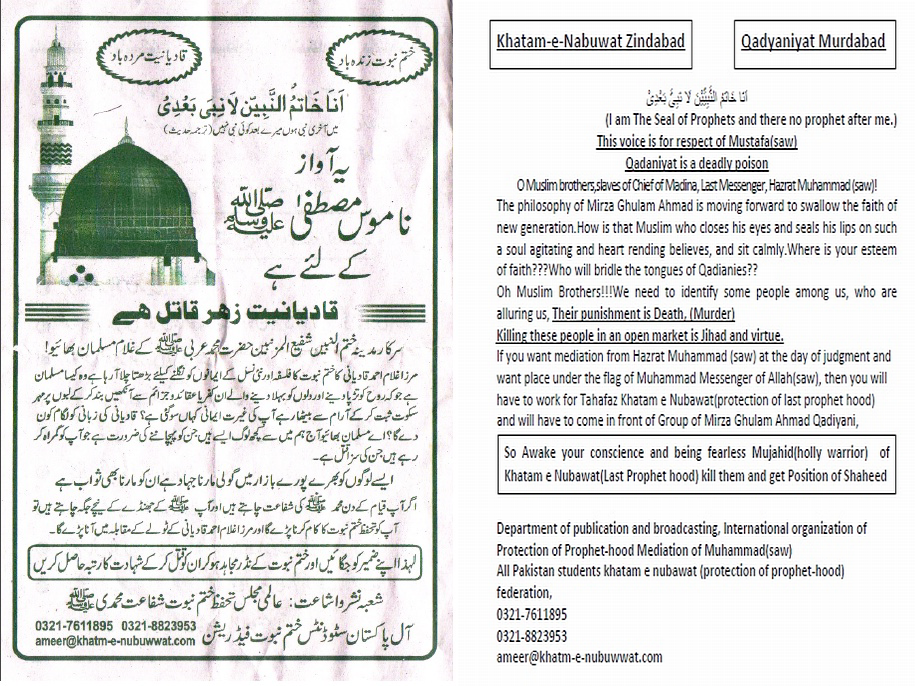
The PPP ( Pakistan Peoples Party) lost its governor in Punjab at the hands of a religious fanatic which the police had ignored in its ranks; and its MNA Sherry Rehman has been made to take back her proposed legislation aimed at humanising the said law in Pakistan. The British Raj did much better with Muslims when the latter were a minority before the division of India into the present three contending states. When Muslims in India complained to the British that their religion was increasingly coming under communal attack, Article 295 was added to the Penal Code in 1927 under which ‘deliberate and malicious acts intended to outrage religious feelings of any class by insulting its religious belief’ became a culpable offence. It suggested a maximum of ten months in jail as punishment and the law did very well in the field. There were only 10 blasphemy cases in the 58 years between 1927 and 1985. Since that year, the number of blasphemy cases has soared to more than 1,200.
Journalists are not free of the blot of intolerance: the chief reporter for The News, Ansar Abbasi, wrote in Jang (12 Jan 2011) that he and a number of conservative lawyers in Lahore got together to file a petition in 1984 at the Federal Shariat Court asking for a law against insult to the Prophet Muhammad. In July 1984, a female attorney, Asma Jahangir, insulted Muhammad in Islamabad during a speech. This was followed by unrest in the meeting:
‘On this Appa Nisar Fatima, [mother of PML-N leader Ahsan Iqbal who hailed from General Zia’s conservative district of Jalundhar in India] presented the bill about 295-C of the Penal Code. It was approved but Law Minister Iqbal Ahmad Khan changed the text at the last minute to assign “death or life” as punishment for blasphemy. Nisar Fatima took the matter back to Federal Shariat Court saying the punishment for blasphemy was a hadd and could not be less than death. Hearing started on first April 1987. Dr Tahirul Qadri held that evidence of intent was not required (sic!) before quickly killing the blasphemer. The Court gave the government till 1991 to amend the Section 295-C. Prime Minister Nawaz Sharif had to obey’.
Associate Professor and Head of Department of Law & Policy, at the Lahore University faculty of Management Sciences, Osma Siddique and Oxford-grad Zahra Hayat, have contributed a paper on blasphemy law which notes that determination of ‘intent’ was no longer a requirement before punishing accused blasphemers.: ‘The absence of an intent requirement in Sections 295-B, 295-C, and 298-A has made it possible for blasphemy charges that may otherwise have failed the mens rea test to spawn lengthy trials continuing to the appellate level’.
Was the ‘nass’ (clear edict) of death for blasphemy mentioned in the Koran? Listen to a TV discussion here to find how Jamaat-e-Islami leader Fareed Paracha ‘proves’ this. He quotes Sura Ahzab verse number 56 saying: “Allah and His angels send Darood on the Prophet Muhammad.” Then he quotes verse 57 saying: whoever hurts the Prophet Muhammad will go to Hell. But after that he omits verses 58, 59 and 60 and quotes verse 61 instead, which says: kill them wherever you find them. The verses he omitted actually talk about munafiqeen (hypocrites).
Not even his spiritual mentor Maulana Maududi in his monumental work of exegesis ‘Tafheem al-Quran’ interprets the above verses to mean that blasphemers had to be punished with death. Today, we cope with the humiliation that comes from having this law on our statute books because no one is prepared to think rationally.
The minorities – the poorest stratum of our society who had received assurances of equal treatment from the founder of the state, Quaid-e-am Muhammad Ali Jinnah – have to bear the brunt of this hatred of ourselves. When the world is outraged by what we do to women and the minorities here, we respond with xenophobia.
Pakistan’s politicians, when not hiding their collective head in the sand, wear blinkers so as to avoid facing up to the moral fallout from the current blasphemy law.
The PPP ( Pakistan Peoples Party) lost its governor in Punjab at the hands of a religious fanatic which the police had ignored in its ranks; and its MNA Sherry Rehman has been made to take back her proposed legislation aimed at humanising the said law in Pakistan. The British Raj did much better with Muslims when the latter were a minority before the division of India into the present three contending states. When Muslims in India complained to the British that their religion was increasingly coming under communal attack, Article 295 was added to the Penal Code in 1927 under which ‘deliberate and malicious acts intended to outrage religious feelings of any class by insulting its religious belief’ became a culpable offence. It suggested a maximum of ten months in jail as punishment and the law did very well in the field. There were only 10 blasphemy cases in the 58 years between 1927 and 1985. Since that year, the number of blasphemy cases has soared to more than 1,200.
Journalists are not free of the blot of intolerance: the chief reporter for The News, Ansar Abbasi, wrote in Jang (12 Jan 2011) that he and a number of conservative lawyers in Lahore got together to file a petition in 1984 at the Federal Shariat Court asking for a law against insult to the Prophet Muhammad. In July 1984, a female attorney, Asma Jahangir, insulted Muhammad in Islamabad during a speech. This was followed by unrest in the meeting:
‘On this Appa Nisar Fatima, [mother of PML-N leader Ahsan Iqbal who hailed from General Zia’s conservative district of Jalundhar in India] presented the bill about 295-C of the Penal Code. It was approved but Law Minister Iqbal Ahmad Khan changed the text at the last minute to assign “death or life” as punishment for blasphemy. Nisar Fatima took the matter back to Federal Shariat Court saying the punishment for blasphemy was a hadd and could not be less than death. Hearing started on first April 1987. Dr Tahirul Qadri held that evidence of intent was not required (sic!) before quickly killing the blasphemer. The Court gave the government till 1991 to amend the Section 295-C. Prime Minister Nawaz Sharif had to obey’.
Associate Professor and Head of Department of Law & Policy, at the Lahore University faculty of Management Sciences, Osma Siddique and Oxford-grad Zahra Hayat, have contributed a paper on blasphemy law which notes that determination of ‘intent’ was no longer a requirement before punishing accused blasphemers.: ‘The absence of an intent requirement in Sections 295-B, 295-C, and 298-A has made it possible for blasphemy charges that may otherwise have failed the mens rea test to spawn lengthy trials continuing to the appellate level’.
Was the ‘nass’ (clear edict) of death for blasphemy mentioned in the Koran? Listen to a TV discussion here to find how Jamaat-e-Islami leader Fareed Paracha ‘proves’ this. He quotes Sura Ahzab verse number 56 saying: “Allah and His angels send Darood on the Prophet Muhammad.” Then he quotes verse 57 saying: whoever hurts the Prophet Muhammad will go to Hell. But after that he omits verses 58, 59 and 60 and quotes verse 61 instead, which says: kill them wherever you find them. The verses he omitted actually talk about munafiqeen (hypocrites).
Not even his spiritual mentor Maulana Maududi in his monumental work of exegesis ‘Tafheem al-Quran’ interprets the above verses to mean that blasphemers had to be punished with death. Today, we cope with the humiliation that comes from having this law on our statute books because no one is prepared to think rationally.
The minorities – the poorest stratum of our society who had received assurances of equal treatment from the founder of the state, Quaid-e-am Muhammad Ali Jinnah – have to bear the brunt of this hatred of ourselves. When the world is outraged by what we do to women and the minorities here, we respond with xenophobia.
Pakistan’s politicians, when not hiding their collective head in the sand, wear blinkers so as to avoid facing up to the moral fallout from the current blasphemy law.
The views and opinions expressed herein are those of the author only, not of Spero News.
© Copyright Spero, All rights reserved.
URL: www.speroforum.com/site/article.asp?idCategory=34...blasphemy+laws
URL: www.speroforum.com/site/article.asp?idCategory=34...blasphemy+laws







 Posts
Posts


