Showing posts with label victimized. Show all posts

Thursday, April 28, 2011

Climate of fear over Pakistan blasphemy laws

South Asia
28 April 2011 Last updated at 09:25 GMT
Climate of fear over Pakistan blasphemy laws

The scene of Shahbaz Bhatti's murder is festooned with banners and flowers commemorating his lifeThe scene of Shahbaz Bhatti’s murder is festooned with banners and flowers commemorating his life
Earlier this year two prominent politicians in Pakistan were murdered over their opposition to Pakistan’s controversial blasphemy laws. The BBC’s Jill McGivering investigates how the abuse of these laws is creating a climate of fear among Pakistan’s religious minorities.

One stretch of road in a residential suburb of Islamabad has the air of a shrine.

This is where Pakistani Minorities Minister Shahbaz Bhatti was shot dead in March. Bunches of flowers, many now dry and brown, are piled on the kerb. Large colour posters showing his picture are displayed alongside.

On seeing the media, guards from his mother’s home nearby rush out to explain what happened.

Mr Bhatti had just left her home, they say as they walk me through the short distance, when another car blocked his path at the junction and the gunmen inside it opened fire.

Mr Bhatti’s murder shocked Pakistan.

It came just weeks after the shooting of another prominent politician, Punjab Governor Salman Taseer.

Both men had dared to speak out about the need for debate and possible reform of the controversial blasphemy laws.

And both men paid with their lives.

Not long before his death, Mr Bhatti had a long phone conversation with one of his brothers, Paul, an affluent doctor based in Italy. I met Paul Bhatti in Shahbaz Bhatti’s old offices.

‘Victimised’

“We discussed his work and the threat to his life,” he told me. “I tried to persuade him to stop and move to Europe but he wouldn’t.”

Meher Aslam Nasir is pursuing a charge of blasphemy against some Ahmadi menMeher Aslam Nasir is pursuing a charge of blasphemy against some Ahmadi men
Now, as a result of his brother’s death, Paul Bhatti has decided to suspend his medical career, return to Pakistan and continue his brother’s fight.

“We need to change the laws,” he said, “and also change people’s thinking. Some people think we want to amend the laws so that people can commit blasphemy. Of course we don’t want that - why would anyone want to do that?

“But we do want to protect innocent people who are victimised by this law. Some people use it for personal revenge.”

The Bhatti family are Christians and particularly aware of false blasphemy charges made against religious minorities.

In terms of actual numbers, most cases are filed against Muslims - but groups like Christians and Ahmadis, a very small proportion of Pakistan’s population, account for a disproportionately high percentage of cases.

'

It’s not only Christians. It's also many Muslims who are suffering because of this

Joseph Coutts
Roman Catholic Bishop of Faisalabad
The recent high-profile murders have certainly added to the climate of fear surrounding this highly sensitive issue.

As I travelled through Pakistan, speaking to people who are directly involved with current cases, either as accusers or accused, many were terrified.

Many of the accused, even those who had been acquitted by the courts, have been forced to abandon their homes and go into hiding.

A blasphemy conviction carries the death penalty although in practice it is not carried out in these cases.

But the accused, whether they are convicted or not, face a constant threat of being murdered.

Many Pakistani Muslims feel intense passion about their faith. Any suggestion that someone may have insulted the Prophet or defiled the Koran sparks anger which can sometimes turn to physical violence.

Conservative clerics oppose attempts to reform the laws. They also warn that if the courts are lenient, the public may increasingly choose to take the law into its own hands and execute its own form of extra-judicial justice.

In Nankana Sahib in Punjab Province, I met Meher Aslam Nasir, a lawyer and leading member of an Islamic political party. He is currently pursuing a charge of blasphemy against several Ahmadi men.

“As Muslims, how can we allow anyone to intentionally or unintentionally defame the Prophet and not bring them to justice? We must implement the law. Innocent people have never been targeted and never will be,” he said.

‘False accusations’

But others disagree. Joseph Coutts, the Catholic Bishop of Faisalabad, says his concern is not with the purpose of the laws but with the way he says they are being abused.

Christians argue they are often falsely accused of blasphemyChristians argue they are often falsely accused of blasphemy
“Most cases are false accusations,” he told me, “to settle personal disputes or sometimes for land grabbing. Once you are accused, no-one stops to ask: excuse me, did you really say this? The emotions just boil over.

“And if it is announced from the mosque, everyone accepts it as true and they’re ready to attack the person. It’s not only Christians. It’s also many Muslims who are suffering because of this.”

There are concerns too about the difficulty of proving innocence. Allegations that someone verbally insulted the Prophet often come down to one person’s word against another’s.

Some suggest that one way of reducing false and malicious allegations would be to introduce stiff penalties for anyone who makes an allegation which fails to lead to a conviction.

In the meantime, one consequence of the recent bloodshed is that public debate has been stifled.

To critics of these laws, that is a severe blow to Pakistan’s weak democracy as it continues to battle against Islamic extremism.

Jill McGivering’s report Blasphemy: A Matter of Life and Death can be heard on the Assignment programme on the BBC World Service on Thursday 28 April.

Tuesday, February 8, 2011

Pakistan’s blinkered political class avoids the issue of Islamic blasphemy laws

Sepro News
Commentary:  Analysis
Pakistan’s blinkered political class avoids the issue of Islamic blasphemy laws
Tuesday, February 08, 2011
By Roderick Samson
The Pakistani government has bitten the dust and can’t be blamed too much because all opposition politicians too have behaved the same way while Muslim clergy upped the ante on blasphemy law.

The PPP ( Pakistan Peoples Party) lost its governor in Punjab at the hands of a religious fanatic which the police had ignored in its ranks; and its MNA Sherry Rehman has been made to take back her proposed legislation aimed at humanising the said law in Pakistan. The British Raj did much better with Muslims when the latter were a minority before the division of India into the present three contending states. When Muslims in India complained to the British that their religion was increasingly coming under communal attack, Article 295 was added to the Penal Code in 1927 under which ‘deliberate and malicious acts intended to outrage religious feelings of any class by insulting its religious belief’ became a culpable offence. It suggested a maximum of ten months in jail as punishment and the law did very well in the field. There were only 10 blasphemy cases in the 58 years between 1927 and 1985. Since that year, the number of blasphemy cases has soared to more than 1,200.

Journalists are not free of the blot of intolerance: the chief reporter for The News, Ansar Abbasi, wrote in Jang (12 Jan 2011) that he and a number of conservative lawyers in Lahore got together to file a petition in 1984 at the Federal Shariat Court asking for a law against insult to the Prophet Muhammad. In July 1984, a female attorney, Asma Jahangir, insulted Muhammad in Islamabad during a speech. This was followed by unrest in the meeting:

‘On this Appa Nisar Fatima, [mother of PML-N leader Ahsan Iqbal who hailed from General Zia’s conservative district of Jalundhar in India] presented the bill about 295-C of the Penal Code. It was approved but Law Minister Iqbal Ahmad Khan changed the text at the last minute to assign “death or life” as punishment for blasphemy. Nisar Fatima took the matter back to Federal Shariat Court saying the punishment for blasphemy was a hadd and could not be less than death. Hearing started on first April 1987. Dr Tahirul Qadri held that evidence of intent was not required (sic!) before quickly killing the blasphemer. The Court gave the government till 1991 to amend the Section 295-C. Prime Minister Nawaz Sharif had to obey’.

Associate Professor and Head of Department of Law & Policy, at the Lahore University faculty of Management Sciences, Osma Siddique and Oxford-grad Zahra Hayat, have contributed a paper on blasphemy law which notes that determination of ‘intent’ was no longer a requirement before punishing accused blasphemers.: ‘The absence of an intent requirement in Sections 295-B, 295-C, and 298-A has made it possible for blasphemy charges that may otherwise have failed the mens rea test to spawn lengthy trials continuing to the appellate level’.

Was the ‘nass’ (clear edict) of death for blasphemy mentioned in the Koran? Listen to a TV discussion here to find how Jamaat-e-Islami leader Fareed Paracha ‘proves’ this. He quotes Sura Ahzab verse number 56 saying: “Allah and His angels send Darood on the Prophet Muhammad.” Then he quotes verse 57 saying: whoever hurts the Prophet Muhammad will go to Hell. But after that he omits verses 58, 59 and 60 and quotes verse 61 instead, which says: kill them wherever you find them. The verses he omitted actually talk about munafiqeen (hypocrites).

Not even his spiritual mentor Maulana Maududi in his monumental work of exegesis ‘Tafheem al-Quran’ interprets the above verses to mean that blasphemers had to be punished with death. Today, we cope with the humiliation that comes from having this law on our statute books because no one is prepared to think rationally.

The minorities – the poorest stratum of our society who had received assurances of equal treatment from the founder of the state, Quaid-e-am Muhammad Ali Jinnah – have to bear the brunt of this hatred of ourselves. When the world is outraged by what we do to women and the minorities here, we respond with xenophobia.

Pakistan’s politicians, when not hiding their collective head in the sand, wear blinkers so as to avoid facing up to the moral fallout from the current blasphemy law.

The views and opinions expressed herein are those of the author only, not of Spero News.

© Copyright Spero, All rights reserved.
URL: www.speroforum.com/site/article.asp?idCategory=34...blasphemy+laws

Thursday, July 8, 2010

Pakistan’s Religious Minorities Face Persecution by the State

Jakarta Globe, Indonesia

July 08, 2010
Pakistan’s Religious Minorities Face Persecution by the State

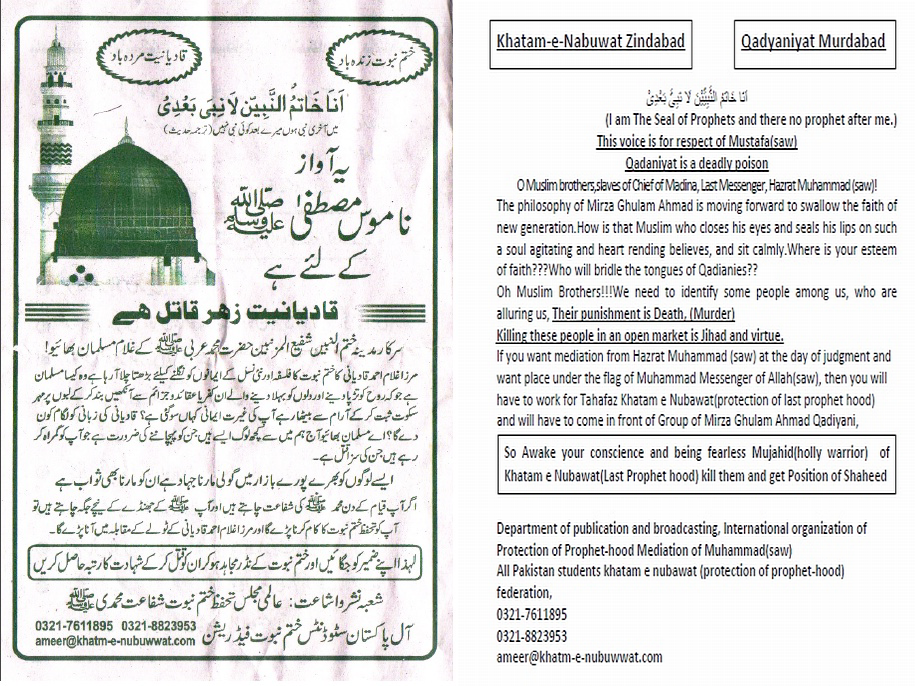
Just a month ago, at least 95 members of the Ahmadiyah Islamic sect were killed and nearly 100 injured in attacks on their places of worship in Lahore, in Pakistan’s Punjab province. The attacks were part of a campaign against Ahmadis by Islamist groups openly sympathetic to terrorist groups, including the Taliban.

Politicians have been strangely silent on the attacks. Punjab’s chief minister, Shahbaz Sharif, the leader of the Pakistan Muslim League, has not shown his face at either Ahmadi mosque targeted in the attacks, despite living down the road from them.

Mohammed Hanif, a journalist, wrote: “When the funerals of the massacred Ahmadis took place there were no officials, no politicians present.”

Several days after the attack, former Pakistani Prime Minister and Pakistan Muslim League leader Nawaz Sharif said the members of the Ahmadi sect were his brothers and sisters and that militants should be flushed out wherever they were active.

His comments drew sharp criticism from religious parties like the Khatm-e-Nabuwat Movement, Jamiat Ulema-e-Islam and Jamaat-e-Islami.

Maulana Ilyas Chinioti, the head of KNM, a member of the PML-N and the Punjab provincial assembly, also condemned Sharif’s statement.

Maulana seems to be openly preaching that non-Muslims are lesser humans, despite the fact that Ahmadis profess that they are Muslims.

Those who dare to defend the rights of religious minorities in Pakistan are usually labeled as being “anti-Islam.”

Ahmadis have been under widespread attack by increasingly violent Islamic fundamentalists across the planet.

The movement was founded in India by Mirza Ghulam Ahmad, who died in 1908 and who claimed to have succeeded the Prophet Muhammad as leader of the religion and who would bring about the final triumph of Islam as per Islamic prophecy.

According to a June 4 story in The News, a surviving attacker of the Lahore carnage, Abdullah, alias Muhammad, said he was misled into believing that Ahmadis were involved in drawing blasphemous caricatures of the Prophet Muhammad, so their bloodshed was a great service to Islam.

The campaign against the sect began a decade ago in Pakistan. Before the 1947 partition of Pakistan and India, anti-Ahmadiyah agitation was instigated by the Majlis-i-Ahrar, a lower-middle-class party.

In 1934, Ahrar set up an anti-Ahmadi movement after the Ahmadi community supported a demand for a Pakistan. In 1953, six Ahmadis lost their lives when an anti-Ahmadiyah wave swept the newly founded country.

According to Waqar Gilani, in 1973 the then president of Azad Jammu and Kashmir, Sardar Abdul Qayyum, declared Ahmadis to be non-Muslims. In the same year, a Saudi Arabian conference also agreed to oust Ahmadis from the circle of Islam.

In 1974 they were declared non-Muslims by the Pakistani Parliament. In 1984, Gen. Zia-ul-Haq promulgated a martial law ordinance containing blasphemy laws that undercut the activities of religious minorities generally, but struck at Ahmadis in particular.

Since then, they have been arrested frequently for greeting someone with the traditional Islamic Assalam-o-Alaikum, reciting Muslim prayers or reading the Holy Koran.

In the period 1984-2009, 105 Ahmadis were killed in Pakistan, according to two authors writing in Viewpoint, a Pakistani online magazine.

“During the same period, 22 Ahmadiyah mosques were demolished, 28 were sealed by authorities, 11 were set on fire and 14 were occupied, while construction of 41 was banned. In at least 47 cases, burials were denied in common graveyards while 28 bodies were exhumed,” the two wrote.

Since 2000, an estimated 400 Ahmadis have been formally charged in criminal cases, including blasphemy. Many remain imprisoned.

Both printed and electronic Pakistani media have played a scandalous role in spreading hatred against the community.

Recently, the Muslim Canadian Congress blamed major media outlets in Pakistan for inflaming rhetoric against Ahmadiyah, Ismaili and Shia Muslims.

In particular, the MCC pointed out that GEO Television had become the voice of Al Qaeda and the Taliban and had spread hatred against these communities as well as against non-Muslims.

Religious minorities in general and Ahmadis in particular are not treated by the Pakistani state as equal citizens. They are routinely intimidated and persecuted because of their faith.

Unless the state changes its mind-set about minorities, they will live under constant threat, which is against international human rights laws and the constitution of Pakistan.

Aftab Alexander Mughal is the editor for a Pakistan-based nongovernmental organization, Minorities Concern of Pakistan.

Copyright 2010 The Jakarta Globe

Tuesday, July 6, 2010

Religious fundamentalism main root of violence in Pakistan

Calgary Herald, Canada
Religious fundamentalism main root of violence in Pakistan
By Mahfooz Kanwar, For The Calgary Herald July 6, 2010

In a little more than a month there have been two major terrorist attacks perpetrated by Muslims against other Muslims at mosques in Lahore, Pakistan.

This past Thursday, two suicide bombers blew themselves up killing at least 42 people and injuring a minimum of 180 people at the Data Darbar shrine, where a famous Sufisaint is buried.

On May 28, fundamentalist Muslims massacred more than 90 Ahmadiyya Muslims at their two mosques in Lahore and injured hundreds more.

When these events occur – and their have been many more in this Punjab region of Pakistan – the world wonders: why do Muslims kill other Muslims?

Not only did some Muslim fundamentalists armed with suicide vests, guns and grenades kill and injure dozens of worshippers, but they also took a large number of Ahmadis hostage.

This appalling, murderous act is not unusual in the history of Pakistan. In 1953, Jamaat-e-Islami Pakistan, a fundamentalist religious and political party in Pakistan, created a murderous upheaval against Ahmadis in the same city of Lahore. Jamaat’s hooligans killed approximately 2,000 innocent Ahmadis. Now, the Taliban and al-Qaeda are suspected in this sectarian violence.

During my schooling, I minored in Islamic studies, and have published a book on Sociology of Islam. I have studied Islam further and have published my research in two other of my books as well as columns in newspapers and I have discussed those results in three of my 21 documentaries over the years.

Many Muslim fundamentalists are semi-literate, and some of them totally illiterate mullahs. The Holy Book of Qur’an makes it very clear that those Muslims who kill or commit suicide will be condemned to hell. Yet, some of these ill-informed Muslim extremists, such as suicide bombers, commit both murder and suicide. And they believe they are acclaimed to go to heaven in their life here after.

Pakistani Islamists always have had issues with the Muslim sect of Ahmadis. Along with the Islamic fundamentalists, some prominent secular politicians have also played the card of religion in Pakistan. The former prime minister of Pakistan, Zulfikar Ali Bhutto, declared Ahmadis as non-Muslims in the early 1970s.

Bhutto’s government introduced a column for religion on the national identity cards as well as passports in singling out the Muslim sect of Ahmadis along with the rest of non-Muslims in Pakistan. This was designed basically to create a system of religious apartheid in Pakistan. That act smacked the basic Islamic principle of tolerance.

In Pakistan, Ahmadis are often barred from praying in their mosques. To preach their faith is considered to be a crime under Article 295 of the Penal Code of Pakistan. The federal sharia Court of Pakistan has ruled that preventing Ahmadis from preaching their faith is no violation of the fundamental rights guaranteed in the Constitution of Pakistan. This is akin to the system of apartheid which was once practised in South Africa.

Although Bhutto was overwhelmingly supported politically by more than two million Ahmadis in Pakistan, he declared Ahmadis as non-Muslims. Bhutto, a secular political leader, betrayed Ahmadis big time. However, the vile fundamentalist and ruthless military dictator Muhammad Zia-ul-Haq expanded the system of apartheid for Ahmadis in Pakistan.

What makes Bhutto, Zia and many mullahs qualified to decide who are or aren’t Muslims? It is supposed to be God’s business to judge His creatures.

In my research for my forthcoming book, Addiction to Religion, I note, among other things, that Islam means peace and Muslims are supposed to adhere to peace, but that does not seem to be the case for decades now.

Islam is a religion but Islamism is an addiction to religion that leads to terrorism. Fundamentalism is a gateway to addiction to religion which blinds people to become suicide bombers who commit two sins in Islam that will take them to hell.

Unfortunately, Pakistan is ruled by five pillars of corrupt establishment. They are: unpatriotic feudal landlords turned politicians (they, along with the Jamaat-e-Islami, were opposed to the creation of Pakistan), cruel military dictators (who have ruled Pakistan ruthlessly for more than half of it’s history), corrupt politicians, depraved bureaucrats, and fundamentalist mullahs.

This last pillar is perhaps the most key. Until the idea of freedom of religion becomes accepted in Pakistan, Muslims will keep on killing each other. That’s because they believe that there is only one way to practice Islam – their way. They are taught no tolerance to other faiths or even to those who share their faith but practise it differently. That’s why Shiites kill Sunnis, Sunnis kill Shiites, both kill Ahmadis and these groups – with the backing of the government and Pakistani law – all persecute and attack Christians and Hindus.

Until and unless something revolutionary happens, Pakistan will continue facing drastic, murderous problems.

Mahfooz Kanwar is Professor Emeritus at Mount Royal University

Copyright © The Calgary Herald

Taliban oppresses Ahmadi Muslim sect in Pakistan

Sepro News
World:  Asia
Taliban oppresses Ahmadi Muslim sect in Pakistan
Tuesday, July 06, 2010
By Spero News

In June 2010, at least 95 members of the Ahmadi Muslim sect were killed and nearly 100 injured in attacks on their places of worship in Garhi in Lahore, Pakistan’s Punjab province. This attack is part of a campaign against Ahmadis by Islamist groups such as the Sunni Tehrik, Tehrik-e-Tahafaz-e-Naomoos-e-Risalat, Khatm-e-Nabuwat and many others who are openly sympathetic to terrorist groups, including Taliban. Ironically, most of the politicians were very careful to condemn the attacks on Ahmadis. Even Punjab’s chief minister, Shahbaz Sharif, leader of Pakistan Muslim League (PML-Nawaz Group), has not shown his face at either mosque, despite living down the road from them. Mohammed Hanif, a journalist, writes, “When the funerals of the massacred Ahmadis took place there were no officials, no politicians present.”

Later, former Pakistan Prime Minister and PML-N chief Nawaz Sharif said that the members of the minority Ahmedi sect are his brothers and sisters and that militants should be flushed out wherever they are active. His comments drew sharp criticism from religious parties like Khatm-e-Nabuwat Movement (KNM), Jamiat Ulema-e-Islam and Jamaat-e-Islami. Maulana Ilyas Chinioti, the head of KNM, a member of the PML-N and the Punjab provincial assembly, also condemned Sharif’s statement. There was no doubt that Maulana Chinioti seems to be openly preaching that non-Muslims are lesser humans. Daily Times says that those who dare to defend the rights of religious minorities are usually labeled as being ‘anti-Islam’.

According to The News of Pakistan, a surviving attacker of the Lahore carnage, Abdullah alias Muhammad, disclosed that he was misled into believing that Ahmadis were involved in drawing blasphemous cartoons of Mohammed, and believed that killing them was a great service to Islam. The attacker belongs to a militant group affiliated with al-Qaeda. He was trained in Miramshah in North Waziristan, lawless tribal area of Pakistan.

Right after the Lahore carnage, a mysterious SMS campaign has been launched against Ahmaddiya community which makes them more fearful, the Minorities Concern of Pakistan learnt. Moreover, the Islamists issued statements in which they asked Ahmadis to cease from hurting the feelings of the majority population. Jamaat-i-Islami chief Syed Munawwar Hasan, on June 18, warned of a fresh Khatm-i-Nubuwwat movement if the “Ahmadis did not accept their minority status” in Pakistan. At the same time, many blame a “foreign hand.” Some openly said that the Indian intelligence agency, Research and Analysis Wing (RAW), was involved in Lahore attacks. However, Interior Minister Rehman Malik declared on June 18 that the RAW was not involved in the killing of Ahmadis.

Ahmadiyya sect was formed in 1880s in Qadian, India. They view themselves as Muslims but hardliners consider them non-Muslims. They are a relatively small minority in Pakistan and they make up somewhere between 0.25 per cent (according to Pakistan’s census 1998). However, the Economist estimates that their population is 2.5 per cent. They have always been a soft target for persecution. The campaign against them is a decade ago. Before the partition, Anti-Ahmadiyya agitation instigated by Majlis-i-Ahrar, a lower middle class party.

In 1934, Ahrar arranged a big gathering against Ahmadis called Tahafuz-e-Khatm-e-Nabuwat Conference, held at Qadian. Ahrar was angry with Ahmadiyya community to support Quaid-e-Azam Muhammad Ali Jinnah for the demand of Pakistan. In 1953, six Ahmadis lost their lives when an anti-Ahmadiyya wave swept in newly founded Pakistan. The state constituted an inquiry commission; Justice Muhammad Munir as president and Justice Kayani as member. The commission’s report, also called Munir Report, carried an analysis of the Ulema’s concept of the Islamic State and of a Muslim. The report concluded that the concept of a Muslim differed for different sects and if the fatwas of the Ulema were relied upon to determine whether an individual is Muslim or Kafir then no sect could be called Muslim because of the lack of a single, coherent and unanimous definition of a Muslim and an Islamic State.

According to Waqar Gilani, in 1973, the then president of Azad Jammu and Kashmir, Sardar Abdul Qayyum declared Ahmadis to be non-Muslims. In the same year, Rabta-e-Alam-e-Islami Conference in Saudi Arabia also gave its stamp of approval to oust Ahmadis from the circle of Islam. The unfortunate beating of the students of Nishtar Medical College, Multan, on May 29, 1974, proved to be a major incident that infuriated this anti-Ahmadi movement. The students, going on train, started shouting against Ahmadis while reaching Rabwah, the headquarter city of Ahmadis in Pakistan, resulting in a strong reaction of Ahmadis to this gathering. The incident geared up the Khatm-e-Nabuwat movement that started a violent protest.

On Sept. 6, 1974, a minor incident sparked other anti-Ahmadiyya riots leaving 24 members of Ahmadiyya community dead. In the same year, they were declared non-Muslims by the parliament.

On April 26, 1984, General Zia-ul-Haq promulgated the Martial Law Ordinance XX. Through this ordinance he introduced some blasphemy laws which undercut the activities of religious minorities generally, but struck at Ahmadis in particular. Since then, frequently, they have been arrested for greeting someone with an Assalam-o-Alaikum, reciting the kalima or reading the Holy Quran. “In the period 1984-2009, 105 Ahmadis were target killed. During the same period, 22 Ahmadiyya mosques were demolished, 28 were sealed by authorities, 11 were set on fire, and 14 were occupied while construction of 41 was banned. In at least 47 cases, burials were denied in common grave yards while 28 bodies were exhumed,” Adnan Farooq and Riaz ul Hassan write in View Point.

Since 2000, an estimated 400 Ahmadis have been formally charged in criminal cases, including blasphemy. According to one report, in 2009, at least 37 Ahmadis were charged under the general provisions of the blasphemy laws and over 50 were charged under Ahmadi-specific provisions of the law. Many of these individuals remain imprisoned.

It is apparent that both the Pakistani state and society are both are very hostile against Ahmadis. Moreover, both printed and electronic Pakistani media have also played a role in spreading hatred against this community. Recently, the Muslim Canadian Congress (MCC) blamed the major media outlets in Pakistan for inflaming the rhetoric against Ahmadiyya, Ismaili and Shia Muslims. In particular, the MCC pointed out that GEO Television has become the voice of al-Qaeda and the Taliban, and spreads hate against these communities as well as against non-Muslims.

According to one report, “After the attacks some newspapers ran op-ed article creating an impression as if these attacks were a violent consequence of ongoing polemic between certain Muslim sects and the Ahmadiyyas.”

The Minorities Concern of Pakistan learnt that when Jamaat-i-Ahmadiyya’s arranged a press conference after Lahore incident most of the reporters refused to take tea there.

Adnan Farooq writes on June 18: It remained a routine with the Urdu papers to print anti-Ahmadiyya statements and hate-mongering stories with bold headlines. However, no paper published the occasional Ahmadiyya explanation. In year 2007, 974 such news items appeared in the press, but in 2008 the number went up to 1033 items. Almost all of these were prejudiced, hate-promoting and false propaganda. The daily Nawa-i-Waqt (with editor Majeed Nizami) led this bandwagon by printing 465 items. The daily Jang stood second, and the Daily Express was a close third. Provocative statements issued by various clerics’ are carried without any verification. A few of these headlines are translated below: Qadianis are not loyal to the country, nation and Islam: ‘Sajid Mir’ (The daily Jang, Lahore; May 27, 2008) - Qadianis are enemies of Islam and Pakistan: Shadabi Raza, Mufti M. Sadeeq (The Daily Express, Lahore; June 2, 2008).

Source: Minorities Concern of Pakistan

© Copyright Spero, All rights reserved.
 
^ Top of Page