Showing posts with label restrictions. Show all posts

Thursday, August 18, 2011

INDONESIA: Conviction of Ahmadyah victim undermines constitutional protections

AHRC Logo
News / AHRC News / INDONESIA: Conviction of Ahmadyah victim …

INDONESIA: Conviction of Ahmadyah victim undermines constitutional protections

August 18, 2011

The Asian Human Rights Commission (AHRC) is disturbed by the punitive decision of the Indonesian Court on August 15, 2011 to jail an innocent Ahmadi Muslim who protected himself during a mob attack, which reveals the impartiality of the judiciary and the legal community.

Deden Sudjana was sentenced to six months imprisonment by the court, for simply protecting the house the mob were attacking. Meanwhile, the 12 men who were responsible for brutally killing three Ahmadi Muslims in an attack in February 2011, were only sentenced to between three and six months imprisonment.

Some 1,500 people attacked the home of an Ahmadiyah community leader in Cikeusik, west Java in February. Sudjana was hit with a machete and almost had his hand severed during the mob attack. Head of security for the Indonesian Ahmadiyah Congregation (JAI) at the time, Sudjana was detained since May for allegedly inciting the attack. In its judgment, the court ruled that he had disobeyed a police order to leave the scene, and had been filmed punching another man. He was thus convicted of articles 212 and 315.1 of the Criminal Code; resisting state officers and maltreatment, respectively.

The decision is senseless and embarrassing, a travesty of justice. The lenient sentences handed out to those convicted of killing three Ahmadis in July raised questions regarding judicial impartiality and upholding of constitutional protections (see AHRC-PRL-034-2011), which have now been spotlighted again. The two verdicts indicate that Indonesia’s criminal justice system is not able to deliver justice independent from religious considerations. Indonesia’s judicial commission must act on this miscarriage of justice and push for reforms that will truly ensure a fair and impartial justice process.

Indonesia today is increasingly seeing extremists push their agenda forward, mostly with the use of violence, resulting in the loss of life and damage to property. The Indonesian government has taken no effective steps to stop or prevent such activities, which will slowly erode the country’s secular values.

Similarly, the Indonesian courts and legal system have shown a complete disregard for the basic rule of law, and have not taken up their mandate of protecting the constitutional rights of Indonesian citizens.

The AHRC urges for a review of both verdicts, and calls upon the Indonesian government and courts to ensure that all religious and other minorities are adequately protected.

Document ID: AHRC-PRL-034-2011
Document Type: Press Release
URL: www.humanrights.asia/news/press-releases/AHRC-PRL-034-2011

Friday, July 29, 2011

INDONESIA: Courts verdict encourages further attacks against religious minorities

AHRC Logo
News / Press Releases / INDONESIA: Courts verdict encourages…
INDONESIA: Courts verdict encourages further attacks against religious minorities

July 29, 2011

(Hong Kong, July 29, 2011) Three to six months in prison was the shocking sentence given to the perpetrators of the mob killing of three Ahmadiyahs earlier this year. The remaining perpetrators will be released on the reading of the verdict on 23 August this year. Most of them will be released during the coming weeks. This lenient punishment and the conduct of the judges in the trial sends a clear signal to religious fundamentalists that they not need to worry about the law and constitutional protection of minorities.

“The verdict and trial conduct does not meet national or international standards” Wong Kai Shing, Executive Director of the Asian Human Rights Commission said. “The lenient punishment will encourage more extremist action against religious minorities” Wong added,” the courts failed to enforce Indonesian law for the protection of citizens.”

On 28 April 2011 the Serang District Court in West Java convicted twelve suspects for maltreatment, joint assault and incitement in the horrendous Cikeusik killing from February this year. A mob set against the discriminated religious minority of Ahmadiyah followers attacked the group in Umbulan village, Cikeusik resulting in five members being injured and three killed. At least one patrol car from Cikeusik sector police and 2 trucks from riot-control force (Dalmas) of Pandeglang dictrict police men were present and watched the violence, doing nothing to prevent it or apprehend the perpetrators. The shocking scenes were published in a video online sparking international outcry.

The Indonesian Ahmadiyah congregation (JAI) commented that the verdict does not fulfil the sense of fairness. According to A. Mubarik Ahmad, the public relation of JAI, this crime must be seen as crimes against humanity, not just a crime against the Ahmadiyah. The Indonesian criminal code never regulated the crimes against Ahmadiyah. Moreover, he stated that the state still cannot find the murderer of the victims, because the trial did not charged the suspect with murder charge, thus there is no examination and trial for the murderer.

In 1980 and 2005, Indonesian Ulama Assembly (Majelis Ulama Indonesia) issued a fatwa against the Ahmadiyah community in Indonesia denouncing Ahmadyah followers as an errant sect. In 2008 a joint ministerial decree banned the group for promulgating its religion and other basic religious rights. The decree is widely believed to be responsible for encouraging attacks against Ahmadis. Numerous attacks against Ahmadiyah communities and their members were documented by the Setara Institute and Wahid Institute over the last years.

The AHRC is concerned that the lenient punishment for a mob killing against the minority group will encourage more fundamentalist violence. Institutions have failed in this case to send a strong message against extremism. The AHRC believes that law and constitutional values were not the basis for the judgement in this case.

Thursday, July 21, 2011

INDONESIA: Ahmadiyah community faces ongoing discrimination

AHRC Logo
Opinions / Interviews / INDONESIA: Ahmadiyah community faces ongoing discrimination
INDONESIA: Ahmadiyah community faces ongoing discrimination

July 21, 2011

An interview with Zaenuda Ikhwanul Aziz from the Indonesian Ahmadiyah Community (JAI) published by the Asian Human Rights Commission regarding the situation faced by Ahmadis in Indonesia.

Zaenuda Ikhwanul AzizZaenuda Ikhwanul Aziz, is the secretary of the legal committee of the Indonesian Ahmadiyah congregation (Jamaah Ahmadiyah Indonesia — JAI). He is actively involved in the struggle of the Ahmadiyah in the country.


How do you feel about what is happening to the Ahmadiyah community in Indonesia?

We feel that we are being discriminated against, especially the Ahmadiyah communities at the localities outside the capital of Jakarta. For example, the government does not give identification cards and marriage certificates to Ahmadiyahs.

At the economic sector many Ahmadiyahs have had to change the location of their businesses. Even in some provinces, the people from the community are intimidated not to buy products from Ahmadiyah shops and businesses and this has resulted in a serious reduction of our income.

In the social sector we also are excluded and intimidated. We are not allowed to be involved in social gatherings.

At the religious sector the Minister of Religion prohibits us from conducting the Hajj, (the pilgrimage to Mekka) and even when we pray, members of the local communities attack our mosques. Sometimes, our villages are also attacked.

Also, in the health sector, many people reject Ahmadiyahs as patients. We therefore feel discriminated against in most, if not all, sectors.

When did you start to feel the discrimination?

The discrimination started when the Indonesian Ulama Assembly (Majelis Ulama Indonesia - MUI) declared Ahmadiyah as an errant sect in 1980. This fatwa brought to light the differences between Ahmadiyahs and the community. The people followed the fatwa believing that Ahmadiyah is errant without seeking any further explanation or consideration.

The main actors involved are the Indonesian government, central and local law enforcement authorities and several Ulama members who influence the people to attack Ahmadiyah communities. This is especially so with those persons who live within Ahmadiyah communities.

In your opinion, what is the reason for the increase of the aggression against Ahmadiyahs in the last few years?

There are several reasons, not the least of which is that the government is indecisive about law enforcement. If the joint ministerial decree against JAI still prevailed then the government could not allow the local regulations in the provinces to declare Ahmadiyah as an errant sect. Unfortunately, the government did nothing to prevent this from happening.

The aggressors see Ahmadiyah as a threat because the numbers of Ahmadiyah communities is increasing and they are scared that they will lose their followers.

Also, the content of the joint ministerial decree has been misinterpreted. There are local regulations which use the joint resolution decree to declare Ahmadiyah as errant whereas there is no such statement in the decree itself. The JAI think this happened because the government is trying to distance itself from the joint of resolution decree.

Is the state doing anything to protect the Ahmadiyahs?

We feel the state protection is still minimal. There is still turmoil because there is no law enforcement. It is seldom that perpetrators of violence against Ahmadiyahs are arrested and they are never prosecuted in the courts.

What do you feel about the work of the police?

In general, the work of the police is still far from professional. However, we must acknowledge that in some areas, there are some good police officers working in relation to Ahmadiyahs.

What about the work of the courts?

Judges are deficient at searching for the truth. Their efforts are deficient when examining at a trial, investigating the witness and proof, such as happened at Cisalada trial. Even the verdict against the Ahmadiyah victim was heavier than that of the perpetrators.

What is the Ahmadiyah community doing in their own defence?

Our representatives visit government officials, legal enforcement authorities, and the community in general. Relating to the legal dealings, we entrust this to our legal counsel.

The result of our visits are promising in that there are several communities and authorities who opened up and accepted us such as in Bandung, Central Java, and Wonosobo. But there have also been rejections such as in Cianjur, Bogor.

What is your ultimate goal in this struggle?

All we ask for is the right to live like other citizens and that these rights are fulfilled by the government

————————
The views shared in this article do not necessarily reflect those of the AHRC, and the AHRC takes no responsibility for them.

Tuesday, February 8, 2011

Pakistan’s blinkered political class avoids the issue of Islamic blasphemy laws

Sepro News
Commentary:  Analysis
Pakistan’s blinkered political class avoids the issue of Islamic blasphemy laws
Tuesday, February 08, 2011
By Roderick Samson
The Pakistani government has bitten the dust and can’t be blamed too much because all opposition politicians too have behaved the same way while Muslim clergy upped the ante on blasphemy law.

The PPP ( Pakistan Peoples Party) lost its governor in Punjab at the hands of a religious fanatic which the police had ignored in its ranks; and its MNA Sherry Rehman has been made to take back her proposed legislation aimed at humanising the said law in Pakistan. The British Raj did much better with Muslims when the latter were a minority before the division of India into the present three contending states. When Muslims in India complained to the British that their religion was increasingly coming under communal attack, Article 295 was added to the Penal Code in 1927 under which ‘deliberate and malicious acts intended to outrage religious feelings of any class by insulting its religious belief’ became a culpable offence. It suggested a maximum of ten months in jail as punishment and the law did very well in the field. There were only 10 blasphemy cases in the 58 years between 1927 and 1985. Since that year, the number of blasphemy cases has soared to more than 1,200.

Journalists are not free of the blot of intolerance: the chief reporter for The News, Ansar Abbasi, wrote in Jang (12 Jan 2011) that he and a number of conservative lawyers in Lahore got together to file a petition in 1984 at the Federal Shariat Court asking for a law against insult to the Prophet Muhammad. In July 1984, a female attorney, Asma Jahangir, insulted Muhammad in Islamabad during a speech. This was followed by unrest in the meeting:

‘On this Appa Nisar Fatima, [mother of PML-N leader Ahsan Iqbal who hailed from General Zia’s conservative district of Jalundhar in India] presented the bill about 295-C of the Penal Code. It was approved but Law Minister Iqbal Ahmad Khan changed the text at the last minute to assign “death or life” as punishment for blasphemy. Nisar Fatima took the matter back to Federal Shariat Court saying the punishment for blasphemy was a hadd and could not be less than death. Hearing started on first April 1987. Dr Tahirul Qadri held that evidence of intent was not required (sic!) before quickly killing the blasphemer. The Court gave the government till 1991 to amend the Section 295-C. Prime Minister Nawaz Sharif had to obey’.

Associate Professor and Head of Department of Law & Policy, at the Lahore University faculty of Management Sciences, Osma Siddique and Oxford-grad Zahra Hayat, have contributed a paper on blasphemy law which notes that determination of ‘intent’ was no longer a requirement before punishing accused blasphemers.: ‘The absence of an intent requirement in Sections 295-B, 295-C, and 298-A has made it possible for blasphemy charges that may otherwise have failed the mens rea test to spawn lengthy trials continuing to the appellate level’.

Was the ‘nass’ (clear edict) of death for blasphemy mentioned in the Koran? Listen to a TV discussion here to find how Jamaat-e-Islami leader Fareed Paracha ‘proves’ this. He quotes Sura Ahzab verse number 56 saying: “Allah and His angels send Darood on the Prophet Muhammad.” Then he quotes verse 57 saying: whoever hurts the Prophet Muhammad will go to Hell. But after that he omits verses 58, 59 and 60 and quotes verse 61 instead, which says: kill them wherever you find them. The verses he omitted actually talk about munafiqeen (hypocrites).

Not even his spiritual mentor Maulana Maududi in his monumental work of exegesis ‘Tafheem al-Quran’ interprets the above verses to mean that blasphemers had to be punished with death. Today, we cope with the humiliation that comes from having this law on our statute books because no one is prepared to think rationally.

The minorities – the poorest stratum of our society who had received assurances of equal treatment from the founder of the state, Quaid-e-am Muhammad Ali Jinnah – have to bear the brunt of this hatred of ourselves. When the world is outraged by what we do to women and the minorities here, we respond with xenophobia.

Pakistan’s politicians, when not hiding their collective head in the sand, wear blinkers so as to avoid facing up to the moral fallout from the current blasphemy law.

The views and opinions expressed herein are those of the author only, not of Spero News.

© Copyright Spero, All rights reserved.
URL: www.speroforum.com/site/article.asp?idCategory=34...blasphemy+laws

Tuesday, September 21, 2010

Editorial: Religious Freedom Needs the Rule of Law

Jakarta Globe, Indonesia
OPINION
Editorial: Religious Freedom Needs the Rule of Law
September 21, 2010

We emphatically support efforts by both the government and the legislature to formulate a law that would guarantee religious harmony. The issue desperately deserves attention, because the joint ministerial decree has been found by many to be fundamentally flawed and wholly unable to provide a strong foundation for pluralism in the country. (Antara Photo/Yudhi Mahatma)
.
The right to worship freely is clearly enshrined in our Constitution. But to our nation’s chagrin, this guarantee may only exist in theory, and not yet in practice. As the recent spate of violence against religious minorities — such as Christian congregations and the Ahmadiyah sect — has shown, the pluralism that our nation’s founding fathers wisely envisioned has yet to materialize.

In a country as wide and as diverse as ours, ignoring pluralism would mean eliminating the very ties that have been able to bind us together as a nation for so long. It is the recognition of this plurality, and the need for all Indonesians to mutually respect each other’s differences, that has been able to make this nation so strong.

But the latest incidents, including the assault on members of the Batak Christian Protestant Church in Bekasi, have not only sullied the tolerance this nation is known for, but also threaten to endanger our national unity and cohesion.

Many people have blamed these problems on the 2006 joint ministerial decree on the building of houses of worship, issued by the attorney general and the ministers of home affairs and religious affairs.

They say it encourages official discrimination against religious minorities and provides justification for the violence increasingly being directed against these minorities.

That is why recent statements from Djoko Suyanto, the coordinating minister for political, legal and security affairs, have come as such a breath of fresh air.

Djoko initially said the joint ministerial decree could always be reviewed and amended, and on Tuesday he supported calls for a law on religious harmony to replace the decree.

Even more welcome was the decision reached on Tuesday by the House of Representatives and the government to immediately start drafting a law on religious harmony.

Although the House remains divided over whether the law should use the controversial joint ministerial decree as its starting point, the willingness to address the problem and try to overcome it is laudable.

We emphatically support efforts by both the government and the legislature to formulate a law that would guarantee religious harmony.

The issue desperately deserves attention, because the joint ministerial decree has been found by many to be fundamentally flawed and wholly unable to provide a strong foundation for pluralism in the country.

It is not our intention to try and influence or interfere with the work of the government and the House.

But we think it is important for us to remind them that to uphold the Constitution, the laws that protect the rights of religious minorities and provide a secure environment for them must be honored.

The new law must go further than the current ones to protect the religious rights of all members of Indonesia’s ever-changing society.

Copyright 2010 The Jakarta Globe

Monday, September 20, 2010

Minister for Religion Says No to Calls to Revise Decree

Jakarta Globe, Indonesia
Jakarta
Minister for Religion Says No to Calls to Revise Decree
Camelia Pasandaran & Eras Poke | September 20, 2010

Jakarta. The minister of religious affairs on Monday said there were no plans to revise the joint Ministerial Decree on Houses of Worship despite a chorus of criticism from rights activists and lawmakers against the regulation.

Suryadharma Ali dismissed calls to amend the decree, which have been mounting since an attack on two leaders of a congregation from the Batak Christian Protestant Church (HKBP) Pondok Timur Indah in Bekasi on Sept. 12, in which one church elder was stabbed.

Tensions have been raised in Bekasi for the past few months with some hard-line Muslim groups opposing the building of a church in the Pondok Timur Indah area because it lacks the proper permits.

“This regulation is needed to maintain harmony,” Suryadharma said. “If this regulation didn’t exist, people would be free to do whatever they wanted.”

The decree, issued by both the ministries of religious affairs and home affairs, requires the approval of at least 60 households in the immediate vicinity of new houses of worship before they are granted permits to build or conduct services.

Suryadharma said securing the approval of 60 households was not too much to ask for.

“In the past, the requirement included securing approvals from up to 300 to 400 households. So if every household in that lot included at least three people, that would mean 1,200 approvals. This is just 60 households,” he said.

The decree, however, has been slammed by rights groups for making it nearly impossible for minority faiths to build houses of worship in Muslim-majority areas.

In recent months, the regulation has been cited to justify a spate of attacks against Christians in the Greater Jakarta area by hard-line Muslim groups who say the congregations have no permits to hold religious services.

Some state officials, however, have expressed support for revising the decree.

Constitutional Court Chief Mahfud MD has said he backs revising — but not abolishing — the regulation, arguing it should adapt to changing social conditions.

“A law should be attuned to the times and consider the changes and developments that take place in the society,” he said.

Several lawmakers have also said the decree should be revised, and have even supported calls to draft a new law to support religious harmony.

In addition to securing the approval of 60 households, the decree also states that new houses of worship need recommendations from the local offices of the Religious Affairs Ministry and Interreligious Communication Forum (FKUB).

But Hendardi, who chairs the Setara Institute for Democracy and Peace, has accused the FKUB of regularly “filtering out” permit applications instead of protecting the rights of religious groups.

Meanwhile, hundreds of people from the East Nusa Tenggara People’s Solidarity and Transparency Forum (Somasi) rallied outside the provincial council building in Kupang to protest against the attacks on the HKBP in Bekasi and the ban on its members from worshiping in a vacant lot.

The demonstrators, who included officials from the provincial branch of the Commission for Missing Persons and Victims of Violence (Kontras), also protested against recent attacks on members of Ahmadiyah, a minority Islamic sect, which Suryadharma has repeatedly called for a ban on, claiming that its followers had “violated regulations” and were “not Muslims.”

Speaking with the East Nusa Tenggara Council speaker, Agustinus Medah, Somasi said the attacks against the HKBP and Ahmadiyah were evidence the state was failing to protect the constitutional right to worship.

“The president should have acted firmly,” said Winston Rondo, a representative of Somasi. “He should do so now and protect his people from violence. He is instead more interested in raising his public image.”

Copyright 2010 The Jakarta Globe

Wednesday, September 8, 2010

Ahmadiyah Again Faces Minister’s Call for a Ban

Jakarta Globe, Indonesia
Jakarta
Ahmadiyah Again Faces Minister’s Call for a Ban
Camelia Pasandaran | September 08, 2010

Jakarta. Ignoring the outrage of rights activists, the religious affairs minister on Tuesday reiterated his belief that an outright ban on Ahmadiyah would be good for both the country and the sect.

Suryadharma Ali said the government had two options: maintain the restrictions on the group’s activities, or ban Ahmadiyah. A ban, he said, would protect group members from attack and also help bring them into the fold of mainstream Islam.

“The government can let them be or ban them. Both carry risks,” he said. “To let them be is not regulated by our laws, but we can ban them because we have regulations for this.”

The minister, who last week caused an uproar by saying Ahmadiyah should be banned because the group had angered mainstream Muslims, was referring to the 1965 Blasphemy Law and a joint decree issued in 2008 by the religious affairs and home affairs ministries, and the Attorney General’s Office, restricting the group’s religious activities.

The decree stopped short of banning the sect but prohibited Ahmadiyah followers from publicly practicing their faith and from proselytizing.

“Banning Ahmadiyah, in my opinion, is not an act of hatred or enmity, it is an act of love and care for all our brothers across the nation. To ban them is far better than to let them be,” Suryadharma said.

“To outlaw them would mean that we are working hard to stop deviant acts from continuing. It is better for us to take the hard steps now and, God willing, all will be well.”

According to Suryadharma, all Ahmadis want to follow mainstream Islam, and therefore “it is the duty of every Islamic figure to take them in, teach them the correct way of the religion.”

The minister also said that until a ban was enacted, Ahmadiyah followers would continue to be targets for violent attacks by hard-line groups.

“Why don’t you study the reactions toward the Ahmadiyah?” he said. “We believe such harsh reactions are because there are rules that are not being followed.”

Ahmadiyah followers have been the target of numerous attacks by hard-line Muslim groups, with authorities being accused of failing to take steps to protect sect members.

Rights activists have said the minister’s comments could be construed by hard-liners as justification for more attacks on the group. Suryadharma, however, said that, in principle, there should be no violence.

Founded in India in 1889, Ahmadiyah holds that the group’s founder, Mirza Ghulam Ahmad, was a prophet — a belief that goes against mainstream Islam, which holds that Muhammad was the last prophet.

Said Aqil Siradj, chairman of Nahdlatul Ulama, the country’s largest Muslim organization with an estimated 40 million members, last week urged caution against banning Ahmadiyah.

“Ahmadiyah has been in Indonesia since 1925. Why is it being made a problem now?” he said. “This is not a local organization, it is present in 102 countries around the globe.”.

Copyright 2010 The Jakarta Globe

Thursday, July 8, 2010

Pakistan’s Religious Minorities Face Persecution by the State

Jakarta Globe, Indonesia

July 08, 2010
Pakistan’s Religious Minorities Face Persecution by the State

Just a month ago, at least 95 members of the Ahmadiyah Islamic sect were killed and nearly 100 injured in attacks on their places of worship in Lahore, in Pakistan’s Punjab province. The attacks were part of a campaign against Ahmadis by Islamist groups openly sympathetic to terrorist groups, including the Taliban.

Politicians have been strangely silent on the attacks. Punjab’s chief minister, Shahbaz Sharif, the leader of the Pakistan Muslim League, has not shown his face at either Ahmadi mosque targeted in the attacks, despite living down the road from them.

Mohammed Hanif, a journalist, wrote: “When the funerals of the massacred Ahmadis took place there were no officials, no politicians present.”

Several days after the attack, former Pakistani Prime Minister and Pakistan Muslim League leader Nawaz Sharif said the members of the Ahmadi sect were his brothers and sisters and that militants should be flushed out wherever they were active.

His comments drew sharp criticism from religious parties like the Khatm-e-Nabuwat Movement, Jamiat Ulema-e-Islam and Jamaat-e-Islami.

Maulana Ilyas Chinioti, the head of KNM, a member of the PML-N and the Punjab provincial assembly, also condemned Sharif’s statement.

Maulana seems to be openly preaching that non-Muslims are lesser humans, despite the fact that Ahmadis profess that they are Muslims.

Those who dare to defend the rights of religious minorities in Pakistan are usually labeled as being “anti-Islam.”

Ahmadis have been under widespread attack by increasingly violent Islamic fundamentalists across the planet.

The movement was founded in India by Mirza Ghulam Ahmad, who died in 1908 and who claimed to have succeeded the Prophet Muhammad as leader of the religion and who would bring about the final triumph of Islam as per Islamic prophecy.

According to a June 4 story in The News, a surviving attacker of the Lahore carnage, Abdullah, alias Muhammad, said he was misled into believing that Ahmadis were involved in drawing blasphemous caricatures of the Prophet Muhammad, so their bloodshed was a great service to Islam.

The campaign against the sect began a decade ago in Pakistan. Before the 1947 partition of Pakistan and India, anti-Ahmadiyah agitation was instigated by the Majlis-i-Ahrar, a lower-middle-class party.

In 1934, Ahrar set up an anti-Ahmadi movement after the Ahmadi community supported a demand for a Pakistan. In 1953, six Ahmadis lost their lives when an anti-Ahmadiyah wave swept the newly founded country.

According to Waqar Gilani, in 1973 the then president of Azad Jammu and Kashmir, Sardar Abdul Qayyum, declared Ahmadis to be non-Muslims. In the same year, a Saudi Arabian conference also agreed to oust Ahmadis from the circle of Islam.

In 1974 they were declared non-Muslims by the Pakistani Parliament. In 1984, Gen. Zia-ul-Haq promulgated a martial law ordinance containing blasphemy laws that undercut the activities of religious minorities generally, but struck at Ahmadis in particular.

Since then, they have been arrested frequently for greeting someone with the traditional Islamic Assalam-o-Alaikum, reciting Muslim prayers or reading the Holy Koran.

In the period 1984-2009, 105 Ahmadis were killed in Pakistan, according to two authors writing in Viewpoint, a Pakistani online magazine.

“During the same period, 22 Ahmadiyah mosques were demolished, 28 were sealed by authorities, 11 were set on fire and 14 were occupied, while construction of 41 was banned. In at least 47 cases, burials were denied in common graveyards while 28 bodies were exhumed,” the two wrote.

Since 2000, an estimated 400 Ahmadis have been formally charged in criminal cases, including blasphemy. Many remain imprisoned.

Both printed and electronic Pakistani media have played a scandalous role in spreading hatred against the community.

Recently, the Muslim Canadian Congress blamed major media outlets in Pakistan for inflaming rhetoric against Ahmadiyah, Ismaili and Shia Muslims.

In particular, the MCC pointed out that GEO Television had become the voice of Al Qaeda and the Taliban and had spread hatred against these communities as well as against non-Muslims.

Religious minorities in general and Ahmadis in particular are not treated by the Pakistani state as equal citizens. They are routinely intimidated and persecuted because of their faith.

Unless the state changes its mind-set about minorities, they will live under constant threat, which is against international human rights laws and the constitution of Pakistan.

Aftab Alexander Mughal is the editor for a Pakistan-based nongovernmental organization, Minorities Concern of Pakistan.

Copyright 2010 The Jakarta Globe

Tuesday, July 6, 2010

Religious fundamentalism main root of violence in Pakistan

Calgary Herald, Canada
Religious fundamentalism main root of violence in Pakistan
By Mahfooz Kanwar, For The Calgary Herald July 6, 2010

In a little more than a month there have been two major terrorist attacks perpetrated by Muslims against other Muslims at mosques in Lahore, Pakistan.

This past Thursday, two suicide bombers blew themselves up killing at least 42 people and injuring a minimum of 180 people at the Data Darbar shrine, where a famous Sufisaint is buried.

On May 28, fundamentalist Muslims massacred more than 90 Ahmadiyya Muslims at their two mosques in Lahore and injured hundreds more.

When these events occur – and their have been many more in this Punjab region of Pakistan – the world wonders: why do Muslims kill other Muslims?

Not only did some Muslim fundamentalists armed with suicide vests, guns and grenades kill and injure dozens of worshippers, but they also took a large number of Ahmadis hostage.

This appalling, murderous act is not unusual in the history of Pakistan. In 1953, Jamaat-e-Islami Pakistan, a fundamentalist religious and political party in Pakistan, created a murderous upheaval against Ahmadis in the same city of Lahore. Jamaat’s hooligans killed approximately 2,000 innocent Ahmadis. Now, the Taliban and al-Qaeda are suspected in this sectarian violence.

During my schooling, I minored in Islamic studies, and have published a book on Sociology of Islam. I have studied Islam further and have published my research in two other of my books as well as columns in newspapers and I have discussed those results in three of my 21 documentaries over the years.

Many Muslim fundamentalists are semi-literate, and some of them totally illiterate mullahs. The Holy Book of Qur’an makes it very clear that those Muslims who kill or commit suicide will be condemned to hell. Yet, some of these ill-informed Muslim extremists, such as suicide bombers, commit both murder and suicide. And they believe they are acclaimed to go to heaven in their life here after.

Pakistani Islamists always have had issues with the Muslim sect of Ahmadis. Along with the Islamic fundamentalists, some prominent secular politicians have also played the card of religion in Pakistan. The former prime minister of Pakistan, Zulfikar Ali Bhutto, declared Ahmadis as non-Muslims in the early 1970s.

Bhutto’s government introduced a column for religion on the national identity cards as well as passports in singling out the Muslim sect of Ahmadis along with the rest of non-Muslims in Pakistan. This was designed basically to create a system of religious apartheid in Pakistan. That act smacked the basic Islamic principle of tolerance.

In Pakistan, Ahmadis are often barred from praying in their mosques. To preach their faith is considered to be a crime under Article 295 of the Penal Code of Pakistan. The federal sharia Court of Pakistan has ruled that preventing Ahmadis from preaching their faith is no violation of the fundamental rights guaranteed in the Constitution of Pakistan. This is akin to the system of apartheid which was once practised in South Africa.

Although Bhutto was overwhelmingly supported politically by more than two million Ahmadis in Pakistan, he declared Ahmadis as non-Muslims. Bhutto, a secular political leader, betrayed Ahmadis big time. However, the vile fundamentalist and ruthless military dictator Muhammad Zia-ul-Haq expanded the system of apartheid for Ahmadis in Pakistan.

What makes Bhutto, Zia and many mullahs qualified to decide who are or aren’t Muslims? It is supposed to be God’s business to judge His creatures.

In my research for my forthcoming book, Addiction to Religion, I note, among other things, that Islam means peace and Muslims are supposed to adhere to peace, but that does not seem to be the case for decades now.

Islam is a religion but Islamism is an addiction to religion that leads to terrorism. Fundamentalism is a gateway to addiction to religion which blinds people to become suicide bombers who commit two sins in Islam that will take them to hell.

Unfortunately, Pakistan is ruled by five pillars of corrupt establishment. They are: unpatriotic feudal landlords turned politicians (they, along with the Jamaat-e-Islami, were opposed to the creation of Pakistan), cruel military dictators (who have ruled Pakistan ruthlessly for more than half of it’s history), corrupt politicians, depraved bureaucrats, and fundamentalist mullahs.

This last pillar is perhaps the most key. Until the idea of freedom of religion becomes accepted in Pakistan, Muslims will keep on killing each other. That’s because they believe that there is only one way to practice Islam – their way. They are taught no tolerance to other faiths or even to those who share their faith but practise it differently. That’s why Shiites kill Sunnis, Sunnis kill Shiites, both kill Ahmadis and these groups – with the backing of the government and Pakistani law – all persecute and attack Christians and Hindus.

Until and unless something revolutionary happens, Pakistan will continue facing drastic, murderous problems.

Mahfooz Kanwar is Professor Emeritus at Mount Royal University

Copyright © The Calgary Herald

Taliban oppresses Ahmadi Muslim sect in Pakistan

Sepro News
World:  Asia
Taliban oppresses Ahmadi Muslim sect in Pakistan
Tuesday, July 06, 2010
By Spero News

In June 2010, at least 95 members of the Ahmadi Muslim sect were killed and nearly 100 injured in attacks on their places of worship in Garhi in Lahore, Pakistan’s Punjab province. This attack is part of a campaign against Ahmadis by Islamist groups such as the Sunni Tehrik, Tehrik-e-Tahafaz-e-Naomoos-e-Risalat, Khatm-e-Nabuwat and many others who are openly sympathetic to terrorist groups, including Taliban. Ironically, most of the politicians were very careful to condemn the attacks on Ahmadis. Even Punjab’s chief minister, Shahbaz Sharif, leader of Pakistan Muslim League (PML-Nawaz Group), has not shown his face at either mosque, despite living down the road from them. Mohammed Hanif, a journalist, writes, “When the funerals of the massacred Ahmadis took place there were no officials, no politicians present.”

Later, former Pakistan Prime Minister and PML-N chief Nawaz Sharif said that the members of the minority Ahmedi sect are his brothers and sisters and that militants should be flushed out wherever they are active. His comments drew sharp criticism from religious parties like Khatm-e-Nabuwat Movement (KNM), Jamiat Ulema-e-Islam and Jamaat-e-Islami. Maulana Ilyas Chinioti, the head of KNM, a member of the PML-N and the Punjab provincial assembly, also condemned Sharif’s statement. There was no doubt that Maulana Chinioti seems to be openly preaching that non-Muslims are lesser humans. Daily Times says that those who dare to defend the rights of religious minorities are usually labeled as being ‘anti-Islam’.

According to The News of Pakistan, a surviving attacker of the Lahore carnage, Abdullah alias Muhammad, disclosed that he was misled into believing that Ahmadis were involved in drawing blasphemous cartoons of Mohammed, and believed that killing them was a great service to Islam. The attacker belongs to a militant group affiliated with al-Qaeda. He was trained in Miramshah in North Waziristan, lawless tribal area of Pakistan.

Right after the Lahore carnage, a mysterious SMS campaign has been launched against Ahmaddiya community which makes them more fearful, the Minorities Concern of Pakistan learnt. Moreover, the Islamists issued statements in which they asked Ahmadis to cease from hurting the feelings of the majority population. Jamaat-i-Islami chief Syed Munawwar Hasan, on June 18, warned of a fresh Khatm-i-Nubuwwat movement if the “Ahmadis did not accept their minority status” in Pakistan. At the same time, many blame a “foreign hand.” Some openly said that the Indian intelligence agency, Research and Analysis Wing (RAW), was involved in Lahore attacks. However, Interior Minister Rehman Malik declared on June 18 that the RAW was not involved in the killing of Ahmadis.

Ahmadiyya sect was formed in 1880s in Qadian, India. They view themselves as Muslims but hardliners consider them non-Muslims. They are a relatively small minority in Pakistan and they make up somewhere between 0.25 per cent (according to Pakistan’s census 1998). However, the Economist estimates that their population is 2.5 per cent. They have always been a soft target for persecution. The campaign against them is a decade ago. Before the partition, Anti-Ahmadiyya agitation instigated by Majlis-i-Ahrar, a lower middle class party.

In 1934, Ahrar arranged a big gathering against Ahmadis called Tahafuz-e-Khatm-e-Nabuwat Conference, held at Qadian. Ahrar was angry with Ahmadiyya community to support Quaid-e-Azam Muhammad Ali Jinnah for the demand of Pakistan. In 1953, six Ahmadis lost their lives when an anti-Ahmadiyya wave swept in newly founded Pakistan. The state constituted an inquiry commission; Justice Muhammad Munir as president and Justice Kayani as member. The commission’s report, also called Munir Report, carried an analysis of the Ulema’s concept of the Islamic State and of a Muslim. The report concluded that the concept of a Muslim differed for different sects and if the fatwas of the Ulema were relied upon to determine whether an individual is Muslim or Kafir then no sect could be called Muslim because of the lack of a single, coherent and unanimous definition of a Muslim and an Islamic State.

According to Waqar Gilani, in 1973, the then president of Azad Jammu and Kashmir, Sardar Abdul Qayyum declared Ahmadis to be non-Muslims. In the same year, Rabta-e-Alam-e-Islami Conference in Saudi Arabia also gave its stamp of approval to oust Ahmadis from the circle of Islam. The unfortunate beating of the students of Nishtar Medical College, Multan, on May 29, 1974, proved to be a major incident that infuriated this anti-Ahmadi movement. The students, going on train, started shouting against Ahmadis while reaching Rabwah, the headquarter city of Ahmadis in Pakistan, resulting in a strong reaction of Ahmadis to this gathering. The incident geared up the Khatm-e-Nabuwat movement that started a violent protest.

On Sept. 6, 1974, a minor incident sparked other anti-Ahmadiyya riots leaving 24 members of Ahmadiyya community dead. In the same year, they were declared non-Muslims by the parliament.

On April 26, 1984, General Zia-ul-Haq promulgated the Martial Law Ordinance XX. Through this ordinance he introduced some blasphemy laws which undercut the activities of religious minorities generally, but struck at Ahmadis in particular. Since then, frequently, they have been arrested for greeting someone with an Assalam-o-Alaikum, reciting the kalima or reading the Holy Quran. “In the period 1984-2009, 105 Ahmadis were target killed. During the same period, 22 Ahmadiyya mosques were demolished, 28 were sealed by authorities, 11 were set on fire, and 14 were occupied while construction of 41 was banned. In at least 47 cases, burials were denied in common grave yards while 28 bodies were exhumed,” Adnan Farooq and Riaz ul Hassan write in View Point.

Since 2000, an estimated 400 Ahmadis have been formally charged in criminal cases, including blasphemy. According to one report, in 2009, at least 37 Ahmadis were charged under the general provisions of the blasphemy laws and over 50 were charged under Ahmadi-specific provisions of the law. Many of these individuals remain imprisoned.

It is apparent that both the Pakistani state and society are both are very hostile against Ahmadis. Moreover, both printed and electronic Pakistani media have also played a role in spreading hatred against this community. Recently, the Muslim Canadian Congress (MCC) blamed the major media outlets in Pakistan for inflaming the rhetoric against Ahmadiyya, Ismaili and Shia Muslims. In particular, the MCC pointed out that GEO Television has become the voice of al-Qaeda and the Taliban, and spreads hate against these communities as well as against non-Muslims.

According to one report, “After the attacks some newspapers ran op-ed article creating an impression as if these attacks were a violent consequence of ongoing polemic between certain Muslim sects and the Ahmadiyyas.”

The Minorities Concern of Pakistan learnt that when Jamaat-i-Ahmadiyya’s arranged a press conference after Lahore incident most of the reporters refused to take tea there.

Adnan Farooq writes on June 18: It remained a routine with the Urdu papers to print anti-Ahmadiyya statements and hate-mongering stories with bold headlines. However, no paper published the occasional Ahmadiyya explanation. In year 2007, 974 such news items appeared in the press, but in 2008 the number went up to 1033 items. Almost all of these were prejudiced, hate-promoting and false propaganda. The daily Nawa-i-Waqt (with editor Majeed Nizami) led this bandwagon by printing 465 items. The daily Jang stood second, and the Daily Express was a close third. Provocative statements issued by various clerics’ are carried without any verification. A few of these headlines are translated below: Qadianis are not loyal to the country, nation and Islam: ‘Sajid Mir’ (The daily Jang, Lahore; May 27, 2008) - Qadianis are enemies of Islam and Pakistan: Shadabi Raza, Mufti M. Sadeeq (The Daily Express, Lahore; June 2, 2008).

Source: Minorities Concern of Pakistan

© Copyright Spero, All rights reserved.

Saturday, March 20, 2010

The situation in Brahmanbaria, Bangladesh

In the Name of Allah, Most Gracious, Ever Merciful
Ahmadiyya Muslim Jama'at, Bangladesh
Public Relations & External Affairs
4, Bakshi Bazar Road, Dhaka 1211
Tel: +88 02 7300808 Mobile (+88) 01713024413 Fax +88 02 7300925
Web: www.ahmadiyyabangla.org

The situation in Brahmanbaria. Bangladesh

The two days 63rd Annual Convention of Ahmadiyya Muslim Jama’at, Brahmanbaria, a town about 100 km east of Dhaka has started on Friday, 19th March, 2010 amidst tense and threats from the Khatme Nabwat people and undue interference from local police at Kandipara under the Brahmanbaria Municipality (please see the Daily Star report).

In our previous report in Bangla (please see below) sent on Thursday, 18th March, 2010, we mentioned that local fanatic mollahs under the banner of “Tahaffuz-e-Khatme Nabuwat” was trying to ban the local Ahmadiyya Annual Convention and accordingly they were creating pressure on local law enforcing authorities. They sent a representation to the Deputy Commissioner, Superintendent of Police and local Member of Parliament to stop the convention. However, after several negotiations and representations from local Ahmadiyya Muslim Jama’at, the authorities permitted to hold the convention under following 7 (seven) conditions (!) signed by Mr. Mohammad Hamidul Islam, Officer In-Charge, Brahmanbaria Model Thana (Police Station):
  1. The programme must be held inside the Ahmadiyya mosque.
  2. Ahmadies will not be allowed to use microphone during the programme. 
  3. The sound of the programme must not go outside of the mosque.
  4. There should not be any political/anti-govt. talk.
  5. There should not be any sorts of provocative comments and wrong religious interpretations.
  6. The discussion must be confined to the teachings of the Holy Prophet (SAW)/and the Holy Qur’an.
  7. Both the days the programme must be finished by 06:00 P.M.
This may be mentioned here that:
  1. Ahmadies arranged the programme inside their own mosque. Almost all surrounding houses of the mosque are also owned by Ahmadies. 
  2. Ahmadies didn’t set any extra microphone except the built-in sound system of the three storied mosque.
  3. Ahmadies assured that the sound of the microphone will not go outside and will not be listen from outside.
  4. Ahmadies NEVER discusses any political issues in their any programme/platform. The question of anti-govt. talk doesn’t arise as Ahmadies are always law abiding peaceful community which is proved in many occasions.
  5. Ahmadies will be discussing their own issues as they normally do in all Jalsas. The question is who will determine the definition of “misinterpretation” and who has been entrusted with such authority ?
  6. The printed progamme have published earlier mentioning the topics that are going to be discussed which is done in all Ahmadiyya Jalsas/conventions, which includes the teachings of holy prophet Hazrat Muhammad (SAW) and the Holy Qur’an. So, does the law enforcing authorities has any authority to fix the agenda ?
  7. Is it justified to fix a time to finish the pogramme as that are going to be held in our own mosque and premises and the participants will offer Isha, Tahajjud and Fajr prayers in the mosque ?
Therefore, we feel that the above conditions imposed by the local police and local authorities are clear violation of basic human rights and freedom of religion ensured by our constitution.

This may be mentioned here that during the inaugural session that was on Friday, 19th March, 2010, after the Juma prayers, police entered to our Brahmanbaria mosque and asked our local authorities to switch off the internal microphone. Our reply was it was the internal sound system and people had been listening the proceedings sitting at the 1st and ground floors as the main speeches were delivered from the 2nd floor. Therefore, if the microphones were switched off then they would not be able to listen the speeches. Moreover, the sounds of the speeches were not going outside, even it was not been heard from the adjacent room of the mosque where the police officers were sitting. But the Second Officer of the Brahmanbaria Police Station became angry with us and in a commanding voice said, “Don’t argue with me, you have been asked to switch off the sound system and you do so, otherwise face the consequences”.

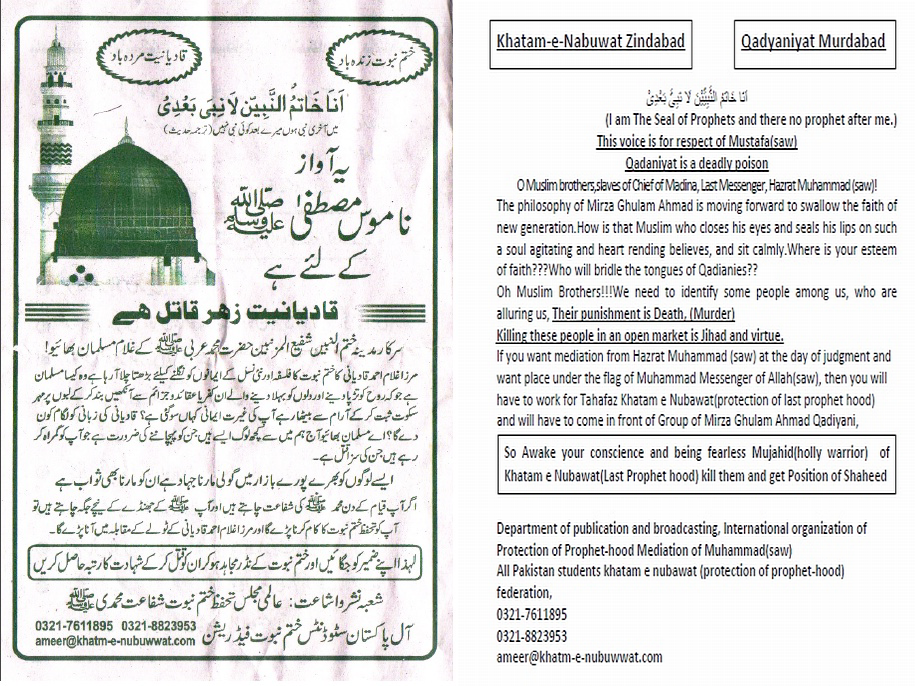
This may also be noted here that a group of fanatic mollahs under the banner of “Tahaffuz-e-Khatme Nabuwat” was trying to create anarchism and was chanting slogans “দাও লও, কুড়াল লও, কাদিয়ানীর কেল্লা লও” (“take lethal weapons, take axes, and behead the Qadianies (Ahmadies)” even in presence of law enforcing authorities and local Member of Parliament. And NO action was taken against them.

Foundation of Ahmadiyyat in Bangladesh and Brahmanbaria: The Ahmdiyya Muslim Jama’at in Bangladesh was first established in Brahmanbaria in 1912 by Hazrat Maolana Syed Abdul Wahed sahib (Rah.) who was a great saint of that area and was known as “Boro Maolana Sahib”. As he accepted the Ahmadiyya Muslim belief and took biat at the hands of the first Khalifa of the Holy Founder of the Jama’at, whom Ahmadies believes as Imam Mahdi, hundreds of people of that area and surroundings became Ahmadi.

In 1987, the central Ahmadiyya Mosque of Brahmanbria town “Masjid Mubarak” was forcefully captured by the religious fanatics/mullahs under the banner of “Tahaffuz-e-Khatme Nabuwat” and the then police authority helped them to capture that as the police in the name of “safeguarding” asked all Ahmadies who were inside the mosque to vacate and later handed over that to the mollahs. The mollahs renamed the mosque as “Masjid Fatah” or the “Conquered Mosque” and later established a Madrassa adjacent to the mosque. Since then the mosque and other three mosques around the Brahmanbaria area named: Ahmadiyya Mosque in Ghatura, Ahmadiyya Mosque in Bhadugarh and Ahmadiyya Mosque in Kharampur have been illegally occupied by the mollahs. All the mosques were legally owned and built by the Ahmadiyya Muslim Jama’at. Our Jama’at appealed various governments during the last 21 (till 2008) years to restore those mosques from illegal occupations and hand over them to the Ahmadiyya Muslim Jama’at, which has the legitimate rights to own them. But unfortunately no heed was given to the appeal. Now, we further appeal to this democratic government, who led our liberation war and committed to up-hold the spirit of our liberation movement and establish a non-communal, secular Bangladesh to take necessary steps to free our mosques from illegal occupations and hand over them to us.

Ahmadiyya Muslims of Brahmanbaria town were not allowed to hold their Jalsa Salana (Annual Convention) since 1987 due to the resistance of Khatme Nauwat people and it was only from 2007 ( during the last care taker govt. and present AL Govt. came to power in 2009) Ahmadies were able to hold their Jalsa inside their mosques. This year it is the 63rd Jalsa Salana.

Background of “Tahaffuz-e-Khatme Nabuwat”: The “Tahaffuz-e-Khatme Nabuwat” is an organization, which’s Headquarters is in Multan of Pakistan and had close attachment with Jamate Islami Pakistan. The then Head of Tahaffuz-e-Khatme Nabuwat, Bangladesh Khatib of Baitul Mukarram National Mosque Obaidul Haq (now deceased) visited Pakistan many times and had several meetings with the leaders of Jamate Islami Pakistan, that came in the news papers of Pakistan and Bangladesh in mid 90’s. Various Pakistani mollahs also visited Bangladesh since 1992 and attended, delivered lectures in anti-Ahmadiyya rallies, organized “Khatme Nabuwat Training Courses” etc. at various mosques in Bangladesh. All these news came to our national news papers.

Ahmadiyya Muslim Jama’at was repeatedly warning all concerned since early 90’s through Press Conferences/various discussions that all anti-Ahmadiyya movements are basically anti-Bangladesh activities under a “religious” coverage and they are trying to import militancy to our country. Now it is a proven truth.

Our Appeal: So, we hope that the government will not show any sort of softness to any anarchy in the name of religion or “religious feelings” and will handle any such attempt by the fanatics in iron hand. We hope that the government will uphold the constitutional rights of all citizens of the country as given by the constitution. Ahmadiyya Muslim Jama’at always assures and proved their allegiance to the laws of the land. We pray and work for the peace, prosperity and development of our beloved motherland. Ahmadies all over the world are acknowledged and recognized as a peaceful, law abiding religious community with NO political agenda. We also appeal that the government will take necessary steps to restore all our 4 (four) mosques now illegally occupied as mentioned above and will hand-over them to us.

ব্রাহ্মনবাড়ীয়াতে আহমদীয়া সম্মেলন বন্ধের চেষ্টা

আগামীকাল শুক্রবার ও পরশু শনিবার ১৯ ও ২০ মার্চ, ২০১০, আহমদীয়া মুসলিম জামা'ত, ব্রাহ্মনবাড়ীয়া তাদের ৬৩তম সালানা জলসা বা বার্ষিক সম্মেলনের আয়োজন করেছে। শহরের কান্দিপাড়ায় অবস্থিত নবনির্মিত নিজস্ব মসজিদ "বাইতুল ওয়াহেদ" প্রাংগনে দু'দিনব্যাপী উক্ত জলসার আয়োজন করা হয়েছে। কিন্তু এ সংবাদে স্থানীয় কিছু উগ্রপন্থী মোল্লা "খতমে নবুয়তের" ব্যানারে উক্ত শান্তিপুর্ণ জলসা যা মসজিদ কমপ্লেক্সের অভ্যন্তরে অনুষ্ঠিত হবে এবং বাইরে থেকে কোনো বক্তব্য শুনা যাবেনা তা বন্ধ করতে জোড় ততপরতা চালিয়েছে। তারা ইতিমধ্যে শহরের বিভিন্নস্থনে মিছিল-সমাবেশ করে জনগণের মধ্যে বিভ্রান্তি ছড়ানোর চেস্টা চালায় এবং স্থানীয় প্রশাসন এবং স্থানীয় সংসদ সদস্যের কাছে জলসা বন্ধের আবেদন জানিয়ে চাপ প্রয়োগের চেস্টা চালিয়ে যাচ্ছে বলে সংবাদ পাওয়া গেছে।

আহমদীয়া মুসলিম জামা'ত, ব্রাহ্মনবাড়ীয়ার প্রতিনিধিবর্গ ইতিমধ্যে স্থানীয় প্রশাসন ও মাননীয় সংসদ সদস্যকে তাদের শান্তিপুর্ণ ও সম্পুর্ণ অভ্যন্তরীন ধর্মীয় অনুষ্ঠান নির্বিঘ্নে পালন করার ক্ষেত্রে যাতে কোনরূপ বাধার সৃস্টি করা না হয় সেবিষয়ে নিশ্চয়তা বিধানের আবেদন জানিয়েছে। আবেদন ও আলোচনার পর তারা আহমদীদেরকে তাদের অনুষ্ঠান করার অনুমতি দিয়েছেন বলে জানা গেছে। তথাপি কোন কোন মহল জলসা যাতে অনুষ্ঠিত হ'তে না পারে সেজন্য নানারূপ ততপরতা চালিয়ে যাচ্ছে বলে সংবাদ পাওয়া গেছে।

উল্লেখ্য যে, ১৯৮৭ সালে উগ্রপন্থী মোল্লারা "খতমে নবুয়তের" ব্যানারে আহমদীদের পুরনো মসজিদ 'মসজিদ মোবারক" যেটিও কান্দিপাড়ায় অবস্থিত (বর্তমানে এর নাম দেয়া হয়েছে "মসজিদে ফাতাহ" অর্থাত "বিজিত মসজিদ" !), সেটি সহ ব্রাহ্মনবাড়ীয়া অঞ্চলের মোট চারটি মসজিদ জোড়পূর্বক দখল করে নেয়, বিভিন্ন সময়ে বিভিন্ন সরকারের কাছে আবেদন জানিয়েও দখলকৃত মসজিদগুলি যা আহমদীদের নিজস্ব স্থানে ও নিজস্ব অর্থায়নে নির্মিত উদ্ধার করা বা ফেরত পাওয়া সম্ভব হয়নি। সেই সাথে ব্রাহ্মনবাড়ীয়ার স্থানীয় আহমদীগণ বাধার কারণে দীর্ঘদিন কোন জালসা করতেও সক্ষম হননি। বিগত তত্বাবধায়ক সরকারের আমল এবং বর্তমান সরকার ক্ষমতায় আসার পর থেকে স্থানীয় আহমদীগণ পুণরায় তাদের জলসা করতে সক্ষম হয়েছেন।

আমরা আশা করব যে, আমাদের মুক্তিযুদ্ধে নেতৃত্বদানকারী ও মুক্তিযুদ্ধের চেতনার দাবীদার সরকার কোন বিশেষ মহল বা গোষ্ঠির দাবীর কাছে নতীস্বীকার না করে সকল ধর্ম, সম্প্রদায় ও মতকে তাদের নিজস্ব ধর্মকর্ম পালনের অধিকার নিশ্চিত করে অসাম্প্রদায়ীক ও ধর্মনিরপেক্ষ বাংলাদেশ গড়ার প্রাতিশ্রুতি পালনে সচেস্ট হবেন; এবং সেই সাথে আহমদীদের দখল হয়ে যাওয়া চারটি মসজিদ ফিরিয়ে দেয়ার বাস্তব পদক্ষেপ গ্রহন করবেন।

নিবেদক-
আহমদ তবশির চৌধুরী
প্রেস সেক্রেটারী
আহমদীয়া মুসলিম জামা'ত, বাংলাদেশ

Wednesday, February 18, 2009

Indonesian clerics flex political muscles

--- The Star Online, Malaysia

Monday February 16, 2009
Indonesian clerics flex political muscles
By Olivia Rondonuwu


JAKARTA (Reuters) — Parliamentary and presidential elections in Indonesia this year may hinge on how the public reacts to a directive from the country’s top Islamic council that all Muslims must vote or risk going to hell.

The controversial edict from the Indonesian Council of Ulama, which consists of elected clerics and scholars, does not state which parties or candidates voters should choose.

But it may encourage Muslims to vote for Islamist candidates and push the country away from secularism toward a more socially rigid government – not necessarily a plus for foreign investors.

“It’s in the interests of some MUI members to maximise the votes of various Islamic parties,” said Greg Fealy, an expert in Indonesian politics and Islam at the Australian National University.

Indonesia’s plethora of political parties mean relatively small shifts among voters could potentially determine which groups form alliances in the April 9 general election and which field candidates in the presidential election in July.

A recent poll shows reform-minded President Susilo Bambang Yudhoyono’s Democrat Party in the lead with 23 percent support, but he may still need to turn to some of the small Islamist parties or his current ally Golkar to form a coalition.

At this stage, 20-30 percent of those polled are still undecided.

PUSHING ISLAMIST AGENDA

Officially secular, Indonesia has the world’s largest Muslim population, about 85 percent of its 226 million people.

Most are moderates, but some of the small, hardline groups, which are represented in MUI, have pushed Islamist agendas, undermining Indonesia’s reputation for tolerance and threatening some of its religious and ethnic minorities.

“What is MUI these days, religious body or party?”, said Adhitya Wisena, a Muslim who works at a fish shop in Jakarta.

Under MUI’s influence last year, the government imposed restrictions on an Islamic sect, Ahmadiyya, and pushed ahead with a controversial anti-pornography law that some minorities, including Bali’s Hindus and Papua’s Christians, consider a threat to their art and culture.

Several districts in Indonesia have introduced sharia bylaws, for instance requiring women to wear headscarves regardless of their faith.

Islamists are also likely to have economic nationalist and protectionist views, which despite their own ostensibly liberal tendencies Yudhoyono and his predecessor Megawati Sukarnoputri have already had a tough time resisting.

Set up by former president Suharto in 1975 in an attempt to control political Islam, part of MUI’s role was to endorse government policies such as family planning.

But with Suharto’s ouster in 1998 and a shift towards greater democracy and freedom of expression, MUI has grown in political importance and is increasingly influenced by conservatives and hardliners within its ranks.

“Although MUI says it has representatives from all major Muslim organisations, there is a disproportionate influence by some small conservative, Islamist groups,” said Fealy, the Indonesian expert at Australian National University.

“That partly explains some of the decisions we have seen on Ahmadiyya (and) the anti-porno bill.”

Fealy said MUI’s influence on public policy was likely to grow, as Indonesia’s economy becomes more “Islamicised”, for example with the increasing importance of Islamic financing and the business of certifying food as halal, or allowed, in Islam.

“All the halal certification is managed by MUI and that generates a lot of revenue from companies who want their product certified,” he said.

“Islamic banks, Islamic insurance companies, Islamic pawn shops all have religious scholars advising them and more often than not they are from MUI. In reality, this is very lucrative for them.”

YOGA AND SMOKING

MUI’s fatwa – a legally nonbinding moral decree – requiring all Muslims to vote is not the council’s first attempt to influence an election outcome.

In 1999, MUI ordered Muslims to vote for Muslim candidates, a deliberate strike against Megawati and her PDI-P party, among Indonesia’s most secular and which then had a high proportion of non-Muslim officials.

It has put pressure on the government to pursue pro-Islam policies, and issued fatwas against liberalism and pluralism, and on lifestyle, health and social issues.

At its national fatwa council meeting in January, MUI banned yoga for Muslims if it involved Hindu chants and meditation, and said it was sinful to smoke in public, and for children and pregnant women to smoke.

But it refrained from banning under-age marriage, despite a recent public outcry when a cleric married a 12-year-old girl.

The expanding number of controversial fatwas is of increasing concern for many of Indonesia’s elite, religious minorities, and Muslim moderates.

“The edicts are out of date, pointless, and counterproductive for the interests of the nation,” wrote M. Syafi’i Anwar, executive director of the International Centre for Islam and Pluralism (ICIP) in an opinion piece in the Jakarta Post.

(Additional reporting by Sunanda Creagh)
Copyright © 2008 Reuters


URL: http://thestar.com.my/news/story.asp?file=...c=Worldupdates
 
^ Top of Page