Showing posts with label secularism. Show all posts

Tuesday, October 5, 2010

Secularism back

The Daily Star, Bangladesh
Your Right To Know
Tuesday, October 5, 201
Front Page

Secularism back
HC says original constitution automatically restored thru' 5th amendment verdict; nobody can be forced to wear burqa, cap, dhuti
Staff Correspondent

The High Court yesterday ruled that Bangladesh is now a secular state since the original constitution of 1972 has been automatically restored following the Supreme Court judgement on the fifth amendment.

In this secular state, everybody has religious freedom, and therefore no man, woman or child can be forced to wear religious attires like burqa, cap and dhuti, the HC said in a verdict.

But nobody could be prohibited from wearing religious attires if he or she wishes to wear those, it said.

The court also directed the authorities to immediately issue a circular asking all educational institutions not to compel students to wear religious clothes.

A division bench of the HC came up with the judgement after hearing a suo moto rule issued by it on August 22 asking the government to explain why compelling women to wear religious attires should not be declared illegal.

The bench comprised of Justice AHM Shamsuddin Chowdhury Manik and Justice Sheikh Md Zakir Hossain had issued the rule following a report published in a Bangla daily with the headline “Rani Bhabani Mohila College: Burqa Na Porle Ashte Mana” (Students of Rani Bhabani Women’s College not wearing veils are barred from entering the campus).

The August 22 report said principal of the college at Natore Mozammel Haque stopped cultural activities and sports at the college, and prohibited students not come to the campus without wearing burqa.

The HC observed that the four state principles including secularism, the main spirit of the Liberation War of the republic, have been re-established since the constitution of 1972 has been restored.

Some military rulers had illegally damaged the constitution of 1972 through martial law regulations, which are not recognised now, the judgement said.

The court directed the government to probe the allegations against the principal and take action.

But he should be kept on suspension during probe, it said.

Earlier, responding to the HC rule, the government had informed the court that it had issued a circular asking the authorities concerned not to compel women students to wear religious attire, and made Mozammel an officer on special duty (OSD).

Mozammel appeared before the HC bench yesterday as per its earlier order.

Secretaries to the ministries of home, education, social welfare and women affairs, and the principal have been made respondents to the court verdict.

SC lawyers Mahbub Shafique and KM Hafizul Alam argued before the court against compulsory wearing of religious attires.

Deputy Attorney General Nazrul Islam Talukder represented the government.

URL: www.thedailystar.net/newDesign/news-details.php?nid=157212

Saturday, August 28, 2010

The secular ideal

Daily Dawn, Pakistan
Columnist
The secular ideal
By Irfan Husain
Saturday, 28 Aug, 2010
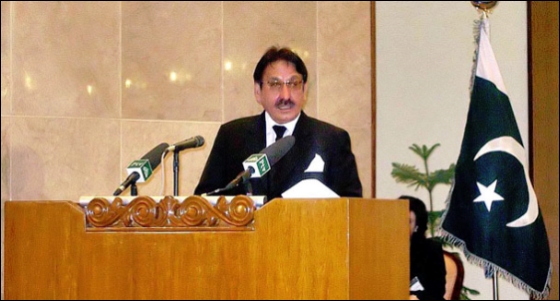
As we have seen over the last 63 years since the inception of the state, religion has been used to divide and alienate one section of society from another. So whatever the chief justice might feel, a genuine debate on secularism is long overdue. - File Photo.
As we have seen over the last 63 years since the inception of the state, religion has been used to divide and alienate one section of society from another. So whatever the chief justice might feel, a genuine debate on secularism is long overdue. — File Photo.

Recently, a reader — clearly more concerned with Pakistan’s welfare than mine — suggested that I set up a political party with the avowed goal of establishing a secular dispensation in the country.

I explained to him why this idea was quite unworkable: apart from my lack of political qualifications or ambitions, secularism is anathema to large numbers of Pakistanis who simply do not understand the concept. When this correspondence took place recently, I did not have the benefit of the Chief Justice of Pakistan’s wisdom on the matter. He was quoted recently as implying that if the National Assembly decided to declare secularism as Pakistan’s polity instead of Islam, this would be unacceptable. While this was a personal view expressed during a hearing on the 18th Amendment to the constitution, it does cast a bleak light on the larger question of the role of the Supreme Court, as well as its position vis-à-vis parliament.

As a forthright editorial in this newspaper asked: “The question is really, should the Supreme Court appropriate for itself the responsibility of determining under what system the Pakistani people want to live, as expressed by their elected representatives? Is the SC a guardian of the document, the constitution, which enshrines how Pakistanis want to organise their state … or is it an institution which determines how the state should be organised? The two are very different matters: the first places the SC as a referee, the second as a determinant of the structural design of the Pakistani state.”

This divergence of views is yet another example of the confusion that has continued to exist over the meaning of the secularist ideal. For decades now, most Pakistanis have laboured under the misconception that the term means ladeeniat, or irreligiosity. This is close enough to atheism to make politicians run for cover if the term is applied to them. The reality, of course, is very different.

After centuries of bloody warfare among various sects of Christianity in Europe, the idea of separating the church from the state came to be accepted, and was enshrined in most constitutions in the West. This did not mean that people stopped going to pray or lost their faith in God. What it did mean was that the law was no longer based on the tenets of Christianity, but reflected a manmade code of conduct.

Has this sea change made the people living under a secular dispensation more lawless? Not according to numerous surveys that measure law and order and the quality of life : countries like Canada, Sweden, New Zealand, and other western societies fare far better than nations who base their laws on religious or ideological dogma. The difficulty in implementing a faith-based code lies in its rigidity. Thus, for communists, Marx’s edicts, pronounced in the middle of the 19th century, had the force of timeless, unchanging law. This is equally true for those who seek to enforce a code that held sway centuries ago in today’s completely transformed world.

Another problem is that under religious law, minorities inevitably get short shrift. Despite the rhetoric about them being treated as equal citizens, the reality is very different. Consider the newspaper reports about a group of Ahmadis trapped in the floods in Punjab being denied relief goods by the administration, as well as by the local maulvi, as an example of the actual position minorities have been relegated to.

Turkey is a good example of a secular state where a mildly Islamic government has been elected repeatedly. There is no contradiction between the religious beliefs of the members of the ruling AK Party and the secular foundations of the Turkish state. While there has been some friction with the generals of the powerful military, the country has made great progress over the last decade. Millions of Turks observe the tenets of Islam without feeling they would enjoy more freedom of belief in a theocracy.

Somehow, many Pakistanis have come to believe that they are better Muslims than those living elsewhere. This arrogant attitude belies a deep insecurity that is the hallmark of recent converts. They forget that ultimately, it is for the Maker to decide who is a good Muslim and who is not. Indeed, we have allowed clerics to hijack a religion in which there are supposed to be no mediators between the believer and his God. This group of professional ulema has branded secularism as heresy in a bid to retain its lock on all matters relating to the faith. They have also used their monopoly on Islam to grab political power; indeed, this is their true goal.

Whatever they might say, I have many friends, Muslims and non-Muslims alike, who are firm believers in the teachings of the religions they were born in, and yet adhere closely to the principles of secularism. The truth is that while Europe has been largely cleansed of the terrible cancer of sectarian wars, many Muslim countries remain locked in conflict.

Unfortunately for Pakistan, Jinnah died before he could mould the new state in his secular vision. His successors were too weak and too willing to compromise with the religious right to assert the principles of Pakistan’s founding father. An increasingly assertive Jamaat-i-Islami spearheaded the drive to Islamise the country, and apart from the periods under Ayub Khan and Bhutto, there has been a steady shift towards fundamentalism. And even these two were not above using Islam when it suited them. Things have got so bad that secularism is now considered a term of abuse.

Currently, there is no debate on the direction the country should take. Almost by default, large numbers of Pakistanis assume that because the Indian subcontinent was partitioned to make a homeland for Muslims, we should automatically become a theocracy. Nothing could be further from the goal of the creators of Pakistan.

As we have seen over the last 63 years since the inception of the state, religion has been used to divide and alienate one section of society from another. So whatever the chief justice might feel, a genuine debate on secularism is long overdue.

©2010 DAWN Media Group. All rights reserved

Saturday, August 21, 2010

Blasphemy: Pakistan’s descent into anarchy

Express Tribune, Pakistan
Blogs
Blasphemy: Pakistan’s descent into anarchy
by by Khubaib UsmaniTaha Kehar
Saturday, 21 August 2010
Upon Pakistan's declaration as an Islamic republic, the rights of religious minorities, particularly Hindus, Christians, and Ahmadiyya, diminished.
Upon Pakistan’s declaration as an Islamic republic, the rights of religious minorities, particularly Hindus, Christians, and Ahmadiyya, diminished.

The widow of Bantu Masih hurls her pet hens inside the cage as she prepares dinner. Her only son Bagga, a scavenger, will return sometime after a full day’s tedious labour. The family lives in a remote locality 65 km from Lahore. They had to shift here overnight, after an enraged crowd killed Bantu Masih, the sole breadwinner of the family, over alleged charges of blasphemy in court premises.

Human rights organisations and secular circles in Pakistan have been condemning the abuse of blasphemy laws in the country for the last many decades. Introduced by military dictator General Zia, the law is termed draconian by human rights organisations of the country fast descending down to further anarchy and chaos due to religious fanaticism.

Analysts believe this is the worst form of human right violation and no government in Pakistan could get rid of this despicable use of the law, the seeds of which were sown in 1949 when Liaqat Ali Khan, the country’s first prime minister made it a preamble of the constitution. The Objectives Resolution passed by the first Constituent Assembly in 1949 including 280 Articles and six Schedules became its preamble. The power to amend the Constitution was contained in Article 239.

The country’s checkered history saw the 1956 and 1962 constitutions, but no government in Pakistan could dare to part ways with the controversial Objective Resolution which many believe to be in direct confrontation with the ideology of the Quaid-e-Azam who in his landmark address to the First Legislative Assembly said:

“You are free; you are free to go to your temples, you are free to go to your mosques or to any other place of worship in this State of Pakistan. You may belong to any religion or caste or creed — that has nothing to do with the business of the State.”

It is surprising as to why a staunch supporter of secularism like Bhutto could not do away with the controversial resolution while he is credited with giving a consensus document after 26 years of the country’s independence. Gen Zia cunningly used religion for his own nefarious designs. He exploited the sentiments of extremist segments in the name of religion when the former USSR invaded Afghanistan. Few believe that it was Pakistan’s war on any account. Sentiments of the public had been deliberately exploited in the name of religion with financial backing of the West.

“The Blasphemy Law is the culmination of the sojourn the nation set upon itself in 1949,” commented a senior human rights activist who requested anonymity. “Jinnah wanted to make Pakistan a secular state but the country lost direction following his untimely death. Upon Pakistan’s declaration as an Islamic republic, the rights of religious minorities, particularly Hindus, Christians, and Ahmadiyya, diminished. These minorities live under the fear of threat to their lives and property, desecration of their places of worship, and the Blasphemy Act that carries a penalty of death,” he observed.

The frenzied mob mentality and the knee-jerk reaction on the streets following a blasphemy charge is a real source of concern for human rights organisations of the country. “Trapping anyone in the vicious cobweb of blasphemy is the easiest job in Pakistan,” says an activist of human rights commission of Pakistan who wished to remain anonymous.

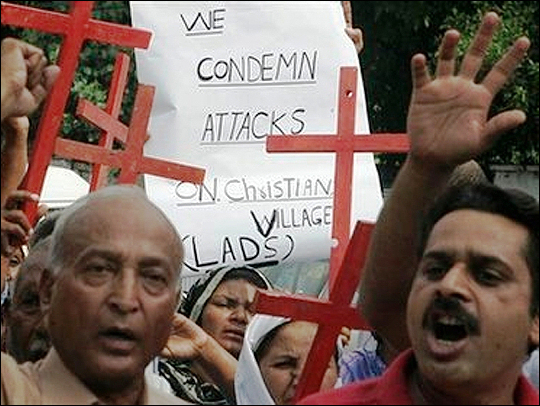
It was not that long ago when Gojra, a small city in the heartland of Punjab witnessed frenzied mob attacks on Christian neighbourhoods which killed nine. The attacks were triggered by reports of desecration of the Holy Quran. It was reported that Mukhtar Maseeh, Talib Maseeh and his son Imran Maseeh had desecrated the papers inscribed with Holy Quran verses at a wedding ceremony. Before the tragic attack in Gojra, mosques were used to make announcements provoking the attack. Locals were urged to “make mincemeat of the Christians” before Gojra. Similarly, in Daudnagar announcements were made from mosques asking people to come out to “fight rampaging” Christians.

On October 28, 2001 in Lahore, militants killed 15 Christians at a church, three weeks after the US-led War in Afghanistan to topple the Taliban. On September 25, 2002, unidentified gunmen shot dead seven people at a Christian charity in Karachi’s central business district. They entered the third-floor offices of the Institute for Peace and Justice (IPJ) and shot their victims in the head. All of the victims were Pakistani Christians.

In November 2005, hundreds of militants attacked Christians in Sangla Hill in the Punjab province and destroyed Roman Catholic, Salvation Army and United Presbyterian churches. The attack was over allegations of violation of blasphemy laws by a Pakistani Christian named Yousaf Masih.

In February 2006, churches and Christian schools were targeted in protests over the publications of the Jyllands-Posten cartoons in Denmark, leaving two elderly women injured and many homes and properties destroyed. A young Hindu labourer, a few months back, was beaten black and blue by his own colleagues in Karachi on the pretext that he used derogatory language against the Holy Prophet (PBUH). The victim died on the spot and his family could not dare to lodge a complaint in the local police station and the police arrested no one. The incident happened in broad day light at a construction site in Karachi. The heirs of the deceased disappeared from their native abode on the fear of further persecution by the locals

“We need a paradigm realignment of the country, unless Pakistani is declared a secular state there will not be any tangible development on human rights front” concludes Muneer Ahmad who is pursuing a master’s degree in History from a well recognized public sector university. According to Minority Rights Group International, Pakistan had the world’s highest increase of threats against minorities last year and was ranked the sixth most dangerous country for minorities overall. Pakistan was ranked after Somalia, Sudan, Afghanistan, Iraq, Burma and the Democratic Republic of the Congo.

URL: http://blogs.tribune.com.pk/story/1172/blasphemy-pakistans-descent-into-anarchy/

Tuesday, May 4, 2010

Pakistan: Sectarian Killings and Role of Media

---Daily Aajkal, Pakistan
   
Pakistan: Sectarian Killings and Role of Media
By Mohammad Shoaib Adil,
Saturday April 24, 2010
Daily Aajkal, Lahore, Pakistan


"Not a single analyst in the media has raised voice in support of Ahmadis. Opponents took benefit of this silence and started one sided propaganda. It is an irony that law enforcement agencies also become a party and sided with religious groups."

In Pakistan, war against terrorism is going on. Taliban have added a new dimension to this war by introducing sectarian killings in urban areas. A large section of Pakistani media is supporting the war against terrorism but fail to express due resentment against sectarian killings. They fail to answer the burning question if sectarian killing is also not a part and act of terrorism.

Actually our media is supporting the war against terrorism half heartedly due to pressure of western countries and US. Other wise Pakistani media often support the activities of Taliban and try to present the unlawful activities of Taliban like burning of CD shops and restricting women to get education according to Shariah. The voice against sectarian killings in Pakistan is weak and government has no strategy to overcome this pathetic attitude. Media and its projected intellectuals do not discuss openly such issues and try to hush up the matter in one or other way. Not a single voice is raised in our electronic media to condemn fundamentalism and support secularism.

History of sectarian violence is as old as Pakistan. After three or four years of partition, sectarian violence is started against Ahmadis (a Muslim sect which was declared non Muslim by parliament in 1974). At that time, secular traditions of United India were prevailing and law enforcement agencies dealt strictly with such issues. But after the passing of objectives resolution (in which Allah is declared supreme authority in making laws instead of Parliament) fundamentalism has grown manifold in our society and secular traditions became vulnerable.

During the period of so called Afghan Jihad, which is declared by US and was actually against Soviet Union, Pakistani society became the hub of proxy war between Iran and Suadi Arabia and sectarian killings were started. So called Islamisation of Pakistan penal code by a dictator, General Zia ul Haq made the situation grave day by day. Now liberals, minorities and women have become targets of this Islamisation.

Actually people of Pakistan became hostage of different religious groups which have strong links with Taliban. These religious groups have been so powerful and dominant that if any government tries to change such legislation, they created hurdles. Recently, due to the pressure of these elements, constitutional committee, headed by Mr. Raza Rabbani, could not strike down the amendments added by a dictator General Zia ul Haq.

Currently People of Pakistan are facing unemployment, inflation and energy crises on one hand and on the other have become victims of suicide bombers. Besides this, large section of people is becoming target of sectarian killings. From the last many years Shia community in Dera Ismael Khan, Para Chanar, Gilgit-Biltistan, Quetta and Karachi have become target of sectarian killings. Ashura processions and majalis have been attacked by jihadi groups. As a result thousands of people have been killed. In Dera Ismael Khan target killing of shia community is continuing and the same situation at Quetta prevails where target killing of Hazra (Shia) community is continuing. Various jihadi groups have accepted responsibility for such killings, but law enforcement agencies kept silent. Media and its sponsored analysts do not dare to condemn these jihadi groups.

In central Punjab besides shia community, minorities are also becoming target of Jihadi groups. In July 2008, on blasphemy charge sixty houses were burnt by highly provoked procession of local people. This was a clear war against Christian community but our media did not mention it initially and reported it as a clash between two local groups. Government of Punjab constituted an inquiry tribunal headed by a Judge of Lahore High Court. Some two months back, the tribunal presented its findings and involvement of Jihadi organization was proved. But the law enforcement agencies are not interested to take any action against jihadi group.

Besides Shia and Christian Community, Ahmadi community is being persecuted and are also a target of sectarian killings. Many Ahamadis have been killed only due to their faith. The news of excesses on Shia and Christian community published in newspapers and noticed by different sections of civil society. But acts of persecution of Ahmadis were not reported in the print and electronic media. Not a single analyst in the media has raised voice in support of Ahmadis. Opponents took benefit of this silence and started one sided propaganda. It is an irony that law enforcement agencies also become a party and sided with religious groups.

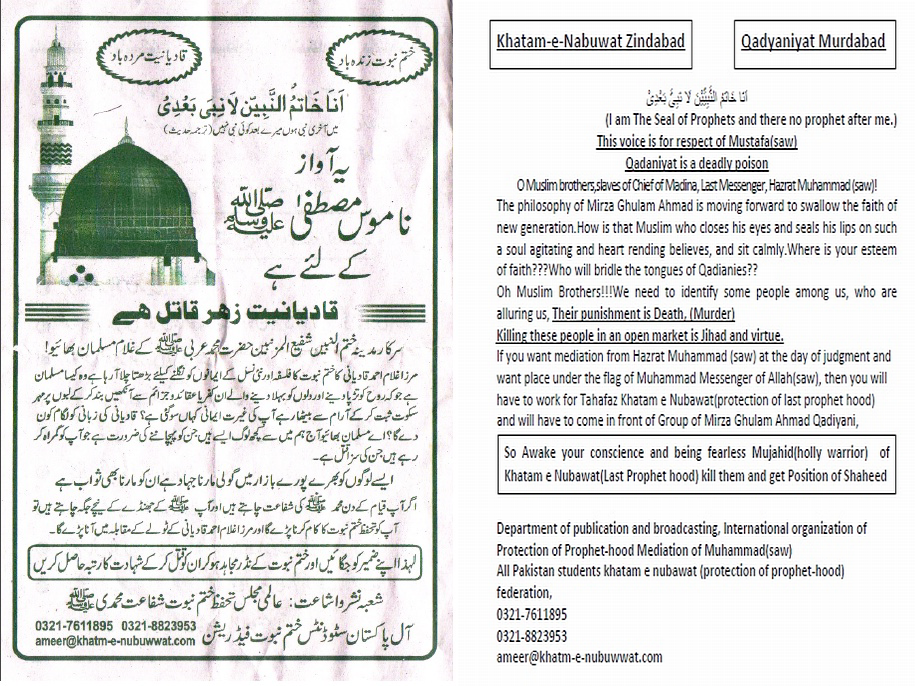
Roots of fundamentalism are so deep in our society that if anybody speaks against persecution of Ahmadis he, too, is declared Ahmadi. This is a simple way to victimize such a person who try to support them. If anybody tries to write in favor of Ahmadis in the press a vicious propaganda is started against such person. In Faisalabad, many Ahmadis have been killed from during last three months and many have been kidnapped for ransom. A local cleric issued a decree in which he allows the looted amount and allow kidnapping for ransom. Ahmadi community in Fasialabad have received threatening letters, ‘advising’ them to renounce their faith, before their homes are raided or relatives abducted. Police have arrested some people and investigations revealed that the culprits belong to Lashker e Taiba, a jhidhi outfit. Last year 23 Ahmadi students (girls and boys) have to quit Medical College on the pressure of religious groups only due to their faith.

Due to Islamisation of General Zia ul Haq, people started to give religious dimension to their personal and business issues to exploit weak groups of society. With the passage of time situation become so grave that if anybody declared from mosque loudspeaker that his opponent is involved in blashpehmy. People became provoked and started to beat him or his family member and police became just spectator.

© Mohammad Shoaib Adil
URL : www.aajkal.com.pk/news.aspx?img=http://ww...=800&h=1222

Wednesday, February 18, 2009

Indonesian clerics flex political muscles

--- The Star Online, Malaysia

Monday February 16, 2009
Indonesian clerics flex political muscles
By Olivia Rondonuwu


JAKARTA (Reuters) — Parliamentary and presidential elections in Indonesia this year may hinge on how the public reacts to a directive from the country’s top Islamic council that all Muslims must vote or risk going to hell.

The controversial edict from the Indonesian Council of Ulama, which consists of elected clerics and scholars, does not state which parties or candidates voters should choose.

But it may encourage Muslims to vote for Islamist candidates and push the country away from secularism toward a more socially rigid government – not necessarily a plus for foreign investors.

“It’s in the interests of some MUI members to maximise the votes of various Islamic parties,” said Greg Fealy, an expert in Indonesian politics and Islam at the Australian National University.

Indonesia’s plethora of political parties mean relatively small shifts among voters could potentially determine which groups form alliances in the April 9 general election and which field candidates in the presidential election in July.

A recent poll shows reform-minded President Susilo Bambang Yudhoyono’s Democrat Party in the lead with 23 percent support, but he may still need to turn to some of the small Islamist parties or his current ally Golkar to form a coalition.

At this stage, 20-30 percent of those polled are still undecided.

PUSHING ISLAMIST AGENDA

Officially secular, Indonesia has the world’s largest Muslim population, about 85 percent of its 226 million people.

Most are moderates, but some of the small, hardline groups, which are represented in MUI, have pushed Islamist agendas, undermining Indonesia’s reputation for tolerance and threatening some of its religious and ethnic minorities.

“What is MUI these days, religious body or party?”, said Adhitya Wisena, a Muslim who works at a fish shop in Jakarta.

Under MUI’s influence last year, the government imposed restrictions on an Islamic sect, Ahmadiyya, and pushed ahead with a controversial anti-pornography law that some minorities, including Bali’s Hindus and Papua’s Christians, consider a threat to their art and culture.

Several districts in Indonesia have introduced sharia bylaws, for instance requiring women to wear headscarves regardless of their faith.

Islamists are also likely to have economic nationalist and protectionist views, which despite their own ostensibly liberal tendencies Yudhoyono and his predecessor Megawati Sukarnoputri have already had a tough time resisting.

Set up by former president Suharto in 1975 in an attempt to control political Islam, part of MUI’s role was to endorse government policies such as family planning.

But with Suharto’s ouster in 1998 and a shift towards greater democracy and freedom of expression, MUI has grown in political importance and is increasingly influenced by conservatives and hardliners within its ranks.

“Although MUI says it has representatives from all major Muslim organisations, there is a disproportionate influence by some small conservative, Islamist groups,” said Fealy, the Indonesian expert at Australian National University.

“That partly explains some of the decisions we have seen on Ahmadiyya (and) the anti-porno bill.”

Fealy said MUI’s influence on public policy was likely to grow, as Indonesia’s economy becomes more “Islamicised”, for example with the increasing importance of Islamic financing and the business of certifying food as halal, or allowed, in Islam.

“All the halal certification is managed by MUI and that generates a lot of revenue from companies who want their product certified,” he said.

“Islamic banks, Islamic insurance companies, Islamic pawn shops all have religious scholars advising them and more often than not they are from MUI. In reality, this is very lucrative for them.”

YOGA AND SMOKING

MUI’s fatwa – a legally nonbinding moral decree – requiring all Muslims to vote is not the council’s first attempt to influence an election outcome.

In 1999, MUI ordered Muslims to vote for Muslim candidates, a deliberate strike against Megawati and her PDI-P party, among Indonesia’s most secular and which then had a high proportion of non-Muslim officials.

It has put pressure on the government to pursue pro-Islam policies, and issued fatwas against liberalism and pluralism, and on lifestyle, health and social issues.

At its national fatwa council meeting in January, MUI banned yoga for Muslims if it involved Hindu chants and meditation, and said it was sinful to smoke in public, and for children and pregnant women to smoke.

But it refrained from banning under-age marriage, despite a recent public outcry when a cleric married a 12-year-old girl.

The expanding number of controversial fatwas is of increasing concern for many of Indonesia’s elite, religious minorities, and Muslim moderates.

“The edicts are out of date, pointless, and counterproductive for the interests of the nation,” wrote M. Syafi’i Anwar, executive director of the International Centre for Islam and Pluralism (ICIP) in an opinion piece in the Jakarta Post.

(Additional reporting by Sunanda Creagh)
Copyright © 2008 Reuters


URL: http://thestar.com.my/news/story.asp?file=...c=Worldupdates
 
^ Top of Page