 |
threat
Persistent persecution
Ahmadi community in Faisalabad keeps carrying the tag of ‘liable to be killed’ with no security
By Aoun Sahi
September 18, 2010
Naseem Ahmad Butt, 55, father of four daughters and a son and a follower of Ahmadi school of thought, was sleeping in the courtyard of his house in Muzaffar Colony in Faisalabad on the night of September 4, 2011 when four unidentified attackers broke into his house and attacked him. He received one bullet in his chest while the second one ruptured his kidney.
The firing woke up his wife whose cries forced the attackers to flee. “My brother was lying in a pool of blood when I saw him. He told me that the attackers were between 20 and 25 years old. One of them kicked him and when he woke up, they shot him. He died in a local hospital seven hours after the attack,” Khalid Pervez Butt, younger brother of Naseem Butt, tells TNS.
Naseem used to work as a technician in a local powerloom and had no enmity. “The attackers did not steal anything from his house. Being Ahmadi seems to be his only ‘sin’ that made him liable to be killed,” says Khalid Butt. His first cousin Naseer Butt was also killed in a similar fashion on September 8, 2010. “Police has made no effort to trace his killers. However, in a hope of assistance, I have got a case registered with police under section 302 of Pakistan Penal Code,” he tells TNS, adding that it is the fourth murder in his family.
 “In 1994, one of my younger brothers and one of my first cousins (younger brother of Naseer Butt) were killed by religious fanatics. Police had arrested the assailants. Local activists of religious parties held protest rallies against the arrests of culprits and one of the assailants had been released just a few months back,” he says.
Three days after this incident on September 7, 2011, another Ahmadi, Chaudhry Basheer Ahmad, was attacked in Rachna Town in Sheikhupura district. He received three bullets and is still in hospital in a critical condition.
September has always been a tough month for Ahmadis in Pakistan as on September 7, 1974, the Parliament of Pakistan declared them non-Muslims. Almost all religious parties hold rallies and gatherings in the first week of September every year against Ahmadis. Majlis-e Tahffuz-e Khatm-e Nubuwwat takes the lead and arranges an annual gathering to celebrate victory against Ahmadis every year in Rabwah — the Jama’at Ahmadiya’s headquarters in Pakistan.
“Faisalabad has become one of the toughest cities in Pakistan for Ahmadis to live in,” Syed Mahmood Ahmad, secretary of the Faisalabad chapter of Jama’at Ahmadiya, tells TNS. “Naseem Butt was neither an active member of our Jama’at nor was an influential person. He was killed only because of his religious beliefs. Within days after his killing, unidentified people have written slogans like ‘slaves of the companions of Prophet (PBUH) and ‘down with Qadyaniat’ on the walls of Muzaffar Colony.
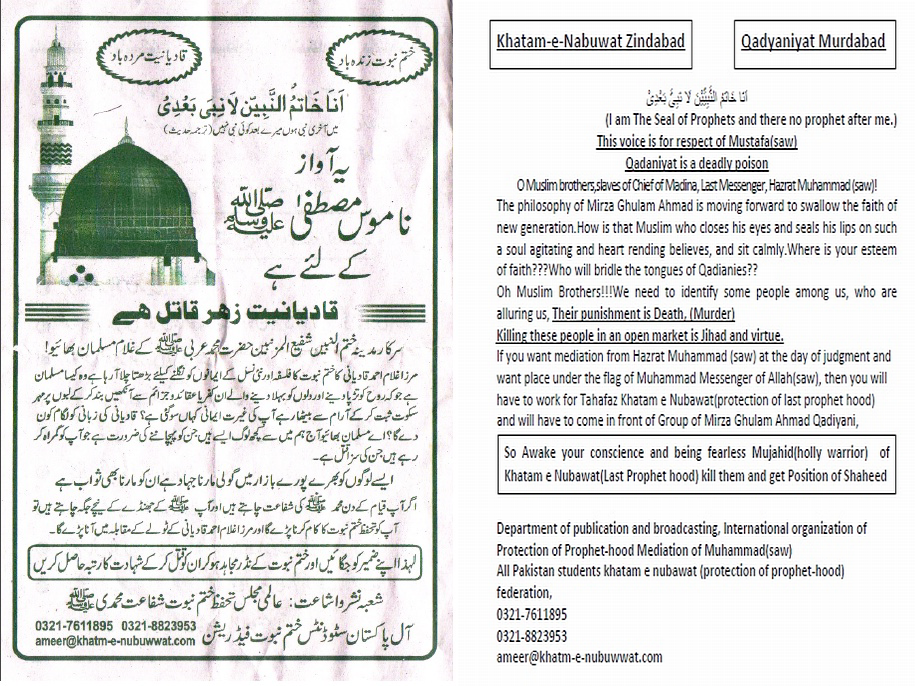
In May this year, a pamphlet terming Ahmadis ‘liable to be killed’ was distributed in Faisalabad. “It also carried names and addresses of prominent Ahmadis in Faisalabad. We have time and again contacted the Faisalabad police that a group of fanatics is threatening Ahmadis in the area. But no action has ever been taken,” says Ahmad. “On June 2, 2011, I sent an email to the home secretary and the police chief of Punjab as well as Faisalabad’s regional police officer, but nothing has been done to help us.”
Over the past two years, as many as six Ahmadis have been killed in Faisalabad, but no killer has been brought to book. “Religious fanatics are being encouraged by a lack of action on the part of the government agencies. It has even become too tough for Ahmadi youth to get education in public sector universities. A few months back, four girls belonging to our community were expelled from National Textile University. The 2010 annual magazine of that university carried three articles against Ahmadis,” says Mahmood Ahmad.
 Police officials in Faisalabad do not seem to have taken the issue seriously. “We have no resources to provide special security for Ahmadis,” Shakir Hussain Dawar, senior police official in Faisalabad, tells TNS. “As far as Naseem Butt’s murder is concerned, we are investigating it from all angles. We have not ruled out the possibility of religious factor,” he says.
Saleemuddin, the Jama’at spokesperson, says that Ahmadis are being threatened all across the country, adding that Faisalabad has become the most hostile city towards the Ahmadis. “Most hate material is being generated and funded there. Eleven Ahmadis have been killed in Faisalabad since 1984.” In May last year, more than 88 people were killed in Lahore when gunmen opened fire at two separate places of worship of Ahmadis. “One year has passed, but no progress has been made in the case.”
Human rights activists have termed the situation deplorable. They are worried about the situation and have been writing constantly to the government about the security of Ahmadis. “Faisalabad has become a test case for the government to check the persecution of Ahmadis. The opponents of Ahmadis have even published their addresses and phone numbers on the pamphlets distributed in Faisalabad around three months back. No action has been taken against the culprits. It seems that the persecution will continue,” says HRCP Director IA Rehman.
The firing woke up his wife whose cries forced the attackers to flee. “My brother was lying in a pool of blood when I saw him. He told me that the attackers were between 20 and 25 years old. One of them kicked him and when he woke up, they shot him. He died in a local hospital seven hours after the attack,” Khalid Pervez Butt, younger brother of Naseem Butt, tells TNS.
Naseem used to work as a technician in a local powerloom and had no enmity. “The attackers did not steal anything from his house. Being Ahmadi seems to be his only ‘sin’ that made him liable to be killed,” says Khalid Butt. His first cousin Naseer Butt was also killed in a similar fashion on September 8, 2010. “Police has made no effort to trace his killers. However, in a hope of assistance, I have got a case registered with police under section 302 of Pakistan Penal Code,” he tells TNS, adding that it is the fourth murder in his family.
“In 1994, one of my younger brothers and one of my first cousins (younger brother of Naseer Butt) were killed by religious fanatics. Police had arrested the assailants. Local activists of religious parties held protest rallies against the arrests of culprits and one of the assailants had been released just a few months back,” he says.Three days after this incident on September 7, 2011, another Ahmadi, Chaudhry Basheer Ahmad, was attacked in Rachna Town in Sheikhupura district. He received three bullets and is still in hospital in a critical condition.
September has always been a tough month for Ahmadis in Pakistan as on September 7, 1974, the Parliament of Pakistan declared them non-Muslims. Almost all religious parties hold rallies and gatherings in the first week of September every year against Ahmadis. Majlis-e Tahffuz-e Khatm-e Nubuwwat takes the lead and arranges an annual gathering to celebrate victory against Ahmadis every year in Rabwah — the Jama’at Ahmadiya’s headquarters in Pakistan.
“Faisalabad has become one of the toughest cities in Pakistan for Ahmadis to live in,” Syed Mahmood Ahmad, secretary of the Faisalabad chapter of Jama’at Ahmadiya, tells TNS. “Naseem Butt was neither an active member of our Jama’at nor was an influential person. He was killed only because of his religious beliefs. Within days after his killing, unidentified people have written slogans like ‘slaves of the companions of Prophet (PBUH) and ‘down with Qadyaniat’ on the walls of Muzaffar Colony.
In May this year, a pamphlet terming Ahmadis ‘liable to be killed’ was distributed in Faisalabad. “It also carried names and addresses of prominent Ahmadis in Faisalabad. We have time and again contacted the Faisalabad police that a group of fanatics is threatening Ahmadis in the area. But no action has ever been taken,” says Ahmad. “On June 2, 2011, I sent an email to the home secretary and the police chief of Punjab as well as Faisalabad’s regional police officer, but nothing has been done to help us.”
Over the past two years, as many as six Ahmadis have been killed in Faisalabad, but no killer has been brought to book. “Religious fanatics are being encouraged by a lack of action on the part of the government agencies. It has even become too tough for Ahmadi youth to get education in public sector universities. A few months back, four girls belonging to our community were expelled from National Textile University. The 2010 annual magazine of that university carried three articles against Ahmadis,” says Mahmood Ahmad.
Police officials in Faisalabad do not seem to have taken the issue seriously. “We have no resources to provide special security for Ahmadis,” Shakir Hussain Dawar, senior police official in Faisalabad, tells TNS. “As far as Naseem Butt’s murder is concerned, we are investigating it from all angles. We have not ruled out the possibility of religious factor,” he says.Saleemuddin, the Jama’at spokesperson, says that Ahmadis are being threatened all across the country, adding that Faisalabad has become the most hostile city towards the Ahmadis. “Most hate material is being generated and funded there. Eleven Ahmadis have been killed in Faisalabad since 1984.” In May last year, more than 88 people were killed in Lahore when gunmen opened fire at two separate places of worship of Ahmadis. “One year has passed, but no progress has been made in the case.”
Human rights activists have termed the situation deplorable. They are worried about the situation and have been writing constantly to the government about the security of Ahmadis. “Faisalabad has become a test case for the government to check the persecution of Ahmadis. The opponents of Ahmadis have even published their addresses and phone numbers on the pamphlets distributed in Faisalabad around three months back. No action has been taken against the culprits. It seems that the persecution will continue,” says HRCP Director IA Rehman.












 Posts
Posts


