Showing posts with label justifying murder. Show all posts

Wednesday, July 21, 2010

Jungle justice

Daily Dawn, Pakistan
FROM THE PAPER »
EDITORIAL

Jungle justice
   Dawn Editorial
   Wednesday, 21 Jul, 2010

Policemen fire teargas shells to disperse the protesters during a demonstration against the killing of two Christian brothers outside the court building in Faisalabad. - Online Photo
Policemen fire teargas shells to disperse the protesters during a demonstration against the killing of two Christian brothers outside the court building in Faisalabad. — Online Photo

There have been several instances where police apathy, perhaps in some cases connivance, has led to under-trial prisoners being targeted by vengeful elements on the court premises.

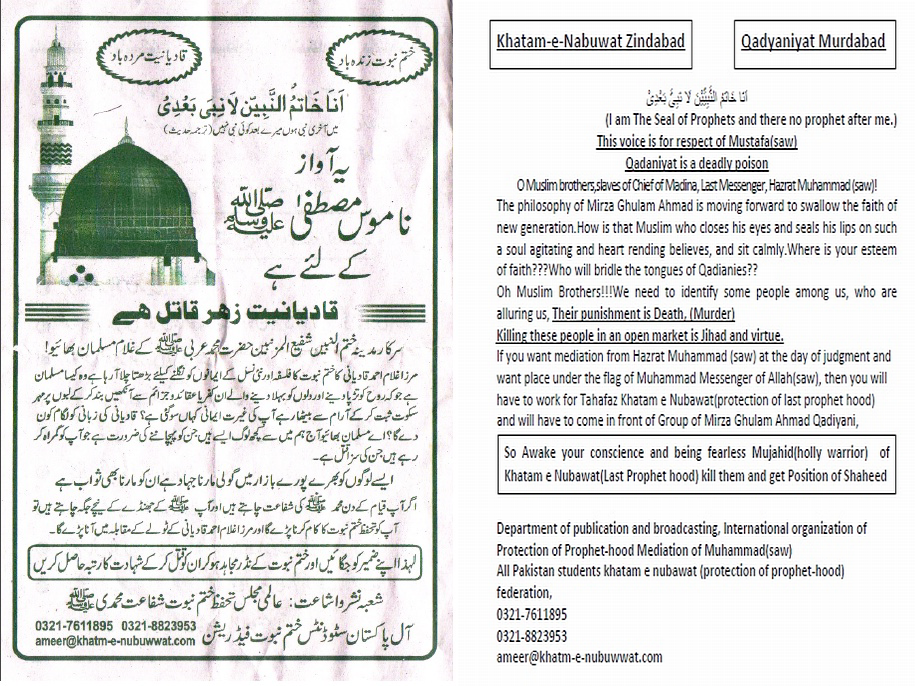
Where the charge involves religion, there is a greater need for the police to be vigilant when escorting the accused to or from court, given the kind of fury that allegations of blasphemy unleash. Sadly, this is far from the case in Pakistan as exemplified by the killing of two Christian brothers by a group of masked men on the premises of a Faisalabad sessions court on Monday. The brothers were accused of distributing blasphemous material — that, unbelievably, also contained phone numbers. The men had been brought to court under police escort to obtain remand. Such cases are a reminder of how allegations of blasphemy can be used to incite jungle justice and mob violence that often mask the real motives behind the targeting of individuals. The motives can range from the settling of personal scores to property disputes.

Monday’s killings led to violent protests by the Christian community in the brothers’ native area of Daoodnagar; a section of the Muslim community reacted by asking the people over mosque loudspeakers to “fight the rampaging” Christians. The situation grew volatile enough to necessitate the imposition of Section 144 for the maintenance of public order. The result is the creation of an atmosphere of fear and violent mistrust that could lead to the targeting of more members of the Christian community. This situation can also be exploited by ill-intentioned groups such as the land mafia. This has, indeed, often proved to be the case in earlier incidents of violence involving allegations of blasphemy, particularly in Punjab.

Arrests under Section 295-C of the PPC for allegations of blasphemy illustrates the dangers inherent in a law that lends itself to misuse. The blasphemy law is rightly criticised for the manner in which it can be abused. We must also note that it helps foster a societal mindset of jungle justice where individuals feel that it is right to take the law into their own hands. The blasphemy law must be repealed.

©2010 DAWN Media Group. All rights reserved

Friday, May 28, 2010

Attackers strike sect mosques in Pakistan; 80 dead

---Yahoo News (via AP)

Attackers strike sect mosques in Pakistan; 80 dead

By BABAR DOGAR and NAHAL TOOSI, Associated Press Writers Babar Dogar And Nahal Toosi, Associated Press Writers – Fri. May 28, 2010 17:30 UTC

LAHORE, Pakistan – Suspected Islamist militants attacked two mosques packed with hundreds of worshippers from a minority sect in eastern Pakistan on Friday, holding hostages and battling police, officials and witnesses said. Some 80 people died, and dozens were wounded in the worst attack ever against the Ahmadi sect.

The assaults in Lahore were carried out by at least seven men, including three suicide bombers, officials said. Two attackers were captured. At one point, a gunman fired bullets from atop a minaret.

Pakistani police officers and others take cover near vehicles damaged in a suspected attack, outside Garhi Shahu mosque in Lahore, Pakistan, Friday, May 28, 2010. Suspected Islamist militants attacked two mosques, Garhi Shahu and Model Town, packed with hundreds of people from a minority sect in eastern Pakistan on Friday, laying siege to one center in a standoff with police, killing scores of people.
It was one of the first times militants have deployed gun and suicide squads and taken hostages in a coordinated attack on a religious minority in Pakistan. Shiite Muslims have borne the brunt of individual suicide bombings and targeted killings for years, though Christians and Ahmadis also have faced violence.

The long-standing threat to minorities in this Muslim-majority, U.S-allied nation has been exacerbated as the Sunni extremist Taliban and al-Qaida movements have spread.

Ahmadis are reviled as heretics by mainstream Muslims for their belief that their sect’s founder was a savior foretold by the Quran, Islam’s holy book. The group has experienced years of state-sanctioned discrimination and occasional attacks by radical Sunni Muslims in Pakistan, but never before in such a large and coordinated fashion.

The attacks Friday took place in the Model Town and Garhi Shahu neighborhoods of Lahore, Pakistan’s second-largest city and one of its politically and militarily most important.

The assault at Model Town was relatively brief, and involved four attackers spraying worshippers with bullets before exploding hand grenades, said Sajjad Bhutta, Lahore’s deputy commissioner.

Several kilometers away at Garhi Shahu, the standoff lasted around four hours.

TV footage showed an attacker atop a minaret of the mosque at one point in the siege, firing an assault rifle and throwing hand grenades. Outside, police traded bullets with the gunmen, an Associated Press reporter saw.

Luqman Ahmad, 36, was sitting and waiting for prayers to start when he heard gunshots and then an explosion. He quickly lay down and closed his eyes.

“It was like a war going on around me. The cries I heard sent chills down my spine,” Ahmad said. “I kept on praying that may God save me from this hell.”

After police commandos announced the attackers had died, he stood to see bodies and blood everywhere.

“I cannot understand what logic these terrorists have by attacking worshippers, and harmless people like us,” he said.

Bhutta said at least three attackers held several people hostage inside the Garhi Shahu mosque. The three wore jackets filled with amunition. “They fought the police for some time, but on seeing they were being defeated they exploded themselves,” he said.

Around 80 people were killed in the two attacks, while more than 80 were wounded, Bhutta said. A breakdown for each location was not immediately available.

Two attackers were caught, and one was being treated for wounds, Punjab province police chief Tariq Saleem Dogar said.

An initial investigation found that one detained suspect was from southern Punjab but had studied at a religious school in the port city of Karachi, Punjab’s law minister said.

Before the attack, the suspect stayed at a center belonging to Tableeghi Jamaat, a conservative Muslim missionary group, Law Minister Rana Sanaullah Khan said. The group has occasionally drawn attention in connection with international terror investigations, but says that it is not violent.

Geo TV reported that the Punjab province branch of the Pakistani Taliban had claimed responsibility, however, such attacks often spur unverifiable claims of responsibility from various groups.

The province’s top executive, chief minister Shahbaz Sharif, appealed for calm.

“We, our security forces will fight this menace till the end,” he said. “Attacks on places of worship is barbarianism. It is a shame to cause bloodshed in mosques.”

Muslim leaders have accused Ahmadis of defying the basic tenet of Islam that says Muhammad was the final prophet, but Ahmadis argue their leader was the savior rather than a prophet.

Under pressure from hard-liners, the Pakistani government in the 1970s declared the Ahmadis a non-Muslim minority. They are prohibited from calling themselves Muslims or engaging in Muslim practices such as reciting Islamic prayers.

A U.S.-based Ahmadi spokesman, Waseem Sayed, said the sect abhors violence and was deeply concerned about the attacks. He estimated Pakistan, a country of 180 million, had around 5 million Ahmadis.

Worldwide he estimated there were tens of millions of Ahmadis, but said that they have faced the most violence in Pakistan, and that this was the worst attack in the history of the sect.

“We are a peaceful people and monitoring the situation and hoping and praying that the authorities are able to take all necessary action to bring the situation to normalcy with the least number of casualties,” Sayed said via e-mail.

Also Friday, a suspected U.S. missile strike killed 11 alleged militants and wounded three others in the Nazai Narai area of South Waziristan tribal region, two intelligence officials said.

The exact identities of the dead were not immediately clear, said the officials, who spoke on condition of anonymity because they are not authorized to speak to media on the record.

The U.S. does not publicly acknowledge the missile program. Pakistani publicly protests the strikes as violations of its sovereignty, but is widely believed to secretly aid the attacks on Taliban and al-Qaida targets.

Pakistan has staged military operations against Taliban militants in its tribal regions, which stretch along the Afghan border and have long had little government influence.

Army fighter planes destroyed at least 10 suspected militant hideouts and one dozen vehicles in the Orakzai tribal region on Friday, killing at least 80 insurgents, administration official Samiullah Khan said,

Information from the tribal areas is nearly impossible to verify independently, because the areas are remote, dangerous and entry to them is largely restricted.

In Pakistan’s southwest Baluchistan province Friday, gunmen on a motorcycle killed four police officers in Quetta city.

One of the slain officers had helped arrest militants from the banned Sunni extremist group Lashkar-e-Jhangvi, senior police official Naveed Ahmed said. But Ahmed did not blame any group for the attack, saying the investigation was continuing.

____

Toosi reported from Islamabad. Associated Press Writers Hussain Afzal in Parachinar, Abdul Sattar in Quetta, and Munir Ahmed and Asif Shahzad in Islamabad contributed to this report.
Copyright © 2010 The Associated Press. All rights reserved.
URL : http://news.yahoo.com/s/ap/20100528/ap_on_re_as/as_pakistan

Monday, May 24, 2010

Vulnerable minorities [Editorial]

---Daily Dawn, Pakistan
Vulnerable minorities
   Dawn Editorial
   Monday, 24 May, 2010

The EU parliament has rapped Pakistan hard on the knuckles for its poor minority rights record — and rightly so. It has also demanded a review of the infamous blasphemy law that has lent itself to misuse, to the extent of justifying murder.

While it is not clear if the European MPs were provoked by a particular incident, one cannot deny that Pakistan has to put in far more effort to gain the trust of its minorities. There are some laws on the statute books — including the blasphemy law — that actively operate against minorities. Although the constitution pledges protection for the rights of minorities, it also contains provisions that have caused a sense of insecurity among them. Attempts have been made to modify some laws, but the situation has not really changed on the ground. The blasphemy law that was introduced by the military regime of Gen Ziaul Haq is the most draconian and open to abuse. It has been used on a number of occasions to penalise communities that are not Muslim, with entire villages having been set on fire — Shantinagar is still fresh in our memory. An attempt by the Musharraf government to modify the process of registering a case under this law also ran into trouble.

With social prejudices increasing in an atmosphere of growing religiosity, it seems that minorities are becoming more vulnerable, even if they have rights under the law. Moreover, against a background of growing lawlessness in the country, they face a real danger of being targeted physically. They are discriminated against and, what is worse, cannot expect any protection from the state. The government must take a firm stand on their rights even if it means standing up to those obscurantist elements that have always opposed greater rights for Pakistan’s minorities. This government would be issuing a political statement in support of the minorities if it were to work towards repealing the blasphemy law. A campaign is also needed to make people aware of the virtues of tolerance. Without a change in the public mindset the current environment of hostility will remain.

©2010 DAWN Media Group. All rights reserved
URL : www.dawn.com/wps/wcm/connect/dawn...religious-freedom-250-hh-09
 
^ Top of Page