Showing posts with label killings. Show all posts

Saturday, September 10, 2011

Ahmadis criticise govt inaction over targeted killings

Express Tribune, Pakistan
Pakistan
Punjab
Ahmadis criticise govt inaction over targeted killings
By Shamsul Islam
Published: September 10, 2011
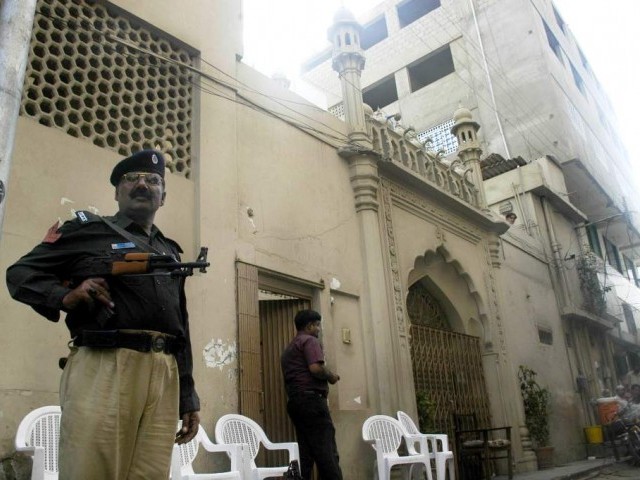
Ahmadis say their community is facing dire threat. PHOTO: EXPRESS/FILE
FAISALABAD: Ahmadis are completely at the mercy of assassins who are targeting and killing them with impunity and police and other law-enforcement agencies were doing nothing to thwart their actions, the secretary of the Faisalabad chapter of the Jama’at Ahmadiyya said in a letter sent to foreign missions and top government functionaries.

Syed M Mahmood, the secretary of the organisation’s general affairs, said that he had “sent a letter (containing) forewarnings regarding the plight of the Ahmadiyya community in Faisalabad”, but no action was taken on it.

The letter was dispatched to the Human Rights Watch, the Asian Human Rights Commission, US embassy in Islamabad, the British High Commission and the embassies of France, Germany, Belgium, Canada, Norway, Sweden and Denmark, Islamabad.

He said that several victims, including Laeeq Ahmed, who was a member of the local chapter of the Jama’at Ahmadiyya, were brutally murdered in public, but police was trying to look the other way.

Citing the example of Laeeq Ahmed’s murder, he said: “It is shocking to know that neither the empties in the car were taken into the possession by the police nor the car was examined.”

According to him, another Ahmadi, Naseem Ahmad Butt became the victim of a targeted killing, but his killers were “roaming free” and asking about the whereabouts of his brother.

He reminded that “both the killings (occurred) in the constituency of the controversial Punjab law minister, Rana Sanaullah, who sides with the extremist groups”.

Expressing his frustration, he said: “We cannot continue to see our dear ones murdered with impunity. I have no option but to send this report also to world organisations on human rights, to different embassies, to show them the disintegration and complete collapse of law and order in Punjab. We (fear) that this (city) might become a second Karachi.”

This letter was also sent to the governor of Punjab, the provincial home secretary, additional secretary (home), IG police, additional IG, RPO Faisalabad, CPO Faisalabad, SSP (Operations) Faisalabad and DCO Faisalabad,

In another letter sent to foreign missions in Islamabad and law-enforcement authorities, the Ahmadiyya community also protested over what they termed forced rustication of three female students from the National Textile University (NTU) in Faisalabad because of their faith.

It was pointed out, “NTU Faisalabad has become the hub of…extremist and militant groups”.

“There has been a planned subversion of all the decent norms of an educational institution. The target has been the Ahmadiyya Community and the weaker Ahmadi female students”.

“So much so, that all the female students had to leave the NTU Faisalabad. Their educational careers were abandoned midway. Moulvis were imported (to the campus) who harangued the students against the Ahmadiyya Community in such an abusive language which defies definition”.

The letter pointed out, “The parents of the students have been approaching the rector of the NTU Faisalabad, but he showed his inability to control the situation”.

“Even the magazine of the NTU, Faisalabad, exhorts that all Ahmadis should be killed.

“This is not a textile university, this is the killing factory of the Taliban.”

“This university, hotbed of extremism, should have no affiliation with any other educational institutions in the world. Otherwise, the name of other decent educational institution will be sullied.”

Published in The Express Tribune, September 10th, 2011.

Copyrighted © 2011 The Express Tribune News Network
URL: http://tribune.com.pk/story/249311/extremist-groups...killings/

Saturday, August 7, 2010

Sectarian Clashes Surge in a City in Pakistan’s Heartland

The New York Times, USA
Asia Pacific

Sectarian Clashes Surge in a City in Pakistan’s Heartland

Pakistanis gathered recently in Faisalabad outside a Presbyterian church damaged in riots after two Christian brothers were killed.
By SALMAN MASOOD
Published: August 7, 2010

FAISALABAD, Pakistan — This industrial city, famous for its textile exports, has lately become renowned as the center of a new wave of sectarian violence that has gripped Pakistan as militancy and extremism have taken firm root here in central Punjab Province.

Last month, violent clashes broke out between Muslims and Christians after two Christian brothers — Rashid and Sajid Emanuel — were shot dead outside the district courthouse after showing up to face charges of blasphemy.

Faisalabad, in Punjab Province, has become the center of a new wave of sectarian strife.
The New York Times
Faisalabad, in Punjab Province, has become the center of a new wave of sectarian strife.
Immediately, there were fears of rioters’ setting fire to the Christian neighborhood where the brothers had lived, Warispura, a poor suburb with about 100,000 people — as they had done in a similar episode last year in a district nearby.

Blasphemy is a capital crime in Pakistan, and rights activists say the allegations are usually spurious and used to settle personal vendettas or to score political points.

In this case, for instance, the troubles started on July 1 when a handwritten letter defaming the Prophet Muhammad was distributed in a marketplace; it contained the address and telephone numbers of both brothers.

“A thief does not leave behind an ID card,” said Aslam Pervez, 60, a Christian teacher and a neighbor of the brothers. “A grave injustice has been done. The charges were not even proven, and they were killed. Is it justice? Where is the law?”

Analysts say the communal and sectarian clashes often have a local spark — an economic grievance, for instance — that is easily ignited in an atmosphere in which militant groups have been allowed to thrive for years by politicians who use them as a base of support, or have little to gain by standing up to them.

Looking to expand their influence, the groups, too, read the political winds as astutely as they do the local political terrain.

Such groups have thrived for decades in Pakistan, though sectarian violence has ebbed and flowed. Some groups, like Sipah-e-Sahaba, a Sunni militant organization, have largely domestic agendas, while others, like Lashkar-e-Taiba, focus on jihad in India and Afghanistan.

But it can be hard to draw a firm line, and sometimes the domestic groups channel militants to the others.

Under the nearly 10 years of military government that ended in 2008, sectarian violence was relatively subdued, in part because the military did not need to manipulate domestic schisms to maintain control. But civilian politics and sectarian tensions work hand in hand in Pakistan, and recently the violence has flared again. The last bad spasm was also under civilian rule in the 1990s.

Christians are not the only targets of the violence. In February, one person was killed during armed clashes between two Muslim sects. One of the sects then burned down the homes of several leaders of the other sect. Then in April, four members of the minority Ahmadi sect, declared non-Muslim by the country’s Constitution, were gunned down in Faisalabad by masked gunmen thought to be from Sipah-e-Sahaba.

Amir Rana, a terrorism expert, said the level of radicalization had grown and spread across Punjab Province, the country’s heartland. Residents say banned Islamic militant groups have managed to increase their presence and clout in Faisalabad, a city of nearly three million, and its surroundings.

Both Sipah-e-Sahaba and Lashkar-e-Taiba, the group that India and the United States have blamed for the 2008 attacks in Mumbai, India, maintain offices in neighboring districts, which also serve as recruiting grounds.

As riots broke out on July 19, groups of agitated men, many of whom were said to be armed, tried to make their way to Warispura, the Christian neighborhood, from a neighboring village, Malkhan Wala, which is a known stronghold of Lashkar-e-Taiba, residents of the Christian neighborhood said.

Mr. Rana speculated that local economic competition might have been a motivator. Christians in Faisalabad are settled on land close to roads and railway tracks. “This is precious land,” he said. “Industrialists and builders have their eyes on such properties.”

Mr. Rana said Sipah-e-Sahaba had a strong base among the working class of the city; most Christians are in the working class, too.

Khalid Rashid, vicar general of the Cathedral of SS. Peter and Paul in Faisalabad, said the acts of violence against minorities, especially Christians, were on the rise, as the militant groups wanted “their presence to be felt.”

Religious minorities are feeling vulnerable and insecure. Christians make up only 5 percent of the population.

Neighbors and family members said the two Christian brothers who were killed had enmity with nobody. Rashid, 31, was a pastor who ran a local prayer group. Sajid, 28, was pursuing an M.B.A. degree.

They were taken into custody after a case was registered against them at the urging of local traders. On July 19, after a court appearance, an unidentified gunman entered the court premises and opened fire in the hallway. Both brothers were shot in the back and died at a hospital. A police officer was wounded. The attacker escaped easily.

The government has ordered a judicial inquiry into the killings. The Punjab police suspended two police officers for security lapses. But the family of the brothers is in hiding. The father, a retired government employee, and his three other sons and a daughter fear being singled out and are afraid to pursue the case.

Joseph Coutts, the bishop of the Cathedral of SS. Peter and Paul, attributed such attacks to the growing intolerance and militancy in Pakistani society.

“These groups have become so strong that they have become a law unto themselves,” he said. He added: “There is a lot of anger amongst Muslims, and there is a revival of militant Islam. Local Christians are seen as linked to the West, the United States, and therefore the fallout.”

Indeed, a city resident, Khurram Shahzad, who lodged the initial complaint with the police against the brothers, claims not to know them personally. Muslims in the Warispura neighborhood said that Christians had been provided financing from abroad to spread Christianity and convert Muslims.

“They had been given money to spread their religion,” said Muhammad Nadeem, 25, an electrician. A crowd of onlookers nodded in agreement.

Waqar Gilani contributed reporting.

A version of this article appeared in print on August 8, 2010, on page A10 of the New York edition.

Friday, May 28, 2010

Attackers strike sect mosques in Pakistan; 80 dead

---Yahoo News (via AP)

Attackers strike sect mosques in Pakistan; 80 dead

By BABAR DOGAR and NAHAL TOOSI, Associated Press Writers Babar Dogar And Nahal Toosi, Associated Press Writers – Fri. May 28, 2010 17:30 UTC

LAHORE, Pakistan – Suspected Islamist militants attacked two mosques packed with hundreds of worshippers from a minority sect in eastern Pakistan on Friday, holding hostages and battling police, officials and witnesses said. Some 80 people died, and dozens were wounded in the worst attack ever against the Ahmadi sect.

The assaults in Lahore were carried out by at least seven men, including three suicide bombers, officials said. Two attackers were captured. At one point, a gunman fired bullets from atop a minaret.

Pakistani police officers and others take cover near vehicles damaged in a suspected attack, outside Garhi Shahu mosque in Lahore, Pakistan, Friday, May 28, 2010. Suspected Islamist militants attacked two mosques, Garhi Shahu and Model Town, packed with hundreds of people from a minority sect in eastern Pakistan on Friday, laying siege to one center in a standoff with police, killing scores of people.
It was one of the first times militants have deployed gun and suicide squads and taken hostages in a coordinated attack on a religious minority in Pakistan. Shiite Muslims have borne the brunt of individual suicide bombings and targeted killings for years, though Christians and Ahmadis also have faced violence.

The long-standing threat to minorities in this Muslim-majority, U.S-allied nation has been exacerbated as the Sunni extremist Taliban and al-Qaida movements have spread.

Ahmadis are reviled as heretics by mainstream Muslims for their belief that their sect’s founder was a savior foretold by the Quran, Islam’s holy book. The group has experienced years of state-sanctioned discrimination and occasional attacks by radical Sunni Muslims in Pakistan, but never before in such a large and coordinated fashion.

The attacks Friday took place in the Model Town and Garhi Shahu neighborhoods of Lahore, Pakistan’s second-largest city and one of its politically and militarily most important.

The assault at Model Town was relatively brief, and involved four attackers spraying worshippers with bullets before exploding hand grenades, said Sajjad Bhutta, Lahore’s deputy commissioner.

Several kilometers away at Garhi Shahu, the standoff lasted around four hours.

TV footage showed an attacker atop a minaret of the mosque at one point in the siege, firing an assault rifle and throwing hand grenades. Outside, police traded bullets with the gunmen, an Associated Press reporter saw.

Luqman Ahmad, 36, was sitting and waiting for prayers to start when he heard gunshots and then an explosion. He quickly lay down and closed his eyes.

“It was like a war going on around me. The cries I heard sent chills down my spine,” Ahmad said. “I kept on praying that may God save me from this hell.”

After police commandos announced the attackers had died, he stood to see bodies and blood everywhere.

“I cannot understand what logic these terrorists have by attacking worshippers, and harmless people like us,” he said.

Bhutta said at least three attackers held several people hostage inside the Garhi Shahu mosque. The three wore jackets filled with amunition. “They fought the police for some time, but on seeing they were being defeated they exploded themselves,” he said.

Around 80 people were killed in the two attacks, while more than 80 were wounded, Bhutta said. A breakdown for each location was not immediately available.

Two attackers were caught, and one was being treated for wounds, Punjab province police chief Tariq Saleem Dogar said.

An initial investigation found that one detained suspect was from southern Punjab but had studied at a religious school in the port city of Karachi, Punjab’s law minister said.

Before the attack, the suspect stayed at a center belonging to Tableeghi Jamaat, a conservative Muslim missionary group, Law Minister Rana Sanaullah Khan said. The group has occasionally drawn attention in connection with international terror investigations, but says that it is not violent.

Geo TV reported that the Punjab province branch of the Pakistani Taliban had claimed responsibility, however, such attacks often spur unverifiable claims of responsibility from various groups.

The province’s top executive, chief minister Shahbaz Sharif, appealed for calm.

“We, our security forces will fight this menace till the end,” he said. “Attacks on places of worship is barbarianism. It is a shame to cause bloodshed in mosques.”

Muslim leaders have accused Ahmadis of defying the basic tenet of Islam that says Muhammad was the final prophet, but Ahmadis argue their leader was the savior rather than a prophet.

Under pressure from hard-liners, the Pakistani government in the 1970s declared the Ahmadis a non-Muslim minority. They are prohibited from calling themselves Muslims or engaging in Muslim practices such as reciting Islamic prayers.

A U.S.-based Ahmadi spokesman, Waseem Sayed, said the sect abhors violence and was deeply concerned about the attacks. He estimated Pakistan, a country of 180 million, had around 5 million Ahmadis.

Worldwide he estimated there were tens of millions of Ahmadis, but said that they have faced the most violence in Pakistan, and that this was the worst attack in the history of the sect.

“We are a peaceful people and monitoring the situation and hoping and praying that the authorities are able to take all necessary action to bring the situation to normalcy with the least number of casualties,” Sayed said via e-mail.

Also Friday, a suspected U.S. missile strike killed 11 alleged militants and wounded three others in the Nazai Narai area of South Waziristan tribal region, two intelligence officials said.

The exact identities of the dead were not immediately clear, said the officials, who spoke on condition of anonymity because they are not authorized to speak to media on the record.

The U.S. does not publicly acknowledge the missile program. Pakistani publicly protests the strikes as violations of its sovereignty, but is widely believed to secretly aid the attacks on Taliban and al-Qaida targets.

Pakistan has staged military operations against Taliban militants in its tribal regions, which stretch along the Afghan border and have long had little government influence.

Army fighter planes destroyed at least 10 suspected militant hideouts and one dozen vehicles in the Orakzai tribal region on Friday, killing at least 80 insurgents, administration official Samiullah Khan said,

Information from the tribal areas is nearly impossible to verify independently, because the areas are remote, dangerous and entry to them is largely restricted.

In Pakistan’s southwest Baluchistan province Friday, gunmen on a motorcycle killed four police officers in Quetta city.

One of the slain officers had helped arrest militants from the banned Sunni extremist group Lashkar-e-Jhangvi, senior police official Naveed Ahmed said. But Ahmed did not blame any group for the attack, saying the investigation was continuing.

____

Toosi reported from Islamabad. Associated Press Writers Hussain Afzal in Parachinar, Abdul Sattar in Quetta, and Munir Ahmed and Asif Shahzad in Islamabad contributed to this report.
Copyright © 2010 The Associated Press. All rights reserved.
URL : http://news.yahoo.com/s/ap/20100528/ap_on_re_as/as_pakistan
 
^ Top of Page