 | Home » News & Politics |
Murshid, Marwa Na Daina
13 JUNE 2011By Mohammed Hanif
What is the last thing you say to your best general when ordering him to conduct a do-or-die mission? A prayer maybe, if you are religiously inclined. A short lecture underlining the importance of the mission if you want to keep it businesslike. Or maybe you just say ‘good luck,’ accompanied by a clicking of the heels and a final salute.
On the night of July 5, 1977 as Operation Fair Play, meant to topple Z.A. Bhutto’s elected government, was about to commence, the then army chief General Zia-ul-Haq took his right-hand man and the Corps Commander of 10th Corps, Lt General Faiz Ali Chishti aside and whispered to him: “Murshid, marwa na daina.” (Murshid, don’t get us killed.)
Zia was indulging in two of his favourite pastimes: spreading paranoia among those around him, and cosying up to the junior officer he needed to do his dirty work. General Zia had a talent for that; he could make his juniors feel as if they were indispensable to the running of this world. And he could make his seniors feel like gods – as Bhutto found out at the cost of his life.
General Faiz Ali Chisti’s troops didn’t face any resistance that night; not a single shot was fired and like all military coups in Pakistan, this was dubbed a ‘bloodless coup.’ There was a lot of bloodshed in the following years though; in military-managed dungeons at Thori gate, in Bohri Bazar, around Ojhri camp and finally at Basti Laal Kamal near Bahawalpur, where a plane exploded killing General Zia and most of the Pakistan army’s high command. General Faiz Ali Chisti, of course, had nothing to do with this. General Zia rid himself of his murshid soon after coming to power. Chishti had started to take that term of endearment – murshid – a bit too seriously, and dictators can’t stand anyone who thinks of himself as the king-maker.
Thirty-four years on Pakistan is a society divided at many levels. There’s the beghairat bunch throwing economic statistics at the ghairat brigade, there are laptop jihadis and liberal fascists and fair-weather revolutionaries. There are Balochi freedom fighters up in the mountains and bullet-riddled bodies of young political activists in obscure Baloch towns. And of course there are the members of civil society with a permanent glow on their faces, presumably on account of all their candlelight vigils.
All these factions may not agree on anything, but there is a consensus on one point: General Zia’s coup was a bad idea. When was the last time anyone heard Nawaz Sharif or any of Zia’s numerous protégés thump their chest and say, ‘Yes, we need another Zia?’ And have ever you seen a Pakistan military commander who stood on Zia’s grave and vowed to continue his mission?
It might have taken Pakistanis 34 years to reach this consensus, but we finally agree that General Zia’s domestic and foreign policies didn’t do us any good. They brought us automatic weapons, heroin and sectarianism; they also made fortunes for those who dealt in these commodities. And they turned Pakistan into an international jihadi tourist resort.
And yet somehow, without ever publicly owning up to it, the army has continued Zia’s mission. Successive army commanders, despite their access to vast libraries and regular strategic reviews, have never actually acknowledged that what they started during the Zia era was a mistake. Clearly, the late Dr Eqbal Ahmed wasn’t off the mark when he said that the Pakistan Army is brilliant at collecting information, but its ability to analyse this information is non-existent.
Looking back at the Zia years, the Pakistan army begins to appear like one of those mythical monsters that chops off its own head, but then grows an identical one and then proceeds on the only course it knows.
In 1999, two days after the Pakistan army embarked on its Kargil misadventure, Lt General Mahmud Ahmed gave a ‘crisp and to-the-point’ briefing to a group of senior army and air force officers. Air Commodore Kaiser Tufail, who attended the meeting, later wrote in an article that they were told that it was nothing more than a defensive manoeuvre and the Indian Air Force would not get involved at any stage. “Come October, we shall walk into Siachen – to mop up the dead bodies of hundreds of Indians left hungry, out in the cold,” General Mahmud told the meeting. “Perhaps it was the incredulousness of the whole thing that led Air Commodore Abid Rao to famously quip, ‘After this operation, it’s going to be either a court martial or martial law!’ as we walked out of the briefing room,” Air Commodore Tufail recalled.
If Rao Abid even contemplated a court martial, he must have lacked leadership qualities because there was only one way out of this mess; a humiliating military defeat, a world-class diplomatic disaster, followed by yet another martial law. The man who should have faced the court martial for Kargil appointed himself the country’s president for the next decade.
General Mahmud went on to command ISI, Rao Abid retired as Air Vice Marshal; both went on to find lucrative work in the army’s vast welfare empire and Kargil was forgotten as if it was a game of dare between too juveniles who were now beyond caring about who had actually started the pointless game. The battles were fierce and some of the men and officers fought so valiantly that two were awarded Pakistan’s highest military honour, the Nishan-e-Haider.
But nobody seems to remember the amount of bloodshed during the mission And where were hundreds of others whose names never made it to any awards list, whose names were, in fact, not mentioned at all, and whose families consoled themselves by saying that their loved ones had been martyred while defending our nation’s borders. Nobody pointed out the basic fact that there was no enemy on those mountains before some delusional generals decided that they’d like to ‘mop up’ hundreds of Indian soldiers after starving them to death.
The architect of this mission, the daring commando, General Musharraf, who didn’t bother to consult his colleagues before ordering his soldiers to their slaughter, doesn’t even have the wits to face a sessions court judge in Pakistan, let alone a court martial. During the entire episode the nation was told that it wasn’t the regular army that was fighting in Kargil, it was the ‘mujahideen.’ But those who received their loved ones’ flag-draped coffins, and those that didn’t even get a corpse to mourn, had sent their sons and brothers to serve in a professional army, not a freelance lashkar.
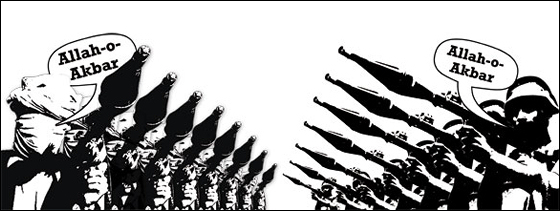
The Pakistan army’s biggest folly has been that under Zia it started outsourcing its basic job – soldiering – to these freelance militants. By blurring the line between a professional soldier who, at least in theory, is always required to obey his officer, who in turn is governed by a set of laws, and a mujahid who can pick and choose his cause and his commander depending on his mood, the Pakistan army has caused immense confusion among its own ranks. When soldiers who cry ‘Allah-o-Akbar’ when mocking an attack are ambushed in real life by enemies who shout ‘Allah-o-Akbar’ even louder, can we blame them if they waver in their response? When the naval chief Nauman Bashir calls the PNS Mehran attackers “very well trained,” is he just giving us hollow justification for what transpired, or admiring the creation of the institution he serves? When naval officials tell journalists that the attackers were “as good as our own commandos,” are they giving themselves a back-handed compliment?
In the wake of the attacks on PNS Mehran in Karachi, some TV channels pulled out an old war anthem sung by Madam Noor Jehan and started playing it against the backdrop of images of the young, hopeful faces of the slain officers and service men. Written by the legendary teacher and creator of childrens’ Tot Batot stories, Sufi Tabassum, the anthem carries a stark warning: Aiay puttar hatan tay nahin vick day, na labh di phir bazaar kuray (You can’t buy these brave sons from shops, don’t go looking for them in bazaars).
Whereas Sindhis and Balochis have mostly composed songs of rebellion, Punjabi popular culture has always lionised its karnails and jarnails and even an odd dhol sipahi. The Pakistan army has, throughout its history, refused to take advice from politicians, as well as thinking professionals from its own ranks. It has never paid heed to historians and sometimes ignored even the esteemed religious scholars it has used to whip up public sentiment for its dirty wars. But the biggest strategic mistake it has made is that it has not even taken advice from late Madam Noor Jehan, one of the army’s most ardent fans in Pakistan’s history. You can probably ignore Dr Eqbal Ahmed’s advice and survive in this country, but you ignore Madam at your own peril.
Since the Pakistan army’s high command is dominated by Punjabi-speaking generals, it is difficult to fathom what it is about this advice that they don’t understand. Any which way you translate it, the message is loud and clear – and lyrical: soldiers are not to be bought and sold like a commodity in shops. “Na awaian takran maar kuray” (That search is futile, like butting your head against a brick wall), Noor Jehan goes on to rhapsodise.
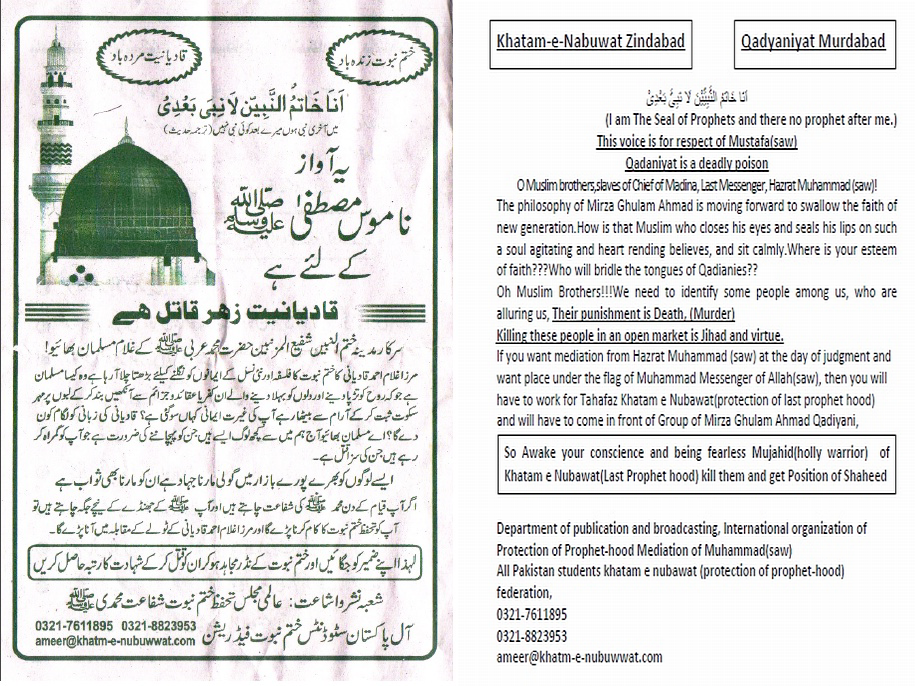
For decades the army has not only been shopping for these private puttars in the bazaars, it has also set up factories to manufacture them. It has, in fact, raised entire armies of them. When you raise the Lashkar-e-Taiba, Jaish Mohammed, Sipah-e-Sahaba, Sipah-e-Mohammed, Lashkar-e-Jhangvi and Al-Badar Mujahideen, others encouraged by the thriving marketplace will go ahead and create outfits like the Anjuman Tahuffuz-e-Khatam-e-Nabuwwat and Anjuman-Tahuffuz-e-Namoos-e-Aiysha. And it’s not just Kashmir, Afghanistan and Chechnya they want to liberate; they want to go back in time and seek revenge for a perceived slur that may or may not have been cast by someone more than thirteen hundred years ago in a country far, far away.
As if the army’s sprawling shopping mall of private puttars in Pakistan wasn’t enough, it has also actively encouraged the import and export of these commodities and even branched out into providing rest and recreation facilities for the ones who want a break. The outsourcing of Pakistan’s military strategy has reached a point where mujahids have their own mujahids to do their job and, inevitably, at the end of the supply chain are those poor, faceless teenagers with explosives strapped to their torsos being despatched to blow up other poor children.
Two days before the Americans killed Osama bin Laden and took away his bullet-riddled body, General Kayani addressed army cadets at Kakul. After declaring a victory of sorts over the militants, he gave our nation a stark choice. And before the nation could even begin to weigh the pros and cons, he went ahead and decided for them: we shall never bargain our honour for prosperity. As things stand, most people in Pakistan have neither honour, nor prosperity. They will readily settle for merely being able to survive in their little worlds without being blown up.
The question people really want to ask General Kayani is that if he and his army officer colleagues can have both honour and prosperity why can’t we, the people, have even a tiny bit of both?
The army and its advocates in the media often worry about Pakistan’s image, as if we are not suffering from a long-term serious illness, but a seasonal bout of acne that just needs better skin care. The Pakistan army has, over the years, cultivated an image of 180 million people with nuclear devices strapped to its collective body, threatening to take the world down with it. We may not be able to take the world down with us and the world might defang us or manage to calm us a bit, but the fact remains that Pakistan as a nation is paying the price for our generals’ insistence on acting like, in Asma Jahangir’s immortal words, “duffers.” And they are adding insult to inquiry by demanding medals and golf resorts for being such consistent duffers for such a long time.
What people really want to do at this point is to put an arm around our military commanders’ shoulders, take them aside and whisper in their ears: “Murshid, marwa na daina.”
On the night of July 5, 1977 as Operation Fair Play, meant to topple Z.A. Bhutto’s elected government, was about to commence, the then army chief General Zia-ul-Haq took his right-hand man and the Corps Commander of 10th Corps, Lt General Faiz Ali Chishti aside and whispered to him: “Murshid, marwa na daina.” (Murshid, don’t get us killed.)
Zia was indulging in two of his favourite pastimes: spreading paranoia among those around him, and cosying up to the junior officer he needed to do his dirty work. General Zia had a talent for that; he could make his juniors feel as if they were indispensable to the running of this world. And he could make his seniors feel like gods – as Bhutto found out at the cost of his life.
General Faiz Ali Chisti’s troops didn’t face any resistance that night; not a single shot was fired and like all military coups in Pakistan, this was dubbed a ‘bloodless coup.’ There was a lot of bloodshed in the following years though; in military-managed dungeons at Thori gate, in Bohri Bazar, around Ojhri camp and finally at Basti Laal Kamal near Bahawalpur, where a plane exploded killing General Zia and most of the Pakistan army’s high command. General Faiz Ali Chisti, of course, had nothing to do with this. General Zia rid himself of his murshid soon after coming to power. Chishti had started to take that term of endearment – murshid – a bit too seriously, and dictators can’t stand anyone who thinks of himself as the king-maker.
Thirty-four years on Pakistan is a society divided at many levels. There’s the beghairat bunch throwing economic statistics at the ghairat brigade, there are laptop jihadis and liberal fascists and fair-weather revolutionaries. There are Balochi freedom fighters up in the mountains and bullet-riddled bodies of young political activists in obscure Baloch towns. And of course there are the members of civil society with a permanent glow on their faces, presumably on account of all their candlelight vigils.
All these factions may not agree on anything, but there is a consensus on one point: General Zia’s coup was a bad idea. When was the last time anyone heard Nawaz Sharif or any of Zia’s numerous protégés thump their chest and say, ‘Yes, we need another Zia?’ And have ever you seen a Pakistan military commander who stood on Zia’s grave and vowed to continue his mission?
It might have taken Pakistanis 34 years to reach this consensus, but we finally agree that General Zia’s domestic and foreign policies didn’t do us any good. They brought us automatic weapons, heroin and sectarianism; they also made fortunes for those who dealt in these commodities. And they turned Pakistan into an international jihadi tourist resort.
And yet somehow, without ever publicly owning up to it, the army has continued Zia’s mission. Successive army commanders, despite their access to vast libraries and regular strategic reviews, have never actually acknowledged that what they started during the Zia era was a mistake. Clearly, the late Dr Eqbal Ahmed wasn’t off the mark when he said that the Pakistan Army is brilliant at collecting information, but its ability to analyse this information is non-existent.
Looking back at the Zia years, the Pakistan army begins to appear like one of those mythical monsters that chops off its own head, but then grows an identical one and then proceeds on the only course it knows.
In 1999, two days after the Pakistan army embarked on its Kargil misadventure, Lt General Mahmud Ahmed gave a ‘crisp and to-the-point’ briefing to a group of senior army and air force officers. Air Commodore Kaiser Tufail, who attended the meeting, later wrote in an article that they were told that it was nothing more than a defensive manoeuvre and the Indian Air Force would not get involved at any stage. “Come October, we shall walk into Siachen – to mop up the dead bodies of hundreds of Indians left hungry, out in the cold,” General Mahmud told the meeting. “Perhaps it was the incredulousness of the whole thing that led Air Commodore Abid Rao to famously quip, ‘After this operation, it’s going to be either a court martial or martial law!’ as we walked out of the briefing room,” Air Commodore Tufail recalled.
If Rao Abid even contemplated a court martial, he must have lacked leadership qualities because there was only one way out of this mess; a humiliating military defeat, a world-class diplomatic disaster, followed by yet another martial law. The man who should have faced the court martial for Kargil appointed himself the country’s president for the next decade.
General Mahmud went on to command ISI, Rao Abid retired as Air Vice Marshal; both went on to find lucrative work in the army’s vast welfare empire and Kargil was forgotten as if it was a game of dare between too juveniles who were now beyond caring about who had actually started the pointless game. The battles were fierce and some of the men and officers fought so valiantly that two were awarded Pakistan’s highest military honour, the Nishan-e-Haider.
But nobody seems to remember the amount of bloodshed during the mission And where were hundreds of others whose names never made it to any awards list, whose names were, in fact, not mentioned at all, and whose families consoled themselves by saying that their loved ones had been martyred while defending our nation’s borders. Nobody pointed out the basic fact that there was no enemy on those mountains before some delusional generals decided that they’d like to ‘mop up’ hundreds of Indian soldiers after starving them to death.
The architect of this mission, the daring commando, General Musharraf, who didn’t bother to consult his colleagues before ordering his soldiers to their slaughter, doesn’t even have the wits to face a sessions court judge in Pakistan, let alone a court martial. During the entire episode the nation was told that it wasn’t the regular army that was fighting in Kargil, it was the ‘mujahideen.’ But those who received their loved ones’ flag-draped coffins, and those that didn’t even get a corpse to mourn, had sent their sons and brothers to serve in a professional army, not a freelance lashkar.
The Pakistan army’s biggest folly has been that under Zia it started outsourcing its basic job – soldiering – to these freelance militants. By blurring the line between a professional soldier who, at least in theory, is always required to obey his officer, who in turn is governed by a set of laws, and a mujahid who can pick and choose his cause and his commander depending on his mood, the Pakistan army has caused immense confusion among its own ranks. When soldiers who cry ‘Allah-o-Akbar’ when mocking an attack are ambushed in real life by enemies who shout ‘Allah-o-Akbar’ even louder, can we blame them if they waver in their response? When the naval chief Nauman Bashir calls the PNS Mehran attackers “very well trained,” is he just giving us hollow justification for what transpired, or admiring the creation of the institution he serves? When naval officials tell journalists that the attackers were “as good as our own commandos,” are they giving themselves a back-handed compliment?
In the wake of the attacks on PNS Mehran in Karachi, some TV channels pulled out an old war anthem sung by Madam Noor Jehan and started playing it against the backdrop of images of the young, hopeful faces of the slain officers and service men. Written by the legendary teacher and creator of childrens’ Tot Batot stories, Sufi Tabassum, the anthem carries a stark warning: Aiay puttar hatan tay nahin vick day, na labh di phir bazaar kuray (You can’t buy these brave sons from shops, don’t go looking for them in bazaars).
Whereas Sindhis and Balochis have mostly composed songs of rebellion, Punjabi popular culture has always lionised its karnails and jarnails and even an odd dhol sipahi. The Pakistan army has, throughout its history, refused to take advice from politicians, as well as thinking professionals from its own ranks. It has never paid heed to historians and sometimes ignored even the esteemed religious scholars it has used to whip up public sentiment for its dirty wars. But the biggest strategic mistake it has made is that it has not even taken advice from late Madam Noor Jehan, one of the army’s most ardent fans in Pakistan’s history. You can probably ignore Dr Eqbal Ahmed’s advice and survive in this country, but you ignore Madam at your own peril.
Since the Pakistan army’s high command is dominated by Punjabi-speaking generals, it is difficult to fathom what it is about this advice that they don’t understand. Any which way you translate it, the message is loud and clear – and lyrical: soldiers are not to be bought and sold like a commodity in shops. “Na awaian takran maar kuray” (That search is futile, like butting your head against a brick wall), Noor Jehan goes on to rhapsodise.
For decades the army has not only been shopping for these private puttars in the bazaars, it has also set up factories to manufacture them. It has, in fact, raised entire armies of them. When you raise the Lashkar-e-Taiba, Jaish Mohammed, Sipah-e-Sahaba, Sipah-e-Mohammed, Lashkar-e-Jhangvi and Al-Badar Mujahideen, others encouraged by the thriving marketplace will go ahead and create outfits like the Anjuman Tahuffuz-e-Khatam-e-Nabuwwat and Anjuman-Tahuffuz-e-Namoos-e-Aiysha. And it’s not just Kashmir, Afghanistan and Chechnya they want to liberate; they want to go back in time and seek revenge for a perceived slur that may or may not have been cast by someone more than thirteen hundred years ago in a country far, far away.
As if the army’s sprawling shopping mall of private puttars in Pakistan wasn’t enough, it has also actively encouraged the import and export of these commodities and even branched out into providing rest and recreation facilities for the ones who want a break. The outsourcing of Pakistan’s military strategy has reached a point where mujahids have their own mujahids to do their job and, inevitably, at the end of the supply chain are those poor, faceless teenagers with explosives strapped to their torsos being despatched to blow up other poor children.
Two days before the Americans killed Osama bin Laden and took away his bullet-riddled body, General Kayani addressed army cadets at Kakul. After declaring a victory of sorts over the militants, he gave our nation a stark choice. And before the nation could even begin to weigh the pros and cons, he went ahead and decided for them: we shall never bargain our honour for prosperity. As things stand, most people in Pakistan have neither honour, nor prosperity. They will readily settle for merely being able to survive in their little worlds without being blown up.
The question people really want to ask General Kayani is that if he and his army officer colleagues can have both honour and prosperity why can’t we, the people, have even a tiny bit of both?
The army and its advocates in the media often worry about Pakistan’s image, as if we are not suffering from a long-term serious illness, but a seasonal bout of acne that just needs better skin care. The Pakistan army has, over the years, cultivated an image of 180 million people with nuclear devices strapped to its collective body, threatening to take the world down with it. We may not be able to take the world down with us and the world might defang us or manage to calm us a bit, but the fact remains that Pakistan as a nation is paying the price for our generals’ insistence on acting like, in Asma Jahangir’s immortal words, “duffers.” And they are adding insult to inquiry by demanding medals and golf resorts for being such consistent duffers for such a long time.
What people really want to do at this point is to put an arm around our military commanders’ shoulders, take them aside and whisper in their ears: “Murshid, marwa na daina.”
Mohammed Hanif is a journalist, novelist and playwright who worked as reporter for Newsline before joining the BBC. He is the author of A Case of Exploding Mangoes.
© 2009 Newsline Publications (Pvt) Ltd
URL: www.newslinemagazine.com/2011/06/murshid-marwa-na-daina/
URL: www.newslinemagazine.com/2011/06/murshid-marwa-na-daina/






 Posts
Posts


