Showing posts with label condemn. Show all posts

Monday, October 3, 2011

The dying canary and Indonesia’s religious freedom

Jakarta Post, Indonesia
OPINIONMon, 10/03/2011 7:57 PM
The dying canary and Indonesia’s religious freedom
Tobias Basuki, Jakarta
“Religious liberty is the proverbial canary in the mine,” according to Doug Bandouw, a senior fellow at the Cato Institute. Canaries are often used by miners as an early-warning signal for poisonous gases. When the small birds stop singing and suffocate, miners know toxic gases have polluted the area and something is wrong.

The right of religious freedom for small groups within a country is a vital indicator of the health of society. Religious freedom is the most basic freedom. Without it, it is doubtful that the lives and dignity of its citizens is truly respected.

Religious minorities in Indonesia have recently been systematically and aggressively silenced. Repression is allegedly perpetrated by religious extremists. The state is not without blame either.

The state partakes in the oppression of its own citizens, first through oversight and omission, and second by undertaking discriminatory actions and policies. The Blasphemy Law and a joint ministerial regulation on the Ahmadiyah minority Islamic sect are proof.

Two cases illustrate the dire condition of religious freedom in Indonesia.

First is the plight of the Ahmadis. The Ahmadis were part of our archipelago’s society even before independence and partook in the independence movement. The sect has now been cast aside and discriminated against.

Physical and verbal attacks against them have intensified in the past five years. One attack culminated in the slaughter of three members in Cikeusik, Banten.

Adding greater madness to the brutality was the gross injustice of our judiciary.

Those who participated in the vicious attacks were sentenced to jail for terms as little as three to six months. Deden Sudjana, whose house the Ahmadis were protecting, received a harsher sentence than those convicted of instigating the violence, who were hailed as heroes upon their release.

The Ahmadis understandably decided not to pursue and prolong the case considering the amount of prejudice and unfair treatment they have had to endure.

It was the first sign that the canary was not doing well.

The Blasphemy Law and the logic used to apply it is schizophrenic. Here is an example: The Blasphemy Law prohibits the existence of religions that resemble a major religion and also prohibits programming based on such religions from being broadcast.

In one city, an Ahmadiyah mosque was attacked and closed because it had a sign identifying it as an Ahmadiyah place of worship. The sign was considered “broadcasting” under the law. In another city, an Ahmadiyah mosque was attacked and closed because it had no signs on it and was accused of luring Muslims inside for conversion.

There are some well-intentioned arguments that state the Ahmadis should declare a new religion to avoid further prosecution. But the same logic would immediately put them in the crosshairs again.

The sect’s similarity to Islam puts it at odds with the law and prejudice against them. Labeling is not the issue; it is the bigoted view and actions of the few that are the main problems.

Another poignant example is the case of GKI Taman Yasmin. The congregation obtained a permit to build a church in July 2006. The construction, however, was stopped in 2008 by the head of Bogor’s Urban Planning and Landscaping Agency.

The church challenged the decision in court, which annulled the suspension issued by the city.

The annulment was disregarded and the church took its plight to the Supreme Court, which also ruled in favor of the church. Obstinately, the Bogor government under Mayor Diani Budiarto has chosen to blatantly disobey the Supreme Court’s ruling.

Opposition to the church’s construction is based on feeble grounds and outright ridiculous statements involving alleged counterfeit signatures, obstructing businesses and the infamous “no church should be on a street named after a Muslim”.

The reasoning proposed by the officials begs a serious question about the real motives behind the church ban. I attended one of the outdoor services conducted by the congregation in front of the sealed church.

None of the “public inconvenience” accusations held true. Even with a large number of visitors and an outdoor service, traffic was barely disturbed. There were no visible or plausible disturbances to businesses or the community.

However, one thing is clear. The mayor has broken the law on several accounts. First, he ignored court rulings, including a ruling from the Supreme Court. Second, the city violated the Regional Autonomy Law, which states that religion is the jurisdiction of the central government, not the local government.

Last but most flagrantly, Diani violated the Constitution and his oath of office. His repeated disregard of a court decision has made him a law breaker. The mayor should be impeached at the very least.

The canary is not dead … yet.

Indonesia as a nation faces two towers of evil. The first is epidemic corruption. It is like anemia. It is fatal, widespread and will kill us slowly. The second is radicalism and narrow-minded bigotry. Many say the radicals are few. It is true, but these few let loose will wound the nation and bleed us.

It is like a flesh wounds. It may not necessarily be fatal, but with a cancer draining our blood, a small wound can worsen and break us apart.

The writer is a graduate of Northern Illinois University and a lecturer at Pelita Harapan University, Tangerang.

Copyright © 2008 The Jakarta Post - PT Bina Media Tenggara. All Rights Reserved
URL: www.thejakartapost.com/news/2011/10/03/the-dying...freedom.html

Sunday, September 18, 2011

Persistent persecution

News on Sunday, Pakistan
threat
Persistent persecution
Ahmadi community in Faisalabad keeps carrying the tag of ‘liable to be killed’ with no security
By Aoun Sahi
September 18, 2010

Naseem Ahmad Butt, 55, father of four daughters and a son and a follower of Ahmadi school of thought, was sleeping in the courtyard of his house in Muzaffar Colony in Faisalabad on the night of September 4, 2011 when four unidentified attackers broke into his house and attacked him. He received one bullet in his chest while the second one ruptured his kidney.

The firing woke up his wife whose cries forced the attackers to flee. “My brother was lying in a pool of blood when I saw him. He told me that the attackers were between 20 and 25 years old. One of them kicked him and when he woke up, they shot him. He died in a local hospital seven hours after the attack,” Khalid Pervez Butt, younger brother of Naseem Butt, tells TNS.

Naseem used to work as a technician in a local powerloom and had no enmity. “The attackers did not steal anything from his house. Being Ahmadi seems to be his only ‘sin’ that made him liable to be killed,” says Khalid Butt. His first cousin Naseer Butt was also killed in a similar fashion on September 8, 2010. “Police has made no effort to trace his killers. However, in a hope of assistance, I have got a case registered with police under section 302 of Pakistan Penal Code,” he tells TNS, adding that it is the fourth murder in his family.

Baitul Hadi“In 1994, one of my younger brothers and one of my first cousins (younger brother of Naseer Butt) were killed by religious fanatics. Police had arrested the assailants. Local activists of religious parties held protest rallies against the arrests of culprits and one of the assailants had been released just a few months back,” he says.

Three days after this incident on September 7, 2011, another Ahmadi, Chaudhry Basheer Ahmad, was attacked in Rachna Town in Sheikhupura district. He received three bullets and is still in hospital in a critical condition.

September has always been a tough month for Ahmadis in Pakistan as on September 7, 1974, the Parliament of Pakistan declared them non-Muslims. Almost all religious parties hold rallies and gatherings in the first week of September every year against Ahmadis. Majlis-e Tahffuz-e Khatm-e Nubuwwat takes the lead and arranges an annual gathering to celebrate victory against Ahmadis every year in Rabwah — the Jama’at Ahmadiya’s headquarters in Pakistan.

“Faisalabad has become one of the toughest cities in Pakistan for Ahmadis to live in,” Syed Mahmood Ahmad, secretary of the Faisalabad chapter of Jama’at Ahmadiya, tells TNS. “Naseem Butt was neither an active member of our Jama’at nor was an influential person. He was killed only because of his religious beliefs. Within days after his killing, unidentified people have written slogans like ‘slaves of the companions of Prophet (PBUH) and ‘down with Qadyaniat’ on the walls of Muzaffar Colony.

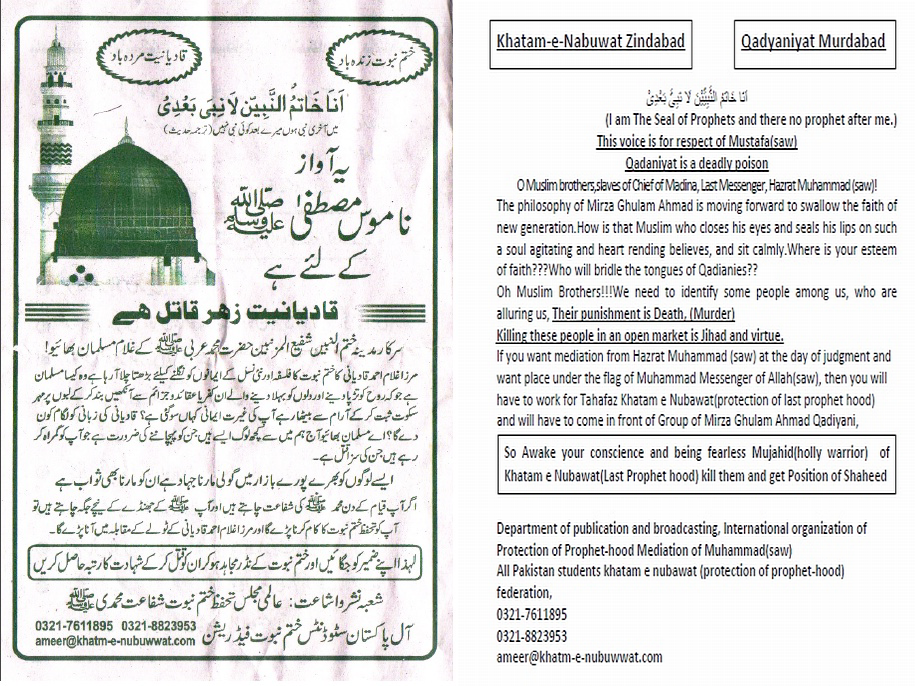
In May this year, a pamphlet terming Ahmadis ‘liable to be killed’ was distributed in Faisalabad. “It also carried names and addresses of prominent Ahmadis in Faisalabad. We have time and again contacted the Faisalabad police that a group of fanatics is threatening Ahmadis in the area. But no action has ever been taken,” says Ahmad. “On June 2, 2011, I sent an email to the home secretary and the police chief of Punjab as well as Faisalabad’s regional police officer, but nothing has been done to help us.”

Over the past two years, as many as six Ahmadis have been killed in Faisalabad, but no killer has been brought to book. “Religious fanatics are being encouraged by a lack of action on the part of the government agencies. It has even become too tough for Ahmadi youth to get education in public sector universities. A few months back, four girls belonging to our community were expelled from National Textile University. The 2010 annual magazine of that university carried three articles against Ahmadis,” says Mahmood Ahmad.

An Ahmadi praying in MosquePolice officials in Faisalabad do not seem to have taken the issue seriously. “We have no resources to provide special security for Ahmadis,” Shakir Hussain Dawar, senior police official in Faisalabad, tells TNS. “As far as Naseem Butt’s murder is concerned, we are investigating it from all angles. We have not ruled out the possibility of religious factor,” he says.



Saleemuddin, the Jama’at spokesperson, says that Ahmadis are being threatened all across the country, adding that Faisalabad has become the most hostile city towards the Ahmadis. “Most hate material is being generated and funded there. Eleven Ahmadis have been killed in Faisalabad since 1984.” In May last year, more than 88 people were killed in Lahore when gunmen opened fire at two separate places of worship of Ahmadis. “One year has passed, but no progress has been made in the case.”

Human rights activists have termed the situation deplorable. They are worried about the situation and have been writing constantly to the government about the security of Ahmadis. “Faisalabad has become a test case for the government to check the persecution of Ahmadis. The opponents of Ahmadis have even published their addresses and phone numbers on the pamphlets distributed in Faisalabad around three months back. No action has been taken against the culprits. It seems that the persecution will continue,” says HRCP Director IA Rehman.

Friday, September 9, 2011

Indonesians Feel Ahmadis Should Be Protected as Fellow Countrymen: Poll

Jakarta Globe, Indonesia
NEWS
Indonesians Feel Ahmadis Should Be Protected as Fellow Countrymen: Poll
Ronna Nirmala | September 09, 2011

FPI members protesting in front of Ahmadiyah secretariat in Makassar. They urged the Ahmadiyah members to stop their activities. (Antara Photo/Yusran Uccang)
Most Indonesians oppose the use of violence against the minority Muslim sect Ahmadiyah and think its followers here are their compatriots and should not be facing oppression, a survey by a human rights watchdog showed on Thursday.

Many respondents also said the deadly February attack in Cikeusik, Banten, occured because the government allowed it to happen, the Setara Institute for Freedom and Democracy said.

When asked who should be held accountable for the Cikeusik attack, in which three Ahmadis were killed, 33 percent of respondents said: “I don’t know.”

Another 32 percent blamed the government and security officials for doing little to prevent it, and 18 percent blamed the Ahmadiyah as they spread “blasphemous teachings.” The remaining 17 percent blamed the hard-line Muslims who carried out the attack, the survey said.

“The poll also indicates that almost 70 percent of the respondents consciously said that whatever happened, Ahmadiyah members are their fellow countrymen — aside from their differences in interpreting religion,” said Ismail Hasani, a researcher with Setara.

The survey was conducted among about 3,000 respondents in 27 districts in nine provinces, including Jakarta, West Java, Yogyakarta, East Java and West Nusa Tenggara.

A majority of respondents, about 60 percent, said they had no idea about what Ahmadiyah teachings entailed.

“Although some [Muslim] respondents refused to call Ahmadiyah followers their brothers, they agreed the attack in Cikeusik should never have happened,” said Bonar Tigor Naipospos, the deputy chairman of Setara. In fact, only a small portion of those questioned said the Cikeusik incident was caused by differences over religious beliefs.

“Some of them believed that it happened because of a fabricated issue from a third party, not related to religious interests,” Bonar said.

Two months ago, the Serang District Court in Banten convicted 12 hard-line Muslims for the Cikeusik attack but sentenced them to a maximum of just six months in jail.

Deden Sujana, the former head of security for the Indonesian Ahmadiyah Congregation (JAI), was a sentenced to six months in jail by the same court last month. He was found guilty of disobeying police officers who had ordered him and about a dozen other Ahmadis to leave the house they occupied just before the violence broke out. Deden was badly injured in the attack.

Thursday, September 8, 2011

Attack on Ahmadiyah condemned by most, survey reveals

Jakarta Post, Indonesia
NATIONALThu, 09/08/2011 8:26 PM
Attack on Ahmadiyah condemned by most, survey reveals
The Jakarta Post
According to Setara Institute, most Indonesians condemn the attack on Ahmadiyah in Cikeusik, Banten, West Java, which occurred earlier this year.

“As many as 82.3 percent of the respondents said they disapproved the attack, 7.9 were in favor, while 9.8 did not give a statement,” Setara Institute researcher Ismail Hasani told The Jakarta Post on Thursday.

The research on people’s perception of Ahmadiyah was conducted in 47 regencies of 10 provinces in the country from July 10 to 25. It comprised 3,000 respondents from various religions, but 90 percent were Muslims

Ismail said the research also found out that 68.2 respondents regarded Ahmadiyah as fellow citizens, 11.9 percent did not regard them as fellow citizens. Twenty percent did not respond.

“The results bring us a hope that tolerance still exists in this country,” he said.

Yet, he said the research also found that more than 40 percent of respondents were in favor of a joint ministerial decree (SKB) and the Indonesian Ulema Councils (MUI) edict declaring Ahmadiyah be disbanded because it was heretic and blasphemous.

The joint decree was issued by the religious affairs and home ministers, and the attorney general in 2008 in efforts to regulate Ahmadiyah followers’ religious practice.

Ismail said people’s inter-religious tolerance in this country was at a good level, “But they can hardly accept others of the same religion, because of a slight variation in beliefs.”

On February 6, Ahmadiyah followers were set upon by angered residents who objected to their beliefs, which they say go against “pure” Islam.

Hundreds of people attacked 21 Ahmadis, killing three of them and injuring at least five, while ransacking and setting a house belonging to Ahmadis on fire.

Copyright © 2008 The Jakarta Post - PT Bina Media Tenggara. All Rights Reserved
URL: www.thejakartapost.com/news/2011/09/08/attack-ahmadiyah...reveals.html

Friday, August 5, 2011

Morden man fears for brother named on Ahmadiyya Muslim murder list in Pakistan

Wimbledon Guardian, UK
News
Morden man fears for brother named on Ahmadiyya Muslim murder list in Pakistan
12:25pm Friday 5th August 2011
By Omar Oakes »

Fears: Chaudhary Nawaz shows a list of names of people, including his brother, who are 'liable to be murdered' in Pakistan
Fears: Chaudhary Nawaz shows a list of names of people, including his brother, who are “liable to be murdered” in Pakistan
The brother of a Pakistani man whose name was published on a religious murder list by Muslim fanatics has said he is distraught with worry.

Chaudhary Nawaz, from Hillcross Avenue in Morden, said his brother Dr Muhammad Nawaz, a technology college academic in Pakistan, had gone into hiding for fear of being murdered for being an Ahmadi Muslim.

Ahmadi Muslims are not considered Islamic in Pakistan under the Government’s strict blasphemy laws and this list of prominent Ahmadis is being widely distributed in Faisalabad, a textile hub in the Punjab province.

The list is published on a pamphlet given out widely in shopping areas and claims: “To shoot such people is an act of jihad [struggle of faith] and to kill such people is an act of sawab [reward].”

Mr Nawaz, 48, said: “I can’t tell you how worried I am. Sometimes I try not to think about it because I am so frightened about what could happen.

“My brother is a good man, an educator. He doesn’t deserve to be targeted like this.

“I feel helpless because he is thousands of miles away and I can’t help him.”

Mr Nawaz, a senior member of the Morden district of the Ahmadiyya Muslim Association, said his brother cannot leave Faisalabad because he has to care for their mother, an 82-year-old Alzheimer’s sufferer.

A similar list of Ahmadis was published two years ago in Faisalabad. Three people on that list were murdered by militants in a crowded market bazaar in April 2010.

Nearly two months later, 94 Ahmadis were murdered in mosques in Lahore.

Last October, the Wimbledon Guardian revealed how religious hatred by hardline Muslims towards Ahmadis was being demonstrated on a much smaller scale in south London, which is home to their UK headquarters, the massive Bait-ul-Futuh mosque in London Road, Morden.

Our investigation revealed Sheikh Suliman Gani, imam at the Tooting Islamic Centre (TIC), had told worshippers to boycott Ahmadi businesses, leading to financial hardship for shop owners and the sacking of a worker who would not renounce his religion.

The Khatme Nabuwwat Academy, an East London-based religious group affiliated to the Pakistan-based Khatme Nabuwwat, was invited to talk at the TIC last year.

The Khatme Nabuwwat’s Pakistani-based website describes Ahmadis as “nothing but a gang of traitors, apostates and infidels”.

Copyright 2001-2010 Wimbledon Guardian, UK. All rights reserved.
URL: www.wimbledonguardian.co.uk/news/9180679.Man_fears.../

Friday, June 11, 2010

Our self-proclaimed demagogues

Express Tribune, Pakistan
Pakistan
Our self-proclaimed demagogues
By Editorial
June 11, 2010

It was bad enough that they could not unequivocally condemn the brutal massacre of nearly 100 Ahmadis in Lahore. Yet the temerity of the leaders of 13 religious and political organisations to label the attack a conspiracy aimed at repealing the discriminatory laws against Ahmadis is nothing short of morally repugnant. If ever these so-called religious leaders had any semblance of moral authority, they have ensured that none remains. In essence, what these people are saying is that the Ahmadis deserve no sympathy from their compatriots simply because their views on faith do not conform to the specifics that these so-called clerics deem within the ambit of the religion. Who appointed them the arbiters of God’s mercy? Who told them that they could create a poisonous environment where Ahmadis are barely considered human? Who told them that they could prevent the rest of us from weeping for their tragedy?

Perhaps these so-called clerics need to be reminded that there is no clergy in Islam, no Majesterium. These people often argue against secularism by saying that there is no separation of church and state in Islam, conveniently forgetting that there is no church at all. Their arrogant insistence on becoming the guardians of other people’s faith, when they are so morally depraved that they cannot get themselves to denounce murder, is offensive to people who view Islam as their spiritual guide. Islam’s central tenet is that every human being has a direct connection to God Himself. “We are nearer to thee than thy jugular vein,” says the Holy Quran in Surah 50, verse 16. Who are they to come between man and God when the Creator of the heavens and the Earth Himself declares the need for an intermediary redundant? There is nothing more damaging to Islam and Muslims than these self-proclaimed demagogues.

Published in the Express Tribune, June 11th, 2010.

Sunday, June 6, 2010

Security of Ahmadiyyas demanded

The Daily Star
Your Right To Know
Sunday, June 6, 2010
Point Counterpoint
Security of Ahmadiyyas demanded
Staff Correspondent
Ahmadiyya Muslim Jama'at, Bangladesh - Press Conference June 5, 2010

Ahmadiyya Muslim Jama’at and civil society members yesterday condemned the May 28 bomb attacks on two Ahmadi mosques in Lahore, Pakistan, that killed 85 people.

They also demanded punishment to the attackers and steps to ensure security of the people of Ahamadiyya community across the world, especially in Pakistan.

The demands were placed at a press conference at the national headquarters of Ahmadiyya Muslim Jama’at, Bangladesh in the city.

Prof Meer Mubashsher Ali, nayeeb-e-amir of the Ahmadiyya Muslim Jama’at, urged the international community to take necessary steps to stop such barbaric attacks on them.

Strongly criticising the Pakistan government for declaring the Ahmadi Muslims of the country ‘Non-Muslim’ in 1974, he urged the international community to take necessary measures to repeal the law to uphold freedom of religion.

A global charter must be formulated to curb such violence in future, he added.

Noted writer and columnist Shahrier Kabir said the international human rights organisations should raise their voice to ensure the right to freedom of religion.

He also called for putting an end to the culture of impunity to prevent such attacks. “If we cannot get rid of the culture of impunity, it would not be possible to ensure security of lives.”

Prof Parveen Hasan of the department of Islamic history and culture of Dhaka University laid emphasis on the formulation of a law to end religion-based discrimination.

Abdul Awal Khan Choudhury, missionary-in-charge of Ahmadiyya Muslim Jama’at, Bangladesh, and Sharif A Kafi, executive director of Bangladesh Development Partnership Centre also spoke.

URL: www.thedailystar.net/newDesign/news-details.php?nid=141587

Friday, June 4, 2010

NA condemns killing of Ahmadis

Daily Dawn, Pakistan
FROM THE PAPER »
FRONT PAGE

NA condemns killing of Ahmadis
   By Raja Asghar
   Friday, 04 Jun, 2010
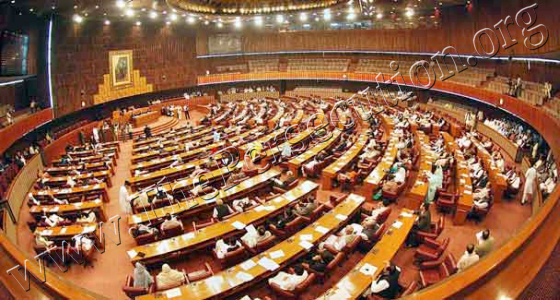
Stating that 'Islam does not permit attacks on minorities but instead seeks to protect all human life as sacred', the resolution called for a thorough investigation and bringing militants who carried out the attacks to justice. - APP Photo
Stating that “Islam does not permit attacks on minorities but instead seeks to protect all human life as sacred”, the resolution called for a thorough investigation and bringing militants who carried out the attacks to justice. – APP Photo

ISLAMABAD: It was after an apparent hesitation and a bold initiative by some women that the National Assembly on Thursday unanimously condemned Friday’s “barbaric massacre” of Ahmadis in Lahore.

It initially appeared that the brutal gun attacks on two places of worship, which killed about 90 people and wounded 105 others, would find no mention on the opening day of the lower house’s budget session as had happened in the Senate a bit earlier, for fear of possible ire of hardline Anti-Ahmadi religious groups.

But PPP’s former information minister Sherry Rehman would not let it go like that and called for an immediate attention to her two adjournment motions on the most deadly attack on the Ahmadi community and the Israeli commando attack on a Gaza-bound aid flotilla on Monday after Minister of State for Foreign Affairs Malik Amad Khan informed the house of Pakistan’s diplomatic moves against the Israeli action.

Immediate support for her move came from three more women members — ANP’s Bushra Rehman, MQM’s Khushbakht Shujaat and PPP’s Farah Naz Ispahani — while some men from both the treasury and opposition benches also jumped into the discussion before agreed resolutions on the two issues were drafted and adopted unanimously as substitutes for the adjournment motions.

One of them, moved by Ms Rehman, called the Lahore carnage “barbaric massacre” and a “coordinated act of terrorism” that it said represented a “serious challenge to the writ of the Constitution in Pakistan”.

Stating that “Islam does not permit attacks on minorities but instead seeks to protect all human life as sacred”, the resolution called for a thorough investigation and bringing militants who carried out the attacks to justice.

The other resolution, moved by PML-N’s Zahid Hamid, described the Israeli attack on the aid flotilla as “an act of aggression and state terrorism” as well as a “crime against humanity” and asked the government to seek intervention by the Arab League, the Organisation of Islamic Conference and the United Nations to get the Israeli blockade of Gaza lifted.

At the beginning of the proceedings, PPP’s re-elected member Jamshed Dasti came to the house in style, seemingly dismissing the shame of being found to have been elected in the first instance in February 2008 with a fake graduation degree and evoked “jiay Bhutto” slogans from supporters in a visitors’ gallery as he and another newly elected party member from Punjab, Asghar Jatt, took oath as MNAs.

Mr Dasti wore a band on his forehead inscribed in Seraiki language with “Asan qaidi takht Lahore dey” (we are prisoners of Lahore’s throne) and a black band on his left arm to protest at alleged excesses against him by the PML-N’s Punjab government.

Some other members also appeared targeting the Punjab government in their speeches about the Lahore attacks for allegedly ignoring intelligence reports about militant threats to Ahmadis.

PML-N chief whip Sheikh Aftab Ahmed dismissed the allegations, saying “terrorism is on the rise in the whole of Pakistan”, not only in Punjab, and was a national problem.

PPP’s chief whip, Labour and Manpower Minister Khurshid Ahmed Shah, said his party did not want to politicise the issue of terrorism and wanted it to be fought by all together.

But he said he had no objection to a demand by Mr Dasti for a house committee to investigate his charges of victimisation by the Punjab government and would like the PML-N to be its part.

However, PPP’s Nawab Yousuf Ali Talpur, who was chairing the proceedings, gave no ruling on the demand before adjourning the house until 10am on Friday.

The house business advisory committee decided before the sitting that the national budget for fiscal 2010-11 would be presented on Saturday and approved on June 28.

©2010 DAWN Media Group. All rights reserved

Ahmadis plead for world help after Lahore killings

Daily Dawn, Pakistan
FROM THE PAPER »
FRONT PAGE

Ahmadis plead for world help after Lahore killings
    Friday, 04 Jun, 2010
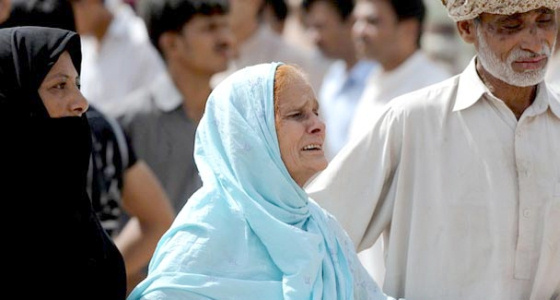
Militants last week stormed two Ahmadi prayer halls in Lahore, killing 82 worshippers in gun and grenade attacks. — Photo by AFP

NEW YORK: A leader of the Ahmadi community pleaded Thursday for international pressure on Pakistan, warning that extremists were bent on wiping out the community after nearly 100 people were killed.

The Ahmadi community in the United States urged Pakistan to repeal laws restricting the community and to clamp down on hardline Sunni clerics, who it said have waged a campaign of incitement.

“The time is now for the world to wake up to the realisation that the goal of the extremist clerics is to execute a full-scale holocaust,” said Naseem Mahdi, the missionary-in-charge of the US Ahmadi community.

“Even today, after this massacre, on television, in the streets, on billboards, in public meetings, the hatred continues to be preached and no one in any governmental body takes steps to stop people from such incitement to murder,” he told a news conference in New York.

Militants last week stormed two Ahmadi prayer halls in Lahore, killing 82 worshippers in gun and grenade attacks. Gunmen later raided the hospital where victims were treated, killing four people in a shootout.

Mahdi, who put the death toll at 94, said urged US officials to raise religious freedom with Pakistan, which is receiving a 7.5 billion-dollar US package aimed at building its economy and democratic institutions.

“The US government must take every measure in its power to have all levels of government in Pakistan eliminate the laws and ordinances that have become the tools to facilitate and institutionalize the persecution of Ahmadi Muslims” and have been used against other minorities, he said.

Founded by Ghulam Ahmad, who was born in 1838, the Ahmadis believe that Ahmad himself was a prophet and that Jesus died aged 120 in Srinagar.

Pakistan declared them non-Muslims in 1974 and 10 years later they were barred from calling themselves Muslims.

The Ahmadis are strongly critical of violence in the name of Islam.

“The extremists have repeatedly used their power over the masses to brutally attack us in the name of the defence of Islam. They try to gain by violence what they fail to gain by argument, reason and rationality,” Mahdi said.

Religious violence in Pakistan, mostly between majority Sunni Muslims and minority Shias, has killed more than 4,000 people in the past decade.

The Ahmadi community has also encountered problems in other countries including Egypt, which earlier this year detained nine Ahmadis.

The US Commission on International Religious Freedom, a government advisory board, called on Egypt to release them “immediately and unconditionally.”

Egypt has held the Ahmadis using a prohibition against insulting Islam along with a controversial emergency powers law.

Neither charge has “any merit whatsoever,” said Leonard Leo, the chairman of the US commission.

“Both are a blatant violation of their international right to freedom of religion or belief as well as contrary to Egypt’s own constitutional protections,” he said.

©2010 DAWN Media Group. All rights reserved
 
^ Top of Page