Showing posts with label clerics. Show all posts

Thursday, August 19, 2010

Inhuman acts

Express Tribune, Pakistan
Editorial
Inhuman acts
Editorial
August 19, 2010

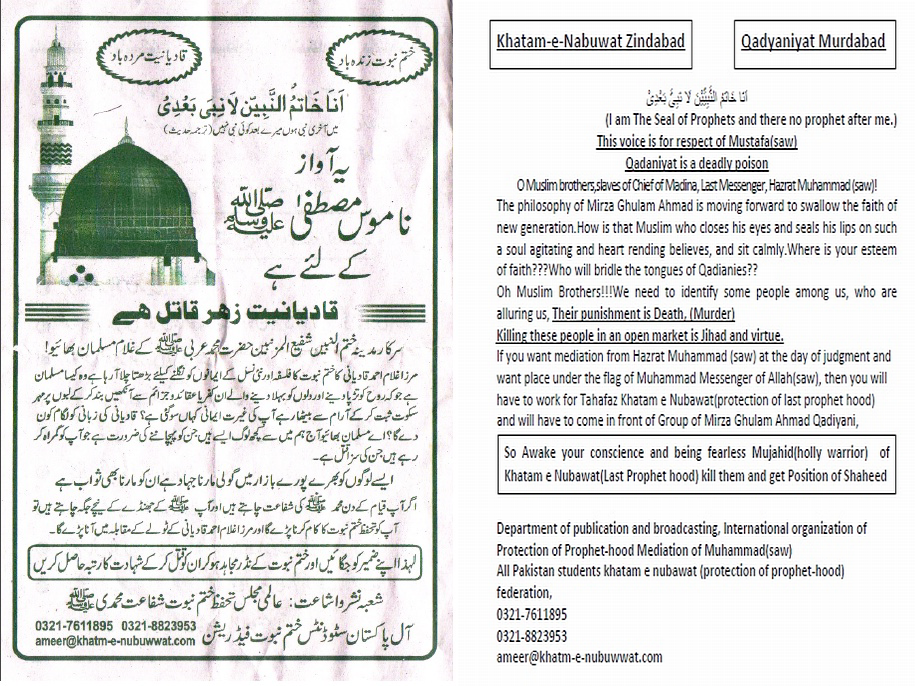
Emergencies are a time when the best of man – and the very worst – comes out into the open. In southern Punjab, where leaders of the Ahmadi community say relief goods or a place in camps was denied to flood victims from their faith, the worst has been on display. The treatment of Ahmadis as sub-human is a consequence of years of discrimination stemming from that fateful decision in the 1970s to declare them ‘non-Muslim’. The result of the state’s decision to determine what belief people practice, regardless of their own assertions, has been catastrophic. The massacre of Ahmadis we saw earlier this year in Lahore is one outcome of this. The increasingly vicious campaigns they have faced have obviously had an influence on poisoning minds and influencing the kind of disgraceful behaviour we have seen following the floods.

But sadly, this is not the only example of such conduct. Humanitarian workers out in the field report many examples of bias. In some cases aid has been denied to those from specific castes or clans; in other instances the weakest and most vulnerable have been pushed aside. Christians in the Punjab are reported to have complained about discrimination and it is possible other minority communities have faced similar experiences. While most international and all UN organisations are bound by their own charter to ensure equitable distribution of aid, and usually attempt to follow them, local organisations may not have rules that are as stringent. Some reports already speak of groups affiliated to religious parties being behind some of the worst acts of deprivation on the basis of belief.

So, what does this say about us as a people? As a society? Do we even deserve the distinction of calling ourselves civilised human beings? It is true that the government for now has a lot on its plate. But despite this, an effort must be made to investigate the incidents in Muzaffargarh and elsewhere. It seems obvious they could not have taken place without the connivance of local authorities, who must be made to answer for their acts.

Published in The Express Tribune, August 19th, 2010.

Wednesday, August 18, 2010

Minorities denied flood relief in Pakistan

Hindustan Times
IconWed. 18 Aug 2010
Pakistan
Minorities denied flood relief in Pakistan
First Published: 23:54 IST(18/8/2010)
Last Updated: 02:38 IST(19/8/2010)
Imtiaz Ahmad, Hindustan Times
Karachi, August 18, 2010

Earlier this week, members of Pakistan’s Ahmadiyya community, who were caught up in the raging floods around the Central Punjab town of Muzaffargarh, were not rescued from their homes because rescuers felt that Muslims must be given priority. Ahmadiyyas are ostracized by Pakistan’s mainstream Muslim community who consider them to be non-believers. In 1973, this community was officially declared a minority. Since then the discrimination against them has been severe.

The Ahmadiyyas complained to the government that not only were their community members not rescued but in some instances ejected from relief camps when their identity was disclosed. This has been refuted by the provincial Punjab government but eye witnesses have attested to this.

As the waters recede and people flock to relief camps and look for help, Pakistan’s power politics have come into play whereby chosen areas are being helped at the expense of others which are being completely ignored. Hamir Soomro, a landlord from Shikarpur, one of the most badly affected districts in Sindh, says that his area is not receiving government help, which is instead going to Khairpur, the constituency of the province’s Chief Minister, Qaim Ali Shah.

The UN says that the government suffers from a “image deficit” problem. “In plain words, they don’t trust the ability of the government to deliver,” says Mian Nawaz Sharif, opposition leader.

Earlier this week, Sharif met with Prime Minister Gilani and both agreed to the formation of a “clean commission” - comprising people of integrity, to oversee distribution of funds for for flood relief. The idea did not go down well with President Zardari whose office has blocked the move on grounds that the government is fully in control.

But the UN and donor agencies dont think so. They have pointed out that the government has no relief plan and is also unable to make an estimate of what is needed where. As a result, the situation has turned dire in many neglected or inaccessible areas.

In Kohistan, there are reports the five children died of starvation because help had not arrived.

Members of the Sikh community, who arrived in Gurdwaras in Lahore also complained of government apathy. They said members of their community were abandoned in Khyber-Pakhtoonkhwa and had to arrange rescue for themselves.

Copyright © 2010 HT Media Limited. All Rights Reserved

The politics of relief: Aliens in their own land

Express Tribune, Pakistan
Pakistan
Punjab
The politics of relief: Aliens in their own land
By Abdul Manan
August 18, 2010
500 flood survivors from Ahmadiya community denied shelter, relief goods

MUZAFFARABAD: The government and local clerics refused to shelter around 500 flood-affected families belonging to the Ahmadiya community in South Punjab’s relief camps. Not only that, the government also did not send relief goods to the flood-hit areas belonging to the Ahmadiya community, The Express Tribune has learnt during a visit to the devastated Punjab districts of Muzaffargarh, Dera Ghazi Khan and Rajanpur.

For its part, the government claims that all relief goods are being distributed among survivors without discrimination. And that all survivors have been sheltered in relief camps without distinction. The flood-devastated families from the Ahmadiya community have strongly criticised the government’s “discriminatory attitude” even at a time when the entire country is reeling from the ravages of the worst flooding in living memory.

Of the 500 Ahmadi families, 350 belong to DG Khan, 60 to Muzaffargarh and 65 to Rajanpur district. According to Ahmadiya community leaders, over 2,500 members of their community have been displaced and are now living with their relatives while some of them have left for Rabwah, the community’s headquarters.

Aziz Ahmad Khan, a local leader of flood victims from the Ahmadiya community in DG Khan, told The Express Tribune that all members of his family have complained of discrimination in DG Khan. He said 200 families from Basti Rindan and Basti Sohrani, 60 from Chah Ismaeel Wala, three from Rakh Mor Jangi, 18 from Ghazi Ghat and 12 from Jhakar Imam Shah of Ahmadpur. Khan alleged that 200 families, who have been displaced from Basti Rindan and Basti Sohrani by flooding, took shelter in a state-run school at Jhok Utra but within days the local administration forced them to leave the school. He said the local administration later told them that people from the surrounding areas did not want the Ahmadis in the relief camp. And that the administration could not allow them to stay at the camp as it could create a law and order situation.

“So we left our cattle and other belongings in the area and took refuge in the homes of our community members on higher grounds,” he said, adding that some of them even migrated to Chanabnagar.

Muhammad Iqbal Sohrani, a member of the Ahmadiya community told The Express Tribune that around 40 Ahmadi families who took shelter in a state-run school at Jhakar Imam Shah near Sumandri, some 40 kilometres from DG Khan, have not received any relief either from philanthropists or from the government. He alleged that relief packages were being distributed through local lawmakers who have been told by the district administration that the Ahmadis are not eligible for any support.

Saleem Chandia, another Ahmadiya community member, said that he along with 40 other community members rented a house but after two days their landlord was forced by local clerics to evict them. Chandia said they were offered help by their own community members after wandering for several days in search of shelter.

Mansoor Ahmad, a resident of Muzaffargarh, told The Express Tribune that over 800 members of the Ahmadiya community were displaced from Bait Nasirabad, Masroornagar, Hussainwala and Shahjamal. At least 100 members of the community, from Hussainwala and Masroorabad, were trapped at Shahjamal. He claimed that they had asked the district police officer (DPO) and the district coordination officer (DCO) to provide them a boat or to rescue the trapped people but they did not take notice.

Ahmad claimed that the trapped Ahmadis were rescued by their fellows on a broken boat. He said local clerics have issued an edict that the Ahmadis should not be provided help.

Naseem Ahmad, from Rajanpur, told The Express Tribune that their 500 community members from the areas of Basti Lashari, Basti Allahdad Dareeshak and from Basti Azizabad were displaced. Their houses were washed away and the government and local clerics ignored them. He said that they were not allowed to stay in state-run schools or in camps, therefore the majority of them were living on the rooftops of their inundated houses.

“The Ahmadiya community itself rescued trapped people and delivered relief to them,” community spokesperson Saleem-ul-Din told The Express Tribune by phone.

He said that the community did not want any relief package from the government for its members. However, the government should protect the property and livestock of the Ahmadis.

Hassan Iqbal, Commissioner DG Khan, told The Express Tribune that he would check the situation. He asked the Ahmadis to directly approach him if they face discrimination anywhere in the district. However, DCO Muzaffargarh Farasat Iqbal said that the Ahmadis have not contacted him.

Published in The Express Tribune, August 18th, 2010.

URL: http://tribune.com.pk/story/40435/the-politics-of-relief-aliens-in-their-own-land/

Wednesday, February 18, 2009

Indonesian clerics flex political muscles

--- The Star Online, Malaysia

Monday February 16, 2009
Indonesian clerics flex political muscles
By Olivia Rondonuwu


JAKARTA (Reuters) — Parliamentary and presidential elections in Indonesia this year may hinge on how the public reacts to a directive from the country’s top Islamic council that all Muslims must vote or risk going to hell.

The controversial edict from the Indonesian Council of Ulama, which consists of elected clerics and scholars, does not state which parties or candidates voters should choose.

But it may encourage Muslims to vote for Islamist candidates and push the country away from secularism toward a more socially rigid government – not necessarily a plus for foreign investors.

“It’s in the interests of some MUI members to maximise the votes of various Islamic parties,” said Greg Fealy, an expert in Indonesian politics and Islam at the Australian National University.

Indonesia’s plethora of political parties mean relatively small shifts among voters could potentially determine which groups form alliances in the April 9 general election and which field candidates in the presidential election in July.

A recent poll shows reform-minded President Susilo Bambang Yudhoyono’s Democrat Party in the lead with 23 percent support, but he may still need to turn to some of the small Islamist parties or his current ally Golkar to form a coalition.

At this stage, 20-30 percent of those polled are still undecided.

PUSHING ISLAMIST AGENDA

Officially secular, Indonesia has the world’s largest Muslim population, about 85 percent of its 226 million people.

Most are moderates, but some of the small, hardline groups, which are represented in MUI, have pushed Islamist agendas, undermining Indonesia’s reputation for tolerance and threatening some of its religious and ethnic minorities.

“What is MUI these days, religious body or party?”, said Adhitya Wisena, a Muslim who works at a fish shop in Jakarta.

Under MUI’s influence last year, the government imposed restrictions on an Islamic sect, Ahmadiyya, and pushed ahead with a controversial anti-pornography law that some minorities, including Bali’s Hindus and Papua’s Christians, consider a threat to their art and culture.

Several districts in Indonesia have introduced sharia bylaws, for instance requiring women to wear headscarves regardless of their faith.

Islamists are also likely to have economic nationalist and protectionist views, which despite their own ostensibly liberal tendencies Yudhoyono and his predecessor Megawati Sukarnoputri have already had a tough time resisting.

Set up by former president Suharto in 1975 in an attempt to control political Islam, part of MUI’s role was to endorse government policies such as family planning.

But with Suharto’s ouster in 1998 and a shift towards greater democracy and freedom of expression, MUI has grown in political importance and is increasingly influenced by conservatives and hardliners within its ranks.

“Although MUI says it has representatives from all major Muslim organisations, there is a disproportionate influence by some small conservative, Islamist groups,” said Fealy, the Indonesian expert at Australian National University.

“That partly explains some of the decisions we have seen on Ahmadiyya (and) the anti-porno bill.”

Fealy said MUI’s influence on public policy was likely to grow, as Indonesia’s economy becomes more “Islamicised”, for example with the increasing importance of Islamic financing and the business of certifying food as halal, or allowed, in Islam.

“All the halal certification is managed by MUI and that generates a lot of revenue from companies who want their product certified,” he said.

“Islamic banks, Islamic insurance companies, Islamic pawn shops all have religious scholars advising them and more often than not they are from MUI. In reality, this is very lucrative for them.”

YOGA AND SMOKING

MUI’s fatwa – a legally nonbinding moral decree – requiring all Muslims to vote is not the council’s first attempt to influence an election outcome.

In 1999, MUI ordered Muslims to vote for Muslim candidates, a deliberate strike against Megawati and her PDI-P party, among Indonesia’s most secular and which then had a high proportion of non-Muslim officials.

It has put pressure on the government to pursue pro-Islam policies, and issued fatwas against liberalism and pluralism, and on lifestyle, health and social issues.

At its national fatwa council meeting in January, MUI banned yoga for Muslims if it involved Hindu chants and meditation, and said it was sinful to smoke in public, and for children and pregnant women to smoke.

But it refrained from banning under-age marriage, despite a recent public outcry when a cleric married a 12-year-old girl.

The expanding number of controversial fatwas is of increasing concern for many of Indonesia’s elite, religious minorities, and Muslim moderates.

“The edicts are out of date, pointless, and counterproductive for the interests of the nation,” wrote M. Syafi’i Anwar, executive director of the International Centre for Islam and Pluralism (ICIP) in an opinion piece in the Jakarta Post.

(Additional reporting by Sunanda Creagh)
Copyright © 2008 Reuters


URL: http://thestar.com.my/news/story.asp?file=...c=Worldupdates
 
^ Top of Page